Specs are compiled from manufacturer listings and verified buyer reviews and can change over time — please confirm the key details on the product page before buying.
You want the campsite to feel like home: a fridge humming, phones topped up, a CPAP running all night. The one number that decides whether that happens is watt-hours — the size of the battery tank — followed closely by how much AC power the box can push out at once. Get those two right and the rest is handle, weight, and how fast you can refill it. This guide walks you through eleven real units and tells you plainly which one fits which kind of camper.
This guide is built by comparing the manufacturers’ published specifications and the patterns across verified customer reviews, so you get each pick’s real strengths and trade-offs instead of marketing spin.
Below you will find the capacity, output, and weight trade-offs spelled out, plus which units suit a weekend tent trip versus a full RV hookup. The crowd favorite here is the BLUETTI Elite 200 V2, holding 4.5+ stars across 900+ ratings, and it earns that spot on raw usable power. So this is the honest shortlist for the best power station for camping.
Top Picks
How To Choose The Best Power Station for Camping
Camping power is a math problem you solve before you leave the driveway. Work out what you will plug in, for how long, and how you will refill the battery. Everything else — app control, handle design, port count — is comfort.
Start With Capacity, Then Output
Capacity is measured in watt-hours (Wh), which is simply how big the fuel tank is. A 1,024Wh unit holds roughly a kilowatt-hour of energy, so a 60W cooler runs for many hours on it. Output is measured in watts (W) and sets what can start at all — a 1,500W AC output handles a kettle, while a 2,600W unit starts bigger appliances. Check both, because a big tank with a small output still cannot run your gear.
Battery Chemistry and Cycle Count
LiFePO4 (lithium iron phosphate) is the chemistry most camping units now use, and it is rated in charge cycles — one cycle is a full drain and refill. Higher cycle ratings mean the pack keeps its capacity longer, which matters if you camp every season. Older lithium packs generally cycle fewer times before they fade.
Weight You Actually Carry
A power station only helps if you can lift it out of the truck. Units in the 23-25 lb range are one-hand carry for most adults, while the 40 lb and up class is a two-person or cart job. Match weight to how far you park from the tent.
Refill Speed and Solar Input
Fast AC charging gets you back to full before the next trip. Off-grid, solar input wattage sets your refill time — a higher panel wattage rating means fewer hours of daylight to top up. Some units need a separate adapter before they accept solar or car charging, so read the fine print.
Side-by-Side Comparison
| Model | Best For | Capacity | AC Output | Weight | Amazon |
|---|---|---|---|---|---|
| BLUETTI Elite 200 V2★ Best Overall | Big appliances, basecamp | 2080Wh | 2600W | 44.5 lb | Amazon |
| DJI Power 1000 V2Quietest Pick | Quiet RV nights | 1024Wh | 2600W | — | Amazon |
| BLUETTI Elite 100 V2Best Value | One-handed portability | 1024Wh | 1800W | 25 lb | Amazon |
| Jackery Explorer 1000 v2 | Light weekend kit | 1070Wh | 1500W | 23.8 lb | Amazon |
| Anker SOLIX S2000 | Fridge backup | 2,010Wh | 1,500W | 35.7 lb | Amazon |
| Jackery Solar Generator 1000 v2 + Panel | Solar bundle buyers | 1,024Wh | 1500W | 23.4 lb | Amazon |
| EF ECOFLOW DELTA 3 Max | High-draw tools | 2048Wh | 3400W | — | Amazon |
| Jackery Explorer 2000 v2 | Home and camp crossover | 2042Wh | 2200W | 39.5 lb | Amazon |
| Anker SOLIX C2000 Gen 2 | RV A/C and TT-30 | 2,048Wh | 2,400W | 41.7 lb | Amazon |
| EF ECOFLOW DELTA Pro | Heavy basecamp demands | 3600Wh | 3600W | 99 lb | Amazon |
Detailed Reviews
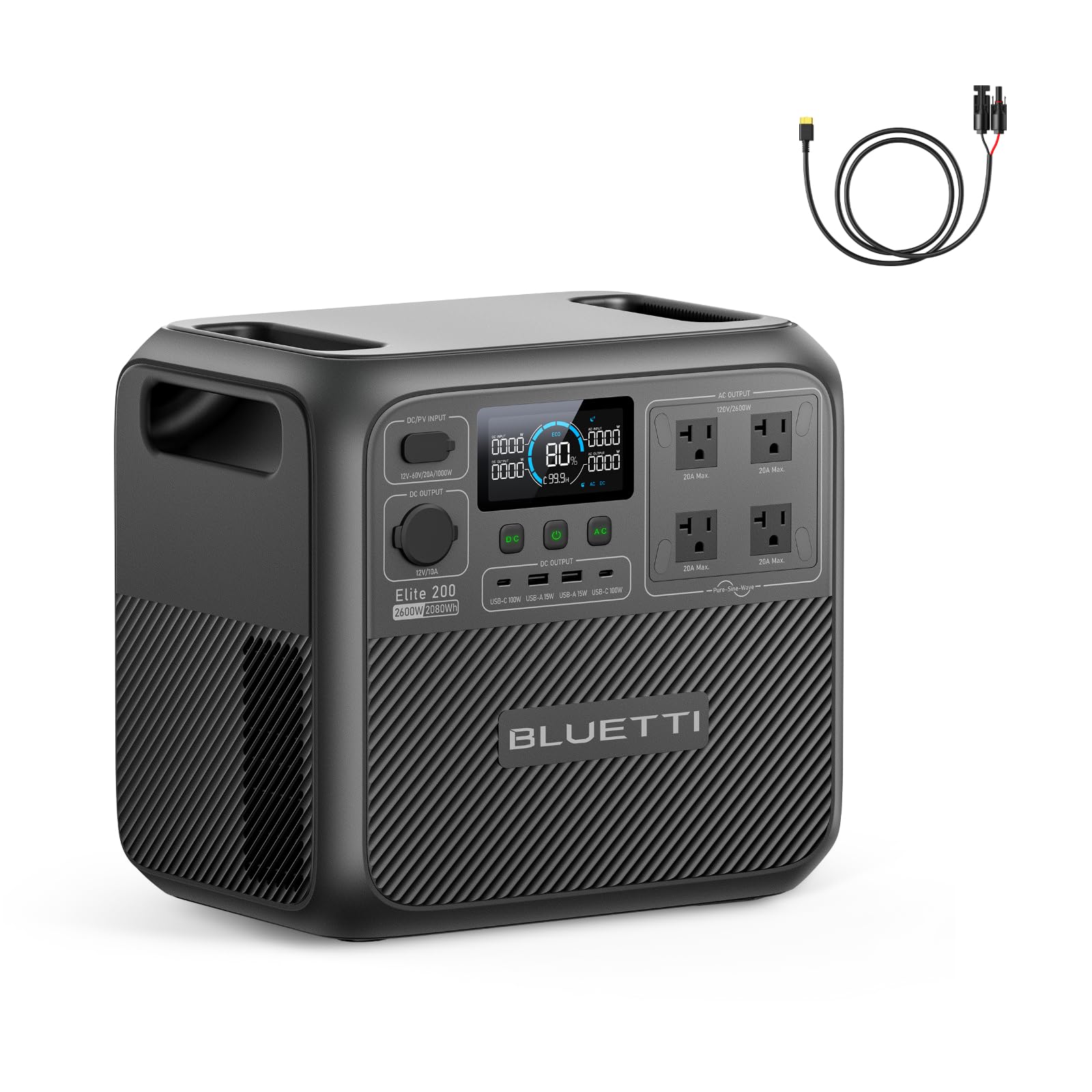
1. BLUETTI Elite 200 V2 Portable Power Station
Our pick — 4.5+★ from 950+ verified ratings; the strongest balance of quality and price.
The basecamp workhorse that runs a diesel heater for days, not hours.
You can run a real fridge and a coffee maker off one box at the same campsite. The Elite 200 V2 stores 2080Wh in a LiFePO4 battery (lithium iron phosphate — a durable chemistry that loses capacity slowly), and it delivers 2600W of continuous AC output. A 3900W lifting mode covers the surge when a compressor or kettle kicks on. That is nearly double the storage of a 1024Wh unit like the DJI Power 1000 V2 below, so a long weekend of fridge and coffee duty fits in one box.
The efficiency is where this pick separates itself. Standby draw sits at just 10W, which means the tank does not quietly leak overnight. A buyer with a 120V 60W diesel heater reported getting 3.3 days at 10 hours a day — the kind of cold-weather camping runtime that makes a difference in a tent. The LiFePO4 battery is rated to over 6,000 cycles, so it keeps its capacity across seasons of camping.
What wins people over is performance — the review pages are full of owners running fridges, heaters, and other real camping loads without trouble. Here is the honest catch: at 44.5 pounds it is the heaviest of the versatile mid-size units here, and the weight is the one recurring gripe. Plan a cart or a second set of hands if the tent is far from the truck.
What Carries This Unit
- 2080Wh capacity runs a real fridge-and-heater camp without rationing
- 2600W continuous with 3900W lifting mode starts high-draw appliances
- 6000+ cycle LiFePO4 rating outlasts the weekend-warrior pace of use
- 10W standby draw means less energy lost between uses
- Nine devices at once, so the whole family’s gear shares one box
What to Weigh First
- 44.5 lb makes it a truck-to-site unit, not a hiking pack
- Overkill capacity for a solo weekend tent trip with one phone and a lamp
Buy this if: you camp with a fridge, a heater, or a family’s worth of devices and want one box that never feels small.
Pick differently if: you load your gear into a backpack — the 44.5 lb body will make you regret it.
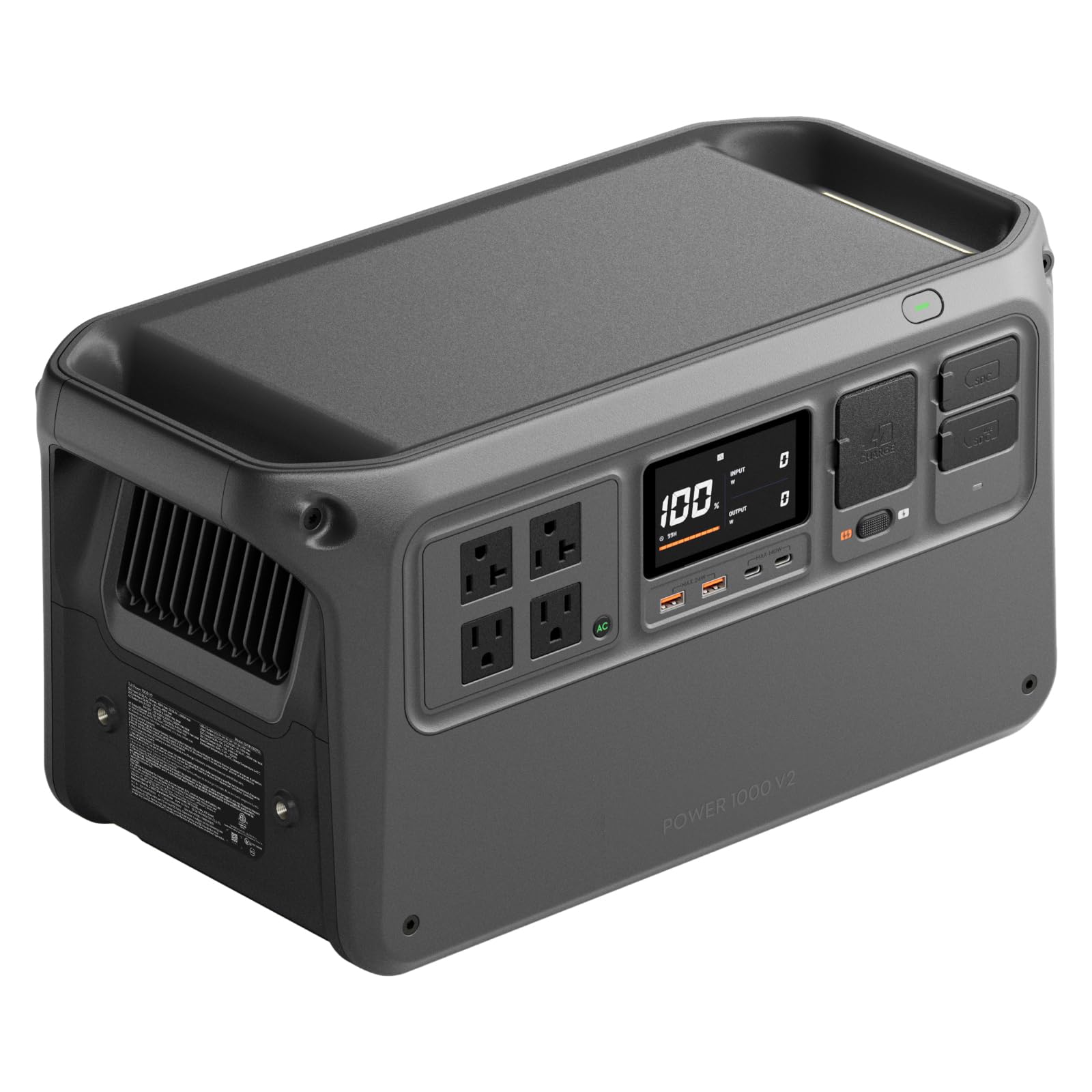
2. DJI Power 1000 V2 Portable Power Station, 1024Wh LFP Battery
A 1024Wh box that punches out 2600W and hides in the quiet of an RV at night.
Twenty-six decibels. That is roughly the volume of a whisper, and it is the number that sells the DJI Power 1000 V2 to anyone sleeping in a camper van. You get big-appliance starting power in a smaller, lighter box.
Charging is fast: 0 to 80% in 37 minutes, so a lunch stop can top it up before the afternoon drive. The UPS switchover happens in 10ms (milliseconds), meaning plugged-in sensitive gear barely notices an outage. Dual 140W USB-C ports add up to 280W total for charging drones, cameras, and laptops on the road. Buyers report it handles marine and household loads reliably, and that drone batteries get charged straight off the box.
The catch is solar. MPPT and car-charging modules are not built in, so you need a separate compatible adapter before panels or a car battery will feed it. That extra piece is easy to forget when you are planning a multi-day off-grid trip. Factor it into the kit list.
The quiet-night payoff: At 26dB this is the unit you can leave charging inside a sleeping space without it waking anyone — a real advantage over the louder boxes in this class.
The solar fine print: You must buy a separate adapter for panels or car charging, so budget the kit before you commit to off-grid plans.
Best matched to: camper-van and RV sleepers who value silence and fast grid charging over raw capacity.
Think twice if: you plan to live off solar panels for days — the missing built-in MPPT module means an extra purchase.
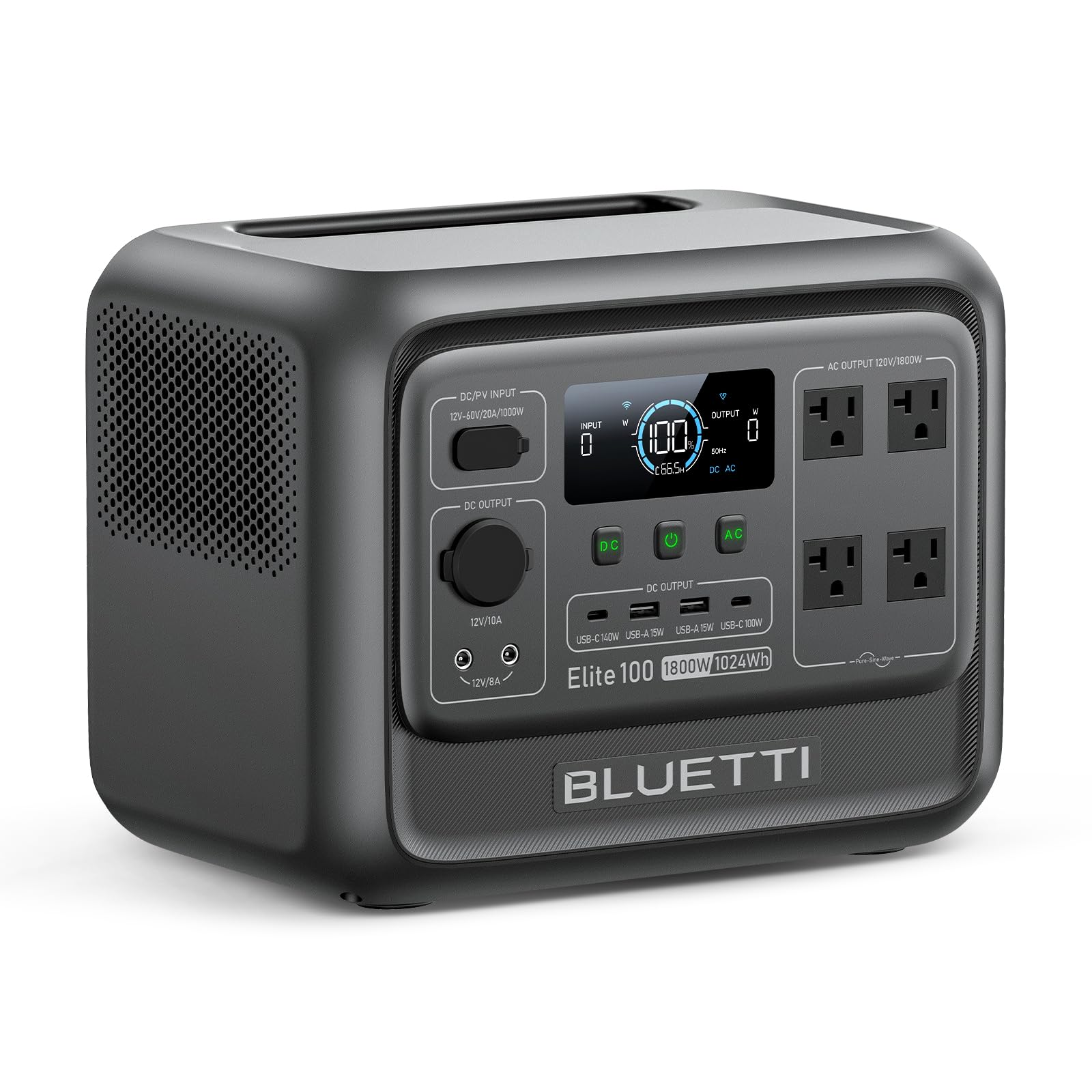
3. BLUETTI Elite 100 V2 Portable Power Station
Carry it one-handed to the tent at 25 pounds and still run 90% of your camp gear.
The Elite 100 V2 lands at 25 pounds, which makes it 78% lighter than the Elite 200 V2 above — the difference between a one-hand grab and a two-person lift. It still packs 1024Wh of LiFePO4 capacity and 1800W rated AC output, with a 3600W surge for startup spikes. BLUETTI says that covers up to 90% of everyday appliances, and for a campsite that means the kettle, the fridge, and the lights all run.
The 11 ports are the quiet hero here. You get AC, USB, and DC outputs in one box, so the whole family’s devices plug into a single unit instead of three. Charging hits 80% in about 45 minutes on the 1200W TurboBoost circuit. In silent mode it runs at 30dB, roughly half the noise of other 1kWh stations, which keeps the tent quiet at night. Owners mention running a 140W filter for about 4 hours, and charging e-bikes, drones, and inflatable paddle boards off it.
Quality is what the crowd talks about here, and the fast charging is a close second. The connectivity features draw mixed reactions — the phone app works, but not everyone finds it worth the fuss. That is a preference, not a fault.
Why campers reach for it: One person can carry the power for a family tent setup. The 1024Wh battery and 25 lb body hit that balance, so you get real overnight capacity without needing two people to haul it.
The app question: Bluetooth and Wi-Fi control are handy, but the connected features get a split reception — use them or ignore them.
Reach for this one when: you need real camping capacity that still goes in one hand and charges fast between trips.
Look elsewhere if: you want a fully dialed-in app experience — that side of it is not the reason to buy.
4. Jackery Explorer 1000 v2 Portable Power Station

The featherweight with an emergency charging switch — full tank in about an hour.
At 23.8 pounds with a foldable handle, this is the most haulable unit on the list. For a tent camper who walks gear in from the parking lot, the weight difference is what you notice first.
The headline feature is that emergency charging mode in the Jackery App, which takes the pack from 0 to 100% in about an hour. It defaults to 1.7 hours for a full charge to protect battery health, so the fast mode is a deliberate choice each time. The LFP battery keeps over 70% of original capacity after 4,000 cycles. Customers note it kept a CPAP machine running through outages, and some see it last up to 48 hours on one charge for lighter loads.
One thing to know: this model pairs only with Jackery solar panels if you plan to go solar, so you cannot mix in a third-party panel. Reliability is what draws the praise here, with easy use close behind.
Reasons It Travels Well
- 23.8 lb with a foldable handle means one-trip gear carrying
- 1070Wh capacity edges out the 1024Wh units in a lighter body
- 1-hour emergency charge mode gets you back to full fast
- 3000W surge handles the startup kick of a small compressor
Where It Asks Patience
- You must enable the fast mode in the app each time before charging
- Solar charging is locked to Jackery panels only
Ideal for: campers who carry their gear in by hand and want the lightest 1kWh-class box with a genuine fast-charge button.
Not your match if: you already own third-party solar panels — this one only takes Jackery’s own.
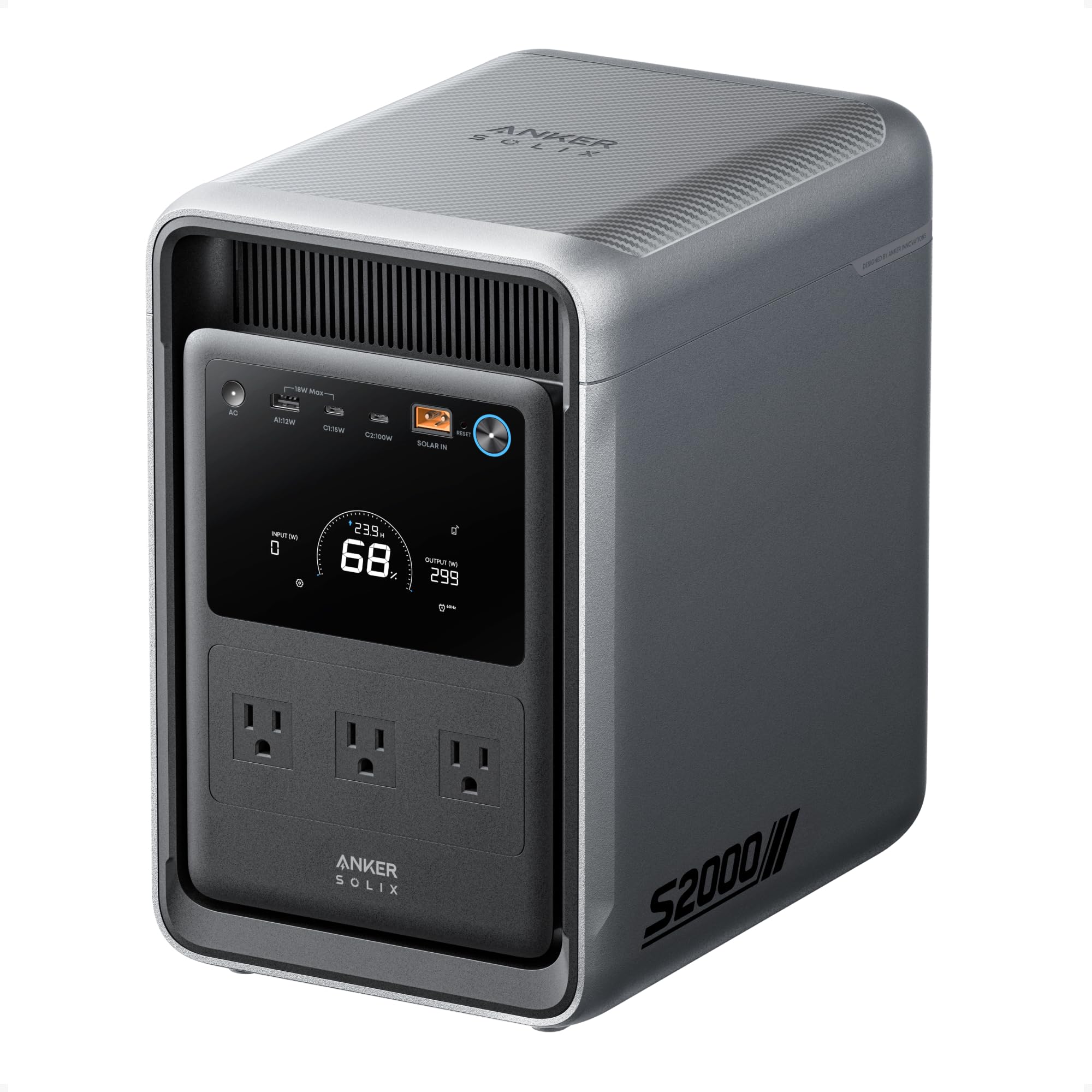
5. Anker SOLIX S2000 Solar Powered Generator, 2,010Wh, 1,500W
A 10,000-cycle battery that keeps a full fridge cold for 35 hours.
Start with the cycle count: 10,000 charge cycles from 314Ah LFP cells, which Anker ties to a 15-year lifespan. That is the longevity number the camping crowd should care about if they use the box every season. The tank holds 2,010Wh and outputs 1,500W continuous with a 3,000W peak, so it runs a full fridge and most essentials without strain.
Efficiency is the real story. A 6W idle draw and 10% higher efficiency let it run 20% longer than other 2kWh systems by Anker’s measure — 35 hours on a fridge. At 8.2 × 11.1 × 12.7 inches and 35.7 lbs, Anker says it is 30% smaller and 25% lighter than the industry average. For a truck-camping setup it is a genuinely manageable lift.
It recharges six ways, including up to 400W solar input and AC-plus-solar together. There is no 12V DC port, which is the one thing to flag for RV owners who rely on one. The 10ms UPS switchover keeps a home office running. The front-and-rear outlet layout keeps the campsite tidy.
Longevity leader: The 10,000-cycle rating is the standout spec — a battery lifespan that rarely lands in a camping-class box.
The missing port: No 12V DC outlet means some RV accessories need a different path to power.
Choose this for: fridge duty where you want the battery to outlast a decade of seasons and can live without a 12V DC port.
Pass it over if: your camper van accessories run on 12V DC — this box does not feed them.
6. Jackery Solar Generator 1000 v2

The one-box solar kit — panel included, so the off-grid math is already done.
Most units on this list make you buy panels separately. This bundle ships the Explorer 1000 v2 and a 100W solar panel together, which removes the guesswork for first-time off-grid campers. The station holds 1,024Wh with 1,500W AC output and a 3,000W surge, and the whole thing weighs 23.4 lbs — among the lightest here.
Charging is quick on AC: 0 to 100% in about 50 minutes with the emergency mode in the Jackery App. It defaults to 1.25 hours so the battery lasts. The LFP pack is rated over 4,000 cycles while holding more than 70% capacity. There is a 10ms UPS switchover, two USB-C ports, one USB-A, one DC car port, and two pure sine wave AC ports. Reviewers point out a mid-sized fridge running most of the day, and a charge to 50% after 7 hours in the sun on the panel.
The panel adds real weight and bulk to your packing, even if the station itself is light. Charging performance is what the crowd singles out, and quality comes up most overall.
Everything in one box: The included 100W panel means no separate adapter hunt and no compatibility surprises — a strong pick for a first solar camp setup.
Packing reality: You are carrying a panel as well as the station, so plan the vehicle space.
Right for: off-grid campers buying their first solar setup who want the panel and the station matched from day one.
skip it if: you already own panels — buying them again in a bundle wastes the advantage.
7. EF ECOFLOW DELTA 3 Max Portable Power Station
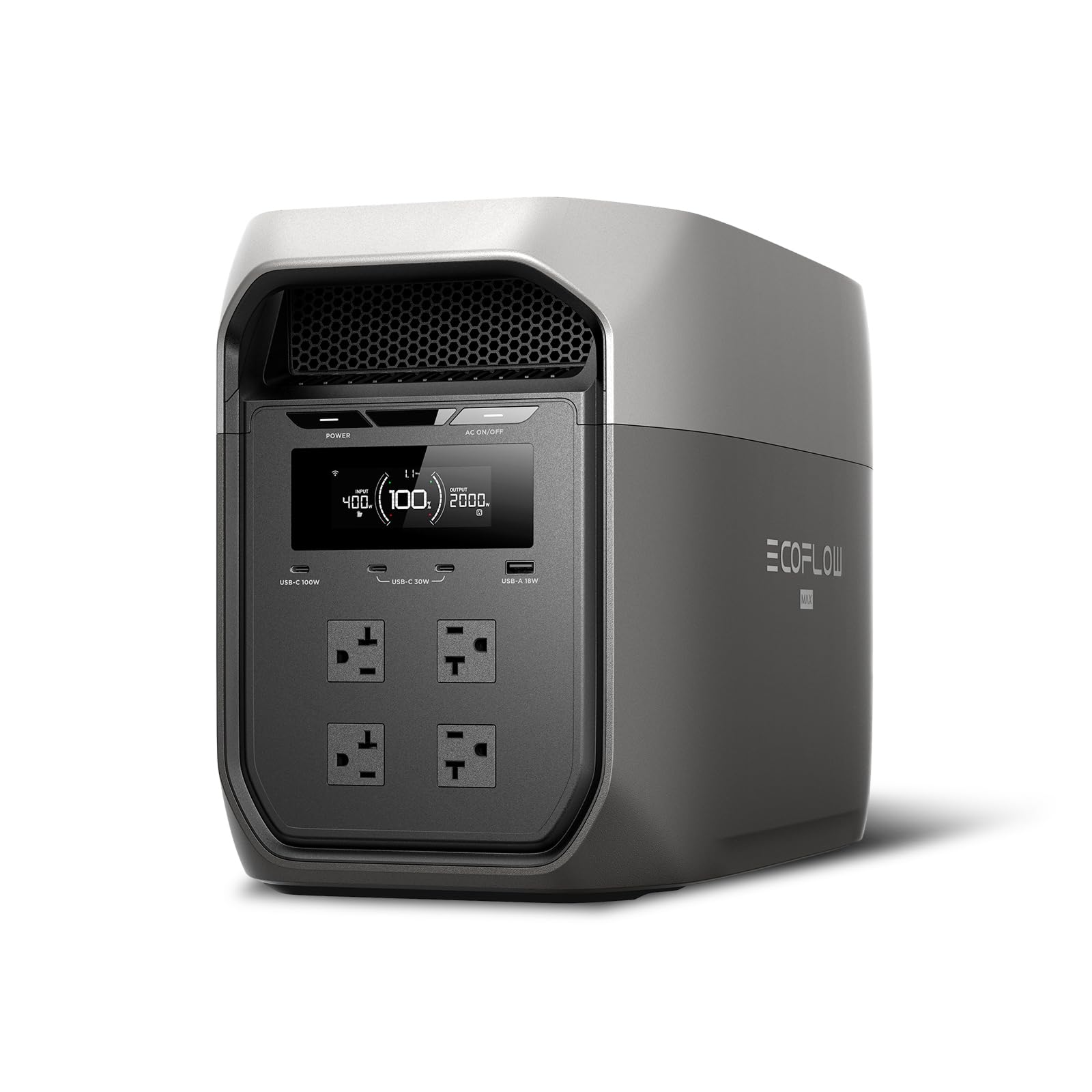
X-Boost output that starts power tools at the campsite, not just the fridge.
If your camping involves tools — a saw, a drill, a microwave — this is the one that behaves like a wall outlet. The tank is 2048Wh of LiFePO4, so it can carry that load for real stretches. For a work-camp or an off-grid cabin build, that combination matters.
Charging runs 0 to 80% in 1.13 hours on X-Stream, so a grid top-up is quick. The UPS transfer is under 10ms, so sensitive electronics stay up during outages. It is built for 10 years of daily use and comes with a 5-year service term. The app tracks energy use in real time and lets you set charging schedules. Quality is what buyers talk about most, and reliability follows close behind.
One trade-off is size and weight: the design is meant for home-to-RV shuttling, not a long walk to a tent. It is a carry-it-in-from-the-truck box, not a backpack unit.
The tool-ready advantage: 3400W X-Boost output lets you run high-draw gear that smaller camping stations simply will not start.
The carry question: This is a heavy, home-to-camp design — count on short hauls, not long treks.
Made for: campers and cabin builders who run tools and high-draw appliances off the box, not just a lamp.
Reconsider if: you need a packable unit for a hike-in site — this one lives near the vehicle.
8. Jackery Explorer 2000 v2 Portable Power Station

A 2kWh crossover that shrinks the weight while keeping the fridge running.
Jackery builds this one on CTB (Cell-to-Body) construction, the same approach EV makers use to pack cells tightly into a rigid frame. That CTB frame holds 2042Wh in a 39.5 lb body — the maker says 41% lighter and 34% smaller than typical 2kWh LiFePO4 stations. Three AC ports deliver 2200W total, and a USB-C PD 100W port fast-charges laptops without an adapter.
Charging runs 0 to 80% in 66 minutes on AC, or full in 102 minutes with the Emergency Super Charging mode in the app. Solar takes as few as 6 hours with 400W panels. The silent mode tops up in 5 hours at 30dB, quiet enough for overnight. The 20ms UPS switchover is tested to UL1778, a safety standard for uninterruptible power systems. Shoppers say a fridge running several hours on a full charge and a full top-up within about 60 minutes.
The recurring notes are around weight and durability expectations — not failures, just things buyers weigh before committing to a 39.5 lb box. For a truck camper moving between home backup and campsite duty, that is a fair trade.
Home-to-camp range: With 2042Wh and a tested UPS, this unit covers both the campsite fridge and the home outage without owning two boxes.
Weight you feel: Just under 40 lb is a two-hand lift for many, so plan the carry.
Good fit for: campers who also want home-outage coverage and value the lighter 2kWh build.
Better elsewhere if: you need the lightest possible kit — the 1kWh class drops about 15 lb off this.
9. Anker SOLIX C2000 Gen 2 Solar Powered Generator
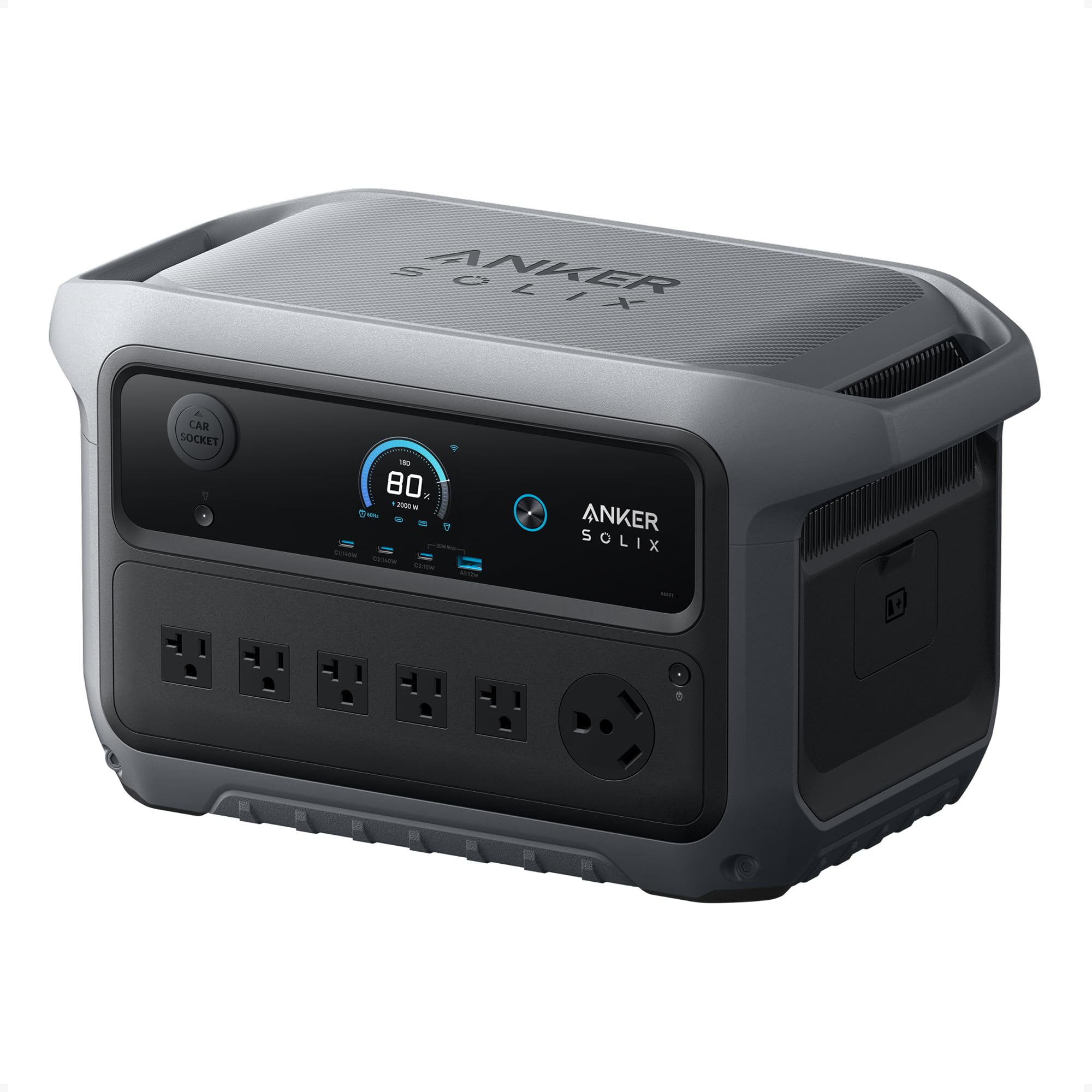
The box with a TT-30 socket — plug your whole RV in, not just a lamp.
The TT-30 port is what makes this the RV pick. That is the 30-amp outlet your camper is wired for, so the C2000 Gen 2 can feed the rig directly instead of through an adapter. It delivers 2,400W rated and 4,000W peak, enough for most window and RV air conditioners. The battery is 2,048Wh LiFePO4 with a full charge in 58 minutes when you combine AC and solar.
Idle draw is just 9W, which Anker says stretches runtime to 7 days on a portable fridge or 32 hours on a dual-door unit. Add an expansion battery and capacity reaches 4kWh, enough for up to 64 hours on that dual-door fridge. An 800W alternator charger refills it from the car in 3 hours. At 41.7 lb and 18.1 × 9.8 × 10.1 inches, Anker says it is 25% lighter and 29% smaller than similar 2kWh units. Buyers report powering a TV, fridge, and WiFi for over 10 hours and running a 10,000 BTU A/C overnight.
The obvious limit is weight: 41.7 lb puts it in the two-hand, near-the-vehicle category. For a drive-in RV site, that is exactly where it belongs.
Where the RV Crowd Wins
- TT-30 socket plugs straight into a camper’s power inlet
- 4,000W peak starts an RV air conditioner
- Expands to 4kWh with an added battery for longer fridge runtime
- 9W idle draw means less waste between uses
Before You Load It
- 41.7 lb is a solid two-hand lift at the campsite
- The extra expansion battery is a separate outlay for maximum runtime
Built for: RV owners who want to plug the whole rig into one box and run the air conditioner.
Not for you if: you camp out of a backpack and need something you can sling over a shoulder.
10. EF ECOFLOW DELTA Pro Portable Power Station
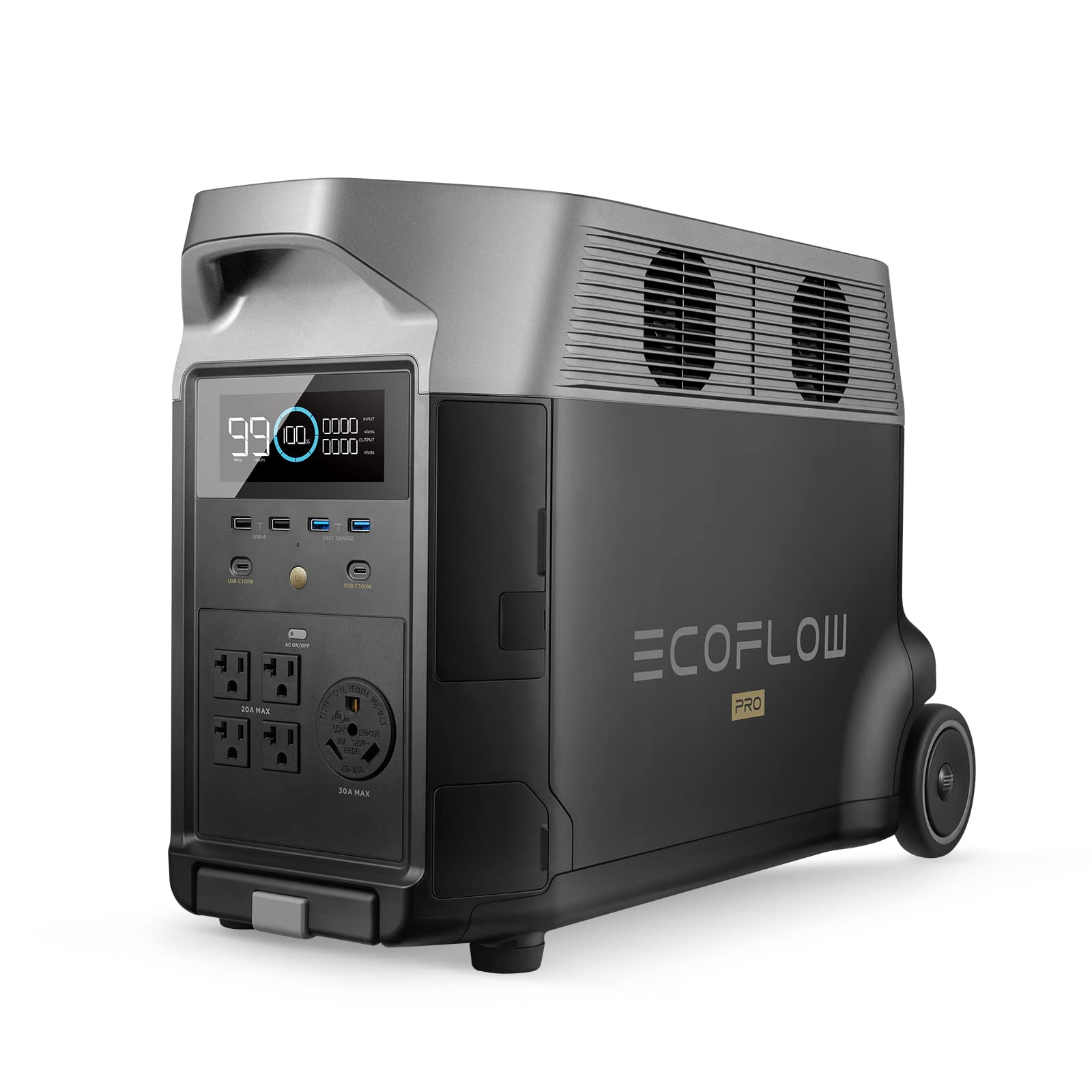
The 3600Wh basecamp battery that grows to 25kWh when you add more modules.
For a full basecamp — a group, a work site, a cabin — the DELTA Pro brings 3600Wh and 3600W AC output in one unit, scalable up to 4500W with X-Boost. Add extra batteries or smart generators and capacity climbs from 3.6kWh toward 25kWh. Two units can pair for 7200W. That is capacity no single camping box on this list matches.
Ports are generous: 15 output methods, including 5 AC outlets, 2 USB-C at 100W, 2 USB-A fast-charge, 2 standard USB-A, 2 DC outlets, a car power output, and an Anderson port. Recharging is fast — full in 1.8 hours on 240V outlets, 2.7 hours on 1800W wall outlets, or 2.8 hours from four 400W solar panels. Customers note it runs everything needed for hours and holds up for both home backup and outdoor use. Quality is what draws the most praise, with value close behind.
At 99 pounds, this is not a camping carry — it is a vehicle-mounted or handcrafted-cart power source. Plan for where it lives, because you will not be moving it far once it is placed.
Scalable ceiling: 3600Wh now, 25kWh later, with 3600W output that two units can double to 7200W — the biggest system capacity here.
The weight: 99 lb means it stays where you put it, so decide that location before you buy.
Pick it for: large basecamps, work sites, or cabins that want capacity they can grow over time.
Wrong choice if: you need to move the power around — at 99 lb, this one is a fixture.
Know the Specs
Watt-Hours (Capacity)
Watt-hours (Wh) measure how much energy the battery holds — think of it as the size of the fuel tank. A 2048Wh pack holds roughly twice the run time of a 1024Wh unit under the same load. Pick capacity from your longest fridge or heater stretch, not the daily phone charge.
Watts (AC Output)
Watts measure how much power the box can push at once, not how long it lasts. A 1,500W output runs a kettle or a small fridge. A 2,600W or higher output starts larger appliances. Surge or “lifting” figures cover the brief spike a motor draws on startup — check that number for anything with a compressor.
LiFePO4 Cycles
A charge cycle is one full drain and refill. LiFePO4 (lithium iron phosphate) packs are rated by how many cycles they last before capacity drops to about 80%. Higher cycle ratings mean more seasons of use before the battery fades, and that is the number to compare across units.
Solar Input and Refill Time
Solar input wattage sets how fast panels can refill the battery when you are off-grid. A higher panel rating means fewer daylight hours to top up. Some units need a separate adapter before they accept solar or car charging, so check that accessory before you count on off-grid refills.
Common Questions
How many watt-hours do I need to run a camping fridge?
Can a camping power station run a CPAP machine overnight?
Is LiFePO4 better than a regular lithium battery for camping?
Will a power station run a camper van’s 12V fridge?
What does power lifting or surge output mean on a power station?
Can I charge a power station with a solar panel from a different brand?
How fast can a camping power station recharge from a wall outlet?
Is a 2kWh power station too heavy to carry to a campsite?
What does a TT-30 port do on an RV power station?
Can these power stations keep a fridge running during a power outage at home?
Do I need to enable a special mode to get the fastest charging speed?
Can I expand a power station’s capacity later if my camping needs grow?
The Bottom Line
For most campers, the power station for camping winner is the BLUETTI Elite 200 V2. Its 2080Wh capacity and 2600W output run a fridge, a heater, and a family’s devices from one box. Its 6,000+ cycle battery is built to keep doing that for seasons. If you carry your power on foot, grab the Jackery Explorer 1000 v2 at 23.8 lbs with a one-hour fast charge. RV owners who want to plug the whole rig in should reach for the Anker SOLIX C2000 Gen 2, thanks to its TT-30 socket (a 30-amp RV outlet) and 4,000W peak. Whichever way you lean, buy the capacity your longest trip needs and the weight you can actually lift — that pairing is where campers end up happiest with a unit year after year.
How we choose
We do not accept paid placement. Every pick is matched to a real buyer and a real use-case; we do not hands-on test units.
Sources
Specifications: manufacturer listings and product documentation. Review insights: verified customer reviews, as of November 2026. Pricing: not shown on this page (it changes often); check the current price via the retailer link.
As an Amazon Associate, Tactical Gear Guy earns from qualifying purchases. This does not affect which products we feature.