Specs are compiled from manufacturer listings and verified buyer reviews and can change over time — please confirm the key details on the product page before buying.
You want a board flat, a door trimmed, or a joist leveled — and you want it done without a belt sander screaming for twenty minutes. A power hand planer does that job in one pass, but only if you pick one whose motor, cut depth, and blade setup match what you actually build. The picks below split cleanly: three budget-friendly units that punch above their tier, three mid-range workhorses, and three premium tools built for daily shop use.
This guide is built by comparing the manufacturers’ published specifications and the patterns across verified customer reviews, so you get each pick’s real strengths and trade-offs instead of marketing spin.
Read the market plainly: amperage sets how hard the tool pushes, cut depth per pass sets how many passes you make, and the shoe (the flat base that registers on the wood) sets whether the result is flat or rippled. The crowd favorite here holds 4.5+ stars across 800+ owners on cut quality, not brand badge. Below you’ll find the power hand planer that matches your bench, your budget, and the wood you actually cut.
Top Picks

How To Choose The Best Power Hand Planer
A hand planer removes wood with a spinning two-blade cutter head, guided across the surface by a flat base called the shoe. That is the whole machine. Everything that separates a good one from a frustrating one sits in four places: the motor, the depth control, the shoe, and how it handles its own shavings.
Match the amps to the wood, not the badge
Amperage is the current the motor draws, and it is the closest thing to a horsepower rating on these tools. Lower-amp units handle pine, cedar, and soft trim without complaint. Hard maple, oak, and old painted fir ask more of the motor, and that is where the higher-amperage models pull ahead. If you are planing doors and fence boards all day, buy the amps. If you are chamfering a few edges on a weekend, you will not feel the difference.
Cut depth per pass sets your finish
Every planer here states a maximum depth of cut — the deepest bite it will take in one trip across the board. A deeper maximum means fewer passes on stock removal, but it also means a heavier bite that can tear grain if you push it on figured wood. The practical move is to buy for the deeper number and then take shallow passes anyway. Precise control at shallow depths is what produces a surface you can finish straight off the tool.
The shoe is the part nobody advertises
The shoe (also called the base) is the machined plate that rides on your workpiece. If it is not flat, the planer will follow every dip in the wood and hand you back a wavy board. Look for a cast aluminum or machined shoe, and on premium models look for front and rear shoes machined together as a pair — that is the detail that keeps a long pass truly flat. The shoe length also matters: a longer shoe bridges across dips rather than diving into them.
Dust: the difference between a clean edge and a snowstorm
A planer makes shavings fast, and a bag or extraction port that clogs turns your bench into a mess in about four feet of travel. Dual-side ejection lets you point the chips away from the finished surface and away from your face. A bagged system means less sweeping. Check what actually ships in the box — a dust port that needs an adapter you do not own is not a dust system.
Blades, chamfers, and the features you will actually touch
Two-blade cutter heads are the norm in this class, and blade material is where the money goes — carbide holds an edge far longer than high-speed steel in abrasive material. Chamfering grooves cut a 45-degree edge on a board end without a second setup, which is genuinely useful on trim and shelving. A spring-loaded stand lifts the base when you set the tool down, so the blades never touch the bench. None of these are gimmicks; all three are the features you will notice in the first week.
Side-by-Side Comparison
| Model | Best For | Amperage | Cut Width | Cut Depth | Amazon |
|---|---|---|---|---|---|
| Makita KP0800K★ Best Overall | All-round shop workhorse | 6.5 A | 3-1/4″ | 0.09 in | Amazon |
| Bosch PL2632KTop Performer | Depth control and fence work | 6.5 A | 3.25 in | 2.6 mm | Amazon |
| Bosch PL1632Best for Door Work | Door edges and long boards | 6.5 A | 8 cm | — | Amazon |
| Makita KP0810 | Deep passes in hard stock | 7.5 A | 3-1/4″ | 5/32″ | Amazon |
| CRAFTSMAN CMEW300 | Two-blade value starter | 6 A | 3-1/4″ | 0.07 in | Amazon |
| PORTER-CABLE PC60THP | Chamfering and depth steps | 6 A | 3-1/4″ | .078 in | Amazon |
| SKIL PL201201 | Clean sightlines on trim | 6.5 A | 3.25 in | 2 mm | Amazon |
| DNTI 58218 | Fast passes on framing | 6.6 A | 3-1/4″ | 2 mm | Amazon |
| VEVOR Electric Hand Planer | First planer on a tight bench | 6 A | 3.25 in | 0.08 in | Amazon |
Detailed Reviews
1. Makita KP0800K 3-1/4″ Planer, with Tool Case
Our pick — 4.5+★ from 800+ verified ratings; the strongest balance of quality and price.
A 6.5-amp cutter head that spins at 17,000 RPM and lands a finish you can sand lightly and call done.
The number that matters here is 17,000 — the cutter head’s RPM, or how many times per minute those two blades sweep past the wood. Higher blade speed means each cut slices cleaner instead of tearing, which is why the finish off this Makita comes back smooth rather than fuzzy. It planes up to 3-1/4 inches wide and 3/32 inch deep in a single pass, so a door edge or a sticking drawer front gets flattened in one or two trips instead of ten minutes of sanding.
What wins people over on this tool is the build — the fit and finish of a machine that behaves like a professional instrument from the first cut rather than needing a break-in period. The spring-loaded stand is a small thing that becomes a habit fast: set the planer down and the base lifts clear so the blades never kiss the bench. The aluminum base stays flat across a long board, and there is a blade gauge assembly and wrench in the case, so blade changes do not turn into a hunt for the right tool.
Now the honest part. This is a 4.6-kilogram tool, and you feel that on overhead work or a full afternoon of door trimming — it is a two-hand, deliberate machine. There is also a dust port that asks for an extractor; the bag situation is a mixed report, and shavings do build up on the bench if you run it bare. Neither is a defect. It is the profile of a tool built for the bench rather than for one-handed reach into a cabinet.
Where it pulls ahead
- 17,000 RPM two-blade head leaves a surface you can finish with light sanding, not heavy sanding.
- 3/32-inch depth in a single pass clears a door or joist in far fewer trips than a shallow-cut unit.
- Spring-loaded stand keeps the blades off the bench every time you set it down.
- Ships in a tool case with a blade gauge assembly, guide rule, and wrench — nothing extra to buy for a blade swap.
Where it makes you work
- At 4.6 kilograms it is a two-handed tool; overhead passes wear you down.
- Dust collection is a weak point — plan on an extractor or a broom.
Buy this if: you want one planer that handles trim, doors, and deck joists and leaves a finish that needs only a light pass with paper.
Think about the weight first: 4.6 kilograms is real, and if most of your planing happens above shoulder height, a lighter unit will treat you better.
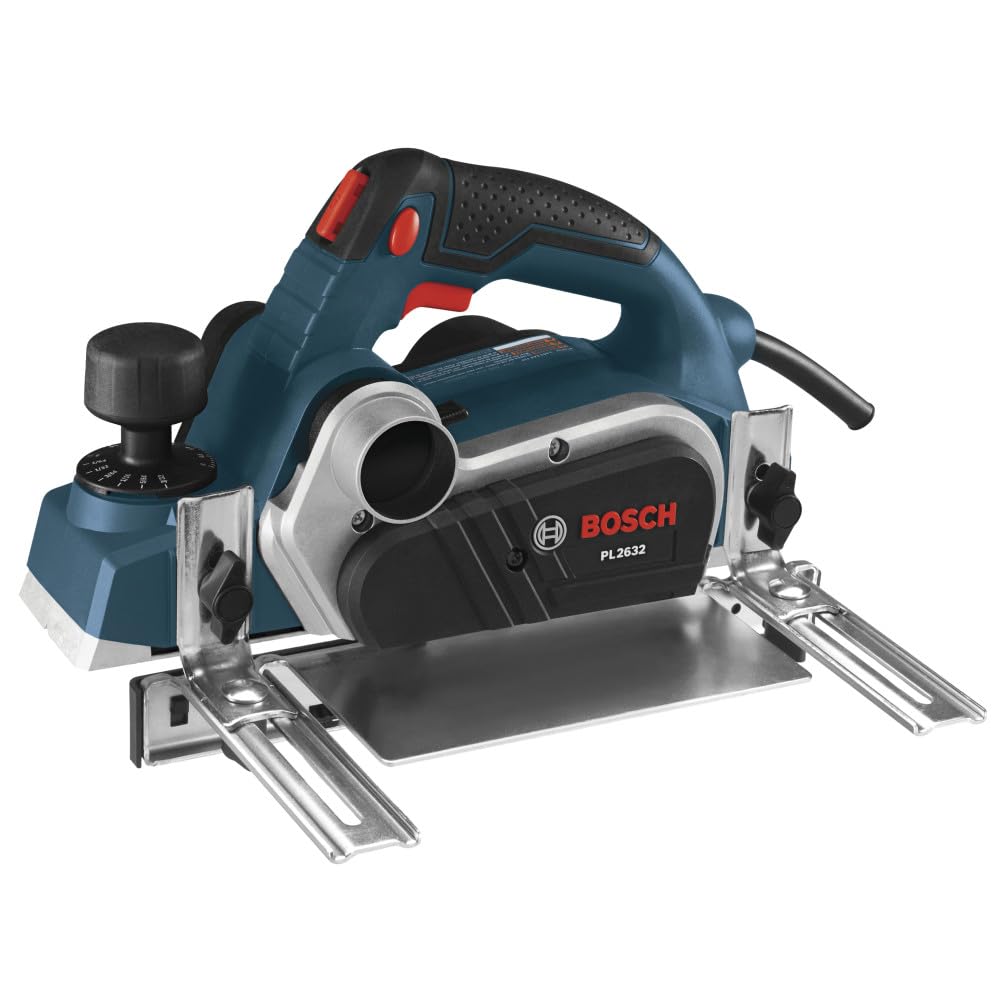
2. Bosch PL2632K 3-1/4 In. Electric Hand Planer Kit
Set the depth once and forget the zero — the ratcheting knob covers 0 to 2.6 mm in a single turn.
Depth adjustment is where cheap planers fall apart. You dial in a number, the reference drifts, and you re-zero the tool every time you touch it. Bosch solves that with a ratcheting depth knob that runs 0 to 2.6 millimeters (3/32 inch) within one revolution and holds its increment — so going from a heavy first pass to a hair-thin finishing pass is a click, not a recalibration. On a door edge where you are sneaking up on a fit, that is the feature that saves the job.
The rest of the kit is built for holding a line. The dual-mount guide fence bolts to either side of the tool so you can register against a door face and plane a consistent edge, and protective overshoes keep the fence from marring the surface you just finished. Front and rear aluminum shoes are machined together after assembly, which is the detail that keeps a long pass flat instead of dipping. The reversible Bosch Woodrazor micrograin carbide blades are rated for up to 30 percent longer life than standard carbide — a maker’s figure worth knowing when you price replacements.
The honest limit sits in the housing rather than the cutter. The construction is praised broadly but the plastic components draw a mixed report, so treat the body panels as the part that ages, not the motor. At 6.3 pounds it is manageable one-handed for short work, and the ball-joint cord swivel keeps the cord from dragging your line. The two-blade head is standard here; converting it to large high-speed steel blades needs optional accessories you buy separately, so budget for that if that is your plan.
What the ratchet buys you: repeatable depth without re-zeroing — the single biggest quality-of-life upgrade in this price band, and the reason this one suits trim carpenters sneaking up on a fit.
What to watch: the plastic housing parts are the weak link over years of shop use, and the steel-blade conversion is not included.
Reach for this if: your work involves door edges, consistent fence-guided passes, and depth changes you need to repeat exactly.
Look elsewhere if: you need a tool that takes a beating in a shared site box — the plastic body will show it before the motor does.
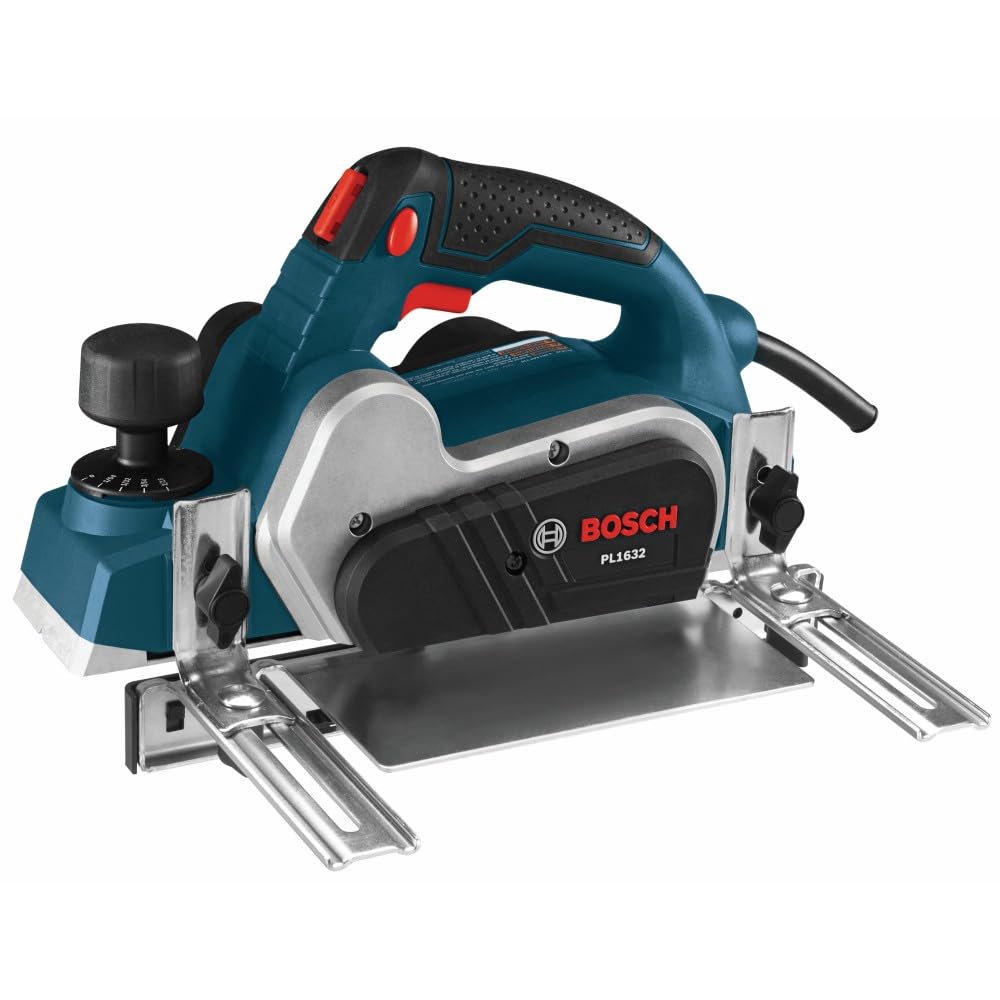
3. Bosch PL1632 6.5 Amp Hand Planer, 3-1/4″
Built around one job — trimming a hung door in place without pulling the hinge pins.
Read the feature list on this Bosch and a single job keeps surfacing: door edges. The dual-mount guide fence carries a protective shield and a plastic overshoe so the fence rides the door face without marring the finish, and the spring-loaded stand has a shape that lets you drop the tool into the middle of a workpiece rather than sliding in from the end. That is exactly how you trim a door that is already hanging. The 6.5-amp motor spins at 16,500 RPM, which is the same fast stock removal and smooth finish formula as the rest of this class.
Two small details separate it from the PL2632K above. The depth scales are marked separately in inches and in millimeters, so you read the scale you think in rather than converting in your head. And the handle runs at an angle tuned to push the tool forward, wrapped in soft grip — a shape you notice at the end of a long board rather than the start. Six pounds and 11.4 inches long, it stays controllable one-handed on a vertical door face.
The catch is scope. Buy this expecting Bosch’s ratcheting depth knob and you will be disappointed, because that feature lives on the other model and not here. This one hands you a depth setting rather than a repeatable click-stop system. For door work and board leveling that difference rarely bites; for production runs where you switch depth twenty times a day, it does.
The door-edge case: a shielded dual-mount fence plus a stand that drops into mid-workpiece makes this the least fiddly option for trimming a hung door without disassembly.
Where it stops: no ratcheting depth knob here — that upgrade belongs to the PL2632K, so pick by workflow, not by brand.
Best fit: remodelers and homeowners trimming doors and leveling boards who want a fence that protects the finished face.
Not the one for: high-volume depth changes across dozens of pieces — you want the click-stop knob instead.
4. Makita KP0810 3-1/4″ Planer

The 7.5-amp outlier that takes 5/32 inch in one pass — nearly double the bite of the shallow-cut crowd.
Here is the head-to-head that decides it. This Makita planes 5/32 inch deep in a single pass. The VEVOR in this list tops out at 0.08 inch. If you are taking a twisted 2×10 down to flat, that difference is not a rounding error — it is the gap between clearing the board in a few passes and grinding at it all afternoon. The 7.5-amp motor is the highest rating in this lineup, and it is what lets the tool hold that depth in hardwood without bogging down.
Precision is handled properly too. The depth knob clicks in 0.1-millimeter increments on an easy-to-read scale, so you can take a real 1/32-inch pass, then a finishing whisper of a pass, and repeat both later. Chip ejection flips to either side of the tool, which matters when you are planing against a wall and want the shavings going somewhere other than your shoes. The lock-on/off button sits where either hand can reach it from either side of the handle.
The trade-off is blade life under abuse. The two-blade cutter head at 16,000 RPM does the work, and the knives themselves hold up, but there are reports of blades breaking rather than dulling — the kind of failure that comes from a hard hit on a nail or a buried staple, not from ordinary planing. Sweep your stock for metal before you run it and this stays a non-issue. Note also that this one does not ship with a listed case or bag in its included components, just blades, a depth gauge, a guide rail, and a socket wrench.
The case for the extra amps
- 5/32-inch maximum depth per pass clears heavy stock removal far faster than the 0.08-inch units here.
- 7.5 A is the highest amperage rating on this page — it holds the cut in hard material.
- Depth clicks in 0.1 mm increments for repeatable shallow finishing passes.
- Chip ejection flips left or right, and the lock button works from either side of the handle.
Where it asks for care
- Blades can break rather than wear when they hit embedded metal — sweep your stock first.
- No case listed in the included components, so plan your own storage.
Choose it for: heavy stock removal in hardwood, sawmill-fresh boards, and any job where pass count is the thing slowing you down.
Check your stock first: run a magnet over reclaimed lumber — a broken knife costs more than the time you saved.
5. CRAFTSMAN Hand Planer, 6-Amp, 5/64-Inch (CMEW300)

Ten positive depth stops and an 11.5-inch cast aluminum shoe — a lot of control for the money.
Positive steps are the answer to the drift problem on cheap planers. Instead of a continuously variable knob that creeps, this CRAFTSMAN gives you 10 detents, so you set a depth and it stays set. Combine that with the 11.5-inch cast aluminum shoe — a long plate that bridges across dips in a board instead of following them — and you get flat passes rather than ripple. The 6-amp motor at 16,500 RPM handles both hard and soft stock, and the cutter head takes the two carbide blades that ship in the box.
The dual-side dust extraction is thoughtful: the port works on either side of the tool, and the vac adapter is included. That last part matters, because a dust port that needs an adapter you do not own is just a hole. There is also an edge guide in the box for running a consistent chamfer or rebate along a board edge. Nothing in this kit leaves you hunting for a piece on day one.
One thing you should know before ordering: there are reports of the box arriving without a dust bag, and the listing has drawn criticism for that gap. It ships with extraction capability and an adapter, but if a bag specifically is what you expect, confirm before you buy or plan to hook up a shop vac. The dust itself is real — this tool throws shavings if you run it bare. That is a fit note, not a flaw: connect extraction and the workspace stays clean.
The control story: 10 detented depth settings plus a long cast shoe give you repeatability that most tools in this range simply do not offer.
The box caveat: extraction hardware is included but the bag itself has been a point of friction — plan on a shop vac, which you probably want anyway.
Good match for: woodworkers who set a depth, run several boards, and need the next pass to match the last one.
Confirm first: if you need a bag in the box, verify what is actually shipping before you commit.
6. PORTER-CABLE Hand Planer, 6-Amp, 5/64-Inch (PC60THP)

Three chamfering grooves built into an 8.2-pound tool that has been flattening doors for a decade.
Most planers make you build a jig to cut a 45-degree chamfer. This one has 3 grooves molded into the base, so you set the tool on the edge, run it, and the bevel comes out consistent. For shelf edges, post caps, and trim returns — the small jobs that eat an afternoon of setup — that is the feature that earns its place on the shelf.
The rest of the spec sheet is aimed at control. An overmold depth knob with 10 positive steps gives you repeatable settings, and the 11-1/2-inch cast aluminum shoe — the longest plate in this roundup — spans across a dip in a board rather than diving into it. It removes 0.078 inch per pass and takes a max rabbet (a stepped notch cut along an edge) of 0.47 inch. The dust bag attaches on either side of the tool, so you can point the shavings away from the surface you just finished.
Here is the trade-off. At 8.2 pounds this is the heaviest tool on this page, and there is a head-to-head that makes the point: the SKIL below weighs 6 pounds against this 8.2 — a noticeable 2.2-pound spread when you are holding it up against a door jamb. The weight is what buys you the stability on a flat pass, but it also means this is a bench tool, not one you wave overhead. Its 3-year limited manufacturer warranty is the longest in this roundup.
Why it holds a line
- 3 chamfering grooves cut a 45-degree bevel without a jig or a second setup.
- 11-1/2-inch cast aluminum shoe is the longest here — bridges dips and keeps the pass flat.
- 0.47-inch max rabbet depth handles notched edges in the same tool.
- 3-year limited manufacturer warranty — the longest coverage here.
The honest counterweight
- 8.2 pounds is the heaviest tool on this page — a 2.2-pound gap over the SKIL, felt on vertical work.
- Depth steps are set, not finely tuned — you get 10 positions rather than a continuous dial.
Pick it for: chamfering trim, shelving, and post caps, plus flattening doors and fence boards where a long shoe carries the pass.
Weigh the weight: at 8.2 pounds, choose this for bench and door work, not for one-handed reach overhead.
7. SKIL 6.5 AMP Electric 3-1/4 Inch Corded Planer – PL201201
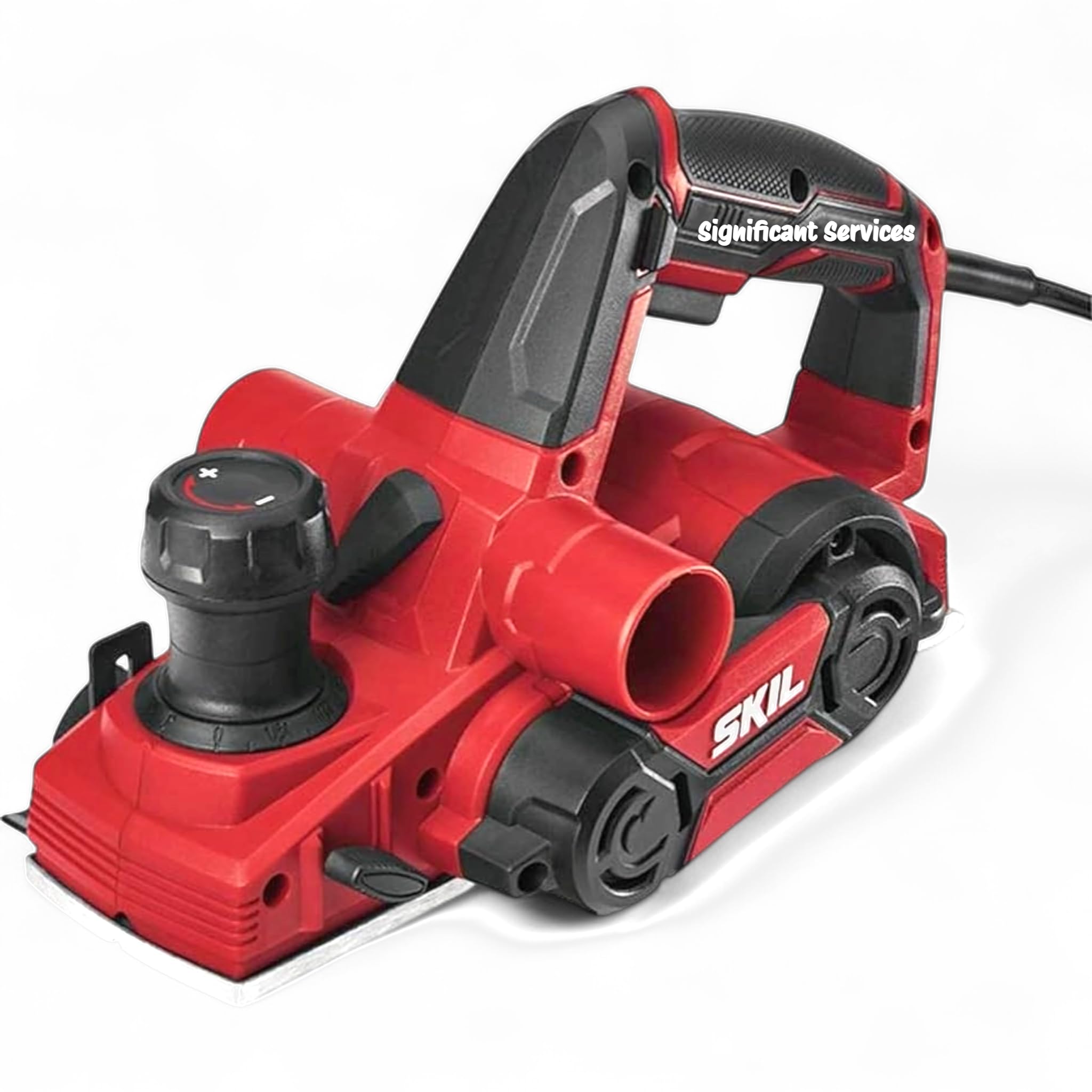
Dual chip exhaust that clears the cut line so you can actually see where the blade is going.
At 6 pounds, this is the lightest full-size planer in this lineup — a full 2.2 pounds lighter than the PORTER-CABLE above. That gap is what makes it a one-hand tool on trim work. More importantly, the dual chip exhaust throws shavings away from both the finished surface and your line of sight, so the edge of the cut stays visible while you run it. When you are planing a door edge to a pencil mark, being able to see the mark is half the job.
The 6.5-amp motor takes a 2-millimeter cut and the cutter head leaves a surface smooth enough that light sanding finishes it. The kickstand is a smooth one — it improve the base so the blade never scratches a finished surface, which is the difference between a clean job and a callback. The lock-off switch prevents the tool from starting if you bump the trigger, and there is on-tool wrench storage, so the wrench is where you left it when you need to swap blades.
The mixed part is worth knowing up front. Depth adjustment and long-term durability draw split reports — some owners find the tool better than expected, while blade retention has been a point of friction for others. Check blade seating after a change and re-torque before a long run. The dust bag, parallel guide, rebate fence, and spanner all ship in the box, so the kit is complete.
The visibility advantage: dual chip exhaust plus a 6-pound body make this the most controllable tool here for trim and door edges where you work to a visible line.
Blade discipline required: depth and blade retention are split reports — verify seating after every blade change.
Suits you if: you plane trim and door edges to a pencil mark and want the lightest full-size body you can get.
Skip the shortcut: if you would rather not check blade torque after each change, a carbide-blade tool is a friendlier fit.
8. DNTI 6.6amp Corded Electric Handheld Planer

6.6 amps and 17,000 RPM at an entry-level ticket — the spec sheet reads like a tool twice the tier.
Numbers first, because they are the argument. This DNTI runs a 6.6-amp motor at 17,000 RPM and takes a 2-millimeter cut across a 3-1/4-inch width. Compare that to the VEVOR beneath it — 6 amps and 16,500 RPM — and you can see where the extra money and motor go. In practice it means this tool handles framing lumber without snagging, which is exactly the kind of work it gets pointed at: leveling uneven floors, shaving 2x4s to fit, and knocking down high spots before decking goes down.
The ergonomics are the other half of the story. The controls are laid out so a first-time user can find depth and start without a manual, and the tool glides across a workpiece rather than fighting you. The dust removal feature with the vacuum attachment earns its keep in a finished space — hook up a vac and the workspace stays workable. None of this is exotic; it is a well-executed version of the standard recipe.
Two caveats keep it honest. Sharpness and durability are the mixed reports on this model — the blades cut well from the start, but long-term edge life is not what the premium tools deliver. Budget for replacement blades as a consumable, not a lifetime part. And if you are comparing footprint, this is 12.6 inches long by 7.28 inches wide, compact enough to keep on a shelf in a small shop.
The power-to-tier read: 6.6 amps and 17,000 RPM give you genuine framing-level output, and the vacuum attachment keeps a finished room clean while you work.
The consumable reality: blade edge life is the weak spot — treat replacements as a running cost, not a repair.
Strong buy if: you are leveling floors, shaving framing to fit, and want real motor power without paying premium-tool money.
Not the long-run choice: if you plan hundreds of board-feet a month, premium blades and build will outlast this one’s edge life.
9. VEVOR Electric Hand Planer 3-1/4-Inch

A 710-watt all-copper motor and a dust bag for the price of a good hand plane.
The motor spec is the reason this one gets recommended to first-time buyers. A 710-watt, 6-amp all-copper motor runs a cutter head at 16,500 RPM, which is enough to take off wood quickly without bogging in soft stock. The blades are HSS — high-speed steel — from W18Cr4V material with a stated hardness of at least 58HRC. In plain terms, they are hard enough to hold an edge through normal trim and DIY work, and they are the consumable you will eventually replace.
For the work most people actually do — planing a sticking door, shaving a stud, chamfering a shelf edge — the depth range is the relevant number. The adjustable depth knob runs from 0 to 5/64 inch (2 millimeters), so you can take a shallow pass and sneak up on a fit. The dust bag is generously sized and reduces how often you empty it. Core components are alloy reinforced with fiberglass-enhanced nylon, which is the structural story behind the durability.
Know what you are buying. This is an entry-level tool, and the expectations should match — it does not carry the fit and finish of the Bosch or Makita picks above, and the plastic-reinforced housings are the part that ages. What it does give you is a full 3-1/4-inch cut width at 6.6 pounds, with a parallel guide, blade, dust bag, and spanner in the box. For occasional use, that is a sensible place to start.
The entry-point argument: 710 watts, 16,500 RPM, and full 3-1/4-inch cut width give a beginner everything needed for trim and quick fits.
Set expectations: the housings and finish are entry-tier — buy this for occasional use, not daily production.
Right for: the first power planer on a home bench, occasional door trimming, and DIY chamfering where a premium tool cannot justify itself.
Expect a learning curve: shallow passes and spare blades — this is a tool you learn on, and it asks you to treat it that way.
Know the Specs
Amperage and wattage
Amperage is the current the motor draws from the wall, and it is the clearest shorthand for how much work the tool can do before it slows. Higher amps hold a deeper cut in hard material — that is why the 7.5-amp Makita KP0810 can take 5/32 inch in one pass while a 6-amp unit typically tops out shallower. Wattage is the same idea stated differently: a 710-watt motor is drawing roughly that amount of power. Neither number tells you about finish quality; that comes from RPM and blade condition.
RPM and blade speed
RPM — revolutions per minute — is how fast the cutter head spins. A two-blade head at 17,000 RPM makes 34,000 blade contacts per minute, and more contacts per inch of travel means a cleaner slice. Lower RPM with dull blades is where you get tear-out on figured grain. The practical takeaway: high RPM plus sharp blades equals smooth, and either one failing gives you fuzzy edges that need sanding.
Cut width and cut depth
Cut width is the widest swath the blades take — 3-1/4 inches is the standard in this class, which covers a standard door edge and most trim profiles. Cut depth is the maximum bite per pass. A deeper maximum clears stock faster but is only useful if the motor can hold it. In practice, buy for the deeper number and then take shallow passes anyway, because shallow passes give you a flatter, cleaner result you can finish off the tool.
The shoe and why it decides flatness
The shoe is the flat base plate that rides on your wood. A longer shoe bridges across a dip rather than diving into it, which is why an 11-1/2-inch cast shoe beats a short one on long boards. Front and rear shoes machined together after assembly — a detail Bosch states for its planers — is what keeps a pass truly flat across its full length. A warped or short shoe produces ripple no amount of technique fixes.
Blade type and replacement cost
Carbide blades hold an edge longer than high-speed steel in abrasive stock, which is why carbide tools cost more up front and less over time. HSS blades are fine for occasional softwood work and cheap to replace. Bosch rates its Woodrazor carbide blades at up to 30 percent longer life than standard carbide. Whatever you buy, plan blade cost as a running expense — it is the one part that wears no matter how careful you are.
Dust control and ejection
A planer produces a startling volume of shavings. A dust bag or vac port on either side lets you direct the stream away from the finished surface and away from your eyes. Dual-side ejection is worth having — it lets you flip the port when you are planing against a wall. Check what ships in the box: an included adapter and bag is a real feature; a port needing an adapter you do not own is not a dust system at all.
Common Questions
Can a power hand planer replace a jointer for flattening boards?
How much depth should I take in one pass?
Will a hand planer work on a door that is already hung?
What is the difference between 6-amp and 7.5-amp planers in real use?
Do I need a dust extractor or is the bag enough?
How do I stop the planer from tearing out grain on figured wood?
What does a spring-loaded stand actually do?
Are carbide blades worth the extra cost over HSS?
Can I cut a chamfer without a jig on these planers?
Is a hand planer safe to use on reclaimed lumber?
The Bottom Line
For most buyers, the power hand planer that makes the most sense is the Makita KP0800K, because its 17,000 RPM two-blade head and 3/32-inch cut depth give you a finish that needs only light sanding, in a case with the blade-setting tools included. If your work runs to door edges and repeatable depth changes, the Bosch PL2632K delivers the ratcheting depth knob and shielded dual-mount fence that make those jobs cleaner. And when you need to take 5/32 inch off a twisted hardwood board in one pass, the Makita KP0810 is the tool with the motor to hold that cut. If you are just starting out and want full 3-1/4-inch width without a premium ticket, the VEVOR is a sensible first bench planer. Whichever you choose, buy for the deepest cut your motor can actually hold and the longest shoe your budget allows — then take shallow passes and let the tool do the work.
How we choose
We do not accept paid placement. Every pick is matched to a real buyer and a real use-case; we do not hands-on test units.
Sources
Specifications: manufacturer listings and product documentation. Review insights: verified customer reviews, as of November 2026. Pricing: not shown on this page (it changes often); check the current price via the retailer link.
As an Amazon Associate, Tactical Gear Guy earns from qualifying purchases. This does not affect which products we feature.