Specs are compiled from manufacturer listings and verified buyer reviews and can change over time — please confirm the key details on the product page before buying.
You do not need a bigger power bank — you need one with enough ports and enough watts to feed everything at once. The trap most buyers fall into is capacity: a 25,000mAh brick sounds huge until you plug in a laptop and watch the output sag because a single USB-C port cannot share the load. What matters is total output wattage, how many ports run at once, and whether the biggest port is fast enough for a laptop rather than just a phone.
This guide is built by comparing the manufacturers’ published specifications and the patterns across verified customer reviews, so you get each pick’s real strengths and trade-offs instead of marketing spin.
Below you will find nine multi-port banks sorted from pocket-friendly travel bricks up to high-wattage desktop replacements, each matched to the devices it actually charges well. The crowd favorite here is the Anker Prime Power Bank, sitting at 4.5+ stars across 800+ owners — a genuinely strong multi-device bank that covers laptops, phones, and tablets without a dongle in sight.
Top Picks
How To Choose The Best power bank for multiple devices
Charging several devices from one brick is a juggling act. The bank has a fixed pool of watts, and every port you fill takes a share. Get the wattage math wrong and your laptop sits at the same percentage an hour later. Get it right and you leave the wall charger at home.
Total watts beat headline capacity
Capacity in mAh (milliamp-hours) is the size of the fuel tank — it sets how long you can keep going. Output wattage is the size of the pipe — it sets how fast anything actually fills. A laptop wants a high-wattage single port. If a bank spreads 165W across three ports, that tells you nothing about how much the laptop port alone can pull. Check the single-port figure, not just the grand total.
Count the ports you will actually fill
Two USB-C plus one USB-A is the workhorse layout here. That covers a laptop, a phone, and a pair of earbuds or a watch. Some picks add a charging base that brings the total to six devices at once. Ask yourself how many you genuinely top up on a travel day before paying for extra ports you will never use.
Airline rules and the 100Wh line
Carry-on lithium limits are usually measured in watt-hours, not mAh. Several picks here are explicitly listed as flight-approved or TSA-compliant. If you fly often, treat that label as a hard requirement rather than a nice extra — a brick you cannot board with is dead weight in your bag.
Side-by-Side Comparison
| Model | Best For | Capacity | Max Output | Weight | Amazon |
|---|---|---|---|---|---|
| Anker Prime Power Bank 20,100mAh★ Best Overall | Desk-and-travel hybrid charging | 20100 mAh | 220W | 510 g | Amazon |
| VRURC 4-Built-in-Cables 20000mAhBest Value | Cable-free everyday carry | 20000 mAh | 22.5W | 345.3 g | Amazon |
| EF ECOFLOW 25,000mAh 170WBest for Travel | Long remote-work days | 25000 mAh | 170W | 580 g | Amazon |
| Baseus Blade 100W 20000mAh | Briefcase-flat portability | 20000 mAh | 100W | 451 g | Amazon |
| Ansody 140W 25000mAh | Balanced laptop-and-phone power | 25000 mAh | 140W | 489.4 g | Amazon |
| UGREEN Nexode 25000mAh 165W | Built-in cable convenience | 25000 mAh | 165W | 550 g | Amazon |
| AsperX 27,600mAh 162.5W | Maximum capacity in a metal shell | 27600 mAh | 162.5W | 790 g | Amazon |
| UGREEN Nexode Pro 25000mAh 200W | Highest total output on this list | 25000 mAh | 200W | 360 g | Amazon |
| Anker 737 Power Bank 24,000mAh | Proven long-haul reliability | 24000 mAh | 140W | 22 oz | Amazon |
Detailed Reviews
1. Anker Prime Power Bank 20,100mAh
Our pick — 4.5+★ from 850+ verified ratings; the strongest balance of quality and price.
Six devices at once, and a base that turns refilling it into a drop-on habit
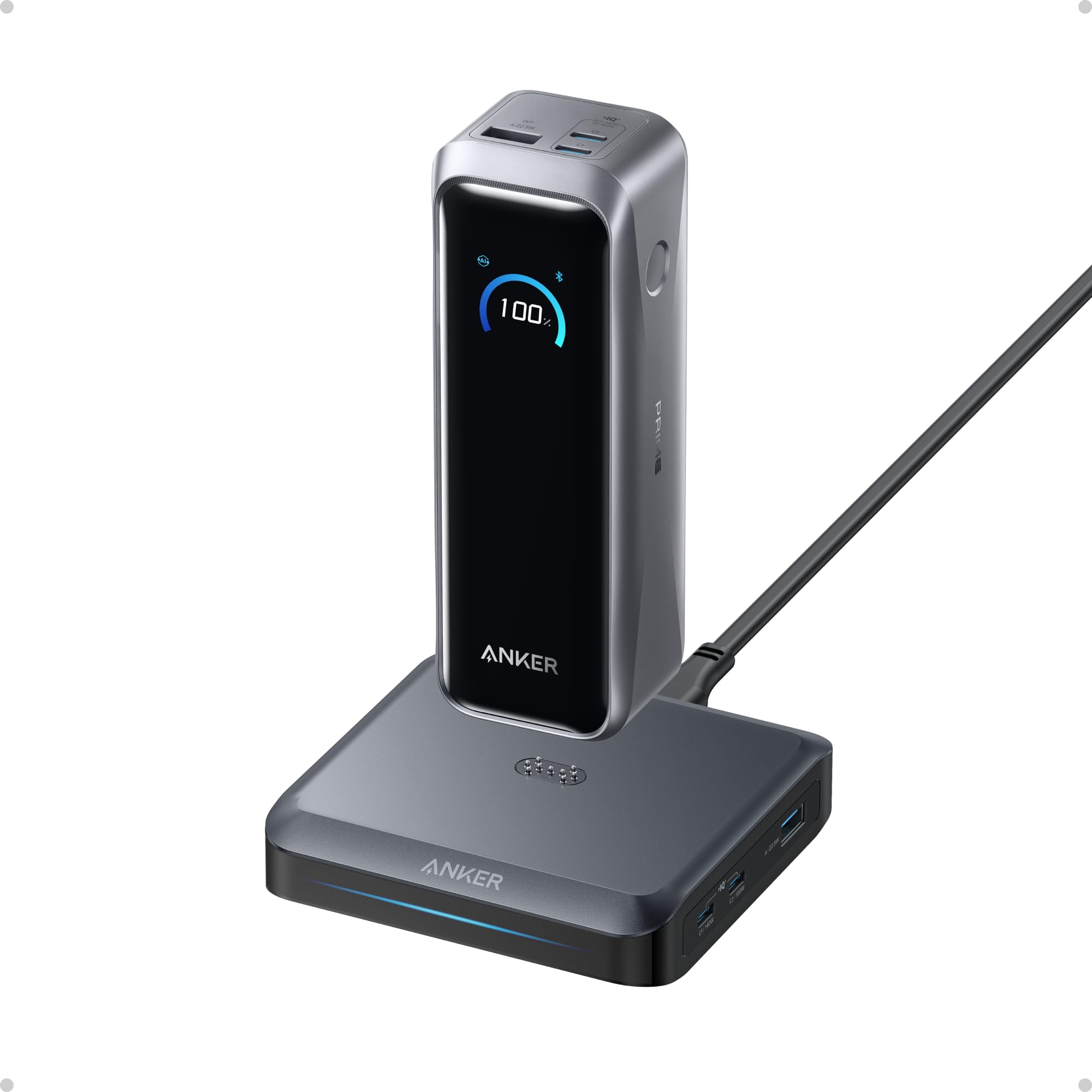
The number that sets this apart is 220W of total output — that is the ceiling on how much power the bank itself can push out simultaneously. In practice, that is the difference between charging a work laptop, a phone, and a tablet in the same sitting rather than in sequence. Two USB-C ports and one USB-A live on the bank; the charging base adds three more. That brings the total to six devices at once, which makes it the only pick here that behaves like a small desktop hub.
Refilling it is fast too. With 100W max input, the bank reaches 50% in 27 minutes from either the base or the USB-C port, and a full charge takes 1.5 hours. Owners consistently describe sustained wattage on high-draw devices without throttling, plus phones filling up in under an hour. The app layer is real as well — you can watch live power flow, check stats, and change how the display looks.
The trade-off is real and specific: the 20,100mAh capacity is the smallest tank among the premium picks here, so if your day is two laptops deep you will want the EF ECOFLOW’s 25,000mAh instead. It is also 510 g, so it lives in a bag, not a pocket. What lands in the box is generous — the bank, the 150W three-port base, a 3.3 ft 240W USB-C cable, the base’s power cord, a travel pouch, and a 24-month warranty.
What earns it the top slot
- 220W total output feeding six devices at once, with the base adding three extra ports
- 50% in 27 minutes and a 1.5-hour full charge at 100W input
- App control over power flow, live stats, and the display
- 150W three-port base and a 240W cable included
Where it stops making sense
- 20,100mAh is the smallest capacity in this article’s upper tier
- 510 g means bag duty, never pocket duty
- The base only helps if you actually keep it on a desk
Buy it if: you want one brick to cover a laptop, phone, tablet, and small extras from a desk or hotel room.
Pass if: you need maximum stored capacity for multi-day backcountry trips.
2. VRURC Portable Charger 20000mAh
The one that kills the cable nest — four connectors built into the brick itself
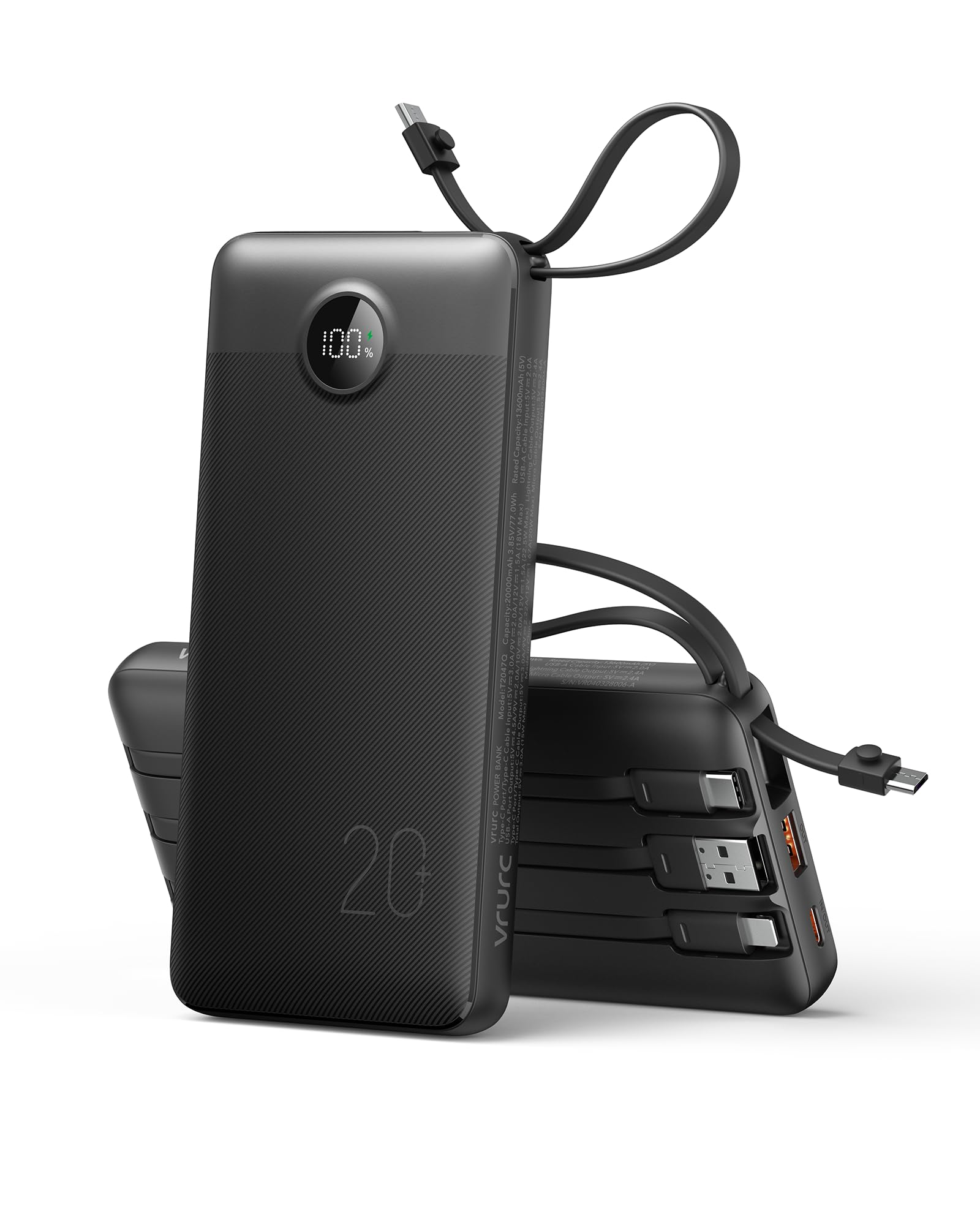
If your bag currently resembles a bowl of spaghetti, this is the pick to look at first. Type-C, Apple, Micro USB, and USB-A connectors are all built into the body, and there are two extra ports (one USB, one Type-C) on top of that. You pull it out, plug in, and go. At 345.3 g it is the lightest bank in this article by a clear margin — the EF ECOFLOW next to it is 580 g, so you feel the difference every time you lift your bag.
What wins people over is the four built-in connectors in daily use, with 22.5W charging speed close behind. That 22.5W low-temperature fast charging gets you up to 50% in 30 minutes, and the dual premium cells are meant to deliver the full 20000mAh rather than a hopeful sticker figure. The 19mm body is listed as 33% thinner than the older version and thinner than the usual 28–30mm bricks, and a strap made from the Micro USB cable lets you hook it to a backpack. Portability earns steady praise in the reviews, which tracks for a bank this light.
Now the honest catch. Owners find it a little heavy and bulky for what the slim profile promises, and the weight does draw negative comments — that is the one recurring gripe. It is also not a laptop solution; 22.5W will keep a phone or tablet moving but will not drive a MacBook at speed. If a laptop is on your list, look at the Baseus Blade or Ansody instead and treat this as the phone-and-accessories brick.
Why it earns its place: four built-in connectors plus two extra ports, a 19mm body, and 22.5W fast charging — the least fussy bank here for phones, tablets, and earbuds on the move.
The caveat that matters: 22.5W is phone territory, not laptop territory.
Reach for this if: you are packing for a festival, a long flight, or a weekend trip and refuse to hunt for cables.
Look elsewhere if: a laptop is part of your daily loadout.
3. EF ECOFLOW Laptop Power Bank 25,000mAh
Two 140W USB-C ports on one brick — rare, and exactly what a two-laptop traveler wants
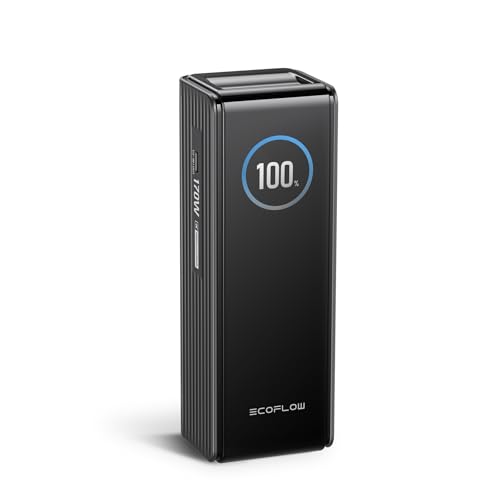
Most banks give you one fast port and a slower companion. This one gives you 2×140W USB-C plus one 33W USB-A, with a 170W total output ceiling. That layout is the reason it belongs on a travel shortlist: a laptop, a phone, and a tablet can all draw at once without one of them crawling. The 25,000mAh high-density cell is pitched at 1–2 days of remote work, and the 140W two-way charging means the brick itself refills quickly between stops.
Portability is where it genuinely delivers. It measures 6.18 × 2.12 × 1.92 inches and weighs 20 oz, and it meets TSA airline carry-on standards. Owners like that the 20 oz body slips into a case or pocket and can drive a laptop mid-flight. The TFT display showing real-time battery level, power status, and charging details also comes up repeatedly as a feature people actually use rather than ignore.
Here is the part you should weigh: the ratings on this one run cooler than the Anker Prime above, and charging speed, reliability, and value all land mixed rather than unanimously positive. Quality draws the strongest praise, and charging capability is the second most-discussed positive. Translation — most buyers are happy with what it is, but this is not the safest blind buy on the list. At 580 g it is the heaviest bank in this article’s mid tier, so pack it deliberately. Read the spec sheet against your own laptop’s wattage before committing.
The draw: dual 140W USB-C ports, 170W total, a 25,000mAh cell, a live TFT display, and confirmed TSA carry-on compliance.
What to think twice about: mixed feedback on speed and reliability means you should confirm it suits your specific laptop before you count on it.
Fits best: frequent flyers who need two high-wattage ports and care about boarding without a debate.
Weigh the alternative: if you want the tightest reliability record at this capacity, the Anker 737 or Ansody sit ahead of it.
4. Baseus Laptop Portable Charger 20000mAh
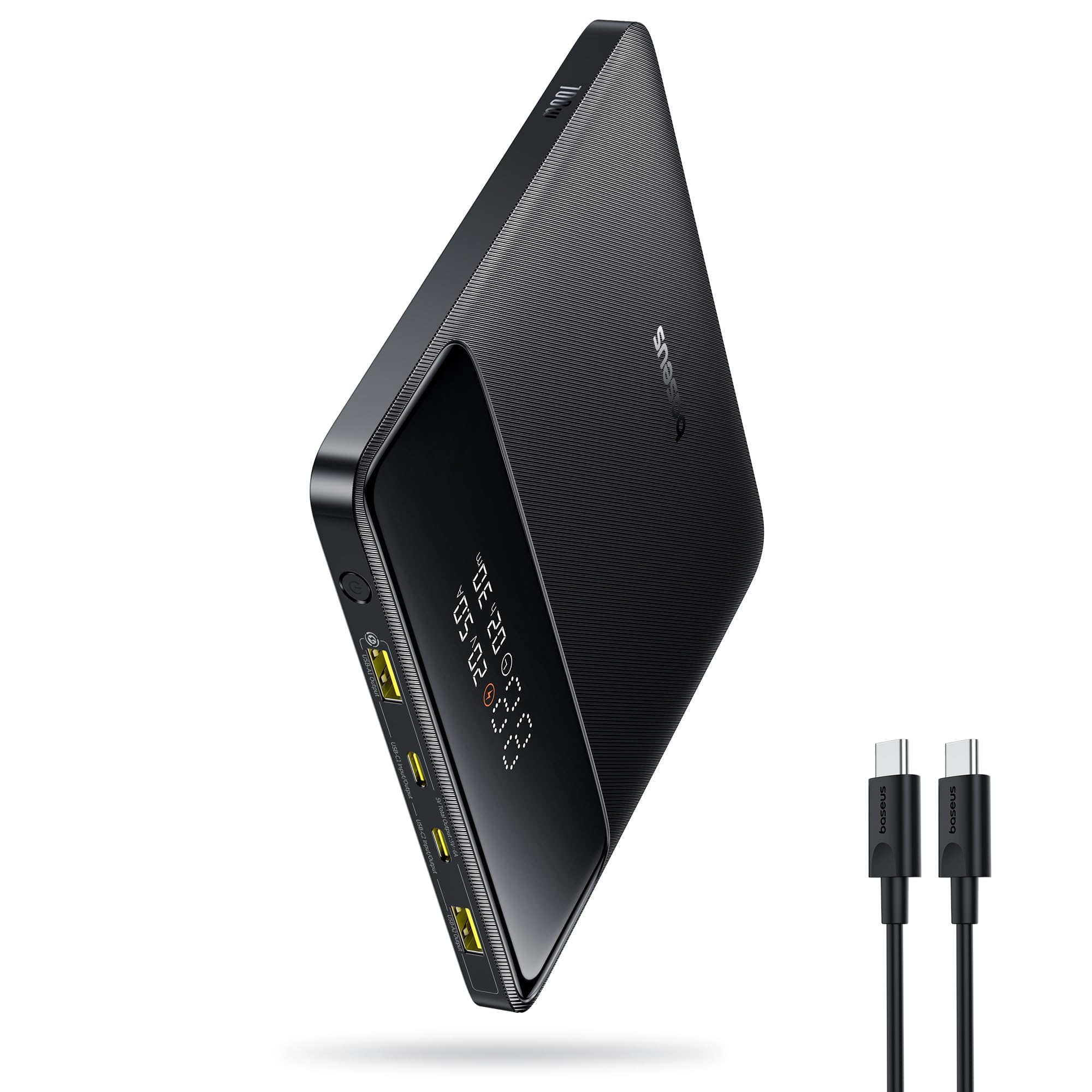
A flat slab that disappears into a briefcase and still pushes 100W to a laptop
Four ports is the headline here: two USB-C and two USB-A on a single flat body. That is more physical ports than most picks in this article, and it means you can run a laptop, a phone, headphones, and a watch off one brick. The 100W USB-C PD side charges a MacBook Pro to 50% in 30 minutes, and the real-time power display helps you ration what is left across those four devices.
Buyers praise build quality above all, with charging speed a close second. Buyers report the 20,000mAh battery refilling from 0% to 100% in about 3 hours and delivering roughly 1.5 charges for a laptop. Portability comes up again and again: this flat shape slides into a laptop bag or briefcase without the usual bulge. Safety is spelled out too — overcharge, overheat, and short-circuit protection certified by UL/IEC (independent safety standards for electrical products).
Two aspects land mixed rather than glowing: battery life and power output. That is worth reading as a fit note rather than a warning — if you expect the full 100W to hold while three other things are plugged in, you may be disappointed. Baseus lists 20000mAh as good for 3–4 iPhone 16 Pro charges or 70%+ battery for most 13–15 inch laptops. At 451 g it is middle of the pack. Keep your heaviest draw on the USB-C port and this behaves well.
Best part of the package: four ports on a flat body, 100W PD for laptops, and a display that shows exactly what is left.
Know before you buy: output drops when you spread the load, so plan your port priority.
Made for: the business traveler who wants one flat brick in a briefcase covering laptop, phone, and audio gear.
Not for: anyone who needs the full wattage on the laptop while three other ports are busy.
5. Ansody 140W Laptop Power Bank 25000mAh

The straight-shooter: 140W to one device, 145W spread across two, no drama
Ansody keeps it simple: one device pulls up to 140W, two devices share 145W between them, and a 25,000mAh cell (milliamp-hours — the battery’s capacity) sits underneath. It charges a 14 inch MacBook Pro to 50% in under 40 minutes, so a quick coffee stop tops up your laptop. The maker’s own math says the cell can charge a MacBook Pro 1.3 times or an iPhone 15 4.3 times. Two USB-C plus one USB-A port means three devices run at once — the balance for a laptop-and-phone workday.
Battery quality is the thing everyone raves about here, with reliability a close second and charging speed in the conversation too. Owners lean on its 140W single-port output for Dell laptops specifically, and it has a reputation for keeping devices running over long stretches. Compatibility is broad — PD3.0, QC2.0, QC3.0, FCP, SCP, AFC, DCP, BC1.2, and Apple 2.4A are all supported, which covers most phones, laptops, and handhelds you would throw at it.
Two numbers deserve your attention. Ansody publishes a 65% efficiency figure, which works out to roughly 16,250mAh of usable output after conversion losses — so treat 25,000mAh as the raw cell, not the real-world total. And this brick is 489.4 g at 6.48 × 3.19 × 1.08 inches, which the maker itself describes as about the size and weight of two iPhone 14 Pro Max units. Weight is the one aspect that reads mixed rather than positive. A full recharge takes 2 hours, and the box includes a 3.28 ft 100W USB-C to USB-C cable.
Standout strengths
- 140W to a single device, 145W split across two, on a 25,000mAh cell
- Three ports: two USB-C and one USB-A, all usable at once
- Very broad protocol support from PD3.0 down to Apple 2.4A
- TFT smart display and a 2-hour recharge
Trade-offs worth knowing
- 65% efficiency means real usable output lands around 16,250mAh
- 489.4 g and roughly two-phone bulk in the hand
- Weight is the one aspect buyers push back on
Solid pick when: you want a no-nonsense laptop brick with three real ports and honest published efficiency figures.
Think again if: you want the lightest possible bag load.
6. UGREEN Nexode 25000mAh 165W Built-in USB-C Power Bank
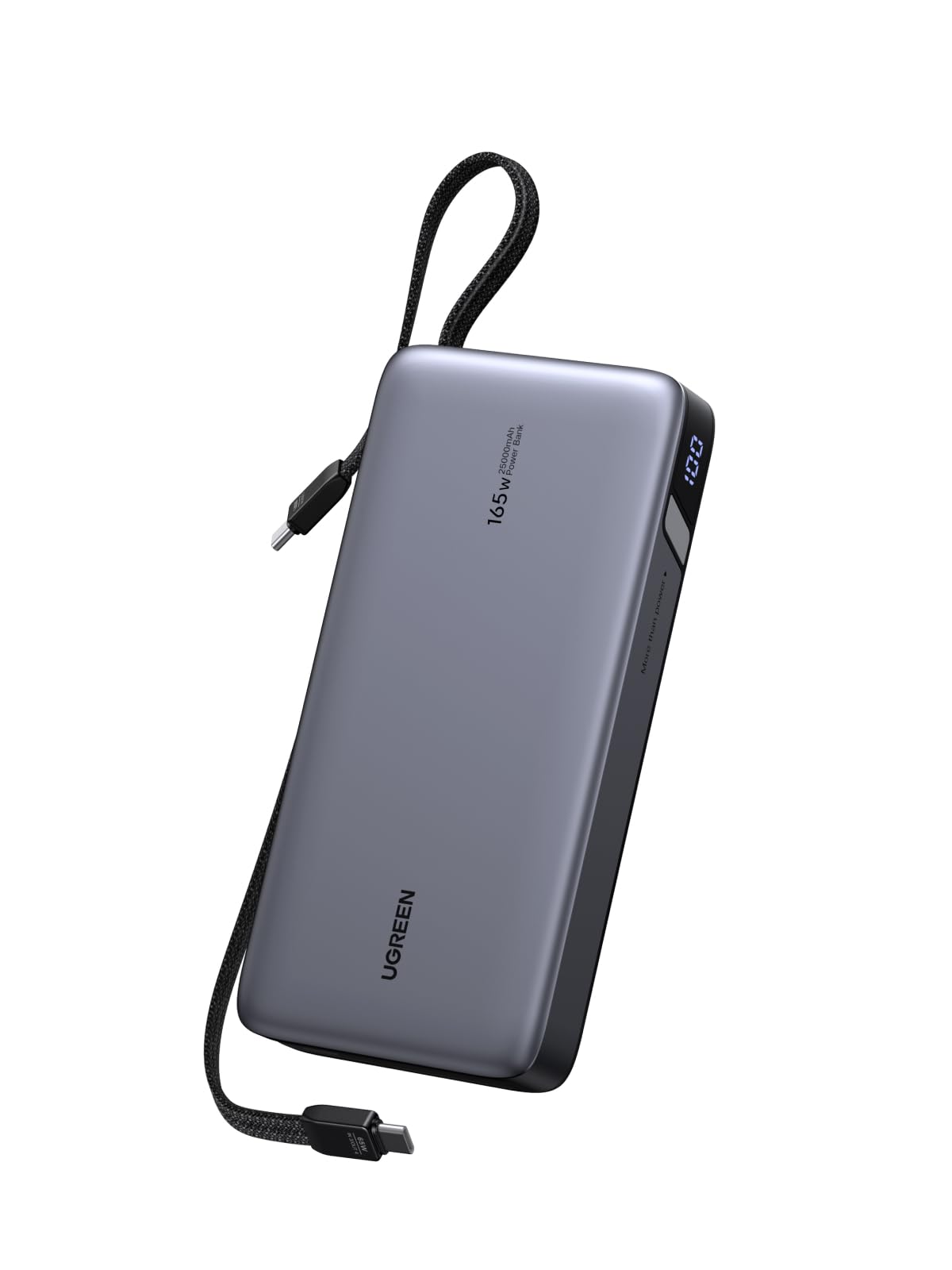
Two USB-C cables that live inside the brick and pop out when you need them
Charging multiple devices usually means multiple cables. UGREEN decided to build them in: two USB-C cables expand when needed and store neatly when not, keeping a work bag free of loops and knots. Those cables feed a 165W total output with up to 140W on a single port, which is laptop-grade power rather than phone-grade. A 25,000mAh cell sits behind it, and 90W input restores the whole thing in roughly 2 hours — short layover territory.
Raw power is what owners talk about most, and charging speed follows close behind. Its 165W total output runs multiple devices simultaneously without an obvious performance drop, which is the whole point of buying a multi-device bank. The built-in cables are named as a specific reason people like it, and it gets called out as a strong travel companion. Protection covers overcurrent, overheating, and short circuits.
The catch is weight, and it is the one aspect that reads negative rather than mixed. At 550 g this is a hefty brick, so it belongs in a bag rather than a jacket pocket. It also puts out 165W total versus the 200W of the Nexode Pro further down this list, so if you are running two power-hungry laptops at once, the Pro is the better call. For one laptop plus a phone, 165W is comfortable headroom.
Where it shines: 165W total and 140W single-port output with two cables built into the body and a 2-hour recharge at 90W.
Fair warning: 550 g is real weight, and two high-draw laptops at once will want the Nexode Pro instead.
Choose this if: you hate packing cables and want laptop-grade output from a self-contained brick.
Skip the built-ins if: a failed internal cable would leave you with no way to charge at all.
7. AsperX Laptop Power Bank 27,600mAh
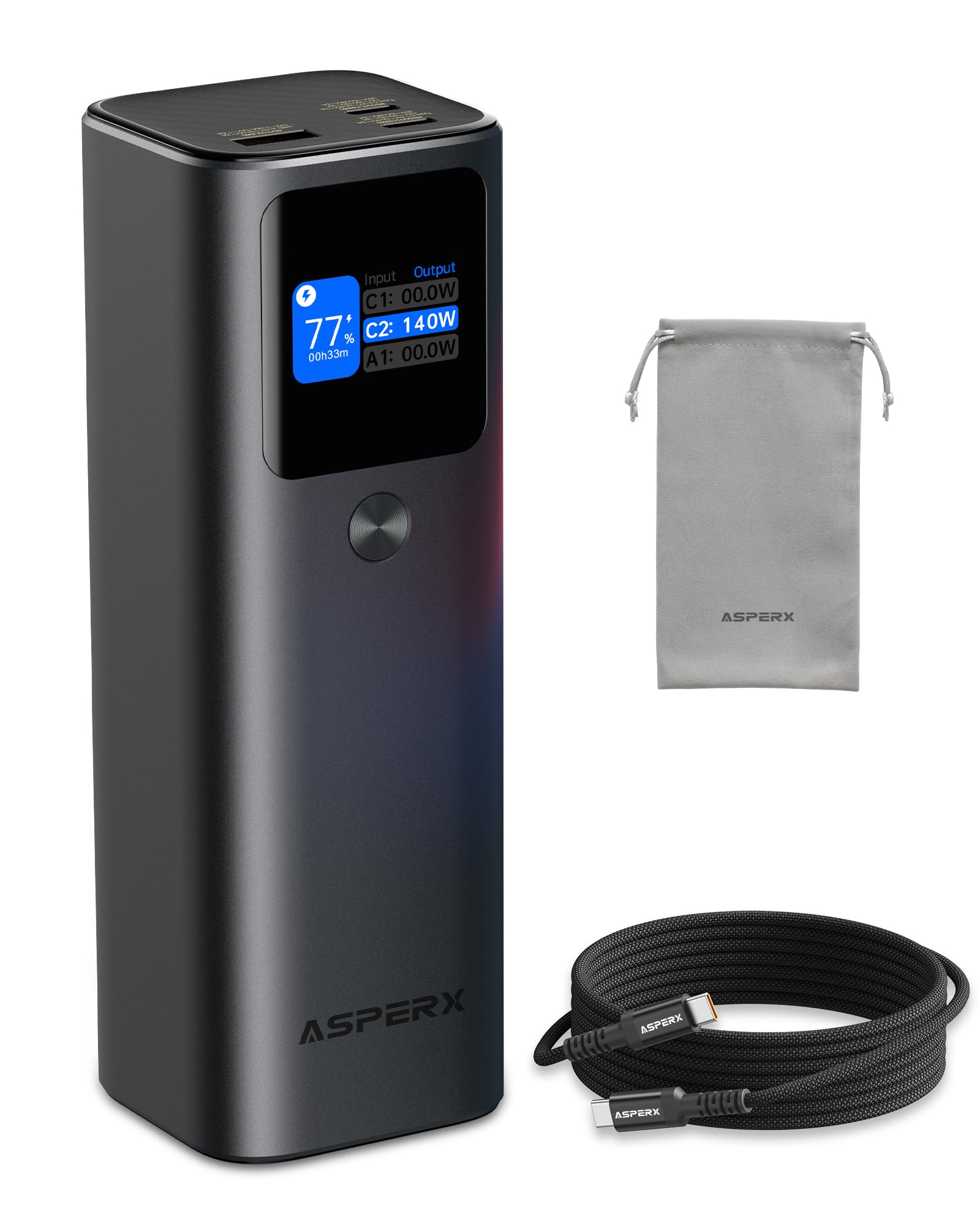
The largest capacity in this article, wrapped in aluminum instead of plastic
27,600mAh is the biggest cell on this list, rated at 99.36Wh — that figure matters because it lands under the usual 100Wh carry-on ceiling that airlines screen for. Output is 162.5W total with 140W available on a single port, and it can feed 65W to each of two laptops at the same time. For a photographer or a field engineer running two machines, that split is the useful part. AsperX says the design is 20% more compact than its predecessor and pitches it at 24+ hours of charging across a laptop and phone.
The shell is the differentiator. Aluminum alloy rather than plastic with metallic paint, which the maker claims dissipates 40% more heat than plastic alternatives — attribute that to AsperX rather than treat it as tested fact. What is verifiable is the shape: 1.08 × 6.56 × 3.21 inches, 790 g, deep grey, with two 140W PD3.1 USB-C ports and a USB-A. The TFT display is described as the largest colorful screen in its class, showing battery level, remaining time, output and input power, with adjustable brightness. A 240W USB-C cable and a carrying bag are both in the box.
Being honest about the weight is necessary. At 790 g this is by far the heaviest pick in the article — the Anker Prime is 510 g, and the burden shows up in daily carry. Travelers who move between hotels will feel it. If your priority is a bank that goes where you go without a thought, look at the VRURC or the Baseus Blade instead. If you need maximum stored energy and a metal body that shrugs off a bag full of camera gear, this is the one.
The case for it: 27,600mAh at 99.36Wh, 162.5W total with 65W to two laptops at once, an aluminum unibody, and a large adjustable TFT display.
The catch: 790 g is a lot of brick to carry all day.
Right for: photographers and field workers who need the largest cell here and two laptops charging together.
Wrong for: anyone who wants a bank that vanishes into a pocket.
8. UGREEN Nexode Pro 25000mAh Laptop Power Bank
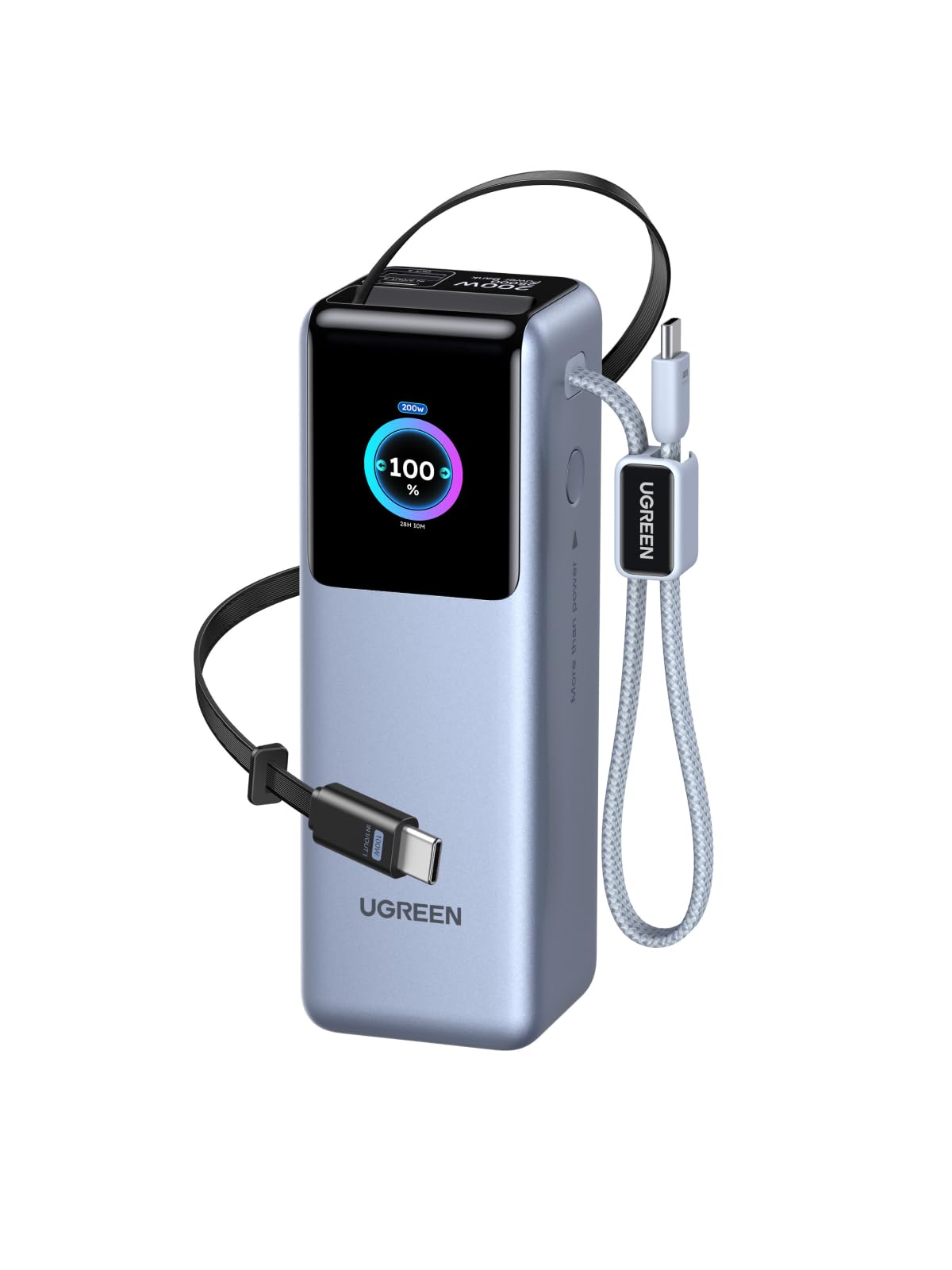
200W on tap — enough to push two 16-inch MacBooks at once in half an hour
Nothing else in this article matches 200W of total output. With 100W per USB-C port, it charges two MacBook Pro 16 inch machines to 43% in just 30 minutes — a genuinely useful number if you are running two power-hungry laptops on a client site. Underneath is a 25,000mAh cell rated at 90Wh, which is 100% airline-friendly, and the maker’s own figures put it at 4.7 iPhone 17 Pro charges, 3.4 Galaxy S25 Ultra charges, or 1.8 iPad Pro charges.
The cable design is the second story. A 26.7 inch retractable USB-C cable is built in, supports 100W PD input and output, and is rated for over 25,000 pulls. There is also a 13.8 inch integrated strap cable. Performance is what buyers praise most, with charging speed close behind — one concrete scene from the reviews is a 12 inch iPad recharging while still in use. The TFT screen shows output wattage, battery health, cycles, and time left, and a Low Current Mode makes earbuds and smartwatches safe to top up. ThermalGuard monitors temperature 200 times per second across a 13-layer protection stack.
Where it stumbles is the honest part. Battery life feedback is split — some find it holds charge for days, others say it drops quickly — and weight draws mixed comments with the brick described as a bit bulky. If sustained output over many hours is your priority, the Anker 737 next to it has the deepest reliability record of anything here. For raw simultaneous wattage on two laptops, nothing on this page touches the Nexode Pro.
Why it justifies top-tier status: 200W total, 100W per port, two 16 inch MacBooks to 43% in 30 minutes, a retractable 100W cable rated for 25,000+ pulls, and a 90Wh flight-friendly rating.
Where to be careful: split feedback on real-world battery endurance and a chunky 360 g body.
Built for: two-laptop professionals who need every watt going at once and want cables that retract themselves.
Look at the Anker 737 instead if: you want the longest track record rather than the biggest output number.
9. Anker 737 Power Bank 24,000mAh
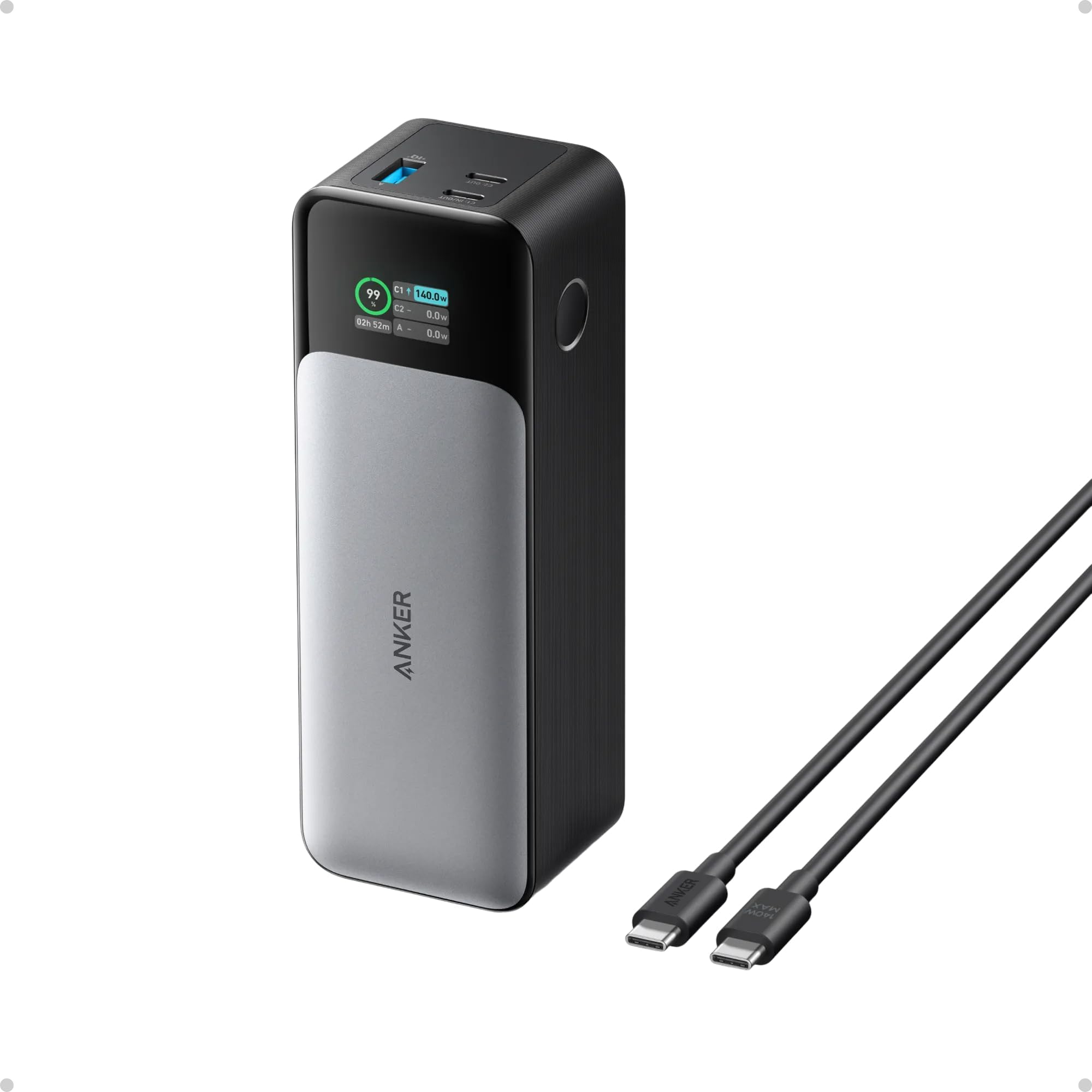
The brick that has quietly survived years of real-world abuse in thousands of bags
If you want the safe bet rather than the spec-sheet winner, this is it. A 24,000mAh cell rated to charge an iPhone 16 Pro 4.13 times or a 13 inch iPad Pro 1.33 times, with 140W two-way Power Delivery 3.1 for laptops and phones alike. Three ports let you run a laptop, a phone, and headphones together, and the smart display shows output and input wattage plus an estimated recharge time so you are never guessing.
Performance is the thing the review pages keep coming back to, with charging capacity ranked second — the mental image owners paint is a MacBook Air, an iPad, and an iPhone all drawing power from the same brick. The display is the third big talking point and genuinely useful rather than decorative. It meets airline carry-on requirements and measures 6.1 × 2.1 × 1.9 inches at about 22 oz, so it rides in a bag without argument. A 140W USB-C to USB-C cable and a travel pouch come included.
Perspective on the negatives: there are hundreds of thousands of charging speed, reliability, durability, and value comments across its long history, and all four read mixed. That is normal for a product with this much accumulated feedback — a small share of any huge room is unhappy. Weight is the one aspect that reads outright negative, and at about 22 oz it is fair. Note also that the 140W output wants a 5A cable and a 140W charger to hit its ceiling.
What you are really buying: 140W two-way PD3.1, a 24,000mAh cell, three ports, a genuinely useful smart display, and airline-safe dimensions of 6.1 × 2.1 × 1.9 inches.
Set your expectations: about 22 oz of weight, and 140W only with the right 5A cable and 140W charger.
Best fit: buyers who would rather have a long-proven design than the newest wattage headline.
Consider the Nexode Pro if: you need 200W and 100W per port rather than 140W shared across three.
Know the Specs
Total Output vs Single-Port Wattage
Total output is the ceiling for everything plugged in at once. Single-port wattage is what one lucky device can pull. A bank rated 165W might deliver 140W to a single port, or spread 165W across three — those are very different experiences. Laptops want a high single-port number. Phones and earbuds are happy with far less. When you compare picks, check both figures: the grand total tells you how much you can run, the single-port figure tells you how fast your biggest device will fill.
Capacity, Watt-Hours, and Real Useable Power
Capacity in mAh is the raw size of the cell. Watt-hours is the same energy expressed the way airlines measure it, and several picks here sit near or under 100Wh to stay inside carry-on limits. Neither figure is what actually reaches your phone. Conversion losses eat a chunk — one pick on this list publishes a 65% efficiency figure, meaning roughly 16,250mAh of usable output from a 25,000mAh cell. Always expect less at the plug than the sticker says.
Recharge Speed and Input Wattage
Input wattage is how fast the brick itself refills, and it is easy to overlook. A high-output bank that takes all night to recharge is a frustration on a multi-city trip. Banks with 90W or 100W input turn a coffee break or a layover into a useful top-up. Look at both directions — output for your devices, input for you.
Built-In Cables: Convenience Versus Wear
A built-in cable removes a packing step entirely and keeps a bag tidy. The trade is that the cable is now a fixed part of the product rather than a replaceable accessory. If durability of the built-in connector matters to you, favour a bank with a strain relief design or a pull rating you can see, and treat the cable gently. Banks with retractable designs list pull counts precisely because buyers ask.
Common Questions
Can a power bank charge a laptop and a phone at the same time without slowing down?
How many devices can these banks charge simultaneously?
Will a 25,000mAh power bank get through airport security?
Why does my laptop charge slowly from a power bank?
Is a bigger mAh number always better?
Do built-in cables wear out faster than separate ones?
Can these power banks charge earbuds and smartwatches safely?
How long does a multi-device power bank take to recharge itself?
Is the Anker 737 a better buy than the UGREEN Nexode Pro?
What is the difference between 100W and 140W for a laptop?
The Bottom Line
One brick that runs a laptop, a phone, and a tablet from a desk or hotel room: that is the Anker Prime Power Bank, with 220W total output, six devices at once when docked on its base, and a 1.5-hour full recharge. Two high-wattage laptops every day? The UGREEN Nexode Pro leads on raw output at 200W, with 100W per port. For phone-and-accessories duty when you refuse to carry cables, the VRURC gives you four built-in connectors at the lightest weight here. Buy the port count and wattage you will actually fill — capacity only matters after that.
How we choose
We do not accept paid placement. Every pick is matched to a real buyer and a real use-case; we do not hands-on test units.
Sources
Specifications: manufacturer listings and product documentation. Review insights: verified customer reviews, as of November 2026. Pricing: not shown on this page (it changes often); check the current price via the retailer link.
As an Amazon Associate, Tactical Gear Guy earns from qualifying purchases. This does not affect which products we feature.