Specs are compiled from manufacturer listings and verified buyer reviews and can change over time — please confirm the key details on the product page before buying.
The hardest part of buying a subwoofer box is that two boxes built for the same sub can sound completely different. One makes tight, punchy bass that hits you in the chest. The other turns every bass note into a muddy rumble that rattles your trunk lid. The difference is rarely the sub itself — it is the box’s internal air space, its port tuning, and how tightly its MDF joints are glued. Below you will find the enclosures that get those three things right, matched to the kind of bass you actually want to hear.
This guide is built by comparing the manufacturers’ published specifications and the patterns across verified customer reviews, so you get each pick’s real strengths and trade-offs instead of marketing spin.
You will see how port tuning changes the character of your bass, why air space has to match your subwoofer’s size, and which enclosures hold up best in a truck or sedan trunk. The right ported subwoofer box turns your sub into something you feel, not just something you hear.
Top Picks

How To Choose The Best Ported Subwoofer Box
Start with the subwoofer you already own. Every other decision — box size, port style, whether it even fits in your trunk — flows from that driver’s diameter, its mounting depth, and the air space it was designed for.
Match the air space to your sub
Air space is the usable volume inside the box, measured in cubic feet. A 10-inch sub typically wants less of it than a 12-inch, and a big 15-inch driver wants a lot. Read your subwoofer’s spec sheet and compare it to the enclosure’s stated figure. A box with too little air space makes a sub sound strained. Too much and the bass turns soft and vague.
Understand tuning frequency before you commit
Tuning frequency is the note, measured in hertz (Hz), where the port does the most work. A box tuned around 36 Hz plays low and deep, which suits hip-hop and movie soundtracks. A box tuned up near 54 Hz hits harder and punchier around the kick drum but drops off lower down. Neither tune is better — 36 Hz favors deep sub-bass, 54 Hz favors kick-drum punch.
Check mounting depth and cutout diameter
Mounting depth is how much room the box gives your magnet before the sub bottoms out against the back wall. Cutout diameter is the size of the hole the sub drops into. Both numbers need to clear your specific driver, so measure your sub before you buy anything.
Look at how the box is actually built
Thicker MDF and well-glued joints keep the box from flexing and buzzing under heavy bass. A spray-on bed liner or carpet finish protects it from trunk wear. Spring-loaded or gold-plated terminals make wiring faster and keep the connection tight.
Side-by-Side Comparison
| Model | Best For | Driver Size | Air Space | MDF Thickness | Amazon |
|---|---|---|---|---|---|
| QPower QBOMB Single 10″★ Best Overall | Shallow-mount 10s and tight trunk space | 10 inches | 1.4 cubic feet | — | Amazon |
| Dual 10 Inch Vented ASC 210VHBest Dual 10 Value | Two 10s on a budget | 10 inches | 1.22 cubic feet | 5/8 inch | Amazon |
| QPower Single 12″ Triangle PortedPunchiest 12 | Big-hitting single 12 in a car | 12 inches | 2.2 cubic feet | 3/4 inch | Amazon |
| BELVA 1SV12B | Deep low-end tuning in a car trunk | 12 inches | 1.8 cubic feet | 3/4 inch | Amazon |
| Atrend Bbox 12SVSC | A tight, rattle-free single 12 build | 12 inches | — | 5/8 inch | Amazon |
| Harmony Audio HA-E112 | A custom single 12 build tuned low | 12 inches | — | 5/8 inch | Amazon |
| CT Sounds CT1X12 | Accuracy-focused kerf port bass | 12 inches | — | 3/4 inch | Amazon |
| Bbox Dual Vented 12 | Two 12s going loud in a trunk | 12 inches | — | 3/4 inch | Amazon |
| Q Power Q Bomb 15″ Dual | Maximum bass from a pair of 15s | 15 inches | 4.6 cubic feet | 0.75 inch | Amazon |
Detailed Reviews
1. QPower QBOMB Single 10″ Subwoofer Box
Our pick — 4.5+★ from 450+ verified ratings; the strongest balance of quality and price.
The shallow-mount box that saves your trunk space without giving up the thump.
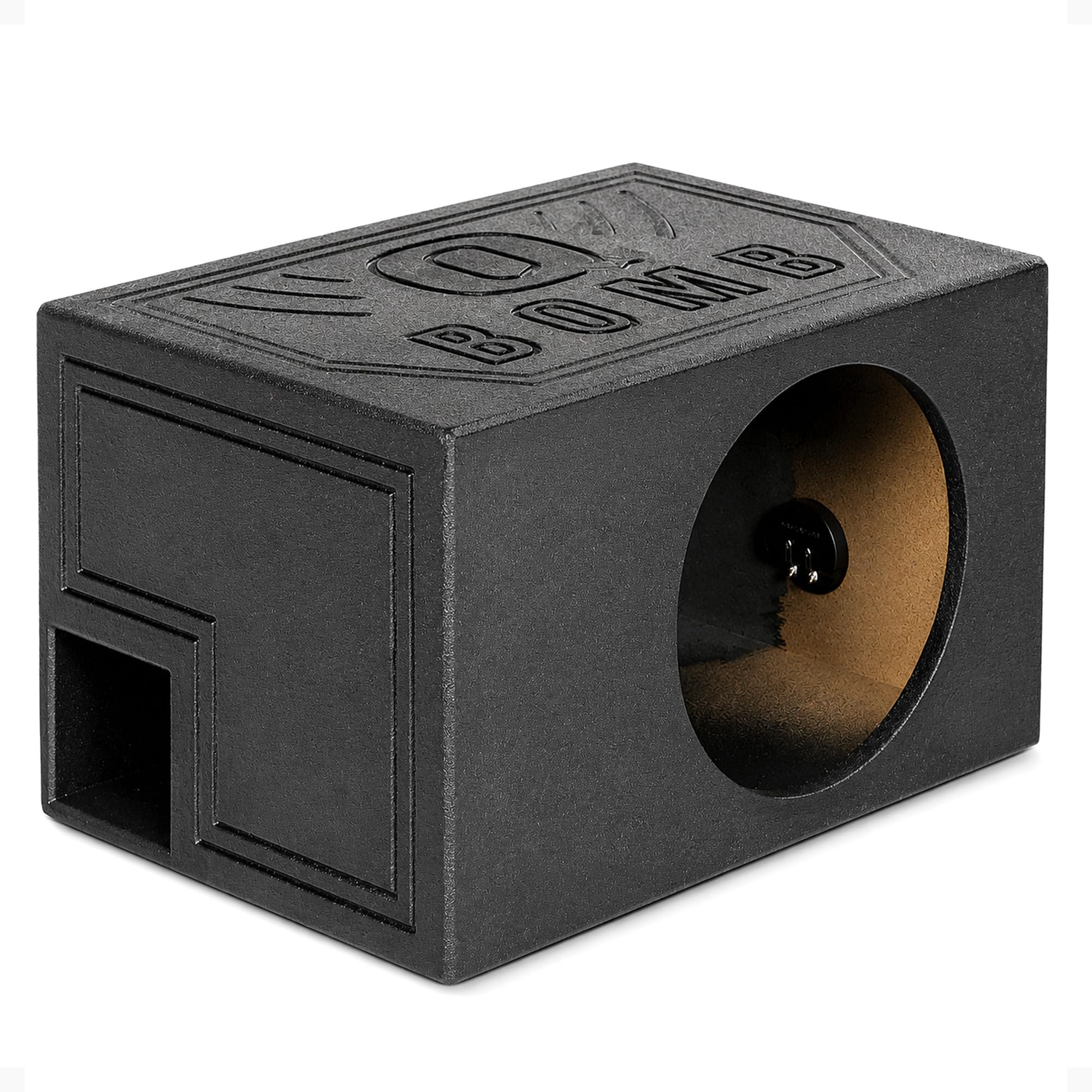
The QPower QBOMB is built for one specific problem: you have a shallow-mount 10-inch sub and not much room to give it. It holds 1.4 cubic feet of air space, which is generous enough for most 10-inch shallow drivers to breathe properly. The vented port lets that air escape in a controlled way, so you get the louder, lower output a ported box is known for instead of the tight, quiet thump of a sealed one. It even slides under the front seats of a boat, which tells you how compact the footprint is.
The finish is a black bedliner spray, the same textured coating truck beds get. The 10-inch driver size keeps it flexible for different midrange speakers and shallow subs alike.
What wins people over most is how it sounds once it is dialed in — full, deep low notes without the box itself buzzing along. The build earns nearly as much praise, with buyers describing it as sturdy and durable.
What earns its keep
- 1.4 cubic feet of air space lets a shallow 10-inch sub play properly
- Black bedliner spray resists moisture and scuffs in a trunk
- Compact enough to tuck into tight spaces, even under a boat seat
- Vented port delivers louder output than a sealed box of the same size
Where it will not suit you
- Built for 10-inch shallow drivers only — a standard-depth or 12-inch sub will not fit
- No stated MDF thickness for buyers who want that figure before committing
Reach for this one: if you run a shallow-mount 10-inch sub and need the box to stay out of the way.
Think twice if: your sub is a standard-depth 10 or any 12-inch driver — this box is sized for shallow only.
2. Dual 10 Inch Vented Subwoofer Box
Two 10-inch drivers in one enclosure, built from 5/8-inch MDF without stretching your budget.
If you already own a pair of 10-inch subs, this ASC 210VH lets you run both in a single vented enclosure and get stereo sound while you do it. Each chamber carries the standard-sized 10-inch holes, and the box holds 1.22 cubic feet of air space for increased output. Its 13.75-inch mounting depth clears the majority of 10-inch subwoofers, so most drivers drop straight in without a fight. It also arrives with speaker wire, mounting hardware, and a user manual in the box — fewer parts to hunt down before install day.
Set against the shallow QPower 10 above, this one holds less air space — 1.22 cubic feet versus 1.4 — but doubles the driver count, so two subs share that room. That is the trade you are making: less breathing room per driver, but two drivers pushing.
The construction gets the most credit, with buyers calling it well-built and worth the money, and sound quality follows close behind. The honest caveat is the factory glue — some owners note it can come apart at the seams, so inspect the joints when it lands and add your own adhesive anywhere it looks thin.
The honest read: a solid value play for a dual-10 build, provided you give the glue a quick once-over before you mount anything.
Worth knowing: the box is not waterproof, so keep it out of a leaky trunk or an open-bed truck.
Best for: anyone running two 10-inch subs who wants vented output on a tight budget.
Look elsewhere if: you want a single-driver enclosure or need mounting depth past 13.75 inches.
3. QPower Single 12″ Subwoofer Box
A triangle port that moves air fast for hard-hitting, punchy bass in a single 12.
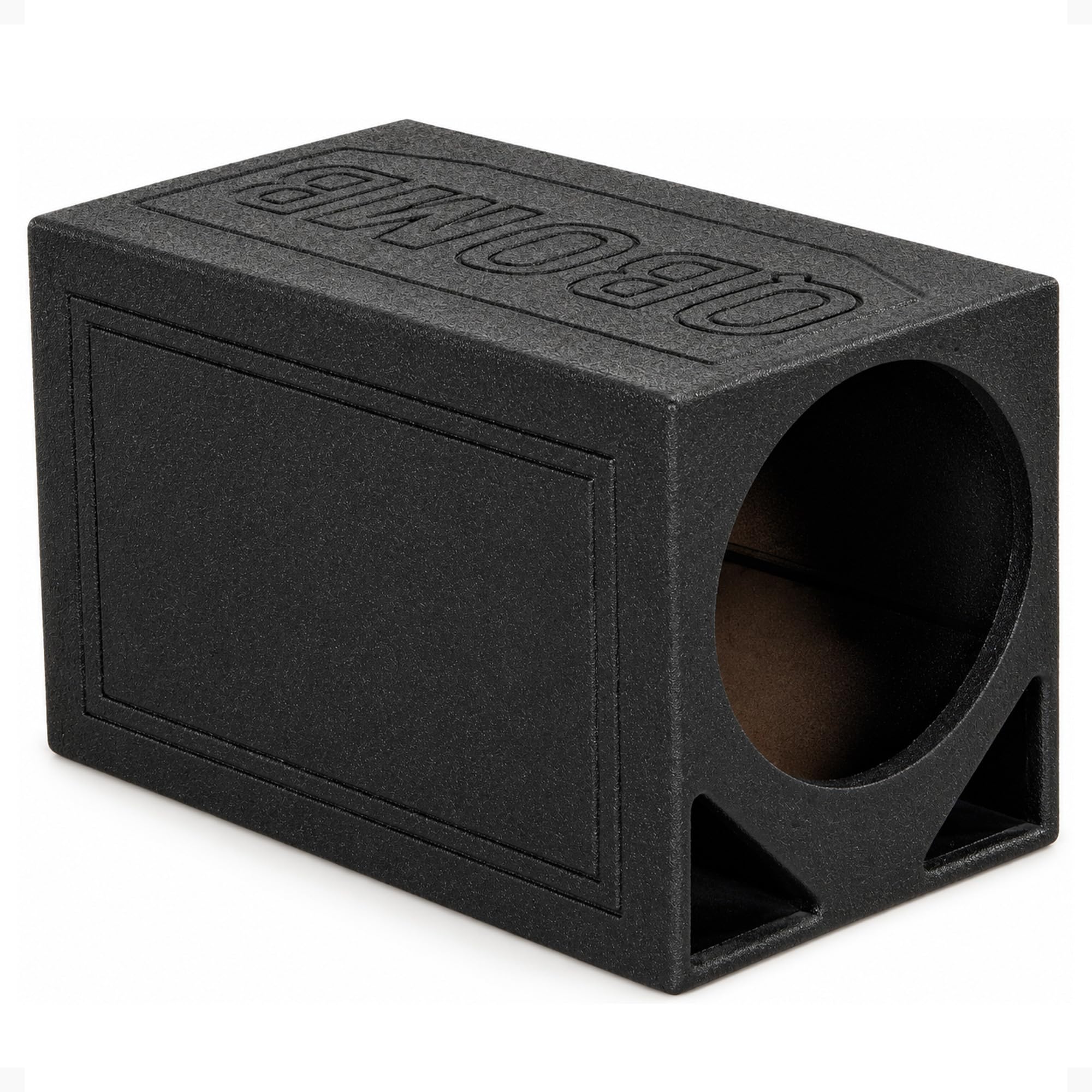
The triangle-shaped port is the defining feature here. That triangle shape smooths airflow through the vent and cuts the port turbulence that chokes a poorly vented box, so the 12-inch driver plays louder and deeper than a plain slot port of the same size. QPower tunes it at 54 Hz, which is squarely in the punchy range — this box is built for kick-drum slam and hard hits rather than the deepest sub-bass rumble. It holds a roomy 2.2 cubic feet of air space, and its 11-inch cutout fits most standard 12-inch subs.
This is the box that beats the BELVA on raw air volume. Compare them directly: 2.2 cubic feet here versus 1.8 in the BELVA, and a 54 Hz tune versus the BELVA’s 36 Hz. If you want maximum low-end extension, the BELVA wins that one. If you want the box that hits hardest in the mid-bass, this is your pick. The 3/4-inch MDF and rugged spray-on bed liner finish hold up to vibration and moisture likewise far better than a bare or carpeted box.
What buyers single out is how good it sounds when a real sub is mounted in it, and the price-to-output balance feels strong. Two honest notes: some report the craftsmanship and durability are not always consistent, and vibration complaints come from drivers expecting a sealed-box tightness. Give the mounting screws a firm seat and the box delivers.
The short version: a punchy, high-output single 12 for buyers who want slam over deep extension, and the bed liner finish is genuinely tough.
Pick it for: a single 12-inch build that needs to hit hard around the kick drum.
Pass on it if: you are chasing the very lowest sub-bass notes — the 36 Hz BELVA is tuned for that instead.
4. BELVA 1SV12B Single 12″ Subwoofer Enclosure

The low-tuned 12 box for bass you feel in your chest, not just your ears.
A 36 Hz tuning frequency is the whole point of the BELVA 1SV12B. That is a full 18 Hz below the QPower triangle box above, which changes the character completely. You get deep, sustained bass that rolls through a movie explosion or a bassline, rather than a quick hard smack. The 1.8 cubic feet of air space is tailored for a single 12, and the 3/4-inch MDF construction gives the walls enough mass to stay composed under pressure.
The details are what make this box feel considered. The internal walls come lined with polyfil, a polyester stuffing that smooths the way sound moves inside the box. The gold terminals keep the wire connection clean and corrosion-free. Durable black carpet covers the shell, and buyers report it slips snugly into a car trunk — a 2010 Camaro is the frequent example. The cabinet is built around stereo output, so it suits a proper single-sub setup where the sub carries the low end.
What earns the most credit is the overall quality and the sound that comes out of it. The one recurring gripe is the carpet — on some units it peels back at the edges, so a dab of adhesive at the corners heads that off early.
Why owners keep it
- 36 Hz tuning digs noticeably deeper than higher-tuned boxes
- Polyfil-lined walls smooth the internal sound and tame resonance
- Gold terminals resist corrosion for a lasting connection
- 3/4-inch MDF holds its shape under strong bass
The caveat to weigh
- Carpet can peel at the edges on some units — seal it early
- 1.8 cubic feet is less air than the QPower triangle box’s 2.2, so it is not the pick for maximum volume
If deep bass is the goal: this is the box tuned to go lowest on the list.
If you want max air space: the QPower triangle enclosure holds 2.2 cubic feet against this one’s 1.8.
5. Atrend Bbox 12SVSC Single Vented 12 Inch Subwoofer Box

Built like a cabinet, not a crate — the glue-and-joint work is what sells this 12.
Atrend builds this box with a construction process you rarely see at the price. Aliphatic wood glue seals every MDF joint, then a second application of glue goes around the internal joints after final assembly. A CNC miter and a dado joint — a groove cut so one panel locks into another — create an airtight, rattle-free chamber. The 5/8-inch MDF is called out as high-grade. It is a lighter-gauge panel than the 3/4-inch boxes, but the joint work is what keeps it quiet. Nickel-finish terminals and a recessed side panel complete the airtight chamber.
This is a single 12 enclosure with a mounting depth of 13.875 inches and an 11.125-inch sub cutout, so check your driver’s magnet depth before you commit. Height runs 13.625 inches, width 16, depth 17.375 — a footprint that fits most trunks. Set beside the QPower triangle box, this one trades some of that 2.2 cubic feet of raw volume for tighter build tolerances, so it leans toward accurate reproduction over sheer loudness.
The sound quality is what buyers talk about most, and the solid construction follows right behind. Fit is the one mixed note — a few find it oversized for a tight trunk, so measure twice before you order. The panel-thickness gap gets a mention too; if you are piling on serious power, the 5/8-inch walls will flex before the 3/4-inch boxes.
My take: if your priority is a box that stays dead quiet when the bass drops, the glue-and-joint build here is worth more than a few extra cubic feet.
Check your sub: 13.875 inches of mounting depth leaves no room for an oversized magnet.
Go here for: a single 12 build where rattle-free, accurate bass matters more than raw output.
skip it if: your trunk is snug — the footprint is 16 inches wide by 17.375 deep by 13.625 tall.
6. Harmony Audio HA-E112 Single 12″ Subwoofer Box

An empty shell tuned to 33 Hz, ready for the 12-inch sub you already trust.
This Harmony Audio arrives empty, with no driver, so it is for the buyer who has a 12-inch sub on the bench and just needs the right home for it. The vented port comes tuned to 33 Hz — the lowest tune in this lineup — which is where you get the drawn-out, settling bass that hangs in the air. The recessed subwoofer design keeps the driver sitting flush, so it looks tidy instead of bolted on top. It is built from 5/8-inch MDF and wrapped in a black-and-grey carpet that guards against wear.
The dimensions run 15 inches deep, 20 wide, and 18 tall — a compact trunk footprint for a 12. Where the BELVA above is carpeted and pre-wired, this one leaves the wiring and terminal choices to you, which is exactly what a custom build wants. It takes a screw-in install, so you supply the mounting hardware that matches your driver.
Buyers describe the build as high-quality and the sound as excellent, and it is forgiving of older subs too — classic Eclipse 12-inch drivers are a common success story. The fit is the one area that splits opinion, with some drivers not matching the cutout. Measure both your sub’s cutout and mounting depth before ordering.
Who it fits: DIY builders with a 12-inch sub already in hand who want the lowest tuning in the lineup.
A match if: you are assembling a custom single-12 system and 33 Hz is the sound you are after.
Not for you if: you want a box that ships pre-wired with terminals — this one is empty and ready for your own work.
7. CT Sounds CT1X12 Single 12″ Subwoofer Box

A kerf port tuned to 34 Hz for bass that stays accurate even when it gets loud.
A kerf port is a curved, smoothly rounded vent instead of a square-edged slot, and that curve keeps this box’s bass deeper and more accurate at high volume. Air leaves the curved kerf port without the turbulence square edges create, so the bass stays clean as the volume climbs. CT Sounds tunes it to 34 Hz, and the 3/4-inch MDF shell with dado and miter joints makes an airtight, vibration-free chamber. The 11.34-inch cutout fits most standard 12-inch drivers.
The extras are what sharpen it against a plain box: poly-filled internal walls dampen resonance, and pre-soldered 12 gauge speaker wires mean you are not soldering before install. Universal-fit sizing lets it drop into more vehicles than a box built for one trunk. On raw build, the dado and miter joints here echo the Atrend’s glued-joint approach, but the kerf port gives this one a deeper, more refined low end.
Owners mention a huge jump in sound quality, with the box even lifting the performance of a budget-priced sub. Construction and value-to-money feedback runs strong, and the trunk fit is described as clean. Size is the one disagreement — some find the enclosure larger than expected, so confirm your trunk space first.
What makes it sing
- Kerf-style port plays deeper and cleaner than a square edge
- 34 Hz tuning reaches low without losing clarity
- Poly-filled walls and 3/4-inch MDF keep resonance down
- Pre-soldered 12 gauge wire saves you install time
Before you buy
- Some find the enclosure bigger than expected — check trunk space
- The 11.34-inch cutout must clear your specific 12-inch driver
Go for it when: accurate, deep bass from a single 12 matters more than a bargain price.
Hold off if: trunk space is tight or your sub’s cutout differs from 11.34 inches.
8. Bbox Dual Vented 12 Inch Subwoofer Enclosure

Two 12s in one pro-tuned enclosure for the kind of bass that turns heads.
This Bbox houses two 12-inch drivers in a single vented cabinet, which is a serious step up in output from any single-sub setup above. It is built with 3/4-inch high-grade MDF, an aliphatic wood glue seal on every joint, and a second glue pass around the inner seams, plus a CNC miter and dado construction for an airtight, rattle-free fit. Spring-loaded speaker terminals make wiring quick and secure. Recessed side panels seal the chamber so air leaks do not steal from your bass.
Where the Atrend single-12 above uses a 5/8-inch shell, this dual box goes 3/4-inch all through, so the thicker walls suit the extra output of two drivers working at once. The stereo output mode and dual terminal cups handle the two subs cleanly, and buyers compare the sound to a serious aftermarket build — some note it brings a Rockford Fosgate P3D2 12 to life.
The build and the bass win the most praise, and the finish matches what most people expect. One real caution keeps this honest: the cabinet has been known to come apart at the seams under heavy abuse within the first few days on some units. If you plan to run serious power, add extra bracing or a second pass of glue on the joints, and this box rewards you with a lot of output.
The trade-off in one line: this is the biggest-output box here, and it asks that you brace it before you push it hard.
Made for: a two-12 build where loudness is the whole point.
Better to avoid if: you want a box you can bolt in and forget — the seams want monitoring under heavy power.
9. Q Power Q Bomb Series 15″ Subwoofer Enclosure

A four-and-a-half-cubic-foot chamber built to move serious air with 15-inch drivers.
Nothing else on this list holds this much room. The Q Bomb packs 4.6 cubic feet of air space, tuned to 39 Hz, with a middle slot port measuring 3 inches wide and 15 inches tall. That is enormous compared to the 1.4 cubic feet in the QPower shallow 10 at the top — it gives big 15-inch drivers the volume they need to produce chest-moving output. It is built from 0.75-inch MDF and finished with the same black bedliner spray as the other QPower, shielding it from moisture and corrosion.
A dual vented chamber lets air flow through properly, and spring-loaded terminals keep the wiring simple and snug. A mounting depth of 16.5 inches means you have room for deep magnets. Two 15s live in here, which is a different league of sound than a single 12. The box weighs 30 pounds empty, so plan for a two-person install if it is going in a trunk or a hatch.
Buyers rate the overall quality highest, followed by the value and the bass, and the finish looks like the photos. Fit is where it can go either way — a few report compatibility trouble with specific models, including the MOFO 15. Measure both driver depths against that 16.5-inch figure, and it will do its job.
My verdict: the box to beat for sheer volume if you run dual 15s and have the trunk to carry it.
Plan for: 30 pounds of empty enclosure and 16.5 inches of mounting depth.
Choose this if: you are running dual 15-inch subs and want maximum air space and output.
Look past it if: a single 12 or a shallow 10 is your sub — the chamber size is far too large for those drivers.
Know the Specs
Tuning Frequency In Hz
Tuning frequency is the low note, measured in hertz (Hz), where the port moves the most air. The lower the number, the deeper and more drawn-out your bass sounds — the QPower triangle box sits at 54 Hz for punchy hits, while the Harmony Audio at 33 Hz digs into sub-bass. Pick your tune to match your music, not the biggest number you can find.
Air Space In Cubic Feet
Air space is the open room inside the box, measured in cubic feet. It has to roughly match the volume your subwoofer was built for. A shallow 10 might want around 1.4 cubic feet (the QPower QBOMB), while a dual 15 chamber needs far more (the Q Bomb runs 4.6). Too little air strangles the sub. Too much makes the bass soft and loose.
MDF Thickness
MDF, or medium-density fiberboard, is the dense engineered wood most enclosures are built from. You will see 3/4-inch and 5/8-inch called out — the 3/4-inch panels have more mass and resist flexing under heavy power, while 5/8-inch keeps the box lighter. Thicker walls paired with well-glued joints are what keep the cabinet from buzzing.
Port Style: Slot, Triangle And Kerf
The port is the opening that lets air out and gives a ported box its louder, lower sound. A slot port is a simple rectangle. A triangle port (like the QPower 12) improves airflow and reduces distortion. A kerf port (like the CT Sounds box) curves the vent for cleaner airflow. All three work — the kerf and triangle shapes smooth airflow for cleaner, deeper notes than a square-edged slot.
Common Questions
Will a ported subwoofer box sound better than a sealed one?
How do I match air space in cubic feet to my subwoofer?
What does 36 Hz tuning actually mean for my bass?
Can I put a standard 12-inch sub in a shallow-mount box?
How do I stop my subwoofer box from rattling or buzzing?
What is the difference between a slot port and a kerf port?
How much mounting depth do I need for my subwoofer?
Is 3/4-inch MDF better than 5/8-inch for a subwoofer box?
Do I need to seal the joints on a new subwoofer box?
Can two subs go in one ported enclosure?
The Bottom Line
For most drivers, the ported subwoofer box worth starting with is the QPower QBOMB Single 10″ because it squeezes 1.4 cubic feet of usable air into a compact, bed-lined box that fits shallow 10s and tight trunks alike. If chasing the deepest low end is your goal, the 36 Hz-tuned BELVA 1SV12B digs lower than anything else here that carries a single 12. And if raw output is the mission and you have the trunk for it, the Q Power Q Bomb 15″ gives you 4.6 cubic feet of air moving behind your subs. Match the box’s air space and mounting depth to the sub you own, and the bass takes care of itself.
How we choose
We do not accept paid placement. Every pick is matched to a real buyer and a real use-case; we do not hands-on test units.
Sources
Specifications: manufacturer listings and product documentation. Review insights: verified customer reviews, as of November 2026. Pricing: not shown on this page (it changes often); check the current price via the retailer link.
As an Amazon Associate, Tactical Gear Guy earns from qualifying purchases. This does not affect which products we feature.