Specs are compiled from manufacturer listings and verified buyer reviews and can change over time — please confirm the key details on the product page before buying.
You do not need the biggest generator on the page — you need one that runs your furnace, fridge, and well pump at the same time without tripping. This guide ranks ten wheeled, whole-home-class portable generators by real running watts, fuel options, and how easy they are to live with during a multi-day outage. One note up front: this list uses flexible matching for whole-home backup capacity, so a pick may sit slightly above or below the wattage you searched. The nearest same-type unit serves the same job.
This guide is built by comparing the manufacturers’ published specifications and the patterns across verified customer reviews, so you get each pick’s real strengths and trade-offs instead of marketing spin.
Your first decision is how many watts your home needs and what fuel you can store safely. Every model here is transfer-switch ready, so the real choice depends on what you can fuel and lift. This breakdown of portable whole home generators helps you settle that.
Top Picks


How To Choose The Best Portable Whole Home Generators
The mistake most first-time buyers make is shopping by the big peak-watt number on the box. Peak watts (the surge a generator can deliver for a few seconds) only matter for motor startup. Running watts (the steady power it holds hour after hour) are what actually keep your house live. Size your house on running watts, then confirm the peak clears your biggest motor.
Start with running watts, then check the surge
A furnace blower, fridge compressor, and well pump all draw a short burst when they kick on, then settle down. Add up the running watts of everything you want on at once, then make sure the generator’s peak number covers the startup of the largest motor. On this list, running watts on gasoline range from 8,300 up to 14,500, which covers a wide spread of home sizes.
Pick your fuel before you pick the model
Gasoline gives the most watts but goes stale and needs stabilizing. Propane stores for years and runs cleaner but cuts your output. Natural gas never runs out if your line stays pressurized during the outage, but it delivers the least wattage of the three. A tri-fuel unit lets you fall back to whatever is actually available when the storm hits — that flexibility is the single most useful feature on this list.
Check the outlet that connects to your house
To power a whole home, you connect through a transfer switch or interlock kit rather than running extension cords through a window. Look for a 50-amp 14-50R or L14-30R outlet labeled transfer-switch ready. Those are the plugs an electrician wires into your panel, and every pick here includes at least one.
Plan for the weight and the noise
These are heavy machines — several on this list weigh well over 200 pounds — so the included wheel kit and handle are not a bonus, they are how you move it. Noise is the other recurring trade-off across owner feedback; park the unit away from bedroom windows and expect a steady engine drone for the duration of the outage.
Side-by-Side Comparison
| Model | Best For | Running Watts (Gas) | Fuel Types | Transfer-Switch Outlet | Amazon |
|---|---|---|---|---|---|
| Westinghouse 12500 Peak Watt Dual Fuel★ Best Overall | All-round home backup | 9,500 W | Gas / Propane | 50A 14-50R | Amazon |
| WEN DF1100X 11000-WattBudget Champion | Tight-budget whole-home | 8,300 W | Gas / Propane | 50A L14-50R | Amazon |
| DuroStar DS13000MXMost Versatile | Jobsites and RV plus home | — | Gas / Propane | 50A | Amazon |
| WEN TF-1450X Tri-Fuel | Natural-gas homes | 11,500 W | Gas / Propane / NG | 50A 14-50R | Amazon |
| Champion 12,500-Watt Tri Fuel | Fuel flexibility plus gauges | 10,000 W | Gas / Propane / NG | Included 50A-capable outlets | Amazon |
| DuroMax XP13000HXT | High-power tri-fuel value | — | Gas / Propane / NG | 50A | Amazon |
| GENMAX GM15000ET | Big tank and 2-wire auto start | 11,000 W | Gas / LPG / NG | 50A | Amazon |
| Westinghouse 18000 Peak Tri-Fuel | Automatic ATS backup | 14,500 W | Gas / Propane / NG | 50A and 30A | Amazon |
| DuroMax XP16000iH Inverter | Clean power for electronics | 13,000 W | Gas / Propane | Transfer-switch ready | Amazon |
Detailed Reviews
1. Westinghouse 12500 Peak Watt Dual Fuel Generator
Our pick — 4.5+★ from 800+ verified ratings; the strongest balance of quality and price.
The dual-fuel workhorse that runs a whole house and still fits a suburban driveway.
For most households the Westinghouse 12500 is the pick that balances power and price — 9,500 running watts and 12,500 peak watts on gasoline, dropping to 8,500 running and 11,200 peak on propane. That running figure is the one that matters: it is enough to carry a full panel of lights, a fridge, and a furnace blower through a multi-day outage. Remote start comes from an included key fob, so you can fire it up without walking out into the rain to pull a cord.
One refill gets you through a normal night: the 6.6-gallon tank with a gauge runs up to 12 hours. The 457cc Westinghouse OHV engine (overhead-valve, a simple design that breathes well) has a cast iron sleeve for wear resistance. It shuts itself down automatically on low oil or if the built-in carbon monoxide sensor detects dangerous fumes. Outlets are set up for the real world — two GFCI household plugs, a 30A transfer-switch outlet, and a 50A 14-50R that an electrician can tie into your panel.
What wins people over is raw performance, and it starts on the first key turn for the vast majority of owners — one buyer happily reports powering a whole 41-foot trailer with it. Setup is genuinely simple, wheels included and minimally assembled. The catch is noise: this is a carbon-monoxide-tuned open-frame unit, so expect a real engine drone, and a share of owners find it louder than they hoped. Park it well away from windows and it does the job quietly enough to sleep through the other side of the house.
What it does well
- 9,500 running watts on gas covers a full panel of essentials
- Key-fob remote start and electric start both included
- CO sensor plus low-oil shutdown handle safety automatically
- 50A 14-50R transfer-switch outlet ready for a home hookup
Where it asks for patience
- Open-frame engine noise is noticeable at close range
- 212.1 pounds means the wheel kit is doing real work
Reach for this if: you want maximum running watts for the money and a home-ready 50A hookup without stepping into premium pricing.
Look elsewhere if: your property sits right under a neighbor’s bedroom and quiet operation tops your list.
2. WEN DF1100X Portable Generator
The entry ticket to whole-home backup — a dual-fuel 8,300-watt runner built for first-time outage prep.
Shop the low end of this category and the WEN DF1100X is where the value lives. Running watts land at 8,300 on gasoline and 7,500 on propane, with surge numbers of 11,000 and 9,500 respectively — enough for the essentials and a little room to spare. A simple turn of the fuel selector dial flips between gas and propane, so you are never locked to one tank. The 457cc four-stroke engine starts with a key, and a 6.6-gallon tank holds up to 8.5 hours of half-load runtime.
Against the beefier WEN TF-1450X further down, this one clearly gives ground — 8,300 running watts versus 11,500, and 8.5 hours versus 12. If you live in a smaller home or only plan to ride out short outages, that gap does not hurt. What you do get is a CO Watchdog shutdown sensor that kills the engine if fumes build up, plus four GFCI household outlets, a 30A twist-lock, and a 50A L14-50R ready for a transfer switch. The build quality is the part owners single out — the parts feel well-made and the unit arrives mostly assembled.
Here’s the honest limitation: with fewer owners behind it, this is a less-proven pick than the top three. It runs as intended and starts reliably once fueled, but the smaller 8.5-hour runtime means a longer outage needs more refills. For a homeowner testing the waters of backup power, the WEN DF1100X is the least-risky way to start — and the price reflects it.
Value read: the lowest entry point in this lineup still delivers dual fuel, electric start, and CO shutdown — the three features that actually matter.
The trade-off: 8.5 hours at half load is shorter than the 12 hours the TF-1450X returns, so plan an extra fuel can.
Suits: the first-time backup buyer who wants whole-home capability without paying for surplus wattage.
Think twice if: you have a large panel, an electric heat pump, or you expect multi-day outages needing longer runtime.
3. DuroStar DS13000MX Portable Generator
A 500cc job-site bruiser that doubles as home backup and RV power on either fuel.
The DuroStar DS13000MX makes its case on sheer engine size: a 500cc four-stroke spinning up 13,000 watts, with a front-facing fuel selector that lets you flip between gas and propane on the fly. It is built around a steel frame and reinforced power panel, so it handles being parked on a trailer or wheeled around a work site. The included wheel and handle kit and remote control come in the box.
The outlet set earns it the “versatile” tag — a 50-amp outlet connects to a transfer switch, and the automatic CO alert shuts the engine down the moment it detects dangerous fume levels. Assembly is genuinely quick; owners consistently say the whole thing goes together in about an hour with the clear instructions. Performance is what owners praise most — it earns the category’s respect as a proven workhorse that powers an entire house when wired in.
The honest caveat here is consistency. Reliability feedback runs mixed on this one — plenty of buyers report flawless starts, but a share flag units that do not stay running or a start button that stops responding. That is a real trade-off, but it does not define the machine — most of them simply work. If you want a mid-price 13,000-watt dual-fuel with a job-site frame and CO safety, this is a fair bet; treat it as a machine that needs its first-start break-in.
Arguments for the DuroStar
- 13,000 watts backed by a 500cc engine
- 50-amp outlet ready for a home transfer switch
- CO alert plus low-oil shutdown built in
- Roughly an hour to assemble
The honest costs
- Reliability is a mixed bag across owner feedback
- Noise level draws split reviews — loud to some, quieter to others
Best fit: the buyer splitting duty between home backup, a work site, and an RV, who wants a 13,000-watt dual-fuel without paying a premium-tier price.
Look past: you want the longest track record of reliable starting — pick the Westinghouse or WEN instead.
4. WEN 14,500-Watt 120V/240V Tri-Fuel Generator (TF-1450X)
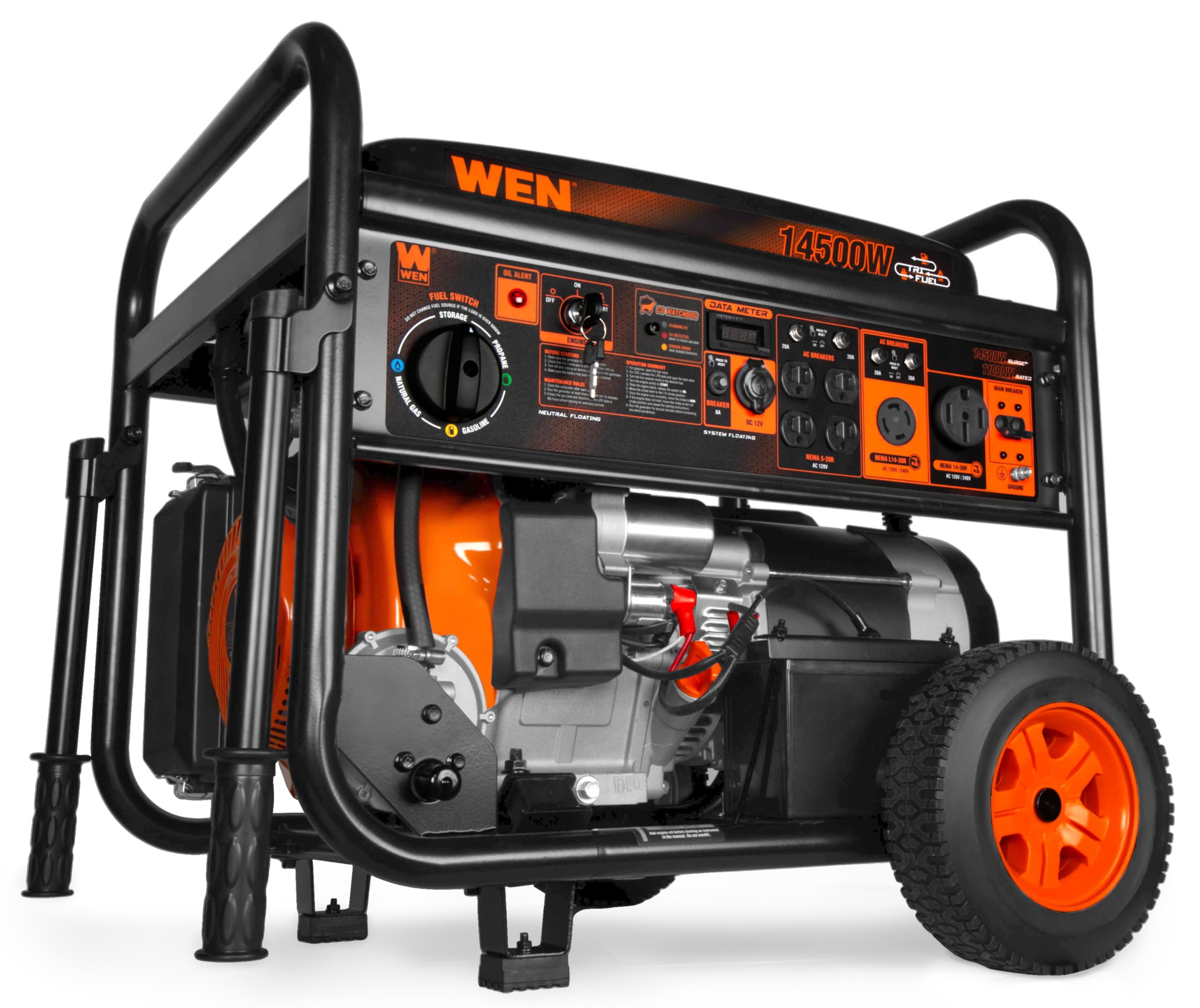
The tri-fuel giant that runs a big home on tap gas, then falls back to propane or gasoline.
If your house already has a natural gas line, this is the one to beat. The WEN TF-1450X runs on gasoline (14,500 peak, 11,500 running), propane (12,500 peak, 10,300 running), or natural gas (10,500 peak, 8,750 running) — and no fuel runs out like a line that stays pressurized during the storm. That flexibility towers over the smaller WEN DF1100X above it: 11,500 running watts versus 8,300, and 12 hours on the 8.2-gallon tank versus 8.5.
A 500cc four-stroke with electric key start handles the cold-start work. Four GFCI household outlets, a transfer-switch-ready L14-30R, and a 14-50R handle the load, with rubber covers on the plugs to keep rain out. The WEN Watchdog CO sensor automatically shuts the whole unit off if carbon monoxide climbs, which matters when you are running a large generator next to a house in a storm. The larger tank and tri-fuel capability combine to make this the rare unit you can leave wired in and running through a long night.
Quality is what buyers rate highest — this is a well-built machine that the majority would buy again, and assembly is straightforward. The one caution: on natural gas the 8,750 running watts is meaningful but bounded — if you have electric heat or a heat pump, confirm those figures before assuming it covers everything. For a gas-heated home with a standard panel, it is an excellent balance.
The real advantage: tri-fuel plus an 8.2-gallon tank gives you a fuel you never store and a runtime that stretches through a full overnight outage.
What to verify: on natural gas the output dials back, so add up your running watts before relying on it as your only fuel.
This is the pick if: you have a natural gas hookup and want the strongest running watts on this list that still fits a wheeled frame.
You’ll want a different unit if: you can’t tap a gas line — without it, you lose the biggest part of this unit’s edge.
5. Champion 12,500-Watt Tri Fuel Generator

The gauge-minded tri-fuel that tracks its own runtime so you never guess when to refuel.
Champion builds the 12,500-watt tri-fuel around one thing home owners underrate until an outage: knowing how hard the machine is working. The Intelligauge tracks voltage, frequency, session run time, and total run time — which means you can watch your output rather than wonder. On gasoline it delivers 10,000 running and 12,500 starting watts, stepping down to 9,000 running on propane and 8,000 running on natural gas. Natural gas and propane hoses come in the box, so it runs on any fuel the day it arrives.
The 500cc Champion engine starts with a rocker switch and comes with the battery included. The CO Shield system automatically shuts it off if carbon monoxide rises — the safety feature every pick here now carries. In practice the tri-fuel capability is the big win: gasoline for maximum output, propane for a stored fuel that doesn’t go stale, natural gas for a line that never empties. Owners praise the power output and build quality in equal measure, and assembly is quick.
The trade-off worth knowing is noise; opinions split between quieter-than-expected and outright loud. At 231 pounds it is also heavier than the Westinghouse dual-fuel, so plan for a helper to move it. For someone who wants three fuels plus the ability to see exactly what the machine is doing, the Champion earns its spot.
Strong points
- Intelligauge shows voltage, frequency, and run time
- Runs on gas, propane, or natural gas from the start
- Rocker-switch electric start with battery included
- CO Shield auto-shutoff for fume safety
What to weigh
- Noise feedback is genuinely divided across owners
- 231 pounds is heavier than several rivals here
Go with the Champion if: you want to see the generator’s real-time load and runtime without adding a separate monitor.
Step away from it if: portability is a priority — this isn’t the unit to wheel around solo.
6. DuroMax XP13000HXT Tri Fuel Generator
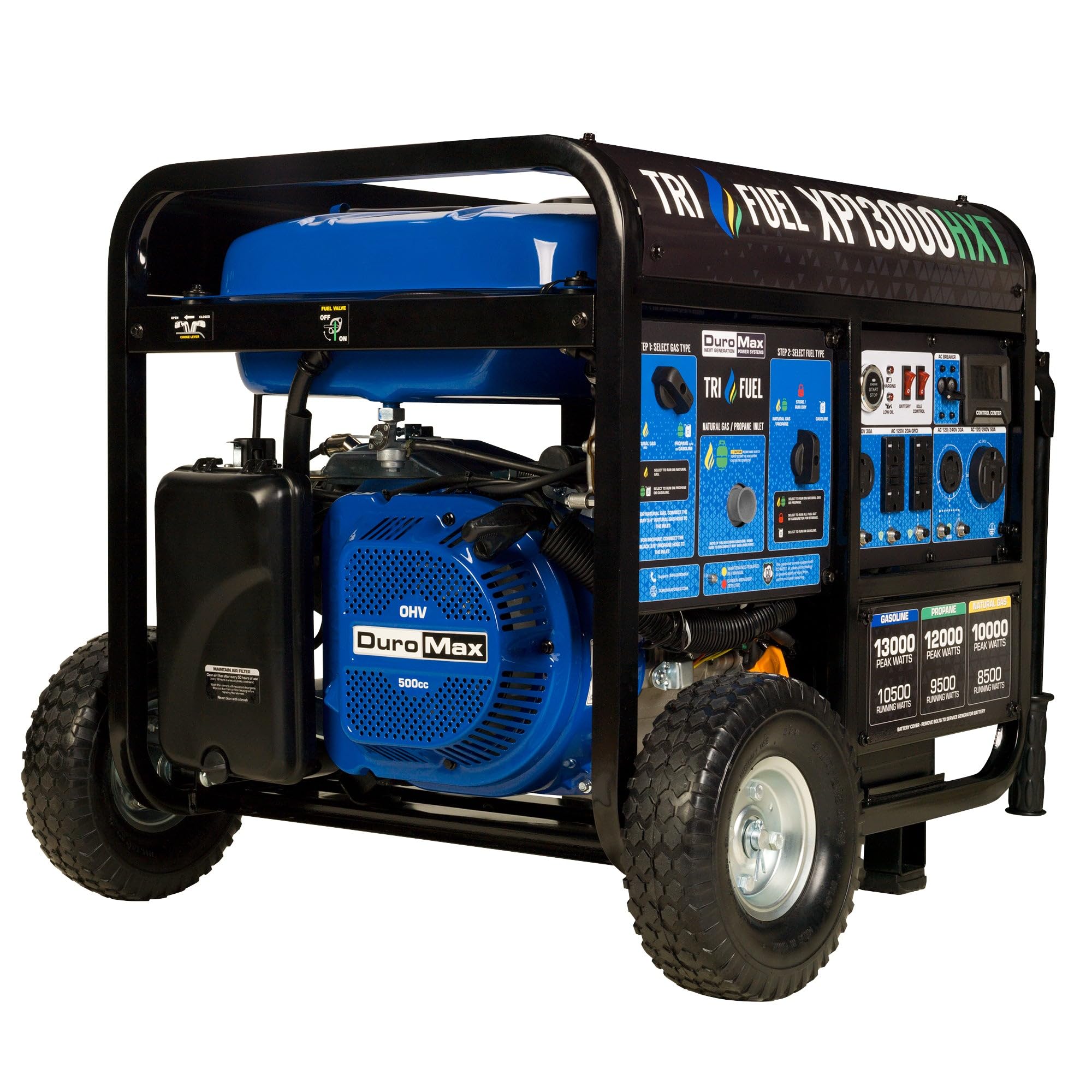
A 500cc tri-fuel with remote start and a 50-amp outlet — premium power for a whole panel.
Step into the premium tier and the DuroMax XP13000HXT is the one that keeps a big house fully live on any of three fuels. A 500cc OHV engine pushes 13,000 watts, and a front-facing interface lets you switch fuel type in seconds — gas, propane, or natural gas. Push-button start and a remote control mean you can light it up from inside the house. The included 15-foot natural gas hose and propane regulator make it ready on gas-line setups.
A 50-amp transfer-switch outlet connects straight to your panel, and CO Alert auto-shutoff protects your family from fumes. Owners are very happy with performance and the tri-fuel capability, frequently describing the XP13000HXT as the best they’ve used, and several note it runs a full house on propane without a hitch. Assembly is fast and the welcome price point for a 13,000-watt tri-fuel is frequently called out.
Reliability and battery life here run mixed — a share of owners mention units that won’t fire or a battery that dies early, while others run for days on end. That’s a real trade-off of a large tri-fuel, not a reason to skip this class of machine. Treat it as premium equipment that benefits from careful first-start break-in and regular battery-tending.
Why it’s a premium contender
- 13,000 watts with 500cc engine across three fuels
- Remote and push-button start for indoor convenience
- 50A outlet built for a transfer switch
- CO Alert automatic shutdown
Where owners hit friction
- Reliability feedback splits between flawless and won’t-start
- Battery life is a recurring mixed point
Pick the XP13000HXT if: you’ve got a big house, a natural gas line, and want remote start plus CO Alert at the premium tier.
Leave it on the shelf if: you want the most bulletproof track record — its mixed reliability is a real caution.
7. GENMAX 15000W Tri-Fuel Portable Generator (GM15000ET)
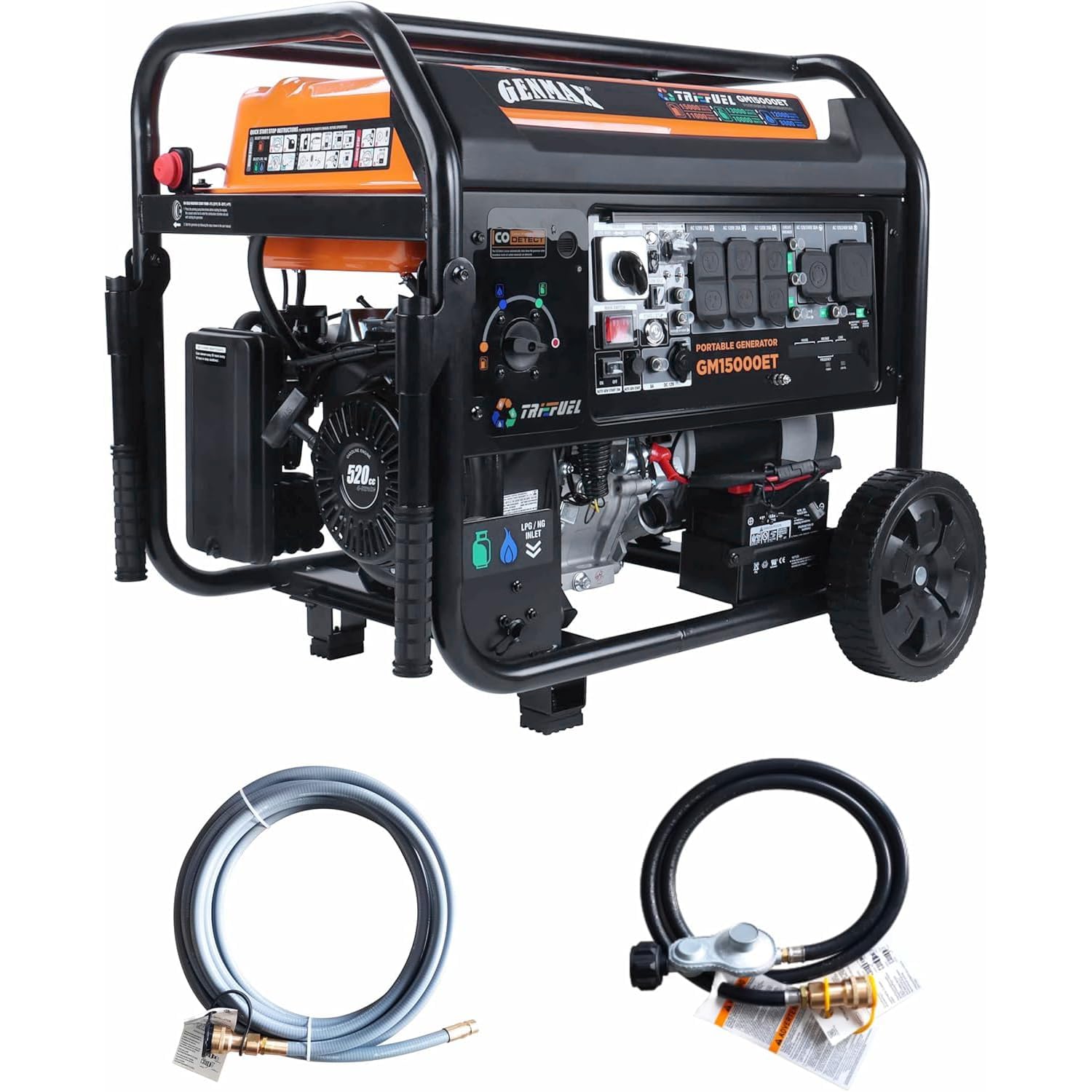
The 10.56-gallon tri-fuel with a 2-wire auto-start that pairs with a solar battery setup.
If you want the longest stretch between refuels on this list, look at the tank. The GENMAX GM15000ET carries a 10.56-gallon fuel reservoir — the biggest here — supporting 11,000 running and 15,000 peak watts. Tri-fuel capability lets it run on gasoline, LPG, or natural gas, and you get three start options: one-button, remote, and recoil backup. A 2-wire automatic start/stop cable and a battery charging port make it useful for a solar-backed home that needs auto-start during an outage.
The multifunctional control panel includes a digital display for real-time data, a DC cigarette-lighter outlet for charging batteries, and a voltage transfer switch that flips 120V to 240V while allowing full power output at 120V. A built-in CO sensor handles fume safety, and a flexible LED rope light stays lit for about 30 seconds to illuminate the panel in the dark. A rain cover and full hose kit ship in the box.
The honest side: this is a newer, lower-rated model than the proven picks above, and reliability plus battery-life feedback run mixed, with a share of units failing to start and reports of short run times. Noise is the one strong positive most owners agree on — it’s surprisingly quiet for a 15,000-watt machine. If you need a big tank for a long outage, it earns its spot; if you want the most-tested reliability at this price, look to the Westinghouse or Champion picks.
The standout: the 10.56-gallon tank and 2-wire auto-start are real advantages for solar-paired or hands-off setups.
The real caution: reliability and battery life are the weakest points in owner feedback — expect to monitor the unit closely.
Best matched to: a solar-paired home or a buyer who values a big tank and automatic starting over a long track record.
Better to pass if: you want proven reliability — the lower-rated model carries real risk.
8. Westinghouse 18000 Peak Watt Tri-Fuel Generator
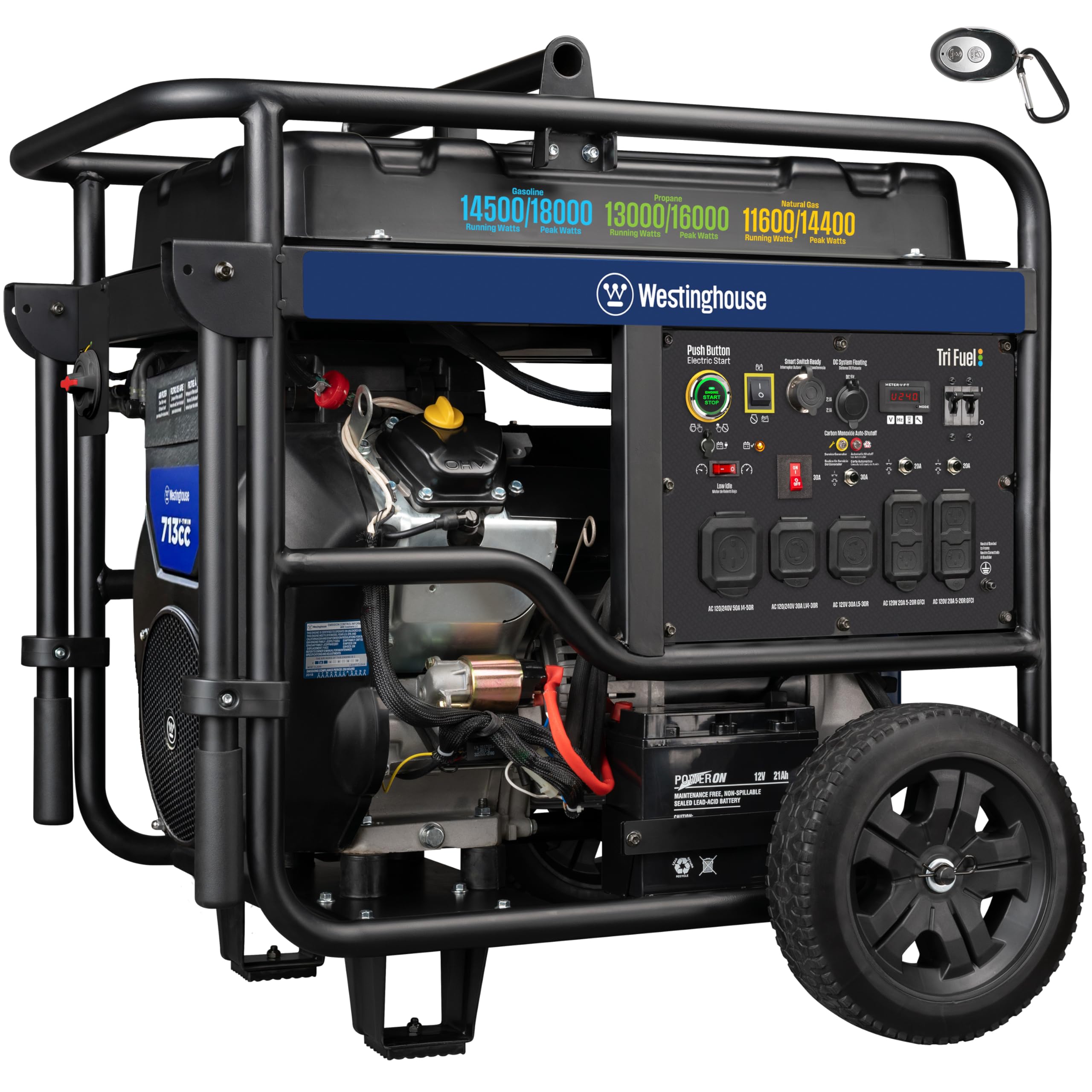
Standby-level convenience in a portable — pairs with an ATS to start itself when the power drops.
This is the one that blurs the line between portable and standby. Pair the Westinghouse 18000 Peak Watt with the WATS200 automatic transfer switch (sold separately) and it starts itself within seconds of an outage — standby convenience without a permanently installed unit. The 713cc engine is the biggest here, delivering 14,500 running and 18,000 peak watts on gasoline, with full-pressure lubrication and an automotive-style oil filter for longer engine life.
Your sensitive electronics run without stress thanks to less than 5% THD (total harmonic distortion, a measure of how clean the sine wave is), so phones, computers, and TVs are safe. Copper windings help it run cooler. Up to 16 hours at 25% load on a 10.5-gallon tank gives you serious overnight capacity. 50A and 30A outlets work with an interlock kit, a manual transfer switch, or the WATS200 ATS. A CO sensor and low-oil shutdown round out the safety list.
The catch is weight and setup. At 348.3 pounds this is a heavy machine that needs the wheel kit and a second person to move, and the ATS is a separate purchase. Reliability feedback is mixed — some units function perfectly for years, others won’t start. For a homeowner who wants automatic backup and clean power for a big house, it’s a strong option; the price is the trade-off for that capability.
Where it shines
- Under 5% THD clean power for sensitive electronics
- 14,500 running watts on a 713cc engine
- Up to 16 hours at 25% load on the 10.5-gallon tank
- ATS-ready for automatic outage backup
Where it bites
- 348.3 pounds makes moving it a two-person job
- Mixed reliability feedback
Best for: a big house with sensitive electronics where clean power and auto-start matter more than easy moving.
Skip if: you need portability or a lower budget — this one needs help moving and the ATS is sold separately.
9. DuroMax XP16000iH 16,000-Watt Dual Fuel Inverter Generator
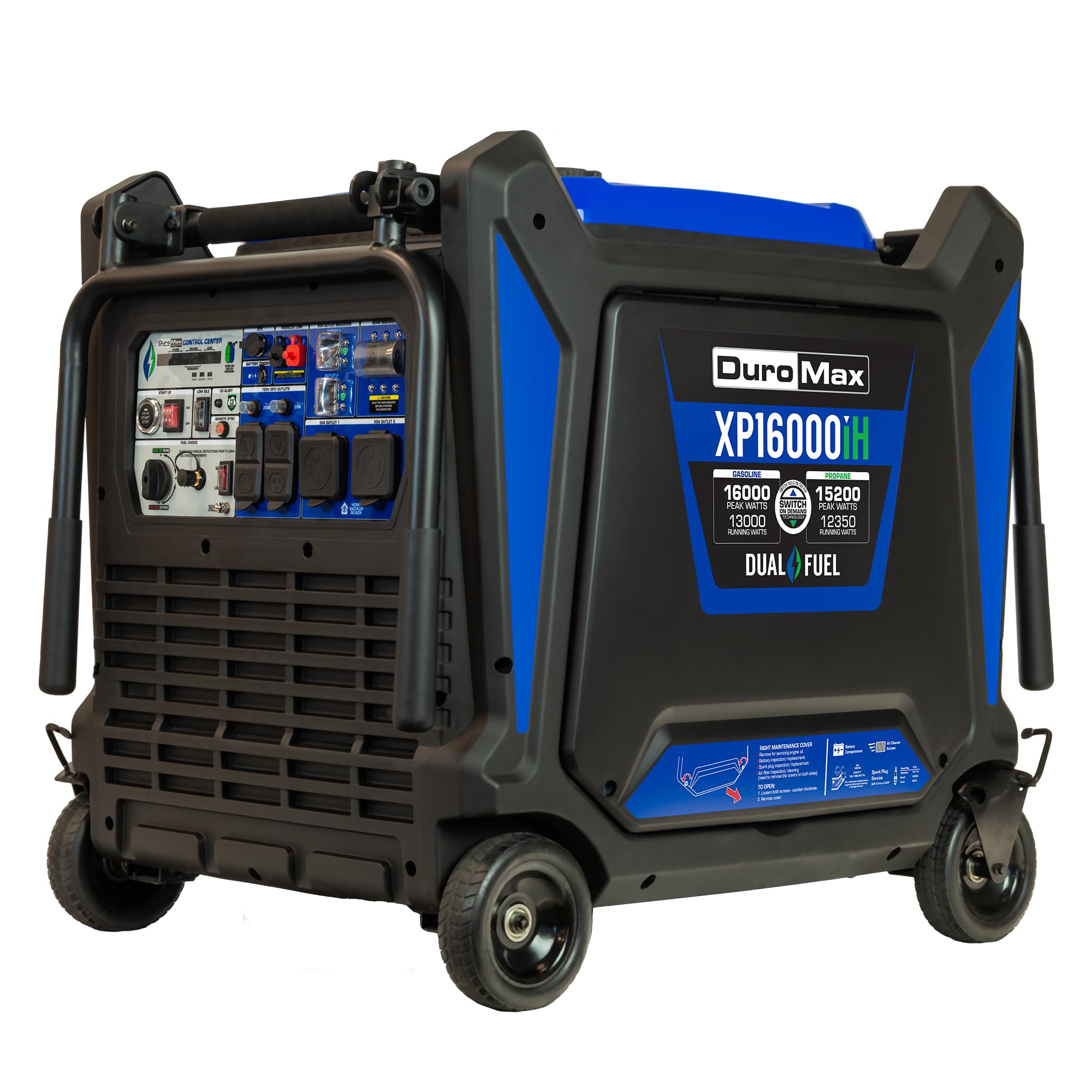
Clean inverter power at 16,000 peak watts — for electronics-heavy homes that can’t tolerate dirty electricity.
Inverter generators don’t send raw engine power straight to your outlets — they convert it to clean, stable electricity first, which protects things like TVs, computers, and any device with a sensitive board inside. The DuroMax XP16000iH applies that to whole-home scale: 16,000 peak and 13,000 running watts on gasoline, with dual-fuel capability for propane. A remote control starts it, and a battery tender keeps the starting battery topped up between uses.
The Digital Control Center displays hours run, voltage output, and load level so you can watch what you’re drawing. Low-oil shutoff protects the engine automatically, and the unit meets EPA and CARB emissions standards. That combination — inverter-clean power and this much output — puts it in a class of its own; no other pick here runs inverter technology at this wattage.
The honest trade-off is that it’s priced at the top of this lineup and rated the lowest of the group, reflecting a shorter track record with only a limited owner base. A 368-pound frame means it stays put. If your home is packed with electronics and you want clean, stable power at the highest peak output here, the inverter tech earns its keep; if you mostly run lights and a fridge, a conventional tri-fuel saves considerable money.
The unique edge: inverter tech at 13,000 running watts cleans power for sensitive electronics the way conventional generators can’t.
The budget reality: it’s the priciest, least-tested pick — the clean power runs steep.
Made for: an electronics-heavy home that needs clean power at maximum output and doesn’t care about relocating the unit.
Not worth it if: your load is lights and appliances — you’re paying for inverter clean power you won’t use.
Know the Specs
Running Watts vs. Peak Watts
Running watts are the steady power a generator holds for hours — the number that keeps your fridge cold through the night. Peak watts are the short surge it can deliver to start a motor like an AC compressor or well pump. Size your house on running watts, then make sure peak covers the largest motor startup. On this list, gasoline running watts span from 8,300 up to 14,500, so match your panel load to the right rung.
Fuel Types Explained
Gasoline gives the highest output but goes stale and needs stabilizing. Propane stores for years and runs cleaner with reduced wattage. Natural gas never runs out if the line stays pressurized, but yields the least wattage of the three. A tri-fuel unit gives you the flexibility to fall back to whatever is available during a storm — the single most useful capability for a multi-day outage.
Transfer-Switch Ready Outlets
A 50-amp 14-50R or L14-30R outlet lets an electrician wire the generator into your home panel through a transfer switch or interlock kit, rather than stretching extension cords through a window. Confirm your chosen model has one labeled transfer-switch ready, and coordinate the outlet type with your electrician before the unit arrives.
CO Shutdown and Low-Oil Protection
A carbon monoxide sensor shuts the engine down automatically if dangerous exhaust fumes build up — critical when a generator runs close to a house in bad weather. Low-oil shutdown protects the engine itself by cutting power before damage occurs. Every model on this list includes at least a basic form of these safety features.
Common Questions
How many running watts do I need to power a whole house?
Is a tri-fuel generator better than a dual-fuel one?
How long does a portable generator run on a full tank?
Can I plug a portable generator straight into my house wiring?
Are these generators safe to run near a house?
Can I move a 200-plus pound generator by myself?
What is the difference between an inverter generator and a standard one?
Do I need a remote start on a whole-home generator?
Can I run my air conditioner on a portable whole home generator?
How often should I maintain a portable generator?
The Bottom Line
The portable whole home generators that best matches most households is the Westinghouse 12500 Peak Watt Dual Fuel, because 9,500 running watts on gasoline and a 50A transfer-switch outlet cover a whole panel without paying a premium. If you have a natural gas hookup and want maximum running watts, reach for the WEN TF-1450X and its 11,500 running watts on gas. And for a big house packed with electronics, the DuroMax XP16000iH delivers inverter-clean power at 16,000 peak watts. The Westinghouse 12500 backs that reputation with 9,500 running watts, a 50A 14-50R outlet, and key-fob start.
How we choose
We do not accept paid placement. Every pick is matched to a real buyer and a real use-case; we do not hands-on test units.
Sources
Specifications: manufacturer listings and product documentation. Review insights: verified customer reviews, as of November 2026. Pricing: not shown on this page (it changes often); check the current price via the retailer link.
As an Amazon Associate, Tactical Gear Guy earns from qualifying purchases. This does not affect which products we feature.