Specs are compiled from manufacturer listings and verified buyer reviews and can change over time — please confirm the key details on the product page before buying.
You want power that comes out of a panel instead of a gas can. The quick answer: buy on watt-hours first, AC output second, and solar input third. The eleven units below all accept solar charging and cover the whole spread — from a car-trunk box that runs a fan and a laptop to a 3,763Wh station that keeps a full-size fridge cold for days.
This guide is built by comparing the manufacturers’ published specifications and the patterns across verified customer reviews, so you get each pick’s real strengths and trade-offs instead of marketing spin.
Most buyers overspend on watts and underspend on stored energy. The lineup runs from a 640Wh weekend unit up to a 3,014.4Wh home-backup box. Below you will find a portable solar electric generator sorted by what it actually does for you.
Top Picks
How To Choose The Best Portable Solar Electric Generator
Two numbers decide almost everything about your purchase, and neither of them is the price tag. Get watt-hours and AC output right and the rest of the spec sheet is comfort features.
Start with watt-hours, not watts
Watt-hours (Wh) are the size of the fuel tank. Watts are the width of the pipe leading out of it. A 2,048Wh station and a 519.48Wh station can both run a mini-fridge — the bigger one just runs it far longer between charges. Add up what you plan to run overnight, then buy roughly double that in Wh so the battery has headroom. If your answer is “a phone and a lamp,” a small unit is enough. If it is “the fridge during a three-day outage,” you need a 2kWh-class box.
Check the AC output against your heaviest appliance
AC output is the continuous wattage feeding your normal wall plugs. Anything with a compressor or a heating element draws far more at startup than it says on its label. Look for a peak or surge figure alongside the continuous figure. A station rated at 600W continuous with a 1,200W surge handles a small fridge. A 2,600W unit with 3,900W lifting power will run a coffee maker. Buying more output than you need mostly buys you weight.
Price the solar side separately in your head
Solar input is the maximum wattage of panel the station accepts, and it directly sets recharge time. Some kits ship with panels; many do not. A station with a 1,000W solar input tops up much faster than one limited to a 200W panel. If you are buying a bare station, budget for panels as part of the real cost. Also note that panel-included kits often ship the panel in a separate box that arrives on a different day.
Weigh the battery chemistry and the cycle count
LiFePO4 (lithium iron phosphate) is the chemistry nearly every unit here uses, and it is the one you want for a decade-long purchase. The spec that matters is the cycle count — how many full charge-and-discharge rounds the battery survives before capacity drops. A 6,000-cycle rating and an 800-cycle rating are very different long-term buys, even if both feel identical on day one. Heavier chemistry also means heavier units, which is the trade-off nobody escapes.
Side-by-Side Comparison
| Model | Best For | Capacity | AC Output | Weight | Amazon |
|---|---|---|---|---|---|
| BLUETTI Elite 200 V2★ Best Overall | Whole-home backup with panels | 2080 Wh | 2600 W | 44.5 lb | Amazon |
| Anker SOLIX S2000Best Run Time | Fridge backup in a tight footprint | 2,010 Wh | 1,500 W | 35.7 lb | Amazon |
| Jackery Explorer 1000 v2Best for Camping | Fast-charging camping kit | 1,024 Wh | 1,500 W | 23.3 lb | Amazon |
| EF ECOFLOW DELTA 3 Max | Running power tools off-grid | 2048 Wh | 2400 W | — | Amazon |
| Jackery Explorer 2000 v2 | Big capacity on a budget | 2042 Wh | 2200 W | 39.5 lb | Amazon |
| BLUETTI Elite 300 | RV and CPAP backup | 3014.4 Wh | 2400 W | 58 lb | Amazon |
| Anker SOLIX C2000 Gen 2 | Panel-included solar kit | 2048 Wh | 2,400 W | — | Amazon |
| EF ECOFLOW DELTA 3800 Gen4 | Longest outage runtime | 3763 Wh | 3600 W | 67.5 lb | Amazon |
| LIBRIDS C600 | Car-trunk emergency box | 640 Wh | 600 W | 16.3 lb | Amazon |
| EBL 500W | Budget camping and CPAP | 519.48 Wh | 500 W | 14.1 lb | Amazon |
| ZeroKor 300W Combo | Light tent and phone kit | 280 Wh | 300 W | — | Amazon |
Detailed Reviews
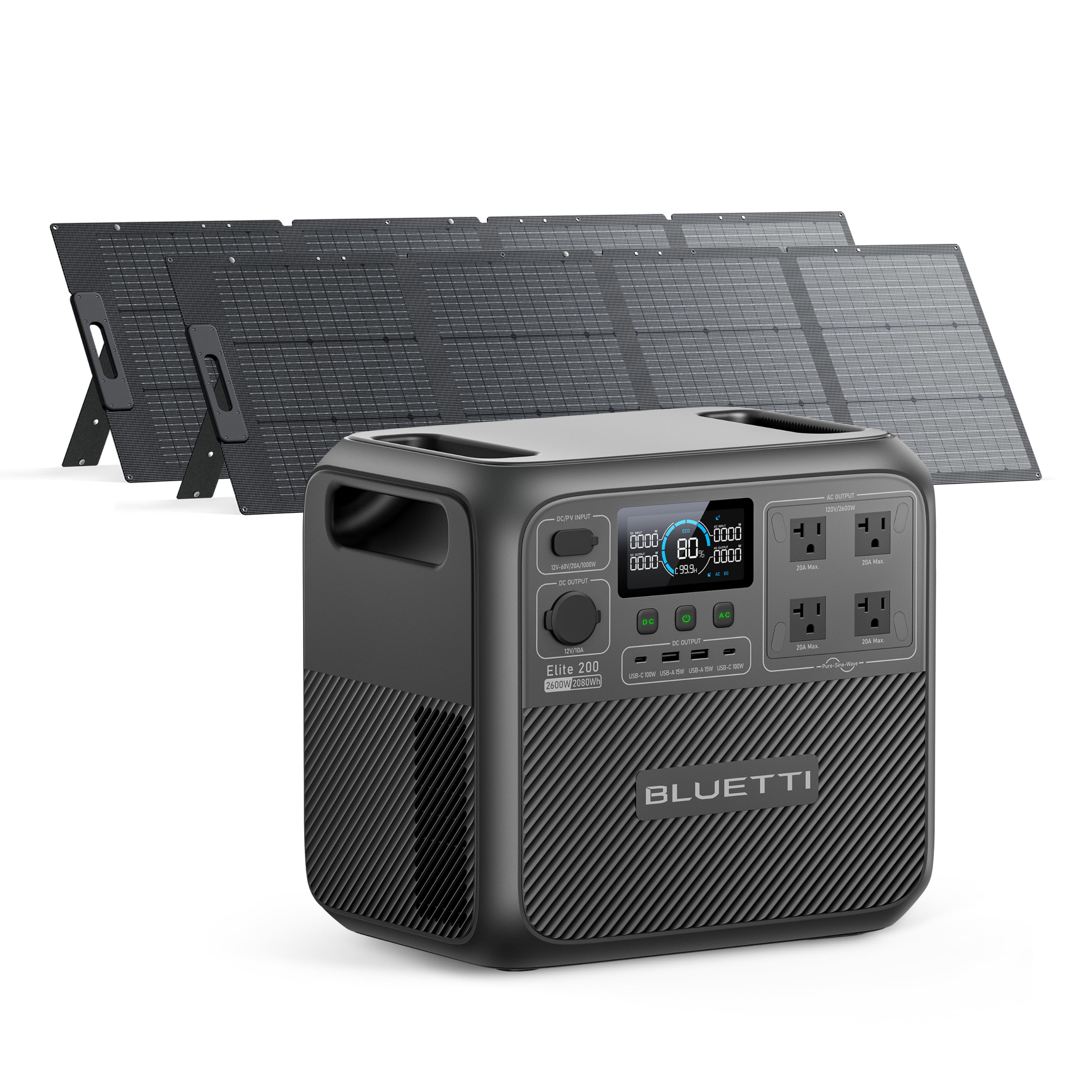
1. BLUETTI Elite 200 V2 Solar Generator
Our pick — 4.5+★ from 950+ verified ratings; the strongest balance of quality and price.
Runs the fridge, the hair dryer, and nine devices at once — with the panels already in the box.
This is the pick for the household that wants a real outage plan and does not want to shop for solar panels afterward. You get 2080Wh of storage (the size of the battery, which sets how long things run) plus two 200W panels in the same kit. Together those panels feed 400W of solar input, and a full solar recharge takes 5.5 hours in good sun. Continuous AC output is 2600W, and a lifting mode pushes to 3900W for appliances that spike on startup.
The gap to the smallest pick here is enormous and worth stating plainly: 2600W of AC output against the EBL’s 500W, and 2080Wh of capacity against that same unit’s 519.48Wh. Weigh it honestly too — 44.5 pounds against the EBL’s 14.1 pounds, so this one gets wheeled or carried by two, not tossed in a backpack. What wins people over is raw performance: it exceeds expectations even in cold temperatures and holds a refrigerator for 24 hours on a charge.
The battery is LiFePO4 (lithium iron phosphate — the long-life chemistry) rated for 6,000+ cycles, and standby draw is only 10W, so leaving it plugged in and waiting wastes very little. There is also a ≤15ms UPS switchover (uninterruptible power supply — it swaps to battery almost instantly when grid power drops). The catch is the one the spec sheet hides: at 44.5 pounds it does not travel far from the car, and setup with two separate panels takes a few minutes each time rather than a single plug-in.
Why it earns the top slot
- 2080Wh storage plus 2600W continuous AC output runs high-demand appliances like fridges, hair dryers, and coffee makers
- Two 200W panels are included, so you can recharge from the sun without a second order
- Supports up to 9 devices at once — one hub for a whole family during an outage
- 6,000+ cycle LiFePO4 battery with 10W standby draw for minimal waste
What you give up
- At 44.5 pounds it is a two-hand or wheeled lift, not a grab-and-go
- Setting up two separate panels adds minutes to every deploy
- Panels ship in their own box, so they can arrive on a different day
Reach for this if: you want one kit that covers home outages and off-grid living, panels included, with the output to run real appliances.
Look elsewhere if: you need to carry the station up stairs or into a tent solo — the 44.5-pound shell makes that a chore.
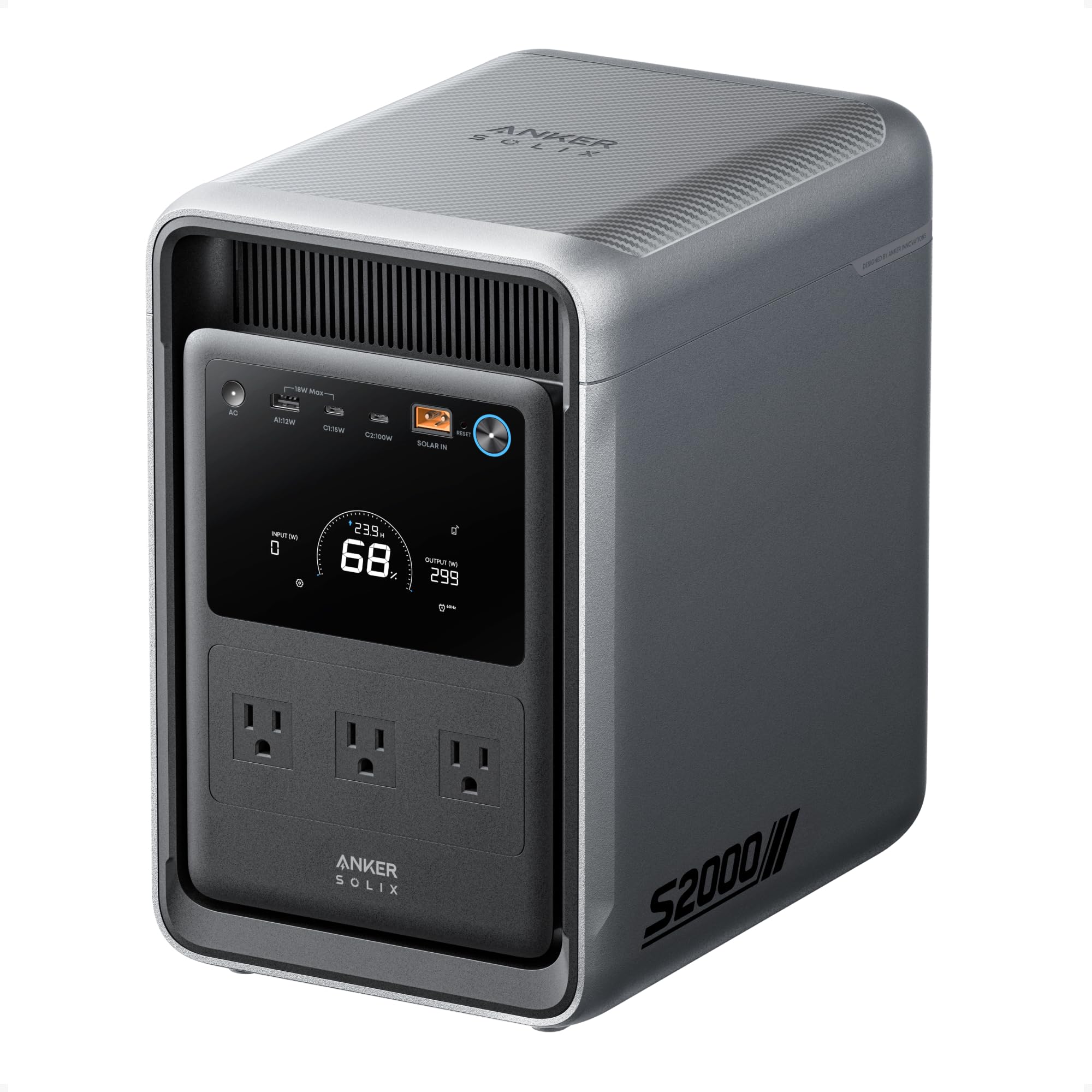
2. Anker SOLIX S2000 Solar Powered Generator, 2,010Wh, 1,500W
The 2kWh station that squeezes into a cupboard and still runs a fridge for a day and a half.
Here is the number that should stop you: 10,000 cycles. That is the rated cycle life of the 314Ah LFP cells (lithium iron phosphate), which the maker reckons at a 15-year lifespan. Capacity is 2,010Wh with 1,500W continuous and 3,000W peak output.
Fridge backup is where this one shines, and the maker claims 35 hours of runtime, helped by a 6W idle draw. It measures just 8.2 × 11.1 × 12.7 inches and weighs 35.7 pounds — The maker calls it 30% smaller and 25% lighter than the industry average for 2kWh stations. That compactness earns real praise from owners, who specifically like that it stores 2kWh of energy in a small footprint. Eight outlets split front and rear, and there is no 12V DC port, which is the one connectivity gap.
Recharging is flexible: up to 400W of solar input, plus AC, generator, alternator charger, or car outlet. Switchover for home office gear is under 10 ms. The honest trade-off is the same one every 2kWh box faces — at 35.7 pounds it is portable between rooms, not between towns. And if you need a 12V car-style socket for a specific device, this unit simply does not have one.
The lifespan argument: a 10,000-cycle rating is the single strongest longevity number in this whole lineup, and it is what you are really paying for.
The one gap to know: no 12V DC port, so plan a USB or AC route for anything that normally plugs into a car socket.
Built for: the buyer who wants a fridge, router, and lights covered for a day-plus and never wants to buy another battery.
Not the pick when: you specifically need a 12V car socket or you plan to haul it on foot.
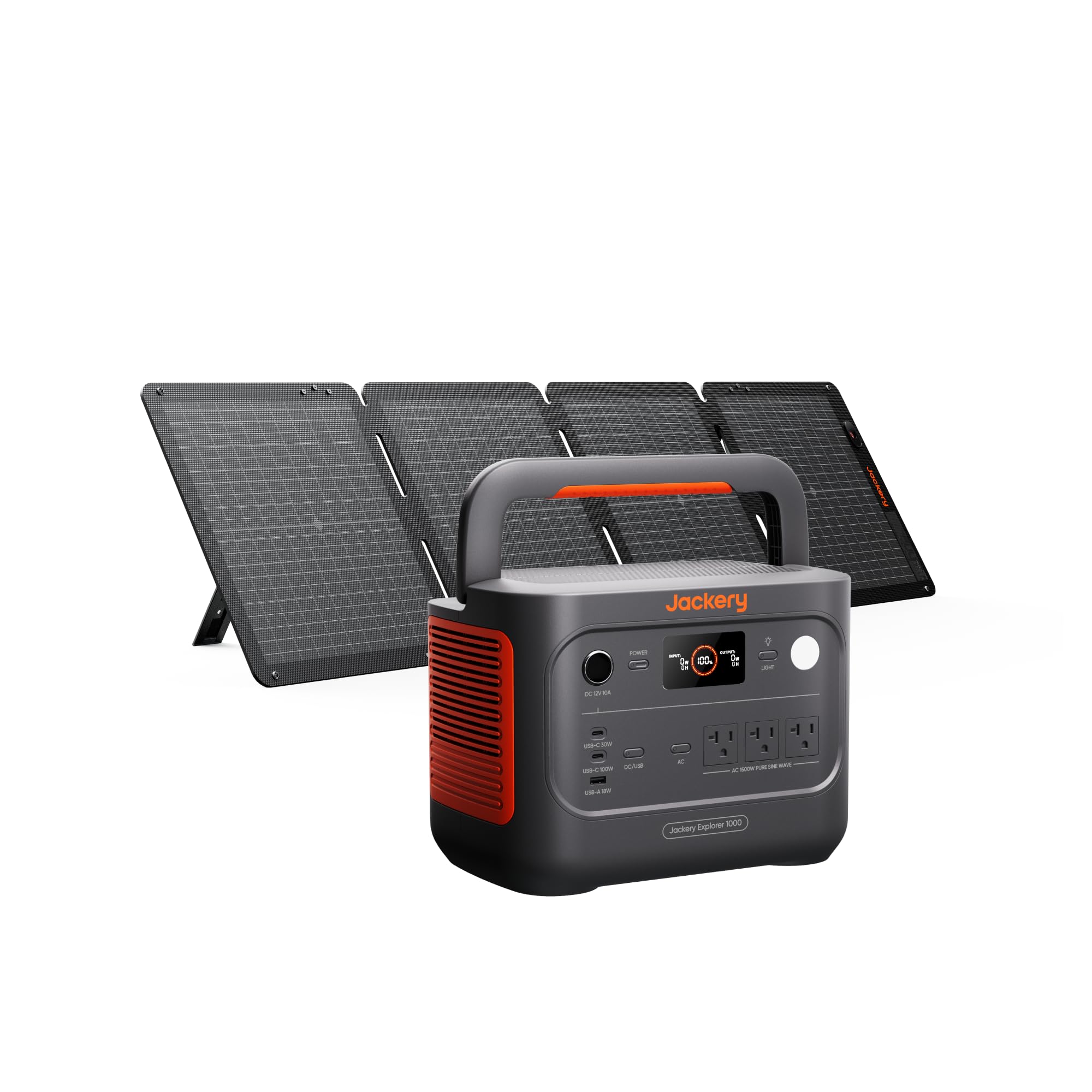
3. Jackery Solar Generator 1000 v2
A panel-included kit light enough to carry one-handed and quick enough to top up over lunch.
Fifty minutes. That is how fast this station goes from empty to full with emergency charging switched on in the Jackery App — and it defaults to 1.25 hours to be gentler on the battery. Capacity is 1,024Wh with 1,500W AC output and a 3,000W surge, and the whole unit weighs only 23.3 pounds with a foldable handle. The 100W panel ships in the same kit, so the solar side is solved on day one.
Chemistry is LFP with a 4,000-cycle rating that holds over 70% of original capacity, which the maker frames as a lifespan exceeding 10 years. Ports cover two USB-C, one USB-A, a DC car port, and two pure sine wave AC outlets, plus LED lights. There is a 10 ms UPS switchover for keeping essentials alive during an outage. Owners describe it as well-made and genuinely easy to run, and the quick charging is the thing that keeps coming up.
The trade-off nudges two directions. First, that headline 50-minute charge needs the app setting flipped every single time — skip it and you are on the 1.25-hour default. Second, some buyers find the power delivery smaller than they expected, which is the usual result of buying 1,024Wh for loads that really want 2kWh.
The carry story: 23.3 pounds with a foldable handle is the point where a station stops feeling like luggage and starts behaving like a cooler.
The app caveat: the fastest charge mode is a setting you turn on, not a default you inherit.
Pick this for: weekend trips and road journeys where the panel rides along and the unit moves with one arm.
Think twice if: your plan is running a fridge for days — 1,024Wh will not stretch that far.
4. EF ECOFLOW DELTA 3 Max Portable Power Station
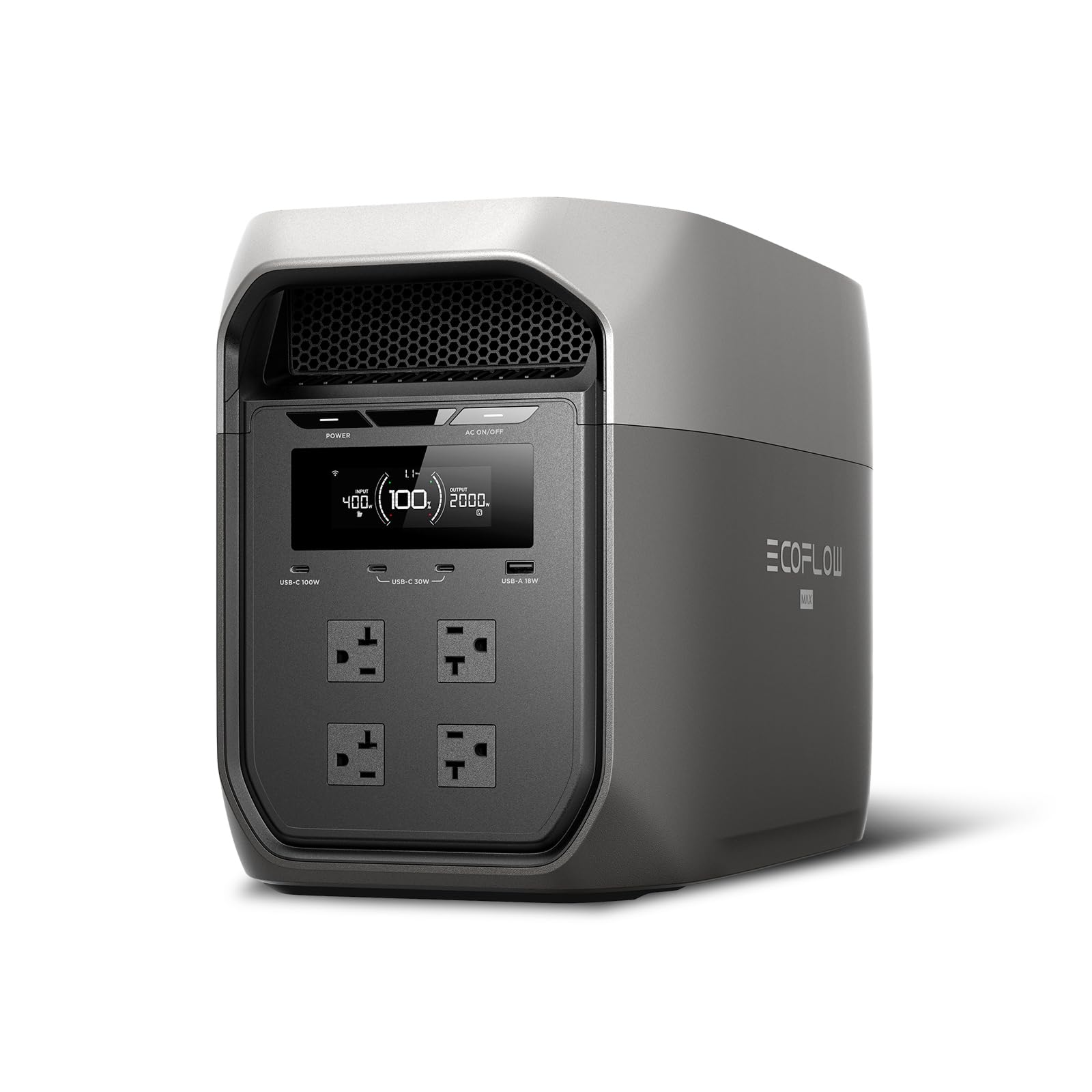
For the workshop that moves: 3400W of boosted output to start tools a 2400W station would refuse.
X-Boost is the feature to understand here. The base AC output is 2400W, but X-Boost pushes it to 3400W so high-draw tools and appliances that would normally trip an overload keep running. Storage is 2048Wh from an LiFePO4 battery, and a 0–80% recharge takes just 1.13 hours on X-Stream charging. That speed is the whole reason this unit earns a slot: you can top it back up during a lunch break and be ready for the afternoon.
Switchover for sensitive electronics is under 10 ms, so a computer or a router riding on this during an outage barely notices the grid drop. Operation stays quiet, and the maker rates the battery for 10 years of daily use with a 5-year service term attached. The EcoFlow app lets you watch energy use live and schedule charging and discharging windows. It is a 2400W-class station that owners describe as a top-quality system with outstanding battery life and fast charging.
Where it falls short: there is no official weight figure published for this model, which is annoying if weight is your deciding factor. And 2400W base output sits below the 2600W the BLUETTI above claims, so if you were choosing on raw continuous watts alone, that pick edges this one out. X-Boost closes much of that gap in practice for motor loads.
What makes it a workshop pick
- 3400W X-Boost keeps power tools and high-draw appliances off the overload trip
- 0–80% in 1.13 hours means a recharge fits inside a break
- Under-10ms transfer covers computers and routers during outages
- App control for watching draw and scheduling charge windows
Where it stops
- No published weight figure, so plan on moving it by feel rather than by spec
- 2400W base output trails the 2600W BLUETTI above on raw continuous watts
Fits: job sites, RV garages, and anyone who needs a circular saw or a microwave to actually start.
Skip if: the absolute highest published wattage is your only benchmark — the top pick still wins that number.
5. Jackery Explorer 2000 v2 Portable Power Station

Two kilowatt-hours of storage with enough output for a microwave, built to ride in an RV.
Start with the shape. This is 2,042Wh of capacity and 2,200W across three AC ports, and it weighs 39.5 pounds. It uses CTB (Cell-to-Body) construction borrowed from electric vehicles, which the maker says makes it 41% lighter and 34% smaller than typical 2kWh LiFePO4 stations. Three AC outlets plus a 100W USB-C PD port cover the usual crowd of phones, laptops, and small appliances without hunting for an adapter.
Recharge is brisk: 0–80% in 66 minutes on AC fast charging, or a full charge in 102 minutes using Emergency Super Charging through the app. Solar tops up in as few as 6 hours with 400W panels, and a Silent Charging mode runs the full charge in 5 hours at just 30dB — quiet enough for a bedroom. There is a 20ms UPS switchover and UL1778 certification for uninterruptible power supply duty. Owners consistently rate it excellent and describe it as protecting the house through storms without fuss.
The honest caveat: a few buyers find it heavier than the lightest 2kWh boxes on the market, and durability reports split — most say it holds up, a minority hit trouble inside the first month. That is a fit-and-fortune picture rather than a pattern. Meanwhile, the flexible silent charging and 400W solar ceiling are the real reasons this earns a spot on the shortlist.
The overnight trick: 30dB silent charging at 5 hours means you can refill it in a bedroom without waking anyone.
The honest split: most buyers report solid durability, a minority hit trouble early — buy from a seller with a clean return path.
Great for: RV owners and small businesses that want 2kWh and a quiet overnight recharge.
Not ideal if: you need it feather-light — 39.5 pounds wants a wheeled cart or a second pair of hands.
6. BLUETTI Solar Generator Elite 300
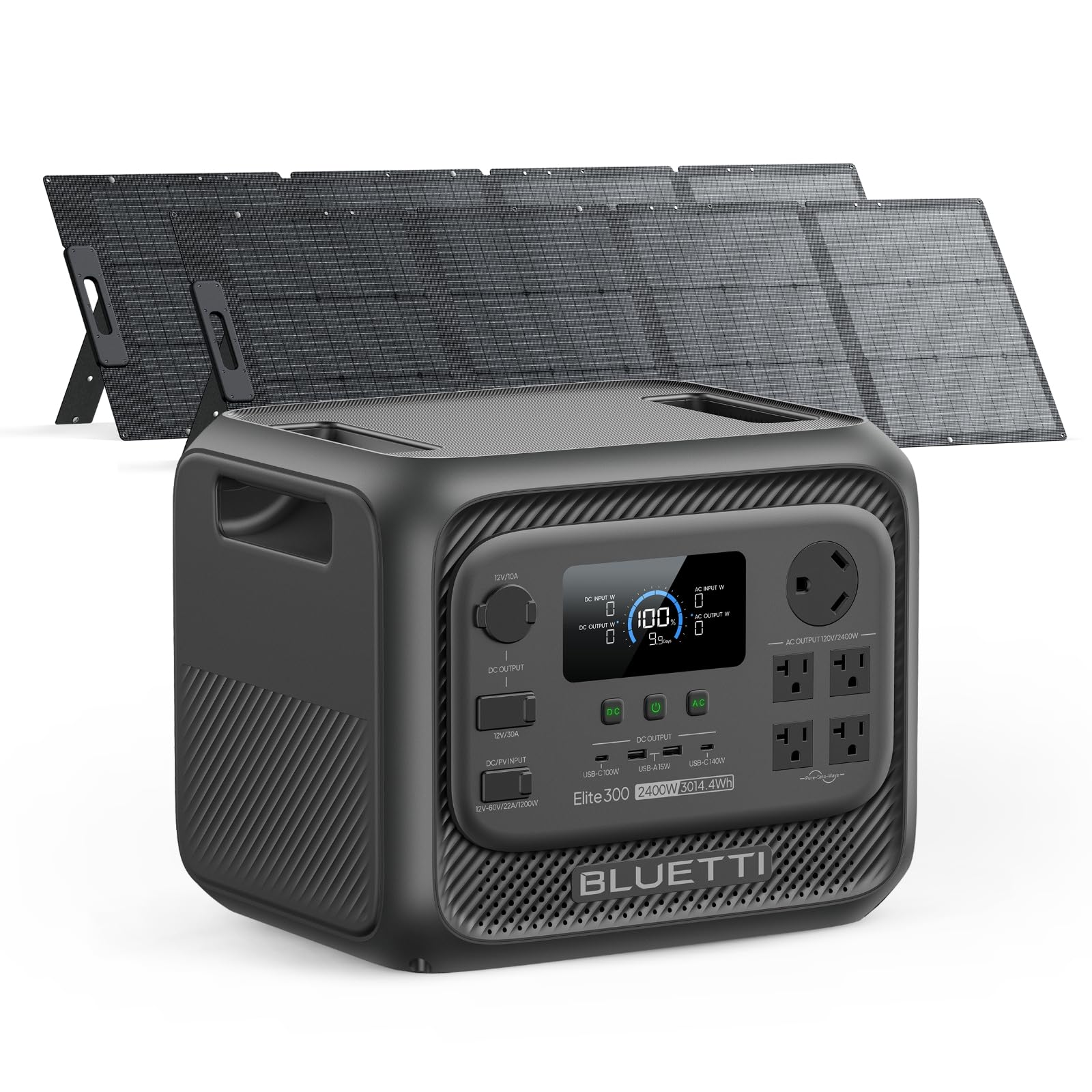
Three kilowatt-hours in a body the maker calls the world’s smallest for its capacity — with an RV socket built in.
RV owners get a dedicated treat here: a TT-30 outlet (the standard 30-amp plug a travel trailer uses) plus a 12V/30A DC port, so the fridge and AC connect without an adapter. Storage is 3014.4Wh of LiFePO4 rated for 6,000+ cycles, with 2400W continuous output and a 4800W surge that will start a kettle. The included two 200W panels recharge the whole pack from 0–100% in about 7–15 hours, and the maker notes the panels ship separately.
Frost & Sullivan recognized this as the world’s smallest 3kWh portable power station, and the design is nearly 59% smaller than traditional large stations in this class. That compactness does not erase gravity though: it still weighs 58 pounds. Owners find it impressive and reliable for both camping and home outages, and several note the charging speed takes about 2 hours from dead to full on wall power.
The trade-off is the weight and the solar patience. At 58 pounds it wants a cart or a permanent home near the door, and 7–15 hours on the included panels is a multi-day project rather than a single afternoon. If you need the panels to do more, you will be waiting.
The RV hookup: TT-30 and 12V/30A DC turn this from a general backup into a proper camper companion.
The patience test: 7–15 hours of solar for a full charge means sunny days, not a quick top-up.
Built for: trailer and camper owners who want 3kWh of storage and an adapter-free hookup.
Move along if: 58 pounds is a deal-breaker for your setup, or you expect solar to fill it in one afternoon.
7. Anker SOLIX C2000 Gen 2 Solar Powered Generator

A solar kit that charges from both sides of its panel and shrugs off rain, mud, and dust.
The panel is the story. This is a 400W bifacial panel (bifacial meaning it collects from the front and the rear), and that dual-sided design delivers up to 10% more output than a single-sided panel of the same rating. It is IP68-rated (sealed against rain, dust, and mud) with a reinforced aluminium frame, and it weighs 21.9 pounds folded. The station side is 2,048Wh with 2,400W rated and 4,000W peak output.
Recharge is fast in both directions: 80% in 45 minutes and 100% in 58 minutes with AC and solar combined, helped along by an idle draw of just 9W. That efficiency means the station powers a portable fridge for 7 days or a dual-door fridge for up to 32 hours between charges. You can expand to 4kWh with an extra battery, which stretches that dual-door fridge figure to 64 hours. Owners describe it as performing well and giving days of usable power, with the value standing out.
Two catch-points. First, the station and the panel ship separately, so expect two deliveries on different days. Second, at 2,048Wh before expansion it is a mid-size box — excellent if you add a battery later, ordinary if you do not. The 4,000W peak is what lets it start most window and RV air conditioners.
What you get in one order
- 400W bifacial panel, IP68-rated, with 10% more output than single-sided
- 9W idle draw for genuine multi-day runtime on a portable or dual-door fridge
- Expands to 4kWh with an extra battery for a longer outage window
- 100% recharge in 58 minutes with AC and solar together
The fine print
- Station and panel arrive as two separate shipments
- 2,048Wh is modest unless you buy the expansion battery
- No published weight for the station itself
Best fit: campers and home-backup buyers who value a weather-sealed panel over a slightly bigger station.
Look elsewhere if: you want a single box on the porch and no expansion shopping later.
8. EF ECOFLOW DELTA 3800 Gen4 Portable Power Station
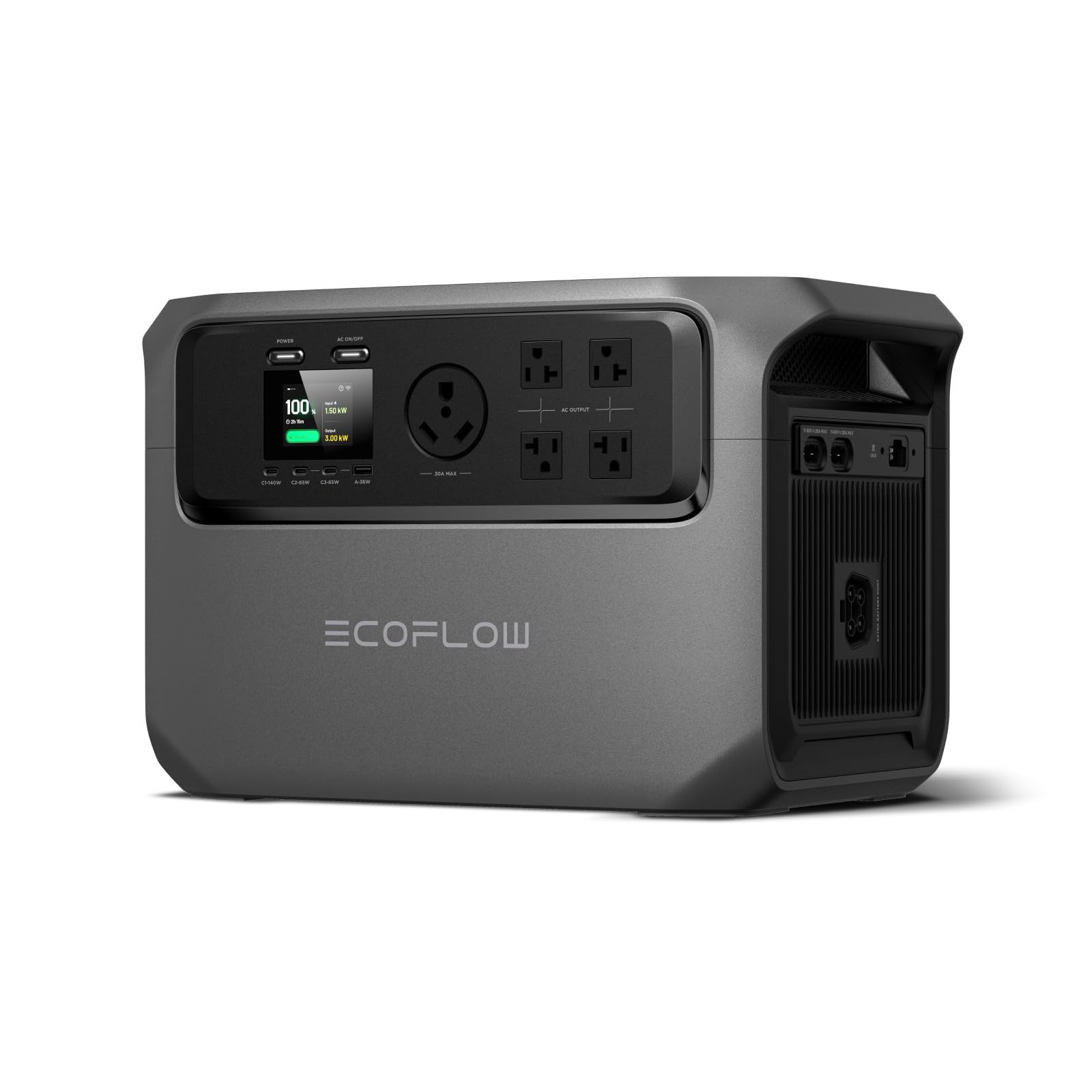
The outage heavyweight: seventy hours on a refrigerator and a 7200W surge for anything with a motor.
If your goal is riding out a multi-day blackout with the fridge running the whole time, this is the pick. Capacity is 3763Wh, expandable up to 12kWh with compatible ecoflow® DELTAPro 3 and DELTA 3 Max Plus extra batteries (separate purchases). Output is 3600W continuous and 7200W surge, enough for microwaves, power tools, and other high-demand appliances. The maker claims up to 70 hours of refrigerator runtime, 32.6% longer than the industry average for comparable 3–4kWh stations.
Standby draw is just 3W, and automotive-grade LFP cells retain up to 99% charge after a year in storage. Recharge is 0–100% in 146 minutes, with six methods including AC wall, solar, alternator, generator, and two combined setups. Under-10ms UPS switchover covers essentials during a grid drop. Owners find it fantastic, with the fast recharge and the ability to run appliances for hours both showing up as the standouts.
The catch, and it is honest with this much battery, is the 67.5-pound build. That is the heaviest in this lineup. Reliability reports also split — most find it works as advertised, a minority hit trouble and rate it poorly — so verify the return window before committing.
The runtime case: 3763Wh expanding to 12kWh turns a weekend outage into a non-event for a full kitchen.
The honest split: a minority of owners mention reliability trouble, so check return terms and register the warranty on arrival.
Target buyer: a household on a rural grid who wants the longest fridge runtime the class offers.
Reconsider if: you need to move it regularly — 67.5 pounds wants a cart, a dolly, or a fixed spot.
9. LIBRIDS Portable Power Station C600
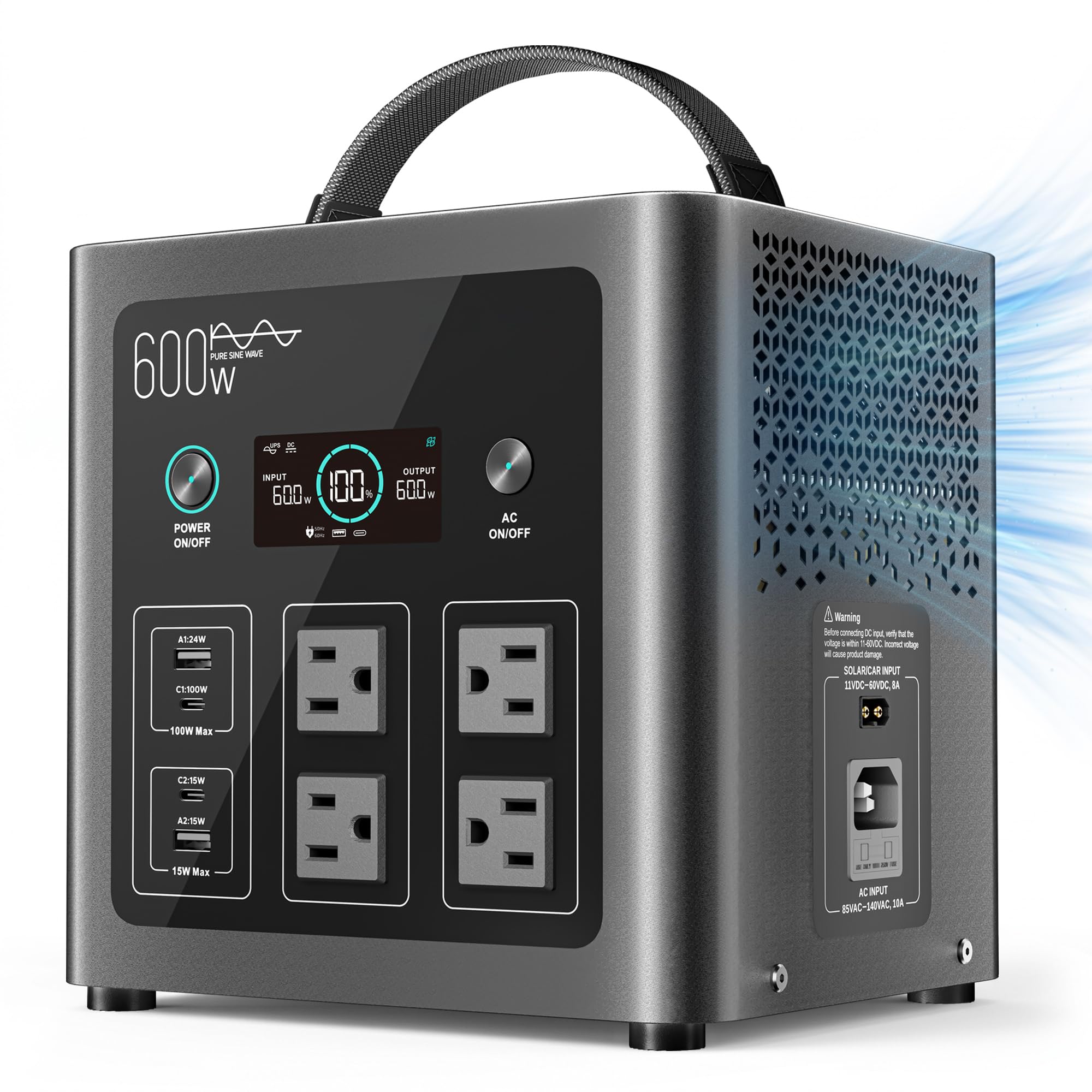
A sturdy metal box that slips into a trunk and keeps eight devices alive on a fishing trip.
This unit’s real strength is compactness. It holds 640Wh with 600W rated and 1,200W surge, and it weighs 16.3 pounds in a body the maker likens to a soccer ball. Four AC outlets plus USB and DC ports cover eight devices at once. That makes it the pick for a car trunk, an RV cupboard, or a small emergency shelf. A 10 ms UPS switchover (battery takes over almost instantly when grid power drops) protects a TV, router, or CPAP-style device.
The battery is automotive-grade LiFePO4 rated for more than 4,000 cycles while holding over 80% of original capacity, which the maker frames as up to 10 years of normal use. Recharging covers AC, solar over XT60, car port, or gas generator, and the fast-charging system refills it in as little as 1.5 hours. Reach for it on a fishing or camping trip where you need camp gear, heated pads, and electronics running alongside a compact metal shell that resists everyday knocks and drops.
What you give up is output ceiling. At 600W continuous you cannot run a demanding appliance like an electric heater or hair dryer, and that is the honest limit. A larger 2kWh station is the answer if that is the goal. But for a trunk box that charges fast and holds its capacity over years of cycles, this is a strong mid-tier pick. A 5-year limited warranty backs the purchase.
Where it earns its keep
- Ig 640Wh in a 16.3-pound soccer-ball-sized metal body fits a trunk or closet
- 4,000-cycle LiFePO4 battery holding 80% capacity
- 10 ms UPS protection for a TV, router, or sensitive device
- 1.5-hour fast charge on AC or solar through XT60
The ceiling to respect
- 600W continuous output rules out high-draw appliances like a heater
- 640Wh is a weekend of small devices, not a multi-day fridge
- Panels sold separately — the 640Wh solar top-up is an add-on order
Suits: travelers who want one metal box for phones, lights, a laptop, and a small fridge.
Does not suit: a buyer expecting to run a space heater or a full-size appliance off it.
10. EBL 500W Portable Power Station
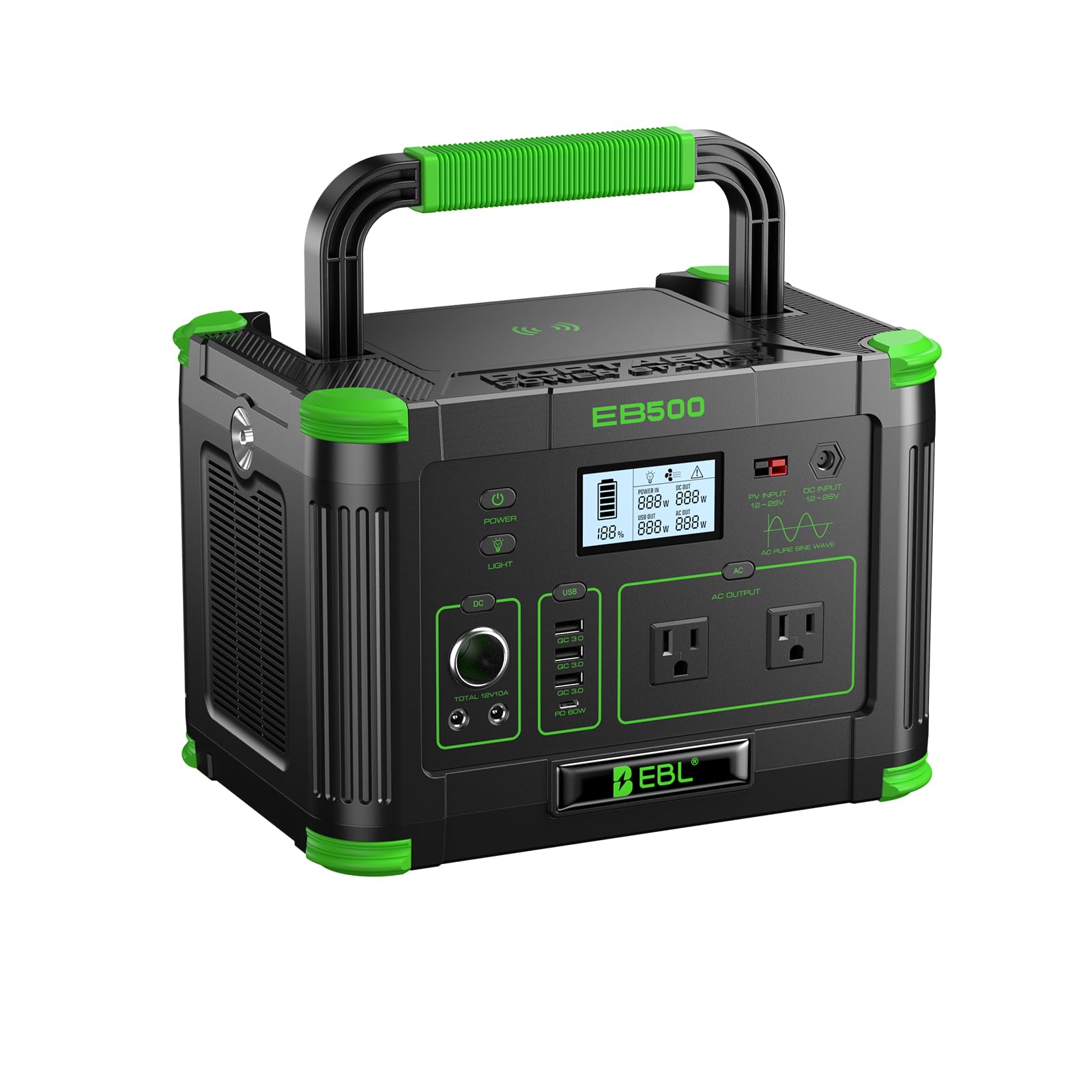
Ten ports in one 14.1-pound box, including a wireless charging pad on top.
Port count is the differentiator here. This unit packs 2 AC outlets, 3 USB-A QC 3.0 ports, a 60W USB-C PD port, 2 12V DC ports, a 12V car port, and a 10W wireless charging pad — ten connections from a single hub. Capacity is 519.48Wh from a 140,400mAh battery, with 500W continuous and 1,000W peak output. Pure sine wave AC keeps sensitive electronics safe, and the whole thing weighs 14.1 pounds.
Compare it straight to the BLUETTI up top and the trade-off is stark: 500W output against 2600W, and 519.48Wh against 2080Wh. You get a fraction of the power in an 14.1-pound body instead of a 44.5-pound one. What it does cover is real: laptops, a mini-fridge, a 32-inch TV for 4+ hours, and a smartphone charged over 40 times. Solar input accepts a 100W or 200W panel (sold separately), An MPPT controller (the part that squeezes more from a panel) extracts up to 30% more energy than a standard controller, even on cloudy days.
The honest trade-off is charging time. The 519.48Wh pack takes 6–7 hours on a wall outlet, 7–8 hours on a 12V car outlet, and 6–9 hours on solar, so this is a station you charge overnight rather than over lunch. There is a built-in 3W LED flashlight with strobe and SOS modes for roadside use, which is a genuinely useful addition for a car kit.
Ports everywhere: a 60W USB-C PD and a wireless charging pad in one hub turns a hotel room or campsite into a charging station.
The time cost: 6–9 hours on solar is a slow fill, so plan around overnight top-ups rather than quick bursts.
Pick it for: a car or tent kit where phones, laptops, and a small TV all need ports at once.
Look further if: you need high-output appliances — 500W will not start a coffee maker.
11. ZeroKor Portable Solar Generator

A tent-sized starter kit that includes the panel and two separate battery packs.
Two power packs in one box. You get a 280Wh station rated at 300W with a 40W folding solar panel, plus a separate 100W portable power pack with its own AC outlet. The big station carries 2 110V/300W pure sine wave AC outlets, a DC port, 3 USB ports, a QC 3.0 USB port, and a flashlight with reading and SOS modes. The 100W pack adds 2 AC outlets, a DC port, USB ports, a QC USB, and a USB-C port.
Both packs run a battery management system that guards against short circuits, over-current, over-voltage, and overload, and the gas-free, low-noise design means no fumes in a tent. The flashlight modes are the kind of small touch that earns its keep on a night hike. Build quality has an honest limit here: the manual is clear that running appliances over 300W may damage the 300W station, and devices with a built-in compressor or heating element are specifically called out as a risk.
That warning matters most for a reason: 280Wh is a small tank, and a 40W panel is a slow fill. This is the entry-level kit for phones, tablets, laptops, and headphones on a weekend, not for a fridge or a heater. If you want to run real appliances, the 2kWh units above are the safer route. As a first solar kit with panels included and a second power bank in the box, it is a sensible entry point.
What the starter kit solves
- Two power packs (280Wh and 100W) in one box
- 40W foldable solar panel included with the station
- Built-in BMS protection against overload and short circuits
- Flashlight with reading and SOS modes for outdoor use
What it will not do
- 280Wh is a light load — phones and laptops, not fridges
- 300W ceiling rules out heaters, coffee makers, and hair dryers
- The 40W panel means a slow solar recharge
Starter set for: tent campers and first-time buyers who want panels included and two battery packs in one order.
Understand first: the 300W limit is real — anything with a compressor or heating element is off the table.
Know the Specs
Watt-Hours (Wh) — the size of your fuel tank
Watt-hours measure stored energy: how much total power the battery holds before it needs recharging. A 519.48Wh unit and a 2,048Wh unit both run a mini-fridge, but the bigger one runs it several times longer between charges. Add up your overnight loads, then buy roughly double that in Wh so the pack is never fully drained. The single most common buying mistake in this category is choosing on output watts and ignoring capacity.
AC Output and Surge — what can start, not just run
Continuous AC output is the wattage feeding your normal wall plugs. Surge (or peak) output is a short burst above that figure, and it is what lets a fridge compressor or a power tool motor get moving. A 600W continuous unit with 1,200W surge handles small compressors. A 3,600W unit with 7,200W surge starts microwaves and power tools. X-Boost is a related trick that lifts base output for motor loads without tripping the overload protection.
Solar Input and Panel Count — how fast the sun fills it
Solar input is the maximum panel wattage the station accepts, and it sets your real recharge time. Two 200W panels give you 400W of input; a single 40W folding panel gives you a fraction of that. Some kits include panels and some do not, and panel-included kits often ship the panel in a separate box on a different day. If you buy a bare station, price the panels into your real budget before deciding.
LiFePO4 Cycle Life — the number that decides your decade
LiFePO4 (lithium iron phosphate) is the long-life battery chemistry and almost every pick here uses it. The spec to watch is cycle count: how many full charge-and-discharge rounds the pack survives before capacity drops. Ratings range from 800+ cycles up to 10,000 cycles, and that spread is the difference between replacing a battery in a few years and owning one for the long haul. Higher cycle ratings usually come with more weight, which is the trade-off every buyer faces.
UPS Switchover — what happens when the grid blinks
A UPS (uninterruptible power supply) mode means the station swaps to battery automatically when wall power cuts out. The number that matters is the transfer time in milliseconds. Under 10 ms is fast enough that a computer or router keeps running without a reboot. A 20 ms switchover covers most household devices fine. Anything with a hard drive or a router benefits from the fastest figure you can get.
Idle Draw and Weight — the two practical costs
Idle draw is how much power the station wastes just sitting switched on, and it is usually written in watts. A 3W standby draw lets a box sit ready for weeks; a higher figure drains it faster between uses. Weight decides whether the station lives in one spot or travels. At 14.1 pounds it goes in a car trunk; at 67.5 pounds it wants a cart or a fixed home near the door. Neither figure appears on the marketing headline, and both shape daily use.
Common Questions
How many watt-hours do I need to run a refrigerator during an outage?
Can I charge a portable solar generator directly from a solar panel without a wall outlet?
What is the difference between continuous watts and surge watts on a power station?
Is LiFePO4 better than a standard lithium battery for a solar generator?
How long does solar charging actually take on a portable power station?
Will a portable solar generator run a CPAP machine overnight?
Can I use a portable power station indoors during a power outage?
Do I need to add a second solar panel to reach full charging speed?
Does a portable solar generator work during cold weather or in freezing temperatures?
Why do some solar generator kits ship the panels in a separate box?
The Bottom Line
For most households, the portable solar electric generator that balances output, panels, and lifespan is the BLUETTI Elite 200 V2. It pairs 2080Wh of storage with 2600W continuous output and ships with two 200W panels, so the solar side is solved in one kit. If you want the smallest footprint and the longest lifespan on a 2kWh-class box, reach for the Anker SOLIX S2000 with its 10,000-cycle rating. And if the goal is riding out a multi-day blackout with the fridge running, the EF ECOFLOW DELTA 3800 Gen4 is the one to reach for.
One honest nudge before you decide: the BLUETTI Elite 300 comes with its solar panel included, so RV owners get a quieter upgrade with no extra panel to buy. Its 3kWh capacity (3,000 watt-hours, the total energy it stores) sits in the smallest body in its class, which makes it the smartest camper combination in this list. Whichever pick you land on, check your watt-hours before you buy — that single number decides how long you stay powered.
How we choose
We do not accept paid placement. Every pick is matched to a real buyer and a real use-case; we do not hands-on test units.
Sources
Specifications: manufacturer listings and product documentation. Review insights: verified customer reviews, as of November 2026. Pricing: not shown on this page (it changes often); check the current price via the retailer link.
As an Amazon Associate, Tactical Gear Guy earns from qualifying purchases. This does not affect which products we feature.