Specs are compiled from manufacturer listings and verified buyer reviews and can change over time — please confirm the key details on the product page before buying.
The short answer: buy the biggest solar-charged battery your back and your budget can handle, because the capacity you leave at home is the capacity that never helps you. A portable solar battery is a battery box you can carry, plug a solar panel into, and run a fridge, a router, or a CPAP machine from when the grid quits. Most buyers get this wrong in the same way — they buy on wattage alone and ignore the two numbers that actually decide whether the thing works: the solar input limit (how fast the sun can refill it) and the weight (whether you can lift it into the truck bed).
This guide is built by comparing the manufacturers’ published specifications and the patterns across verified customer reviews, so you get each pick’s real strengths and trade-offs instead of marketing spin.
Below you will find the units that survive real outages and real campsites, sorted by what they actually do well. This breakdown of the best portable solar battery covers solar recharge speed, usable capacity, and honest carry weight for each pick.
Top Picks
How To Choose The Best Portable Solar Battery
A portable solar battery lives or dies on three things: how much energy it stores, how fast a panel can refill it, and whether you can physically move it. Get those three right and everything else is detail. Get them wrong and you own an expensive brick that sits in the garage.
Capacity in watt-hours is the real fuel tank
Watt-hours (Wh) tell you how long a load runs. A 1,024Wh unit running a 100W device gives you roughly ten hours of runtime on paper, minus inverter losses. For a weekend campout, small packs in the 192Wh to 257Wh range cover phones, lights, and a laptop. For a fridge through a blackout, you want a unit in the 2,000Wh class. Match the tank to the job, not to the brochure.
Solar input watts decide how fast the sun refills it
The solar input rating — the maximum watts of panel the unit will accept — is the spec serious off-grid buyers check first. A 60W solar input on a small pack means a slow trickle. A 400W input on a 2kWh station means a full tank in a single good day of sun. If you plan to live off the panel rather than the wall, buy the highest solar input you can afford.
Rated watts versus surge watts
Rated watts is the continuous power the inverter holds. Surge watts is the brief spike a motor draws at startup — a fridge compressor or a power tool. A unit rated at 300W with a 600W surge starts small motors that a plain 300W rating would trip on. Check both numbers before you plug in anything with a compressor.
Battery chemistry and cycle count
LiFePO4 (lithium iron phosphate) is the chemistry to look for now. It holds up to far more charge cycles than older lithium-ion packs and tolerates heat better. Cycle counts in the data range from 1,500 charges on an entry unit to 10,000 on a premium one. If you plan to cycle the battery daily, that number matters more than peak output.
Carry weight and form factor
Every watt-hour adds pounds. A 257Wh pack can weigh 4.6 lbs; a 2,080Wh station weighs 44.5 lbs. Decide up front whether this battery rides in a backpack or lives in the garage on a shelf. Built-in wheels and foldable handles only appear on the heavy end of the range.
Side-by-Side Comparison
| Model | Best For | Capacity | AC Output | Weight | Amazon |
|---|---|---|---|---|---|
| BLUETTI Elite 200 V2 + 2x200W Panels★ Best Overall | Whole-home backup with panels included | 2080Wh | 2600W (3900W lifting) | 44.5 lbs | Amazon |
| DaranEner NEOZ2 192WhSmall-Pack Standout | Budget camp and boat power | 192Wh | 300W (600W peak) | 5.7 lbs | Amazon |
| Bailibatt 257WhFeatherweight Pick | Featherweight backpack power | 257Wh | 300W (600W surge) | 5.4 lbs | Amazon |
| Anker SOLIX S2000 | Fridge backup in a compact shell | 2,010Wh | 1,500W (3,000W peak) | 35.7 lbs | Amazon |
| Jackery Solar Generator 1000 v2 | Camping with a panel in the box | 1,024Wh | 1,500W (3,000W peak) | 23.4 lbs | Amazon |
| EcoFlow DELTA 3 Max | Fast wall charging and RV duty | 2048Wh | 2400W (3400W X-Boost) | — | Amazon |
| Jackery Explorer 2000 v2 | Quiet home backup and UPS duty | 2042Wh | 2200W | 39.5 lbs | Amazon |
| Anker SOLIX C2000 Gen 2 | RV hookups and fast solar fills | 2,048Wh | 2,400W (4,000W peak) | 41.7 lb | Amazon |
| EcoFlow DELTA 3 Ultra | Heavy appliance and power-tool loads | 3072Wh | 3600W (7200W surge) | 72.1 lbs | Amazon |
Detailed Reviews
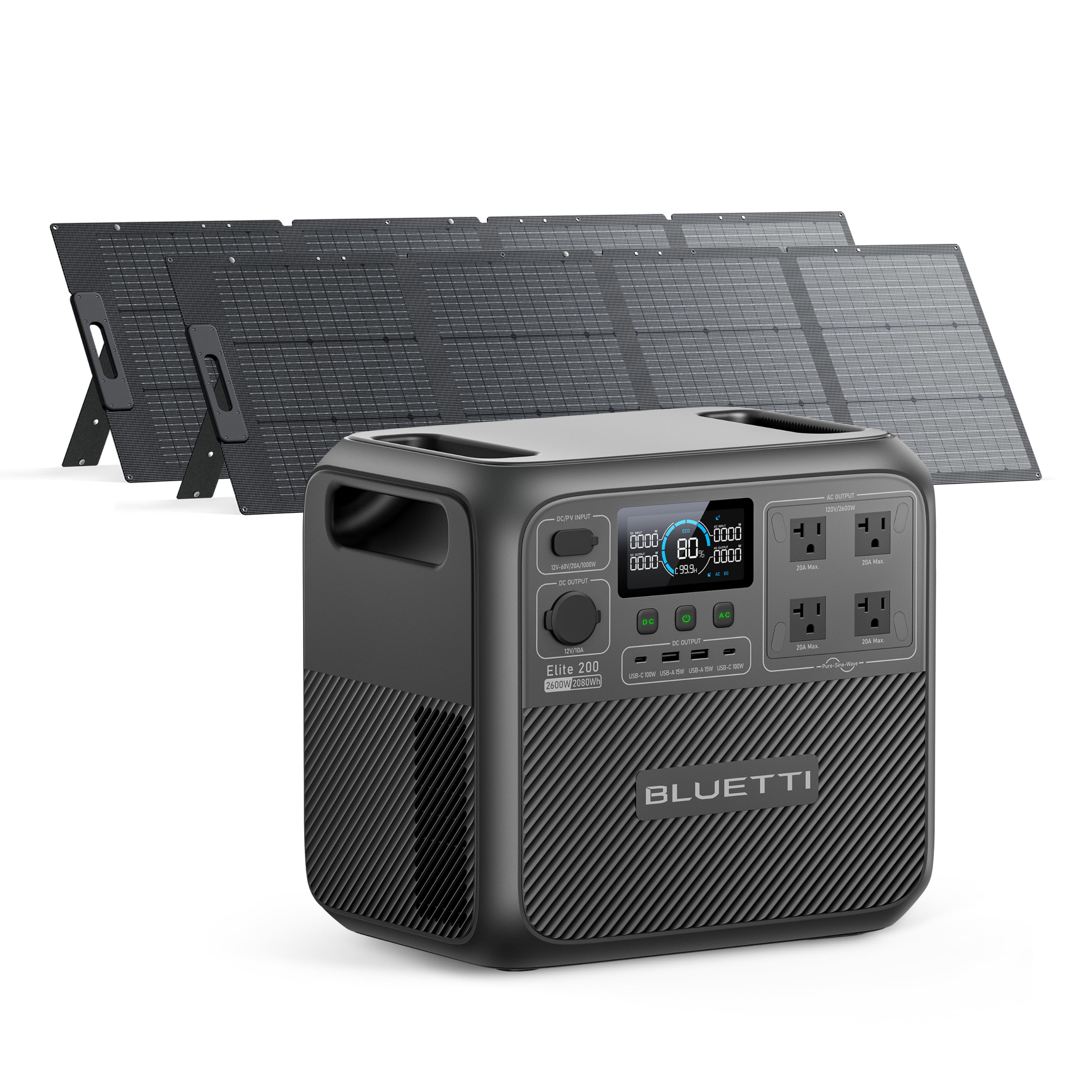
1. BLUETTI Elite 200 V2 Solar Generator
Our pick — 4.5+★ from 950+ verified ratings; the strongest balance of quality and price.
Two panels in the box, 2080Wh in the tank — a blackout kit that arrives complete.
The number that justifies top spot is the bundle itself: a 2080Wh power station plus 2x200W solar panels, so 400W of sun feeds it and a full solar recharge takes 5.5 hours. Compare that with the DaranEner’s 192Wh and 60W solar input — this BLUETTI carries 2080Wh against 192Wh, and its 2600 watts of continuous AC dwarfs the DaranEner’s 300 watts. For a house that loses power for days, that gap is the whole ballgame.
Runtime and longevity are where owners get genuinely attached to it. The LiFePO4 pack is rated for over 6,000 cycles and a 17-year lifespan of everyday use, and its 10W standby draw is low enough that a 120V 60W fan runs 11 days on a 3-hour-a-day schedule. Buyers report its 2600-watt inverter handles appliances like refrigerators through a 24-hour outage, and it can take up to 1000 watts from a properly designed PV array. The 3900W power lifting mode is what lets it start high-demand gear like hair dryers and coffee makers.
The catch is weight, and the numbers are honest about it. At 44.5 pounds and measuring 13.78″L x 9.84″W x 12.74″H, this is a garage-and-patio battery, not a backpack one. Wall charging is quick — 0-80% in 50 minutes with dual AC and DC — but you feel every one of those 44.5 pounds on a set of stairs. Think of it as a stationary home backup that can travel in a truck, not a camp gadget you sling over a shoulder.
Where It WIns Outright
- 2080Wh capacity with 400W of included solar panels — a complete off-grid kit in one purchase
- 2600W continuous and 3900W lifting power runs fridges, coffee makers, and hair dryers
- Over 6,000 cycles on the LiFePO4 pack, with just 10W standby draw wasting almost nothing
- Recharges 0-80% in 50 minutes on dual AC and DC
The Real Friction
- 44.5 lbs means it stays where you put it — this is not a hike-and-carry battery
- The two 200W panels ship separately, so the kit arrives in more than one box
Buy this when: you want one purchase to cover a multi-day home outage and you have a garage or covered patio to keep it in.
Think twice if: you need to carry the battery up stairs regularly — 44.5 lbs gets old fast.
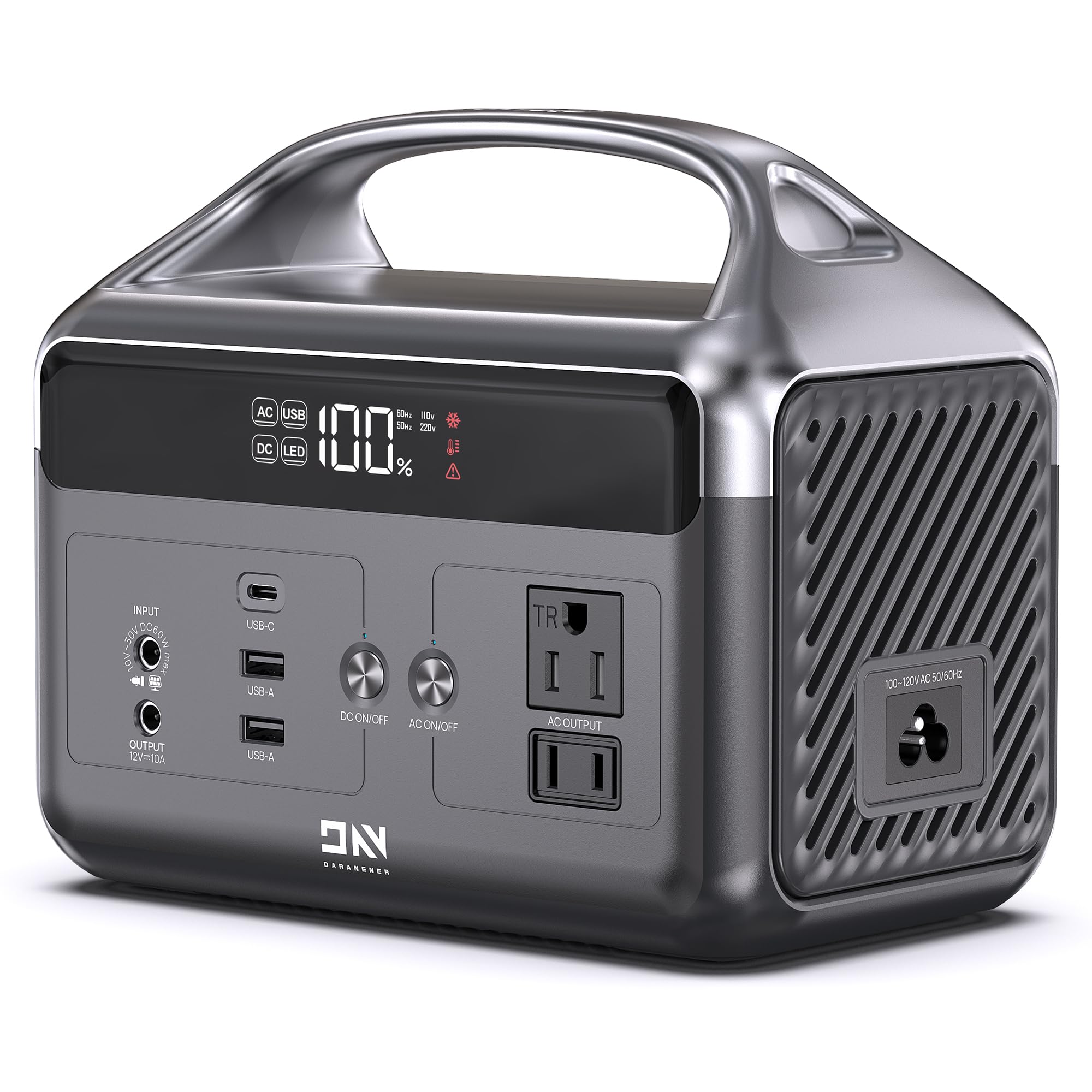
2. DaranEner Portable Power Station, 192Wh LiFePO4
A toaster-sized pack that keeps the boat electronics alive and shrugs off a 2-day campout.
If your power need is a phone, a laptop, a fan, and a CPAP machine rather than a fridge, this is the sane entry point. It stores 192Wh and puts out 300W continuous with a 600W surge through pure sine wave, which is enough for sensitive electronics and small motors but honest enough to tell you up front it will not run a rice cooker, hair dryer, or mini-fridge. The 5.73-pound body and toaster-scale footprint are what buyers keep talking about — it disappears into a boat locker or a tent corner.
Solar matters here more than raw capacity: a 60W max DC solar input with a built-in MPPT controller (the circuit that squeezes the most wattage out of a panel) means you can trickle-fill from a folding panel off-grid. For comparison, the Anker SOLIX S2000 takes 400W of solar input — this pack’s 60W is a fraction of that, so expect slow panel days. The LiFePO4 cells are rated for 3500+ cycles, roughly double the 1,500-cycle entry-level packs in this roundup.
Sensible maintenance is baked into the manual: two full charge-and-discharge cycles when it arrives, and a recharge every 1-2 months when idle. Owners mention it worked well on a 2-day camping trip, and the built-in LED flashlight with 4 brightness modes including SOS earns its keep in a blackout. The compact 8.66″L x 7.09″W x 5.12″H shell fits on a shelf without dominating it.
What seals it: 192Wh, dual 300W AC outlets, USB-C PD 60W, and a 6-device ceiling make this a complete small-load hub, and the LiFePO4 chemistry is a real upgrade over older lithium-ion packs at this size.
What to keep in mind: solar panels and the car charging cable are not in the box, so budget for a panel separately if off-grid refill is the point.
Reach for this if: your loads are small, your storage is tight, and you want LiFePO4 cycle life without a heavy unit.
Look elsewhere if: you plan to run anything with a compressor — 300W continuous will trip.
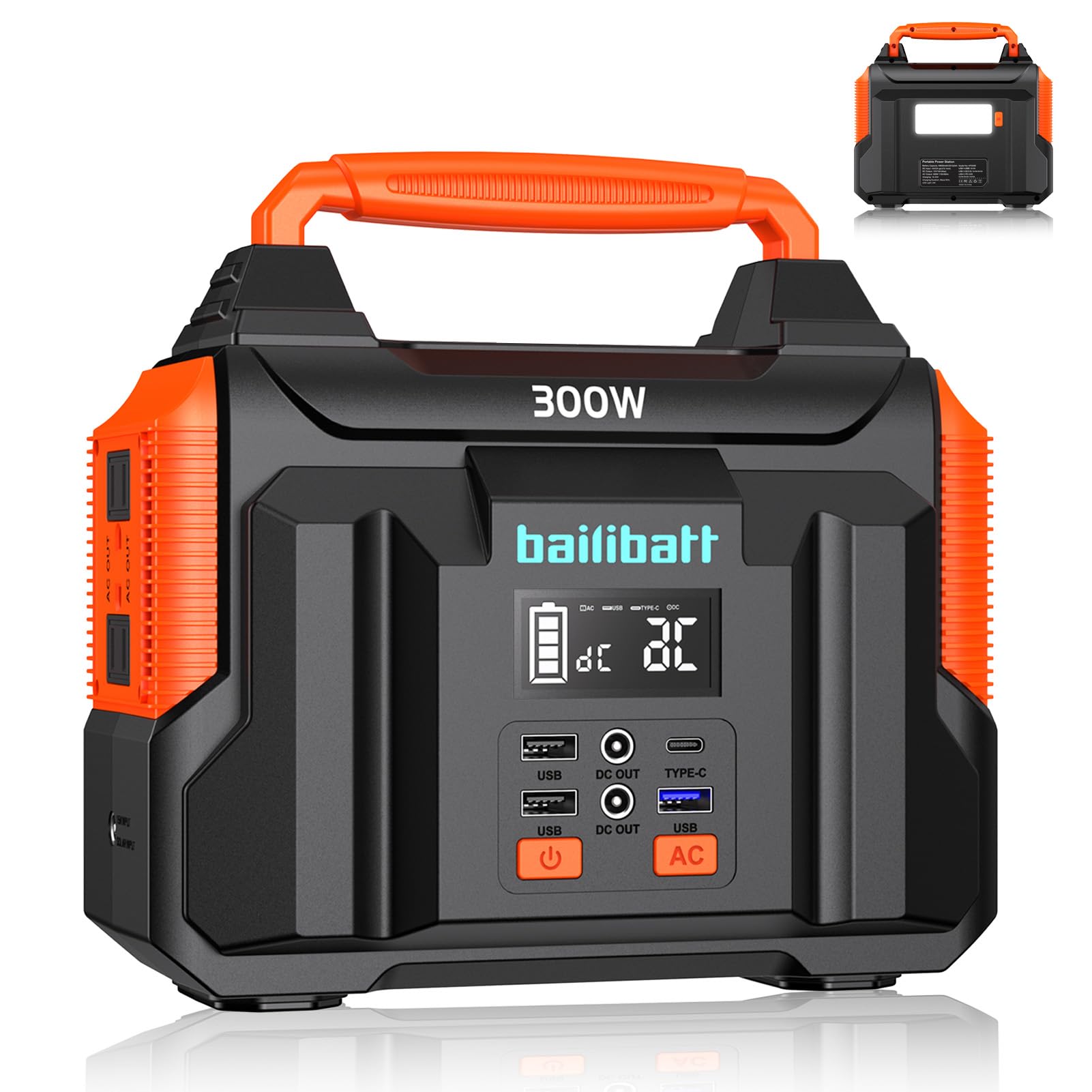
3. Bailibatt Portable Power Station 600W Surge, 257Wh
At 4.6 pounds, this is the pack that goes in the daypack without a second thought.
The 4.6-pound body is the headline, and it changes how you use a battery like this. It measures 8″L x 4″W x 6.5″H — small enough to slot into a backpack side pocket, and the spec sheet backs up the portability claim with a built-in 69,600mAh pack. Compare the bulk: the BLUETTI Elite 200 V2 runs 13.78″L x 9.84″W x 12.74″H, so this Bailibatt is roughly a third of that footprint in every direction and a tenth of the weight, which is the whole point of a carried battery.
Ports are generous for the size: 8 outputs total, including 2x120V pure sine wave AC outlets, dual DC 12V/10A ports (120W total), USB-C PD (24W), QC3.0, and 2 USB-A ports. The 257Wh Grade-A pack supports 1500+ charge cycles, and an LCD screen shows operating status, voltage, current, and temperature at a glance. Customers note devices charge quickly and it fits easily in a backpack, and one buyer says it can charge a phone up to six times on a single charge.
Three recharging routes — AC wall adapter, 12V car outlet, or solar panels sold separately — cover the realistic cases. The trade-off worth knowing is that this is a small-load hub, not a fridge battery: total load is capped at 300W, and solar accessories are not included. For hiking, hunting, and blackout top-ups for phones and lights, that is a fair limit. It has no business running a mini-fridge.
The case for it: 257Wh and 8 ports in a 4.6-pound shell is a lot of battery per ounce, and the 1500+ cycle rating gives it real staying power for the trail.
Bear in mind: the solar panel and car charging cable are sold separately, so the solar side is an add-on, not a kit.
It beats the heavier packs on: carry weight and port count — 4.6 lbs against the DaranEner’s 5.7 lbs, with 8 outputs versus 6.
It falls short on: total load, capped at 300W, so high-draw appliances stay out of reach.
4. Anker SOLIX S2000 Solar Powered Generator, 2,010Wh
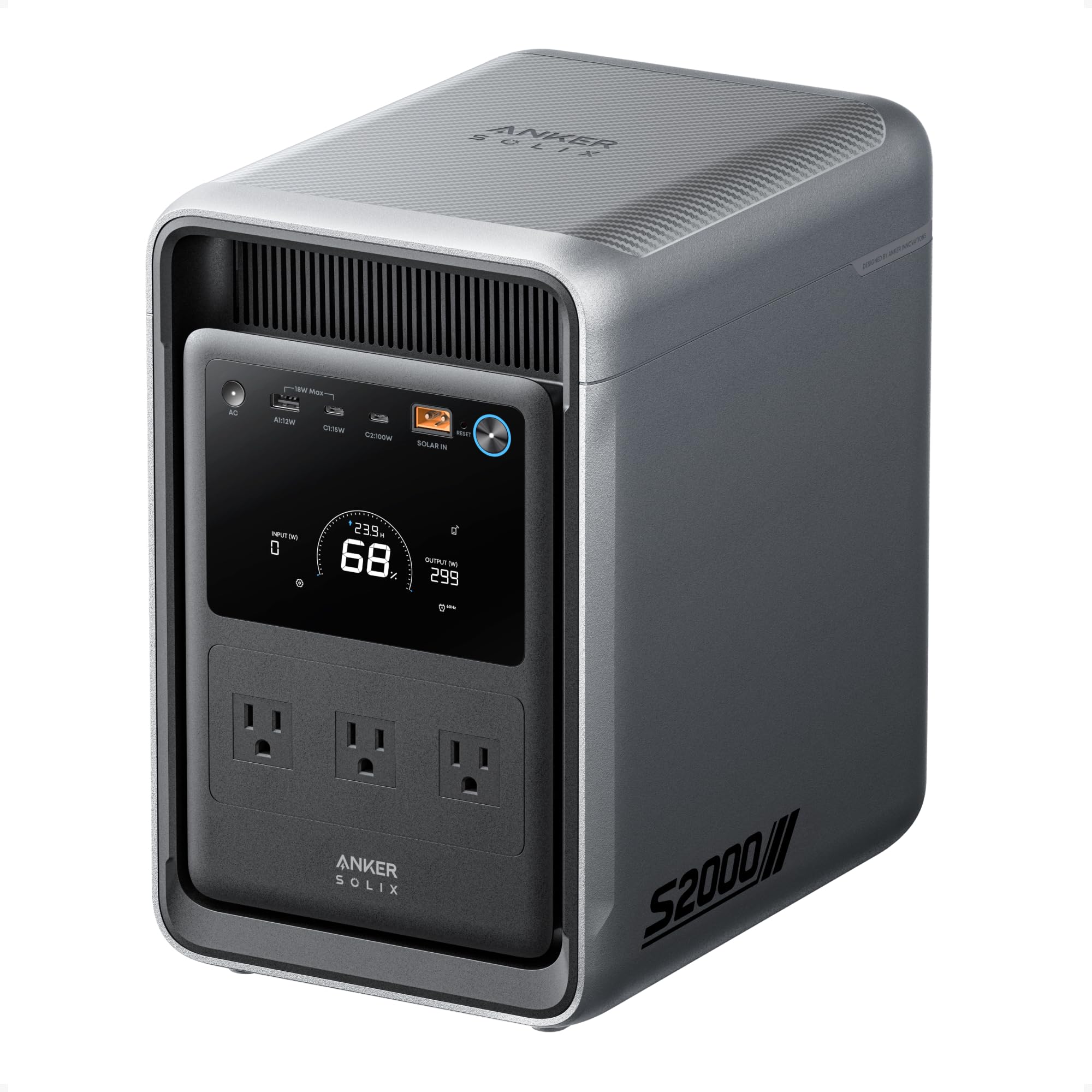
A 2,010Wh fridge battery that weighs 35.7 pounds — the number that makes the class work.
Thirty-five point seven pounds is remarkable for a 2kWh-class station, and the rest of the sheet is tuned to match. A 6W idle draw and a 10% higher efficiency claim stretch its runtime past other 2kWh systems, and the spec sheet says a full-size fridge gets 35 hours of backup. That 6W idle figure is the quiet hero: every watt saved at idle is a watt that goes to the fridge instead of the inverter.
The LiFePO4 cells are rated at 10,000 charge cycles and a 15-year lifespan — the longest cycle rating in this roundup, against the 10-year lifespans claimed by the EcoFlow DELTA 3 Max and Jackery Explorer 2000 v2. Solar input tops out at 400W, versus 60W on the DaranEner — a meaningful gap if you plan to live off a panel. Six recharge routes (AC + solar, wall, generator, solar panels, alternator charger, car outlet) mean you are never stuck without a way to fill it.
The counterweight to all that is simple: no 12V DC port. There are 8 outlets split front and rear and a sub-10ms UPS switchover for a home office, but if your gear runs on a 12V car-style plug, you will need an adapter.
What makes it click: 2,010Wh of LiFePO4 in a 35.7-pound body with a 10,000-cycle claim and a 35-hour fridge runtime — that is the whole home-backup brief, solved.
The honest asterisk: no 12V DC port anywhere on the unit, and the 8.2 × 11.1 × 12.7 in body is compact but not pocketable.
It suits: the household that wants a fridge and a router to survive a multi-day outage with minimal fuss.
Pass it by if: your kit runs on 12V DC plugs, since this one leaves that port off entirely.
5. Jackery Solar Generator 1000 v2 and 100W Solar Panel
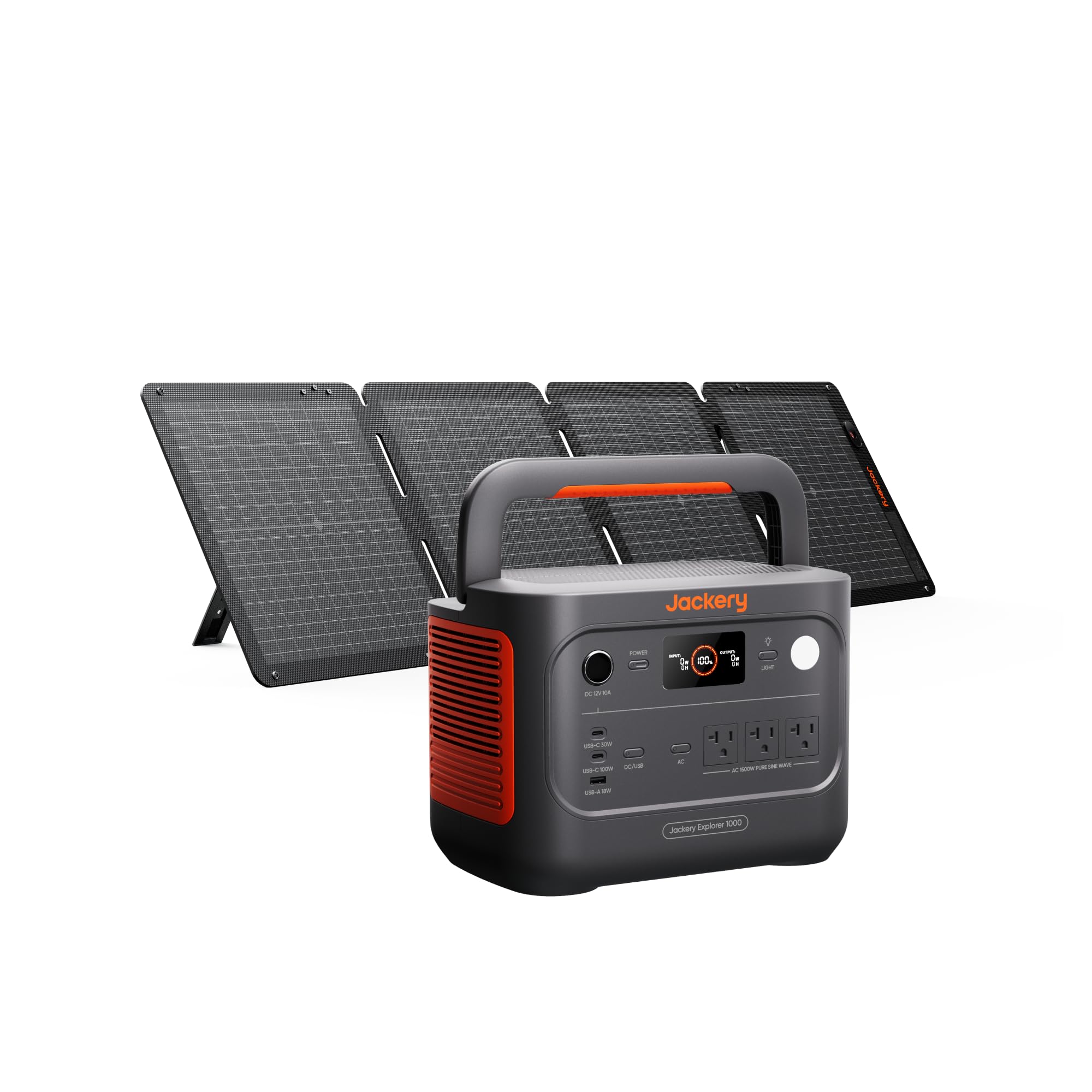
A 1,024Wh pack with a panel in the box and a 50-minute charge when you need it fast.
Bundle convenience is the opening argument here: the 1,024Wh Explorer 1000 v2 and a 100W solar panel ship together, so the solar side is complete from the start. The 1,500W AC output with a 3,000W surge handles AC units, fridges, and electric pots, and the LiFePO4 battery keeps over 70% of its original capacity after 4,000 charge cycles. Compared with the Anker SOLIX C2000 Gen 2’s 58-minute full charge, the Jackery’s headline number is a 50-minute 0-100% charge — but only with emergency charging switched on in the Jackery App, and only after you enable it before each charge. Default mode is 1.25 hours.
That app control is where the daily practicality lives. Silent overnight charging runs at 30 dB, and you can switch modes without touching the unit. The 10ms UPS switchover is the fastest in this roundup alongside the EcoFlow DELTA 3 Max’s 10ms, so sensitive devices keep running through an outage. Reviewers point out it powers a mid-sized fridge for most of the day and charges to 50% after 7 hours in the sun — realistic panel numbers rather than lab fantasy.
At 23.4 pounds with a foldable handle, the carry story is friendly. It measures 12.34″L x 7.91″W x 9.19″H, which means it fits in a car trunk without a fight. The honest note: 50 minutes needs the app enabled each time, so the fast charge is a deliberate action rather than the default, and the panel and generator ship in separate boxes, so expect two tracking numbers.
Standout move: a panel in the box, 23.4 pounds to carry, and a fast-charge mode that beats its own default by over half an hour.
Trade-off to plan around: the emergency charge must be armed in the app before every session, or you get the 1.25-hour default instead.
This one’s for: campers and road-trippers who want the panel handled for them and a carry weight they can live with.
Consider the bigger pick instead if: you need to run a fridge for days, since 1,024Wh gives hours, not days.
6. EF ECOFLOW DELTA 3 Max Portable Power Station
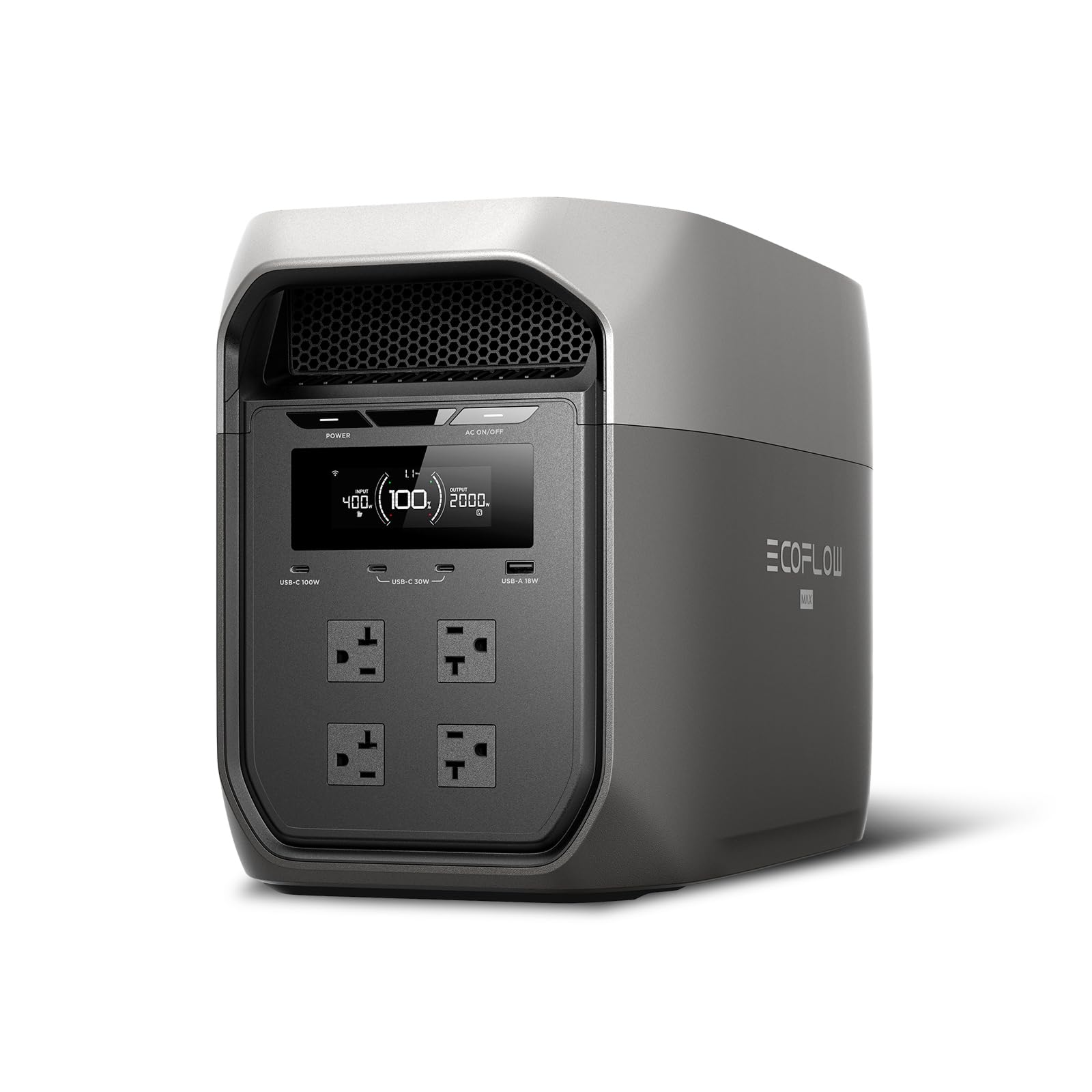
A 2048Wh station that refills 0-80% in 1.13 hours — the wall-charge king of the list.
Speed is the argument for the DELTA 3 Max: X-Stream technology takes it from 0 to 80% in 1.13 hours, which is the fastest AC recharge figure in this roundup. That matters when a storm forecast puts you on the clock. Its 3400W X-Boost mode runs high-demand appliances including fridges, microwaves, and power tools, and the 2048Wh LiFePO4 battery carries a claimed 10-year daily-use lifespan.
The subtitle matters for the backup crowd: a sub-10ms transfer time with quiet operation means it can act as a UPS for computers and sensitive gear, and the EcoFlow app lets you schedule charging and discharging to cut energy costs. Shoppers say it can run all day without issues and power a TV for about 12 hours. The quality and reliability praise is the heaviest in the review pages, which fits a pack built around a 2048Wh LiFePO4 core.
Portability is the honest weak spot: the body measures 9.4″L x 12″W x 19.44″H, and the weight column in the spec sheet is left blank. This is a two-hands-with-bent-knees lift, not a one-armed carry. Solar panel is optional rather than included, so the solar path costs extra.
Why it earns its tier: the 1.13-hour 0-80% charge and 3400W X-Boost output make it a backup that is ready when you are, and the LiFePO4 core is rated for 10 years of daily use.
Worth knowing: no solar panel in the box, and the 19.44-inch height means it lives on a floor or shelf rather than a shelf cubby.
The pick for: RV owners and preppers who want to be ready within two hours of deciding to be ready.
Not for: off-grid buyers expecting panels in the box — solar is a separate purchase here.
7. Jackery Explorer 2000 v2 Portable Power Station, 2042Wh

Silent charging at 30dB and 20ms UPS switching — a backup that stays out of earshot.
Jackery built this one around discretion. Silent Charging mode fills the 2042Wh battery in 5 hours at 30dB, which is roughly a library whisper, and smart temperature control adjusts fan speed to keep it that way. For a unit that lives in a bedroom or a small apartment, that spec is worth more than peak watts. The 2,200W output with three AC ports and USB-C PD 100W covers home backup, camping, and small-business duty.
Two charge paths deserve attention. Standard AC fast charging takes it 0-80% in 66 minutes, while the Emergency Super Charging mode via the app reaches a full charge in 102 minutes; solar takes as few as 6 hours with 400W panels. The LiFePO4 battery is rated for up to 10 years, and the 20ms UPS switchover keeps essentials running through storms. That 20ms is twice as slow as the 10ms switchover on the Jackery 1000 v2 and the EcoFlow DELTA 3 Max, so if millisecond timing is critical for a medical device, that fact matters.
Weight sits at 39.5 pounds — manageable for a 2kWh-class unit, and the CTB (Cell-to-Body) construction borrowed from EV design keeps the frame compact. Buyers report it powers a fridge for several hours on a full charge and charges fully within 60 minutes. It is UL1778 tested for Uninterruptible Power Systems, which is exactly the certification a home-office buyer should want to see on the label.
Where it digs in: the 30dB silent charge mode, 20ms UL1778-tested UPS switching, and a 2042Wh LiFePO4 core make it a backup you can live next to.
Worth flagging: the 20ms switchover is slower than the 10ms units in this list, so critical devices need a closer look.
Reach for this if: quiet operation and a certified UPS matter more to you than the absolute fastest switchover.
skip it if: your gear needs the tightest millisecond protection — the 10ms units above are the better fit.
8. Anker SOLIX C2000 Gen 2 Solar Powered Generator, 2,048Wh
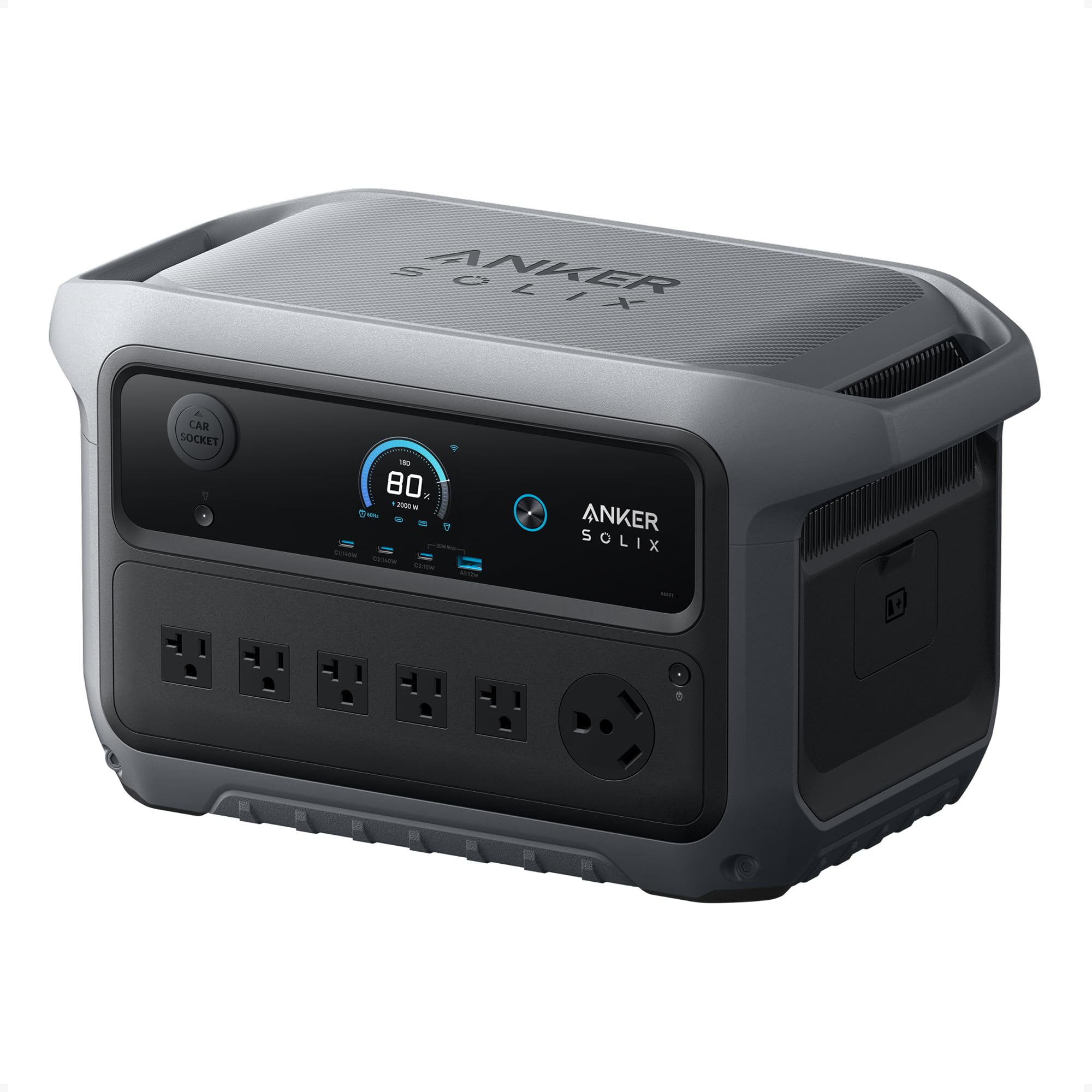
A TT-30 RV socket and 4,000W peak — this is the one built for trailer life.
If you tow a trailer, the TT-30 port is the reason to read this entry first. That socket is the standard 30-amp RV hookup, so you can power the whole rig without an adapter chain. The 2,400W rated and 4,000W peak output handles most window and RV A/C units, and the 2,048Wh LiFePO4 core reaches 4kWh expandable when you add an expansion battery — which, per the spec sheet, runs a dual-door fridge for up to 64 hours.
The recharge math is equally strong. Six ways to recharge reach 100% in 58 minutes on AC and solar combined, and the 800W UltraFast alternator charging fills it in 3 hours from a car. That is the fastest vehicle-based recharge on this list. A 9W idle draw lets it power a portable fridge for 7 days or a dual-door fridge for up to 32 hours. Compared with the BLUETTI Elite 200 V2’s 10W standby, the 9W figure is one watt leaner — small on paper, real over a week of camping.
At 41.7 pounds and 18.1 × 9.8 × 10.1 inches, it is 25% lighter and 29% smaller than similar products per the manufacturer, and the flat shape slides into an RV bay without trouble. Owners mention it ran a 10,000 BTU AC unit through the night and powered a TV, fridge, and WiFi for over 10 hours.
The defining feature: a native TT-30 RV port, 4,000W peak, and 800W alternator charging make this the most RV-ready unit in the roundup.
The trade: that 4kWh figure only comes with an add-on expansion battery, so plan for a second purchase.
It wins for: trailer owners who want a single box that handles the A/C and recharges from the tow vehicle.
Look at the S2000 above instead if: you want the smallest possible 2kWh shell and do not need the RV socket.
9. EF ECOFLOW Delta 3 Ultra 3072Wh Portable Power Station
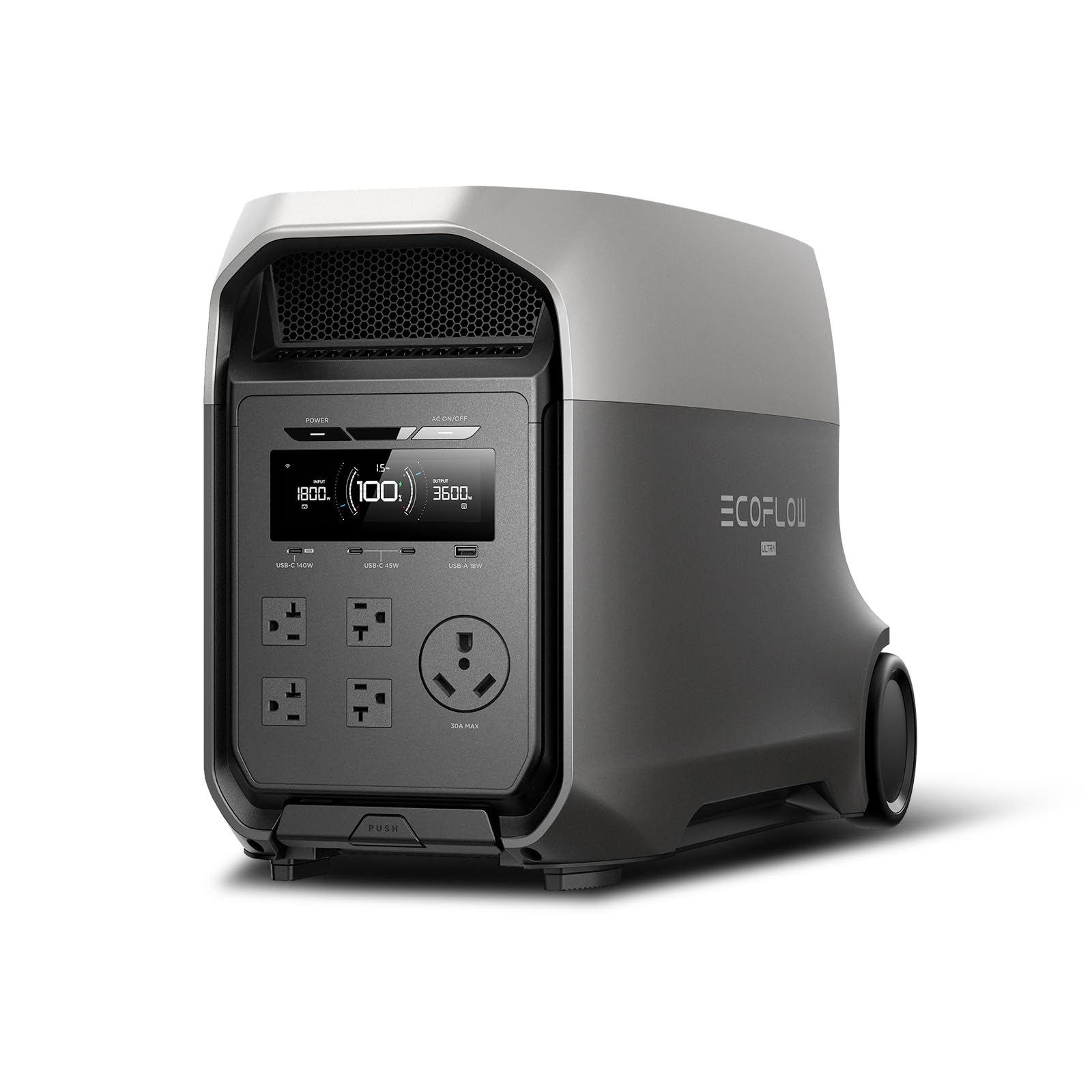
3,072Wh and 3,600W continuous — power tools and heaters without a second thought.
The biggest numbers in the roundup sit here: 3,072Wh of capacity and 3,600W continuous output with a 7,200W surge. Set those against the DaranEner’s 192Wh and 300 watts and the scale difference is the entire reason this unit exists. X-Quiet 3.0 cooling keeps it at just 25dB under load, making it the quietest high-output unit on the list, and a sub-10ms UPS switchover keeps PCs, routers, and medical equipment running without a manual step.
Capacity buys runtime, and browsers here get a real picture. A fridge runs through outages for extended periods, and the built-in wheels make movement manageable despite 72.1 pounds. The LiFePO4 battery is rated for 10 years of daily use with an EV-grade CTC structure and 24/7 protection, and four charge routes — wall outlet, solar panels, car input, or EcoFlow Smart Generator — cover the realistic top-up methods. A 100% recharge takes about two hours of wall power.
The honest ceiling is weight and value. At 72.1 pounds and measuring 24.6 x 12.9 x 15.6 inches, it is a garage appliance, not a camp carry. It also occupies the premium tier, and the value-for-money aspect in its own reviews reads mixed rather than glowing — the power is real, but so is the outlay.
Where it dominates: 3,072Wh, 3,600W continuous with 7,200W surge, and 25dB operation — a power-tool and heater solution that stays quiet.
The honest limit: 72.1 pounds with wheels is a floor-bound unit, and three outlets means some juggling.
It suits: contractors, off-grid cabins, and homes that need to run power tools and heaters, not just a fridge.
Not the one if: you want something you can move by hand regularly — wheels help, but 72.1 pounds is still 72.1 pounds.
Know the Specs
Watt-hours versus rated watts
Watt-hours (Wh) is the size of the fuel tank — how much total energy the battery stores. Rated watts is the width of the pipe — how much power it can push out at once. A 2,042Wh unit can run a 100W load for roughly twenty hours on paper, but its 2,200W rating is what lets it start a fridge compressor in the first place. Buyers who focus only on capacity often end up with a big tank and a pipe too narrow for their appliance. Check both, and check the surge rating too, because a compressor can briefly pull double its running wattage at startup.
Solar input watts and MPPT
The solar input rating is the maximum wattage of panel a unit will accept — the recharge speed on sunshine. A 60W input means you can trickle from a small folding panel; a 400W input means a full day of sun can refill a 2kWh station. MPPT (maximum power point tracking) is the controller that constantly adjusts the panel’s electrical load to squeeze the most watts out of changing light. Without MPPT, a panel’s real output drops noticeably under clouds or partial shade. If you plan to charge off-grid rather than from a wall, the solar input number is the first spec to compare.
LiFePO4 chemistry and cycle life
LiFePO4 (lithium iron phosphate) is a battery chemistry that trades a little energy density for a lot of durability. Cycle life is the number of full charge-and-discharge cycles a battery survives before its capacity drops below a usable level, and the data here ranges from 1,500 cycles on an entry unit to 10,000 on a premium one. If you cycle a pack daily, that number is the difference between one season of use and a decade. LiFePO4 also handles heat better than older lithium-ion, which matters for a battery that lives in a garage.
UPS switchover time
UPS (uninterruptible power supply) mode means the unit instantly takes over when grid power fails, so plugged-in devices never blink off. The switchover time is how long that handoff takes — the units here range from 20ms on the Jackery Explorer 2000 v2 to under 10ms on several others. For a desktop PC or a router, 20ms is usually fine. For sensitive medical equipment, tighter is safer, so check the number against the device you plan to protect. A UPS mode is only useful if you leave the unit plugged in and switched on.
Common Questions
Can I charge a portable solar battery directly from a solar panel without a wall outlet?
How many watt-hours do I need to run a refrigerator during an outage?
Is LiFePO4 better than a standard lithium-ion battery for solar charging?
What is the difference between rated watts and surge watts on these units?
How long can a portable solar battery sit unused before it needs a recharge?
Can a portable solar battery run a CPAP machine overnight?
How fast can these units recharge from a wall outlet?
Do I need to buy a solar panel separately for these power stations?
Is a portable solar battery safe to run indoors during a blackout?
Will a portable solar battery power a window air conditioner?
The Bottom Line
For most buyers, the portable solar battery that makes the most sense is the BLUETTI Elite 200 V2, because it arrives with 2x200W panels included, stores 2080Wh, and pushes 2600W continuous with a 3900W lifting mode — a complete off-grid kit rather than a box that needs more boxes. If your priority is a fridge through a blackout in the smallest possible shell, the Anker SOLIX S2000 runs a full-size fridge for 35 hours at 35.7 pounds. And for trailer life, the Anker SOLIX C2000 Gen 2 is the one to reach for — its native TT-30 port and 800W alternator charging are built for the road.
The one honest nudge worth making: the BLUETTI kit has the fewest reviews of the top group — under 1,000 — while the Jackery Explorer 2000 v2 carries more, but the BLUETTI holds the higher score at 4.5+. Fewer owners, stronger signal, and a bundle that includes the panels. That is the combination that wins here.
How we choose
We do not accept paid placement. Every pick is matched to a real buyer and a real use-case; we do not hands-on test units.
Sources
Specifications: manufacturer listings and product documentation. Review insights: verified customer reviews, as of November 2026. Pricing: not shown on this page (it changes often); check the current price via the retailer link.
As an Amazon Associate, Tactical Gear Guy earns from qualifying purchases. This does not affect which products we feature.