Specs are compiled from manufacturer listings and verified buyer reviews and can change over time — please confirm the key details on the product page before buying.
You want one saw that cuts true on the tailgate of a truck, folds up alone at the end of the day, and still rips a full sheet of plywood without walking. That is the whole job description. This guide covers ten portable jobsite saws that genuinely fold or roll for transport, then explains in plain English which one suits which kind of work — a remodeler chasing trim, a framer cutting 2x4s all day, or a garage woodworker who needs a small footprint.
This guide is built by comparing the manufacturers’ published specifications and the patterns across verified customer reviews, so you get each pick’s real strengths and trade-offs instead of marketing spin.
One honest note before you scroll: I matched products to the “portable jobsite” brief flexibly, so the nearest same-type size or amp rating stands in where an exact match was not listed. Every pick below still folds or rolls and still cuts on site. The short version of this portable jobsite table saw roundup: match the saw to your material, not to the badge on the motor.
Top Picks


How To Choose The Best Portable Jobsite Table Saw
Start with the material you actually cut, not with the motor size. A saw that rips a 4×8 sheet cleanly on a driveway is worth more to a cabinet installer than a bigger blade that will not fit in the truck bed. Work backward from the board.
Rip capacity is the number that frees your hands
Rip capacity is how far the fence slides from the blade — the widest strip you can cut with the blade buried in the material. A 24-1/2-inch capacity lets you break down a full 4×8 sheet of plywood without calling someone to hold the far side. Larger capacities, like the 32-1/2-inch figure on the bigger DEWALT and BOSCH models, buy you room on shelving and long trim. If most of your work is framing lumber and sheet goods, put rip capacity near the top of your list.
The fence is where cheap saws fall apart
A rack-and-pinion fence uses a geared rail so the fence stays parallel to the blade as it slides. The alternative — a fence you nudge by hand and re-measure — drifts, and a fence that is off by a hair gives you a tapered board. Look for a geared system and a scale you can read without squinting.
Corded amps versus a battery platform
A 15-amp corded motor pulls power straight from the wall and holds up under long, heavy passes. A cordless saw trades that for setup anywhere, but it runs on whatever battery platform you already own or buys into a new one. Neither is “better” — one wins on gutting a kitchen, the other on a job with no outlet in reach. Think about the last three places you cut before you decide.
How the stand should handle weight
Most of these saws are two pieces: the saw body and a separate stand. Gravity-rise and scissor stands let one person tip the saw up and roll it, which matters when you are loading alone. Check the saw’s own weight and whether the stand folds flat for a truck bed or a garage wall. A heavy saw on good wheels is easier than a light saw you carry by its table.
Side-by-Side Comparison
| Model | Best For | Rip Capacity | Weight | Power Source | Amazon |
|---|---|---|---|---|---|
| DEWALT DWE7485 & DW7440RS★ Best Overall | Rolling compact on a stand | 24.5 in. | 33 lb. | 15 A corded | Amazon |
| SKIL TS6308-00Best Value | Budget-breaking sheet goods | 24.5 in. right / 12 in. left | 40 lb. | 15 A corded | Amazon |
| RYOBI ONE+ HP PBLTS01KMost Cordless Freedom | Cutting with no outlet | — | 30 lb. | 18 V cordless | Amazon |
| Evolution R10TS | Mixed materials and metal | 26 in. | — | 15 A corded | Amazon |
| BOSCH GTS15-10 | Big rips on a wheeled stand | 32-1/8 in. | 103 lb. | 15 A corded | Amazon |
| Milwaukee 2736-20 | M18 owners who rip sheets | 24-1/2 in. | 42.1 lb. | 15 A (tool only) | Amazon |
| FLEX FX7221-1J | Cordless 4×4 in one pass | — | — | 24 V cordless | Amazon |
| DEWALT DWE7491X | Wide rips with dust control | 32-1/2 in. | 87 lb. | 15 A corded | Amazon |
| BOSCH 4100XC-10 | Production volume on wheels | 30 in. | 94 lb. | 15 A corded | Amazon |
| SawStop JSS-120A60 | Flesh-detection safety | — | 113 lb. | 15 A corded | Amazon |
Detailed Reviews
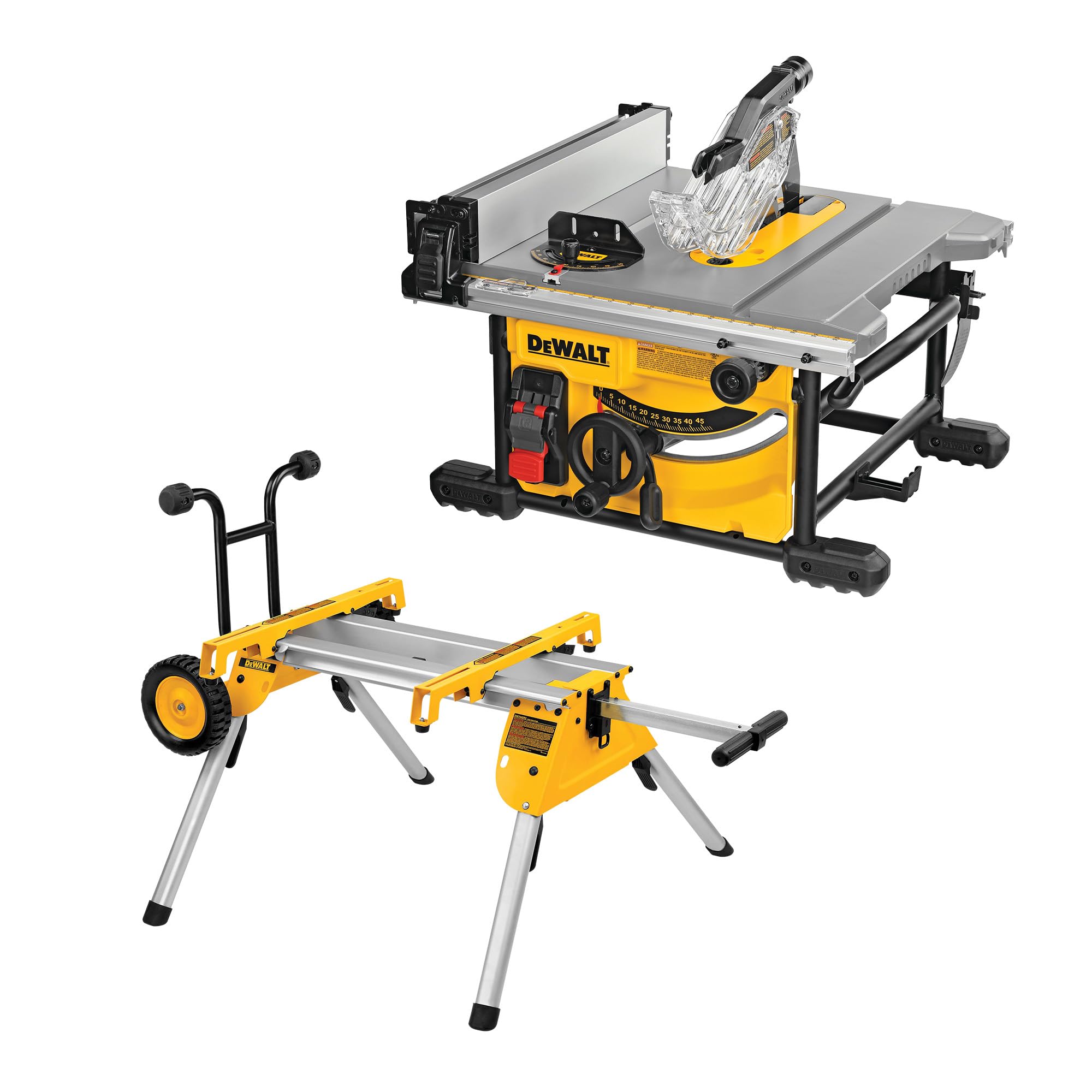
1. DEWALT DWE7485 Table Saw
Our pick — 4.5+★ from 250+ verified ratings; the strongest balance of quality and price.
Thirty-three pounds of saw that rolls out of the truck and cuts square by lunchtime.
The reason this one sits at the top is simple arithmetic. A 33-pound saw body on a kickstand-mounted rolling stand is light enough for one person to load and move, and DEWALT rates it 20% less weight to carry than other competitive mobile stands. It also gives you 24.5 inches of rip capacity, which is exactly enough to break down a 4×8 sheet of plywood or OSB without a helper holding the far edge. That is the whole promise of a portable jobsite saw, met in one package.
The fence is the part that earns its keep. Rack and pinion telescoping rails make the fence slide fast, smooth and accurate, so you can reset between a narrow rip and a full sheet without hunting. The quick-connect stand brackets let you pop the saw off the stand for loading, which is how this stays a one-person operation at the end of a long day. Buyers report the saw working well and the stand doing its job — the kind of combination that gives you a square cut on day one.
The catch is the assembly of the stand, which is the one mixed thread in the feedback. Bolting the stand together and attaching the saw takes longer than it should for some buyers, and the recurring note is that it suits people comfortable turning a wrench. Budget an hour and read the diagram twice and you will not think about it again. The rest of the machine holds its own against bigger saws.
What it delivers on the job
- 33 lb. saw body plus a rolling stand you can load alone
- 24.5 in. rip capacity for full 4×8 sheets of plywood or OSB
- Rack and pinion fence stays parallel for repeatable cuts
- Quick-connect brackets detach the saw from the stand fast
What to expect at build time
- Stand assembly takes longer than expected for some
- Best for buyers comfortable assembling brackets and hardware
The short answer: if you want the easiest saw to move and you mostly cut sheet goods, this is the one to buy.
The honest catch: the stand arrives in pieces, so plan for an assembly session before your first cut.
2. SKIL TS6308-00 Table Saw
The entry-point saw that still gives you a geared fence and a forgiving 2-1/2-inch cut depth.
Here is a number worth knowing: at 0 degrees this saw cuts 2-1/2 inches deep, which lets you slice up to 3x material in a single pass. That is enough for dimensional lumber and stacked sheet goods without flipping the board. Add a 15-amp motor and 24.5-inch blade-right rip capacity and you have a saw that handles the work most jobsite cuts actually require — ripping plywood, cross-cutting 2x4s, and cutting dado joints. Paired with the rack-and-pinion fence, the value story writes itself.
What wins people over here is the combination of quality and value. The fence has geared rails and stays parallel to the blade, so cuts come out square, and the table is a solid aluminum surface rather than a stamped pan. A 12-inch blade-left rip capacity adds another working dimension for narrow stock. The 40-pound weight is light enough to carry from truck to bench without a stand, and the compact dimensions make it easy to tuck into storage. Owners repeatedly note it cuts accurately fresh from the start.
The honest trade-off shows up in the adjustability and durability scores, which land mixed. A recurring note is that some of the components feel lighter-duty than the price would suggest, and one buyer felt the cutting ceiling was limited. That is fair for the value tier — this is a saw for a remodeler cutting trim and sheet goods, not a daily-production machine for framing a whole house. For weekend jobs, it holds up.
The value calculation: rack-and-pinion fence and 24.5-inch rip capacity at the entry tier is the real story. You give up some material heft in the fence rails and table, but you get square cuts and a saw light enough to carry solo.
Who it fits: a garage woodworker or a trim carpenter who wants a saw that lives on a bench and gets wheeled out when a sheet needs breaking down.
Worth grabbing if: you want a geared fence and decent rip capacity without stepping into premium spend.
Look elsewhere if: you cut four days a week on a paid crew and want the heavier rails of a premium build.
3. RYOBI ONE+ HP 18V Table Saw Kit
For the jobsite with no outlet: a 30-pound cordless saw that runs on the same batteries as your drills.
This is the saw you reach for when the cut is in a driveway, a basement, or a job with no live outlet close enough. It runs on 18-volt power from the ONE+ line, and the kit includes two 4.0 Ah batteries and a charger, so you can cut while the second pack tops up. Weight is 30 pounds — you can lift it into a truck bed by yourself, and the smaller footprint fits under a bench when the day is done. That is the whole advantage of cordless in this category.
A steel frame gives it rigidity, which matters when battery-powered saws lose stiffness to save weight. The lower and adjustable self-aligning fence is built for thinner materials, so it holds tight on trim and thin stock where a toothy fence would leak. Quick blade height adjustment lets you dial depth, and on-board storage keeps the accessories on the tool rather than in a bucket. The result is a capable tool for small woodworking projects and on-site trim cuts where a cord would be a nuisance.
The catch is the battery platform ceiling. As your batteries go from 4.0 Ah up, performance rises, but the saw is only as strong as the pack on it — a well-used 4.0 pack in cold weather will feel different than a fresh one. That is the honest trade of going cordless here. If you already run ONE+ tools, the value is real. If you do not, you are buying into a battery system.
The setup: steel frame and self-aligning fence keep it cutting accurately for thin stock and trim, and the on-board storage keeps the miter gauge and wrench on the tool.
The honest limit: performance rides on the battery pack you load, so keep a charged second cell close on long days.
Reach for this if: your work has no outlet and you already own ONE+ batteries you can spread across tools.
Better to pass if: you only cut in a shop with a live outlet and want a corded saw that never runs out on a long rip.
4. Evolution R10TS 10″ Jobsite Table Saw

A 10-inch blade that eats wood, mild steel, aluminum and composite with the same tooth set.
Most portable saws are built for wood and struggle with anything harder. This one is engineered around a multi-material claim: a high-torque 15-amp motor with soft start and a premium 10-inch tungsten-carbide-tipped blade for cutting wood, mild steel, aluminum and composites. That is a genuinely different brief. If your jobsite work crosses from trim to metal channel to composite, this saw saves you from carting a second tool.
The blade bevel table gives you a 0-45° range with geared adjustment, which is twice the 90-degree cutting angle of the SKIL above — the bevel lets you cut angles, not just square crosscuts. The features back it up: 26-inch rip capacity, 3-3/8-inch maximum cut depth, a zero-clearance throat plate that reduces tear-out, a dado plate for grooves, and a rack-and-pinion fence system for repeatable alignment. Performance is what wins people over here, and it is not subtle — the saw runs hard maple and plywood without drama. Cuts glide through and stay clean.
The friction point is assembly. Put-together time is the mixed thread in the feedback, with some buyers feeling the written instructions fall short of the saw’s quality. Stability and construction also land mixed, and one user notes this is not a saw you heft around by yourself easily. So: budget setup time, plan to calibrate the fence, and consider a helper for truck loading. None of that changes what the saw does at the fence line.
Why it earns its spot
- 15 A motor with soft start and a 10 in. multi-material tungsten carbide blade
- 0-45° bevel and a 26 in. rip capacity for angled and wide cuts
- Zero-clearance throat plate and dado plate included
- Electronic blade brake and quick-release riving knife for safety
What to plan around
- Assembly and setup take longer than the saw’s quality suggests
- Mixed reports on stand stability and frame heft
Best fit for: someone cutting mixed materials — wood, aluminum, composite — who wants one saw to do the lot.
Think twice if: you want a saw that arrives calibrated and cuts accurate straight off the pallet.
5. BOSCH GTS15-10 Table Saw
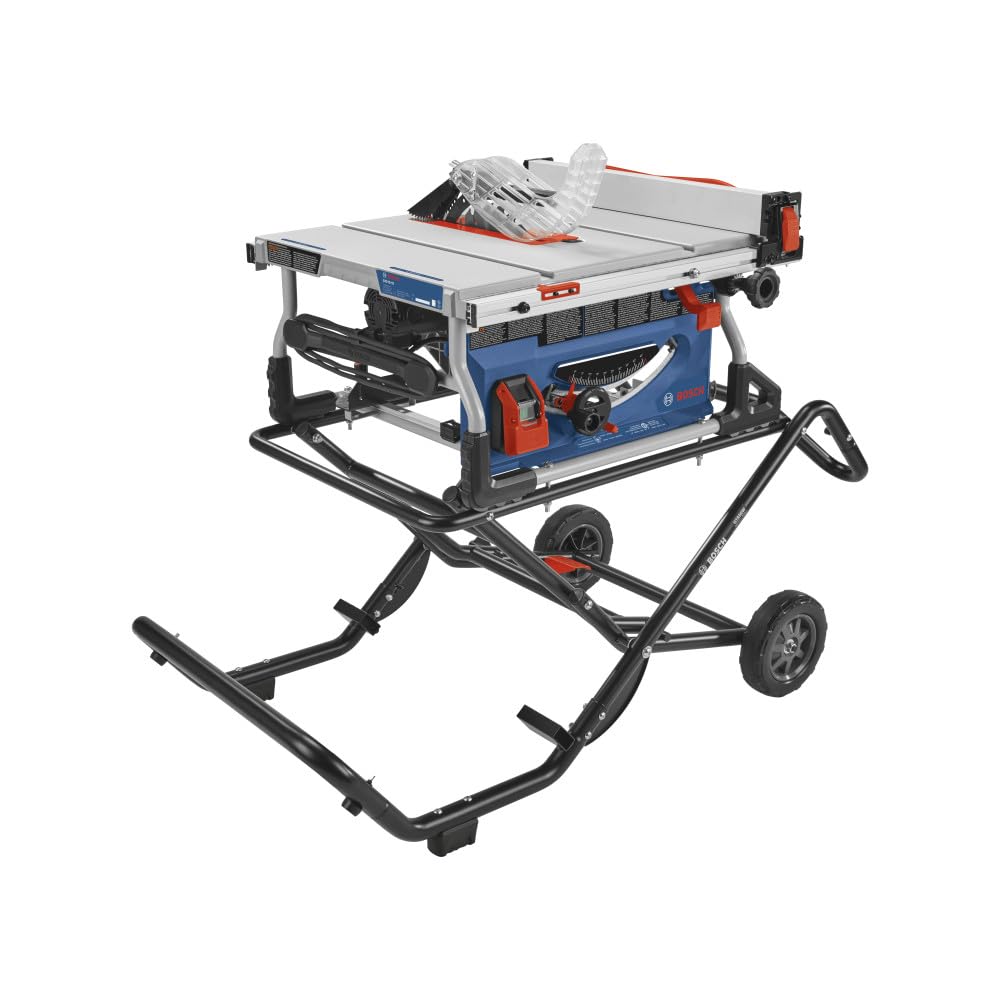
A 32-1/8-inch rip capacity and a gravity-rise stand that turns a 103-pound saw into a one-person move.
The headline is the rip capacity — 32-1/8 inches is enough to cross-cut shelving and trim stock wide, not just break down plywood. A 15-amp motor spinning at 3,800 rpm handles rip-cutting and cross-cutting of fine and hard woods. Color-coded index pins on the rack-and-pinion fence match a color-coded scale, so you can dial a width by hand and know the fence is parallel. On a big sheet of material, that is the difference between a clean cut and a do-over.
The portability is the clever part. A 103-pound saw sounds like a two-person lift, but the Gravity-Rise Wheeled Stand uses a single action to set up and take down, so the wheels do the work. The open-frame roll bar adds durability against a jobsite floor. An electronic brake stops the blade in about three seconds, and soft start limits the startup surge to reduce breaker trips. The electronically regulated speed holds under load. Quality leads the feedback, and it is echoed in how owners describe the saw cutting accurately again and again.
Compare it honestly to the DEWALT DWE7491X: this BOSCH carries a 32-1/8-inch rip versus that saw’s 32-1/2-inch, so the DEWALT gives you a fraction more room. The BOSCH answers with its gravity-rise stand and 3,800 rpm motor. Build quality and adjustability land mixed in the feedback, so plan a calibration pass after assembly. At 103 pounds against the RYOBI’s 30 pounds, this is a saw that stays on the stand and rolls — not one you carry.
The standout: 32-1/8-inch rip plus a 3,800 rpm 15-amp motor makes this a serious sheet-goods machine.
The caveat: at 103 pounds, plan on the stand for every move — this is not a carry-it saw.
Go with this one if: you rip wide material and want a wheeled stand that one person can roll into a truck.
Give it a miss if: you need a saw you can lift onto a bench by hand every morning.
6. Milwaukee 2736-20 M18 FUEL Table Saw
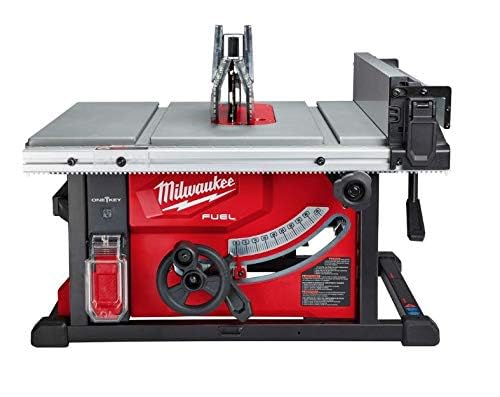
A 24-1/2-inch rip capacity crammed into a cordless M18 frame that is rated to cut 4×8 sheets.
For M18 users, this is the table saw that speaks your battery language. It rips 4×8 sheets of plywood or OSB at a 24-1/2-foot rip capacity, and the bevel tops out at 47 degrees, which is a wider angle range than the SKIL’s 90-degree cutting angle. It sports a single-wrench blade change and tool-free guard and riving knife changes, so swapping between rip and crosscut setups is quick. Everything you need to store — guard, riving knife, push stick, fence and miter gauge — lives on the saw.
Here is the important note: this is the tool only. Battery and charger are not included, and the saw is compatible with all M18 batteries. Milwuakee’s own note is that higher-capacity batteries yield higher performance, so if you want the saw to run near its potential, pair it with a high-capacity pack. Quality feedback is strong, with owners describing the saw running well and being easy to set up and use. For a crew already on M18, that is a sensible way to add a jobsite saw without a new ecosystem.
The honest catch is the balance sheet. At 42.1 pounds and 15 amps nominal, it is a heavier lift than the RYOBI and a much lighter carry than the BOSCH wheeled saws. But it is bare tool only, so the total cost climbs once you add batteries and a charger if you do not already own them. There is also a note in the feedback about a guide gear not engaging from the start, which points to a quick test on arrival before you put it into rotation.
The right buyer: an M18 owner who wants a jobsite saw that shares batteries, chargers and pack compatibility.
The stinger: bare tool only, so factor batteries and a charger into the decision before you commit.
7. FLEX 24V Brushless Cordless 10-Inch Table Saw Kit FX7221-1J

The cordless saw that cuts a 4×4 in a single pass — the one thing most battery saws cannot do.
Cutting a full 4×4 in one pass is the kind of capability that changes your workday. Most compact saws need a flip or a second pass for thick stock; this cordless 10-inch saw claims to do it in one. It runs on FLEX 24V Stacked Lithium, and the kit includes a 10.0 Ah battery and a 280W Rapid Charger, so you are not buying into a battery system and then buying more. FLEX rates its Stacked Lithium packs at 200% more power, 300% longer runtime and 100% faster charging than its own baseline.
The details are built for the jobsite. A rack-and-pinion fence system allows quick alignment without recalibration, and CutSense stops the blade after each cut to extend runtime. A rechargeable LED fence light lights up your work, and it pops off for extra lighting elsewhere. The kit includes a 40-tooth 10-inch blade, miter gauge, push stick and the fence light. Cross-compatible with all FLEX 24V tools and chargers — and backed by a 5-year limited warranty when you register within 30 days.
The trade-off is the battery ecosystem. Unless you already own FLEX 24V tools, this saw means starting a new platform, and the 10.0 Ah pack is the one that makes it sing. A FLEX 24V Power Adapter sold separately open up AC power for extended runtime, which softens the all-battery angle but adds cost.
What separates it: a 10-inch blade on a cordless saw with a 10.0 Ah pack, and the one-pass 4×4 cut claim.
The one cost: you are starting or extending a FLEX battery platform to make full use of it.
Pick it if: you cut thick stock on a jobsite with no usable outlet and want a full-size blade on battery power.
Pass on it if: you already own a different battery system or mostly cut where a cord reaches.
8. DEWALT DWE7491X 10-Inch Jobsite Table Saw with Scissor Stand

A 32-1/2-inch rip and a scissor stand that folds the saw under your workbench.
This saw is built around wide material. A 32-1/2-inch rip capacity handles larger shelving and trim easily, and the rack-and-pinion telescoping fence system keeps adjustments fast, smooth and accurate. The two-position flip-over rip fence is a smart touch — it lets you swap between narrow rip cuts and material support without changing the fence out.
DEWALT’s Site-Pro modular guarding system lets you adjust the guarding components tool-free for each application, and a 2-1/2-inch dust collection port hooks to a vacuum for extraction. The scissor stand folds the saw down flat, so it stows under a workbench in a garage shop — a real benefit when you do not have wall space to spare. The saw’s quality is the strongest thread in the feedback cycle, with owners describing a powerful saw with plenty of features and a flexible rip-fence design that speeds work along.
Now the reality check: at 87 pounds, this is a heavier machine than the DEWALT compact at 33 pounds, and against the 20-inch length of that compact saw, this one measures 26.75 inches — more saw, more stable table, more footprint. It also requires the stand for anything but a permanent spot. That said, if you work with wide sheet goods most days, the wider rip and heavier table are what keep cuts clean, and the scissor stand makes storage painless.
Where it shines
- 32-1/2 in. rip capacity for shelving and trim stock
- Two-position flip-over rip fence for narrow and wide cuts
- Tool-free guarding adjustments via the Site-Pro system
- 2-1/2 in. dust port for vacuum hookup
Where it asks more
- 87 lb. saw is a stand-dependent machine
- Larger footprint than the compact DEWALT
Land on this one if: most of your cuts are wide sheets and you want the extra rip capacity on a stand that folds away.
Move along if: you want a saw light enough to toss in a truck bed one-handed.
9. BOSCH 4100XC-10 Table Saw

A large cast-aluminum top and a Gravity-Rise stand that handles the roll while you handle the cut.
The large cast-aluminum top on this saw gives you more working space and material support with a 30-inch ripping capacity, which is a meaningful step up from 24.5-inch machines. The 15-amp motor with 4.0 max HP and 3,650 rpm handles rip-cutting and cross-cutting of fine and rough material without bogging. Constant response circuitry keeps speed under load, and restart protection prevents accidental startup. SquareLock rip fence is engineered for clamping and trueness, so the fence locks where you set it.
The Gravity-Rise Wheeled Stand is the other half of the package: single-action setup and take down, so you can roll a 94-pound saw into place and drop the stand. Onboard storage keeps all the components on the tool, and the Smart Guard system gives you a riving knife, anti-kickback pawls and a guard assembly without obstructing the cut. Owners praise the portability and the way the saw attaches for moving between jobs. One note worth flagging: BOSCH lists a newer version, the GTS15-10, as the current model — so if you are shopping this exact saw, understand you are buying the outgoing version.
The tough feedback thread is durability, which lands negative — this saw does not always hold up over a long life, and adjustability draws mixed reports. Assembly is mixed, with some finding it easy and others finding the written instructions confusing. The blade height is also a known limit for thick dimensional cuts. None of that makes it a bad saw — it is the bulletproof top and the stand that keep it on jobsites — but it is a saw you buy knowing the version is being replaced.
The case for it: large cast-aluminum top and 30-inch rip capacity with BOSCH’s Gravity-Rise stand make it a fast setup on-site.
The honesty check: it is the older version, and durability is the weak thread in the feedback.
For the crew that: wants a big cast-aluminum top, a 30-inch rip, and a stand built for rolling in and out of trucks.
Maybe not for you if: you want the newest BOSCH and the longest track record on durability.
10. SawStop JSS-120A60 Jobsite Saw PRO with Mobile Cart

The one portable saw with blade-brake flesh detection built in — and no, it is not cheap reassurance.
Every saw on this list cuts wood; this one adds a genuine differentiator — SawStop’s patented flesh-detection system senses skin contact and fires the brake in under 5 milliseconds. That is a short, brutal speed. The blade brake cartridge fires and the blade disappears into the table. If you have ever held your hand near a spinning blade on a jobsite, the value of that feature is self-explanatory. It is also worth checking the feedback: safety is one of the strongest threads on this saw, and owners appreciate it.
The saw is more than safety. A class-leading 24-5/8-inch table depth enhances accuracy and control during large cuts, and the one-turn elevation system raises or lowers the blade quickly. Compact stowed dimensions of 26.5″ L × 29″ W × 45″ H make transport and storage easy — it folds up against the wall of a small workshop, which is not something you can say about the 103-pound BOSCH. The cart has a collapsible rolling assembly, and the saw arrives with a 10-inch blade, active dust collection blade guard, blade wrenches, push stick, riving knife and standard brake cartridge.
What this saw is not: a budget saw, or the lightest saw at 113 pounds. Adjustability is mixed in the feedback — some want a micro-adjustable fence that arrives at the same level as the red or yellow-brand saws. But the quality and worth threads are strong, and one user’s safety episode on this machine is the kind of story that turns a purchase into a decision you are glad you made. If you cut alone and worry about your fingers, this deserves the premium.
The decisive reason: flesh-detection and a sub-5-millisecond blade stop make this the safest portable saw on the list.
The cost of safety: premium spend, 113 pounds of weight, and a fence that does not micro-adjust the way some pros expect.
Know the Specs
Rip Capacity — how wide you can cut
Rip capacity is the distance the fence can move from the blade, and it decides the widest sheet you can break down without extra support. A 24.5-inch capacity is enough to rip a full 4×8 sheet of plywood or OSB, which is the practical minimum for cabinet and trim work. Figures like 30 inches, 32-1/8 inches and 32-1/2 inches buy you extra room on shelving and long stock. Look at the number and picture your biggest board — if the board is wider than the capacity, you are flipping or asking for a hand.
Fence Type — where cuts go wrong
A rack-and-pinion fence is geared so it slides out parallel to the blade instead of drifting at one end. That keeps your cut square from one edge to the other. A hand-nudged fence can look straight and still be off by a hair, which is how tapered boards happen. If you see “rack and pinion” in a listing, that is a good sign — the SKIL, DEWALT and BOSCH picks all use that system. The Evolution’s dual rack-and-pinion fence goes a step further with repeatable alignment.
Cut Depth and Bevel — thick stock and angle cuts
Depth of cut is how deep the blade reaches into the material at a given angle, and it caps the thickest board you can cut in a single pass. The SKIL’s 2-1/2-inch depth at 0 degrees handles up to 3x material in one pass. Bevel is the angle range of the blade tilt, and that is where the Evolution’s 0-45° range and the Milwaukee’s 47-degree bevel extend what you can do. If your work has angle cuts, look at both numbers before you commit.
Corded Amps vs Cordless Battery Platforms
A 15-amp corded motor takes power straight from the wall and holds up on long, heavy passes. A cordless saw like the RYOBI 18V, FLEX 24V or Milwaukee M18 shops in whatever battery platform you own, so setup is unrestricted. The trade is that battery saws perform at the level of the pack loaded — the FLEX’s 10.0 Ah pack and Milwaukee’s higher-capacity batteries make that clear. Pick the platform you already own, or the one you plan to grow into.
Common Questions
Can a portable jobsite table saw really rip a full 4×8 sheet of plywood?
Is a cordless jobsite table saw strong enough for hardwood?
What does rack and pinion mean on a table saw fence?
How much does a portable jobsite table saw weigh, and can I load it alone?
Do I need a stand, or can I bolt a jobsite saw to a bench?
Is the SawStop flesh-detection system worth the premium?
How deep can these saws cut, and what does bevel get me?
Should I buy a corded saw or a cordless one?
Will a portable saw on a wheeled stand fit through a standard doorway?
Do these saws cut metal or composite, or just wood?
The Bottom Line
If you want the cleanest mix of portability, price and square cuts, take the DEWALT DWE7485 compact with its rolling stand — a 33-pound saw with 24.5 inches of rip capacity and a rack-and-pinion fence, and it is the crowd favorite at 4.5+ stars across 290+ owners. Know that the stand arrives in pieces, so budget an assembly session before your first cut. If wide sheet goods are your daily bread, the DEWALT DWE7491X gives you 32-1/2 inches of rip on a scissor stand that folds flat, and the BOSCH GTS15-10 answers back with 32-1/8 inches and a Gravity-Rise stand. Cutting metal and composite alongside wood? The Evolution R10TS is the only saw here designed for it. And if fingers and safety are the deciding factor, the SawStop JSS-120A60 is the one portable saw with blade brake flesh detection. One last nudge: if you cut alone and often, the safety investment on the SawStop is the single call I would not second-guess — its blend of quality and on-site portability is why it earns its premium spot on this list.
How we choose
We do not accept paid placement. Every pick is matched to a real buyer and a real use-case; we do not hands-on test units.
Sources
Specifications: manufacturer listings and product documentation. Review insights: verified customer reviews, as of November 2026. Pricing: not shown on this page (it changes often); check the current price via the retailer link.
As an Amazon Associate, Tactical Gear Guy earns from qualifying purchases. This does not affect which products we feature.