Specs are compiled from manufacturer listings and verified buyer reviews and can change over time — please confirm the key details on the product page before buying.
You want to keep your legs moving while you sit at a desk all day, but you do not want a machine that slides across the floor or squeaks loud enough for the whole office to hear. Under a desk, stability and noise decide whether you keep using it. The picks below are small enough to tuck under a desk or beside a couch, and each one is honest about what it does well and where it struggles.
This guide is built by comparing the manufacturers’ published specifications and the patterns across verified customer reviews, so you get each pick’s real strengths and trade-offs instead of marketing spin.
Some of these pedals move on their own with a motor; others make you do the pushing. Match the drive type and footprint to your knees and floor before you buy. The right portable exercise pedal depends on matching the motor and the footprint (how much floor space it takes up) to how you actually sit and use it every day.
Top Picks
How To Choose The Best Portable Exercise Pedal
The first split to settle is simple: do you want the machine to spin the pedals for you, or do you want to push them yourself? Motorized units glide your legs through the motion and are aimed at stiff knees and low-effort movement. Manual units make you supply the push, which builds more strength but asks more of your joints. Motorized suits stiff, sore joints; manual suits anyone chasing strength.
Motorized or manual resistance
A motorized pedal like the TDH runs a set speed and can switch forward or reverse, so your legs move without you driving them. That is gentle on sore joints, but it means you are not building much force yourself. A manual machine with an adjustable tension knob lets you dial resistance up or down, and you do the work. If you are rebuilding strength after time off your feet, the motorized glide often feels kinder at first.
Stride length and pedal placement
Stride length is how far each pedal travels on its loop, and it decides how much your knee has to bend. A short stride keeps the motion tight and knee-friendly; a longer one feels more like a proper bike pedal. Pedal position matters just as much — some units let you slide the whole machine forward or back so your knees sit at a comfortable angle rather than cramped under the desk.
Floor grip and weight
A pedal machine is only as useful as it is stable. Light plastic frames can creep across smooth floors as you pedal, which is why many buyers put a mat underneath or strap the unit to a chair. Heavier frames with a metal flywheel hold their spot better but are harder to lift and carry. Think about your floor — carpet grips better than hardwood or tile — and whether you plan to move the unit between rooms.
Noise and the office test
Quiet matters if you pedal during calls or while others are in the room. Some units advertise noise levels under 15 dB, which is below a whisper. Belt-driven and magnetic resistance designs generally run smoother than friction pads, and smooth pedaling also protects your knees from jerky stops. In a shared office, a belt or magnetic drivetrain beats a bigger display.
Side-by-Side Comparison
| Model | Best For | Drive Type | Weight | Resistance / Speeds | Amazon |
|---|---|---|---|---|---|
| TDH Under Desk Elliptical★ Best Overall | Desk workers wanting motorized glide | Electric / magnetic | 13 lbs | 12 speeds + P1-P3 auto | Amazon |
| AN Pedal ExerciserBudget Champion | Budget manual pedaling | Manual knob | — | Adjustable tension knob | Amazon |
| MOMODA Under Desk BikeMost Portable | Foldable storage in small rooms | Manual | 2.2 kg | Tension knob | Amazon |
| MGGYM Upgraded Flywheel | Steady weighted frame | Manual | 12 lbs | Tension knob, 5 lb flywheel | Amazon |
| himaly Mini Exercise Bike | Cheap arm and leg work | Manual | 8 lbs | Multi-level tension | Amazon |
| Sunny Health & Fitness Smart Mini Cycle | Smooth belt-drive pedaling | Manual belt-drive | 11.7 lbs | Stepless micro-adjust | Amazon |
| LUBBYGIM Motorized Bike | Joint-friendly rehab sessions | Electric motor | 9.2 lbs | 6 speed levels | Amazon |
| UMAY Eclipse Elliptical | Programmed auto workouts | Electric quiet-drive | 10 lbs | 12 programs, auto + manual | Amazon |
| Morelax Under Desk Oval | Custom speed control for seniors | Electric | 5.2 kg | 12 speeds + P1-P3 auto | Amazon |
Detailed Reviews
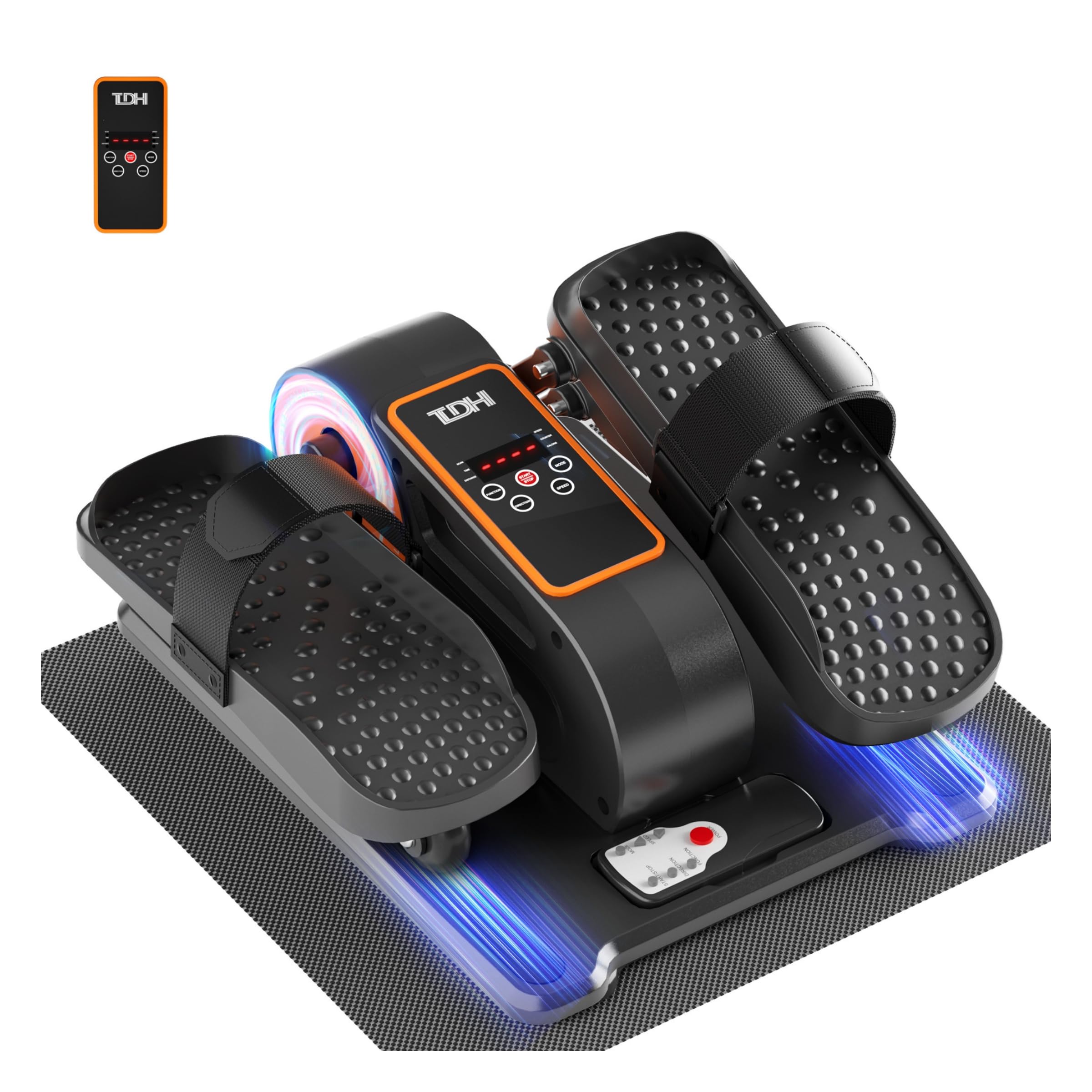
1. TDH Under Desk Elliptical Machine Leg Exerciser Electric
Our pick — 4.5+★ from 300+ verified ratings; the strongest balance of quality and price.
The motorized glider that hustles your legs through the motion so your knees never have to push.
For someone chained to a desk for ten hours, the TDH’s biggest draw is that the pedals can move on their own. It runs a magnetic resistance system (a magnet-based drag that feels smooth instead of gritty) and offers 12 speed levels plus three automatic programs (P1-P3) that vary the pace and direction for you. That means you can set it spinning and let your legs follow passively, or switch to a self-pedaling mode where you drive the motion. Either way, the point is gentle movement without a hard knee push.
Footprint is the other reason it travels well: at 15″D x 7″W x 8″H it is one of the taller, narrower frames here and slips into narrow gaps under a desk. It weighs just 13 lbs, so carrying it from the home office to the den is easy. Its small size is also its trade-off — the AN unit above sits in a 20″D x 9″W x 15″H footprint, so the TDH cuts a tighter profile while leaving less room for a broad stance. The frame supports up to 300 pounds and the silent wheels with sound insulation knock the noise down to below 15 dB (quieter than a whisper).
Buyers praise the solid build and the movement it brings back, especially for knees. Desk workers report that steady pedaling breaks up stiffness, and buyers recovering from a knee replacement describe building motion back slowly. The LCD (the small screen) shows speed, distance, time, and calories, though the readout is small and takes a squint. A sturdier RF remote (a wireless remote that changes modes) lets you switch settings without bending down, which spares your back if reaching low is a problem.
What the living room gets
- 12 speeds plus P1-P3 automatic programs let you pedal passively or actively
- Below 15 dB running noise keeps it invisible on a call
- 13 lbs and a 15″D x 7″W x 8″H frame handle tight desk gaps
- 300 lb weight limit and a remote that saves your back
Where it asks for patience
- The small LCD readout needs a squint for time, distance, and calories
- Motorized modes do the work for you — not the pick if you want to build real pushing force
- Plastic frame feels light compared with flywheel units
Grab it if: you want a quiet, motorized machine to keep stiff knees moving under a desk.
Think twice if: you want to push heavy resistance yourself — a manual unit builds more force.
2. AN Pedal Exerciser
The entry-level manual pedaler that gets the basics right for the smallest outlay.
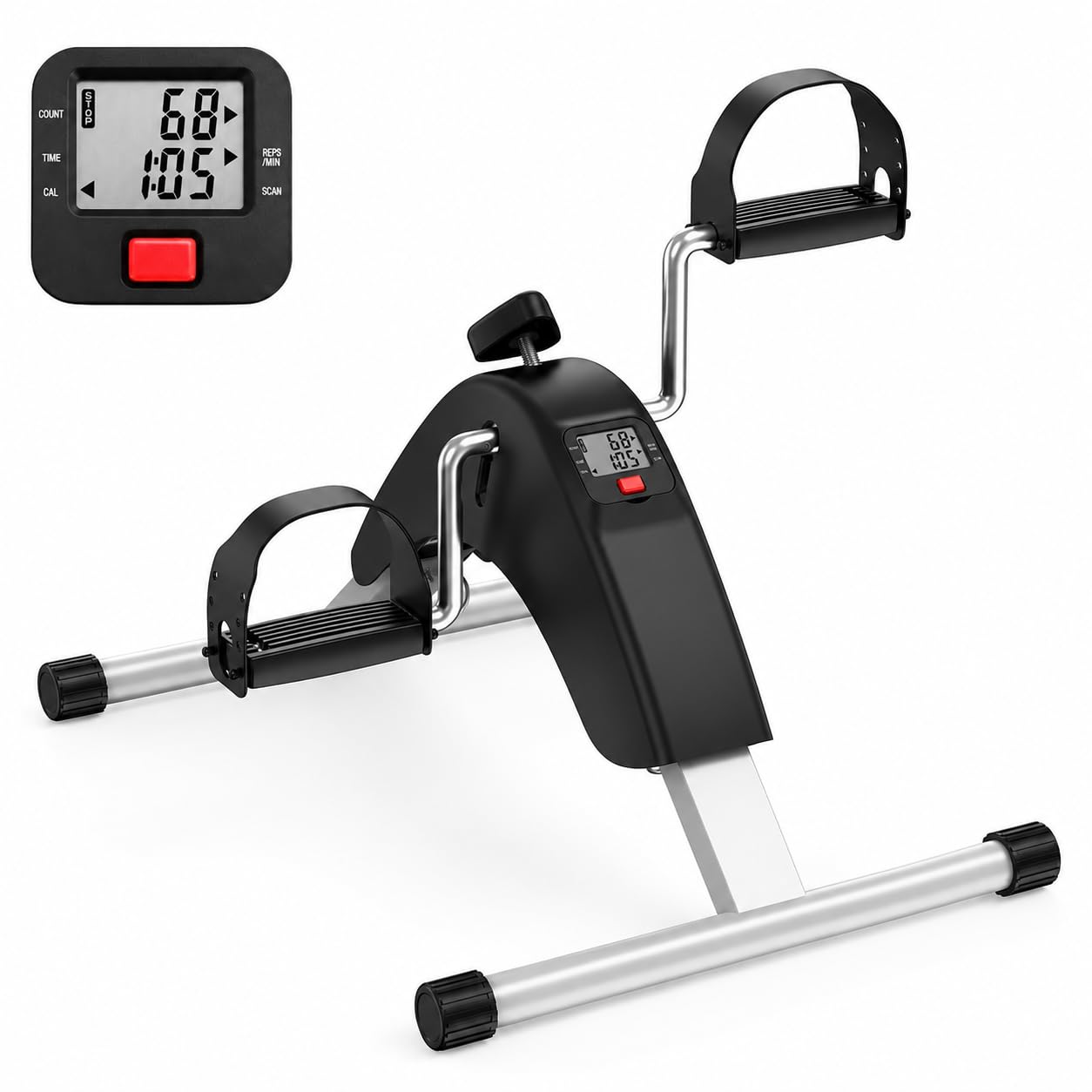
If you just want your legs moving while you sit without paying for a motor or a smart monitor, the AN is the straightforward choice. It has an LCD display that tracks time, count, and calories, along with a tension knob you turn to make the pedaling light or harder. The big non-slip pedals with adjustable straps hold your feet in place. Sturdy iron construction and non-slip end caps provide the stability. The footprint is 20″D x 9″W x 15″H, which is the largest spread among the manual models, so it needs a bit more floor.
Nothing to charge, nothing to pair — just set the knob and pedal. There is nothing to charge and no remote to lose — just set the tension and pedal. That makes it a friendly first pedal for a couch or a home office. One thing to check before you commit: this listing’s review summary reads like it was written by a computer and talks about cushions, so it does not match the actual product. Ignore that description and judge the machine by the knob, straps, and frame. A few buyers have noted the pedal joint can loosen over time, so gentle use and a quick check of the fittings keeps it solid.
Best for first-timers: the turning tension knob is the whole control scheme — easy to grasp, hard to break.
The caution: the oversized pedals and straps help, but the wider 20-inch footprint means it will not tuck into every desk gap.
Reach for it if: you want a manual, no-frills pedal and you have the floor space to place it.
Pass on it if: you need a compact frame or a monitor you can read across the room.
3. MOMODA Under Desk Bike Pedal Exerciser with LCD Display
Folds away between sessions, then sets up in about two minutes when you want it.
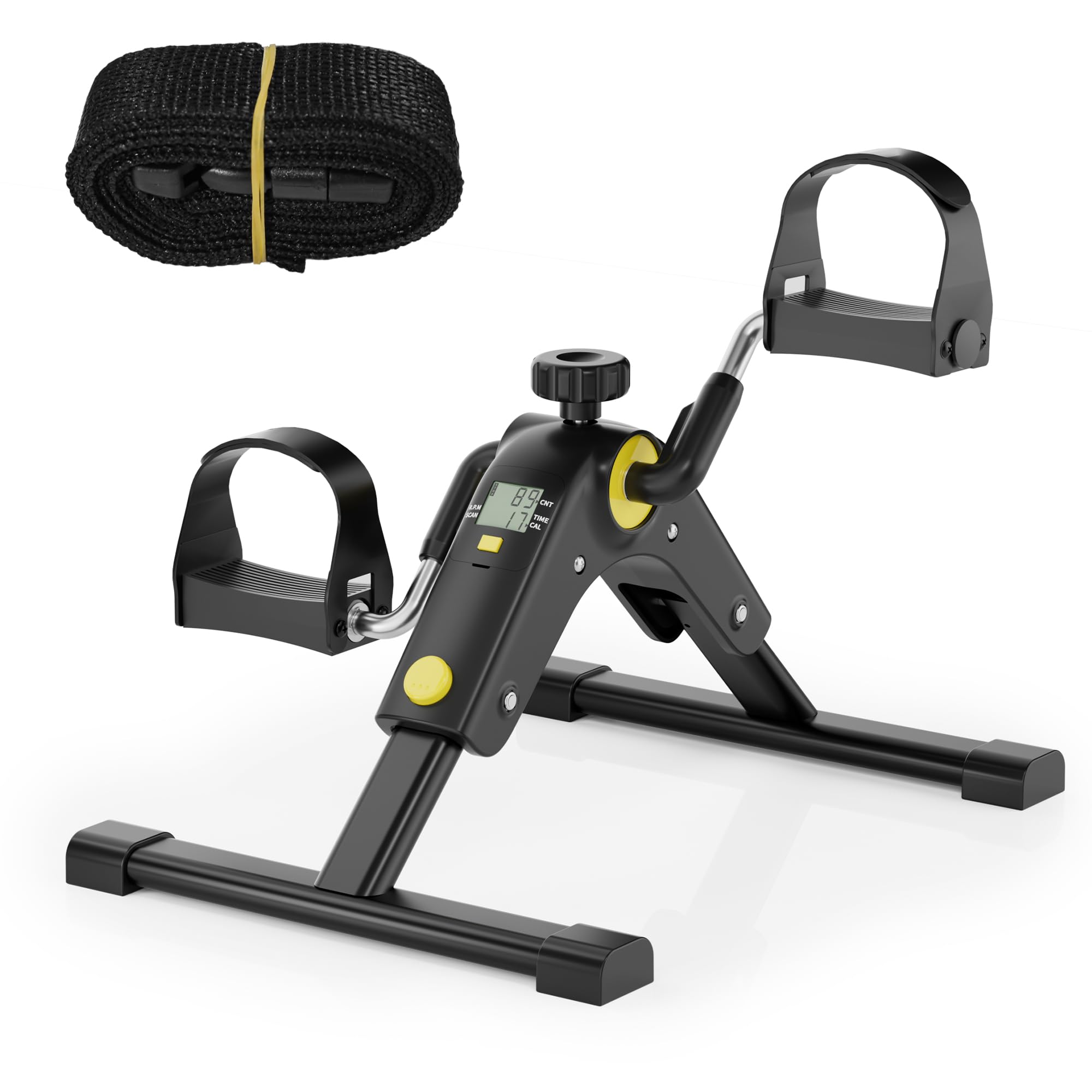
The MOMODA is the pick for a small apartment or a shared desk where the machine has to disappear after use. Its foldable design lets it collapse for storage, and at 2.2 kg it lifts easily with one hand. Put it on the floor for leg work or on the tabletop for arm work — the dual-use design means one machine covers both. The LCD shows RPM, time, calories, count, and a scan mode that cycles through them all.
The tension knob lets you dial the resistance from gentle to challenging, which is what makes it work for a beginner building stamina or an older user keeping joint range. Pedaling motion is smooth, and the anti-slip straps anchor your feet. Because the frame is plastic and light, it can wobble under hard pedaling, and on slick floors it may creep — the included chair strap is worth using from day one. A few owners find it noisy once you push the pace, so this is a gentle-use machine, not a sprint trainer.
The folding advantage
- Collapses for flat storage and weighs only 2.2 kg
- Dual arm and leg use from one unit
- LCD tracks RPM, time, calories, count, and scan
Keep it steady
- Light plastic frame can wobble and drift on smooth floors
- Gets noisy once you pedal hard — better suited to gentle sessions
Your match if: storage space is tight and you want arm and leg options in one foldable unit.
Not your match if: you plan to pedal hard and want a frame that stays dead still on hardwood.
4. Upgraded Pedal Exerciser

The one that trades lightness for a chunky metal flywheel and a mat to hold the floor.
A five-pound metal flywheel is the standout here. In plain terms, that is a weighted disc inside the frame that carries momentum, so the pedaling feels steadier and less choppy than a light plastic unit. The whole machine weighs 12 pounds, which is enough heft to resist creeping while you pedal — and MGYM throws in a non-skid floor mat for smooth surfaces like marble or ceramic. A tension knob adjusts how hard you push. The LCD tracks time, distance, counts, and calories, and it runs on a AAA battery (not included), so you have one more thing to pick up.
Where this pick splits opinion is the ride quality. Owners praise the easy assembly and the quiet operation, and knee-focused buyers like it for steady, low-impact work. The recurring gripe is stability and smoothness — some find the pedaling jerky and the frame shifts even with the mat, wanting more weight on the base to lock it down. If you have a carpeted room, it behaves better than on bare hard floors.
What the flywheel buys you: momentum that carries each pedal stroke, so the motion feels less twitchy than a featherweight frame.
The honest catch: jerkiness in the pedal assembly is the most common complaint — this rewards a light, even stroke over a hard push.
Pick it when: you want a weighted, mat-protected frame that stays grounded on a rug or carpet.
Skip it when: you will pedal on bare tile and need dead-flat stability from the frame alone.
5. himaly Mini Exercise Bike, Under Desk Bike Pedal Exerciser
A metal-frame arm-and-leg trainer that buyers keep using through shoulder and knee recovery.
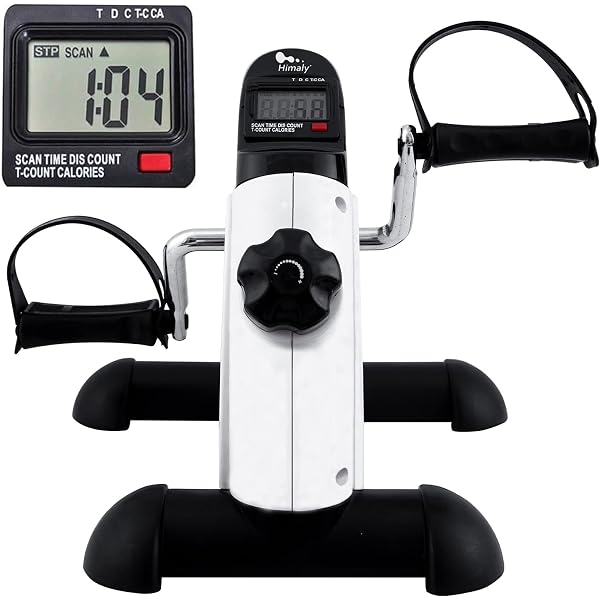
The himaly earns its spot by working your arms or your legs, so one machine covers two routines. You set the adjustable tension knob to your comfort level, and the multi-function LCD tracks time, count, calories, and distance (in meters) with a scan mode that cycles through every reading. The metal frame, anti-slip pedals, and non-slip feet are built to stay put while you pedal. It weighs 8 pounds, and the compact 43x32x20cm body tucks under a desk or beside a chair. Assembly takes a few minutes with the included tools — no extra kit needed.
The reason it lands here is its fitness for recovery. Buyers rehabbing a rotator cuff or a knee use it for gentle motion, and hard-floor users report it fits under a desk well. One quirk to know: the pedals screw in opposite directions, so match the threads carefully on assembly. The most-discussed downside is stability — the light 8-pound frame can slide on smooth surfaces, and the pedaling can feel jerky with tension dialed high. It is best treated as an at-home gentle-motion tool, not a heavy trainer.
Why recovery buyers like it
- Arm and leg use from one metal-framed unit
- Adjustable tension knob with LCD scan of time, count, calories, and distance
- 8 lbs and compact enough to slide under a desk
- Assembles in minutes with included tools
The trade-off to size up
- Light frame can creep on smooth floors
- Pedaling can feel jerky at higher tension
- No motor — you supply the push
The right fit for: at-home arm and leg motion during recovery, where gentle beats heavy.
Look elsewhere if: you need a motorized assist or a frame that anchors itself on tile.
6. Sunny Health & Fitness Smart Mini Cycle

A belt-driven alloy-steel cycle whose stepless resistance glides between easy and hard.
The Sunny Health & Fitness mini cycle leans on a mesh belt-drive (a rubber belt instead of a friction pad), which is why the pedaling feels smooth and quiet. Its “stepless micro-adjustment” means there are no fixed clicks — you turn the knob and the resistance changes in tiny increments, so you can find a level that suits a stiff knee or a harder push. A digital monitor reads speed, time, distance, and calories. The white alloy-steel frame weighs 11.7 pounds and includes a handle for carrying it between rooms, and it is rated for 300 pounds.
Two things set it apart from the cheaper manual units above. First, the build is sturdy enough that buyers who had tried friction-pad bikes describe it as a step up. Second, the low-impact motion suits office staff and seniors who want to stay active while seated. The catch is that same heft — at 11.7 pounds it is noticeably heavier to lift than the lightest picks here, and a few owners find it slides on hardwood, so plan on a rug or chair anchor to hold it in place.
Smooth-ride strengths
- Belt-drive plus stepless resistance gives a quiet, gliding pedal stroke
- Alloy-steel frame rated to 300 pounds with a carry handle
- Digital monitor tracks speed, time, distance, and calories
Where it takes work
- 11.7 lbs makes it heavier to reposition than featherweight units
- Can slide on smooth hardwood without a rug or anchor
Worth it for: anyone who wants a genuinely smooth, quiet pedal and does not mind the extra heft.
Hold off if: you need something one-hand light to move daily, or you pedal on slick floors without a mat.
7. LUBBYGIM Mini Exercise Bike
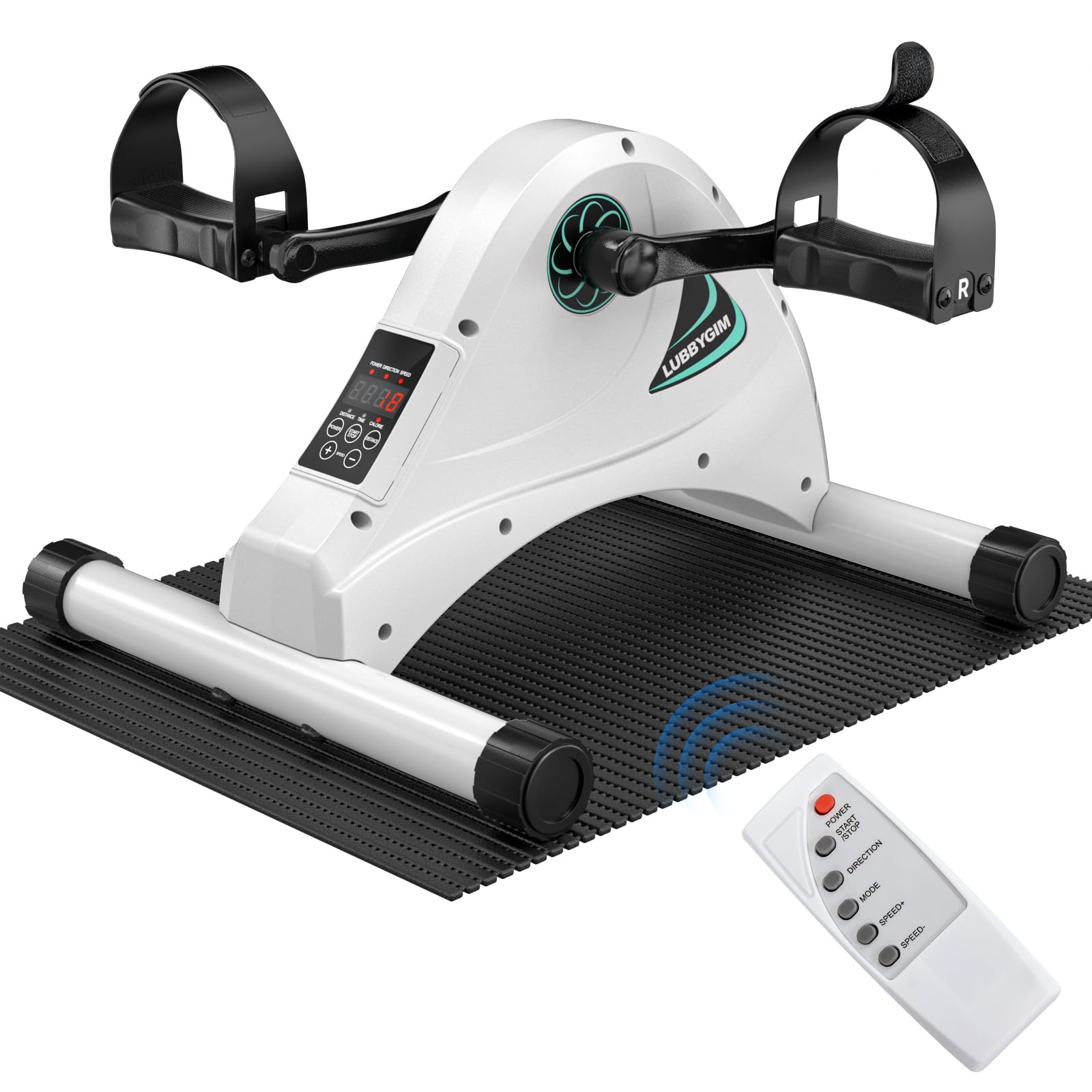
The rehab-focused motor that moves your legs for you, controlled from a remote so you never bend.
The LUBBYGIM runs a motorized drive with 6 speed levels, so it can move your arms and legs gently instead of making you push. It pedals forward and backward, and you can choose between motorized or manual passive motion. A remote lets you adjust the speed and mode without leaning down, which matters if bending forward strains your back. The multi-function LED display reads time, speed, and calories. Weighing 9.2 pounds, it is light enough to shift around.
This is the pick for someone building movement back after surgery or for an older parent who wants gentle arm and leg motion at home. The low-impact glide keeps the effort light. The motorized design also means the machine does more of the work — you are not building much pushing force yourself. Two honest notes: the remote has a reputation for taking several presses to respond, and the light frame wants a firm, non-slip surface to stay put. The unit is rated for low weight and speeds up to 6 rpm, so treat it as a gentle-motion tool rather than a strength builder.
What makes it rehab-friendly: the motor drives the pedals through 6 speeds, so sore joints never have to push against resistance.
What to expect: remote response can be fussy and the frame is light — place it on a firm, grippy surface.
Made for: gentle motorized motion after surgery or for a senior who wants passive pedaling.
Not made for: anyone who wants to build leg strength through their own resistance.
8. UMAY Under Desk Elliptical Eclipse Leg Exerciser Electric

A one-piece electric elliptical that sets the workout for you with 12 preset programs.
Auto mode is the UMAY’s headline: 12 pre-set programs vary the speed and direction on their own, so you press start and let the machine guide the session. Manual mode hands you full control of speed and forward or reverse motion. The 15″ x 15″ x 9″ one-piece body needs no assembly — it is ready from the box — and at 10 pounds it moves easily between rooms. Its quiet-drive system is rated under 15 dB, so it stays silent even at higher speeds, and the textured non-slip pedals hold your feet. A remote changes settings without bending, and the frame supports up to 330 pounds.
The low-impact elliptical path keeps the motion easy on knees, which is why it appeals to seniors and desk workers alike. Buyers like the ease of use and the gentle lower-body movement. One thing to know before you pick a program: a few users report the 12 preset programs cannot be altered, so if you want to tweak a routine mid-session, manual mode is where the flexibility lives. Stay seated while it runs, as the maker advises for safety.
The draw: 12 auto programs plus manual control covers both “let it run” and “I’ll set it” moods.
The limit: preset programs are fixed and cannot be customized — you change routine by switching to manual.
Choose it if: you want a no-assembly electric elliptical that programs the workout for you.
skip it if: you want to fine-tune every program, since the presets are locked.
9. Morelax Under Desk Oval Leg Exerciser for Elderly
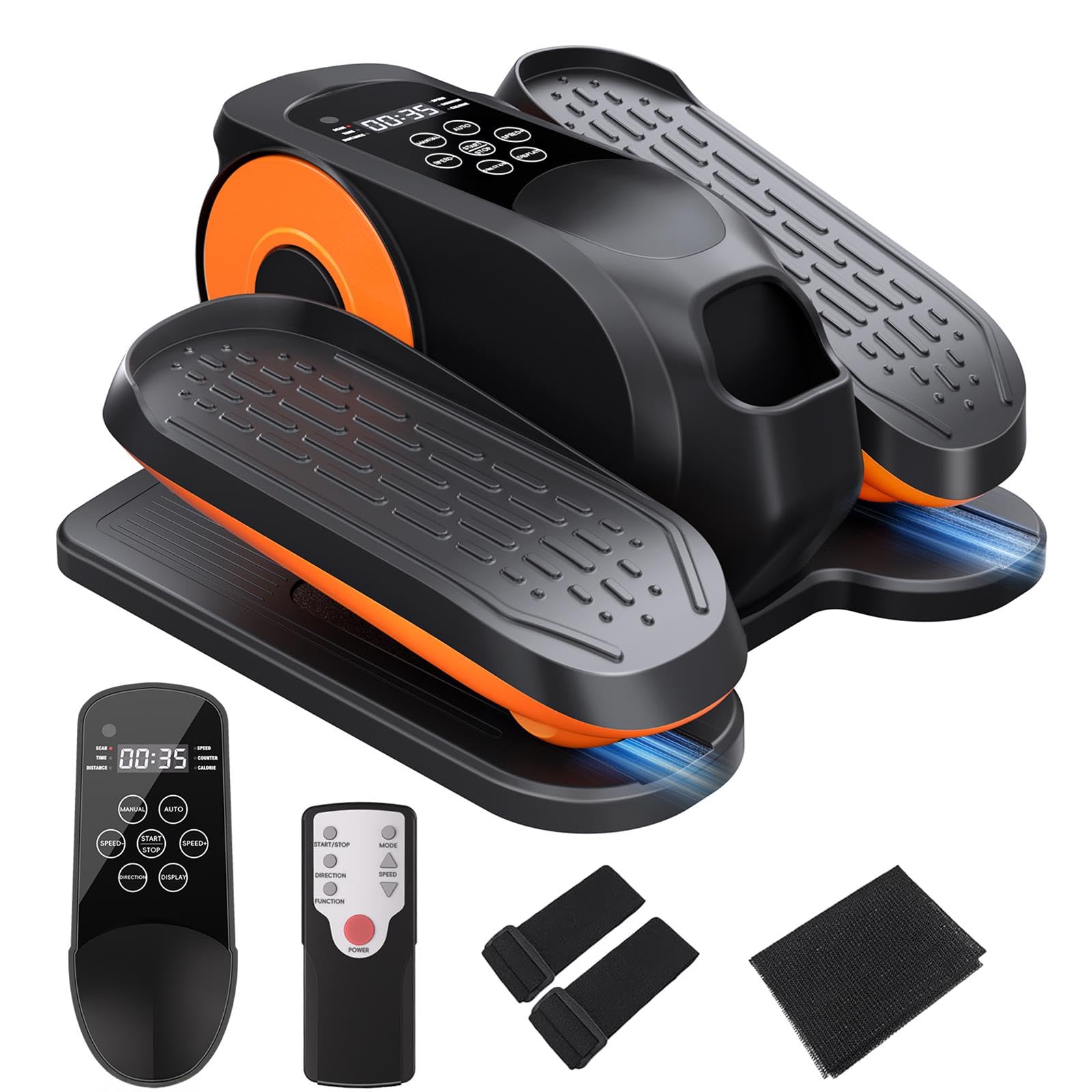
Twelve manual speeds plus three auto programs give you precise control while seated.
The Morelax splits its control between manual and automatic. In manual mode you get 12 adjustable speeds so you can build a plan that matches your pace, and the three automatic modes (P1-P3) come preset with speed, resistance, and direction — press start and go. A remote changes modes without bending over. The smooth elliptical path keeps stress off knees and hips, and the pedals work forward and backward to hit different muscles. It weighs 5.2 kg, sits in a 17.32″D x 15.75″W x 9.84″H frame, and includes a resistance band alongside the remote and power cord.
This is the senior-friendly pick that gives you fine speed control rather than a fixed glide. Buyers report using it for hours a day and find it easy under a desk, quiet during conference calls, and steady for daily low-impact movement. Two things to know: the remote is basic and points only toward the panel, and the build is light plastic, so it favors gentle sessions. For anyone who wants to dial in a slower, controlled pace, the 12-speed range is the reason to choose it over single-speed units.
Fine control for seated users
- 12 manual speeds plus three auto programs
- Forward and reverse pedaling to target different muscles
- Remote for mode changes and quiet seated use
- Includes a resistance band with the remote and power cord
What to keep in mind
- Remote is basic and must point at the panel
- Light plastic build favors gentle sessions over hard use
Best suited to: a senior or seated user who wants granular 12-speed control and a remote.
Better elsewhere if: you want heavy resistance and a metal-built frame for hard pedaling.
Know the Specs
Motorized vs manual drive
A motorized pedal moves the pedals for you, which suits stiff joints and passive movement — like the TDH’s P1-P3 auto modes or the LUBBYGIM’s motorized drive. A manual pedal makes you push against a tension knob, which builds more force but asks more of sore knees. Choose motorized if you want gentle motion without effort; choose manual if you want to work harder.
Resistance and speed levels
Resistance is how hard you have to push; speed levels are the preset pace steps. Stepless resistance, like the Sunny Health & Fitness belt-drive, lets you fine-tune without fixed clicks. Speed levels, like the Morelax’s 12 steps or the TDH’s 12-speed dial, give repeatable steps. More levels give finer pace steps, not more resistance.
Quiet-drive and decibels
Belt-drive and magnetic-resistance designs run quieter than friction pads. A quiet-drive system rated under 15 dB, as on the UMAY and TDH, is quieter than a whisper — enough to pedal through a call without disturbing anyone. In a shared office, spend on the drivetrain, not the display.
Footprint, weight, and stability
Light plastic frames travel easily but can creep on smooth floors; heavier frames with metal flywheels, like the 12-pound flywheel unit, hold their spot better but are harder to lift. Matching the machine’s weight to your floor — carpet grips better than tile — prevents the constant readjusting that spoils a session. Many units include a mat or a chair strap to help.
Common Questions
Is a motorized pedal better than a manual one for bad knees?
How much floor space does an under-desk pedal need?
Will a mini exercise bike slide on hardwood floors?
Can I use a pedal exerciser for my arms as well as my legs?
How quiet is a quiet-drive pedal exerciser?
What is the difference between auto mode and manual mode?
Do I need to assemble these pedal machines?
How much weight can a portable pedal exerciser hold?
Does a mini exercise bike track calories and distance?
The Bottom Line
For most people, the portable exercise pedal that gets you moving with the least fuss is the TDH Under Desk Elliptical. Its motorized 12-speed glide runs quietly, so stiff knees keep moving at a desk without a hard push. If you would rather push the pedals yourself for more force, the belt-driven Sunny Health & Fitness Smart Mini Cycle gives a smooth, stepless stroke. And for gentle, remote-controlled arm and leg motion after surgery or for a senior parent, the LUBBYGIM Motorized Bike is the one to reach for.
How we choose
We do not accept paid placement. Every pick is matched to a real buyer and a real use-case; we do not hands-on test units.
Sources
Specifications: manufacturer listings and product documentation. Review insights: verified customer reviews, as of November 2026. Pricing: not shown on this page (it changes often); check the current price via the retailer link.
As an Amazon Associate, Tactical Gear Guy earns from qualifying purchases. This does not affect which products we feature.