Specs are compiled from manufacturer listings and verified buyer reviews and can change over time — please confirm the key details on the product page before buying.
You want power that doesn’t die with the grid — a charger you fill with loose batteries you already own, then use to top up your phone when the wall socket is gone. That is the whole appeal of a portable charger that takes batteries: no sealed cell to wear out, no waiting on a dead internal pack. The picks below run on AA or 18650 cells you can swap in seconds, so your backup is only as dead as the spare you’re carrying.
This guide is built by comparing the manufacturers’ published specifications and the patterns across verified customer reviews, so you get each pick’s real strengths and trade-offs instead of marketing spin.
Some of these are true battery chargers that can also push power out to a phone, while others are empty shells you load with your own cells. Knowing which one you’re holding changes how you pack it, and this guide walks you through the best portable charger that takes batteries for blackout nights and trail days alike.
Top Picks

How To Choose The Best Portable Charger That Takes Batteries
The first fork in the road is simple: do you want a charger that refills your AA cells and can also loan power to a phone, or an empty case you stuff with 18650 cells you supply yourself? The first is plug-and-play and safer for beginners. The second gives you more raw capacity but asks you to understand lithium cells and buy them separately.
Check what batteries it actually eats
AA and AAA cells are the ones you can buy at any gas station, which makes them the survival-friendly choice. The Panasonic unit is built around eneloop AA and AAA rechargeables. The imuto takes lithium, Ni-MH, and even plain alkaline AA cells, so you can scavenge whatever is in a drawer. The LIJIANI and XTAR units are built for 18650 lithium-ion cells instead, which hold more energy but are not something you grab off a supermarket shelf.
Look at the output, not just the input
A charger that takes batteries only earns its keep if it can push power into your phone at a usable rate. The XTAR and SMALLRIG units advertise fast-charging support, while simpler units run at a steady lower output. Match the output to your device — a modern phone wants more than a trickle, but an emergency top-up call or text doesn’t need a full-speed charge.
Decide how much you trust the cells
Battery chemistry decides everything downstream. Alkaline AA cells leak when abused; rechargeable lithium and Ni-MH cells hold up over hundreds of cycles. The imuto AA cells are rated for up to 2500 recharge cycles, so the cells outlast hundreds of phone top-ups. That number matters because it tells you how many times you can refill before the cells themselves call it quits — the whole reason you’d pick a swappable design in the first place.
Side-by-Side Comparison
| Model | Best For | Battery Type | Output | Charge Time | Amazon |
|---|---|---|---|---|---|
| Panasonic BQ-CC87ABBA eneloop★ Best Overall | Charging AA/AAA and topping phones | AA/AAA eneloop | 5V / 1A | ~3 hrs for 4 AA | Amazon |
| LIJIANI 18650 Power Bank CaseBest for DIY | DIY builders with loose 18650 cells | 18650 lithium-ion | 5V / 2A | 12 hrs | Amazon |
| imuto AA Emergency Charger | Blackouts and mixed-cell emergencies | AA lithium/Ni-MH/alkaline | 5V | — | Amazon |
| XTAR PB2SL V2 | Fast-charging 18650 swaps on the go | 18650 / 21700 | 4.2V / 2A | — | Amazon |
| SMALLRIG SC18 EDC | Action-camera rigs and EDC carry | 21x70mm lithium | 20W | — | Amazon |
Detailed Reviews
1. Panasonic BQ-CC87ABBA eneloop Battery Charger
Our pick — 4.5+★ from 250+ verified ratings; the strongest balance of quality and price.
The do-everything charger that refills four AA cells and then lends your phone a lift.
Here’s the trick most people miss: this is a charger first and a power bank second, and that order is exactly what makes it dependable. It individually charges each AA or AAA eneloop cell on its own station, so one weak battery doesn’t drag the rest down. The 5V 1A USB port then lets you push that stored battery power into a phone — a genuine two-way tool, not just a battery filler.
Four separate LED lights make it obvious where you stand at a glance. Green means a cell is 80% or better, orange flags 20% to 80%, and red warns it’s at 20% or below — so you never guess which battery needs more time. A retractable AC plug folds away for storage, and at 3.52 ounces it drops into a glovebox or drawer without bulk.
Where it earns its keep with owners is the battery handling itself — the unit’s core job of charging cells well is what wins people over, and users regularly note the versatility of charging both AA and AAA cells at once. Four discharged AA cells refill in roughly 3 hours; two AA or two AAA cells finish in up to 1.5 hours. The honest trade-off is speed when used as a charger and the plastic feel — it isn’t built like armored gear, and as a phone top-up it’s a slow lane, so treat the USB port as an emergency trickle rather than a fast charge.
What wins people over
- Charges each AA or AAA cell individually so none gets under- or over-charged
- USB port turns stored AA/AAA power into a phone top-up
- Three-color LEDs show charge level per slot at a glance (green, orange, red)
- Retractable AC plug stores flat; 3.52 oz travels easily
The honest catches
- USB output is a slow 5V 1A — fine for a call, not a fast fill
- Cheaper-feeling plastic shell that wants careful handling
- Built around eneloop cells; other AA brands are not its stated target
Settled verdict: The one to grab if you keep rechargeable AA/AAA cells around and want them charged right, plus an emergency phone top-up in the same pocket-sized box.
Think twice if: You need to fill a modern phone fast — its 5V 1A port is a trickle, not a turbocharger.
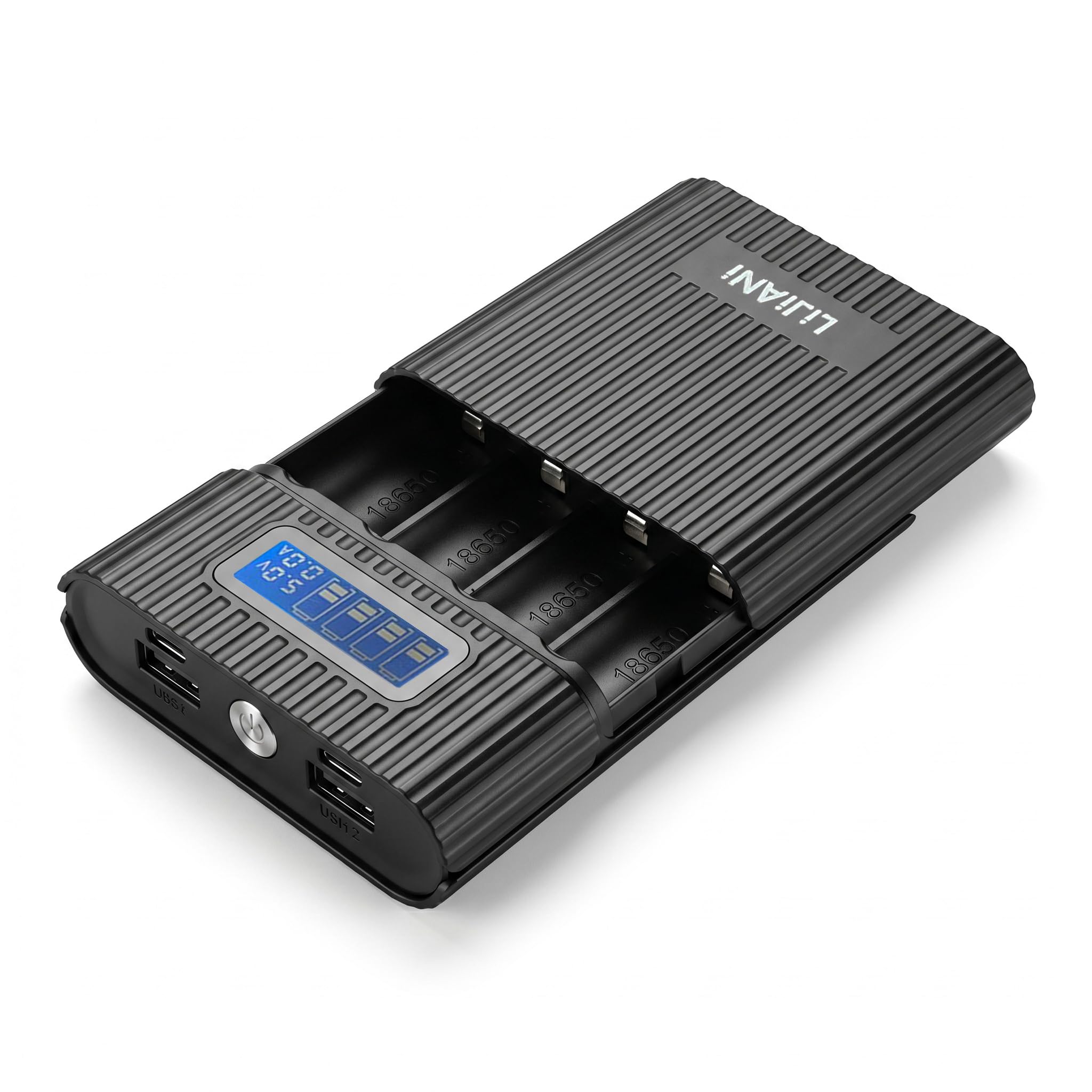
2. LIJIANI 18650 Power Bank Case Portable DIY Battery Pack
An empty shell that turns your spare 18650 cells into a pocket power station.
Nothing is included here — that’s the point. You drop in up to four 18650 cells (0.7 inches in diameter, 2.56 inches in length) and the case turns them into a power bank with a 5V 2A output across its USB and Type-C ports. The LCD screen shows voltage, current, and remaining power per slot, so you’re reading real cell data instead of guessing from a blinking dot. Long-press the switch and it doubles as a flashlight.
That 2A output is double the 1A the Panasonic eneloop charger puts out, so if raw throughput to a phone is your priority, this case delivers it. Just understand the trade: the case runs at 12 hours to charge under its own spec, which is a slow refill of the cells themselves. A bad-battery detector blanks the slot symbol if a cell is dead or inserted backward — a small smart touch that saves you from cooking a reversed cell.
The real-world caveat is durability and consistency. The plastic housing is the recurring gripe — some units don’t survive extended use, and the ports draw their share of mixed notes. It also explicitly asks for buyers who know their way around lithium cells; the maker’s own manual warns the unfamiliar to steer clear. This is a builder’s tool, and it rewards you if you treat it as one.
Who it suits: Tinkerers with a drawer of loose 18650 cells who want a readable, dual-port case and don’t mind sourcing the batteries themselves.
What to expect: 5V 2A output and per-slot LCD data are genuinely useful, but the housing and slow self-charging are the price of entry.
Reach for this if: You already own 18650 lithium cells and like seeing exact voltage and current on a screen.
Look elsewhere if: You want something you can hand to a family member who has never handled loose lithium cells.
3. imuto AA Battery Emergency Charger
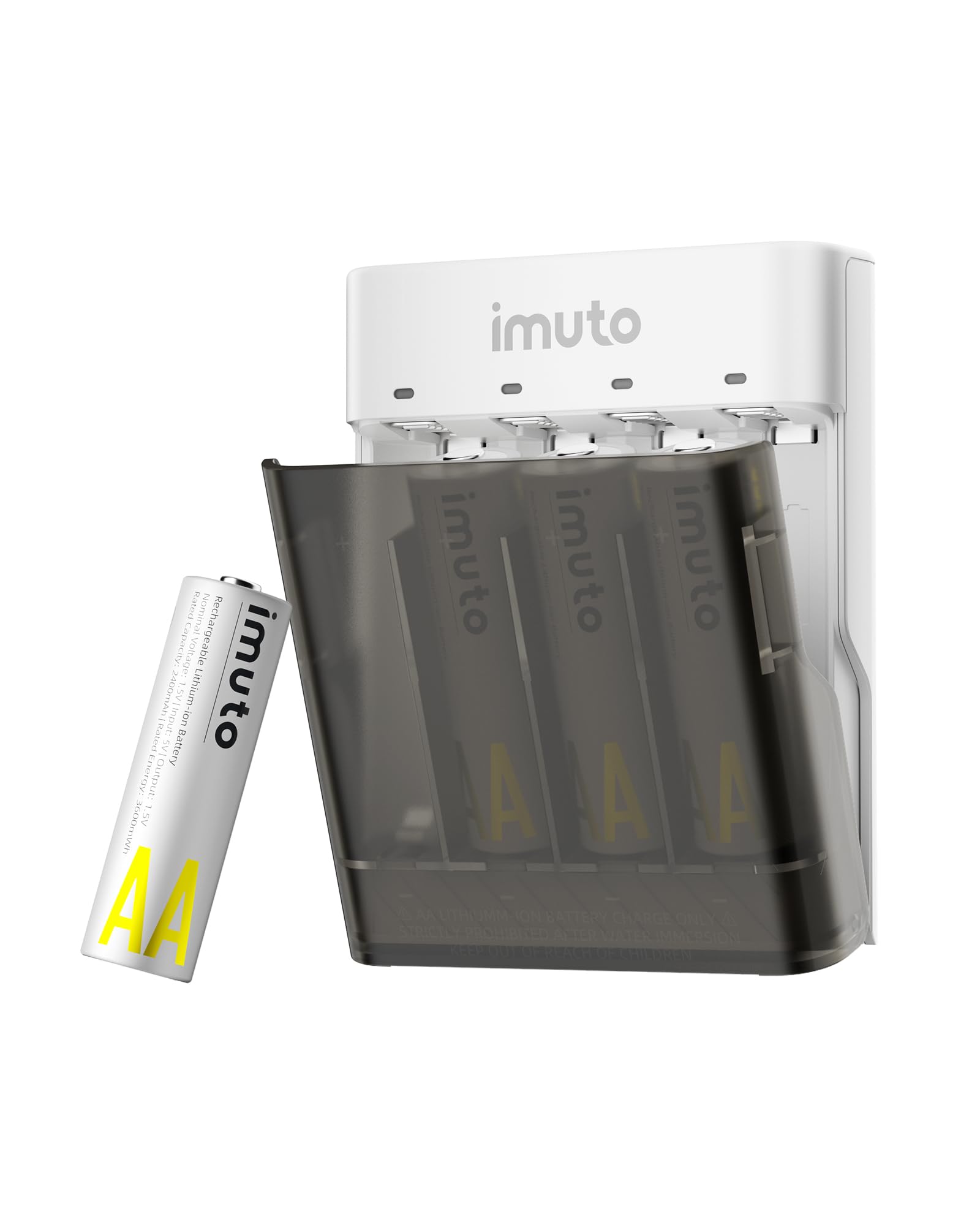
Four AA cells in, a phone charge and a flashlight out — the blackout-night kit in one box.
This is the pick for the person who wants a self-contained emergency kit, not a component. Four AA lithium cells come included, each rated 3600mWh (roughly 2400mAh at 1.5V) and up to 2500 recharge cycles. Insert them and the case becomes a power bank with a USB-C output to charge a phone; a built-in LED flashlight lights a dark hallway or roadside when the power is out.
What makes it forgiving is the chemistry flexibility. It accepts lithium, Ni-MH, and even alkaline AA cells, so in a genuine emergency you can scrounge whatever 1.5V cells you find and keep the phone alive. It’s rated to operate from -40°F to 140°F. Green light means it’s charging the batteries from the wall, blue means it’s pushing power to your phone, and red warns the cells are running low.
The honest caveat is that battery life and charging are the most debated parts of this unit — some cells hold up for hours, others fade fast, and the red indicator can blink in ways that confuse people. It’s also slower than dedicated chargers at refilling. But it’s the most popular unit here for a reason: it does the whole job — charge the cells, power the phone, light the dark — without asking you to buy batteries separately.
Best fit: Households that want one grab-and-go box for hurricanes, outages, and roadside trouble, complete with cells already inside.
Caveat to weigh: Cell performance and charge speeds draw divided reports, so treat the battery indicator as a rough guide, not a fuel gauge.
4. XTAR PB2SL V2 USB C Battery Charger Not Included Battery

A fire-resistant shell and fast-charge protocols for people who carry 18650 cells daily.
The engineering angle: Built from flame-retardant, fire-resistant PC material with a protection circuit against over-current, over-charge, over-voltage, and short-circuit, plus a soft-start function and 0V activation to revive over-discharged cells. A precise auto cut-off kicks in when a cell hits full.
The headline spec: It supports QC3.0 and PD3.0 fast charging (protocols that let a compatible phone pull more power) and runs on 18650 or 21700 cells you supply. At 3.2 ounces it’s a touch lighter than the 3.52-ounce Panasonic eneloop charger above, so it disappears into a pocket — though it runs at 12 volts input against that charger’s 5 volts, a much higher input tier for fast-charge adapters.
The catch is consistency. Functionality is the single most-discussed subject, and it splits down the middle — some cells and phones charge fine, while others report it quitting early or delivering only a sliver of charge. The lid closure that holds cells in place also draws divided feedback. So bring cells you trust, and test it at home before you rely on it in the field.
The short version: A well-built, fast-charging 18650/21700 carrier for someone already versed in lithium cells who wants PD3.0 speeds and real circuit protection.
Honest limitation: Reports of early failures and inconsistent charging mean it’s not the one to trust blind on a first backcountry trip.
5. SMALLRIG SC18 EDC Power Bank
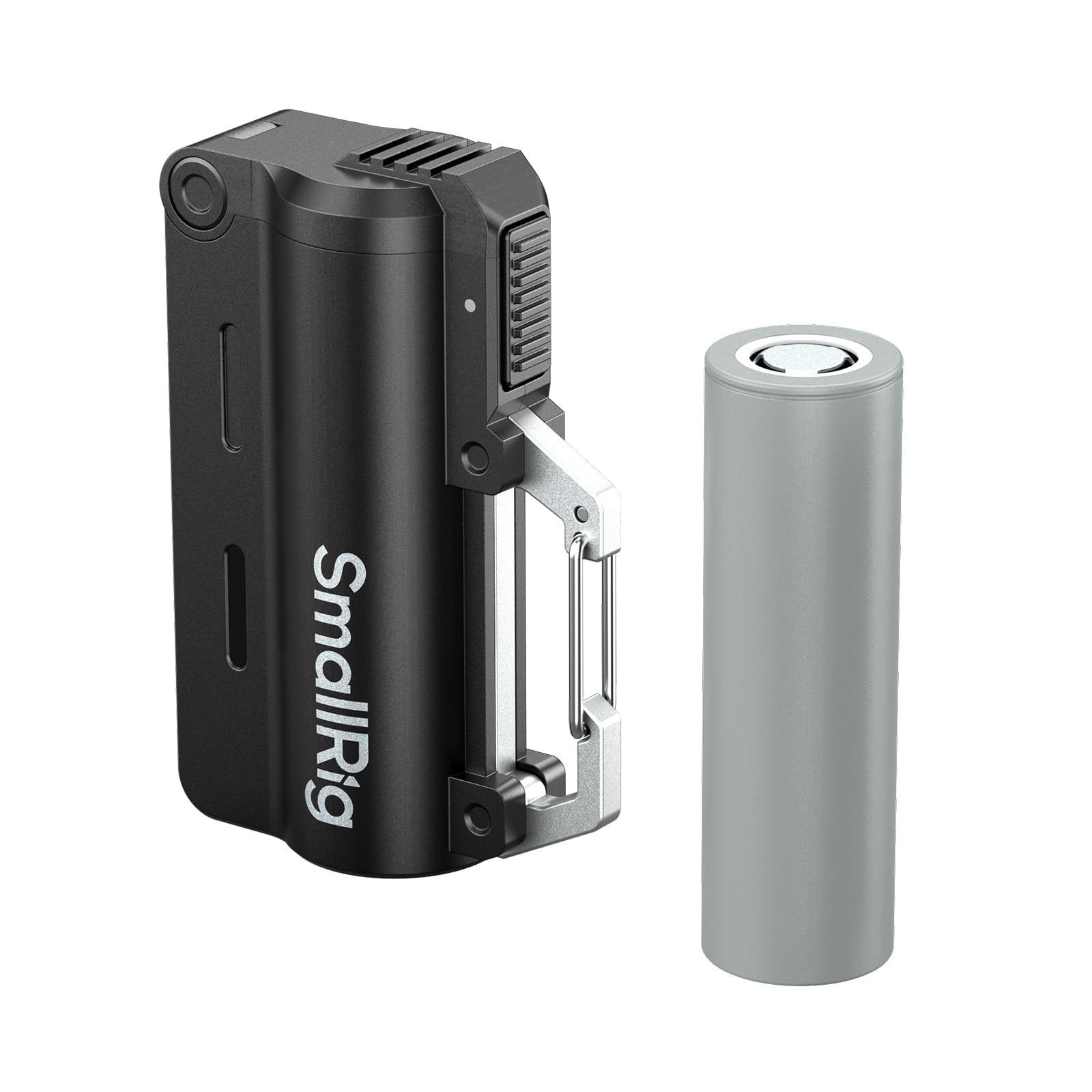
A 115-gram capsule built to keep an action camera rolling through a mid-shoot battery swap.
If your rig is a DJI Osmo or Insta360, this is aimed at you. It holds one 21x70mm cell (a 5000mAh, 18Wh unit) and the swap is the whole pitch: pull the spent cell, drop in a fresh one, and you’re back to 20W output without waiting on a recharge. The case itself clips on with a 5-series aviation aluminum carabiner, so it mounts straight to a camera rig, belt, or bag during a shoot.
The output is the fastest here at a stated 20W, well above the trickle of the simpler units, and the protections cover reverse polarity, short circuit, overcurrent, overheating, overvoltage, and undervoltage. The complete unit with the battery weighs just 115g (4.1oz), so it hangs off a strap without dragging. SMALLRIG claims a single swap extends DJI Osmo Action 6 runtime by about 1.5x — a maker figure, not an independent test.
The trade-off is narrowness. It’s built around action cameras first, and its 21x70mm format is a specific cell size, so your spare batteries need to match — it won’t run on a loose AA. There’s also a brand mismatch worth flagging: the spec list includes a DJI Osmo Pocket 3 / 4 and Osmo Action 4 / 5 / 6 compatibility line, yet the listed camera-compatibility field names only the Osmo Pocket family. Check your exact camera before you mount up.
Who it beats: Any action-camera shooter who wants hot-swap power bolted to the rig and doesn’t want to pause a take to charge.
Who it leaves out: Anyone carrying standard AA cells — this wants one matching 21x70mm cell and specific action-camera bodies.
Know the Specs
Output voltage and amperage
Output (like 5V 1A or 5V 2A) is how fast the unit pushes power into your phone. A 2A output moves roughly double the current of a 1A port, so it fills a modern phone faster. A 1A port is a trickle — fine for a call or message, slow for anything more. Match the output to how urgently you need a full charge.
Battery chemistry and cell format
The cells a unit takes decide everything downstream. AA/AAA cells are everywhere and easy to scavenge; 18650 and 21x70mm lithium cells hold more energy but demand you supply and understand them. A charger that accepts lithium, Ni-MH, and alkaline is the most forgiving in an emergency, because it works with whatever cells you find.
Capacity: mAh vs mWh
mAh (milliamp-hours) and mWh (milliwatt-hours) measure stored energy. The imuto cells are rated 3600mWh, roughly 2400mAh at 1.5V. Bigger numbers mean more stored power, but capacity only helps if the output is fast enough to use it before the phone’s own battery dies.
Charge time and cycle life
Charge time is how long it takes to refill the cells; faster is convenient but can run warmer. Cycle ratings tell you how many refills a cell survives; the imuto cells are rated for up to 2500. Higher cycle counts mean a longer useful life before the cells themselves wear out.
Common Questions
Can a charger that takes AA batteries actually charge my phone?
What is the difference between a battery charger and a DIY power bank case?
Will a 18650 power bank case work with regular AA batteries?
Can I use alkaline AA batteries in a rechargeable charger?
What does 3600mWh mean compared with mAh?
Why is the USB output on some of these so slow?
Is it safe to leave lithium cells in a power bank case long term?
Which one should I carry for an action camera rather than a phone?
Do these units come with batteries included?
The Bottom Line
The winner for most people is the Panasonic eneloop BQ-CC87ABBA, because it does the everyday job — charging AA and AAA cells individually with clear per-slot lights — and still gives you a USB port to keep a phone alive when the wall is gone. It’s the least fussy way to own a portable charger that takes batteries. If emergency readiness with cells already inside is the goal, the imuto is the grab-and-go kit with a flashlight and alkaline compatibility built in. And for action-camera rigs that need 20W hot-swap power on the mount, the SMALLRIG SC18 is the one built for the job.
How we choose
We do not accept paid placement. Every pick is matched to a real buyer and a real use-case; we do not hands-on test units.
Sources
Specifications: manufacturer listings and product documentation. Review insights: verified customer reviews, as of November 2026. Pricing: not shown on this page (it changes often); check the current price via the retailer link.
As an Amazon Associate, Tactical Gear Guy earns from qualifying purchases. This does not affect which products we feature.