Specs are compiled from manufacturer listings and verified buyer reviews and can change over time — please confirm the key details on the product page before buying.
If your bathroom mirror fogs over before you finish washing your hands, you need a fan that actually moves air — not a decorative vent that hums and does nothing. A plug-in exhaust fan solves that without an electrician, a permit, or a hole in your ceiling: you mount it in a window or wall opening, plug it into a normal outlet, and switch it on. The list below covers eight fans you can set up yourself, ranked by how well they clear steam, how loudly they do it, and whether they last past the first season.
This guide is built by comparing the manufacturers’ published specifications and the patterns across verified customer reviews, so you get each pick’s real strengths and trade-offs instead of marketing spin.
Some move four times the air of others while running quieter, and a few trade raw pull for a near-silent hum you can forget about. Here is the practical shortlist of the best portable bathroom exhaust fan options you can install without touching your home’s wiring.
Top Picks


How To Choose The Best Portable Bathroom Exhaust Fan
The wrong way to buy one of these is to pick the biggest number on the box. The right way is to match the fan’s CFM to your bathroom’s square footage, then check the dB rating and the mount type against the opening you actually have. Get airflow, noise, and mounting right, and the rest is comfort.
Match the airflow to your square footage
Airflow is quoted in CFM — cubic feet per minute, or how much air the fan pushes out in one minute. A small powder room clears fast with a modest figure, while a full bathroom with a shower needs more muscle. One fan on this list rates its coverage at 75 to 108 square feet, which gives you a real benchmark to compare against your own room. Too little CFM and the mirror still fogs; far more than your square footage needs just adds noise.
Read the noise number before the airflow number
Noise is usually listed in dB (decibels — the everyday loudness scale) or sones, and lower is better. A fan in the low 30s is background-level, while one around 40 dB is a soft, audible hum you notice in a quiet house. Two fans can move wildly different amounts of air at similar loudness, so compare both figures side by side rather than trusting the word “quiet” on the packaging.
Confirm the mount and the cord reach
Every fan here is plug-in, but they are not interchangeable. Some sit in a window frame, some mount to the wall, and some need a square opening cut to their own panel size. Check the cord length too — a short lead may not reach your nearest outlet from the window, and a longer one buys you flexibility. Measure your opening before ordering, because a fan that doesn’t fit is a return, not a repair.
Side-by-Side Comparison
| Model | Best For | Airflow | Noise | Mount / Cord | Amazon |
|---|---|---|---|---|---|
| 6″ Bathroom Exhaust Fan With Front Panel & Plug in★ Best Overall | All-round bathroom pick | 110 CFM | 39 dB | Window or wall / 5 ft cord | Amazon |
| 6-Inch Wall Exhaust FanStrongest Pull | Wall or glass mounts | 188 cfm | — | Wall / pull chain | Amazon |
| Exhaust Fan 4″ Home Ventilation FanMost Compact | Small spaces and tight openings | 56 cfm | Under 34 dB | Window, wall or ceiling / 3 ft cord | Amazon |
| 9″ Twin Window Fan – FWT9 | Bedroom and multi-room airflow | — | — | Window / snap-on feet | Amazon |
| 6″ Shutter Exhaust Fan | High-airflow garage and greenhouse | 258 cfm | 40 dB | Window or wall / 5 ft cord | Amazon |
| HG Power 6 Inch Reversible Exhaust Fan | Intake and exhaust in one | 310 cubic meter per hour | — | Wall / 6.56 ft cord | Amazon |
| Nalle 10 Inch Window Reversible Exhaust Fan | Big rooms and reverse airflow | 460 CFM exhaust / 380 CFM intake | — | Through-wall or window / 55 in cord | Amazon |
| Vornado PORTAL Window Fan | Quiet window installs | — | — | Window (24″–38″ wide) / corded | Amazon |
Detailed Reviews
1. 6″ Bathroom Exhaust Fan With Front Panel & Plug in
Our pick — 4.0+★ from 250+ verified ratings; the strongest balance of quality and price.
The bathroom first pick: a full front panel, a plug, and steam that actually leaves.
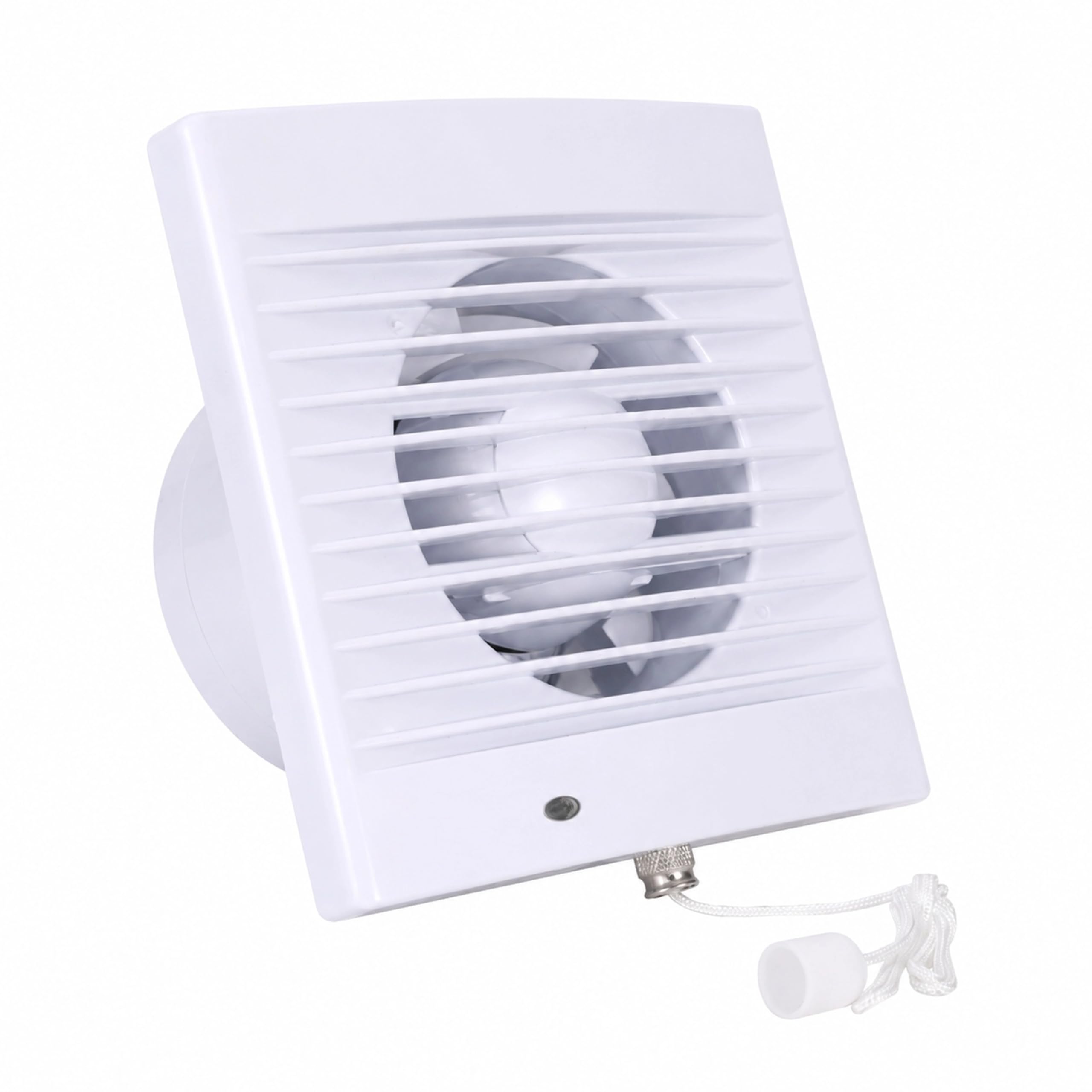
This is the fan to reach for when you want the simplest possible fix. It moves 110 CFM of air — 110 cubic feet per minute, meaning it shifts 110 cubic feet of humid air out of the room every minute — which the maker rates for rooms between 75 and 108 square feet. For a standard bathroom, that’s a working figure, not a token one. It runs at 39 dB and 1.0 sones, so the noise sits at a low, steady hum you hear but can talk over.
The full-screen front panel is the detail buyers single out. It keeps splashes out of the blades and wipes clean without disassembly, which matters in a room where water hits everything. The 5-foot cord with an inline on/off button means you don’t have to reach up to a wall switch or hunt for a pull chain — you just hit the switch on the lead. It mounts either in a window or on a wall, and the 100% copper motor is the part meant to go the distance.
What buyers keep coming back to is that it works quietly — someone could forget it’s running, and several note it clears steam and condensation without a racket. The honest limit shows up in the airflow: one long-term user found the pull less powerful than anticipated, so treat this as a bathroom-and-laundry fan rather than a heavy-duty workshop blower. If you need to clear a garage fast, look further down this list.
What earns it first place
- 110 CFM clears steam from rooms the maker rates at 75–108 ft².
- 39 dB / 1.0 sones is quiet enough to run unnoticed.
- Full front panel keeps splash off the blades and wipes clean.
- Inline cord switch plus a 5 ft lead saves reaching for a wall control.
Where it stops short
- Pull is modest — heavier-duty exhaust fan jobs want more airflow.
- Window or wall mount only, so your opening has to suit it.
The everyday choice: a normal bathroom or laundry room that fogs up and needs quiet, consistent clearing.
Think twice if: you’re ventilating a large garage or greenhouse and want serious suction.
2. 6-Inch Wall Exhaust Fan
Wall-mounted muscle with a pull cord you can reach from standing height.
Here’s the number that sets this one apart: 188 CFM at a fixed 1300 RPM, the rotational speed of the blades. That airflow is well beyond the 110 CFM of the top pick, so it clears a steamy room in noticeably less time. The pull-chain switch is a small but clever touch — it lets you turn the fan on and off even when it’s mounted high up, where a cord switch would be out of reach.
It’s built for wall or glass mounting, and the wind-proof ABS sheet (a plastic flap that seals the opening) blocks dust, leaves, pollen, and backflow when the fan is off. The removable lattice filter pops out for cleaning. Power draw is 18W, and a sealed copper motor with overheat protection is meant to keep it running through long stretches without cooking itself.
The catch is rooted in its own lightness. It’s made of ABS plastic, and a heavier-handed owner described it as delicate — so install it firmly and leave it be rather than yanking the chain. Run it as intended, though, and it holds up: one user reports it running around the clock and still going. Airflow noise dominates over mechanical noise, which most people find easier to live with than a motor whine.
Why it’s worth a look: 188 CFM at 1300 RPM gives it real clearing power, the pull chain suits high mounts, and the built-in overheat cutoff protects the motor.
Fair warning: the plastic body rewards a careful install — treat the pull chain gently and it won’t be a problem.
Reach for this if: your fan lives on a wall or glass panel and you want strong pull with a cord you can actually grab.
Look elsewhere if: you need a window-frame fan that sits in an existing sash opening.
3. Exhaust Fan 4″ Home Ventilation Fan Window and Wall Mount
A tiny, near-silent extractor for tight openings and small rooms.
If your bathroom opening is small, this 4-inch unit fits where the bigger fans won’t. It runs on just 12W of power at 110v and moves 56 CFM, which is a fraction of the 258 CFM the 6-inch shutter fan manages — so read this as a small-room extractor, not a whole-bath heavy lifter. For a half bath, a small window, or a workshop corner, that’s plenty. Its noise spec of under 34 dB makes it the quietest fan here by the published figures.
The check valve in the duct is the clever part. It’s a spring-loaded damper that shuts automatically when the airflow stops, so cold air, bugs, and backdraft don’t creep in when the fan is idle. You can also remove it if you’d rather keep the air reversible. The 3-foot cord is on the short side, so check the distance to your outlet before committing. It mounts to a window, wall, or ceiling.
Airflow is where opinions split. Buyers praise how it works and how quietly it does it, and a few have run it nonstop through a whole summer without trouble. But the pull receives mixed feedback — some find it weaker than expected, and the low CFM figure backs that up. Treat it as a quiet helper for a small space rather than a steam-clearing powerhouse.
Best for: small bathrooms, tight window openings, and anyone who prizes near-silent operation above raw airflow.
skip it if: you need to clear a large, steamy room quickly — the 56 CFM won’t keep up.
4. 9″ Twin Window Fan, 2 Speed, Exhaust, Expandable – FWT9
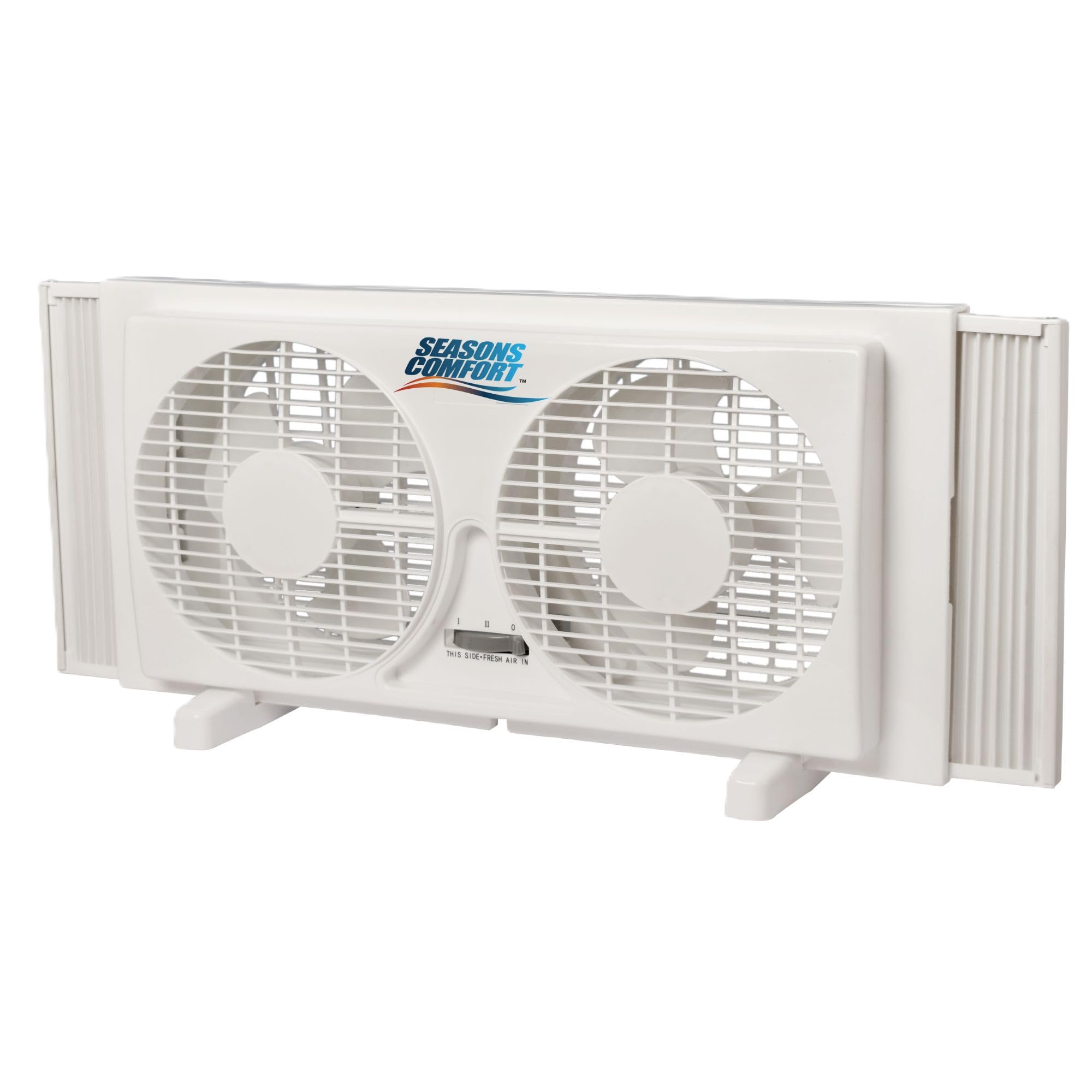
A double-blade window fan that cools a bedroom as easily as it vents a bathroom.
This one flexes across rooms. It’s a 9-inch twin window fan with two speeds, snap-on feet, and three airflow directions — intake, exhaust, or air exchange — so you can pull cool night air in or push stale air out. Set it on the floor or in a window, no tools needed.
Fit is its standout: buyers consistently say it drops into window frames cleanly. As a bedroom cooler it earns real affection — one owner describes waking up wrapped in a comforter in the middle of summer. It’s ETL listed (independently safety-tested) and comes with a 1-year warranty, and it’s light enough to carry between rooms.
The build is the honest trade-off. Reports on durability and construction skew toward the cautious, with some fans developing a rattle early or a blade giving out. That’s a fair caution rather than a dealbreaker — plenty of buyers use it happily — but if you want one fan to run for years in a permanently damp bathroom, a dedicated metal-bodied exhaust unit is the safer bet. This is the pick for flexible cooling and occasional venting.
Where it shines: the twin-blade design and three-direction airflow make it a genuine two-season fan, and it slots into standard windows without fuss.
The honest caveat: build longevity is the weak spot — a fan meant for everyday damping will outlast it.
Pick it for: a bedroom or office window where you want cool airflow plus an exhaust option.
Pass if: your priority is a permanent bathroom moisture machine built to take years of steam.
5. 6″ Shutter Exhaust Fan
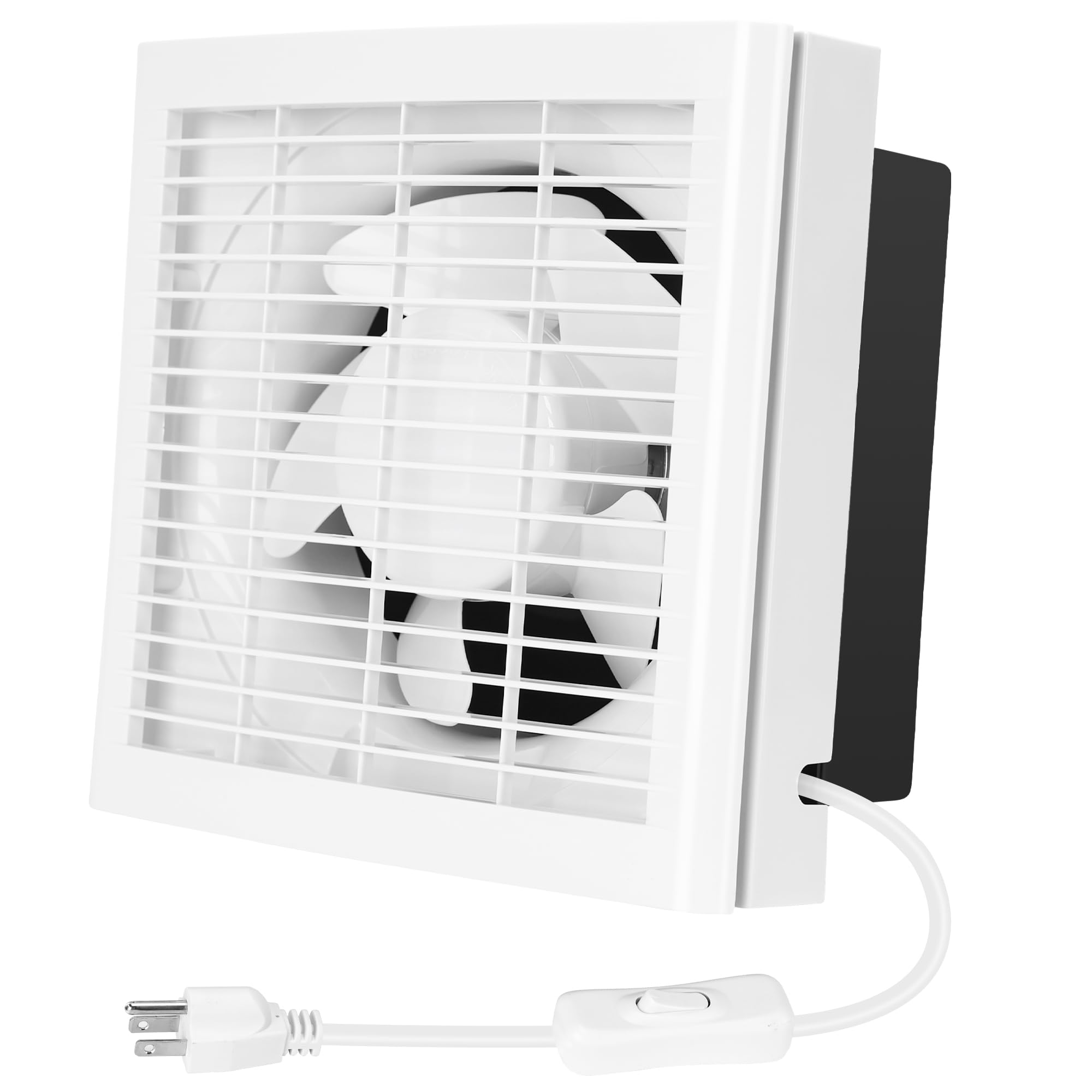
The heavyweight: 258 CFM through five blades and automatic shutters.
On raw airflow, nothing in the mid-tier comes close. This 6-inch shutter fan pushes 258 CFM at 1350 RPM through five blades, against just 56 CFM from the compact 4-inch unit — a stark difference in clearing power. That makes it the right call for a garage, greenhouse, attic, or laundry room where you need real suction. It runs at 40 dB, so it’s louder than the bathroom-first pick, but still a soft hum rather than a roar.
The shutter louvers close when the fan stops, sealing the opening against drafts and pests. The front oil-sink panel disassembles for cleaning, and the 5-foot cord makes install flexible. It’s built from an ABS frame with thick plastic blades, and it works as a window or wall mount.
Where it earns trust is under load. One owner mounted it in a wooden bathroom window frame, where it pulls out heat, moisture, and smells without complaint; another ran it in a greenhouse through a full winter. Two honest gripes surface: mounting guidance is thin — some buyers frame it out themselves — and a few find the pull weaker than 258 CFM suggests. As a high-airflow extractor for tough spaces, though, it’s a serious fan for the money.
Go here for: garages, greenhouses, and laundry rooms that need maximum air moved, with shutters that seal when off.
Look past it if: you want whisper-quiet bathroom duty above all — the bathroom first fan runs a touch softer.
6. HG Power 6 Inch Reversible Bathroom Exhaust Fan
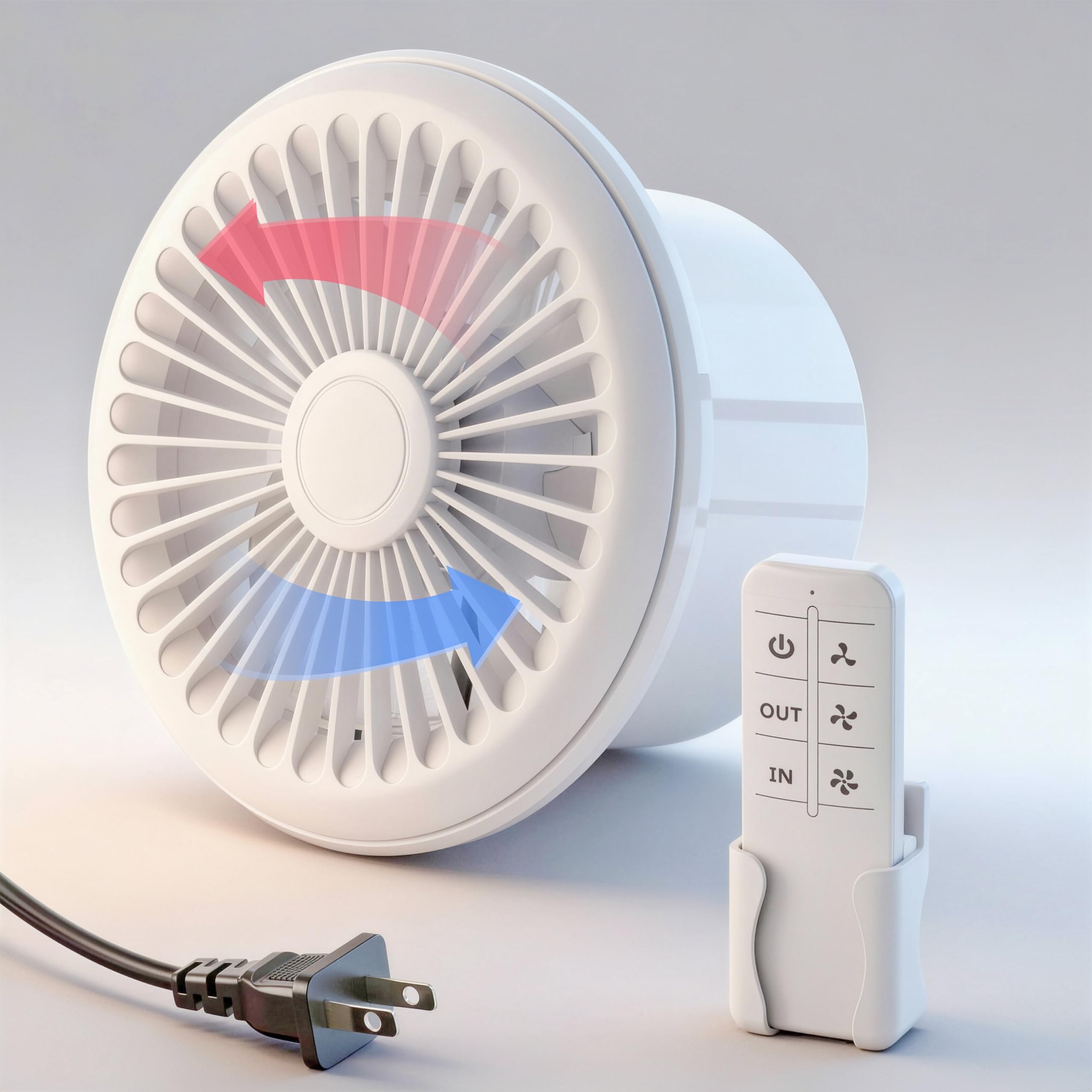
Blows out stale air or pulls fresh air in — and you control it from across the room.
Two-way airflow is the reason to pay more for this HG Power. A reversible motor lets it exhaust stale, humid air or switch to intake and draw fresh air in, so one fan handles both jobs. Three speeds give you a Turbo setting for fast moisture removal, a Medium for steady circulation, and a Low that runs at reduced noise. The included remote turns it on, changes speed, and flips the direction without you climbing to reach it.
Its rated airflow is listed as 310 cubic meters per hour — a metric figure, so don’t compare it line-by-line with the CFM fans here; treat it as a strong, high-capacity mover. Twin mesh screens keep debris out of the blades, and the ABS plastic body is built for everyday wear. The power cord runs 6.56 feet, one of the longer leads here, giving you more freedom on outlet placement.
Reliability is the honest split. Many owners find it excellent — one uses it to swap attic heat for cooler air during showers, accepting a louder high setting. But a minority report units that stopped after a few weeks, and a few find the front grill tricky to seat. Buy it for the flexibility and the remote, and check the grill fits snugly on arrival.
The case for the remote: reversible intake and exhaust plus three speeds makes it the most adaptable fan here, and needing no wall switch is a real convenience in a steamy room.
One thing to know: high settings are louder and long-term reliability is a mixed bag — inspect the grill fit and keep the receipt handy.
Suits you if: you want one fan that both vents moisture and pulls in fresh air, run by remote from anywhere in the room.
Not for you if: you need the simplest, most predictable motor for a permanent install.
7. Nalle 10 Inch Window Reversible Exhaust Fan

A 10-inch louver blower that moves 460 CFM when you need serious volume.
For a big room or a stubborn steam problem, this is the airflow ceiling of the list. The 10-inch louver fan rates at 460 CFM in exhaust and 380 CFM in intake, dwarfing the mid-range fans here. It’s a two-way linkage type, meaning a pull cord cycles it through three positions: first pull exhausts outward, second reverses to draw air in, third stops and closes the louvers. The 55-inch power cord gives you reach, and it fits a through-wall or window installation.
It’s built to work hard, with a sleeve bearing motor the maker rates for continuous running and an overheat protector plus temperature fuse for safety. The shell and blades are ABS. The louvers close when it stops, and the parts disassemble for cleaning, which keeps performance from fading as dust builds up.
The size is also the caveat. It needs a 13.5 x 13.5 panel opening, and some buyers find it takes more than unboxing and plugging in — expect to frame the opening yourself. Durability is mixed: some run it happily for a season, while a few had one fail inside a year. If you need maximum air moved through a large opening and can handle the install, it delivers on volume.
Worth it when: you have a big opening and want raw airflow to clear a large or humid space fast.
Weigh up if: you want a plug-and-play unit — this one rewards a proper framed install.
8. Vornado PORTAL Window Fan

The low-profile window fan tuned for near-silent running and a clean view.
This one is aimed at people who care how the window looks as much as how it works. The horizontal design fits windows 24 to 38 inches wide using a modular block system, and it needs at least an 8-inch tall opening. It runs on 3 speeds with a reversible exhaust mode to flip between pulling cool air in and pushing stale air out. At 6.9 pounds it stays put once seated, and its low-profile body keeps your view clear.
Quiet is its signature. Owners repeatedly call it extremely quiet when properly installed, and many find it a step above the bulky double-fan setups that block whole windows. Reviews also point to a solid, well-made feel and a clean appearance that looks tidy in a bedroom or living room.
Both airflow and power draw spark real disagreement. Some find it moves a great deal of air; others find it seriously underpowered, especially in exhaust mode, and think it costs a lot for the output. The mounting also has quirks — foam is included to seal gaps, but window depth can complicate the fit. If you want whisper-quiet window airflow and a slim profile, this delivers; if maximum pull is the goal, the bigger blowers win.
Strengths worth noting
- Extremely quiet running from 3 speed settings.
- Low-profile look keeps your window view open.
- Reversible mode gives intake and exhaust in one fan.
- Modular blocks fit windows 24″ to 38″ wide.
Where expectations realign
- Airflow and power draw divide opinion — some find it underpowered.
- Window depth can affect fit; screen removal may be needed.
The fit: a bedroom or living-room window where quiet, good looks, and reversible airflow matter most.
Not the pick for: a steamy bathroom that needs fast, forceful extraction over a slim profile.
Know the Specs
Airflow (CFM)
CFM stands for cubic feet per minute — how much air the fan moves out of the room every sixty seconds. It’s the number that decides whether steam genuinely clears or just swirls. Small rooms clear with modest CFM; bigger, steamier spaces need more. Some makers rate in cubic meters per hour instead, so match the units before comparing two fans directly.
Noise (dB and sones)
dB is the decibel scale for loudness — lower is quieter. A fan in the low 30s fades into background; one near 40 dB is a soft, noticeable hum. Sones are a related loudness scale where lower also means quieter. Two fans can move very different amounts of air at similar loudness, so check the airflow beside the noise figure before deciding.
Common Questions
Do portable bathroom exhaust fans need to be installed by an electrician?
What airflow do I need for a small bathroom versus a large one?
How loud is a portable exhaust fan in a bathroom?
Can a window exhaust fan handle a steamy shower every day?
What does reversible airflow mean on an exhaust fan?
How long do the cords run, and does that matter?
Will a wall-mount fan work in the same spot as a window fan?
How often should I clean the fan, and how hard is it?
Is a shutter exhaust fan better than one without shutters?
The Bottom Line
If you want the safest all-round pick, the 6″ Bathroom Exhaust Fan With Front Panel & Plug in earns it — 110 CFM, 39 dB, and a full front panel that keeps splashes out and wipes clean. For a small bathroom where quiet is everything, the 4″ Allvent fan runs under 34 dB. And if you need to clear a garage or greenhouse fast, the 6″ Shutter Exhaust Fan brings 258 CFM to the job. Match the fan to your opening and your room’s square footage, and the steam problem is solved.
How we choose
We do not accept paid placement. Every pick is matched to a real buyer and a real use-case; we do not hands-on test units.
Sources
Specifications: manufacturer listings and product documentation. Review insights: verified customer reviews, as of November 2026. Pricing: not shown on this page (it changes often); check the current price via the retailer link.
As an Amazon Associate, Tactical Gear Guy earns from qualifying purchases. This does not affect which products we feature.