Specs are compiled from manufacturer listings and verified buyer reviews and can change over time — please confirm the key details on the product page before buying.
The decibel rating is the spec you will notice first. An 81 dB pancake compressor is loud enough that many home garages end up with it shoved in a corner, unplugged, gathering dust. A unit rated under 70 dB gets used for tires, inflatables, and a quick nail in a door frame on a Sunday morning; an 81 dB one gets left unplugged.
This guide is built by comparing the manufacturers’ published specifications and the patterns across verified customer reviews, so you get each pick’s real strengths and trade-offs instead of marketing spin.
I have grouped the picks below by what they do best at home, from near-silent one-gallon units to six-gallon tanks on wheels. Each entry tells you the tank size, the air delivery figure and the noise level in plain terms so you can judge whether it suits your workshop. This is how you pick the right portable air compressor for home use without dragging home a tank that is too loud or too small.
Top Picks


How To Choose The Best Portable Air Compressor for Home Use
Most people shop for a home compressor assuming the biggest tank wins. That assumption gets people stuck with a 6-gallon, 80-plus dB tank they can barely move. At home, a sub-70 dB rating and a weight you can carry matter far more than tank volume.
Decibels decide whether it lives in your garage
A compressor’s loudness is measured in decibels (dB), a scale where every extra ten points roughly doubles the perceived volume. A unit rated around 59 dB lets you hold a normal conversation while it cycles. One at 81 dB has you raising your voice. Since you will hear it every time it refills, a low decibel figure is the single most important comfort spec to check first.
Tank size against the job you actually do
Tank size is a buffer, not a fuel tank. A larger tank stores more compressed air, so a tool like a nailer can fire more shots before the motor kicks back on. A one-gallon tank refills almost instantly and suits tire topping and light trim work. A six-gallon tank supports sustained nailing and longer air-tool runs. Match the tank to what you do most weeks, not to a one-off weekend project.
Airflow (CFM) tells you what tools it can run
CFM stands for cubic feet per minute — the volume of air the compressor delivers while a tool is running. A tool’s manual lists its required CFM, and the compressor has to meet or exceed it at the working pressure (usually stated at 90 PSI). Filling tires and blowing off a workbench need very little airflow. Running a framing nailer non-stop or spraying paint needs much more, so check the tool before you check the tank.
Oil-free pump and the maintenance question
An oil-free pump runs without a sump, so there is no oil to check or change and no filter to replace on a schedule. That means it starts more reliably in cold weather and costs less to keep running. The trade-off is that oil-free units typically run louder than oil-lubricated ones — which is exactly why manufacturers add silencers and low-speed motors to the better models.
Weight and footprint for a home garage
A 20-pound compressor with a carry handle gets used; a 60-pound one stays in the corner. Think about whether the unit has a carry handle, a roll cage, or wheels, and where it will sit when you are not using it. Compact footprints let it slide under a workbench instead of eating a whole corner.
Side-by-Side Comparison
| Model | Best For | Tank | Airflow At 90 PSI | Max PSI | Amazon |
|---|---|---|---|---|---|
| Makita MAC320Q★ Best Overall | Home garages that hate noise | 3 gallons | — | — | Amazon |
| VEVOR 2 Gallon Steel TankStrong Runner-Up | Quick tire and workshop jobs | 2 gallons | 2.1 cfm | 120 psi | Amazon |
| Craftsman 2 Gallon Hot DogMost Compact | Small inflations and light stapling | 2 gallons | 0.5 cfm | 125 psi | Amazon |
| Metabo HPT EC28M | Indoor quiet work | 1 gallon | — | — | Amazon |
| VEVOR 6.3 Gallon 2 HP | Bigger jobs on a mid budget | 6.3 gallons | 3.35 cfm | 116 psi | Amazon |
| Craftsman 6 Gallon Pancake | Nailing and garage maintenance | 6 gallons | 2.6 cfm | 150 psi | Amazon |
| Limodot 5 Gallon Oil-Free | Full kit, quiet, versatile | 5 gallons | 2.8 cfm | 120 psi | Amazon |
| ECOMAX 6 Gallon Pancake | Portable all-rounder with accessories | 6 gallons | — | 150 psi | Amazon |
| DEWALT DWFP55130 | Trim and finish work | 2.5 gallons | 3 cfm | 200 psi | Amazon |
Detailed Reviews
1. Makita MAC320Q Air Compressor
Our pick — 4.5+★ from 550+ verified ratings; the strongest balance of quality and price.
The 60 dB home compressor that refuses to interrupt a conversation.
Makita’s MAC320Q is the pick that solves the problem most home buyers do not realize they have until delivery day: the noise. It runs at 60 dB — quiet enough that the motor cycling behind you does not force you to stop talking. That figure is the whole reason this one sits at the top of the list. A three-gallon tank gives you a useful buffer for tires, blow guns, and light nailing without turning the machine into furniture you cannot move.
The pump is oil-free and runs on a dual-piston design, meaning there is no oil sump to check and no scheduled maintenance to forget. Makita keeps the motor revving at a low 1,750 RPM, which is gentler on the motor and pump than the screaming high-speed units common at this tier. The whole unit sits inside a complete roll cage, so bumping it against a workbench while carrying it does not put the tank or fittings at risk.
The honest trade-off is weight. The figure on the spec sheet looks heavy, and the weight aspect is called out as mixed in buyer feedback — the compressor is built to be tough, not to slip into a backpack. Homeowners who need to carry it up stairs or a long driveway will want wheels, and more than one buyer has said as much. It is a garage compressor that happens to be portable, not a handheld inflator. If your use case is topping off tires twice a year and blowing out the garage, it is more compressor than you need. For the buyer who wants one solid, quiet machine that will last years of home use, it earns its place.
What earns it the top spot
- 60 dB operation — quiet enough for indoor work and conversations
- Low 1,750 RPM motor reduces strain on the pump for longer life
- Oil-free dual-piston design needs no oil changes
- Full roll cage protects the tank during transport and storage
- Refills in under a minute, so tools keep running
What to weigh before buying
- Heavier than most home users expect — wheels are worth adding
- Larger and pricier than a one-gallon unit if you only inflate tires
- Tank size is fixed at 3 gallons, so heavy sustained tool use will outrun it
Reach for this if: you want a quiet, well-built compressor for garage work, trim nailing, and regular tire duty, and the machine will mostly stay in one place.
Look elsewhere if: you need to carry it up stairs regularly or only ever inflate tires — a lighter one-gallon pick serves you better.
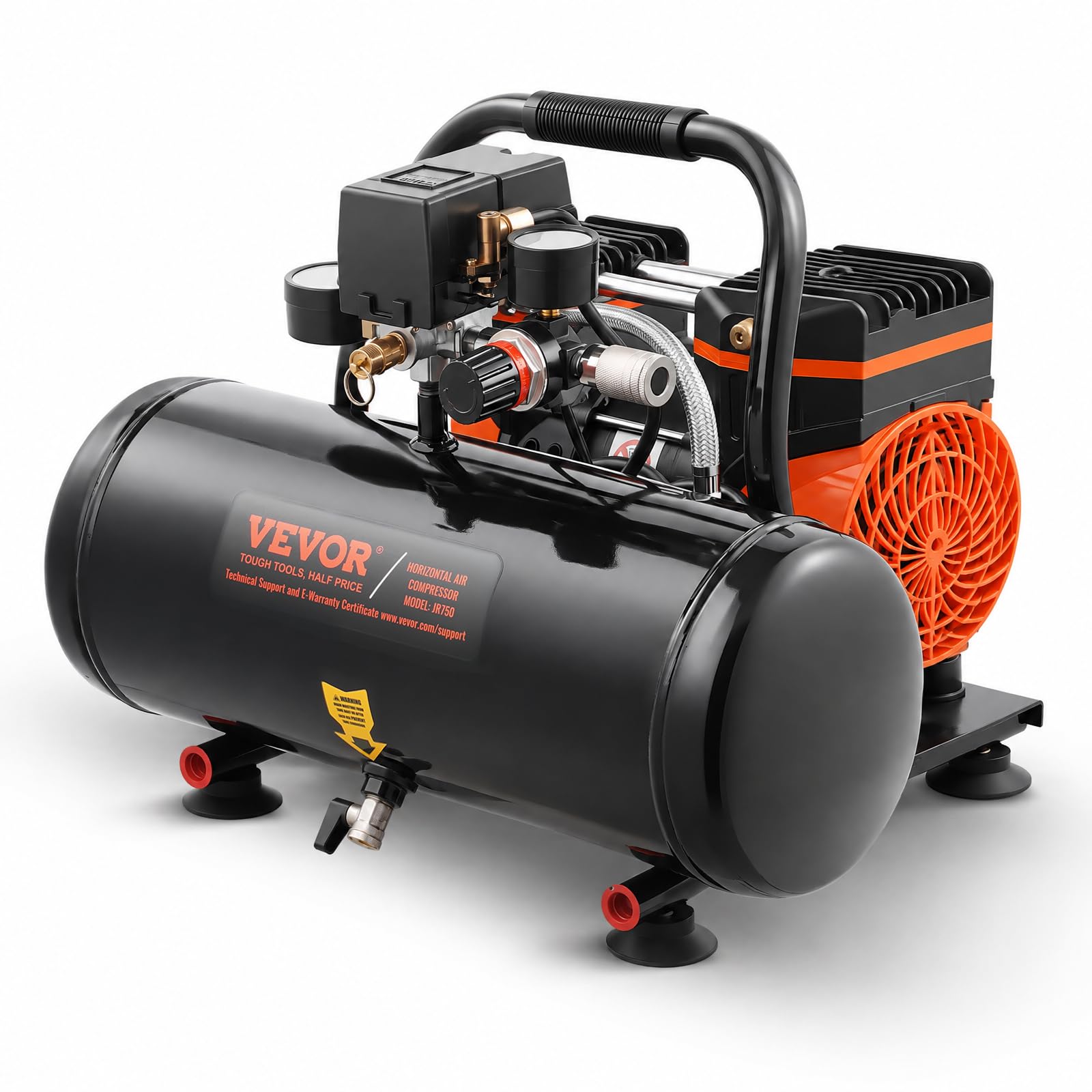
2. VEVOR 2 Gallon Air Compressor
A two-gallon steel tank that punches well above its size on airflow.
The VEVOR 2-gallon is the value pick for anyone who needs real air delivery without the bulk. Its 1 HP oil-free motor drives 2.1 CFM at 90 PSI — enough for a nail gun, an impact wrench, a spray gun, or a pneumatic screwdriver. Contrast that with the Craftsman hot dog below, which lists 0.5 CFM at 90 PSI: the VEVOR moves a good deal more air for tools that demand it. It tops out at 120 PSI, so tires, blow guns, and light spray work are all well within reach. A 2-gallon steel tank gives you a working buffer without the weight of a mid-size shop tank.
What gets this one regularly praised is the build quality and the performance relative to its footprint. The steel tank goes through a three-layer finishing process — a rust and wear-resistant layer, a plastic powder coat, and structural steel — built to resist corrosion. There is an automatic overheating cut-off and pressure relief that kicks in when things run too hot or too high, which matters in a home garage where nobody is watching the gauge. One detailing business uses it for small tools and finds it a great fit. Another buyer has run it a year with no complaints and notes it is very quiet. The noise rating sits at 81 dB, which is not silent but is a real improvement over older pancake screamers.
What the money buys: a steel-tank compressor with a genuine 2.1 CFM at 90 PSI and automatic safety shut-offs for a mid-range price. Light enough at 33.1 pounds to move around a garage, and compact enough to tuck away.
The catch worth knowing: durability is the mixed note in buyer feedback — the unit is well-regarded for how it performs, but a few long-term owners have run into minor niggles with debris in the tank or a slow gauge leak. Treat it as a solid everyday compressor rather than a lifetime shop tool.
Pick this one if: you want the most airflow you can get from a modest, easy-to-move tank and you run nailers, impact tools, or a spray gun around the house.
Think twice if: you plan to hammer it daily on long jobs — a bigger tank with sustained recovery suits that better.
3. Craftsman 2 Gallon Air Compressor
The hot-dog shape that frees up shelf space and slips into tight corners.
Craftsman’s 2-gallon hot dog is the compressor for the person who has no dedicated workshop and needs something that stores easily. The horizontal hot-dog tank sits low and long — 17.1″L x 6.3″W x 12.6″H — which lets it slide under a workbench or onto a shelf in a way a tall pancake unit cannot. At 18 pounds it is far lighter to lift and carry than the 33.1-pound VEVOR above, and the built-in carry handle makes that weight practical. A 2-gallon tank with a 125 PSI maximum covers tire inflation, stapling, fastening, and light nailing — the everyday home jobs.
The 1/3 HP motor is modest, and that is exactly the point — this is not built to run a framing nailer non-stop. It is built to fill a wheelbarrow tire, run a staple gun on a small repair, or blow dust out of a project. Owners describe it as easy to carry and quick to recover pressure. The oil-free pump means no maintenance, and the built-in gauge lets you watch the tank pressure without hunting for a separate meter. A 1-year limited warranty backs it up. The one thing you will want to buy alongside it is a hose, because it does not come with one.
Where this one asks for patience is the noise. The 1/3 HP motor is not silenced the way the Makita or Metabo HPT are, and the airflow is genuinely limited — running a blow gun continuously will send the motor into a thermal shutdown. One buyer likened the sound to something ready to blow up, and it is fair to say the noise is the biggest compromise here. For infrequent, short jobs, it is perfectly serviceable. For anything involving sustained air use, it will frustrate.
Why it earns a place
- Hot-dog shape stores under a bench and fits tight spaces
- 18 pounds with a handle — easy to carry to the job
- 125 PSI maximum handles tires, stapling, and fastening
- Oil-free pump means no maintenance routine
- Built-in gauge for at-a-glance pressure checks
Where it falls short
- Loud for a home compressor — not a quiet-run unit
- Limited airflow, so continuous blow-gun use overheats the motor
- No hose included — budget for one
Best fit for: the small-space homeowner who needs occasional tire and inflatable duty and wants something light that stores easily.
Not for: sustained nailing or spray painting — the airflow limit and the noise will wear you down fast.
4. Metabo HPT EC28M Air Compressor

At 59 dB, this is the quietest tank here — quieter than the Makita even.
If quiet is the deciding factor for you, the Metabo HPT EC28M edges out everything else on this list at 59 dB. That is quiet enough to hold a normal conversation while the compressor cycles, which is a meaningful thing when your home workspace shares a wall with a bedroom or a home office. The trade for that silence is a one-gallon tank — small. It refills quickly to compensate, so for short bursts of work it keeps up well. Weighing just 25.2 pounds, it is genuinely light to carry around a job site or a home, with a roll cage and a rubber handle built for comfort.
A universal quick coupler on the front lets you swap between framing, siding, finish, and roofing nailers without changing fittings — handy if you do varied trim work. The integrated control panel gives you accurate pressure adjustments. The pump is oil-free with overload protection that cuts power if the motor gets stressed. Out of the many positives in buyer feedback, quiet operation and overall quality lead the way, and the weight and low-maintenance perks follow close behind. For pin nailers, finish work, and small home projects, it does exactly what it is asked.
The real thing to weigh is durability. It is the most-shared concern in the reviews — some units have failed after a year of use. That is not universal, and plenty of owners run theirs happily for years, but the risk exists. Air pressure is also mixed in feedback. If your use is light and intermittent, the risk is low and the quiet is priceless. If you plan to run it hard daily, a different pick may outlast it.
What it does best: 59 dB of near-silent operation at a remarkably light 25.2 pounds, with a universal coupler that makes tool swapping fast. For indoor finish work and small-scale hobby use, that combination is hard to match.
The honest caution: a one-gallon tank means continuous heavy tool use outruns it quickly, and long-term reliability is the most-discussed mixed note in buyer feedback. It is a wonderful light-duty compressor, not a heavy-duty one.
The smart pick for: quiet indoor work, finish nailing, RC hobbies, and any home where a loud compressor is a non-starter.
Consider a different model if: you run nailers non-stop on a big project or need a unit you can lean on for years of daily use.
5. VEVOR 6.3 Gallon Air Compressor
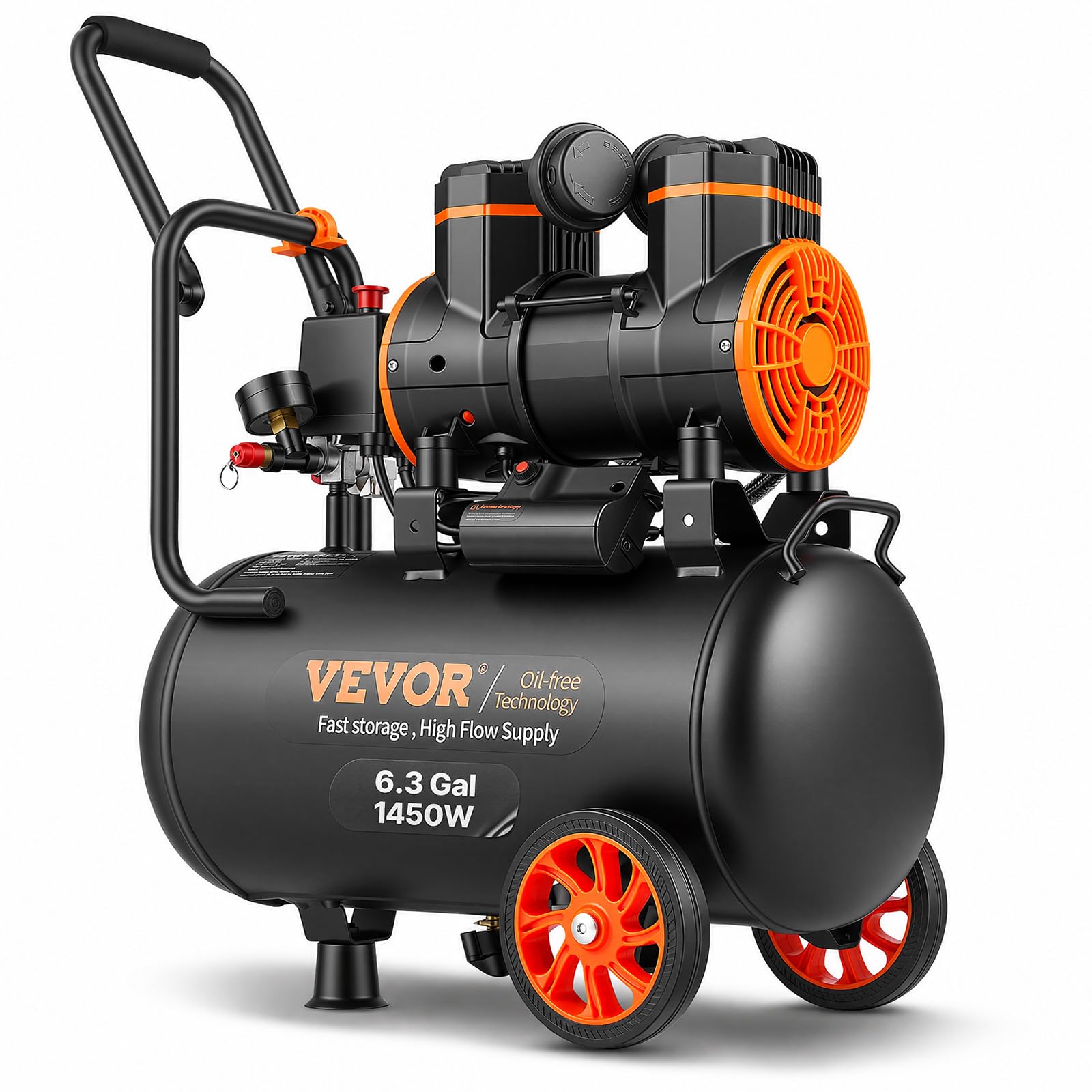
The big-tank option that still stays shop-floor friendly on noise.
When a two-gallon buffer is not enough and you want sustained air for a spray gun or an impact wrench, this VEVOR 6.3-gallon is the value move. The 2 HP motor pushes 3.35 CFM at 90 PSI — noticeably more airflow than the 2 HP, 2-gallon VEVOR above, which means tools like a bigger impact wrench or a spray gun get the volume they need. The steel tank runs through the same three-layer corrosion-resistant finish, and the unit ships with a foot pad, casters, and two silencers. It also has automatic overheating protection and pressure relief for safety at home. At 43 pounds with a 24-liter tank, it is a substantial unit — you will want the casters installed to move it easily.
The quiet is the standout feature for a tank this size. Buyers genuinely appreciate the dual silencers — the noise is often compared favourably to louder shop compressors. The compact footprint and the value for money both come up consistently in feedback. For a home garage that runs a larger tool and wants to keep the tank on wheels, it hits a good balance of volume, noise control, and price.
The concern to weigh honestly is the mixed performance and pressure feedback. A number of buyers report the unit struggling to start or failing to build pressure, and one received a unit that looked used. That does not describe the majority, and the value story is strong, but it is the trade-off most worth checking against your own return window. For buyers who want lots of tank for a mid-range price and a quieter garage, it is a compelling option — provided you inspect it carefully on arrival.
The value read: 6.3 gallons, 3.35 CFM at 90 PSI, dual silencers, and casters — a genuine big-tank compressor without the big-tank pricing.
The one to verify: performance and pressure are the mixed notes in feedback, so test the startup and pressure build as soon as it arrives.
This one suits: the home garage that needs real tank volume for impact tools or spray painting and wants it on casters.
skip it if: you need guaranteed reliability above all else and would rather pay more for a single, proven unit.
6. CRAFTSMAN CMXECXA02106410 Air Compressor
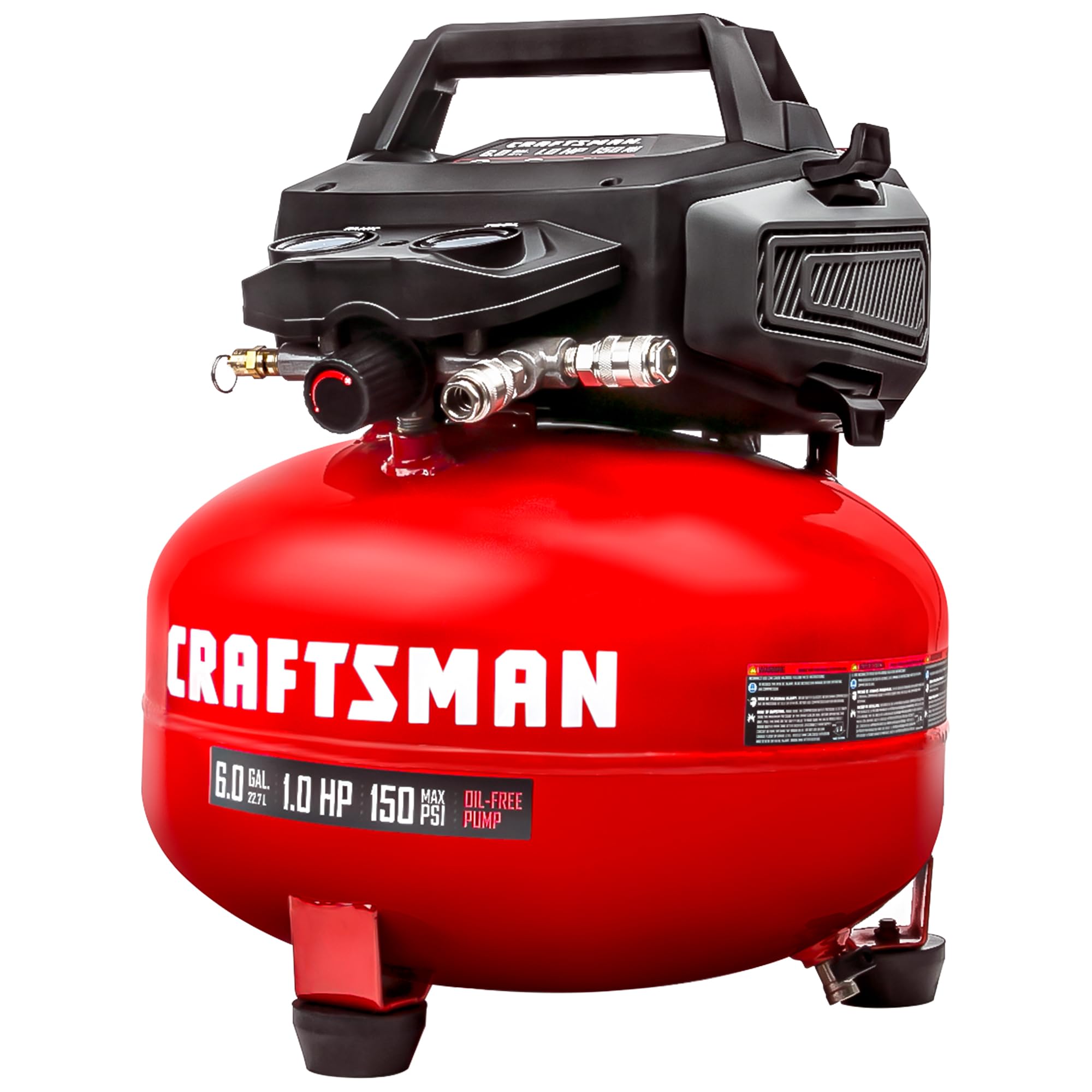
Six gallons and two couplers for the home carpenter who fires a lot of nails.
For a home garage that sees regular nailing and woodworking, this six-gallon Craftsman pancake is a strong mid-tier choice. The 1.0 HP motor and 150 PSI maximum deliver 2.6 SCFM at 90 PSI — enough to run a single framing nailer non-stop, which buyers confirm. Dual quick couplers mean you can run two nailers or two tools concurrently without swapping hoses. The oil-free low-voltage start motor is a thoughtful touch for home use, because it lets the unit start on a standard circuit without tripping a breaker. At 30.8 pounds, it is lighter than the VEVOR 2-gallon above, which is surprising for three times the tank volume, and the carry handle makes it genuinely portable.
What gets this the highest quality marks in its class is craftsmanship — well-made, reliable, and performing better than expected for home projects. A homeowner notes the compressor does not hop around the floor and that it is easy to assemble. The iron body and the low-maintenance oil-free pump add up to a tool built to last. And two tools at once is a real workflow advantage for a home woodworker. The compactness and the quiet friendly operation also come up positively.
The standout: a 6-gallon tank with 2.6 SCFM at 90 PSI and dual couplers, at a weight of 30.8 pounds — a rare mix of capacity and portability for a home project.
The catch: durability feedback is mixed, with a small number of units arriving with a broken handle. Inspect the handle on delivery — the compressor itself is well-rated for performance and quality.
Ideal for: the home woodworker running framing nailers, staplers, and blowers who wants a big tank they can still move easily.
Not the best match if: you need something for only occasional tire inflation — a lighter unit will serve you fine.
7. Limodot 5 Gallon Air Compressor

The complete kit — hose, accessories, and wheels — for the ready-to-work home buyer.
Most compressors arrive and leave you at the store buying a hose, a tire chuck, and fittings. The Limodot skips that trip. It ships with a 25 ft PVC air hose, a 13-piece air tool accessory kit, quick-connect fittings, and a wheels kit — everything you need to inflate tires or run a blow gun the day it arrives. The tank holds 5 gallons, and the 1.2 HP motor delivers 4 CFM at 40 PSI or 2.8 CFM at 90 PSI. That is enough for staple guns, brad nailers, roofing nailers, airbrushes, blow guns, drills, and HVLP spray guns. Top pressure is 120 PSI.
At 68 dB, it runs on the quiet side — quiet enough to operate inside a house or workshop without interrupting others. The induction motor runs at a low 3,400 RPM to keep the sound smooth. Refill from empty to full takes around 80 seconds, and recovery is 25 seconds, which keeps tools running without long waits. The oil-free design means no maintenance for long stretches and reliable cold-weather starts. Owners mention filling up fast and keeping up with a home laser engraver, and the pressure holds well with no leakage.
One thing to know: the fill speed and quiet are genuine strengths, but the 5-gallon tank on a 1.2 HP motor means sustained high-demand tool use will eventually outrun it. You also get less power than a 2 HP unit, so if your main job is a big framing nailer, look at the bigger choices. For home use, tire inflation, woodworking, and a variety of accessories in the box, this is one of the best all-in packages here.
Go for this if: you want a quiet, near-complete compressor setup from the start without hunting for a hose and fittings.
Look elsewhere if: you need maximum power for heavy framing — a 2 HP tank gives more punch.
8. ECOMAX 6 Gallon Air Compressor
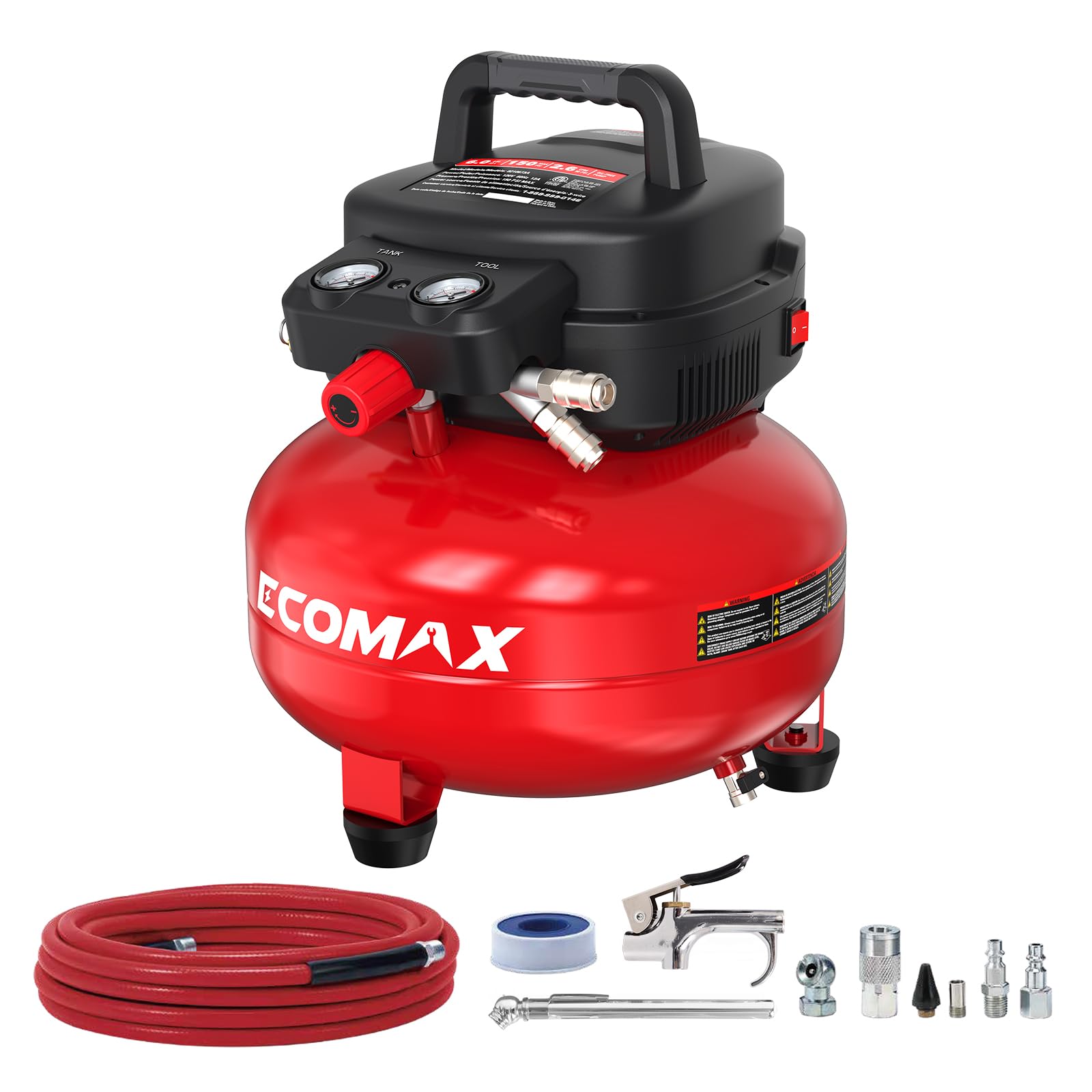
A six-gallon pancake with a hose, chuck, gauge, and blow gun already in the box.
The ECOMAX 6-gallon is a similar shape to the Craftsman pancake above but leans harder into the accessories. It comes with a 25 ft PVC air hose, a thread seal tape, a ball foot air chuck, a tire pressure gauge, a blow gun, and a sleeve — ten pieces in all. A 1.5 HP motor pairs with a 150 PSI maximum and a six-gallon tank. The convenient flip-up handle and a 34.17-pound build make it carry-able, and the oil-free pump cuts maintenance to near zero. The wording on the listing mentions 3 cubic inches at 90 PSI and 180 watts, which is worth checking against your own tool needs before you commit.
Buyers describe it as portable enough to pick up and carry into the driveway and powerful enough for a new impact wrench and angle grinder. The quad gauges and dual quick couplers let you monitor and use two tools at once, and a winding bracket keeps the cord tidy. The versatility for home, garage, and light workshop use earns it consistent praise. For a person who wants a big tank, a kit, and low-maintenance operation, it is a strong fit.
The mixed note is noise. It runs loud for a home compressor, and the listing is honest about not being a quiet model. Customers note the noise is tolerable but present. If you do a lot of work under the same roof with people nearby, check the noise tolerance before you buy. For garage jobs where no one is bothered, it is a solid, well-equipped choice.
What you gain
- Ten-piece kit included — hose, chuck, gauge, and blow gun in the box
- 6-gallon tank and 150 PSI for good tool support
- Dual quick couplers let you run two tools
- Oil-free pump keeps maintenance low
What to keep in mind
- Louder than the quiet models — noise is the mixed note in feedback
- Heavier at 34.17 pounds, so carrying up stairs is a chore
- A couple of reviewers point out gauges failing from the start
Good pick for: a garage buyer who wants a six-gallon tank with all the accessories included in one box.
Less ideal for: indoor or shared-wall work where a quiet compressor matters more than a big tank.
9. DEWALT DWFP55130 Air Compressor
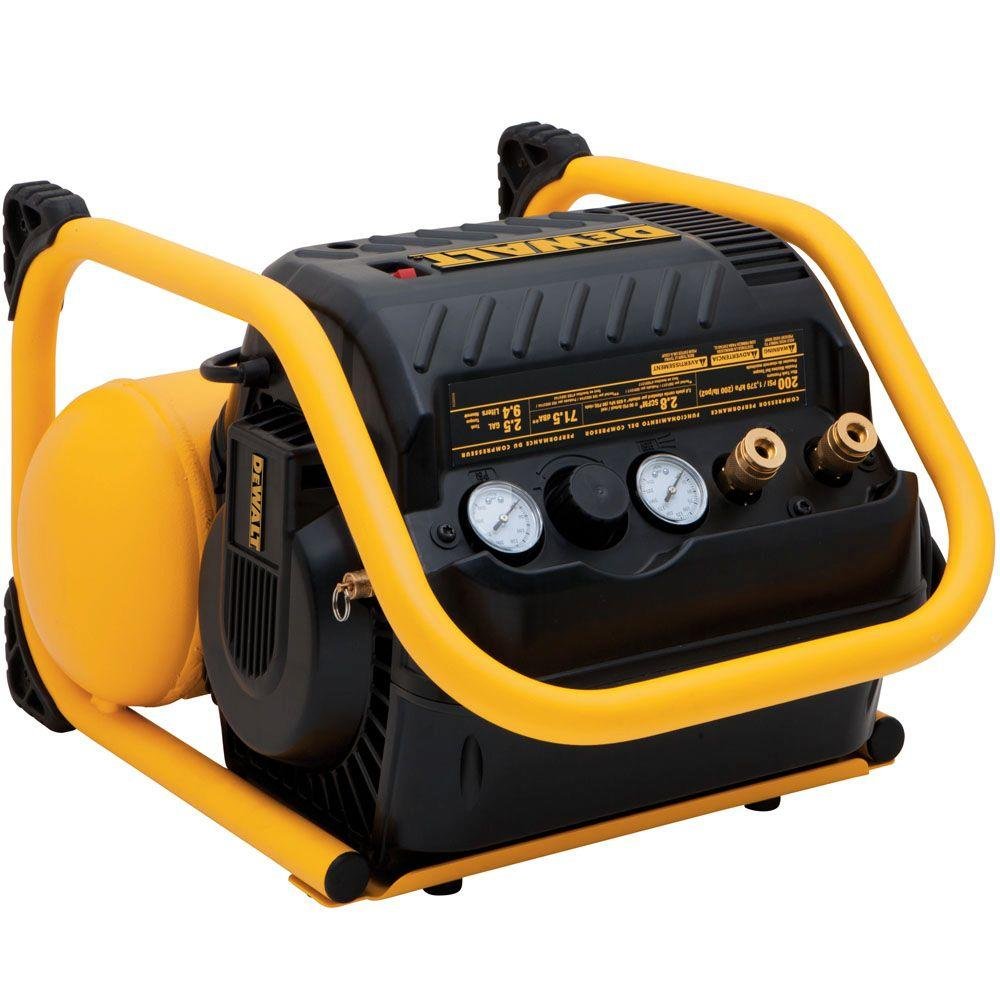
Two hundred PSI and three SCFM — built to fire trim nails and not stop.
If trim and finish work is your main use, the DEWALT DWFP55130 is the most tool-focused pick here. That combination enables a large number of nails to be fired and gives quick recovery between shots, so a trim or brad gun keeps firing without stalling. The tank is 2.5 gallons, smaller than the six-gallon units, but the high pressure more than compensates for trim work. Dual quick couplers support two nailers. The oil-free pump means extended maintenance-free use, and a ball valve drain makes emptying the tank quick.
At 71.5 dBA, it is on the quieter side for the power, and a low 12 amp draw helps it start on standard home circuits and reduces breaker tripping. The thin 12.5-inch profile and 36-pound build let it be stored vertically or horizontally, which suits a home garage where floor space is tight. The roll cage and control panel protect key parts. Shoppers say it will push any nail gun and that it is quiet and lightweight for the power. The portability — fill it, unplug it, and carry it — is a real plus for home projects.
The caveat to consider carefully is reliability. The reliability aspect is mixed in feedback, with a small number of units failing after a year or sooner. The pressure is also noted as mixed — one buyer finds it sustains only 25 psi for continuous runs. This is a trim and finish compressor, not a continuous-run tool for long spray jobs. As long as you use it for its intended purpose, it performs well. Buyers who rely on it for big, sustained jobs do occasionally get bitten.
The buying case: 200 PSI and 3.0 SCFM at 90 PSI in a 36-pound, thin-profile body — more pressure and airflow than the six-gallon Craftsman pancake, at a smaller 2.5-gallon tank that still handles trim work.
The main caution: durability and reliability are the mixed notes in buyer feedback, so treat it as a trim specialist rather than a do-everything compressor.
Right for: the home carpenter who runs trim, siding, and brad nailers and wants strong pressure and quick recovery from a unit that stores vertically.
Wrong for: continuous spray painting or long high-demand jobs where a bigger, steady tank is the safer bet.
Know the Specs
Decibels (dB) — the quiet factor
Decibels measure loudness, and at home this is the spec you feel every time the motor cycles. A unit around 59-60 dB lets you hold a normal conversation while it runs, which is why the Makita and the Metabo HPT sit so high on this list. A unit in the low 80s is noticeably louder — not unbearable, but it will make you think twice about starting it at night. Since a compressor refills whenever pressure drops, quiet is not a one-time feature, it is the everyday experience.
CFM at 90 PSI — the power measure
CFM stands for cubic feet per minute, and it is the volume of air the compressor can keep delivering while a tool is running. The figure at 90 PSI matters because most air tools are rated at that pressure. A nailer needs a small steady flow; a spray gun or a big impact wrench needs more. Check the tool’s required CFM before you buy the compressor — if the compressor’s figure is lower, the tool will run weak or not at all. Tank size alone tells you less than this number.
Tank size — the buffer
The tank stores compressed air so the motor does not have to run constantly while you work. A one-gallon tank is a small cup that empties fast, so it suits short bursts. A six-gallon tank is a reservoir that lets a nailer fire for longer stretches before the motor kicks back on. Bigger is not always better at home — it means more weight and more floor space. Pick the tank that matches your typical job length, not your biggest one-off project.
Oil-free pumps — maintenance
An oil-free pump has no oil sump, so there is nothing to check, change, or top up. That saves you a recurring chore and money on oil over the years, and it starts reliably in cold weather. The trade is that oil-free pumps tend to run hotter and louder than oil-lubricated motors, which is why good manufacturers build in silencers and low-RPM motors. For home use where the compressor runs intermittently, oil-free is the practical choice.
Common Questions
How loud is a home air compressor, really?
Can a portable air compressor run a nail gun at home?
Is a bigger tank always better for home use?
Do I need oil for an oil-free air compressor?
What size hose and fittings do most home compressors use?
Can I run a compressor in an apartment or indoor room?
How often do I need to drain the tank?Drain it after every session where you have used it, and more often in humid weather. Moisture condenses inside the steel tank as the air cools, and leaving it there is what causes rust. A ball valve drain, like the one on the DEWALT, makes this a few seconds of work rather than a wrestling match. Crack the valve, let the water out, then close it back up.?
How long does a home air compressor last?
Can I use a home compressor for spray painting?
The Bottom Line
For most homes, the best portable air compressor for home use winner is the Makita MAC320Q because it nails the one thing a home buyer values most — a 60 dB operation that lets you work beside it without shouting, backed by a low-RPM motor, an oil-free pump, and a roll cage built to survive garage life. If quiet is non-negotiable and you only run light tools, the Metabo HPT EC28M at 59 dB and 25.2 pounds is the most civilised small tank here. Want the biggest tank for the money and can live with a louder motor, reach for the VEVOR 6.3-gallon — 3.35 CFM at 90 PSI and casters included. And if you fire trim nails on the regular, the DEWALT DWFP55130 at 200 PSI and 3.0 SCFM at 90 PSI does that job better than anything else here.
One honest nudge before you buy: the pick with the most enthusiastic following here is the Limodot five-gallon, and it earns that with a complete kit and 68 dB operation in one box. Whatever you choose, drain the tank after each session — it is the single habit that decides how long your compressor lasts.
How we choose
We do not accept paid placement. Every pick is matched to a real buyer and a real use-case; we do not hands-on test units.
Sources
Specifications: manufacturer listings and product documentation. Review insights: verified customer reviews, as of November 2026. Pricing: not shown on this page (it changes often); check the current price via the retailer link.
As an Amazon Associate, Tactical Gear Guy earns from qualifying purchases. This does not affect which products we feature.