Specs are compiled from manufacturer listings and verified buyer reviews and can change over time — please confirm the key details on the product page before buying.
Your basement is the coolest room in the house in winter and the muggiest in July — that is exactly why a normal portable AC struggles down there. Basements trap humidity, so a unit that needs a drain pan emptied every few hours becomes a chore fast. The picks below are chosen around that single problem: how much moisture each machine can get rid of on its own, and how much of your below-grade space it can actually cool.
This guide is built by comparing the manufacturers’ published specifications and the patterns across verified customer reviews, so you get each pick’s real strengths and trade-offs instead of marketing spin.
In a basement, how long the unit runs without you emptying a tank and how loud it hums decide whether you actually use the room. A 42 dB unit (a soft hum, like a quiet fridge) versus a 52 dB one (about the level of a normal conversation) is the difference between a room you can work in and one you leave. Below is a full comparison of the best portable AC for basement use, with the real trade-offs spelled out on each pick.
Top Picks

How To Choose The Best Portable AC for Basement
Two things break a basement cooling setup that work fine upstairs: moisture and airflow. Your basement is partly underground, so the air down there holds more water, and the unit has to shed that water without you babysitting a drain hose. Add a low ceiling and often a single small window for the exhaust, and you get a room where a poorly matched unit runs all day and still feels clammy. Here is what to weigh before you buy.
Drainage-free run time is the first thing to check
Most portable ACs pull moisture out of the air as a byproduct of cooling. In a dry bedroom that water evaporates back out through the exhaust on its own. In a damp basement it collects faster than it can evaporate. Look for a stated drainage-free window — several picks here claim 72 hours free of draining in humidity under 90%. Above that humidity, expect to attach the included drain hose and let gravity carry the water away continuously.
Dual hose versus single hose in a closed basement
A single-hose portable AC pulls room air in, cools it, and blows the hot exhaust outside — which means it is also pulling outside air back in through every gap. A dual-hose unit takes its intake air from outside too, so it stops fighting itself. In a basement with a sealed window kit, the dual-hose design holds your set temperature with less effort. That is why you will see it called out on the stronger picks below.
Match the BTU number to the actual square footage
Every unit here lists two cooling figures: an ASHRAE rating (the larger, older measurement) and a SACC rating (the smaller, newer one that better reflects real-room performance). A unit sold as 14,000 BTU ASHRAE is usually about 10,000 BTU SACC. Use the SACC figure when you match a unit to your basement’s square footage, and give yourself a little headroom if the space is open-plan or has a stairwell bleeding warm air down.
Decibels decide whether the basement stays usable
A basement often doubles as an office, a guest room, or a den. The quietest units here run at 42 dB — roughly the level of a quiet conversation — while the loudest list 52 dBA. If the room is where you take calls or sleep, treat the dB figure as a hard filter, not a nice-to-have. Sleep modes on most of these drop the fan and compressor to a lower, steadier setting overnight.
Side-by-Side Comparison
| Model | Best For | Cooling Power | Floor Area | Noise Level | Amazon |
|---|---|---|---|---|---|
| ZAFRO Smart Inverter 14,000 BTU★ Best Overall | Best overall for damp basements | 14000 BTU | 550 sq ft | 42 dB | Amazon |
| DREO 515S 12,000 BTUQuietest Pick | Quietest bedroom-grade unit | 12000 BTU | 150 sq ft | 45 dB | Amazon |
| HUMHOLD Inverter 16,000 BTUBiggest Coverage | Big open basement rooms | 16000 BTU | 700 sq ft | 42 dB | Amazon |
| Midea 14,000 BTU ASHRAE | Simple app-controlled cooling | 13500 BTU | 450 sq ft | — | Amazon |
| Westinghouse 14,000 BTU with Heat | Year-round basement comfort | 14000 BTU | 700 sq ft | 52 dBA | Amazon |
| Whynter ARC-1030WN 12,000 BTU | Compact tower footprint | 12000 BTU | 500 sq ft | — | Amazon |
| AC Infinity 5-in-1 12,000 BTU | Heat and cool from one box | 12000 BTU | 600 sq ft | 48 dB | Amazon |
| Midea Duo 14,000 BTU with Heat | Hose-in-hose dual design | 14000 BTU | — | — | Amazon |
| Whynter ARC-1230WN 14,000 BTU | Premium cooling for large rooms | 14000 BTU | — | — | Amazon |
| ZAFRO 12,000 BTU Drainage-Free | Budget basement starter | 12000 BTU | — | 47 dB | Amazon |
Detailed Reviews
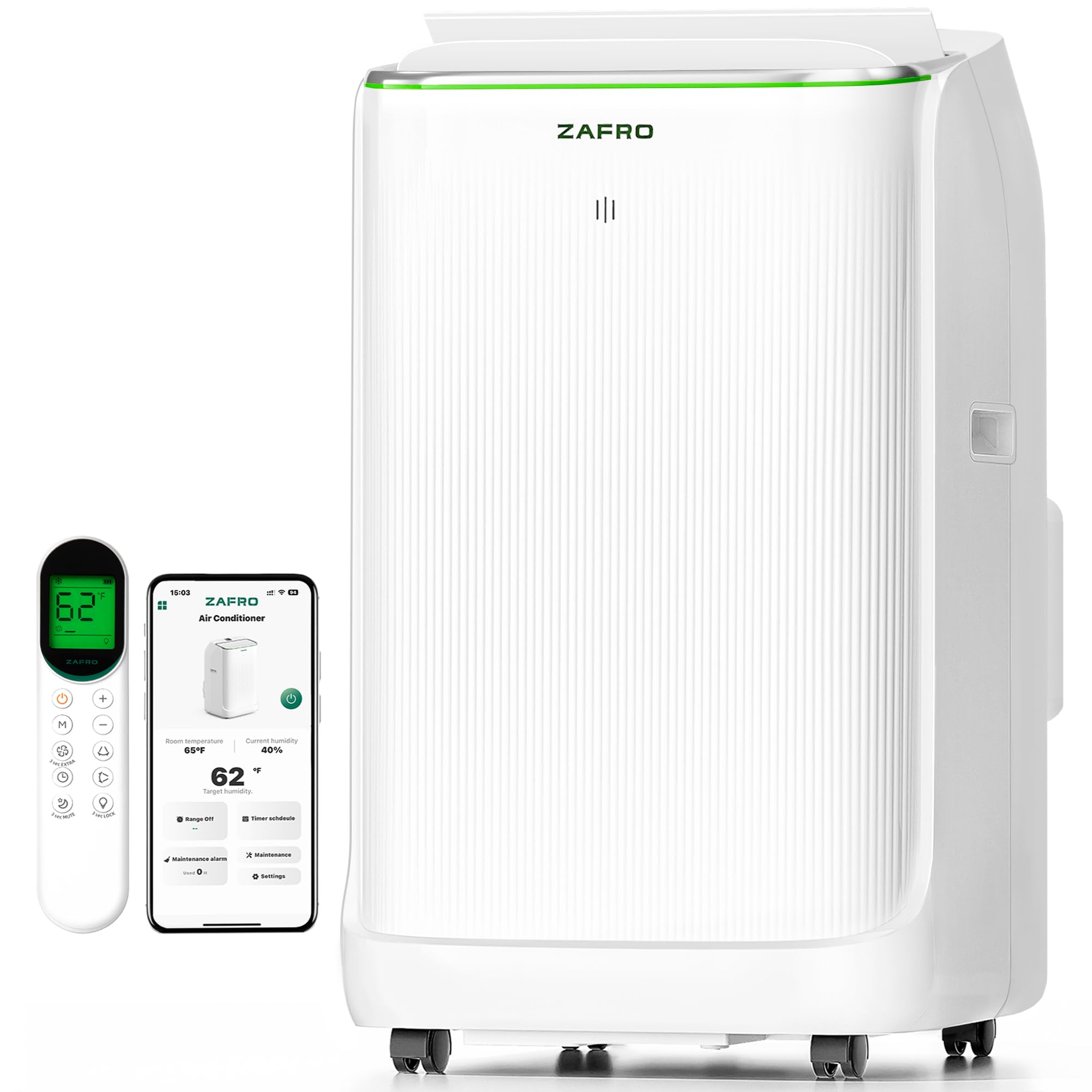
1. ZAFRO Smart Inverter Portable Air Conditioners 14000 BTU
Our pick — 4.0+★ from 500+ verified ratings; the strongest balance of quality and price.
The basement specialist that pulls its own air from outside, then barely whispers while it works.
The number that decides this one is 42 dB — a noise level about as loud as a quiet conversation, which is why a finished basement stops feeling like a mechanical room. It pairs that with 14,000 BTU of cooling (10,000 BTU SACC, the more realistic smaller rating) spread across 550 square feet, the largest of the mid-tier picks here. Dual hoses mean the unit breathes outside air in and pushes hot air out, so it is not constantly sucking in the damp basement air it just cooled.
Where the ZAFRO really earns its spot downstairs is the self-evaporating system. A water-slinging wheel throws collected moisture onto the condenser, where it evaporates away naturally. The maker rates it drainage-free for 72 hours at humidity under 90% — the range a damp basement hits in July. Deep-dive the buyer feedback and cooling performance comes up more than anything else, with people describing a bedroom dropping to a comfortable temperature in about two hours and 350-square-foot rooms handled easily. One basement-apartment owner reports it running “ice cold” across three good-sized rooms.
Six modes cover more than you will likely use — Cool, Dry, Fan, Sleep, Extra, and Eco — and the Extra mode locks the thermostat at 61 degrees Fahrenheit and runs flat out for brutal heat waves. The 24-hour timer and app let you pre-cool the space before you come downstairs. Compare it against the Midea 14,000 BTU below and the ZAFRO covers 550 square feet to Midea’s 450, so it handles a bigger room with room to spare. Its yearly draw is 942 kWh against the Midea’s 946 — a near tie, and both inverter compressors draw less than a non-inverter unit.
Where it pulls ahead
- 42 dB operation — quiet enough for a basement office or guest room
- 550 sq ft coverage, the widest of the mid-tier units here
- Dual hose design stops outside air from leaking back in
- 72-hour drainage-free in humidity under 90%
- App, remote, and touch control, plus a 24-hour timer
What to weigh first
- Above 90% humidity you will need to hook up the drain hose
- Height of 550 sq ft coverage means it is a big physical unit
- Inverter compressor is smooth but not a silent-mode substitute for a sleep timer
Best for: A damp, finished basement you actually use — this is the one that keeps the air dry, the room cool, and the noise low enough to work beside.
Know going in: If your basement reads above 90% humidity on a gauge, budget for the drain hose running continuously rather than counting on the 72-hour window.
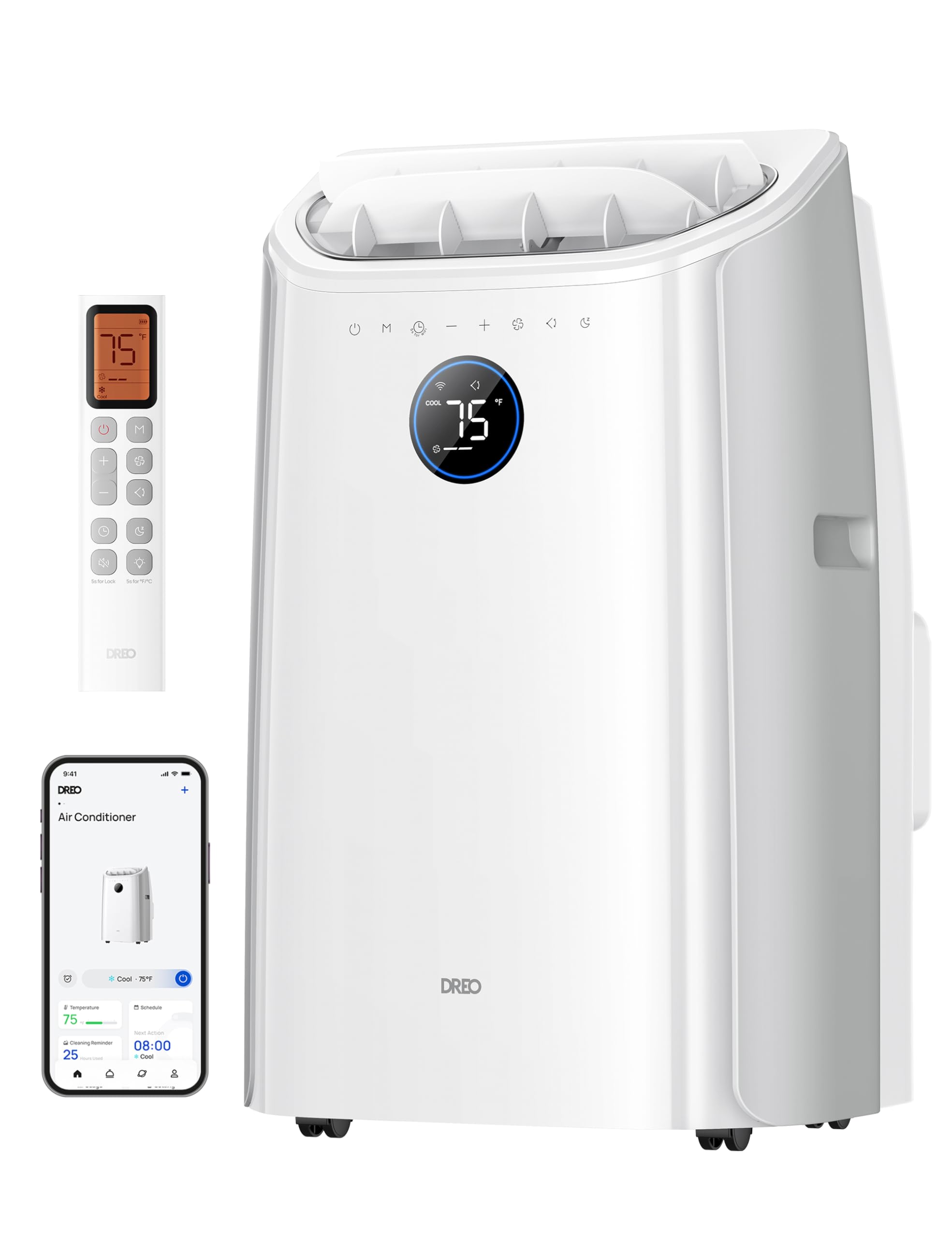
2. DREO Portable Air Conditioner 515S 12000 BTU
For the basement that doubles as a bedroom — engineered so the compressor noise disappears.
If you sleep two floors down, the DREO’s 45 dB is the whole argument. Its patented noise isolation system knocks down both the compressor rumble and the air turbulence that most portable units leak everywhere. The 12,000 BTU ASHRAE rating (8,000 BTU SACC) and 150-square-foot coverage mean this is a smaller-room machine, so it suits a single basement bedroom or home office rather than a whole open floor.
Its drainage-free system is genuinely smart rather than just a marketing line. Sensors and a pump actively push excess water out, so in humidity under 90% you never think about the tank. The app adds a sleep-curve function — you set how the temperature should drift through the night, and the unit follows it — plus humidity monitoring you can check from upstairs. Voice control works with Siri, Amazon Alexa, and Google Home if your basement has decent Wi-Fi reach.
Reliability is the theme in the feedback: it holds up summer after summer and keeps running even when conditions push past its rated range. The honest catch is the size ceiling. If your basement is larger than one room, you will feel the 150-square-foot limit and should look at the 550-square-foot ZAFRO or the 16,000 BTU HUMHOLD instead.
The standout spec: 45 dB with an active pump is a hard combination to find — most portable ACs at this noise level still make you drain them by hand.
The real limit: 150 square feet means one room, not a whole basement floor, so measure before you commit.
Reach for this if: your basement bedroom or office is a single enclosed space and you need silence to sleep or take calls.
Look elsewhere if: the space is open-plan or over 150 square feet — step up to a wider-coverage unit.
3. Inverter 16000BTU Portable Air Conditioners
The brute-force answer for a full open basement — 16,000 BTU and a dual-hose setup that pushes hard.
This is the highest cooling output on the list at 16,000 BTU ASHRAE (12,000 BTU SACC), and it is aimed at 600 to 800 square feet. On paper that is a finished basement with a rec room, a bar area, and a home gym all in one open span. The dual-hose design lets it intake and exhaust outdoors independently, which stops the hot outside air from seeping back through gaps — the maker puts the cooldown gain at 30 to 40% faster than a single-hose unit.
You get steady, quiet cooling because of the inverter compressor (a compressor that varies its speed instead of slamming on and off). That steady running is why sleep mode can sit below 42 dB (a soft hum you can sleep through). The 3-in-1 layout covers cool, a 3-speed fan, and dehumidifying at 95 pints a day (about 45 liters of moisture pulled from the air daily) — that last figure matters in a basement, because the unit is pulling serious moisture out of the air, not just cooling it.
Read this basement detail carefully: the self-evaporation system (it reuses the water it pulls from the air to cool itself) is drainage-free for everyday use. But the maker is explicit that a humid room like a basement may need draining every 8 hours or continuous drainage, or the unit stops when the internal tank fills. So plan for the drain hose. Once that is handled, buyers report fast, powerful cooling — turbo mode drops a room quickly, and one owner reports the space reaching 62 degrees within a couple of hours. Airflow is the other recurring note: strong enough to cool a living room and a foyer together.
The case for it
- 16,000 BTU ASHRAE is the strongest cooling here — 600 to 800 sq ft
- Inverter compressor plus dual hose keeps temperatures steady
- 95 pints a day of dehumidifying handles damp basement air
- Sleep mode runs below 42 dB
- 15 to 75-degree auto-swing spreads air across the room
The basement caveat
- In humid-room use the maker expects drainage every 8 hours or a continuous hose
- Tower-size footprint takes floor space in a low-ceiling room
- One account describes cooling failing after about a year
Go this route: when the basement is one wide-open space and you want a single machine to cover it all.
Think twice: if you cannot run a drain hose to a floor drain or sump — the humidity here will fill the tank fast.
4. Midea 14,000 BTU Portable Air Conditioner

The app-first unit that turns your phone into the basement thermostat from anywhere in the house.
Midea leans into control rather than raw output here. The 14,000 BTU ASHRAE rating (10,000 BTU SACC) covers up to 450 square feet, and the SmartHome app lets you switch modes, set a schedule, and manage temperature from upstairs. It pairs with Alexa or Google Assistant so a voice command does the same job. The digital controls and easy-read LED display keep it simple if you would rather not use the app at all.
You can set it up without a drill — the exhaust hose, window kit, and instructions all come in the box, so a basement window is ready in minutes. Cooling performance is what buyers talk about most, and it does the job on large rooms quickly. Wheels underneath let you roll it across a concrete or hardwood basement floor, which matters if the unit moves between a storage end and a living end of the space. Set it beside the ZAFRO and the trade is honest: 450 square feet versus 550, and 946 kilowatt hours a year (kWh, the unit on your power bill) versus the ZAFRO’s 942 — nearly a wash on energy but a real difference in coverage.
The follow-up question is reliability. The recurring note in the feedback is units occasionally switching off unexpectedly, so treat a stable outlet and a properly seated window kit as part of setup. Most owners describe fast, effective cooling with no fuss.
What it does well: true set-and-forget control through the app, voice assistants, and a schedule — the kind of unit you cool from the kitchen before heading down.
The honest trade: a smaller coverage window than the top pick, plus the occasional shut-off quirk worth watching in the first weeks.
This is your unit if: you want the basement cooled by schedule and voice with no daily hands-on fiddling.
Pass if: you need more than 450 square feet covered — the top pick reaches 550.
5. Westinghouse 14,000 BTU Air Conditioner with Heat Mode
A four-season basement appliance — cool it in July, heat it in January, dry it out in between.
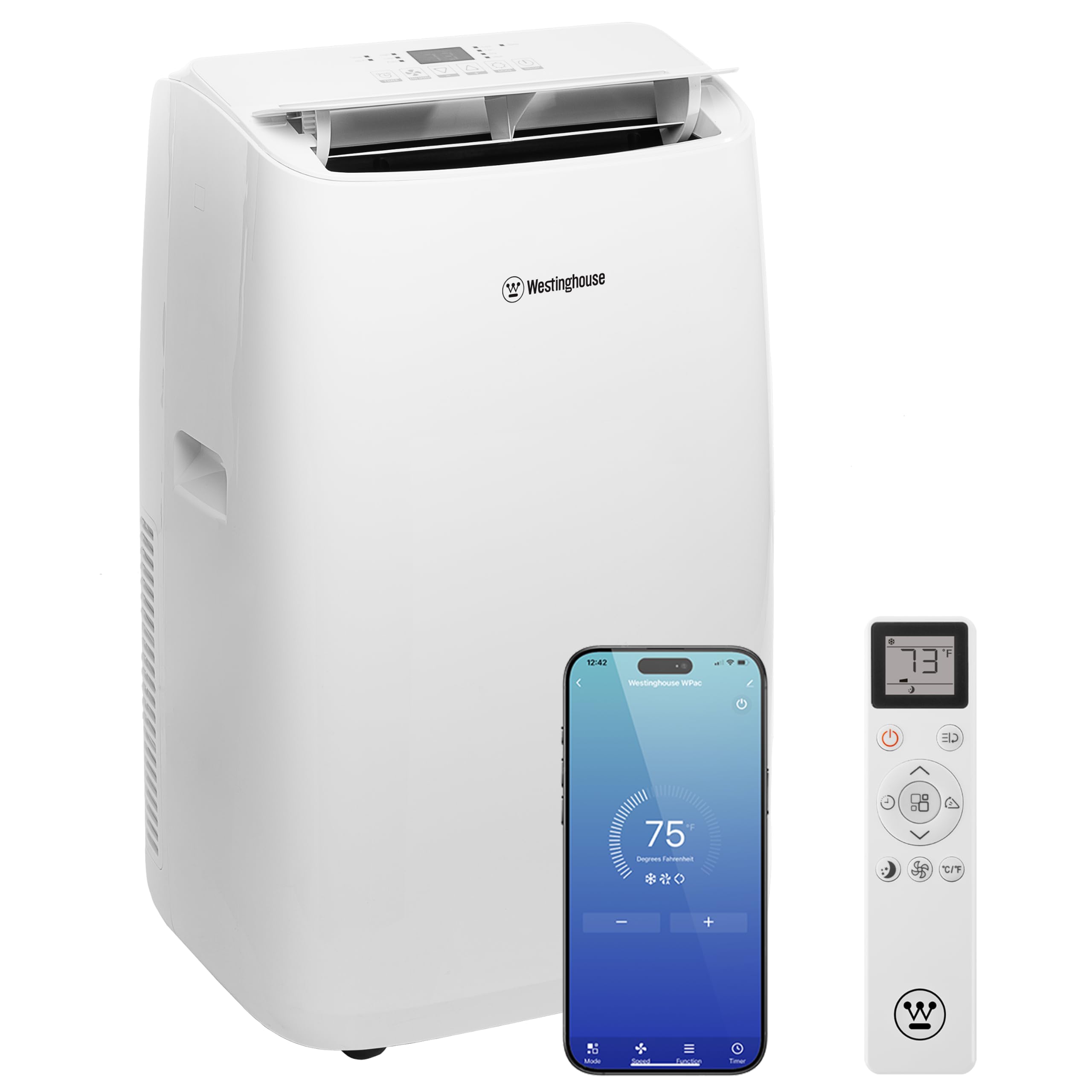
A basement is often the coldest room in winter and the dampest in summer, and this Westinghouse handles both ends. The 14,000 BTU ASHRAE (8,150 BTU DOE) unit covers up to 700 square feet and adds a heat mode on top of cool, fan, and dehumidify. As a dehumidifier it pulls 90 pints of moisture a day from spaces up to 4,000 square feet, which is well beyond anything a single basement needs.
Setup is quick — connect the exhaust hose to the window panel, adjust it with the quick-adjust knob, and you are running in about five minutes if you follow the included instructions. It is built for double-hung or sliding windows, which most basement windows are. Controls span a remote (up to 20 feet), a smartphone app, and simple touch buttons on the top panel. Noise sits at a stated 52 dBA, a touch above the quietest picks, and the sleep mode drops it further for overnight.
Drainage is the thing to plan around. The feedback is blunt on this point — if you do not have a spot to drain into continuously, you will be emptying water by hand on a short cycle. With a floor drain or sump nearby, the continuous option solves it. Otherwise owners mention the cooling performance meeting the promise, keeping the temperature where you set it even on triple-digit days, and the dual cooling-plus-heating function doing exactly what they wanted.
Why it works year-round
- Heat mode plus cool, fan, and dry in one box
- 700 sq ft of cooling coverage
- 90 pints a day of dehumidifying
- Five-minute window install with included kit
- Remote, app, and touch control
Plan around this
- Manual draining comes up fast without a continuous drain spot
- 52 dBA is louder than the quietest picks here
- One account describes a component failing after four months
Made for: a basement you want comfortable in every season, with a floor drain close enough to run a continuous hose.
Not the fit if: there is no drain nearby and you will not commit to emptying a pan regularly.
6. Whynter Portable Air Conditioner Inverter 12000 BTU ARC-1030WN

A tower footprint that fits a tight basement corner, with inverter cooling that stays smooth all day.
The Whynter earns its spot on floor space: as a tower, it takes a narrower slice of floor than the boxy picks here, which helps in a basement where furniture already crowds the walls. Inside, it holds 12,000 BTU (British thermal units, the standard measure of cooling power) for rooms up to 500 square feet. Its inverter compressor (one that varies speed instead of slamming on and off) modulates output steadily, and that steadier behavior keeps both temperature and noise level even.
The dual-hose design is the sleeper feature for basement use. Separate intake and exhaust hoses stop the unit from pulling conditioned indoor air outside, so it holds the set temperature with less strain. Add the built-in dehumidifier — 82 pints — and you have cooling and moisture removal from one free-standing unit, no separate dehumidifier taking up more floor. Wi-Fi app control lets you set temperature, mode, and timer from your phone.
Quality leads the buyer feedback, with owners calling it the best of several portable units they have owned. It is quiet, energy-efficient, and manages even the hottest rooms without trouble, and the auto fan mode speeds up and slows down based on the set temperature. The size is the honest limit — 500 square feet is a decent basement but not a whole floor, and it is heavy enough that moving it between rooms takes some effort, though the wheels help.
Standout: the tower form factor plus dual hose is an uncommon pairing — narrow footprint, no self-fighting airflow.
The catch: 500 square feet caps it at a single large room, and it is a heavy unit to relocate.
Pick this when: floor space is tight but the room is large, and you want steady, quiet inverter cooling from a narrow tower.
Choose a bigger box instead if: your basement runs past 500 square feet or you need to move the unit often.
7. AC Infinity Smart Portable Air Conditioner 5-in-1
The climate-control brain of the group — it decides cool versus heat and does the switching itself.
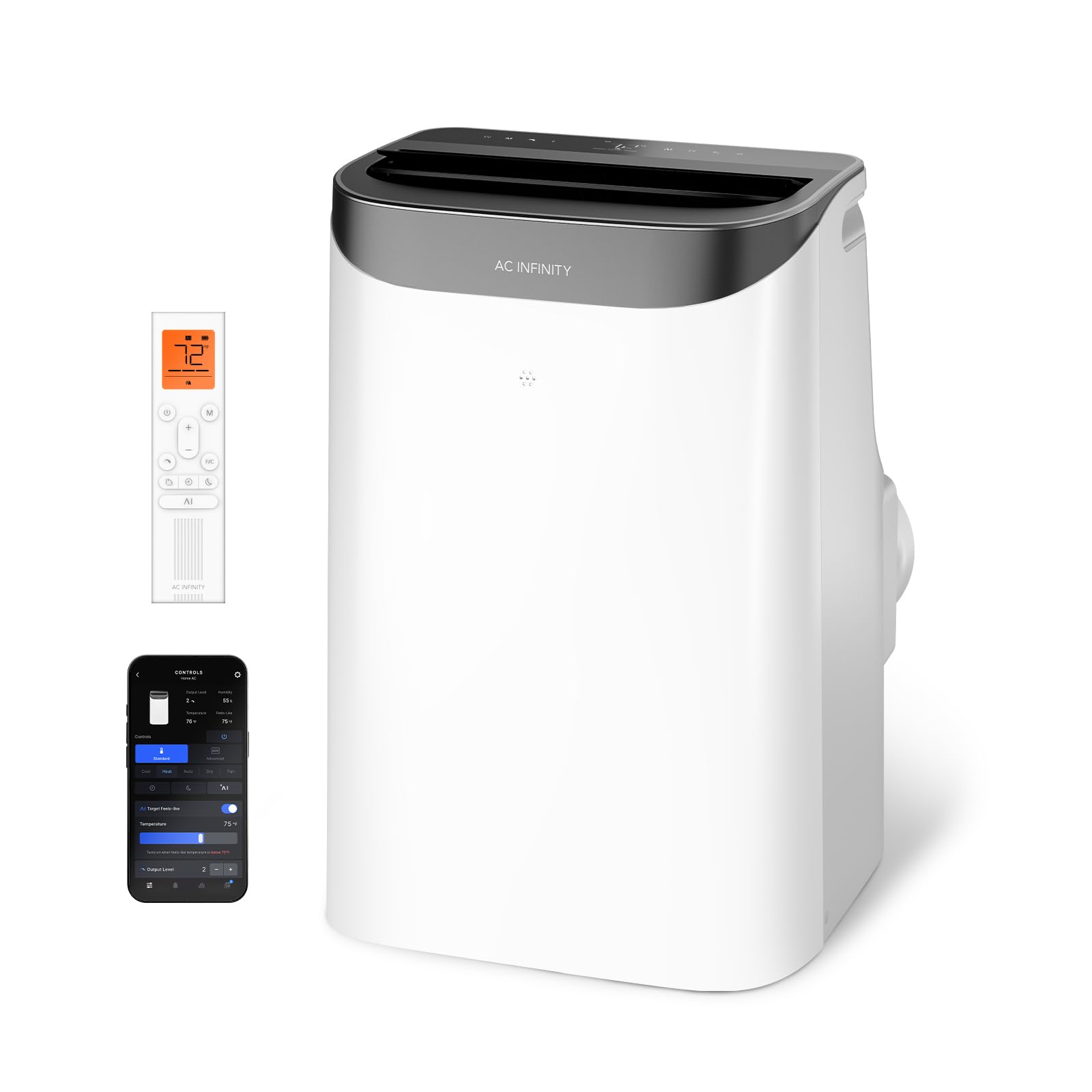
AC Infinity’s pitch is adaptive rather than brute-force. It combines 12,000 BTU of cooling with intelligent heating and automatically toggles between them to hold a “feels-like” temperature, which is exactly what a basement needs when the same room is clammy in August and chilly in November. It covers up to 600 square feet and runs its 5-in-1 modes — Cool, Heat, Dry, Fan, Auto, and Combo — without you babysitting the switch.
The True Comfort AI is the interesting spec: it factors in both temperature and humidity to decide how hard to cool, which is more relevant in a damp basement than a straight thermostat reading. A wide-angle oscillator spreads air, and the noise-isolated compressor runs at 48 dB while the unit stays drainage-free to cut maintenance. Voice control with Alexa or Google Home plus app data charts round out the smart side.
Customers note it genuinely handles both seasons — used for heat and AC across a few months with no complaints, and quiet enough that one buyer describes finally sleeping through hot days. The honest gap: test the heating side, because heat mode on at least one unit would not run past about 20 minutes, so give the heating function a solid trial inside the return window. A 2-year warranty backs it.
what separates it: True Comfort AI reads humidity, not just temperature, which is genuinely useful for a basement’s clammy air.
Test early: run the heat mode through a full cycle in the first weeks — one account saw it cut out around 20 minutes.
Suits you if: you want one machine that cools, heats, and dehumidifies a basement that swings between seasons.
Skip the swap if: you only need summer cooling — the simpler picks below cost less for the same job.
8. Midea Duo 14,000 BTU Portable Air Conditioner with Heat

Midea’s dual-hose-in-hose trick, built to cool harder with less electricity — and heat when you need it.
The engineering headline here is the industry-first hose-in-hose design: one hose nested inside another lets the unit take in and exhaust air outdoors, keeping the indoor air balanced and stopping hot outside air from leaking in. Paired with the inverter compressor, Midea rates it as cooling more on considerably less electricity than a traditional single-hose portable. The 14,000 BTU rating and heat pump — operating between 41 and 86 degrees Fahrenheit — make it a year-round option for a basement.
What buyers feel first is the airflow. Cooling performance and effectiveness both come up strongly, with the unit dropping a room’s temperature within a short time and handling a second-floor hot room that a regular AC could not touch. The inverter also keeps it quieter than expected. App and voice control work through the SmartHome app with Alexa and Google Assistant, and the heating function is a genuine bonus for a cold basement corner.
Two things are worth knowing before you buy. The venting hookup gets mixed notes — vertical windows in a basement may need extra attention to seal properly. And a vaulted or high-ceiling space can outrun this unit’s capacity, so it suits standard basement ceiling heights far better than an open, tall room.
What’s genuinely better
- Hose-in-hose design that stops outdoor air leaking in
- Inverter compressor for steady, quieter cooling
- Heat pump covers 41 to 86 degrees Fahrenheit
- Strong airflow that reaches across a whole room
- App and voice control included
Where it asks more of you
- Vertical basement windows need careful sealing on the vent kit
- High or vaulted ceilings cut its effective reach
- Premium tier means you pay for the dual-hose engineering
Best matched to: a standard-height basement room where you want strong airflow plus heat in one premium unit.
Hold off if: your basement ceiling is vaulted or open to a tall space — it will struggle to keep up.
9. Whynter Portable Air Conditioner Inverter 14000 BTU ARC-1230WN
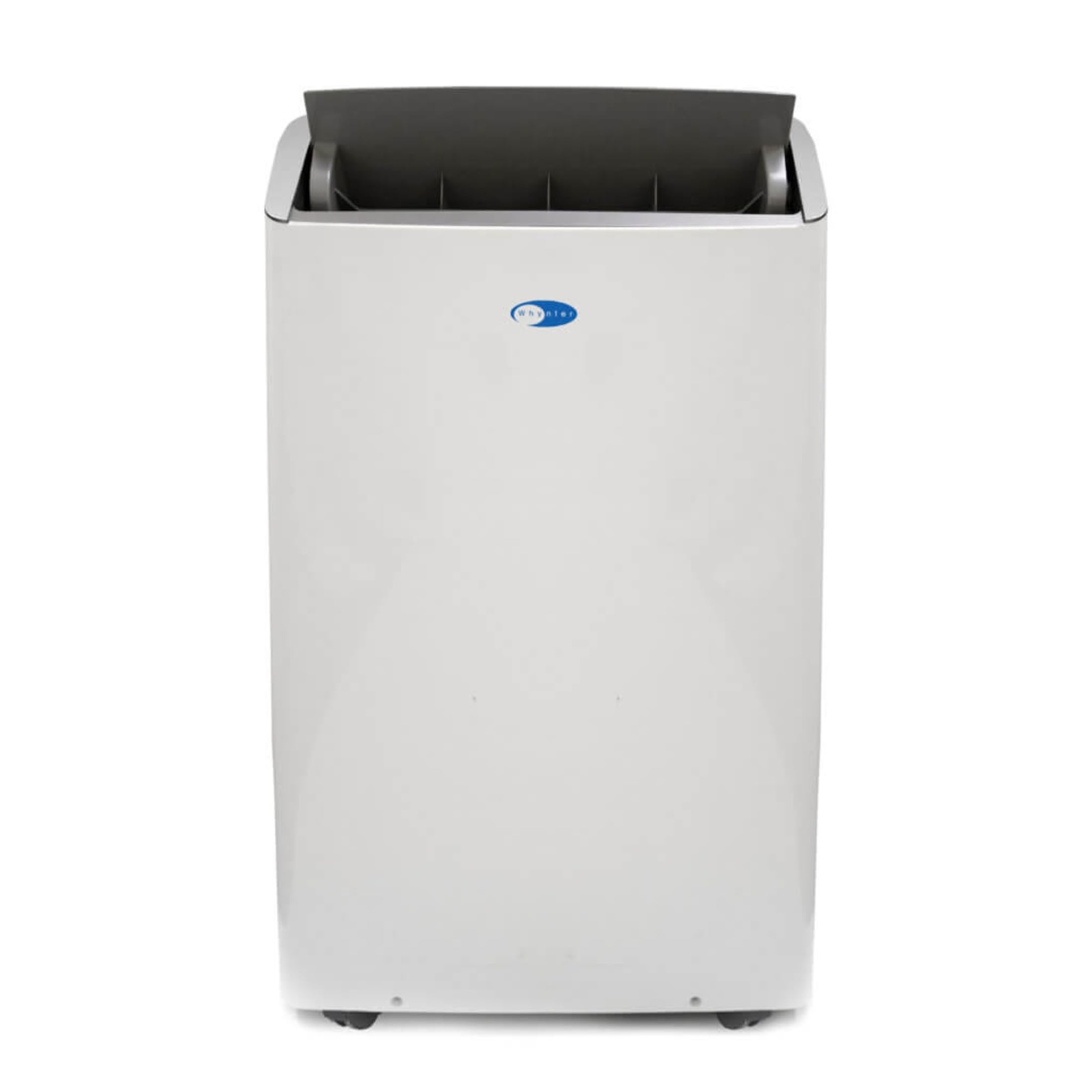
The bigger brother of the Whynter tower — 14,000 BTU of dual-hose cooling with a 12.3 efficiency rating.
Where the smaller Whynter caps at 12,000 BTU, this ARC-1230WN steps up to 14,000 BTU with a dual-hose design that keeps the intake and exhaust separate, so it holds a set temperature without working against itself. The inverter compressor runs steady rather than slamming on and off, and the efficiency figure of 12.3 with a 244 cubic-feet-per-minute-per-watt airflow rating points to strong cooling per unit of power. The built-in dehumidifier handles 87 pints, so a damp basement gets dried while it cools.
The effectiveness here is the standout. Owners describe it dropping a house’s temperature by 8 degrees and cooling a 400-square-foot room from 85 to 78 in about 15 minutes. The dual-hose setup with supplied materials seals a window tight enough that one buyer calls it “the most secure” install of any unit they have used. It is quiet after the initial compressor cycle, and app plus voice control handles the routine adjustments from your phone.
The durability question is the fair one to raise. A small number of accounts describe refrigerant leaks taking units out within a year, so treat the first months as your test window. For everyone else, it is described as blowing very cold air and easy to install with no assembly required for the unit itself.
What it brings: 14,000 BTU, dual hose, and a 12.3 efficiency figure make it the strongest premium cooling package in the group.
Watch the first season: a handful of units have hit refrigerant leaks, so track performance closely early on.
The match for you: a large basement where you want maximum dual-hose cooling and can be patient on the premium price.
Consider the smaller Whynter if: 500 square feet is all you need — same design, less output.
10. ZAFRO Portable Air Conditioner 12000 BTU
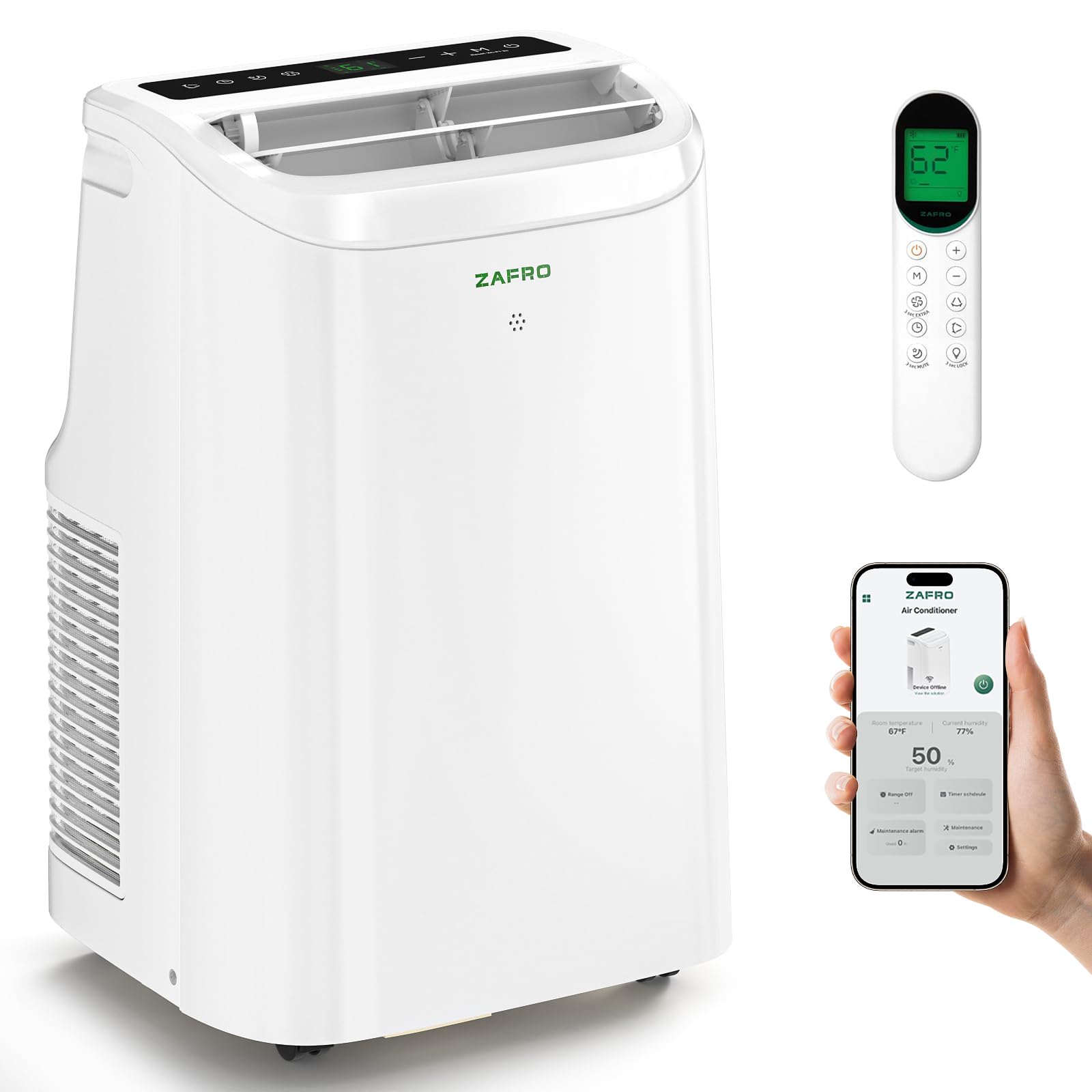
The entry ticket to drain-free basement cooling — same self-evaporating idea, lower output and lower outlay.
The reason this one belongs on a basement shortlist is the 72-hour drainage-free claim. Its water-slinging wheel throws condensate onto the condenser so it evaporates away, which saves you a daily pan-emptying routine in a room that generates moisture faster than most. Cooling is 12,000 BTU (8,000 BTU SACC) with three modes — cooling, dehumidifying, and fan — plus four fan speeds. Set the temperature anywhere from 61 to 86 degrees Fahrenheit.
Daily use stays easy with the smart controls: the ZAFRO app, Amazon Alexa, and Google Home for adjusting modes and timers remotely, plus a stated 22.97-foot long-range remote (about 7 meters, so it works from across the room). Sleep mode settles to 47 dB (a soft hum) and drifts the temperature and fan speed through the night. Four casters and side handles let you roll it across the floor without lifting. Against the top ZAFRO, this one draws 802.5 kWh a year versus 942 and runs at 47 dB versus 42 dB — cheaper to run, louder in the room.
For a budget basement unit it performs above its class. Owners say it cools a bedroom down fast, handles a whole apartment, and delivers more than models that cost more. It is small enough that one buyer runs it in a camper van.
The value read: 72-hour drainage-free at the entry tier is the reason to pick it over cheaper no-name units that make you drain daily.
The honest limit: 47 dB is a step above the quietest picks, so it suits a rec room more than a bedroom.
Get it if: you want drain-free basement cooling on a tighter budget and 8,000 BTU SACC fits the room.
Step up if: the basement is larger or you need near-silent operation — spend the extra on coverage and quiet.
Know the Specs
ASHRAE vs SACC BTU
Every portable AC quotes two cooling numbers, and they never match. The ASHRAE figure is the older, larger measurement; the SACC figure is the newer one that better reflects how much cooling actually reaches the room. A unit labeled 14,000 BTU ASHRAE is typically about 10,000 BTU SACC. For a basement, use the SACC number when you match the unit to square footage — that is the figure that predicts whether the room feels cold.
Drainage-Free and Humidity
Self-evaporating systems push collected moisture back onto the hot condenser so it evaporates out the exhaust. That works beautifully in a normal room, and makers typically rate it drainage-free up to about 90% humidity. A basement in summer can push past that line, which is why the stronger picks include a drain hose and expect continuous drainage in very humid conditions. Plan for the hose, and the unit never shuts itself off on a full tank.
Dual Hose vs Single Hose
A single-hose unit pulls room air to cool the condenser and blows it outside — creating a slight vacuum that drags hot outside air back in through gaps. A dual-hose design draws its intake air from outside as well, so it does not fight itself. In a sealed basement window setup, the dual-hose version holds your set temperature with less effort and cools faster, which is why it shows up on most of the top picks.
Decibels in a Living Space
Portable AC noise comes from two sources: the compressor and the fan turbulence. A 42 dB unit is roughly the level of a quiet conversation; a 52 dBA unit is noticeably louder. If the basement is a bedroom, office, or media room, treat the lower figure as the requirement. Sleep modes drop the fan and compressor to a steadier, quieter setting overnight, which is when the difference between the quietest and loudest picks matters most.
Common Questions
Will a portable AC actually cool a basement or just add humidity?
Does a portable AC for basement need a window for the exhaust?
What is the difference between ASHRAE and SACC BTU ratings?
Is a dual hose portable AC better for a basement than a single hose?
How often will I have to empty the water tank in a humid basement?
Can a portable AC in a basement run continuously overnight?
How many BTU do I need for my basement square footage?
Do I need a separate dehumidifier if I run a portable AC in the basement?
How quiet is a portable AC, and can I sleep next to one in a basement bedroom?
How much does a portable AC raise my electric bill in a basement?
The Bottom Line
For most basements, the portable ac for basement winner is the ZAFRO Smart Inverter 14,000 BTU because it combines the widest mid-tier coverage at 550 square feet, a 42 dB noise level, and a 72-hour drainage-free system that fits a damp room better than most. If you need the strongest cooling for a large open basement, the 16,000 BTU HUMHOLD pushes the most air at 600 to 800 square feet. And for a basement bedroom where silence matters most, the DREO 515S at 45 dB is the one to reach for.
One nudge before you commit: the top pick’s strong ratings rest on consistent drain-free performance and low noise — the two specs that make or break a basement setup. Whichever you choose, connect the drain hose on day one. A drain hose costs nothing and turns daily tank-emptying into a machine you forget about.
How we choose
We do not accept paid placement. Every pick is matched to a real buyer and a real use-case; we do not hands-on test units.
Sources
Specifications: manufacturer listings and product documentation. Review insights: verified customer reviews, as of November 2026. Pricing: not shown on this page (it changes often); check the current price via the retailer link.
As an Amazon Associate, Tactical Gear Guy earns from qualifying purchases. This does not affect which products we feature.