Specs are compiled from manufacturer listings and verified buyer reviews and can change over time — please confirm the key details on the product page before buying.
A pop-up camper turns into an oven the moment the sun hits that canvas roof, and a standard household air conditioner simply cannot help you — the roof panel is too thin, the power supply is too limited, and the vent hole is usually a fixed size. The one worth buying first is the Outequip 12V rooftop — a 10,000 BTU unit (a measure of cooling power) that runs off your vehicle’s 12V system and cools in 15 minutes, rated 4.5+ stars across 100+ owners. This guide covers 11 units in real terms so you can match one to your camper’s power, roof opening, and how hot your summers actually get.
This guide is built by comparing the manufacturers’ published specifications and the patterns across verified customer reviews, so you get each pick’s real strengths and trade-offs instead of marketing spin.
Roof-hole size, power draw, and cooling capacity decide whether a unit fits your camper at all, so we broke every spec down in plain words and matched it to the job it does for you — the rest of this guide to the best Pop-Up Camper Air Conditioner.
Top Picks

How To Choose The Best Pop-Up Camper Air Conditioner
The wrong unit for a pop-up camper is almost always a power mismatch, not a cooling-quality problem. A rooftop unit that needs 110V shore power will sit dead at a dispersed campsite, and a portable cooler that draws too many watts will flatten a small battery bank before morning. Your first job is deciding how you camp, then matching the unit’s power source and cooling capacity to that reality.
Match cooling power to your camper’s volume
Cooling power is measured in BTU (British thermal units — the standard measure of how much heat a unit moves out of a space). A 10,000 BTU rooftop unit suits a full-size camper, while a 5,100 BTU portable suits a tent or a small pop-up with the canvas zipped tight. Oversizing wastes power and money; undersizing means the unit runs flat out and never catches up on a 95°F afternoon.
Decide between 12V DC, 110V AC, and inverter power
A 12V DC unit runs straight off your vehicle’s electrical system or a battery bank, which is what you want for off-grid nights. A 110V AC unit needs a shore-power hookup or a generator. Inverter-style compressors (a design that varies motor speed instead of switching on and off) generally draw less power at startup and hold temperature more steadily — worth the premium if you boondock often.
Check the roof opening and install type
Most rooftop RV units drop into a standard 14″ x 14″ or 14.25″ x 14.25″ vent opening, and a few fit 1.02″–3.93″ ceiling thicknesses. Non-ducted models (no ductwork needed) are the friendliest for a camper build because they skip major modification. Window-saddle units avoid roof cutting entirely but eat into your window view and need a sill strong enough to hold them.
Weigh noise and power draw before you commit
Noise is quoted in decibels (dB — the scale used for sound level), and anything in the low 40s is quieter than a normal conversation. Power draw in watts or kWh tells you how long a given battery bank will last. Read both figures against your own setup — a quieter, lower-draw unit often matters more on a small camper than a few extra BTU of headroom.
Side-by-Side Comparison
| Model | Best For | Cooling Power | Power / Form | Noise | Amazon |
|---|---|---|---|---|---|
| Outequip 12V 10000 BTU Rooftop★ Best Overall | Off-grid rooftop cooling | 10,000 BTU | 12V DC, rooftop | Quiet brushless fans | Amazon |
| Ivation 6,500 BTU Over-the-SillNo-Cut Window Mount | Window-mount, no roof cutting | 6,500 BTU | Window saddle | Split design, damped | Amazon |
| BAYKUL 6-in-1 Dual Cool/HeatCools and Heats | Year-round portable use | 6,800 BTU cool / 7,500 BTU heat | 110V AC or car inverter | 46 dB | Amazon |
| Cybertake 5100 BTU AC/DC Portable | Tent and off-grid portability | 5,100 BTU cool / 6,100 BTU heat | AC and DC compatible | 40 dB | Amazon |
| Contrymod 12V 10000 BTU Rooftop | Low-draw rooftop cooling | 10,000 BTU | 12V DC, rooftop | 45–55 dB | Amazon |
| TOSOT 16000 BTU RV | Big cooling for larger campers | 16,000 BTU cool / 12,500 BTU heat | Rooftop, WiFi-ready | 43 dB | Amazon |
| Coleman Mach 3+ | Established plug-and-play rooftop | 13,500 BTU cool | 115 VAC rooftop | — | Amazon |
| TURBRO Inverter 13.5K | Slim inverter rooftop with heat | 13,500 BTU cool / 13,500 BTU heat | Rooftop, inverter | Mixed reports | Amazon |
| RecPro 13.5K Non-Ducted | Low amp draw, off-grid friendly | 13,500 BTU | Rooftop, low amp | 59.7 dB | Amazon |
| Coleman-Mach MACH 15 | Maximum cooling output | 15,000 BTU | Medium-profile rooftop | — | Amazon |
| Furrion Chill Cube 18K | Highest capacity, variable speed | 18,000 BTU | Rooftop, variable speed | Quiet variable speed | Amazon |
Detailed Reviews
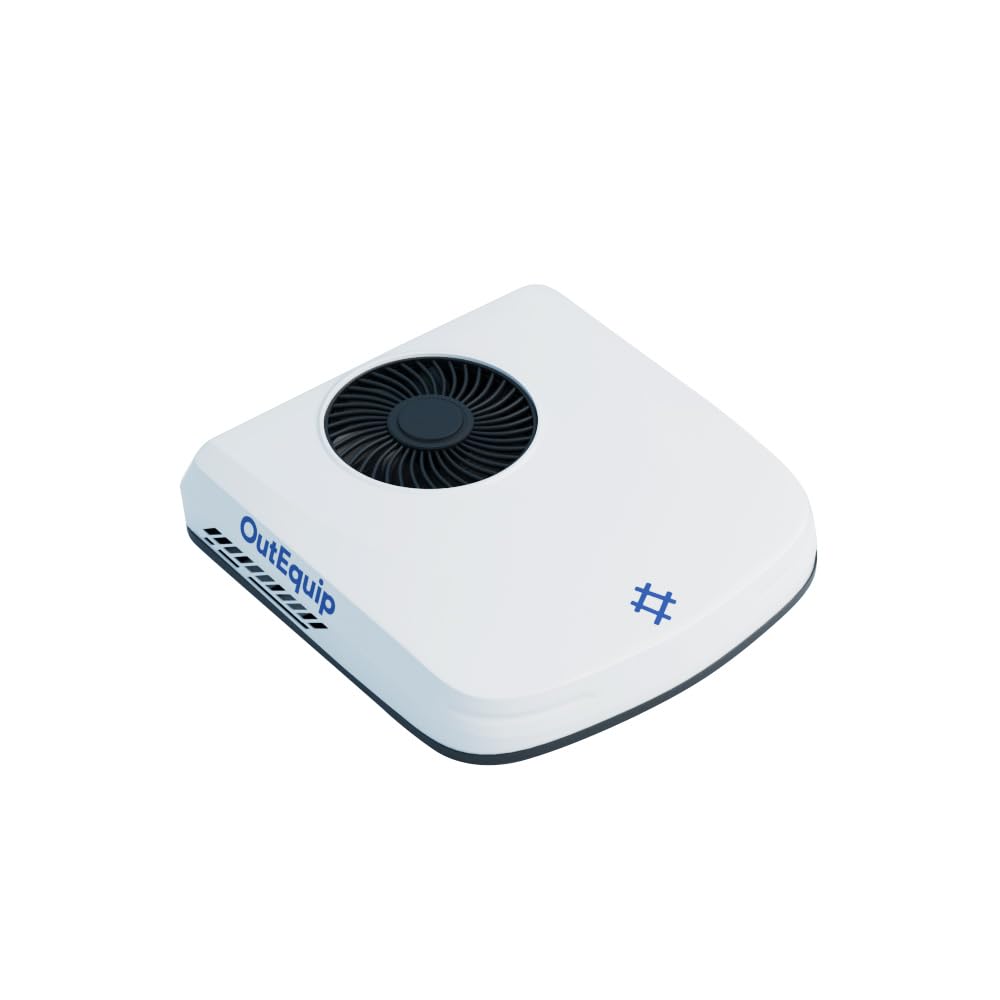
1. Outequip RV Air Conditioner, 12V 10000 BTU Rooftop
Our pick — 4.5+★ from 100+ verified ratings; the strongest balance of quality and price.
The off-grid rooftop that pulls 10,000 BTU straight off your vehicle’s 12V system.
The Outequip earns top spot because it pairs a serious 10,000 BTU of cooling power with a 12V DC power source — so your pop-up cools without a shore-power hookup. It drops into a rooftop install and chills the cabin in 15 minutes, which is fast for a canvas-roof camper on a hot afternoon. Buyers report a temperature swing of up to 20 degrees, and build quality is the most-praised trait in the reviews.
Off-grid runtime is the headline. It runs 8 hours of cooling on a 480Ah power source and 10 hours on a 600Ah bank, so a full night’s sleep on battery is realistic with a bank that size. That cooling power beats the portable picks handily — 10,000 BTU against the Cybertake’s 5,100 BTU — and it is the largest capacity in this lineup at 1 ton versus the Ivation’s 0.54 tons. The rotary scroll compressor and copper core carry the durability story, while UV-stabilized ABS, an EPDM foam gasket, and a zinc-coated condenser are built for weather. Brushless copper fans, spring-supported mounts, and a directional duct keep the sound low enough that several owners say they can barely hear it running.
A remote plus eco, sleep, and turbo modes give you control without climbing up to the roof, and temperature monitoring rounds it out. The trade-off is commitment: this is a rooftop cut-in, so you need the right opening and a 12V wiring run to do it right. Budget for a battery bank sized to your nights too, because the runtime figures assume 480Ah or 600Ah on hand.
What makes it the winner
- 10,000 BTU cools the cabin in 15 minutes, with owners reporting up to a 20-degree swing
- Runs 8 hours on a 480Ah bank and 10 hours on 600Ah — a full night off-grid
- Quiet enough that owners barely register it running, thanks to brushless fans and damped mounts
- UV-stabilized ABS, EPDM gasket, and zinc-coated condenser stand up to harsh weather
What to plan around
- Rooftop install needs the right opening and a 12V wiring run
- Runtime depends on a sizable battery bank, not a small one
Go rooftop if: you boondock and want 12V cooling without a generator roaring all night.
Prep first: confirm your roof cutout and battery bank size before the install, or the runtime numbers work against you.
2. Ivation 6,500 BTU Camper Air Conditioner
Keeps your roof intact and your window view by hanging the noisy half outside.
If you do not want to cut a hole in a camper roof, the Ivation solves it from the windowsill. Its split design puts the compressor portion outside and the cooling unit inside, so the loud mechanical work happens away from your bunk. Shockproof dampers absorb vibration on top of that, and the over-the-sill mounting keeps the window fully usable and lets daylight in. The 6,500 BTU unit also runs as a fan and a dehumidifier, and you get 3-in-1 cooling, dehumidifying, and ventilating across all seasons.
The control set is genuinely useful for camper life: a bright LED display shows temperature and time, with a range of 60°F–86°F, fan speed, swing, timer, sleep mode, and a °F/°C toggle. It draws 567 kWh a year — modest for a 6,500 BTU window-saddle unit. Compared with the Outequip’s 10,000 BTU and 1 ton, this is the smaller-capacity route at 6,500 BTU and 0.54 tons — sensible for a compact pop-up, tight for a full-size rig in a heat wave. Cooling and effectiveness are what buyers praise most, and the quiet operation comes up often too.
The honest wrinkle: functionality draws a split read from owners, with most saying it works very well but a few hitting issues. That is the reality of a split-saddle design that depends on a solid window and correct bracket setup. Mount it right and it hums; rush it and a leaky seal will make you think the unit is weak.
Where it earns its keep: no roof surgery, full window function, and 60°F–86°F control on a push-button panel with a sleep timer.
Get the bracket right: a few owners hit functionality snags, so a careful install protects the cooling performance this design is praised for.
Reach for this if: you want cooling without modifying the roof and your camper has a sturdy window sill.
Look elsewhere if: you need to chill a large rig fast — 6,500 BTU has limits on a big interior.
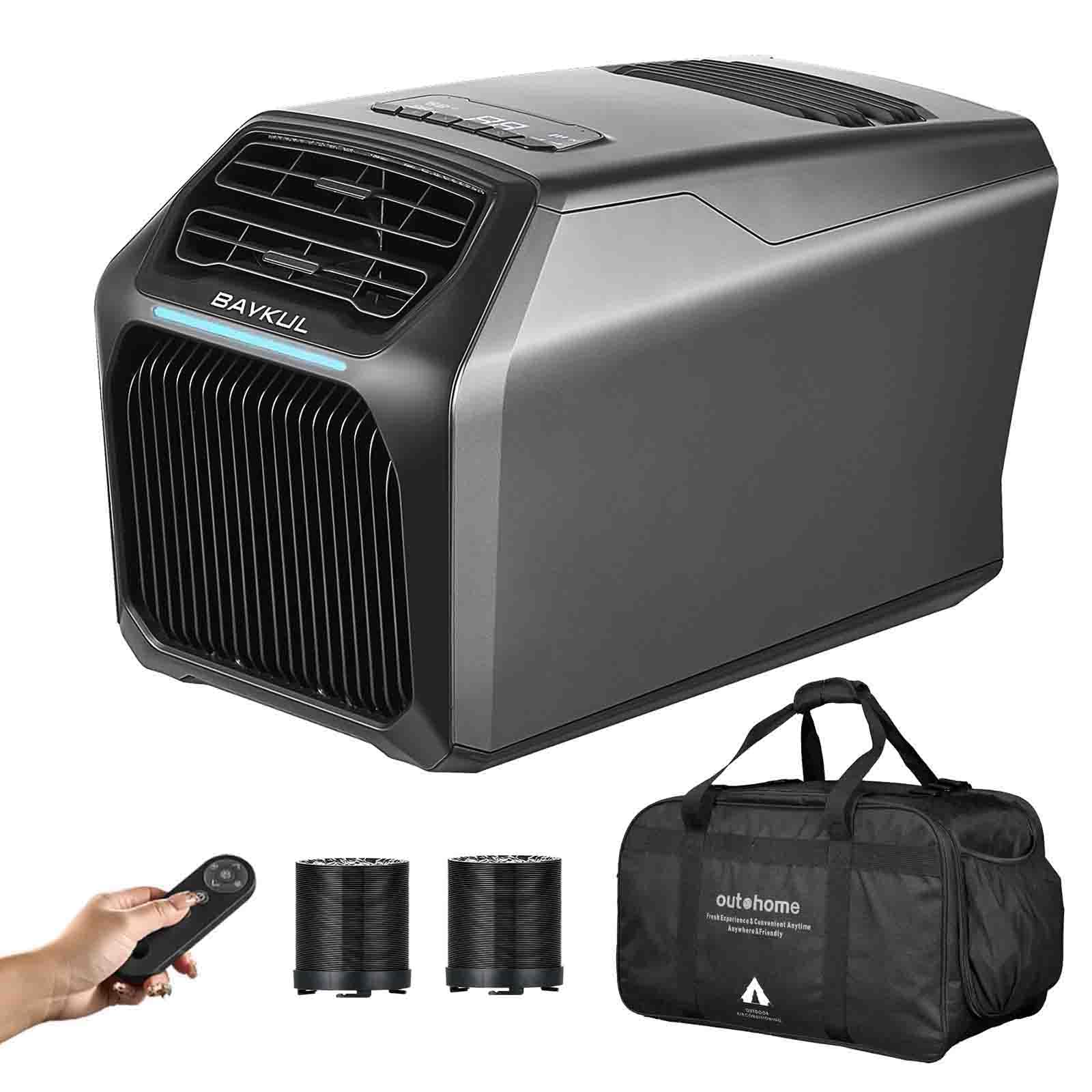
3. BAYKUL Portable Camping Air Conditioner & Heater
One portable box that swings from 6,800 BTU of cooling to 7,500 BTU of heat.
The BAYKUL is the pick for shoulder-season camping, when mornings are cold and afternoons are brutal. It delivers 6,800 BTU of cooling and 7,500 BTU of heating, so the same unit handles both ends of the day. Six modes cover cooling, heating, fan, dehumidifying, sleep, and timer, and it runs on standard 110V AC outlets or a car inverter. The RF remote works through walls, which is a nice touch when the unit is wedged in a corner. R-32 refrigerant keeps the refrigerant side compact for its output.
At 35.7 pounds, this is the heaviest portable in the lineup — noticeably more to lug than the Cybertake at 21 pounds — but the slim body and included carry bag make one-handed transport workable. It sips power at an average draw of 550 watts, and the smart energy mode adjusts output to your space. Noise lands at 46 dB, quiet enough for a tent or a bedroom. Effectiveness is the aspect buyers praise most, and it does the job reliably.
Here is the catch to size honestly: cooling performance reads mixed. Some campers report it holds the cabin about 5 degrees cooler than outside, while others find that weak on really hot days. In a small tent with the flaps zipped, that gap feels great. In a bigger space with sun beating on it, this portable is not the same animal as a 13,500 BTU rooftop.
Best at: dual-season camping where you want heat in the morning and cool by afternoon from one 550-watt box.
The real limit: the 6,800 BTU cooling suit small, sealed spaces better than large or sun-baked ones.
Pick it for: tent and small-camper campers who want a heater and an AC in one carry bag.
Think twice if: your space is large or runs hot all day — the cooling ceiling is modest.
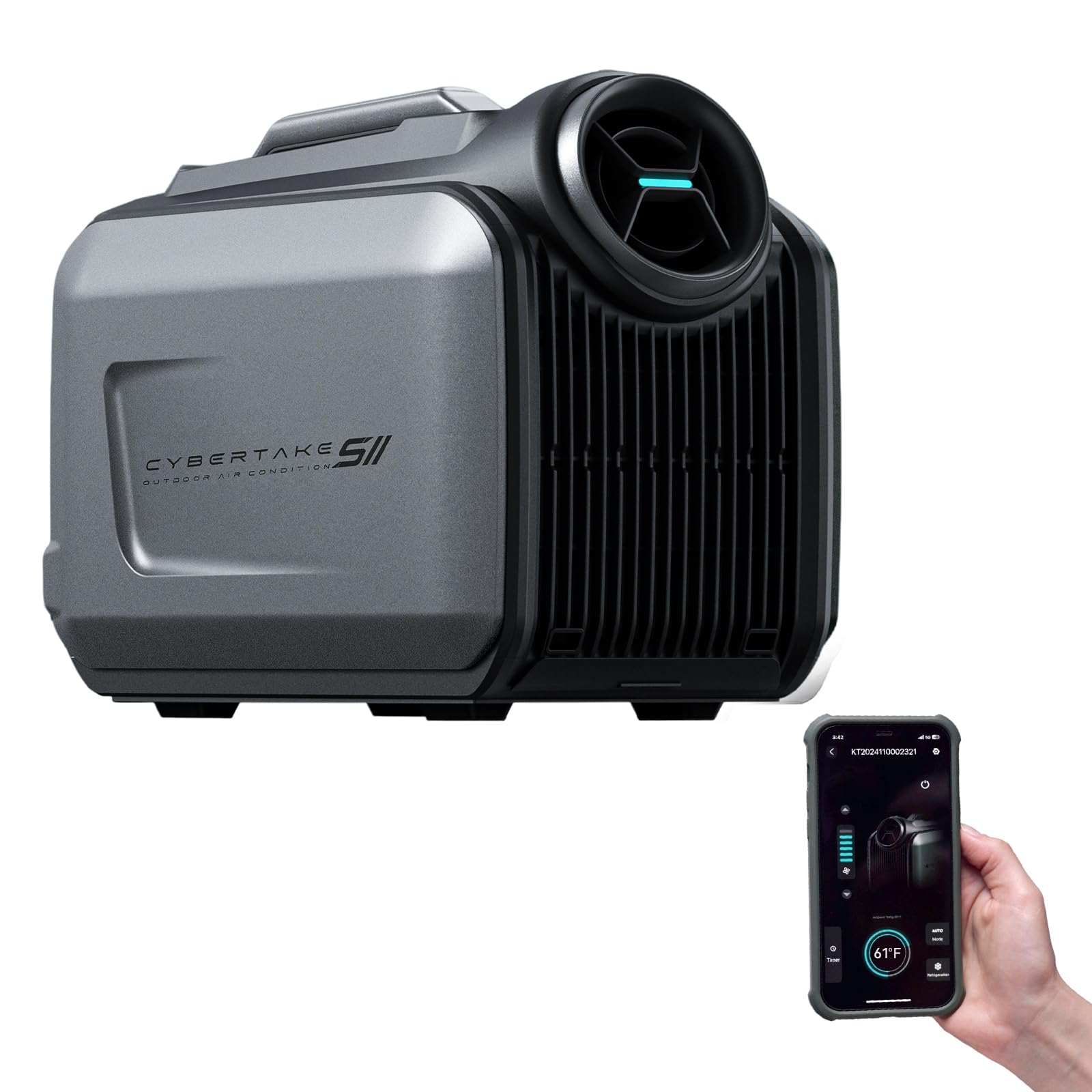
4. Cybertake Portable Camping Air Conditioner, 5100 BTU
A 40 dB tent cooler that sips power and shrugs off rain splashes.
The Cybertake is the light-carrying tent option: 21 pounds, a rugged IPX4 shell that repels splashes and rain, and waterproof silicone buttons you can work with wet hands. It cools at 5,100 BTU and heats at 6,100 BTU, which suits spaces up to 130 sq. ft. It runs on AC or DC, and Eco+ mode draws as little as 1 kWh over 8 hours — that is low enough to pair with a modest battery. At 40 dB it is quieter than a dishwasher, so it will not fight your sleep.
Compared with the BAYKUL’s 35.7 pounds and 6,800 BTU, this is the lighter, smaller-output machine — less cooling, but far easier to carry and lower on power. Four modes (Cool, Heat, Dehumidify, Eco+) plus three fan speeds and a 0–12 hour timer give you real control. It uses R290 refrigerant, comes with a 1-year full-unit warranty and a 2-year compressor warranty, and the included hose and adapter kit gets it running in about 30 seconds. The temperature range for operation is 41°F–113°F.
Two things to know. Compressor cooling takes roughly 5–10 minutes to reach steady performance after startup — normal, not a fault. And the boost converter for DC runs is sold separately, so confirm you have it if you plan to power from a battery rather than shore power.
Reasons campers grab it
- 21 pounds with a carry-friendly build and an IPX4 rain-resistant shell
- Runs as little as 1 kWh over 8 hours in Eco+ mode
- 40 dB operation keeps the tent quiet at night
Worth knowing first
- DC runs need a boost converter that ships separately
- Expect 5–10 minutes to reach stable cooling
Suits you if: you camp in a tent and want light, low-draw cooling that tolerates weather.
Check first: add the boost converter for DC battery setups before you head out.
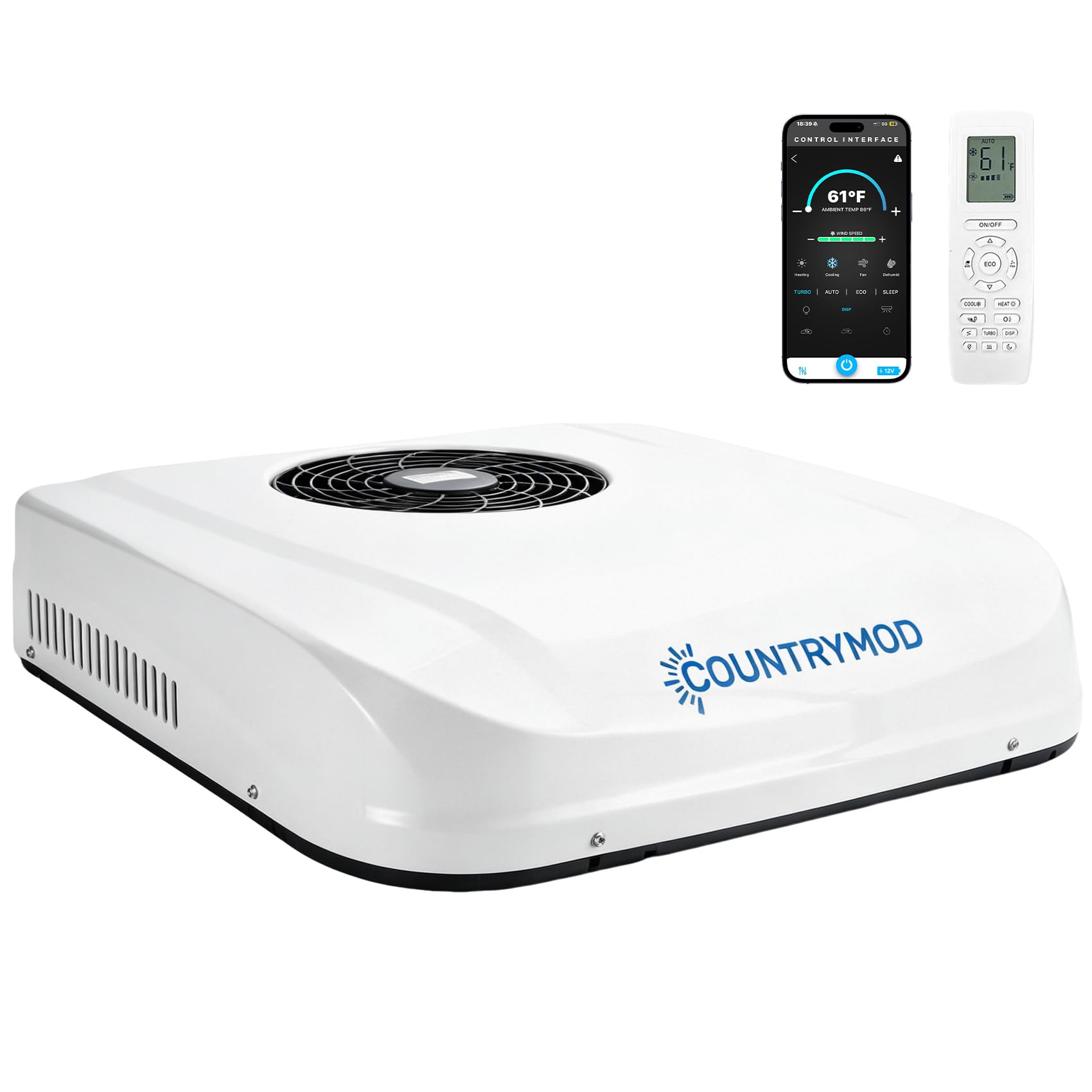
5. Contrymod 12V DC RV Air Conditioner 10000 BTU
A 12V rooftop that runs on 0.3 kWh an hour and lasts up to 10 on a bank.
The Contrymod makes its case on efficiency. Its 10,000 BTU cooling runs on a 300–900W inverter design and draws only 0.3 kWh per hour — the maker frames that as 5 times more efficient than a standard 1.5 kWh/hour unit. With the right battery it holds up to 10 hours of runtime, and owners mention a 300Ah battery lasting up to 12 hours in ECO mode. Performance is what buyers praise most here, and low power draw comes up repeatedly as the reason they are happy.
Install is friendly for a camper build. It fits a standard 14″ x 14″ roof vent, and because it is ductless it needs no major modification — though it is not suitable for RVs that already have ducts. Sound lands at 45–55 dB, and owners describe it as surprisingly quiet. Compared with the TOSOT’s more powerful 16,000 BTU, this gives up some brute force but wins on power frugality.
The genuine weak point is the documentation: the instructions are thin, and that is the most consistent complaint in the reviews. The unit itself gets high marks for build and performance, so this is an install-readiness issue rather than a hardware one. Come prepared with your own plan and it goes smoothly.
Why it stands out: 0.3 kWh per hour and up to 10 hours of runtime make it the off-grid value pick on the roof.
Bring your own guide: the included instructions are skimpy, so plan the wiring and mount yourself.
Choose it when: you want 12V rooftop cooling that stretches a battery bank across the night.
Not for you if: your RV already has ductwork — this ductless unit is not built for it.
6. TOSOT 16000 BTU RV Air Conditioner

16,000 BTU of cooling at 43 dB — the light-sleeper’s big-rig rooftop.
For a larger pop-up or a travel trailer, the TOSOT brings the muscle: 16,000 BTU of cooling plus a 12,500 BTU heat pump for cool spring and fall mornings. It handles ambient temps from 23°F to 115°F, which covers real shoulder-season camping. And it runs at 43 dB — the maker frames that as 32% quieter than standard RV ACs and quieter than normal conversation. Owners confirm the quiet, noting they can still hear each other and the TV with it running.
It fits standard 14.25″ x 14.25″ rooftop vent openings and is non-ducted, so it works with most existing rooftop cutouts and comes with all hardware plus a step-by-step guide. The Gree+ WiFi app and included remote let you set temperature, fan speed, mode (Cool/Heat/Dry/Fan), and timer from inside. Performance is the aspect buyers praise most, followed by that quiet operation. One shipping note from the maker: it arrives in 2 separate packages, so confirm both have landed before you schedule the install. It carries a 2-year warranty and is ETL certified.
The fair caveat is power appetite — the maker’s own listing is honest that power consumption is the mixed point, with more draw on smaller camper vans. If your rig is small and your battery modest, this bigger machine may be more than you need.
Why big-rig campers like it
- 16,000 BTU cooling with a 12,500 BTU heat pump for year-round use
- 43 dB operation that owners say lets them hear the TV
- Non-ducted drop-in fits 14.25″ x 14.25″ vents with full hardware included
The honest trade
- Power draw is higher, which matters on a small battery bank
- Ships in 2 packages — confirm both arrive before install
Right for: larger campers that need heavy cooling and a whisper-quiet night.
Skip if: you run a tiny rig with limited power — this unit wants more current than a micro setup offers.
7. Coleman Mach 3+ A/C Unit

A familiar name with 13,500 BTU and a 5,600-watt heat element on 115V.
The Mach 3+ is the known quantity: 13,500 BTU cooling, a 5,600-watt electric heat element, and 320 CFM airflow on a 115 VAC, 60Hz electrical rating. Cooling amps hit 13.1 on high, which is the number to check against your shore-power or generator setup. Installation is what owners praise most — it is a plug-and-play rooftop swap that goes in without drama, and the build quality carries a long reputation.
On paper it lines up against the Furrion’s 18,000 BTU and the MACH 15’s 15,000 BTU as the mid-tier choice, and its 320 CFM is the airflow number to weigh for a ducted rig. Performance and quality are the strongest points in the reviews.
Be real about the risks. Cooling performance splits between buyers who find it effective and those who feel it does not blow cold enough, and a stretch of customers note units that failed early or arrived missing ceiling assembly, control box, or heating element parts. That is a fit-and-fortune story for some builds, not a reason to write the brand off — but it is a reason to inspect every box on arrival and test the unit before the return window closes.
The strong suit: 13,500 BTU, 320 CFM airflow, and a genuine plug-and-play install that owners rave about.
Inspect on arrival: missing-parts and early-failure cases mean you should unbox everything and test before the window closes.
Worth it for: a ducted rig that wants a proven 13,500 BTU rooftop with straightforward install.
Double-check the delivery: count the ceiling assembly and control box in the box before you build.
8. TURBRO Inverter 13.5K BTU RV Air Conditioner
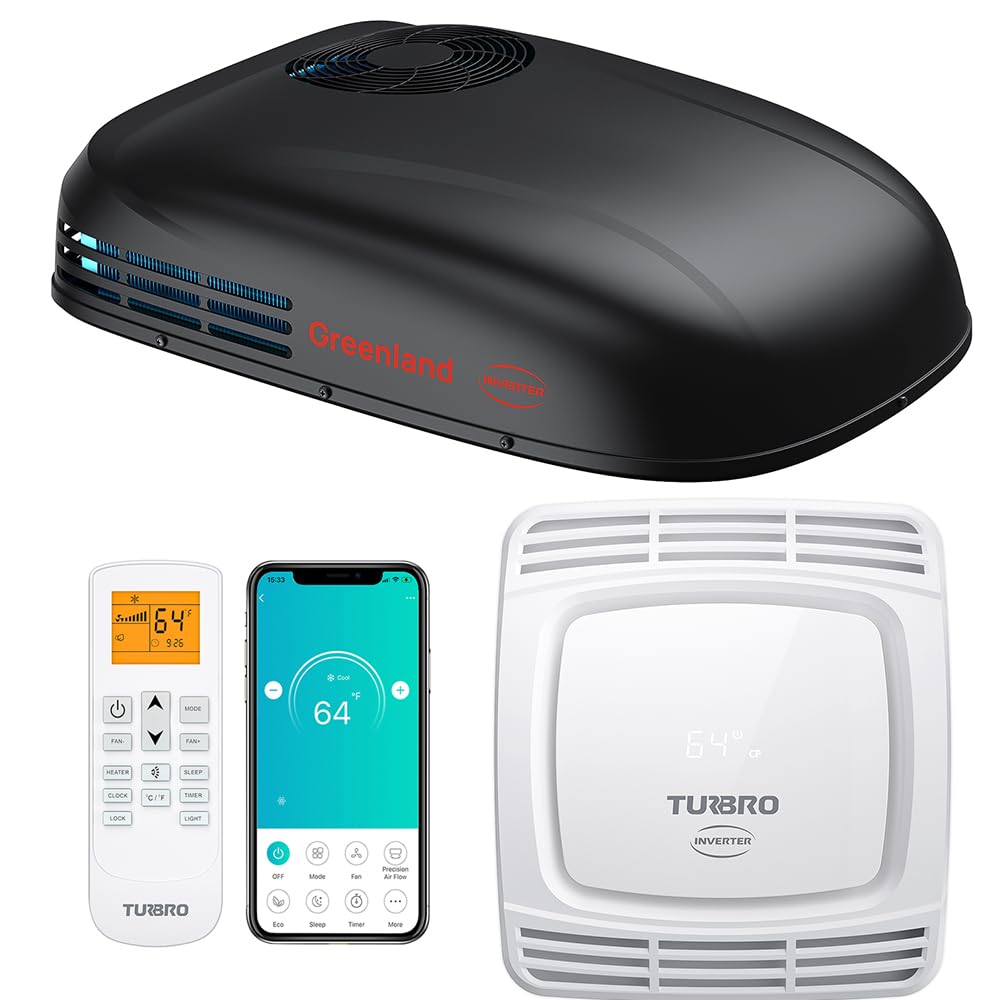
A 10-inch-thin inverter rooftop that heats, cools, and lights your ceiling.
The TURBRO’s inverter compressor is the story — the maker claims up to 30% greater efficiency than non-inverter systems, with smooth starts that skip the need for an added soft starter. It delivers 13,500 BTU cooling and 13,500 BTU heating through a heat pump, works from 19.4°F to 109.4°F, and adds fan and dry modes. At 10.0″ thick, it is up to 35% thinner than most rival units, which the maker ties to lower air resistance and better fuel efficiency.
The ceiling assembly includes an atmosphere lamp with blue, yellow, or white lights, controlled by remote or smart app. It fits 14.25″ x 14.25″ roof openings and 1.02″–3.93″ ceiling thicknesses with modular ducting. Performance, effectiveness, and cooling in extreme heat are the things buyers like most, and power consumption gets positive note for being low. Against the Coleman MACH 15’s 15,000 BTU, this gives up some raw output but brings inverter efficiency to the table.
Two honest limits: the noise level splits sharply between owners who find it quieter than before and those who call it loud, and value for money is the soft spot in the reviews. Get the right ducting and a good spot on the roof and the inverter payoff is real.
what separates it
- Inverter compressor with smooth starts and low power draw
- 13,500 BTU cooling and 13,500 BTU heat pump for year-round trips
- 10.0″ thin profile with a ceiling mood lamp in three colors
Where opinions split
- Noise reports are mixed — some find it loud
- Value for money is the weakest read among buyers
Lean toward it if: you want an inverter rooftop with heat and a slim profile on a full-featured rig.
Weigh carefully if: quiet is your top priority — noise is the split point here.
9. RecPro 13.5K Non-Ducted RV Air Conditioner

Built to run alongside your other appliances without tripping the system.
The RecPro’s pitch is low amp draw, and that is the number that matters when you are on solar, a generator, or a small setup and want to power more than just the AC. It puts out 13,500 BTU from a UV-resistant plastic rooftop housing with an aerodynamic profile that cuts drag on the road. Sound is quoted at 59.7 dB, which the maker likens to gentle rain. Owners describe it as remarkably quiet and some say they do not hear the compressor at all.
The control setup is friendly: a wireless multi-function remote plus a touchscreen LED panel, with cool, dry, fan, sleep, and timer modes and no thermostat wiring needed. It works in both ducted and non-ducted configurations, so you can match it to your rig. Performance and quality are the strongest points in the reviews, with cooling described as ice cold. Against the Outequip’s 12V off-grid design, this is a conventional rooftop that leans on your amp budget rather than a battery bank.
The mixed note is the remote — some owners love it, others hit functionality glitches. With a 59.7 dB rating it is louder than the TOSOT’s 43 dB, so if pin-drop quiet is the goal, weigh that.
Why it sells: low amp draw lets you power more appliances at once, and the install plus ice-cold cooling satisfy owners.
Small gripe to size: the remote’s functionality splits opinion, and 59.7 dB is louder than the quietest picks here.
Great match for: off-grid, solar, or generator setups where every amp counts.
Look at the TOSOT instead if: low noise is your deciding spec — 43 dB edges out 59.7 dB.
10. Coleman-Mach MACH 15 Medium-Profile Air Conditioner
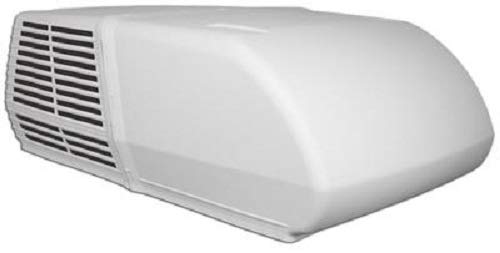
The highest cooling output in the Mach line, in a medium-profile shell.
If raw cooling is the goal and you have the power for it, the MACH 15 packs 15,000 BTU/h — its own listing calls it the highest available cooling output in the series. The medium-profile design and textured white shroud keep the rooftop footprint tidy, and it fits a split-system install. Installation is what owners praise most, describing it as straightforward to get onto the roof.
Compare it to the Furrion’s 18,000 BTU up the list: this gives up a bit of ceiling but stays a step above the Mach 3+’s 13,500 BTU. For a big pop-up that struggles to cool in high summer, the extra output is exactly the point.
Reliability is the honest watch item. Owners split between excellent performance and early compressor failures, and quality is the mixed note in the reviews. Treat that as a fit warning for a rig that will get heavy year-round use, and keep your receipts handy. When it works, it works hard; when it doesn’t, the warranty is your protection.
The draw: 15,000 BTU/h of cooling with a clean medium-profile look and an easy install.
Sized caveat: early-failure reports mean you should register the unit and lean on the warranty.
Buy it if: you need plenty of cooling and want a proven rooftop brand on a split install.
Think it through if: long-term reliability is your top concern — this is the mixed read.
11. Furrion Chill Cube 18K Non-Ducted Rooftop RV AC

The biggest cooling ceiling here, with a variable-speed compressor that never slams on.
The Furrion is the top of the capacity ladder at 18,000 BTU — well ahead of the Mach 3+’s 13,500 BTU and the TOSOT’s 16,000 BTU. Its variable-speed compressor runs continuously instead of cycling hard on and off, which the maker ties to fewer sudden amp spikes and steady cooling.
At 72.4 lbs, it is about 10% lighter than other units in its class, with an aerodynamic rooftop profile that reduces drag and wind resistance. That is a real benefit on the road for mileage and handling. Quiet operation is a strong suit: owners say it can barely be heard on its lowest setting, and power consumption earns all-positive note for using significantly less draw. Performance and cooling are the two things buyers like most.
Note the install detail in the listing: this is the AC unit only, and the ADB (air distribution box) is sold separately — that box carries the install components, so budget for it before you plan the build. The remote is the mixed note, with some reporting missing components or temperature-readout quirks.
Why the big rigs pick it
- 18,000 BTU — more cooling capacity than any other unit here
- Variable-speed compressor holds steady temp with fewer amp spikes
- 72.4 lbs and about 10% lighter than comparable units
Plan the build around these
- ADB sold separately and needed for install components
- Remote gets a mixed read on missing parts and temp accuracy
Pick it for: large rigs and campervans that need maximum cooling and steady variable speed.
Add the ADB: it ships separately and carries the install parts, so order it with the unit.
Know the Specs
BTU (Cooling Power)
BTU stands for British thermal units — the measure of how much heat a unit removes from a space. Higher BTU cools a larger or hotter space. A 5,100 BTU portable suits a tent, while 13,500–18,000 BTU rooftop units suit full-size campers. Match the number to your space or you either waste power or never catch up.
Power Source and Draw
12V DC runs off your vehicle’s electrical system or a battery bank, ideal for off-grid. 110V or 115 VAC needs shore power or a generator. Power draw in watts or kWh tells you how long a battery lasts, and inverter compressors (variable-speed motors) generally draw less and hold temperature steadier than fixed-speed units.
Noise in Decibels (dB)
The decibel scale measures sound level. Low 40s dB is quieter than normal conversation and easy to sleep beside; high 50s dB is noticeable. If you sleep a few feet from the unit, the noise figure matters as much as the BTU rating.
Roof Vent and Install Type
Most rooftop units drop into a standard 14″ x 14″ or 14.25″ x 14.25″ vent opening. Non-ducted units skip ductwork but will not work on aduct system. Window-saddle units avoid roof cutting but need a sturdy sill. Confirm your opening size and whether your rig is ducted before ordering.
Common Questions
Will a rooftop air conditioner fit my pop-up camper’s vent opening?
How many BTU do I need to cool a pop-up camper?
Can I run a camper air conditioner off a battery instead of shore power?
Is a 12V DC rooftop better than a 110V window unit for a pop-up?
How loud is a pop-up camper air conditioner at night?
Do I need a soft starter or inverter for my camper air conditioner?
Can a camper air conditioner also heat the space?
What does a non-ducted air conditioner mean for my camper?
How long does a camper air conditioner take to start cooling?
What extras do I need to buy separately for a camper air conditioner install?
The Bottom Line
For most campers, the pop-up camper air conditioner winner is the Outequip 12V 10000 BTU Rooftop because it pairs 10,000 BTU of cooling with a 12V DC power source and up to 10 hours of runtime on a 600Ah bank — real off-grid comfort without a generator. If you want to skip cutting the roof, grab the Ivation 6,500 BTU and saddle it over a window sill. And for a light tent-and-battery setup, the Cybertake 5100 BTU is the one to reach for at 21 pounds and 40 dB (a measure of sound level).
One last thing: the Outequip carries the highest rating of any unit on this list — the strongest single signal that the 12V rooftop route works as advertised.
How we choose
We do not accept paid placement. Every pick is matched to a real buyer and a real use-case; we do not hands-on test units.
Sources
Specifications: manufacturer listings and product documentation. Review insights: verified customer reviews, as of November 2026. Pricing: not shown on this page (it changes often); check the current price via the retailer link.
As an Amazon Associate, Tactical Gear Guy earns from qualifying purchases. This does not affect which products we feature.