Specs are compiled from manufacturer listings and verified buyer reviews and can change over time — please confirm the key details on the product page before buying.
If you want one answer before you scroll: the 70mai T800E is the safest first buy here, because it records front, cabin and rear at once and still holds up in Texas heat. A dash camera only helps after something goes wrong, so judge every pick on whether it caught the plate, the face and the lane — not on how many features the box listed. That single test is how every pick below was judged.
This guide is built by comparing the manufacturers’ published specifications and the patterns across verified customer reviews, so you get each pick’s real strengths and trade-offs instead of marketing spin.
You will see how each camera handles night plates, heat, cabin coverage and parking duty, plus the honest trade-offs nobody prints on the box. I ranked these by what survives a real drive, which is exactly what makes a police dash camera worth fitting to your windshield.
Top Picks

How To Choose The Best Police Dash Camera
The name tells you the job: these are cameras that sit on your windshield or over your mirror and record the road, the cabin and the traffic behind you. A police dash camera in the consumer sense is your own rolling witness — the footage you hand to an insurer, a lawyer or an officer after a collision. Four things decide whether it earns its place.
Night plate reading beats day resolution
A 4K badge means nothing if the plate turns into a white smear at 9pm. Look for HDR (which balances bright headlights against a dark road) and for a wide aperture — the F1.5 to F1.7 range lets more light into the lens. A STARVIS 2 sensor is a Sony light-sensitive chip that holds detail in low light, and it is the single clearest night-vision signal in this category.
Field of view: wide enough to cover lanes, not so wide it warps
Field of view is measured in degrees — the arc of road the lens can see. A 170-degree front lens covers multiple lanes and catches a car pulling out from a side street. Push much past that and the edges start to bow, which makes distant plates smaller. Front angles here run from 130 degrees up to a 402-degree combined three-channel figure.
Heat is the quiet killer
A windshield in summer can hit brutal temperatures, and lithium batteries swell and fail there. A supercapacitor is a battery-free power part that shrugs off heat and cold. Check the temperature range the maker quotes — the numbers here span 14°F to 140°F and -20°C to 70°C. This is why nearly every serious pick on this list uses a capacitor.
Storage and parking duty
Loop recording (it automatically overwrites the oldest clip) means the card size sets how many days of driving you keep. The smallest card here is 256GB and the largest is 1TB. Parking mode (the camera keeps watching with the ignition off) needs a hardwire kit wired to your fuse box. Most picks list that kit as a separate purchase, so factor it in before you assume it is included.
Side-by-Side Comparison
| Model | Best For | Channels | Max Card | Front View | Amazon |
|---|---|---|---|---|---|
| 70mai T800E★ Best Overall | All-round first buy | 3 (4K front) | 512 GB | 402° combined | Amazon |
| BOTSLAB G300H PlusBest Value Dual | Clean dual-channel value | 2 (4K + 1080P) | 256 GB | 170° | Amazon |
| Pelsee S12Mirror Screen Pick | Mirror-screen commuters | 2 (4K + 2.5K) | 256 GB | 160° | Amazon |
| VIOFO A119M Pro | Hidden single-channel | 1 (4K front) | 512 GB | 130° | Amazon |
| BOTSLAB 4 Channel | Full 360° coverage | 4 (3K four-way) | 512 GB | 560° combined | Amazon |
| Vantrue N4S | Cabin and cargo watch | 3 (2.7K three-way) | 1 TB | 360° combined | Amazon |
| ROVE R2-4K Dual PRO | Dual STARVIS 2 footage | 2 (4K + 2K) | 1 TB | 150° | Amazon |
| REDTIGER F17 Elite | Color night vision | 3 (4K three-way) | 512 GB | — | Amazon |
| WOLFBOX G900 Tripro | Off-road bumper view | 3 (4K three-way) | 512 GB | 170° | Amazon |
| VIOFO A329S | Fisheye cabin transit | 3 (4K three-way) | 512 GB | 210° cabin | Amazon |
| THINKWARE U3000 PRO | Radar parking watch | 2 (4K + 2K) | 512 GB | 147.2° | Amazon |
Detailed Reviews
1. 70mai 4K Dash Cam Front and Rear Inside, 3 Channel (T800E)
Our pick — 4.0+★ from 750+ verified ratings; the strongest balance of quality and price.
Three lenses, one box, and a heat-proof power part — the safest all-round first buy here.
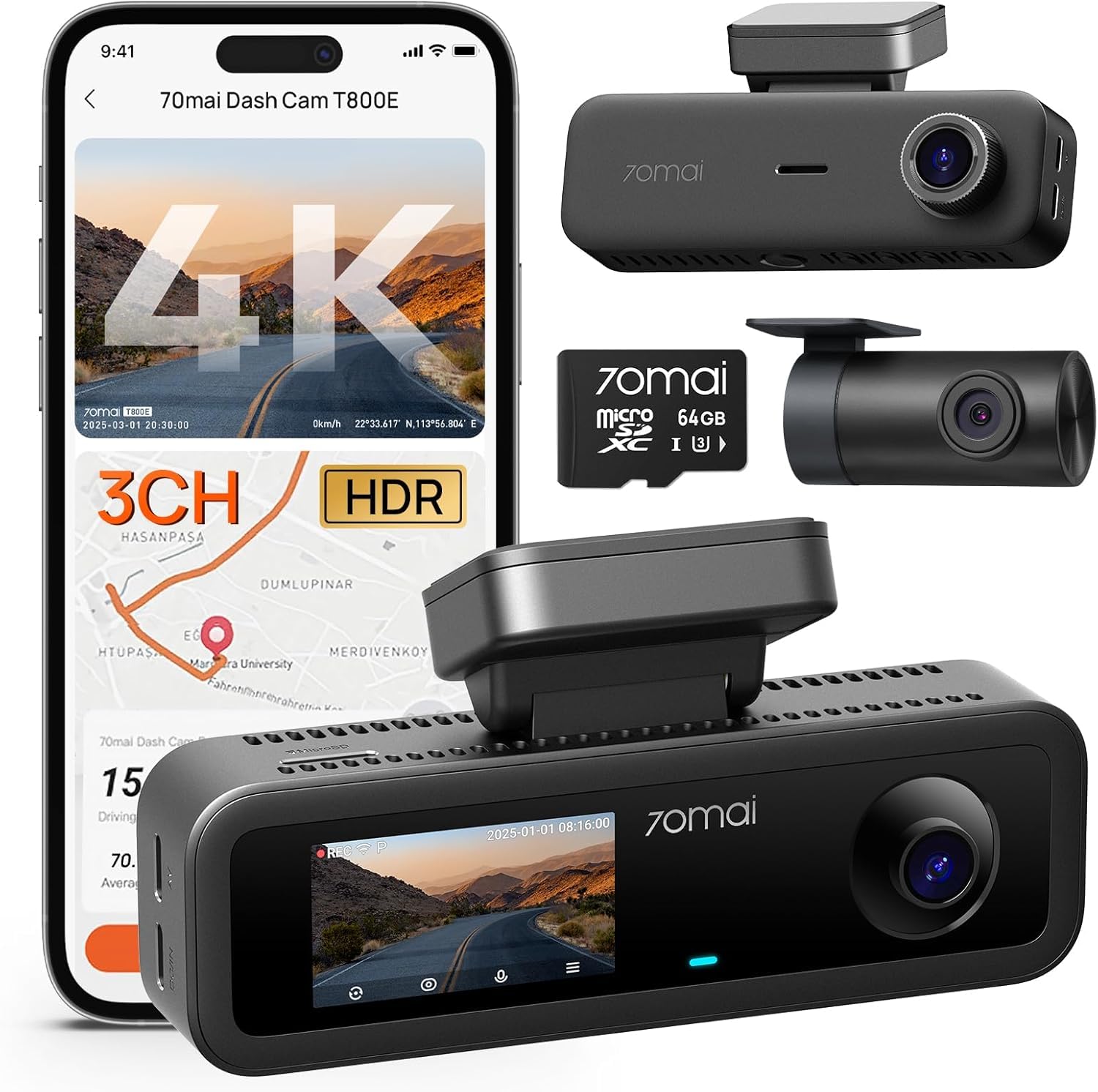
This is the camera to buy if you want front, cabin and rear covered in a single install. It records 4K out the front, 1080P inside and 1080P behind, and those three lenses together cover 402 degrees. It ships with a 64GB card, so you can drive off the lot recording — no separate purchase needed.
The footage that lands on your phone is sharp enough to read a plate in a parking-lot bump. The video that lands on your phone is sharp enough to read a plate, so you can capture a licence plate in a parking-lot bump. The unit sits low enough that it does not eat your windshield view. It keeps working through a Texas summer thanks to a supercapacitor (a component that stores power without a battery) rated from 14°F to 140°F. It is the most popular pick here, and the owner feedback backs that up.
Two honest limits. File transfer over Wi-Fi 6 (a fast wireless standard) reaches up to 10 MB/s, but if you drive all day the included 64GB card fills quickly, so a larger card is the smart add-on — this unit accepts up to 512GB. And it cannot talk to CarPlay (Apple’s in-car phone system) while you are connected to its own Wi-Fi, so reviewing clips means sitting parked. The night-vision interior lens has switchable infrared (invisible light for low-light recording), which you switch off when you do not need it.
What earns it the top spot
- Front, cabin and rear recorded at once — 402 degrees of combined coverage.
- Supercapacitor rated 14°F to 140°F, so heat does not end it.
- 64GB card included and support up to 512GB for long-haul recording.
- Switchable infrared on the interior lens for dark-cabin footage.
- Wi-Fi 6 transfers at up to 10 MB/s, five times quicker than older Wi-Fi 4.
The trade-offs worth knowing
- Cannot run alongside CarPlay on a connected phone.
- Parking monitoring needs the separate hardwire kit.
- All-day drivers will want more than the included card.
Reach for this one if: you want one clean install that watches the road, your passengers and your tail in a single recording.
Look elsewhere if: you need live CarPlay in the same phone session, or you refuse to buy a hardwire kit for overnight parking.
2. BOTSLAB G300H Plus 4K Dual Dash Cam Front and Rear
A front-and-rear workhorse with a STARVIS 2 sensor and F1.5 lens that records without fuss.
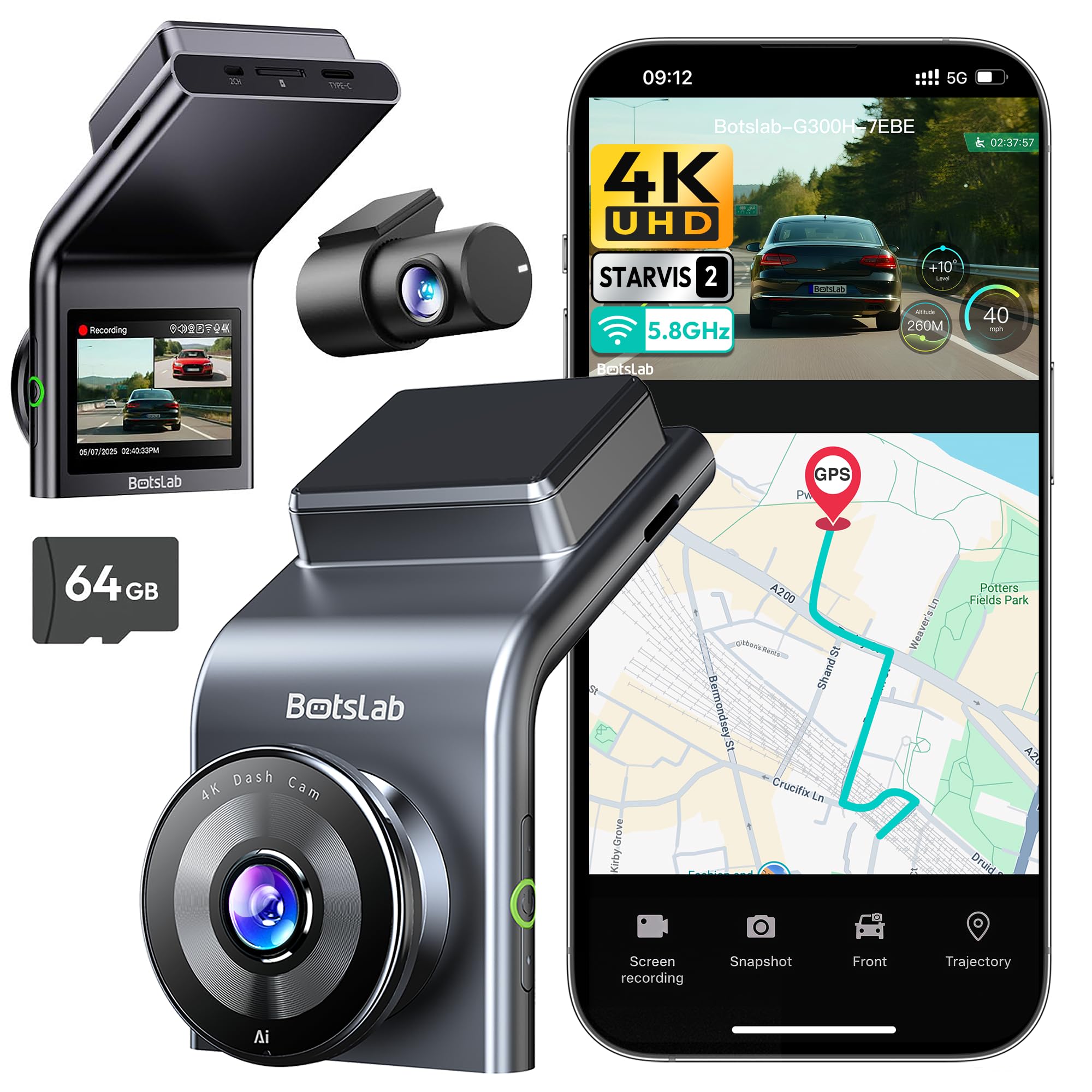
The G300H Plus goes front and rear only — 4K out the windshield and 1080P behind — and backs the front lens with a STARVIS 2 sensor plus an F1.5 aperture. That combination is why plates stay legible after dark, and it is a genuinely strong night package for the money. The front lens opens to 170 degrees. Compare that with the 70mai above and you see the gap: the 70mai reaches 402 degrees across three channels, while this one holds 170 degrees on the front alone.
Setup is quick, the mount tucks in neatly, and it records without fuss — delivery drivers and commuters both get along with it. Setup is quick, the mount tucks in neatly, and the whole thing just records without fuss — delivery drivers and commuters both get along with it. Records drop onto your phone through 5.8GHz Wi-Fi, which the maker claims is far quicker than the older 2.4GHz band.
Here is the part to plan for: the included 64GB takes a 256GB maximum, so this is not the camera for someone who wants weeks of retained footage. Compare it to the 70mai, which tops out at 512GB. And like nearly every pick here, overnight parking needs a hardwire kit. The screen is on the small side, too — fine for setup, not for reviewing footage at a roadside.
Where the money goes: into the sensor and the lens. A STARVIS 2 chip and F1.5 glass are the two parts that decide whether a night plate is readable, and this camera spends there instead of on extras.
What you give up: cabin coverage and card headroom. This is a front-and-rear camera by design, so a rideshare driver who needs to watch passengers should look up the list.
Suits you if: you drive a normal commute and want honest night footage without paying for channels you will never use.
Skip if: you need to record your cabin, or you want to stash more than a couple of days of driving on one card.
3. Pelsee S12 Native 4K + 2.5K Mirror Dash Cam
A 12-inch mirror screen that streams a live 2560×1440P rear view while it records.
Strap this over your existing mirror and you get a 12-inch screen streaming the road behind you in 2560×1440P. That is a real jump in parking confidence, because you are watching a clear rear feed instead of squinting at a dim mirror. The front camera records native 3840×2160P from an 8MP GC8613 sensor with a 160-degree view, and the maker is explicit that this is true 4K, not upscaled footage.
Night recording runs through an F/1.4 aperture, and it is worth being realistic here. The rear camera films through your rear glass, so tint and reflections blunt it in very dark conditions. The maker says so plainly. The front does better, and the wide screen makes the whole setup feel like a factory option rather than a bolt-on. Wi-Fi 6 downloads at up to 30 MB/s, and the external GPS module keeps the install tidy.
Check your mirror before ordering — the straps need an original mirror at least 6.3 inches wide and no thicker than 5.91 inches. If a sensor housing sits behind your glass, the adjustable front lens needs a clear view or you will want the bracket mount. The rear camera is IP67-rated, which means it shrugs off rain and wash spray, though a few owners have seen fogging in the rear view after a wash.
The big-screen argument: a 12-inch live rear view genuinely changes reversing and lane changes, and it is the reason to choose this over a compact windshield cam.
The honest caveat: rear-window filming is only as clear as your glass. Tint, dirt and reflections all cost detail, and the maker says as much.
Built for: commuters and road-trippers who want a bigger rear view plus recording in one piece of hardware.
Think twice if: your mirror is narrow, thick or blocked by a sensor pod — measure first, because the straps have a hard fit limit.
4. VIOFO A119M Pro 4K HDR Mini Dash Cam
A palm-sized single lens built to vanish behind the mirror and pull clean 4K plates.
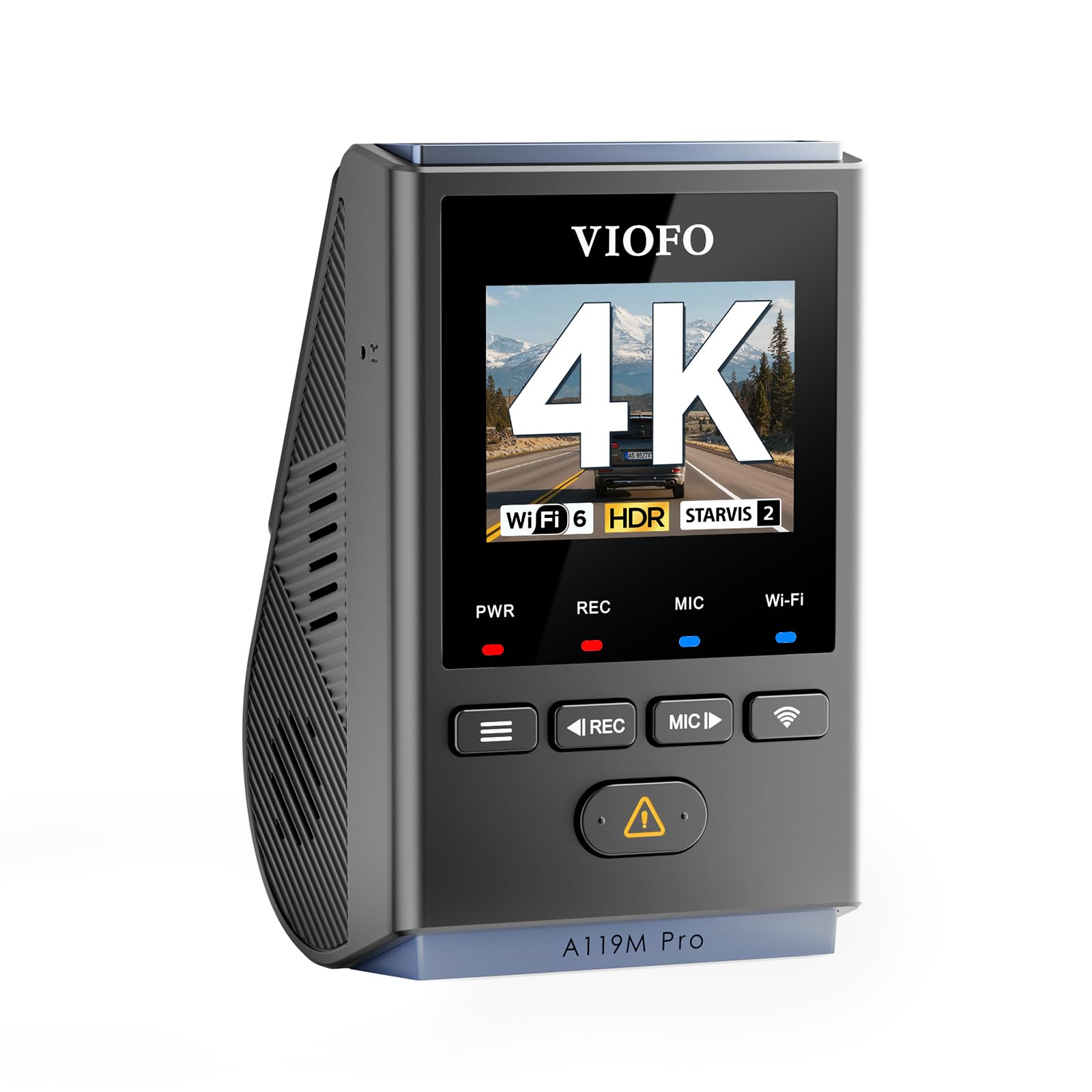
If your only goal is one excellent front view with nothing on show, this is the shape you want. It records 4K at 30 FPS from a STARVIS 2 IMX678 sensor and mounts low-profile behind the rearview mirror. Its field of view is 130 degrees — narrower than the 170-degree BOTSLAB above, which means it trades lane-edge coverage for a tighter, less distorted frame on the car directly ahead.
Night work is helped by HDR and Night Vision 2.0, which pulls detail out of tunnels and rain. A CPL filter comes in the box — that is a polarizing lens that cuts windshield glare and dashboard reflections, and it genuinely sharpens the image on sunny days. Wi-Fi 6 pushes files out at up to 30 MB/s, and the quad-mode GPS logs speed, route and timestamp for each trip.
The catch is that this camera asks more of you. There is no microSD card in the box, so it will not record until you buy one — VIOFO rates it up to 512GB and recommends its own industrial-grade cards. Setup instructions for the Wi-Fi link are thin, and the recording has not been flawless for everyone. Treat this as a camera for someone who enjoys a tidy single-lens install and does not mind sourcing a card.
The size play: 130 degrees on a small body means it hides from view outside and never blocks your line of sight inside.
Plan the extras: no card, no hardwire kit. Budget for both before the camera ever leaves the box.
Your pick if: you want one discreet front lens and a glare-cutting CPL filter included, with nothing extra mounted on the glass.
Not your pick if: you need cabin or rear footage, or you want a camera that records the moment you unbox it.
5. BOTSLAB 4 Channel 360° Dash Cam
Four lenses watching every side, and a split screen that shows all of them at once.
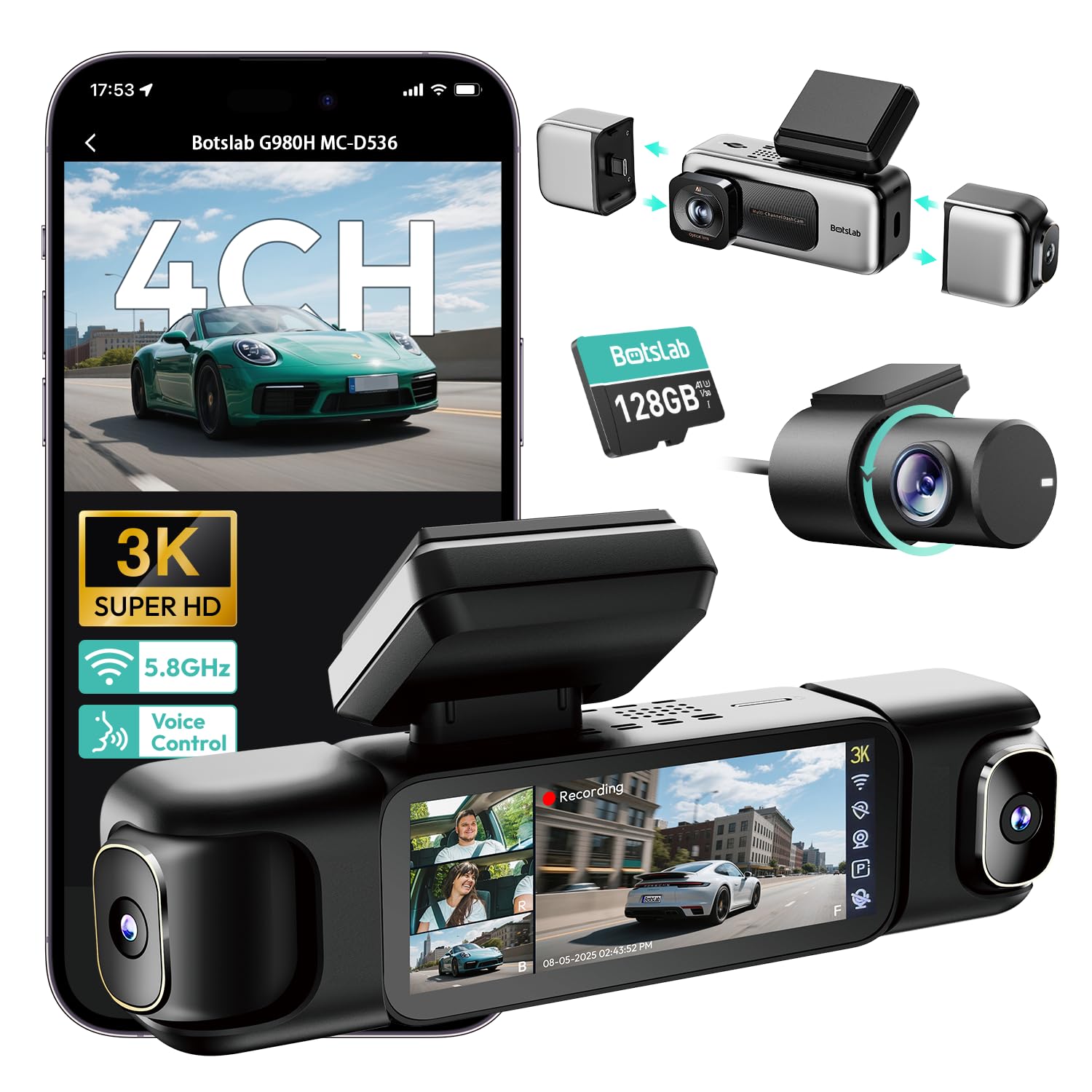
Nothing else here covers this much ground. Four cameras record together — 170 degrees at the front, dual 120-degree side lenses and 150 degrees at the rear, adding up to a 560-degree combined view. The side cameras ride on detachable magnetic mounts, so you can switch down to a three-channel or two-channel setup when you do not need the full spread.
The 3.18-inch touchscreen does something genuinely useful: it shows all four feeds at once during playback, so you are not clicking between angles while working out what happened. Voice control lets you start recording or snap a photo without reaching, and the 128GB card is in the box. A built-in G-sensor keeps the 8 seconds before an impact, which is often the clip that proves what caused it.
Now the part to weigh. Connectivity is the weak seam — a handful of iPhones have refused to pair, and the Wi-Fi range is short at 3-5 meters, so you cannot pull footage from inside the house. Parking mode also needs the separate hardwire kit. This is a camera for someone who wants maximum coverage and will accept that the app is not the smooth part.
Why the coverage crowd picks it
- 560 degrees across four simultaneously recording lenses.
- Split-screen playback shows every angle at once.
- 128GB card included, and it supports up to 512GB.
- 8-second pre-recording keeps the moment before an impact.
- Magnetic side mounts let you drop to three or two channels.
Where it makes you work
- App pairing has been rocky for some iPhone users.
- Wi-Fi range is short at 3-5 meters.
- Full parking mode requires the hardwire kit, sold separately.
Made for: rideshare and fleet drivers who need to prove what happened on every side of the car.
Not ideal for: anyone who mostly wants a fast app and is happy with front-and-rear only.
6. Vantrue N4S 2.7K 3 Channel Dash Cam

Three STARVIS 2 lenses, and a rear camera that swings round to watch the kids or the cargo.
The N4S records 2.7K up front, 2.5K in the cabin and 2.5K at the rear, all from STARVIS 2 sensors. Its angles are 158 degrees ahead, 165 degrees in the cabin and 160 degrees behind. That rear lens rotates a full 360 degrees, so it can face backwards down the road or pivot inward to keep an eye on a pet, luggage or a sleeping child in the back. That pivot is the feature that separates it from the 70mai up top, which covers the cabin but with a fixed interior lens.
Low-light work gets extra help from PlatePix, which the maker says sharpens plate detail by 2X, along with triple HDR to balance headlights against dark roads. The supercapacitor handles -4°F to 140°F. Installation is tool-free thanks to a magnetic mount and cable clips, and 5GHz Wi-Fi keeps the transfer wait short. It accepts up to 1TB of storage, the largest ceiling on this list alongside the ROVE below.
The honest note is card and connection. No microSD is in the box, so it cannot record until you fit one, and the maker warns that a loose rear-camera connection causes faults. Wi-Fi is the usual soft spot — get it paired once and leave it alone, and this camera will quietly do its job.
The family angle: a pivoting rear camera that can face the cabin is exactly what you want with children or cargo aboard, and the 165-degree cabin lens covers the whole back seat.
Card discipline: with 1TB supported it scales beautifully, but you must supply the card yourself.
Choose it if: you carry passengers, pets or equipment and want one camera to watch all three directions.
Look past it if: you want every part of the kit included, or you hate fighting a Wi-Fi pairing screen.
7. ROVE R2-4K Dual PRO Dash Cam Front and Rear
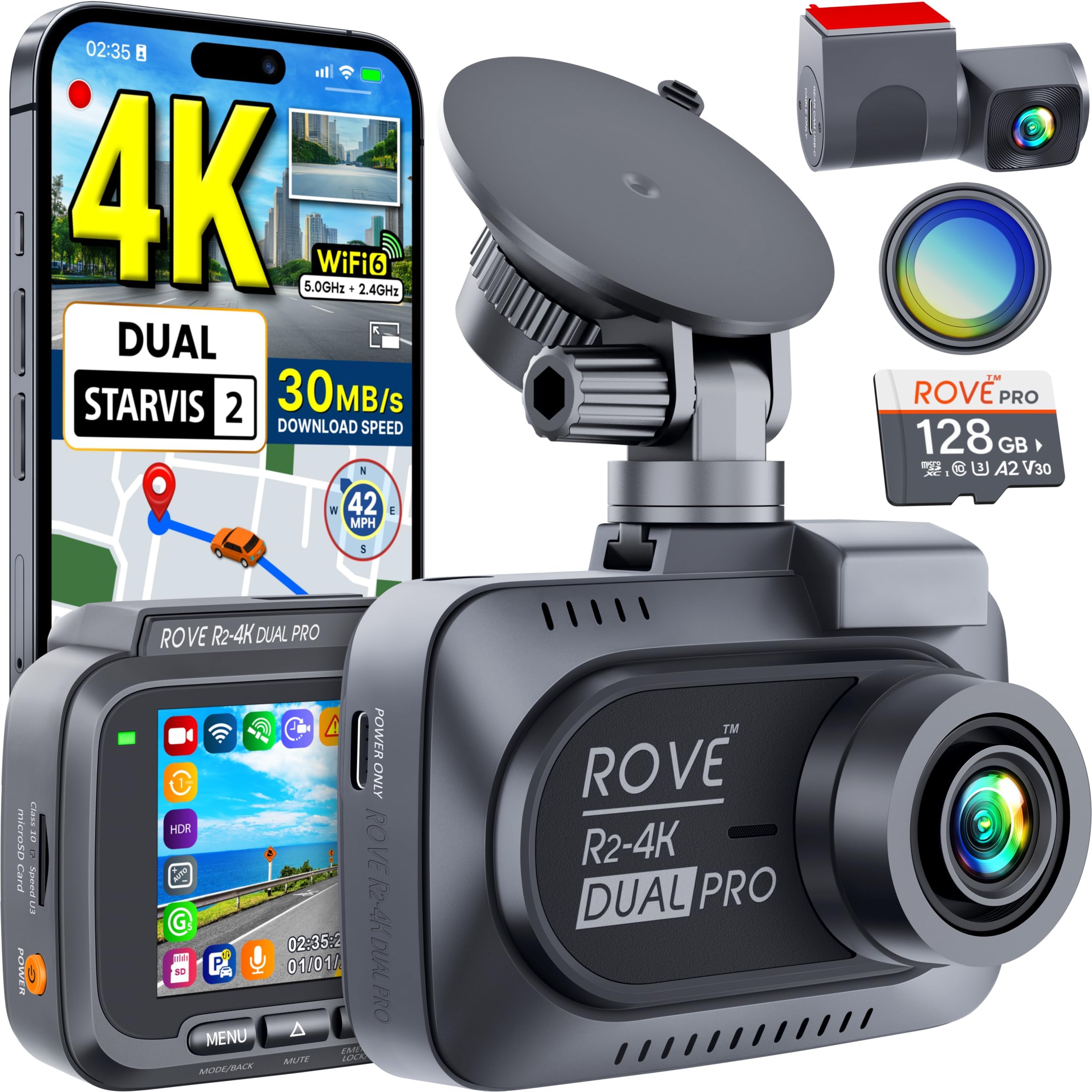
Both lenses get Sony’s best sensor here — no compromised rear view.
Most dual cameras give the front lens the premium sensor and leave the rear weaker. The R2-4K Dual PRO fits a STARVIS 2 IMX678 (8MP) up front and an IMX675 (5MP) at the back, recording 3840×2160P front and 2560×1440P rear, both at 30 FPS. The front lens is F1.7 and opens to 150 degrees, with 140 degrees at the rear. The result is rear footage that holds up at night instead of turning to mush.
The box is generous for the tier — a 128GB ROVE PRO card, a CPL filter for glare, a suction mount, spare sticky tape and cable clips all come with it. Wi-Fi 6 runs dual band at up to 30 MB/s, and quad-mode GPS stamps speed, route and location onto every clip. The 24-hour parking mode records a 1-minute event clip and alerts you at the next start-up.
The one caveat hangs on the front camera itself. It has worked flawlessly for most drivers, but a small share of units have stopped recording, and that is the kind of failure you cannot see until you need it. Check the screen indicator every so often. Parking mode also needs the hardwire kit, sold separately.
The dual-sensor payoff: matching STARVIS 2 chips front and rear is rare at this tier, and it shows in the rear night footage.
The check to build in: glance at the recording light on a routine basis — a camera that stops silently is worth less than nothing.
Your match if: you refuse to accept a weak rear camera and want the card and CPL filter already in the box.
Consider alternatives if: you need cabin recording too, since this one covers front and rear only.
8. REDTIGER F17 Elite 4K 3 Channel Dash Cam
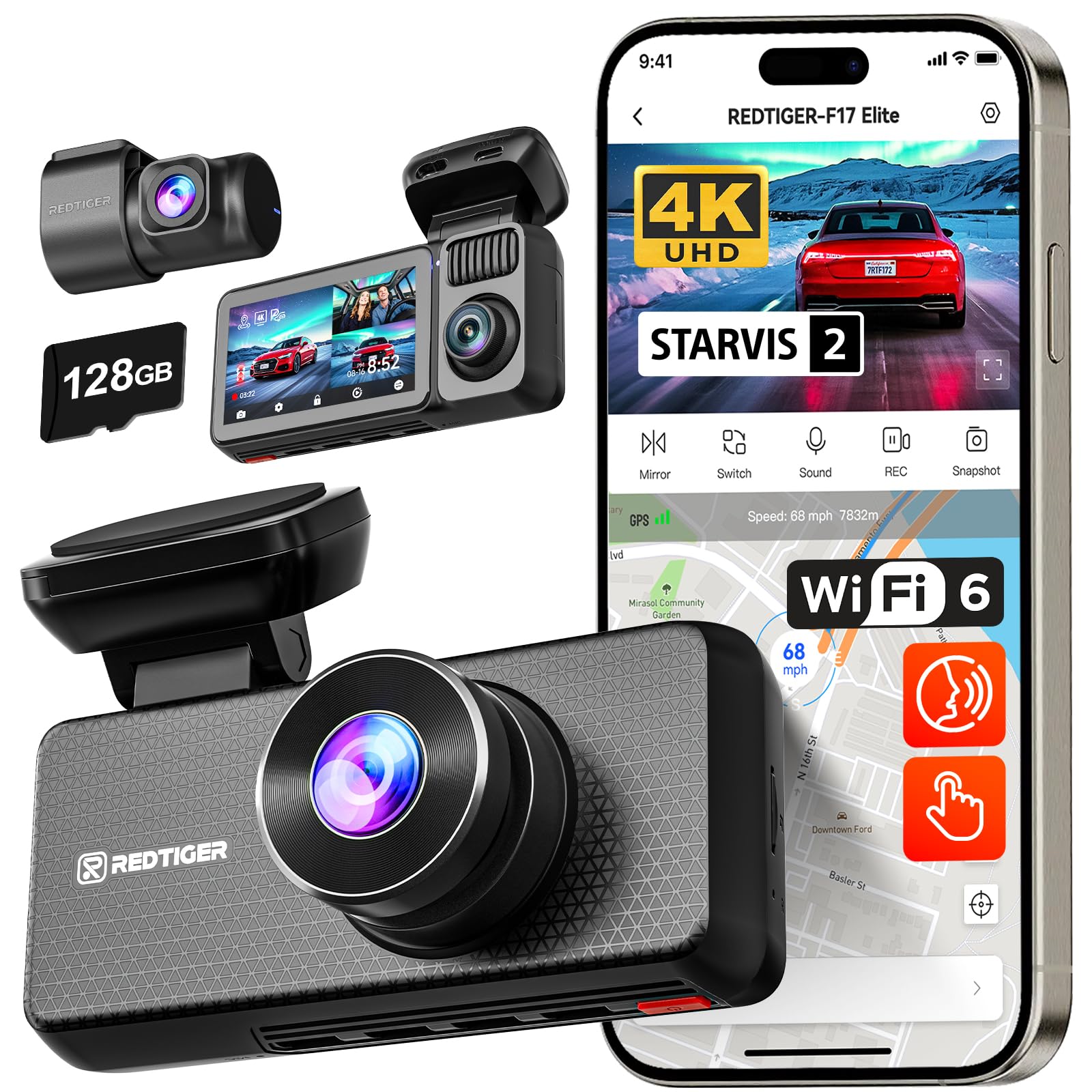
Night footage in real color instead of grainy infrared, front and cabin both.
Most interior cameras flip to black-and-white infrared in the dark. This one keeps full color on the front and cabin lenses, using an 8MP IMX678 up front and a 4MP IMX675 at the rear. It records true 4K front, 2.5K rear and 1080P cabin. If identifying a face or a paint shade at night matters to you, color is the difference between a description and a guess.
The kit is ready to run — a 128GB card is pre-installed, and it expands to 512GB. A supercapacitor handles heat, GPS stamps location and speed, and 5.8GHz Wi-Fi 6 downloads at up to 30 MB/s. A privacy toggle lets you cut the cabin camera when you do not want it recording, which is a thoughtful touch for passengers who object.
The caveat here is heat tolerance. Some owners in very hot climates have seen the unit stop working when the sun bakes the windshield, though others report it holding up in Texas heat. Anecdotal on both sides, and worth thinking about if you park outdoors in a hot state. The mount has also been known to loosen over time — check it now and then.
The color argument: real color on both front and cabin lenses at night gives you identifying detail that infrared cannot, from a sensor pair that most cameras reserve for the front alone.
Watch the mount: a camera that sags off aim is a camera that films your hood, so give it a firm press every few weeks.
Worth it for: drivers who want color cabin footage at night and a card already fitted.
Think hard if: your car sits in direct summer sun all day with no shade.
9. WOLFBOX G900 Tripro Bumper 3 Channel 4K Mirror Dash Cam
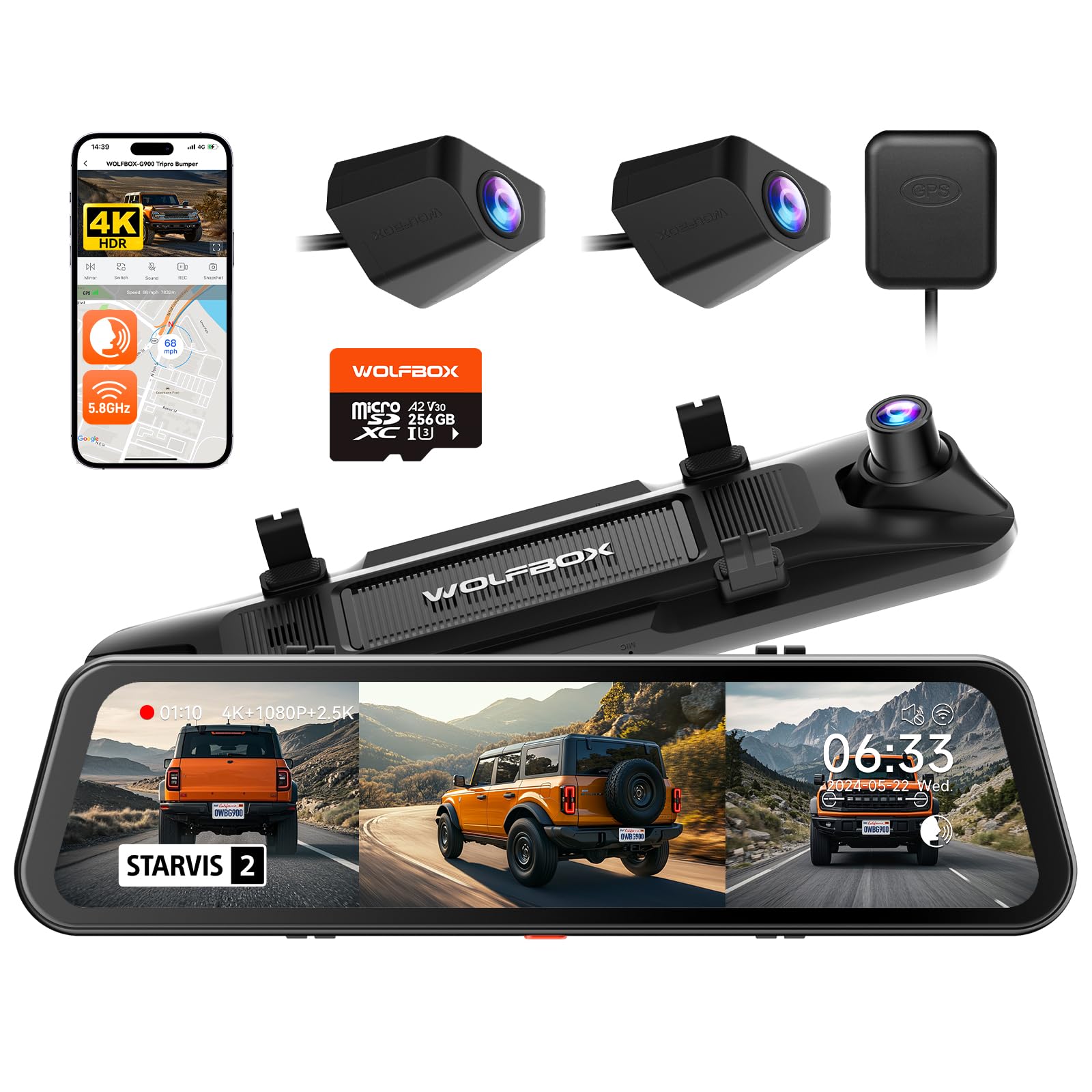
A waterproof lens on your bumper that shows you exactly what your front wheels are about to hit.
No other camera here films from the bumper. This one adds a 1080P waterproof camera mounted at the front of the vehicle, alongside a 4K front camera and a 2.5K rear. For an off-road driver that low angle is the whole point — you see the obstacle in front of the wheels rather than guessing over the hood. The front records 3840×2160 at 30 FPS from a STARVIS 2 IMX678, and the 170-degree field of view is as wide as anything on this list.
It is a mirror unit, so the 4K feed lands on a screen where your rearview mirror sits. A 256GB card is pre-installed, GPS works through an external antenna, and 5.8GHz Wi-Fi handles transfers to the WOLFBOX app. Voice control covers the basic commands so your hands stay on the wheel.
Two things to accept up front. A mirror screen changes your focal distance, and the maker says give yourself a few weeks to adjust. Some owners also find the system glitches at random, and connectivity has been the weakest point in owner feedback. Parking monitoring needs a hardwire kit on top. For trail work, none of that outweighs a waterproof camera pointed at the rocks.
The trail case: a bumper eye plus a 170-degree front lens is a genuine off-road tool, not a gimmick, and the 256GB card is already installed.
Give it time: the mirror screen rewires your sense of distance, and the maker is upfront about the adjustment window.
For you if: you take a truck or overlander off pavement and want to see the ground ahead of your bumper.
Pass if: you want a set-and-forget street camera and dislike re-learning a mirror view.
10. VIOFO A329S 4K+2K+2K Dash Cam Front Cabin and Rear

Its cabin lens sweeps 210 degrees — nobody in the back seat escapes the frame.
Three STARVIS 2 sensors run here: an IMX678 up front at 4K 30 FPS, and IMX675 chips behind and inside. The cabin lens is the headline — a 210-degree fisheye that takes in the whole interior, which is the widest cabin coverage on this list and a real advantage for rideshare work. Rear detail runs at 2K. Every channel records in HDR, so plates stay readable in fast motion from all three angles.
Storage is where this one pulls away. It takes a microSD up to 512GB, or an external SSD up to 4TB through a Type-C cable — the maker says that is over three weeks of continuous recording. Wi-Fi 6 hits up to 30 MB/s, which the spec sheet frames as a 1-minute 4K clip in under 10 seconds. The slim 2.8mm coaxial cables resist radio interference, keeping the install clean near other electronics.
Be clear-eyed on two fronts. Neither a card nor an SSD is in the box, so budget for storage. And the app is the recurring weak point — pairing complaints are common, and a few units have stopped working within weeks. The maker’s hardware is well-regarded; the software is where patience pays.
The storage story: 4TB of SSD support (a solid-state drive holds far more video than a memory card) is class-leading here, which makes this the long-haul pick for week-long road trips.
The app caveat: connectivity complaints are the honest downside, and a dead unit is a real risk however rare, so verify recording after installing.
Right for: high-mileage drivers and road-trippers who want fisheye cabin coverage and near-endless storage.
Wrong for: anyone put off by sourcing a card or SSD, or expecting a polished app on day one.
11. THINKWARE U3000 PRO Dash Cam 4K Front and 2K Rear
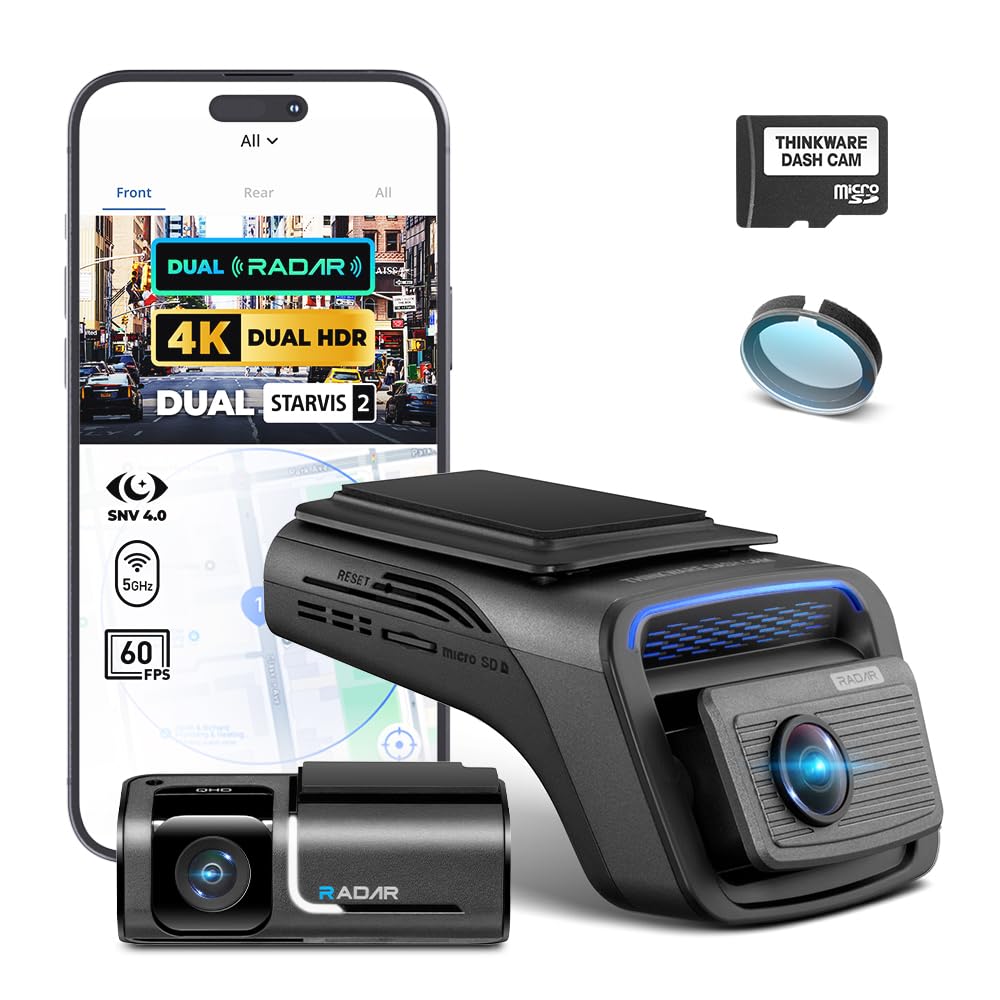
Radar wakes it when someone approaches, then films 20 seconds around the event.
The U3000 PRO is the parking-first camera here. Radar motion detection wakes the unit and records a 20-second clip, and each event file keeps 10 seconds before and after the trigger so you get context, not just the moment of impact. It runs a 4K front camera and 2K rear on STARVIS 2 sensors with an Ambarella processor, and WDR balances harsh lighting. The front field of view is 147.2 degrees.
On-road safety is where this one stands out. It warns of forward collisions and lane departures, and GPS tags speed and location while flagging speed cameras. Dual-band Wi-Fi covers 2.4GHz and 5GHz, and a 64GB card is included for immediate recording, with support up to 512GB. The built-in motion and impact sensors mean you are not relying on the app to keep your evidence safe.
The reality check is the software and heat. Connectivity has been the roughest part — pairing to the app has frustrated a fair number of owners, and some report the unit running hot. Another driver found parking mode would not work at all, so test that feature the day you install it. Hardware-wise it is a well-built camera; the app is where the friction lives.
The radar edge: motion-triggered 20-second clips with before-and-after context is smarter than plain motion detection for overnight parking.
Test early: set up parking mode and the app on day one — that is where issues surface, while support can still help.
Pick this if: parking lot protection is your main threat and you want radar-triggered evidence with context.
Give it a miss if: you want a frictionless phone app or you expect a small, cool-running body.
Know the Specs
Field of view and why degrees matter
Field of view is the arc of road a lens can capture, quoted in degrees. A wider angle sees more lanes and catches the car pulling out at the edge of your bumper, but past a point the corners bow and a distant plate shrinks. The cameras here run from 130 degrees for a tight, distortion-free frame up to 170 degrees for lane-to-lane coverage. Three-channel systems quote a combined figure — the 70mai covers 402 degrees total across its three lenses.
Sensor type and night plate reading
A sensor is the chip that turns light into an image. STARVIS 2 is a Sony line built for low light, and its larger light-sensitive area holds detail where cheaper chips smudge. Pair it with a wide aperture — F1.5, F1.55 or F1.7 here lets in more light — and plates stay readable at night. HDR then balances the bright headlights against a dark road so neither end blows out.
Supercapacitor versus battery
A supercapacitor stores power without the lithium cell that swells and dies in a hot windshield. Every serious pick here uses one, and the quoted ranges run from 14°F to 140°F and -20°C to 70°C. In practice that means a camera that survives a summer dash and a winter night without failing, at the cost of no built-in battery for recording after a crash.
Storage, loop recording and the card you add
Loop recording overwrites the oldest clip so the camera never stops. The card size sets how many days you keep — the ceilings here are 256GB, 512GB, 1TB and, for the A329S, an external SSD up to 4TB. Several cameras ship with a card and several do not, so check the box contents. Most makers also recommend a high-endurance card built for constant writing.
Common Questions
Will a dash cam interfere with CarPlay or my car’s Wi-Fi?
How much recording time do I get from a 512GB card?
Do I need a hardwire kit for parking mode?
Is a 3-channel camera worth it over front and rear only?
Will a mirror-style dash cam fit my existing rearview mirror?
Why do dash cams use a supercapacitor instead of a battery?
Can I use a regular microSD card for 4K recording?
Is the camera’s Wi-Fi fast enough to download footage at the roadside?
Do these cameras record audio from inside the car?
What happens when the cabin gets very hot in summer?
Can a dash cam capture a license plate at night?
The Bottom Line
For most drivers, the best police dash camera winner is the 70mai T800E because it covers front, cabin and rear in one install and keeps going through heat. It ships with a 64GB card, so the recording starts the day it arrives. If you want a cleaner night plate without cabin coverage, grab the BOTSLAB G300H Plus — a STARVIS 2 sensor and F1.5 lens for the money. And for parking-lot proof, the THINKWARE U3000 PRO radar mode is the one to reach for.
Whichever you fit, do one thing on day one: check that the recording light is on and glance at your footage. A camera that stopped recording without warning is the only failure that matters. Do that check and any of these will hand you the clip you need when it counts.
How we choose
We do not accept paid placement. Every pick is matched to a real buyer and a real use-case; we do not hands-on test units.
Sources
Specifications: manufacturer listings and product documentation. Review insights: verified customer reviews, as of November 2026. Pricing: not shown on this page (it changes often); check the current price via the retailer link.
As an Amazon Associate, Tactical Gear Guy earns from qualifying purchases. This does not affect which products we feature.