Specs are compiled from manufacturer listings and verified buyer reviews and can change over time — please confirm the key details on the product page before buying.
If you are pulling nails from pallet wood, barn lumber, or old decking with a hammer and pry bar, you already know the routine: bent nails, split boards, and aching arms by lunchtime. A pneumatic nail remover changes that job completely — you press the nose against the board, squeeze the trigger, and a burst of air drives the nail out the other side. This guide covers the models worth your money, sorted by what they actually do well.
This guide is built by comparing the manufacturers’ published specifications and the patterns across verified customer reviews, so you get each pick’s real strengths and trade-offs instead of marketing spin.
You will see how air pressure, nail gauge range, and nose design decide whether a tool handles your wood or fights it. The right pick for most people is the AP700, and it earns its place in this pneumatic nail remover roundup on price-to-performance as much as raw power.
Top Picks


How To Choose The Best Pneumatic Nail Remover
Your compressor’s air output, the nail sizes you actually need to punch, and how tight your work space is decide which nail remover works for you. Get one wrong and you will be fighting the tool instead of the nails.
Match PSI to your compressor first
Every remover on this list runs on compressed air, and each one publishes an operating range in PSI (pounds per square inch — the air pressure your compressor pushes through the hose). The AP700 family runs at 80-120 PSI, while several others run at 60-100 PSI. Check your compressor’s working output before you buy, because a tool that wants 80 PSI minimum will feel weak on a small pancake compressor that tops out lower under load.
Know your nail gauge before you shop
Gauge here means the wire thickness of the nail — and a lower gauge number is a thicker nail. A tool rated for 9-16 gauge covers a wider spread than one rated for 10-20 gauge, which matters if your scrap pile mixes framing nails with thin brads. If you regularly pull 16d framing nails out of 2x4s, look for a range that includes the thick end of the scale.
The nose shape decides where you can work
A slim elongated nose lets you slide the tool into tight spots — between deck boards, inside pallet gaps, into sheathing — where a hammer simply cannot swing. The nose also guides bent nails straight before the punch, so you are not fighting a curved nail that refuses to budge.
Side-by-Side Comparison
| Model | Best For | Operating Pressure | Nail Gauge Range | Tool Weight | Amazon |
|---|---|---|---|---|---|
| AP700★ Best Overall | All-around pallet and deck work | 80-120 PSI | 10-20 gauge | 2.29 lb | Amazon |
| WORKPRO Pneumatic Nail RemoverBest Value | Budget-minded hobbyist salvage | 60-100 PSI | 9-16 gauge | 2.42 lb | Amazon |
| UPWOOD Professional Air Punch NailerBest for Hardwoods | Mixed hardwood and softwood boards | 80-120 PSI | Up to 0.197″ nail diameter | 2.42 lb | Amazon |
| KT50 Pneumatic Nails Puller | Safety-lock users in tight spaces | — | 0.118″-0.236″ head diameter | 3.74 lb | Amazon |
| AIR Locker AP700 with Coupler | Plug-and-play setup from the start | — | — | 1.18 kg | Amazon |
| AP700-KIT3 | Spare piston driver included | 80-120 PSI | 10-20 gauge | 2.31 lb | Amazon |
| AeroPro 700V | Long 1-4 inch nails in cramped spots | 60-100 PSI | 9-16 gauge | 1.7 lb | Amazon |
| AP700-44US-KIT | Steel piston driver durability | 80-120 PSI | 9-16 gauge | 2.31 lb | Amazon |
| AP900 | Heavy daily denailing volume | 50-110 PSI | 9-16 gauge | 3.08 lb | Amazon |
Detailed Reviews
1. AP700 Air Punch Nailer
Our pick — 4.5+★ from 3,000+ verified ratings; the strongest balance of quality and price.
The 2.29-pound workhorse that turns a whole house of sheathing into a one-afternoon job.
The AP700 is the tool that most pallet salvagers end up with, and the reason is simple: it covers the widest nail range on this list at 10-20 gauge. That means the same tool punches out a fat 10-gauge framing nail and a thin 20-gauge brad without you swapping noses or reaching for a second gun. For anyone tearing apart pallets, fence panels, or old decking, that spread is the whole ballgame.
The air spec matters just as much. Running at 80-120 PSI through a 1/4 inch NPT thread air inlet, the AP700 will pull nails out of plywood sheathing — the kind of boards that usually split the moment a pry bar touches them. Buyers report punching 2,000 nails with no piston driver failure. The 0.16-inch driver diameter is the push rod that actually contacts the nail, and it is small enough to seat on nail heads without chewing up the surrounding wood.
Where the AP700 asks something of you is the air fitting — it does not ship with one, so plan on a trip to the hardware store or a quick add-on order before your first job. And like every tool in this category, nails come out fast and fly, so a bucket or soft landing zone underneath your workpiece is not optional. Set against the AP700-KIT3, this base model weighs 2.29 pounds against the KIT3’s 2.31, so you are not saving meaningful weight by skipping the kit — you are simply skipping the spare piston driver.
What earns the top spot
- 10-20 gauge range handles framing nails and thin brads with one tool
- 80-120 PSI working range clears nails from plywood sheathing without splitting boards
- 2.29 pounds — light enough to run all day without arm fatigue
- Proven under high volume, including full-sheathing teardowns
Where it asks a little extra
- No air fitting in the box, so you need one before first use
- Punched nails ricochet — you must control the landing zone yourself
- The 10-20 gauge top end stops short of the thickest 9-gauge nails
Worth buying if: you tear down pallets, decks, or sheathing at volume and want one gun that covers nearly every nail you meet.
Think twice if: you regularly pull 9-gauge nails or want the spare driver and coupler bundled in.
2. WORKPRO Pneumatic Nail Remover
The entry-priced denailer that punches 1-4 inch nails out of pallets and still feels solid in the hand.
If you are starting a pallet-salvage habit and do not want to over-commit, the WORKPRO is the smart first purchase. Its 2-3/4 inch inner diameter, 6mm nail nose handles nails from 1 to 4 inches long at 9-16 gauge — a range that covers most pallet and box lumber. The hardened nose delivers a powerful blow, and the slim profile slides into cramped pallet gaps where a hammer is useless.
The 360° adjustable exhaust on the cap lets you point the air blast away from your face, and the 1/4 NPT air inlet comes with a cover to keep dust out. Running at 60-100 PSI keeps it compatible with smaller compressors. Against the AP700-KIT3, which wants 80-120 PSI, this tool’s lower floor means it will run on a modest compressor that struggles to hold the higher range.
The honest catch is sturdiness at the heavy end. Buyers describe it as a great tool for the hobbyist and are unsure how it would hold up under daily professional use — which is an assessment you should weigh if you denail for a living. It is also loud; that is the nature of compressed air. As for the results, owners mention that it removed over 50 nails on a single job and consider it well worth the money. Set it over a trash can with soft material at the bottom and the ricochets stay contained.
The real draw: a low-pressure floor (60 PSI) that plays nice with small compressors, plus a 1-4 inch nail window that covers typical pallet lumber.
The honest trade-off: it is built for hobbyists, and heavy daily professional use is outside what customers note it handles comfortably.
Reach for this if: you salvage on weekends and want a capable first denailer that will not strain your compressor.
Look elsewhere if: you need a tool that survives professional-volume teardowns every day.
3. Professional Air Punch Nailer
Built for reclaimed oak, hickory, and osage orange — the woods that break weaker tools.
Most denailers list the softwoods and move on. This UPWOOD lists the hard stuff by name: oak, locust, hickory, osage orange, white oak, and maple. If your salvage comes from old barn beams or fence posts, that hardwood pedigree is the spec that matters. The tool runs at 80-120 PSI and has a nose that handles nails up to 0.197 inches in diameter, pulling each one less than 2 inches per stroke.
Owners describe a punch that sends the nail straight out the other side of the lumber, leaving the wood reusable. That is the whole point of denailing for recycling — you want the board back in one piece. The rubber grip shows up as a favorite detail, and the tool is described as not heavy but well made. For comparison, this tool beats the WORKPRO on nail diameter coverage, though it falls behind the AP700’s 10-20 gauge spread on the thin end.
The one note that follows this tool: it is more efficient when paired with the nail remover tool UW-BD70 for stubborn pulls, so plan on that add-on if you keep running into nails that need a second pass. Reviewers point out denailing a single stud in 2 to 3 minutes. That pace is why reclaimers keep it in the truck.
Why reclaimers reach for it
- Named for oak, hickory, locust, osage orange, and maple — genuinely hard woods
- 0.197-inch max nail diameter and up to 2 inches of pull per stroke
- Punches the nail clear of the board, so the lumber stays reusable
- Rubber grip keeps fatigue down over long denailing sessions
What to keep in mind
- Stubborn pulls go easier with the UW-BD70 companion tool, sold separately
- Wants 80 PSI minimum, which rules out very small compressors
Suits you if: your scrap is hardwood and you need the board usable afterward, not just nail-free.
Keep looking if: you mostly pull thin brads from softwood pallets and want the wider thin-nail coverage.
4. KT50 Pneumatic Nails Puller
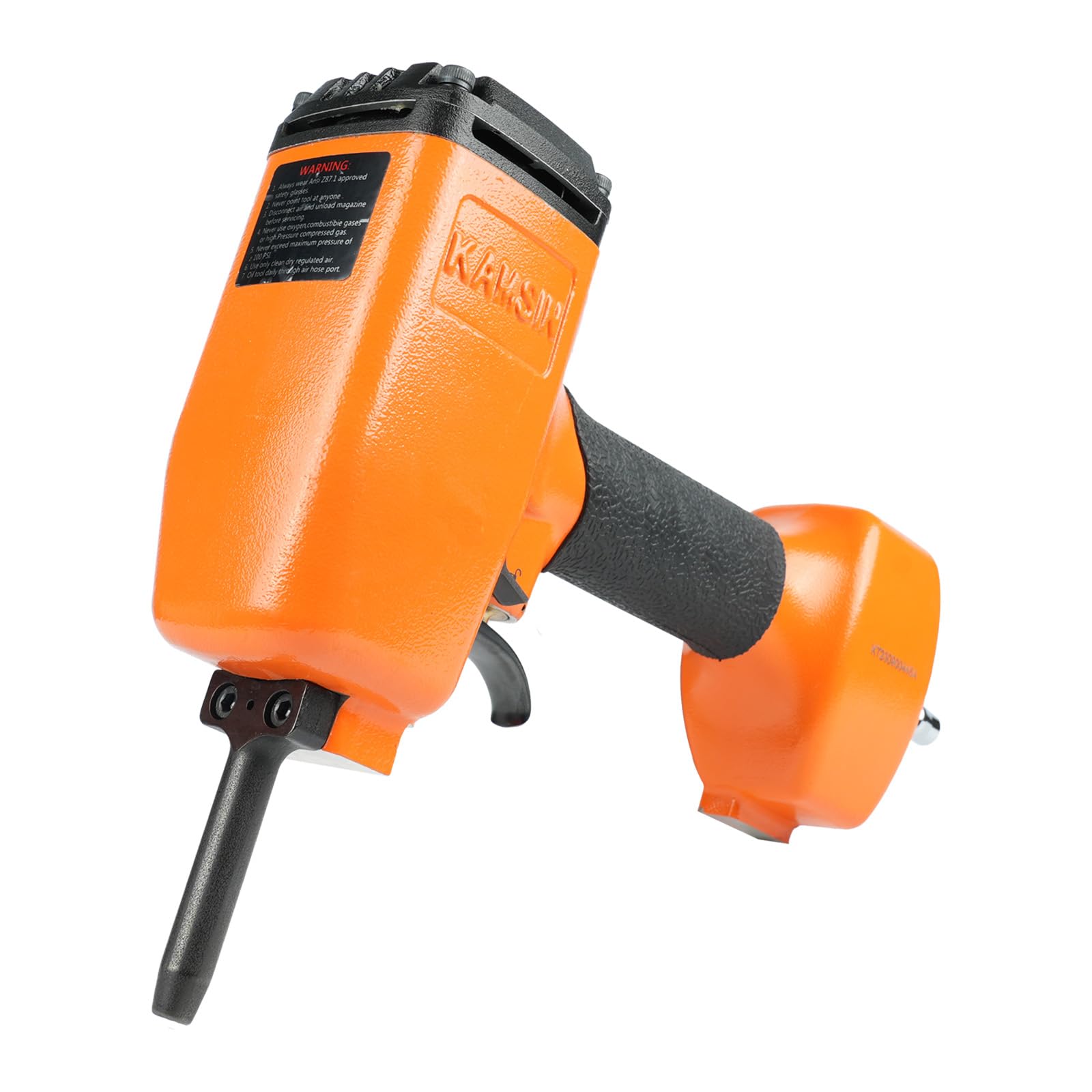
The one with a lock switch that keeps the firing pin from catching your fingers between jobs.
That larger cylinder is what the maker points to for the power behind each strike, and the claim is that the nail comes out every time. Removable nails run from 0.118 to 0.236 inches in head diameter, so you get a defined window rather than a gauge number.
The safety lock is the feature that separates it from the rest. Turn the switch up to lock the firing pin and down to release it, and you cut the chance of an accidental discharge catching a finger. The slim elongated nose also gets you into tight spaces while preserving the wood around the nail. If you have ever worried about a hair-trigger air tool in a crowded shop, that lock is a real comfort.
One thing to weigh: this tool has a smaller body of owner feedback than the AP700 family, so long-term durability is less proven. The maker also warns directly about nail splashing, which means protective measures are part of ownership, not an optional extra. Buy it if the safety lock solves a real worry for you; skip it if saving weight matters more.
Best for: anyone who wants a deliberate lock-out switch on a powerful air punch, even at the cost of extra heft.
Skip if: a 3.74-pound tool over a long session will wear you down, or you want the track record of thousands of owner logs behind your purchase.
5. AIR Locker AP700 Punch Nailer
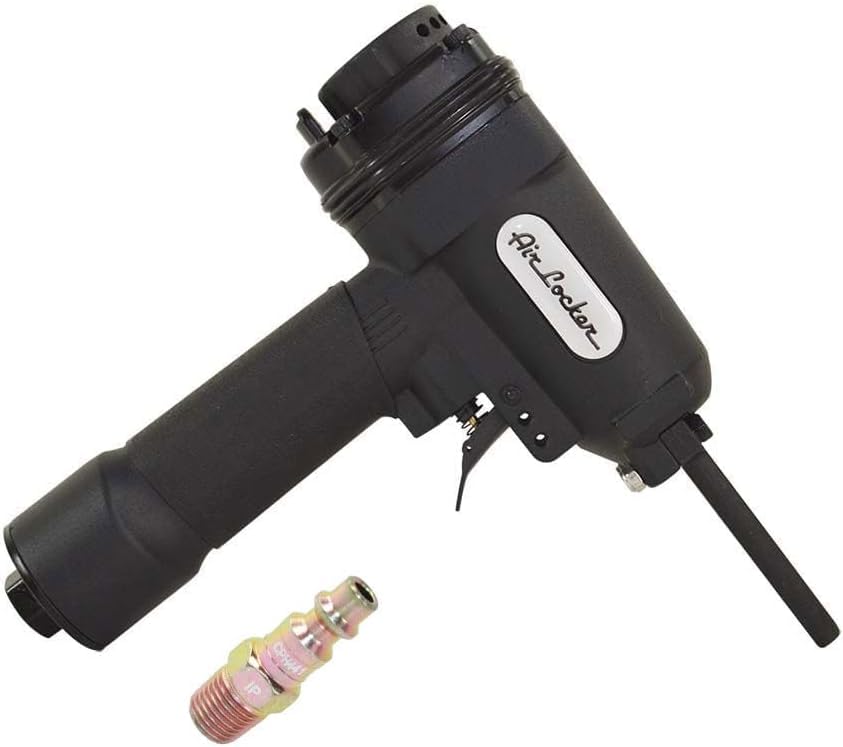
Same proven AP700 punch, but with the air coupler in the box so you can work the day it lands.
The AP700 formula again, this time bundled with a free steel coupler plug at 1/4 inch by 1/4 inch male NPT. That sounds like a small thing until you remember the base AP700 ships without an air fitting — here, the missing piece is already in the box. The body is aluminum, the working weight is listed at 1.18 kg, and owners consistently describe it as light in the hand and easy to use.
What it does well is fast teardown. Pallet work and framing nail resets are the two jobs it gets talked about for most, and owners describe the time saved as the reason they keep it. Owners repeatedly say the time saved on pallet teardowns pays back the tool’s mid-range price. Against the base AP700, this version saves you the coupler purchase, though it has a smaller body of owner data behind it.
Durability is the honest caveat. Some shoppers say the tool failing quickly under hard use, a shorter professional lifespan than the price suggests. For weekend salvage work, that trade is easy to accept. For day-in, day-out site work, budget for a replacement sooner than you might want.
What buyers prize: the plug-and-play setup and the pace — the coupler is included, and it tears pallets down fast.
Weigh this: durability under heavy professional use is the weak spot, with some units failing inside the first couple of jobs.
Great match for: hobbyists and side-work salvagers who want a working tool on day one without a hardware-store run.
Not the pick for: full-time professionals who need maximum service life from every tool purchase.
6. AP700-KIT3 Air Punch Nailer

The AP700 with a spare piston driver, so a worn rod does not sideline your whole teardown.
The piston driver is the steel rod that actually hammers the nail out, and it is the part that wears first. This kit ships with a spare, which is exactly the kind of thing you appreciate halfway through a pallet run when the rod starts mushrooming. The driver diameter is 0.157 inches, and the tool punches nails between 10-20 gauge at 80-120 PSI through a 1/4 inch NPT air inlet. At 2.31 pounds it stays light enough to hold steady on a vertical board.
Against the WORKPRO, the KIT3’s 10-20 gauge range reaches further down to thin brads, while the WORKPRO’s 9-16 range reaches thicker at the top. If your nails sit at the thin end — brads, small finish nails — the KIT3’s range suits you better. Owners call it light but strong, and one reports a year of service with no complaints. Small brads sometimes bend instead of punching clean, which is the one place the tool shows its limits.
Jams clear easily per owner feedback, so a frustrating stuck nail does not mean a long break in the work. Plan on an air adapter if your compressor uses a different fitting, since the tool does not come ready to connect to every hose. If you want the widest gauge spread at the top end, the AP900 or AeroPro is the better fit; for everything from pallets to sheathing to light finish work, the KIT3 covers it.
What makes this kit worth it
- Spare piston driver in the box — the wear part is covered from day one
- 10-20 gauge handles thin brads and framing nails in one tool
- Light enough at 2.31 pounds to hold on vertical boards
- Jams clear easily, so a stuck nail costs minutes, not hours
Small print to know
- Small brads sometimes bend instead of punching clean
- Air adapter may be needed if your hose fitting differs
Buy it if: you want the trusted AP700 action plus insurance against the piston driver wearing out.
Hold off if: your work is dominated by thick 9-gauge nails the 10-20 range misses.
7. AeroPro 700V Pneumatic Punch Nailer

At 1.7 pounds, the lightest tool here — and it still covers 1-4 inch nails at 9-16 gauge.
If arm fatigue is your problem, this is the answer. The AeroPro’s die-cast aluminum body keeps it at 1.7 pounds, less than half the KT50’s 3.74 pounds. The 2-3/4 inch, 6mm nail nose handles nails from 1 to 4 inches long at 9-16 gauge, and the slim profile gets into cramped demolition spaces where a bulky tool cannot reach.
The 360° adjustable exhaust lets you aim the blast away from your face, and the 1/4 NPT inlet has a cover to keep dust out — a small detail that adds up over years of use. It runs at 60-100 PSI, so a modest compressor drives it fine. Bent nails straighten against the nose guide before the punch, and a hardened nose delivers enough force for the stubborn ones.
Here is where you need to go in with open eyes: durability sits at the mixed end of the feedback. Several buyers report the plunger wearing out fast and the housing cracking during driver changes. The tool feels inexpensive and is priced accordingly — the trade is real. Owners mention it removes nails from pallet boards with ease, and if you only occasionally denail, the light weight and low price are the right priorities. If you denail for a living, the extra cash for the AP900 buys you a heavier build.
Right for you if: light weight and easy reach into tight spaces top your list, and your denailing is occasional.
Wrong for you if: you need the tool to survive daily abuse — the plunger and housing are the weak points.
8. AP700-44US-KIT Air Punch Nailer

The AP700 fitted with an S7 steel driver — a tougher rod aimed squarely at the wear problem.
The AP700 body is familiar by now, but this kit steps up the piston driver to US S7 steel. That is a tool-steel grade chosen for shock resistance, and the point is clear: the rod that wears first gets upgraded so the tool lasts longer under load. It runs the same 80-120 PSI through a 1/4 inch NPT air inlet and covers 9-16 gauge — a wider top end than the base AP700’s 10-20 gauge, which suits framing nails.
It also lists the full hardwood roster: pine, poplar, chestnut, sycamore, oak, locust, hickory, osage orange, white oak, and maple. Floorboards, weatherboards, fiber sheets, skids, pallets, barn lumber, sheathing, and decks are all in its wheelhouse. That is a tool that does not care which old board you put in front of it. Owners describe it blasting nails out at light speed once you get the rhythm.
Two honest notes. An internal leak creating a constant small hiss is a known quirk on this model — not a dealbreaker, but something to expect. And if you swap drivers often, the fit can loosen over time. If neither bothers you, this is a strong choice for anyone who wants the broader 9-16 range plus the tougher rod.
The standout: S7 steel driver paired with a 9-16 gauge range and a full hardwood list that reads like a lumberyard inventory.
The caveat: a small internal hiss is a known quirk, and the driver fit can loosen if you change rods frequently.
Choose this if: you want a tougher wear part and the wider 9-16 gauge range for framing nails.
Pass if: a constant hiss or driver-swap looseness would drive you up the wall.
9. AP900 Air Punch Nailer

A 40% larger driver than the AP700, built to push stubborn nails out of hard woods all day.
The AP900 earns its spot with a driver listed as 40% larger than the AP700’s. A bigger driver contacts more of the nail head and delivers more force per strike, so it is described as pushing nails out of hard woods and handling stubborn ring nails that stop weaker guns. It runs 50-110 PSI (pounds per square inch, the air pressure your compressor supplies) through a 1/4 inch NPT inlet (a standard threaded air fitting) and removes nails from 9-16 gauge (wire thickness).
At 3.08 pounds it is heavier than the AP700’s 2.29 pounds, so this is a tool you steady with both hands rather than one. It comes packaged in a blow-molded case, which keeps the tool protected between jobs. The slim elongated nose still fits tight spaces, and the rubber grip keeps operation comfortable over long sessions. Customers note pulling over 300 nails and saving hours of labor, volume that justifies the 3.08-pound build.
The known quirk: the air fitting size can be an odd one, and owners have had to dig through their spare parts to find a match. Budget for an adapter. The maker also recommends a bucket of water or soft material under the workpiece to prevent ricochets. If you salvage pallets and construction lumber at serious volume, the AP900’s larger driver and heavier build are worth the extra money.
Why volume reclaimers pick it
- 40% larger driver than the AP700 for more punch per strike
- Handles stubborn ring nails and hard woods that stop lighter tools
- 50-110 PSI range gives low-pressure flexibility
- Ships in a blow-molded case for protected storage
Weigh these before buying
- 3.08 pounds — heavier than the AP700 by a noticeable margin
- Air fitting size can be odd; have an adapter on hand
Go for it if: you process pallets and construction lumber at serious volume and want the biggest punch in the Air Locker lineup.
Reconsider if: the extra weight will wear you down, or you want a tool that fits your existing hose without an adapter hunt.
Know the Specs
Operating Pressure (PSI)
PSI means pounds per square inch, the air pressure your compressor pushes through the hose. Every tool here lists a range, and the low number is the one to watch: a tool rated 80-120 PSI will feel weak on a small compressor that cannot hold 80 PSI under load, while one rated 60-100 PSI will run fine on that same compressor. Match the tool’s floor to your compressor’s real output and you avoid a gun that refuses to punch.
Nail Gauge Range
Gauge is the wire thickness of the nail, and a lower number means a thicker nail. A tool rated 9-16 gauge covers framing nails down to thinner finish nails; one rated 10-20 gauge reaches further into the thin end but stops short of the thickest nails. If your scrap pile mixes 16d framing nails with thin brads, choose the range that covers both ends.
Driver Diameter
The driver is the steel rod that actually contacts the nail head and hammers it through the board. A larger driver transfers more force per strike, which matters on stubborn nails and hard woods. It is also the part that wears first, which is why some kits ship with a spare piston driver or upgrade it to a steel grade chosen for shock resistance.
Nose Design
The nose is the front end that guides the nail and positions the tool. A slim elongated nose gets into tight spots — pallet gaps, between deck boards, inside sheathing — where a hammer cannot swing. A hardened nose delivers the blow without deforming, and a nose guide straightens bent nails before the punch so they do not bind.
Common Questions
Will a pneumatic nail remover work with my small home compressor?
What nail gauge do I need for pallet and framing nails?
Can a pneumatic nail remover pull bent nails?
Do I need an air fitting separately?
How do I stop punched nails from ricocheting?
Is a larger driver worth the extra money?
Can these tools remove nails from hardwoods like oak and hickory?
What is the difference between the AP700 and AP900?
What safety gear do I need when using a nail remover?
Will a pneumatic nail remover damage the wood I am salvaging?
The Bottom Line
For most people, the pneumatic nail remover winner is the AP700 — the 10-20 gauge spread covers nearly every nail most buyers meet, and its 2.29-pound body stays comfortable across a full teardown. If your scrap is hardwood and you want the board reusable, the UPWOOD Professional Air Punch Nailer lists oak and hickory by name. And for heavy daily volume on thick nails, the AP900 brings the 40% larger driver and heavier build that professional reclaimers depend on. Pick the pressure range your compressor can feed, the nail gauge that matches your stock, and the tool that fits how often you denail — the rest is technique.
How we choose
We do not accept paid placement. Every pick is matched to a real buyer and a real use-case; we do not hands-on test units.
Sources
Specifications: manufacturer listings and product documentation. Review insights: verified customer reviews, as of November 2026. Pricing: not shown on this page (it changes often); check the current price via the retailer link.
As an Amazon Associate, Tactical Gear Guy earns from qualifying purchases. This does not affect which products we feature.