Specs are compiled from manufacturer listings and verified buyer reviews and can change over time — please confirm the key details on the product page before buying.
Buying a plyometric wooden box is really a question of one thing: does it stay put when you land on it. The right box gives you three jump heights from one frame, assembles in minutes with pre-drilled holes, and stays planted on landing. The wrong one rocks on its joints, strips its own screws during assembly, or turns slick the moment your hands get sweaty.
This guide is built by comparing the manufacturers’ published specifications and the patterns across verified customer reviews, so you get each pick’s real strengths and trade-offs instead of marketing spin.
Below are nine wooden boxes, ranked by how they hold up on jump day, so you can match one to your ceiling height, training style, and floor. Every box here is plywood rather than foam or steel, and each one flips to give you three different heights.
Top Picks


How To Choose The Best Plyometric Wooden Box
Plyometric training forces your muscles to fire at maximum effort in short bursts, which is why a jump box lives or dies on stability. A box that shifts a quarter inch on landing turns a box jump into a hesitation drill. Pick one where the plywood thickness, the joint fit, and the landing surface all work together.
Height range versus your actual ceiling
Most people fixate on the tallest face, but the smallest face matters just as much for your ceiling. A box that flips to 30 inches needs real headroom above it, plus room to step back down safely. If your garage gym has a low ceiling or you train in a spare room, aim for a box whose lowest face sits around 12 to 16 inches. That way you can add height without cracking your knuckles on a beam.
Plywood thickness and internal bracing
Thicker plywood flexes less under a hard landing. Boxes built from 3/4 inch plywood with internal bracing behind the largest faces distribute that impact across the whole frame instead of one panel. If a listing does not mention bracing, assume the smaller faces carry the load and keep your heaviest jumps on the lower heights. Weight rating is the other half of this: a 300 lb limit covers a big adult plus a loaded squat bar, while a 450 lb limit gives you more margin.
The surface and the edges
Non-slip coatings range from a textured PVC layer to a honeycomb pattern to a simple roughened finish. Any of them helps when your shoes are dry, and all of them wear with handling over time. Rounded, sanded edges and recessed screw heads are the quieter safety features — they stop you snagging a shin or a hand on a corner during a missed jump.
Side-by-Side Comparison
| Model | Best For | Height Options | Weight Rating | Item Weight | Amazon |
|---|---|---|---|---|---|
| Yes4All 3-in-1 Wooden Plyo Box★ Best Overall | All-around home gym pick | 16 / 14 / 12 in | 450 lbs | 50 pounds | Amazon |
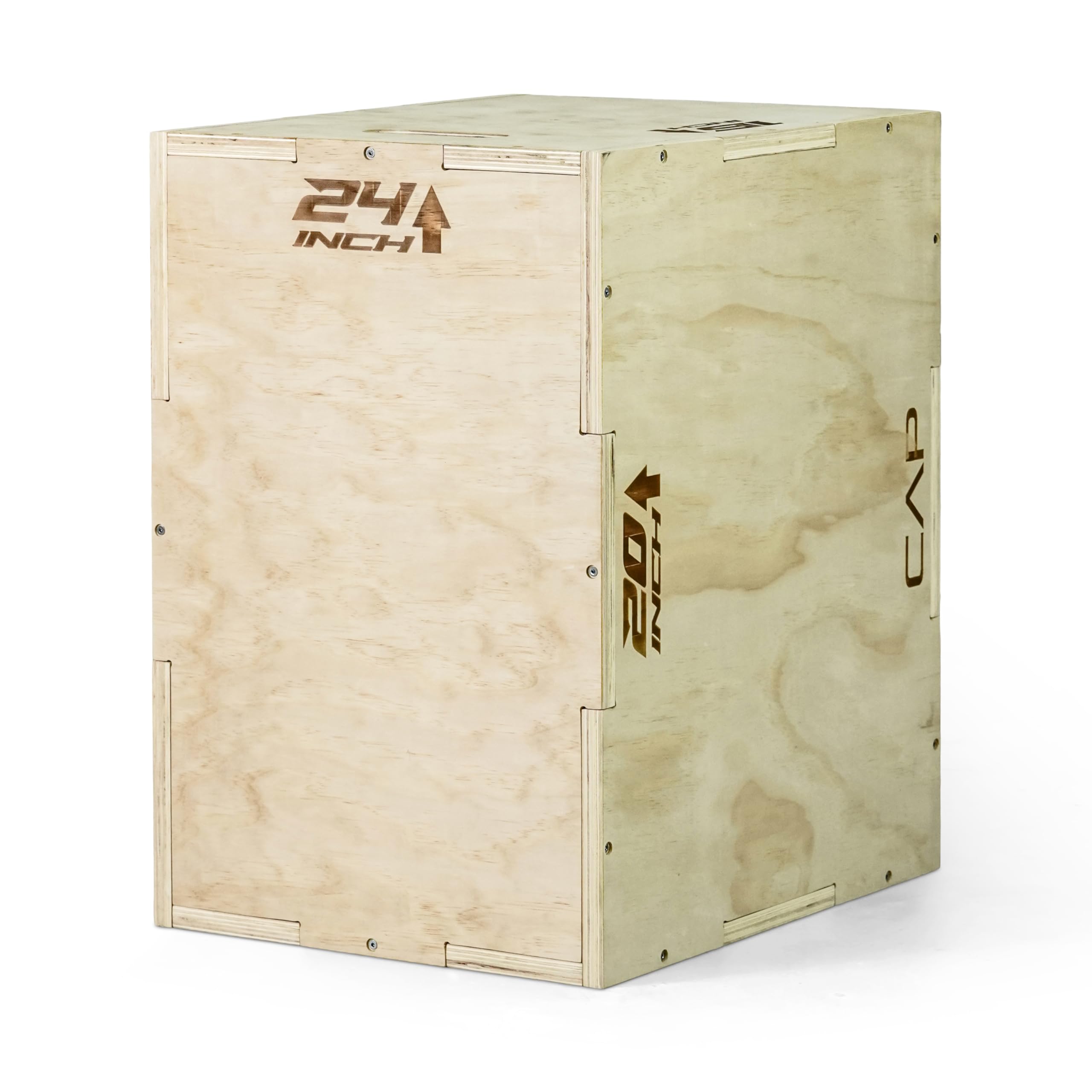
| CAP Barbell 3-in-1 Plyometric BoxBudget Champion | Budget-friendly starter box | 24 / 20 / 16 in | 300 lbs | 33.1 pounds | Amazon |
| Philosophy Gym 3-in-1 Wooden Plyo BoxTop Performer | Highest-rated build quality | 24 / 20 / 16 in | 300 lbs | 33.5 pounds | Amazon |
| Fitvids 3 in 1 Non-Slip Wooden Plyo Box | Tallest jump option | 30 / 24 / 20 in | — | — | Amazon |
| Synergee 3 in 1 Non-Slip Wood Plyometric Box | Thick 3/4 inch plywood deck | 20 / 18 / 16 in | 450 lbs | 26.8 pounds | Amazon |
| ProsourceFit 3-in-1 Wood Plyometric Jump Box | Tight-space training | 24 / 20 / 16 in | 300 lbs | — | Amazon |
| Ultra Fitness Gear Wooden Plyo Box | Deep-cut screw recesses | 20 / 24 / 30 in | 450 lbs tested | 15 pounds | Amazon |
| CAELUM 3-in-1 Wood Plyo Box | Wide landing surface | 20 / 24 / 30 in | 400 lbs | — | Amazon |
| Bells of Steel Plyo Box | Anti-slip PVC top layer | 30 / 24 / 20 in | — | — | Amazon |
Detailed Reviews
1. Yes4All 3-in-1 Wooden Plyo Box for Home Gym
Our pick — 4.5+★ from 450+ verified ratings; the strongest balance of quality and price.
The box that takes a hard landing without a creak, and rates for 450 lbs.
If you only read one line about this box, read the rating: 450 lbs of support from a wooden frame built for indoor jump training. That headroom means you can push your heaviest step-ups on the small face and still trust the structure underneath you. The three faces give you 16, 14, and 12 inches, which is a genuinely useful beginner-to-intermediate spread for someone working on their first consistent box jump.
Assembly is where this pick earns its keep. Pre-drilled holes and puzzle joints mean the panels line up and lock together without guesswork, and Yes4All includes clear printed instructions plus online video tutorials for anyone who wants to see it done first. The wide built-in handles let you flip between heights without wrestling the box across the floor. Edges come smooth and sanded, so a missed jump is less likely to leave a mark on you.
The trade-off is honest and worth knowing up front: the surface is a laminated wood finish rather than a rubberized or PVC coating, so a sweaty landing can feel slicker than a textured top would. The screws that ship in the bag are the other weak point — several went in and snapped off at the head during assembly. Swap in better hardware before you build it and most of that complaint disappears. What wins people over, beyond the build, is how quickly the box goes together and how solid it feels once it does.
What earns it the top spot
- 450 lb weight rating gives real margin for loaded step-ups and heavier athletes
- Pre-drilled holes and puzzle joints make the build a 10-minute job, no guesswork
- Three faces at 16, 14, and 12 inches cover beginner through intermediate jumps
- Wide built-in handles make flipping heights easy mid-session
Where it falls short
- Laminated wood top feels slicker underfoot than a textured or PVC-coated surface
- Included screws are soft enough to snap at the head during install
Grab this one: Home gym owners who want a 3-in-1 box with a 450 lb rating and no fuss at assembly.
Look elsewhere: If a guaranteed non-slip landing surface is non-negotiable, a PVC-coated box is the better fit.
2. CAP Barbell 3-in-1 Plyometric Box
A lighter, cheaper plyo box that proves weight ratings and price tags don’t make a flimsy frame.
At 33.1 pounds, this CAP box is far easier to relocate between garage sessions than the yes4all box, which lands at 50 pounds. That portability matters if your training space doubles as a parking spot. The height spread is broader too — 24, 20, and 16 inches across three faces, versus the Yes4All’s 16, 14, and 12. If you already have decent jump mechanics and want room to grow, that top face gives you more runway before you outgrow the box.
Sturdiness is the thing that fuels the positive feedback here. The interlocking panels and countersunk screws pull the frame into a genuinely rigid platform, and the textured surface gives your forefoot a better grip than a plain wood face. Rounded edges and recessed hardware mean you’re less likely to catch a shin on a screw head. The three heights let you progress from a step-up to a full jump without buying a second box.
Two caveats worth hearing. The 300 lb rating is solid for most home lifters but leaves less margin than a 450 lb box if you’re a heavier athlete loading a squat bar. And the engineered wood is a stain-it-yourself finish — a few owners have painted or stained it to taste, which is a project rather than a flaw. It’s the pick to beat if you want a sub-premium box that does not feel like one.
The honest read: A well-engineered, lightweight frame with a textured non-slip face that feels sturdier than the price suggests, at 33.1 pounds and 300 lb capacity.
Where you’ll notice it: The 300 lb rating is a ceiling — a 220 lb lifter with a loaded bar will feel it. Heavy athletes should step up to a 450 lb box.
Built for: Budget-conscious home gym builders who want a rigid, non-slip frame with 24 inches of top height.
Not for: Lifters chasing a 450 lb rating — the CAP tops out at 300 lbs.
3. Philosophy Gym 3-in-1 Wooden Plyo Box
High-grade plywood and internal bracing, built to absorb forceful jumps without a wobble.
This is the box for the lifter who wants to grow into a higher jump, not build a collection of boxes. It’s the same 24 / 20 / 16 inch setup as the CAP box but with high-grade plywood construction and internal bracing on the three largest sizes for extra reinforcement. That bracing is what sells it: the largest faces get extra structure behind them, so your heaviest stuffed jumps land on a stiffer deck. It clears a 300 lb limit, and it held several owners well past 220 lbs without complaint.
Three faces give you progression from a step-up to a full jump on one box, and the 24-inch top makes it a legitimate next step once the 16-inch face feels easy. The pieces are pre-drilled and ship with an assembly guide, so the build is quick and the panels line up. Smooth sanded edges and a natural finish mean it also just looks decent sitting in a corner, which matters in a shared room.
It’s not a 450 lb box — if you’re loading a squat bar, the heavier-duty options further down this list carry more margin. And the surface is a plain wood finish, so a sweaty landing will feel less locked-in than a PVC or textured top. For an unladen home lifter in the 180 to 250 lb range, though, there’s a lot of box here for the money.
Trained verdict: High-grade plywood, internal bracing on the largest sizes, and a 300 lb rating give you a stiff, quiet deck for loaded bodyweight work.
The fit note: Same story as the CAP — no non-slip coating, and the 300 lb ceiling leaves little room for a loaded barbell.
If your goal is a 24-inch jump: This box’s braced high-grade plywood deck earns its spot as the solid mid-range pick for under 300 lbs.
If you’re chasing 450 lb rating: The Yes4All or Synergee offer more margin for heavy lifters.
4. Fitvids 3 in 1 Wooden Plyo Box

The 30-inch ceiling that other boxes in this list don’t reach.
If you’ve outgrown a 24-inch box, this is where the conversation starts. The Fitvids tops out at 30 inches, giving you a full 6 inches more top-end height than the Yes4All’s 20-inch maximum. The 30 / 24 / 20 height spread covers a full progression from intermediate to advanced jumping, all on one wooden frame. The non-slip surface adds real confidence when you plant and go, and the compact design makes it easier to stash against a wall between sessions.
The build quality is strong, with all parts lining up cleanly and heavy weigh-in that gives it a planted feel. That heft is doing work for you: a heavier box resists sliding on a hard floor. Backed by a 2 year manufacturer warranty, it’s the pick for someone who wants to keep a single box through a full training block rather than swapping up a size.
Assembly is the one spot that divides opinion. Several owners found the instructions difficult to follow and the process frustrating, though others got it together with a screw gun. If you go the powered route, be careful — the supplied screws strip or over-tighten easily under a drill. Do the final tightening by hand and you avoid most of the headache. Consider it a slightly fussier build for a taller landing face.
Why height wins here: A 30-inch top face makes this the Fitvids the tallest reach on the list, beating the Yes4All’s 20-inch max by a full 10 inches.
The build-day caution: The instructions are difficult and the screws strip under a power drill — go slow on the final turns.
For the tall-jumper: Anyone who needs a 30-inch landing face and a non-slip surface, this is your pick.
Skip the drill: If you don’t want to babysit a fiddly assembly, plan for a patient session with a screwdriver instead.
5. Synergee 3 in 1 Wood Plyometric Box

A 3/4 inch plywood deck rated to 450 lbs, built for the heaviest jumpers in the room.
The 3/4 inch plywood is the kind of thick, low-flex deck that stays quiet under a 285 lb lifter repeatedly stepping with 80 to 225 pounds. It’s rated to 450 lbs, and it ships with inner supports, screws, and pre-drilled holes for assembly. The PVC non-slip coating has a hexagonal pattern that diverts sweat and water away from the landing surface — a small design detail that makes a difference when your shoes are wet.
Three faces span 20, 18, and 16 inches at 26.8 pounds, so it moves between positions without much effort. The assembly runs about 30 minutes with a helper, and the frame feels solid in every position used. It’s the pick for a garage gym where the box will take punishing, loaded repeats rather than just bodyweight jumps.
The honest catch is the surface longevity. The non-slip PVC layer is what makes this box feel safe on the first hundred jumps, but it can peel with heavy handling over time — treat the coating as consumable rather than permanent. Marks and scratches on the wood are normal with regular use and don’t affect performance. If you need a 450 lb rating and a genuinely grippy landing, it’s a smart pick.
Where it shines: A 3/4 inch plywood deck with inner supports and a 450 lb rating, matched to a 20 / 18 / 16 inch height spread that suits loaded step-ups.
Worth watching: The PVC non-slip layer can peel under heavy handling — plan to treat it as a wear item.
Pick it for: Heavy lifters who want a thick-deck, 450 lb-rated box with a real non-slip coating.
Expect over time: The PVC surface layer will wear with heavy handling — the wood beneath stays solid.
6. ProsourceFit 3-in-1 Wood Plyometric Jump Box

A stable wooden platform for tighter training corners and lighter load days.
This box earns its spot for the small space: its 24 x 20 x 16 inch footprint is the same face-size family as the CAP and Philosophy boxes. what separates it is the internal brace on the two largest sizes, which gives it a stiff feel on the 24 and 20 inch faces. It holds 300 pounds, and a 6’3″ 235 lb lifter reports no movement at all when stepping on it. That matters if you train alone — a box that does not budge lets you commit to the jump.
Sanded rounded edges and pre-drilled holes make it a quick build, and the 3-in-1 design saves you buying a second box when you’re ready to move up in height. The plywood is sturdy enough for WODs, step-ups, dips, and decline push-ups, and the assembly guide is included. It’s a solid middle-ground pick for someone whose training space is smaller than a full garage bay.
The catch is the long-term finish. The plywood can start to chip at the edges with heavy use, so it rewards careful handling and a bit of touch-up now and then. And the 300 lb rating, like the CAP and Philosophy boxes, caps how heavy you can go on loaded work. For bodyweight and moderate dumbbell training, it’s plenty.
Solid where it counts: Internal bracing on the largest faces and smooth sanded edges make this a stable platform for heavy step-ups.
Honest limitation: Plywood edges can chip with use, and the 300 lb rating is the ceiling.
Made for tight spaces: A compact 24 x 20 x 16 face and 300 lb rating in a small-room-friendly frame.
Size the weight: If you’re a heavy lifter loading a bar, the 450 lb boxes give more headroom.
7. Ultra Fitness Gear Wooden Plyo Box
The box you build in 10 to 15 minutes and then forget about, thanks to hardware sunk deep in the wood.
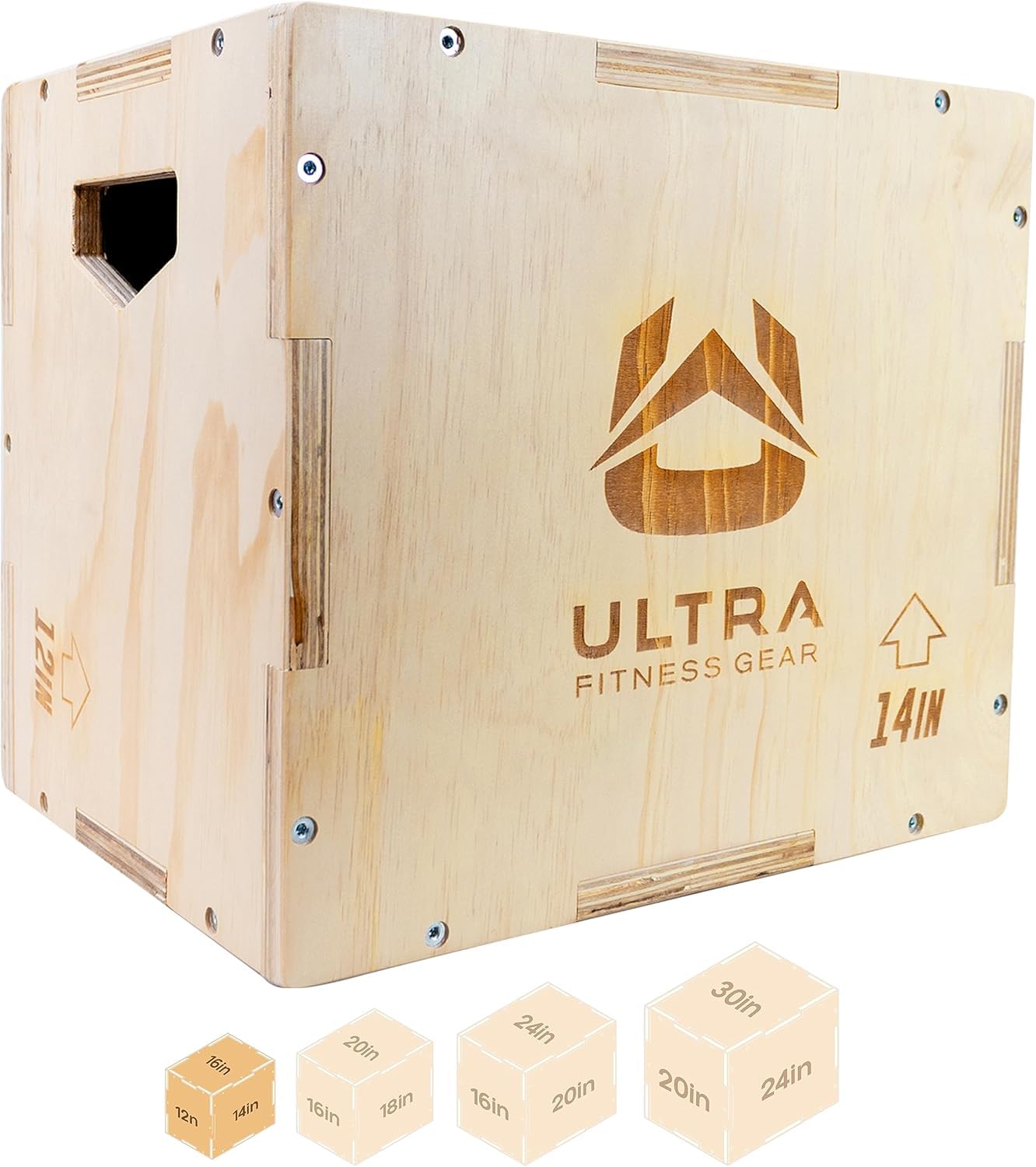
At 15 pounds, this is the lightest box on the list, and that’s not a sign of flimsiness — it’s built from high-grade 3/4 inch plywood that fits together like a puzzle. The countersunk screw holes are routed deeper than most so you can’t snag yourself on a head, which is a genuine safety detail when you’re jumping onto the top face. Routed radius corners and larger handle openings mean you can grab it from any direction to flip heights.
It offers 20, 24, and 30 inch faces, with the larger sizes carrying internal bracing for extra support. Ultra Fitness Gear has tested it to 450 lbs, though they don’t claim a hard ceiling — a sensible way of saying the structure has margin. Assembly realistically takes 10 to 15 minutes. One 210 lb owner reported it’s perfectly sturdy for their bodyweight, which is the kind of confirmation that reassures you before you commit.
The caveat here is the same as on any non-coated plywood box: no rubberized or PVC non-slip surface, so a damp landing will slide more than on a textured top. Very tall jumpers going straight to the 30-inch face may also find the extra-real-estate configuration cramped on the top landing. For the money though, you get thick plywood and deep-recessed hardware that most boxes at this level don’t offer.
Why the build detail matters: Deeply countersunk screws and routed edges are the kind of safety feature you only notice when you miss a jump.
What you give up: No non-slip coating, and the top face at 30 inches leaves less margin for a wide landing.
Best for careful builders: Someone who wants the thinnest snag risk and a puzzle-fit 15-pound frame with three heights.
Lands softer with grip: If you want a non-slip surface, the Synergee or CAP boxes are a better match.
8. CAELUM 3-in-1 Wood Plyo Box

A honeycomb-textured deck rated to 400 lbs, with more room to land.
The CAELUM is the pick for someone who wants a wide, forgiving landing zone. It’s built at 30 x 24 x 20 inches, giving you more surface area on the top face than the smaller 24-inch boxes. The 400 lb rating sits between the 300 lb boxes and the 450 lb heavyweights, which is a sensible middle for a lifter who sometimes loads a bar. Precision puzzle joints and internal bracing keep it from wobbling under high-impact work.
The honeycomb-textured non-slip surface is the standout feature — a raised pattern that improves traction when your hands and shoes are sweating during intense sessions. Smooth, sanded edges and side handles make it easy to move and safer to miss. Pre-drilled pilot holes and included screws mean assembly takes a few minutes. It also carries a 2 year manufacturer warranty, which is reassuring on a box you’ll be landing on repeatedly.
The honest caveat comes from the stability side. The honeycomb coating boosts traction most of the time, but some owners find the box can still slide on bare floors, especially if the floor is smooth and your landing is hard. A rubber mat underneath solves it. And the 400 lb rating is respectable but not the 450 lb top-end some boxes offer. For most home lifters, it’s a well-built, wide-landing box.
What makes it different: A 30 x 24 x 20 inch footprint with a honeycomb-textured non-slip surface and a 400 lb rating.
The floor note: On slick flooring, the box can still slide — a mat under it fixes the problem.
The wide-landing fit: Trainers who want a larger top face and a textured non-slip surface at a 400 lb rating.
Pair it with a mat: Smooth floors call for a rubber base to keep the box planted.
9. Bells of Steel Plyometric 3-in-1 Wooden

An anti-slip PVC layer and trimmed corners, packaged for anyone who wants a safer miss.
This is the premium option, and it earns that for a specific reason: an extra thin layer of anti-slip PVC (a grippy plastic coating) covers the landing surface, and the corners are trimmed down to reduce the chance of a painful clip on a missed jump. It’s a 30 x 24 x 20 inch box with three heights, so you can scale each exercise up or down. The frame is rated for box squats as well as jumps, which makes it more versatile than a pure jump platform.
Assembly is designed to be approachable. You get all the bolts and an Allen key in the box, no extra tools needed, and the build takes about 20 minutes with a screwdriver. A power drill speeds it up if you have one. That matters if you’re not handy with tools — this is one of the few boxes where the hardware is complete enough to build straight away.
The one thing to know: this is a small-size box, and the listing sizes the frame as a Large at 30 x 24 x 20 inches. If you want the tallest landing face, it delivers. But check that the top face dimensions suit your jump style — a smaller top leans toward precise landings rather than broad ones. For a premium build with a grippy layer, though, it’s a solid top-end pick.
The premium case: Anti-slip PVC layer and trimmed corners make this the most safety-focused box on the list, and the included Allen key means no extra tools at build time.
Where it demands precision: The small-size top face rewards clean landings over casual ones.
Worth the premium: Buyers who want a grippy PVC top layer, trimmed corners, and all hardware included.
One trade-off: The smaller top face suits precise landings rather than broad, casual ones.
Know the Specs
3-in-1 height design
A 3-in-1 box gives you three faces of different heights so you can set one box on its side and train at three levels. On the Yes4All, that means 16, 14, and 12 inches; on a taller box like the Fitvids, it means 30, 24, and 20. The flip lets you progress without buying a new box, and the widest face is usually the most stable landing surface. Check both the top and bottom height — a box that goes too tall leaves you with no warm-up height.
Weight rating and item weight
Weight rating tells you how much a box will carry safely; item weight tells you how easy it is to move. A 450 lb rating like the Yes4All or Synergee handles a heavy lifter plus a loaded squat bar. A 300 lb box suits bodyweight jumps and lighter dumbbell work. Heavier boxes like the 50-pound Yes4All slide less on hard floors, while a 15-pound box is easier to reposition but may need a mat underneath to stay planted.
Plywood thickness and bracing
Thicker plywood flexes less when you land. Boxes built from 3/4 inch plywood, like the Synergee and Ultra Fitness Gear, are the stiffer options. Internal bracing — extra support panels inside the frame — distributes the impact across the whole box. On most boxes it appears only on the largest sizes, so keep your heaviest jumps on the widest face.
Surface and edge finish
A non-slip surface can be a PVC layer (like the Bells of Steel), a honeycomb texture (the CAELUM), or a simple textured finish (the CAP). All of them help when your shoes are dry and wear down with handling over time. Smooth, sanded edges and recessed screw heads are the small details that keep a missed jump from cutting a shin.
Common Questions
Do I need a 450 lb rated plyo box or is 300 lb enough?
Can I do box squats on a wooden plyo box?
How long does it take to assemble a wooden plyo box?
Is a wooden plyo box slippery for box jumps?
What is the difference between a 24 inch and 30 inch plyo box face?
Do plyo boxes with non-slip surfaces wear out?
Can a plyo box handle a 250 lb person jumping on it?
Do I need a rubber mat under a wooden plyo box?
Can a wooden plyo box be used outdoors or on concrete?
How do I know which height options a plyo box offers before I buy?
The Bottom Line
For most home gyms, the plyometric wooden box to grab first is the Yes4All 3-in-1 Wooden Plyo Box. Its 450 lb rating, pre-drilled puzzle joints (slots that lock the panels together), and three height faces cover the widest range of training without a wobble. If you need a taller landing face and a non-slip surface, reach for the Fitvids 3 in 1 and its 30-inch top. And if you want premium anti-slip grip with trimmed corners and every bolt included, the Bells of Steel is the one to commit to.
How we choose
We do not accept paid placement. Every pick is matched to a real buyer and a real use-case; we do not hands-on test units.
Sources
Specifications: manufacturer listings and product documentation. Review insights: verified customer reviews, as of November 2026. Pricing: not shown on this page (it changes often); check the current price via the retailer link.
As an Amazon Associate, Tactical Gear Guy earns from qualifying purchases. This does not affect which products we feature.