Specs are compiled from manufacturer listings and verified buyer reviews and can change over time — please confirm the key details on the product page before buying.
Most weighted vests fail at the same moment: the second you start moving fast, the plate shifts, the shoulder straps dig in, and you spend the rest of the session thinking about your ribs instead of your training. The fix is not more padding. It is a carrier built around how plates actually sit against your back, and the right weight ceiling for the work you do. This guide ranks nine plate carriers by load ceiling, plate pocket size, and strap system, so you can match one to the way you actually train.
This guide is built by comparing the manufacturers’ published specifications and the patterns across verified customer reviews, so you get each pick’s real strengths and trade-offs instead of marketing spin.
Here is how each of the nine carriers holds up under load.
Top Picks
How To Choose The Best Plate Carrier Weight Vest
Start with the plates you already own or plan to buy. A carrier is only a harness — the plate pocket is the single dimension that decides whether the vest works or sits in a closet. Match pocket size first, then load ceiling, then strap system.
Plate Pocket Size and Load Ceiling
Most carriers list a pocket size in inches, and that number is the hard limit. A carrier built for 10×12 inch ruck plates will not swallow a longer 45 lb plate, no matter how tough the stitching is. Then check the load ceiling. A 20 lb ceiling supports lighter endurance work; a 60 lb or 150 lb ceiling supports progressive strength training where you add plates over months.
Strap System: Shoulder, Sternum, Waist, Cummerbund
Shoulder straps carry the vertical load. A sternum strap (the horizontal strap across your chest) stops the vest from swinging out. A waist belt or cummerbund locks the bottom edge to your hips so the weight sits still. Hook-and-loop closures trade speed for micro-adjustment — fast to strip off, slower to fine-tune plate by plate.
Nylon Weight and Finish
A 600D nylon shell is a common mid-weight fabric that resists abrasion without feeling like cardboard. Heavier 1000D nylon appears on rugged rucking carriers. Ripstop weaving (a grid pattern that stops small tears from spreading) and reinforced stitching at stress points are worth checking on any vest you plan to load heavy.
Side-by-Side Comparison
| Model | Best For | Load Ceiling | Pocket Size | Shell Material | Amazon |
|---|---|---|---|---|---|
| Polyfit Fortify★ Best Overall | All-round fitness and rucking | 40 lbs (two 20 lb pockets) | Up to 13″ x 11″ | 600D nylon | Amazon |
| Madoats Rucking Plate CarrierBest for Rucking | Dedicated ruck training | 30 lbs | 10″ x 12″ | 1000D ripstop nylon | Amazon |
| WF Tactical Adjustable VestBiggest Load Range | Progressive functional fitness | 60 lbs | — | 600D polyester | Amazon |
| ZELUS Plate Carrier Vest | Tactical and obstacle training | 65 lbs | — | 600D nylon | Amazon |
| Amstaff Tactical Weighted Vest | Plate-included starter kit | Up to 80 lb fabric load | — | 600D Oxford fabric | Amazon |
| GORUCK Ruck Plate Carrier 3.0 | Streamlined rucking only | Standard / Long / Heavy plate sizes | 10, 20, 30 LB Standard | — | Amazon |
| UNBROKENSHOP Adjustable Vest | CrossFit WODs with gym plates | Regular gym plates or sand plates | — | Nylon 900D and leather | Amazon |
| GORUCK Curved Weighted Vest | Walking and rucking comfort | 14 or 20 lbs loaded | — | 500D CORDURA exterior | Amazon |
| Kensui EZ-VEST Pro | Heavy weighted calisthenics | 150 lbs | Fits 2-inch Olympic plates | Fiberglass-reinforced nylon | Amazon |
Detailed Reviews
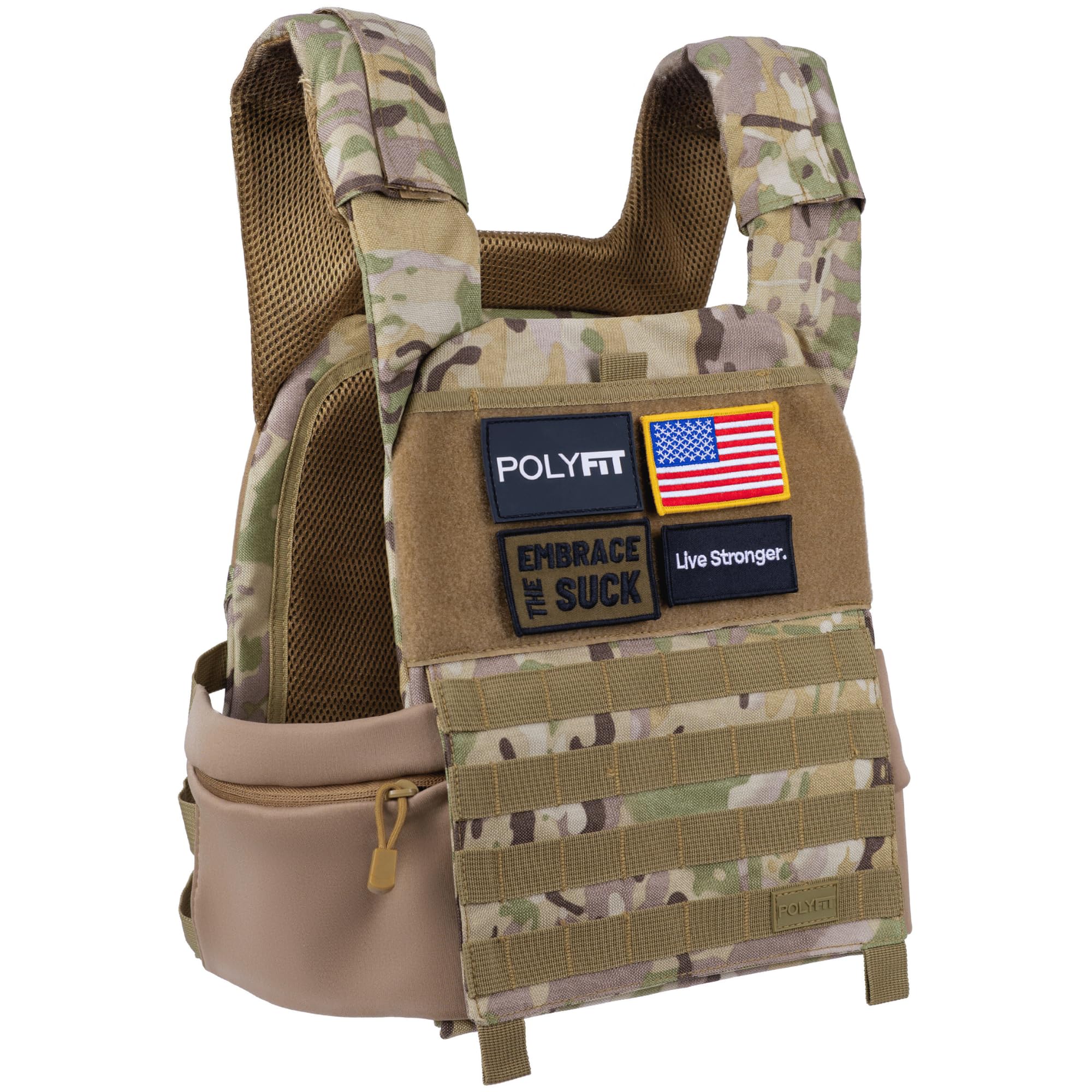
1. Polyfit Fortify Weighted Vest
Our pick — 4.5+★ from 250+ verified ratings; the strongest balance of quality and price.
Two 20 lb pockets that hold plates tight enough to run in — that is the whole pitch.
The Fortify carries two plates — one front, one back — and each pocket takes up to 20 lbs, for a 40 lb total capacity. That pocket is sized for plates up to 13 by 11 inches, so it swallows most standard vest plates and Polyfit’s own. With a 40 lb ceiling and a 13″ x 11″ pocket, it covers light walks and loaded rucks without a second carrier.
What wins people over is the stability. Interior straps lock the plates down, and the stretch waist belt with a hook-and-loop closure pulls the whole thing tight against your torso, so it does not bounce through runs, rucks, or bodyweight circuits. The shoulder straps are padded and the interior is breathable mesh, which keeps the weight spread across your shoulders instead of pinching in one spot. The 600D nylon shell with reinforced stitching is a mid-weight fabric that resists abrasion without feeling stiff.
The catch is right on the listing: plates are sold separately. You are buying the harness, and your plate weight and pocket fit are your job. It is also a fitness vest only — Polyfit states it is for training use, not body armor. Owners who stay within the 20 lb per pocket limit report it holds up; overstuffing past that is where complaints start.
Where the Fortify earns its spot
- 40 lbs total capacity across two 20 lb pockets, with plates locked by interior straps so they stay put while you move.
- Fits plates up to 13″ x 11″, which covers most standard vest plates without a sizing gamble.
- Stretch waist belt with hook-and-loop closure plus padded shoulder straps distribute load and cut heat buildup.
- 600D nylon with reinforced stitching holds up to repeated runs, rucks, and strength circuits.
What to weigh before you buy
- Plates are not included — budget for them separately.
- Fitness use only; not a ballistic or armor-rated carrier.
- The 40 lb ceiling will feel limiting if you plan to load much heavier over time.
Go for it if: you want one plate carrier for rucks, runs, and strength days and you already own or plan to buy standard vest plates.
Look elsewhere if: you need a carrier rated for body armor or a load well past 40 lbs.
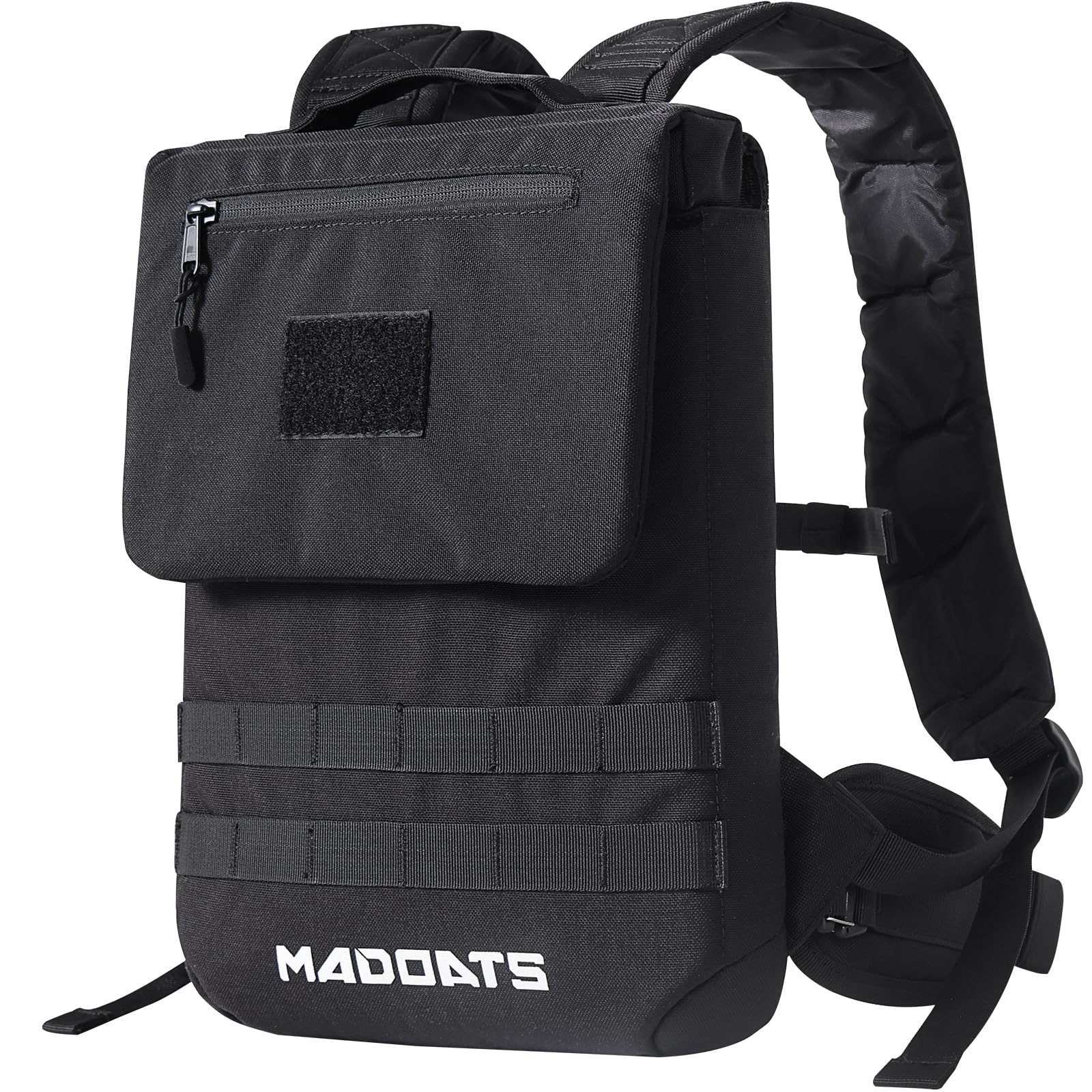
2. Madoats Rucking Plate Carrier With Ergonomic Carrying System
Built around one plate size and one job — carrying it high and tight on a long walk.
This is a purpose-built ruck carrier: a 1.5 inch deep main compartment that takes 10 by 12 inch ruck plates up to 30 lbs. There is no pretending it does anything else. If you already own a 10×12 plate and want to ruck three times a week, this is the simplest way to get there, and at 0.7 kg empty it is a lighter harness than the Polyfit Fortify at 0.95 kg.
The carrying system is where the thought went. S-shaped shoulder straps, a chest strap, and a waist strap pull the load in against your back so it stays put, and the back panel is breathable soft fabric with extra-thick padding. EVA foam blocks and strong hook-and-loop layers hold the plate down. The shell is 1000D ripstop nylon — the heavier, tear-stopping weave that suits repeated training — with reinforced stitching at the stress points. MOLLE webbing on the outside gives you somewhere to hang extra gear on longer outdoor sessions.
The limits are real, though. It takes 10×12 plates only, so a longer 45 lb plate is not going in. And with a 30 lb ceiling, heavier ruckers will outgrow it. The Fit range is generous and sized to fit men, women, and different body types via the adjustable straps, but this is a rucking harness, not a general-purpose gym vest. For walks and loaded carries, the 30 lb ceiling is enough; for lifting with plates on, look at a higher-ceiling carrier.
Nylon that takes abuse: the 1000D ripstop shell and reinforced stress-point stitching are the right materials for a carrier that lives on your back in the rain and on rough ground.
Plate-size lock-in: 10×12 inches at 30 lbs max means the plates decide the fit — check yours before ordering.
The right call for: ruckers who want one clean plate pocket and a strap system that holds it still on long walks.
The wrong call for: anyone wanting to load a 45 lb long plate or push past 30 lbs.
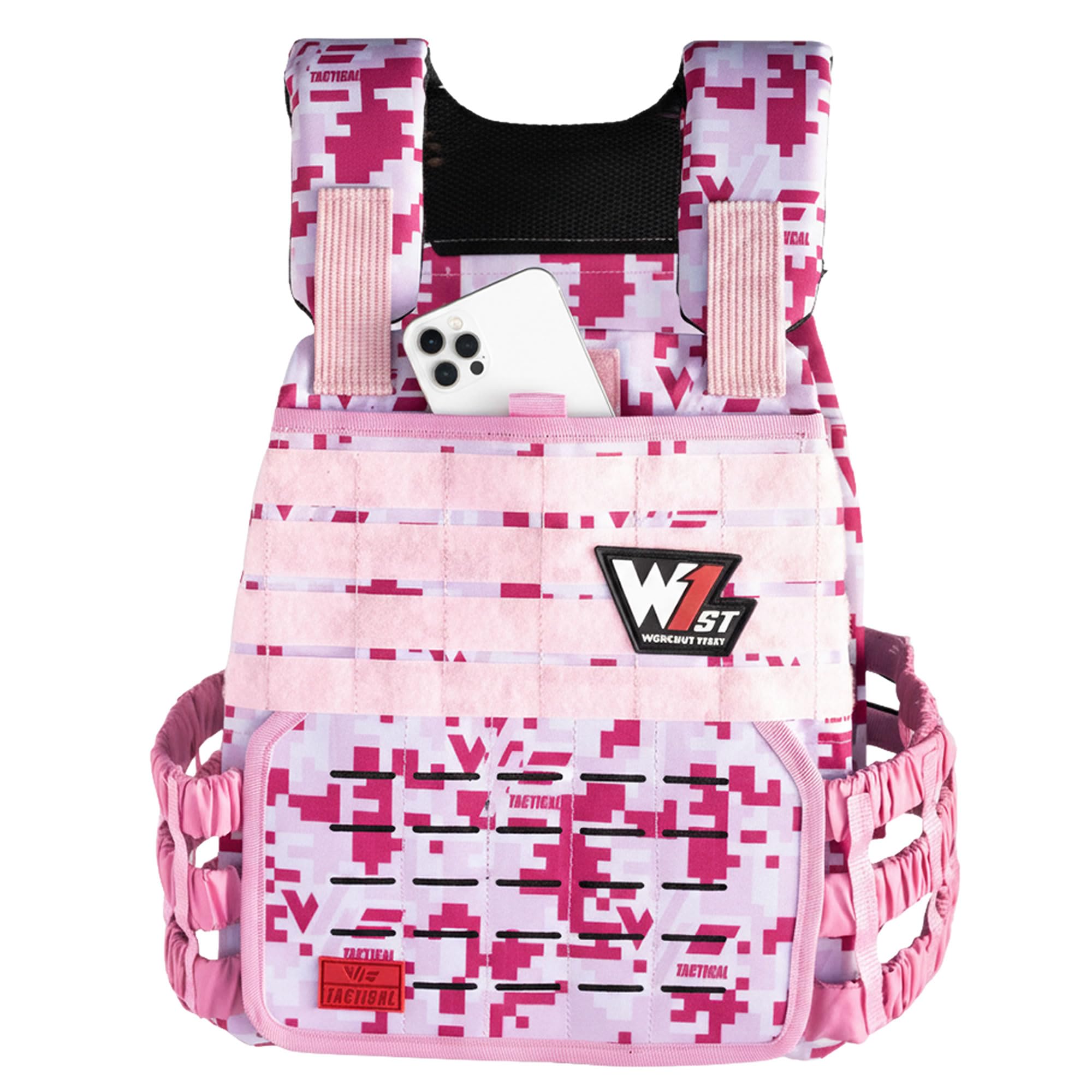
3. WF Tactical Adjustable Weighted Vest (14–60 lb)
A 14–60 lb range that lets you add load in steps instead of buying a new vest.
Front and back plate pockets let you dial the resistance from a light 14 lb session up to 60 lbs, which is a much wider working range than the 40 lb Polyfit Fortify offers. For a progressive strength program or Hyrox-style prep, the 14–60 lb range lets you add resistance month by month without swapping gear.
The fit side is well thought out. Quick-adjust shoulder and waist straps with buckle and hook-and-loop closure give you a stable setup that cuts shifting during running, jumping, squats, and push-ups. The ventilated mesh interior moves air, padded shoulders spread the load, and reflective details help you stay visible on early or late outdoor sessions. The front pocket takes a phone or keys. The shell is 600D polyester with reinforced stitching, built for sweat and repeated use rather than a single season.
One thing to know up front: the 60 lb figure is the ceiling of the pockets, and plates are sold separately — so what you actually load is up to you. Treat 60 lbs as the top of the range, not the everyday weight. The pink colorway is a real style choice that will not suit everyone, but the build underneath is a serious functional-fitness vest.
Range is the selling point: 14 to 60 lbs in front and back pockets is the widest working window on this list short of the Kensui’s heavy calisthenics rig.
Pick it when: your training plan climbs in load and you want one vest to carry you from beginner volume to heavy conditioning.
Think twice when: you need the plate-included simplicity of the Amstaff or the rucking-specific shape of the Madoats.
4. ZELUS Weighted Plate Carrier Vest

65 lbs of capacity with four hook-and-loop retention layers holding the plates in place.
A 65 lb ceiling puts the ZELUS above the 40 lb Polyfit Fortify and above the 60 lb WF Tactical in raw capacity — if heavy is what you want, it goes further than most here. It weighs 2.67 lbs empty and takes plates in built-in compartments secured by 4-layer hook-and-loop retention, which is the design piece meant to stop plates slipping or dropping during explosive movements like burpees and jumps.
The tactical side is what makes it distinct. Front and back MOLLE panels let you attach pouches or accessories, and there is a rear attachment buckle for a resistance parachute. The chest pocket takes small essentials, and the rear storage makes it a workable setup for obstacle training and conditioning circuits. Fully adjustable hook-and-loop shoulder straps and a waist belt pull it snug to different bodies, so it stays tight rather than swinging out mid-set.
The 600D nylon with reinforced stitching is breathable and sweat-managing, and the tactical-gym crossover is real, but buyers should go in with realistic expectations on build consistency. If you want front and back MOLLE panels and a 65 lb ceiling, it earns its place; if you want a higher-rated safe bet, look at the Amstaff or the Polyfit Fortify. Plates are not included.
Where it stands out: MOLLE panels, a parachute buckle, and a 65 lb load ceiling make it the most accessory-ready carrier here.
Where to be careful: the lower rating means quality consistency varies, so inspect seams and hook-and-loop on arrival.
Suits you if: you want a MOLLE-capable tactical carrier with a 65 lb ceiling for obstacle and conditioning work.
skip it if: you want the highest-confidence build in the lineup and do not need the tactical accessory panels.
5. Amstaff Tactical Weighted Vest

The one that arrives with plates, so you can train the day the box lands.
This is the only pick that ships ready to load: two 8.5 lb plates plus a 3 lb vest, for 20 lbs total from the start. Add plates in pairs later — 3.5, 5.5, 8.5, or 13.5 lbs — and the fabric is rated to bear up to 80 lb. At 3 lbs the vest is heavier than the 2.67 lb ZELUS, but that is a fair trade for an included plate set.
What wins people over is the weight capacity and the comfort. The curved plates hug your body, and airflow channels with breathable mesh padding sit between plate and torso so the load stays cooler through a long session. Two sets of waist straps come in the box to help dial in the fit. Padded shoulder straps are stitched to spread the load, and the shell is water-resistant 600D Oxford fabric built for sweat and dirt. CrossFit-style circuits, push-ups, pull-ups, and Murph-style work are all in its range.
The recurring gripe is durability. The shell is durable for standard gym use, but a small share of the longer-term comments mention seams starting to open. The waist belt also draws occasional gripes for not locking down as firmly as some want. Treat it as a starter vest you will replace after a few hard years, not a forever carrier — and it is explicitly not body armor.
Why it lands in the lineup
- Ships with two 8.5 lb plates and a 3 lb vest — 20 lbs total, ready to train.
- Curved plates and airflow channels with breathable mesh padding keep long sessions comfortable.
- Fabric rated to bear a load up to 80 lb, with plates expandable in pairs.
- Two sets of waist straps plus padded shoulder straps help dial the fit.
What the long haul brings
- Seams can start to open with heavy long-term use — a starter vest rather than a lifetime one.
- The waist belt does not always lock as firmly as some riders want.
- Fitness accessory only; not body armor.
It fits: anyone who wants a complete beginner-to-intermediate weighted vest with plates in the box and room to grow to 80 lb.
It does not fit: a heavy daily trainer who wants a carrier built to survive years of seam stress.
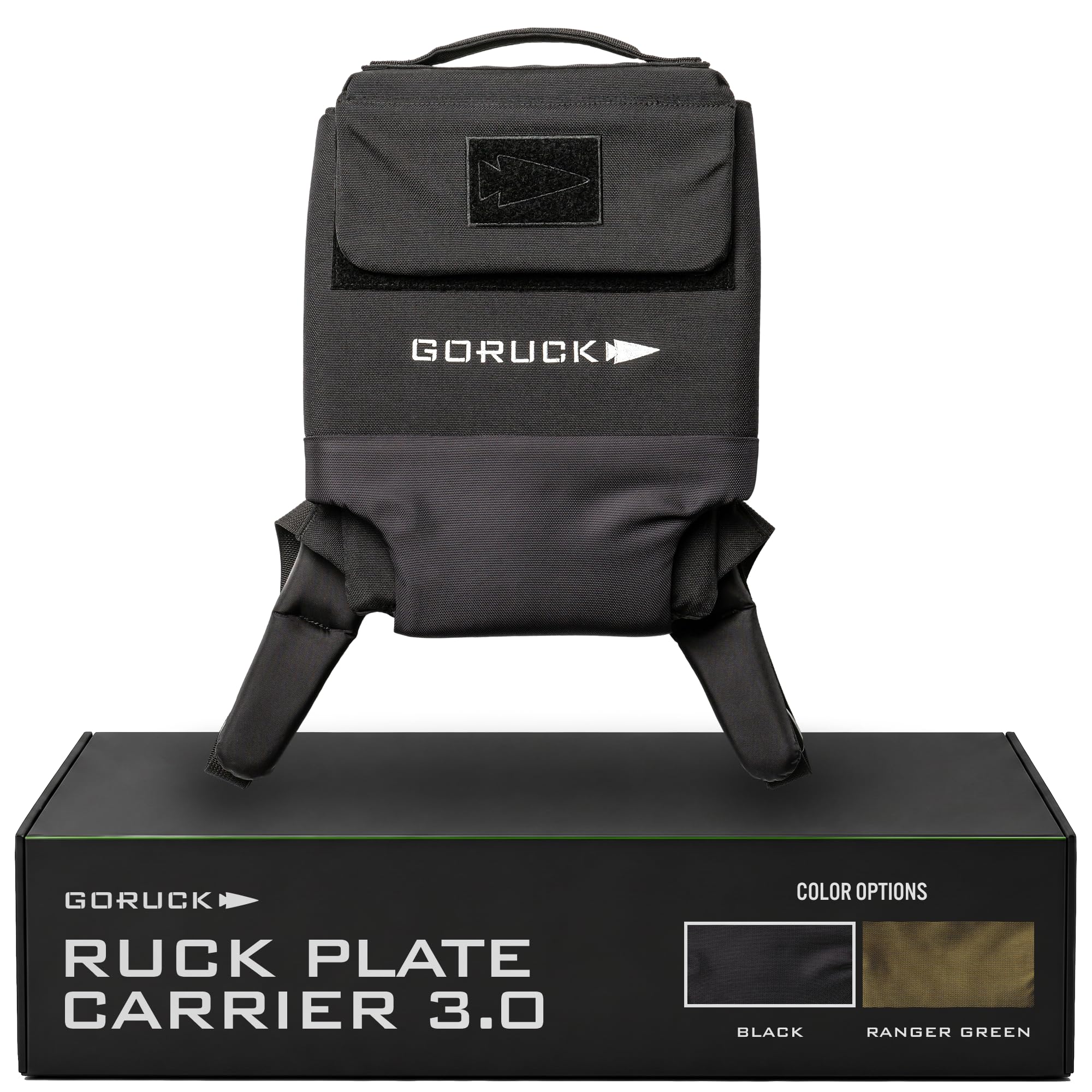
6. GORUCK Ruck Plate Carrier 3.0
One job, done deliberately: hold a ruck plate high and tight against your back.
GORUCK builds this around a single idea — an improve plate pocket that holds compatible plates high and tight against your back for stability and less shifting. The Standard fits 10, 20, and 30 LB Standard Ruck Plates; the Long fits 30 and 45 LB Long Ruck Plates; the Heavy version uses dual Long pockets for heavier training. That is a lot more plate-size flexibility than a fixed 10×12 pocket.
What wins people over is the build. The construction and ruggedness are the reasons people stay — the vest is made to take a beating and keep going. The sternum strap (called the Training Sternum Strap) works with the shoulder straps to hold the weight secure without restricting breathing, and the weight is designed to distribute evenly across the upper body. It is also intentionally streamlined: no cargo room for water, clothing, or everyday gear, which keeps it light and focused on carrying a plate.
The honest trade-offs sit in fit and comfort. Some body types find the shoulder design irritating on longer walks, and the 45 lb Long plate does not fit everyone comfortably. The Heavy version is the answer for heavier loading. If you want a dedicated rucking tool rather than a gym vest, that focus is the feature; if you want a vest you can also use for lifting circuits, a higher-ceiling carrier like the WF Tactical is a better fit.
Built to take it: quality and durability are what buyers keep coming back to across the ruck, and the improve pocket keeps the plate where it belongs.
Size your plate first: Standard, Long, and Heavy plate formats mean picking the right version is the whole decision.
The choice for: dedicated ruckers who want a streamlined carrier and will match their plate size to the Standard, Long, or Heavy version.
Not the choice for: training that needs a cargo pocket or a load beyond the plate formats offered.
7. UNBROKENSHOP Adjustable Weighted Vest

Your existing gym plates or sand plates go straight in — no proprietary plate to buy.
Most carriers on this list want you to buy their plates. The UNBROKENSHOP lets you use regular gym plates or sand plates you likely already own, and at 0.86 kg empty it is a compact harness. That flexibility is what wins people over — carrying 20 lbs of your own plates into a WOD beats adding a plate set to the cart.
It is built for Cross Fitness: heavy-duty webbing and buckles lock quickly and securely, the meshing padded interior breathes, quick-release buckles speed up transitions, and the padded mesh shoulder pads cut into the load. There is a pocket for your phone and wallet, and hook-and-loop panels let you customize the look with two included patches. The shell is 900D nylon with leather trim, and full adjustability means it adapts to different body types from beginner to high-performance athlete. Size registers as a 20 lb configuration.
The trade-off you should know: the plastic hardware is the weak point in long-term use, with clips breaking over months of heavy weekly loading. For occasional or moderate loading — say a few 5 kg plates for calisthenics and runs — it holds up; push it to 40 lbs five days a week and the plastic clips are the part that gives first. That is a fit decision, not a knock on the vest itself.
The value case: plate flexibility and a quick-release buckle setup make it one of the more versatile carriers for CrossFit-style WODs.
The plastic caveat: heavy repeated loading stresses the clips — size your weekly load and frequency to the hardware.
Worth it if: you already own gym or sand plates and want a compact WOD vest that takes them without a proprietary format.
Look at the ZELUS or Amstaff instead if: you plan to load heavy plates multiple times a week and want the hardware to match.
8. GORUCK Rucking Weighted Vest for Men and Women

A curved vest with a cutout plate that takes pressure off your diaphragm while you walk.
GORUCK’s angle here is honest comfort. The vest follows your body’s curve to cut pressure points, and the Curved Ruck Plates (sold separately) have a hole cut so the weight comes off your diaphragm — so you can breathe on a long walk. Unloaded it weighs 1.5 lbs, and fully loaded it comes to 14 or 20 lbs, so this is a walking and light-rucking tool rather than a heavy strength carrier.
The build is premium: 500D CORDURA exterior with 210D CORDURA interior, and front and back panels measuring 11 inches wide by 13 inches high. What wins people over is the fit — sizing is accurate and it stays comfortable on long walks or workouts, with strong hook-and-loop holding the plate snugly inside. The adjustable side straps aim to fit a plus-size or women’s frame, and the L/XL size is intended to cover most men and women. The front and back panels stay the same across sizes; only the shoulder straps and cummerbund change.
Two honest limits. The vest runs compact — a chest at 47 inches sits at the edge of the elastic straps, so bigger frames need to check sizing carefully. And the waist belt hook-and-loop is not generous enough to secure as firmly as some want. Neither makes it a bad vest; it makes size the decision you have to get right before ordering. If you are a walker or light rucker in the middle of the size range, it is a comfortable, well-made carrier.
Comfort engineering: the curved panels and a diaphragm cutout in the plates are the two details that make longer walks feel easier.
Check the sizing: the L/XL cut runs snug — a 47 inch chest sits at the elastic strap limit, so larger frames should measure first.
A fit for: walkers and light ruckers who want a curved, comfortable vest with a premium CORDURA shell and accurate sizing.
Not a fit for: broad-chested or heavy-training users who need a wider strap range and a higher load ceiling.
9. Kensui EZ-VEST Pro Adjustable Weighted Vest
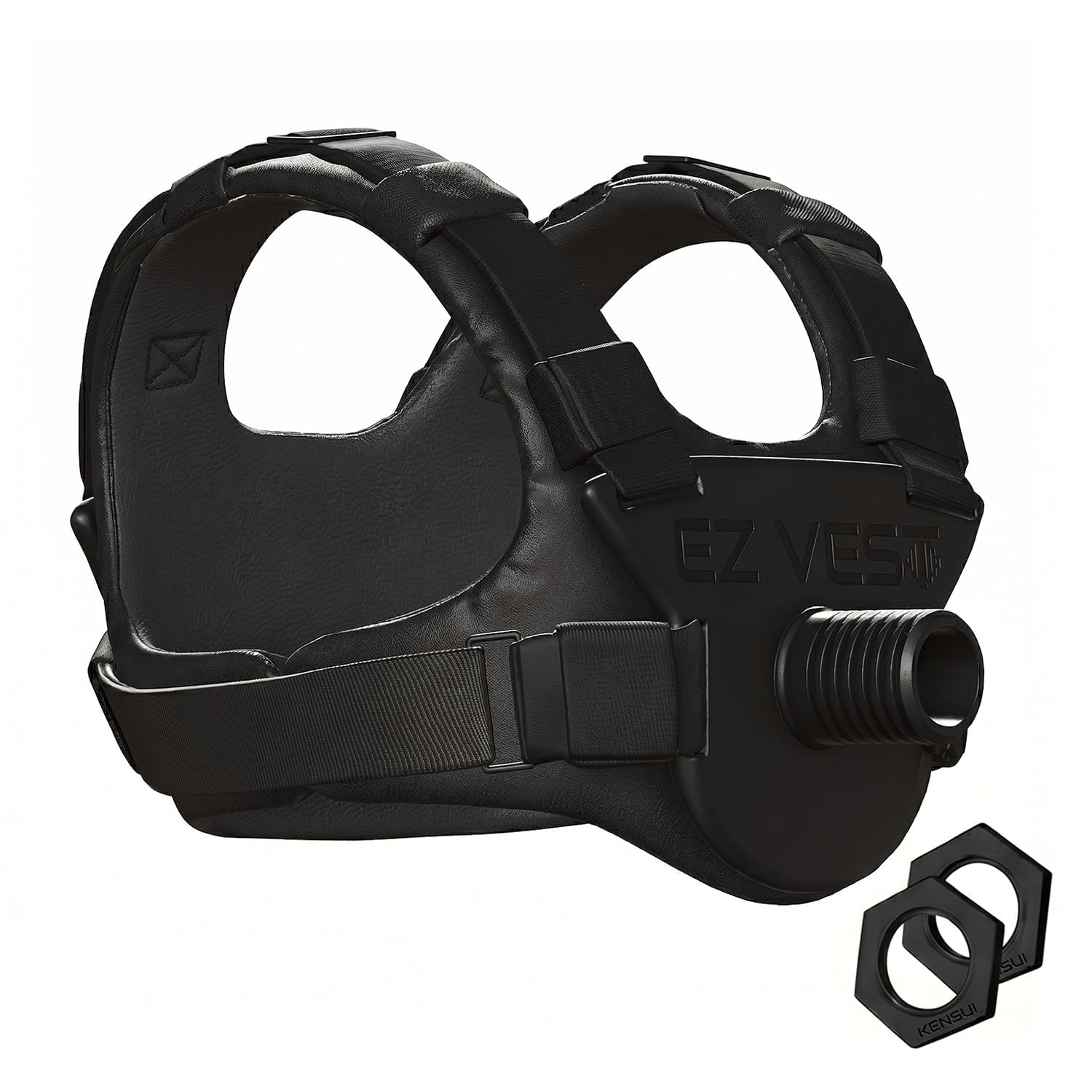
A 150 lb ceiling that turns bodyweight work into loaded strength training.
Nothing else on this list comes close to the load ceiling: the EZ-VEST Pro supports up to 150 lb of plate load, versus 65 lb on the ZELUS or 40 lb on the Polyfit Fortify. If your training is weighted pull-ups, dips, and lunges with heavy progression, this is the only carrier here built to go the distance. It fits compatible 2-inch Olympic plates and includes securing collars — 1-inch standard plates need the matching adapter, sold separately.
The comfort side is engineered for heavy lifts: 6 mm padding plus an air mesh lining where the vest meets your torso, and a fiberglass-reinforced nylon frame to support plate-loaded training. Adjustable shoulder and waist straps let you set the hook-and-loop fastening before training and re-adjust between sets. Push-ups, dips, pull-ups, squats, and lunges all work with the load in place.
The honest note is on fit. The highest-cited concern is fit and room — several users report insufficient space for multiple or larger plates, and the pegs are sized for 2-inch plates only, so 1-inch plates need the adapter. Lighter plates under 35 lbs sit more securely. If you load moderate weights with a big ceiling in mind, this is a strong choice; if you want to load 100-plus lbs in one go, size up your plate choices and expect a snug fit.
The load ceiling: 150 lb of compatible plates with securing collars makes it the heaviest-capacity carrier here by a wide margin.
The plate-format catch: 2-inch Olympic only on the pegs — standard 1-inch plates need a separately sold adapter.
Reach for it if: you train weighted calisthenics, own 2-inch Olympic plates, and want one carrier that grows with heavy progression.
Pass if: your plates are 1-inch standard, or you want a general walking-and-rucking vest.
Know the Specs
Load Ceiling (lbs)
The maximum plate weight the carrier’s pockets and fabric are rated to hold. A 20 lb vest suits light endurance sessions; a 60 lb or 150 lb ceiling supports progressive strength training where you add plates over months. Treat the ceiling as a top-of-range number, not your everyday working weight.
Pocket Size (inches)
The plate dimensions a carrier accepts — 10×12 inches is a common ruck-plate size. Check this before you buy: a pocket built for a 10×12 plate will not take a longer 45 lb Long plate. Some carriers list compatible plate formats instead, such as Standard, Long, or Olympic, which work the same way.
Fabric Denier (D)
Denier is a measure of fabric weight and toughness. 600D nylon or polyester is a common mid-weight shell that resists abrasion; 1000D appears on rugged rucking carriers; 500D CORDURA is a lighter premium weave. Higher denier is generally tougher, but weight and stiffness rise with it.
Strap System
Shoulder straps carry the vertical load, a sternum strap stops the vest swinging out, and a waist belt or cummerbund locks the bottom to your hips. Hook-and-loop closures are quick to strip off but take longer to fine-tune. Buckles are faster and more repeatable but less micro-adjustable.
Common Questions
Do plate carrier weight vests come with the weight plates?
Can I put any plate in any plate carrier weight vest?
Is a plate carrier weight vest the same as body armor?
What load capacity should I start with for rucking?
How do I stop the plates from bouncing during runs?
Will a plate carrier weight vest fit women?
What is MOLLE webbing for on a weight vest?
Can I wear a weighted vest for weighted calisthenics?
Does a curved vest really help with breathing on long walks?
How should a plate carrier weight vest fit?
The Bottom Line
For most people, the plate carrier weight vest winner is the Polyfit Fortify because it covers the whole job — 40 lbs across two 20 lb pockets, plates locked by interior straps, and a stretch waist belt that keeps the weight still through runs and rucks. If you want a dedicated rucking harness with a 1000D ripstop shell and a 30 lb ceiling, grab the Madoats Rucking Plate Carrier. And for heavy weighted calisthenics, the Kensui EZ-VEST Pro is the one to reach for — its 150 lb ceiling goes far past anything else here. Whatever you pick, size the plate pocket and load ceiling to the way you actually train, and you will get years out of it.
How we choose
We do not accept paid placement. Every pick is matched to a real buyer and a real use-case; we do not hands-on test units.
Sources
Specifications: manufacturer listings and product documentation. Review insights: verified customer reviews, as of November 2026. Pricing: not shown on this page (it changes often); check the current price via the retailer link.
As an Amazon Associate, Tactical Gear Guy earns from qualifying purchases. This does not affect which products we feature.