Specs are compiled from manufacturer listings and verified buyer reviews and can change over time — please confirm the key details on the product page before buying.
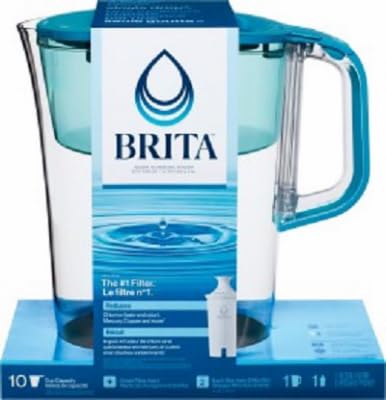
You can get filtered water without a plastic jug. Pick a pitcher whose body, lid, and housing are glass or steel, then check the filter’s own numbers before you buy. The Brita 50686 leads here: its stainless steel body holds 10 cups, and the filter swaps out every 4 weeks. Below are four plastic-free pitchers, sorted by what each one actually does well.
This guide is built by comparing the manufacturers’ published specifications and the patterns across verified customer reviews, so you get each pick’s real strengths and trade-offs instead of marketing spin.
Glass bodies, steel housings, and filter lifespans that range from 4 weeks to 12 months all change what you actually live with day to day. This breakdown of the best plastic free water filter pitcher covers capacity, filtration claims, and the fragility trade-off glass brings.
Top Picks
How To Choose The Best Plastic Free Water Filter Pitcher
The plastic you are trying to avoid can hide in three places on a pitcher: the reservoir body, the lid, and the handle. A glass reservoir with a plastic lid is not fully plastic-free, so read the material line for every part you touch. Stainless steel and borosilicate glass are the two materials that show up most in this category.
Match the filter lifespan to your refill habit
Filter changes are the recurring cost of owning a pitcher, and the intervals vary wildly between models. One here calls for a new filter every 4 weeks, another every 2 months or 40 gallons, and a third stretches to 264 gallons or 6-12 months for its membrane stage. Pick the interval you will actually keep up with, because a filter left in too long is the most common way people undermine a good pitcher.
Read the micron number, not the marketing words
A micron is one-millionth of a meter — a size scale for particles floating in water. A 0.2 micron filter catches the fine sediment and organism-scale particles that a coarser carbon pad lets through. When a listing names a micron rating, it is telling you something measurable. When it only says “pure,” it is not.
Decide how much water you need to hold
A 1.3 liter pitcher suits one person filling a glass at a time. A 3.7 liter pitcher covers a family or a full day of refills without a second trip to the tap. The trade-off is counter space and weight — a 3.7 liter glass pitcher is a two-hand lift when full, while a 1.3 liter model is a one-hand pour.
Side-by-Side Comparison
| Model | Best For | Capacity | Body Material | Filter Life | Amazon |
|---|---|---|---|---|---|
| Brita 50686★ Best Overall | Households wanting steel over glass | 10 cups | Stainless Steel | 4 weeks | Amazon |
| Puro Glass Pitcher | One-person kitchens and quick pours | 1.3 liters | Glass | — | Amazon |
| GLACIER FRESH Purela | Two-stage filtration in a compact body | 10 cups | Borosilicate Glass | 40 gallons carbon / 264 gallons membrane | Amazon |
| Glass Pitcher of Life | Large-batch alkaline water and power outages | 3.7 liters | Borosilicate Glass | 1500 cups per filter | Amazon |
Detailed Reviews
1. Brita 50686 Water Filter Pitcher
Our pick — 4.0+★ from 150+ verified ratings; the strongest balance of quality and price.
Steel instead of glass, so you never flinch when the handle clinks the sink edge
Ten cups of capacity in a stainless steel body is the reason this one sits at the top. That is a full day of drinking water for one person, or a family breakfast plus a top-up, without a refill in the middle. The steel housing also solves the accident problem that glass pitchers live with — a knock against the tap does not end the pitcher’s life.
What you get is a filter rated to pull out chlorine and lead, plus a flip-top lid that opens with one finger for filling. The indicator light is the quiet win: it tells you when the filter is spent, so you are not counting days in your head. Replacement is a 4-week cycle, which is the most frequent of the four pitchers here, so budget for steady filter reorders. Two pitchers ship in this set (quantity 2), so you can stage one in the kitchen and one wherever you drink most.
Durability is the split point. The steel shell holds up, but the handle has broken off in enough hands that it is worth lifting the pitcher by the body rather than the grip when it is full. Set that against everything else and the picture stays strong: good water, fast filtration, a light that does the remembering for you. It is also the group’s crowd favorite at 4.4 stars across 180+ ratings, ahead of the Puro’s 4.2 across 900+ ratings. The capacity gap to the Glass Pitcher of Life is real, though — 10 cups against 3.7 liters — so big households should read that one too.
Where the Brita pulls ahead
- Stainless steel body with no glass to shatter in the sink
- Indicator light removes the guesswork from filter changes
- Fast filtration and a water taste people describe as clean and pleasant
- 10 cups covers a household without constant refilling
What to weigh before buying
- A 4-week filter cycle means more frequent reorders than any other pick here
- The handle is the weak point — carry it by the body when full
- 10 cups is modest next to the 3.7 liter Glass Pitcher of Life
Reach for this if: you want plastic-free water without babysitting a glass body — steel tolerates the bumps glass does not.
Think twice if: you have a large household; the 10-cup capacity fills fast at dinner time.
2. Puro Glass Water Filter Pitcher

The glass pitcher that skips the wait and pours cleaner water straight into the glass
The Puro filters as it pours, which is the detail that changes how you use it. There is no carafe sitting idle on the counter waiting for a reservoir to drain — you fill, you tip, and water comes out filtered. That is the fastest path to a glass of clean water among the four, and it is the reason this pitcher suits someone who drinks a glass at a time rather than filling bottles in advance.
Inside, the filter tackles chlorine, lead, odors, rust, and general impurities. The maker rates one filter as replacing 1,600 water bottles, a useful figure if cutting bottle waste is why you are going plastic-free. At 1.3 liters it is the smallest pitcher here — the Glass Pitcher of Life holds 3.7 liters, so if you are filling for a family, the Puro will run dry first. For a single person or a couple topping up glasses, 1.3 liters is about right.
Here is the honest trade-off, and it is the one everyone lands on with glass: it is fragile. The Puro earns its quality and taste marks easily, and owners describe the filtered water as crisp. But glass this thin does not forgive a hard knock against the sink, and a drop is usually the end of it. Handle it like a wine glass and it rewards you; treat it like a plastic jug and it will not. Of the four, this is the pick that most rewards careful hands.
The pour-to-clean speed: filtering as it pours means no waiting for a reservoir to empty — you drink sooner than with any pitcher holding water back for filtration.
The fragility tax: glass body, glass consequences. Set it on a shelf away from the sink edge and it lasts; knock it around and it will not.
Suits you best when: you drink a glass at a time and want filtered water in seconds, not minutes.
Look elsewhere if: your household empties a pitcher at dinner — 1.3 liters will not keep up.
3. GLACIER FRESH 10-Cup Purela Glass Water Pitcher
Two filters stacked in one pitcher, so the fine particles and the taste get handled separately
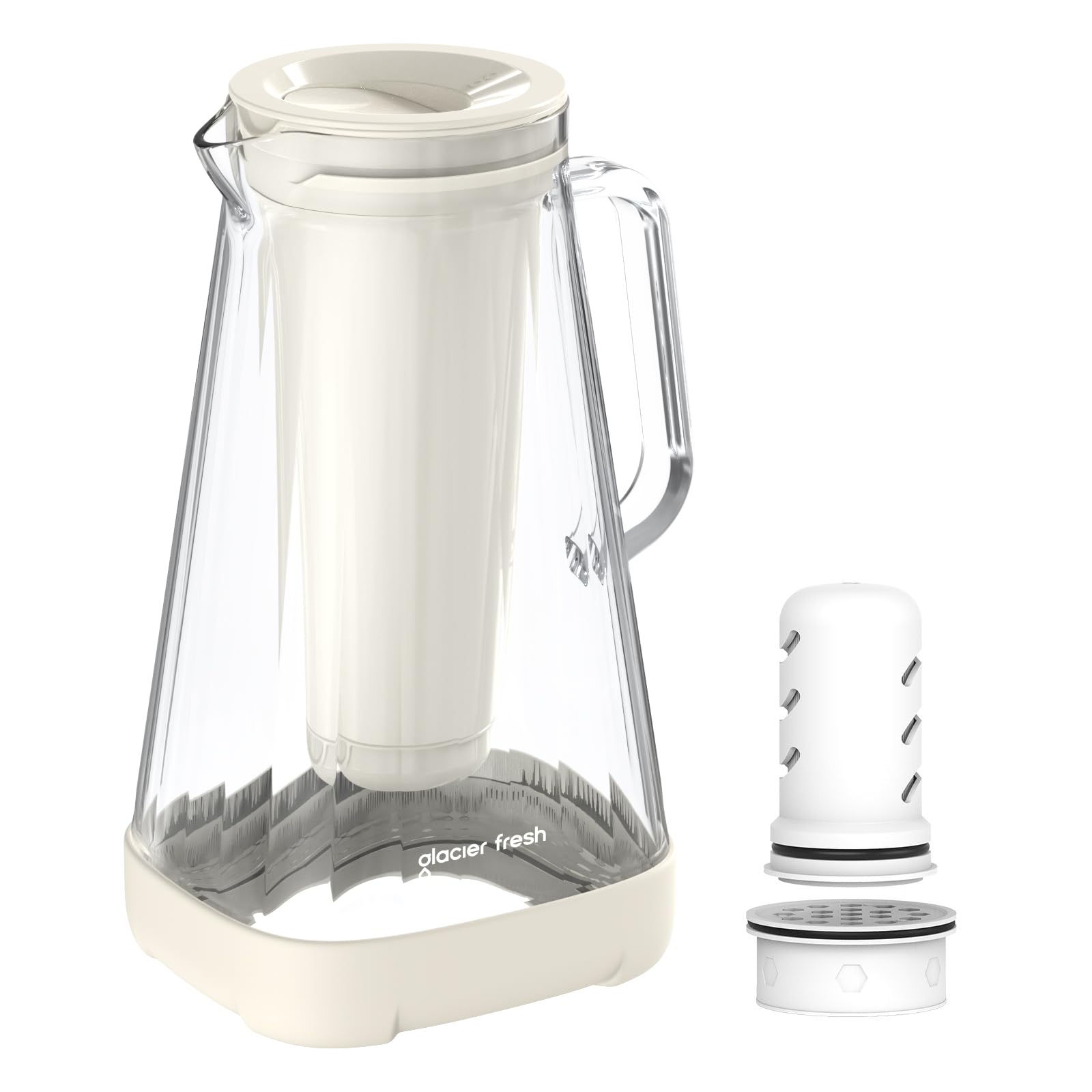
Most pitchers here run a single carbon filter. The Purela runs two stages — an ultrafiltration membrane and an activated carbon fiber pad — and the maker specs the membrane’s micropores at 0.2 microns. That membrane stage is what pulls out the smallest particles, while the carbon stage handles chlorine and taste. Two filters in the box means you start with a spare, and the two stages wear out on different clocks: the carbon pad every 40 gallons or 2 months, the membrane every 264 gallons or 6-12 months.
The body is handblown borosilicate glass, the same heat-tolerant glass used for labware. A spout lid keeps dust and stray particles out between pours, and the handle is shaped for a one-hand lift. At 10 cups it matches the Brita for capacity while keeping the glass body you wanted. That glass costs you 3.3 pounds: fill it with two hands when full, then pour one-handed once it tips.
The catch is speed. The same membrane that catches fine particles slows the flow, and filling takes noticeably longer than the pour-through Puro. If you are used to a pitcher that fills in a blink, this one will test your patience. What wins people over here is the water itself — a crisp taste and a glass body that looks good enough to leave out on the counter. It is a trade of a few extra seconds for finer filtration.
The filter math: two stages on two different schedules means you rarely replace both at once — a slight hassle, but a fine membrane stage that outlasts the carbon pad by six times or more.
The pace you pay: 0.2 micron filtration is thorough and slow. Plan for a fill that takes a moment longer than the Puro’s instant pour.
This is your pitcher if: you want the finest particle filtration on the list and do not mind waiting a few extra seconds for it.
Pass on it if: a slow fill is a dealbreaker — the Puro pours faster.
4. Glass Pitcher of Life Alkaline Water Pitcher
A gravity-fed glass pitcher for the household that goes through water faster than it can refill
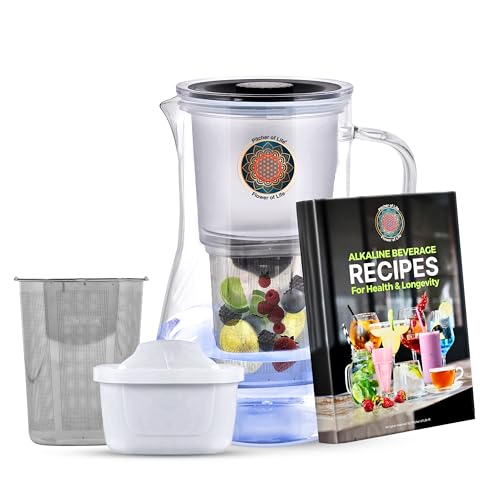
At 3.7 liters this is the biggest pitcher here — nearly three times the Puro’s 1.3 liters, and more than double the Brita’s 10 cups. That size suits a family, an office, or anyone who wants to fill once and be done for a while. It also does something the others do not: it is gravity-fed and non-electric, so it keeps working when the power is out. That is a real advantage if the pitcher’s job is a backup water supply as much as daily drinking.
It goes beyond filtering to alkalizing. The A-4 series filter adds minerals like calcium and selenium while reducing heavy metals, fluoride, chloramine, and chlorine. The bamboo lid carries a stainless steel underside for a clean contact surface, and the body is break-resistant borosilicate glass. One filter is rated for 1500 cups — the longest filter life of the four pitchers here. A recipe book for alkaline beverages is included if you want to put the mineral water to use beyond drinking straight.
The honest limit is that filtration performance gets mixed feedback — some owners find it does the job well, others less impressed. At 2.16 kg (about 4.8 pounds) it is heavy to lift when full, so keep it on a counter spot near the tap. The 3.7 liter glass body is a two-hand carry, especially when brimming. Size and backup capability are the draw; the filtration claims are the part to weigh for yourself.
Reasons it earns space on the counter
- 3.7 liter capacity refills less often than any other pick
- Gravity-fed and non-electric, so it works when the power does not
- 1500 cups per filter — the longest stretch before a reorder here
- Adds minerals like calcium and selenium while filtering
What you give up
- Mixed feedback on how well the filter actually performs
- Heavy when full — a two-hand lift, not a one-hand tip
- Presence of the alkaline stage means more going on than a basic carbon pitcher
Worth it for: a large household or a backup-water setup, where capacity and no-electric operation beat a small pour-through.
Not the one for: a single drinker or anyone who cannot comfortably lift a full pitcher with two hands.
Know the Specs
Capacity in liters vs cups
The listings here mix units — some quote liters, some quote cups, and one quotes both its filter’s gallons and its body’s cups. That makes apples-to-apples hard until you pick a single unit. Liters tell you how much a single person drinks in a day; cups tell you how many glasses a household gets before a refill. A 1.3 liter pitcher suits one person; a 3.7 liter one suits a family or a full day’s refills. When you compare two pitchers, convert both to the same unit before deciding.
Filter lifespan and micron rating
Two numbers decide how often you buy filters: the lifespan and the micron rating. Lifespan shows up as weeks, gallons, or cups depending on the maker — 4 weeks, 40 gallons, 264 gallons, 1500 cups all mean different amounts of use between changes. The micron rating tells you how fine the filter’s mesh is; a smaller number catches finer particles. A 0.2 micron membrane is the finest rating on this list, and it is the reason that pitcher trades speed for thoroughness.
Common Questions
What makes a water filter pitcher truly plastic free?
Is a glass water pitcher better than a stainless steel one?
How often do I need to replace the filter?
Will these pitchers remove lead from my water?
What does a 0.2 micron filter actually catch?
Do I need an alkaline pitcher or is plain filtered water enough?
Can these pitchers work during a power outage?
How do I keep a glass pitcher from breaking?
Which pitcher is best for a family of four?
Do glass pitchers affect the taste of the water?
The Bottom Line
For most households, the best plastic free water filter pitcher is the Brita 50686 because a stainless steel body gives you plastic-free water without the glass fragility, and the indicator light handles the filter change calendar for you. If you drink a glass at a time and want filtered water in seconds, the Puro Glass Pitcher is the faster pour at the cost of a more fragile body. And for a large household or a backup-water setup, the Glass Pitcher of Life at 3.7 liters is the one to reach for.
How we choose
We do not accept paid placement. Every pick is matched to a real buyer and a real use-case; we do not hands-on test units.
Sources
Specifications: manufacturer listings and product documentation. Review insights: verified customer reviews, as of November 2026. Pricing: not shown on this page (it changes often); check the current price via the retailer link.
As an Amazon Associate, Tactical Gear Guy earns from qualifying purchases. This does not affect which products we feature.