Specs are compiled from manufacturer listings and verified buyer reviews and can change over time — please confirm the key details on the product page before buying.
Cutting steel pipe is where cheap cutters expose themselves. A wheel that wanders turns a two-inch cut into a spiral groove, and you end up grinding the end square with a file. The picks below all handle steel, and they range from a four-piece kit you can throw in a bag to a hinged cutter built for four-inch cast iron.
This guide is built by comparing the manufacturers’ published specifications and the patterns across verified customer reviews, so you get each pick’s real strengths and trade-offs instead of marketing spin.
Steel is the hard part: it demands a hardened wheel, a rigid frame, and rollers that keep the pipe from climbing. Below you will find the best pipe cutters for steel pipe sorted by what each one actually does well, from a shop-grade classic to a compact four-wheel tool for tight spaces.
Top Picks
How To Choose The Best Pipe Cutters for Steel Pipe
Steel pipe does not forgive a loose tool. The wheel has to stay in the groove it started, or the cut walks sideways and you are left with a ragged end that will not thread. Three things decide whether a cutter holds that line: capacity, the feed mechanism, and how rigid the frame is.
Match the capacity to the pipe you actually cut
Capacity is listed as a range in inches of outside diameter. A 1/8-inch to 2-inch cutter covers most residential steel, black pipe, and galvanized work. If you are cutting cast iron soil pipe or large ductile iron, you need a hinged cutter with a 2-inch to 4-inch span and a full-closed frame.
Look for a ball thrust bearing feed
The feed mechanism is the screw that pushes the wheel into the pipe as you turn the knob. A steel ball thrust bearing (a ring of steel balls that carries the load so the knob spins freely) lets you apply steady pressure without the wheel chattering. That steady pressure is what produces a square, burr-free cut instead of a spiral.
Decide between one wheel and four
A single-wheel cutter needs room to swing a full turn around the pipe. A four-wheel cutter lets you work in short arcs where a full turn is impossible, which is why it belongs in tight chases and under sinks. The trade-off is that four wheels cost more and take a different technique to track straight.
Side-by-Side Comparison
| Model | Best For | Pipe Capacity | Weight | Wheels | Amazon |
|---|---|---|---|---|---|
| RIDGID 32820 Model 2-A★ Best Overall | All-round steel and stainless work | 1/8″ to 2″ | 3.52 ounces | Single wheel | Amazon |
| SHALL 4-Piece Tubing Cutter SetMost Versatile | Mixed-material jobs and tight spots | 1/4″ to 2″ OD | 1.61 pounds | Set of cutters | Amazon |
| Pipe Cutter Tool 1/8-2″Fastest Feed | Speed on galvanized and iron | 1/8″ to 2″ | 3.19 pounds | Single wheel, 2 spare blades | Amazon |
| QWORK Heavy Duty Pipe Cutter | Iron and steel only, budget frame | 1/8″ to 2″ | — | Single wheel, spare included | Amazon |
| 1/8–2″ Inch Heavy Duty Pipe Cutter | Big galvanized and exhaust tubing | 1/8″ to 2″ | 3 pounds | Single wheel, extra blade | Amazon |
| Steel Dragon Tools 2A | RIDGID-compatible parts on a budget | 2A pattern | 7.85 pounds | Single wheel, up to three | Amazon |
| Steel Dragon Tools 74227 H4 | Cast iron and ductile iron | 2″ to 4″ | — | Hinged frame | Amazon |
| RIDGID 32870 Model 42-A | Tight spaces and partial turns | 3/4″ to 2″ | — | 4 heavy-duty wheels | Amazon |
Detailed Reviews
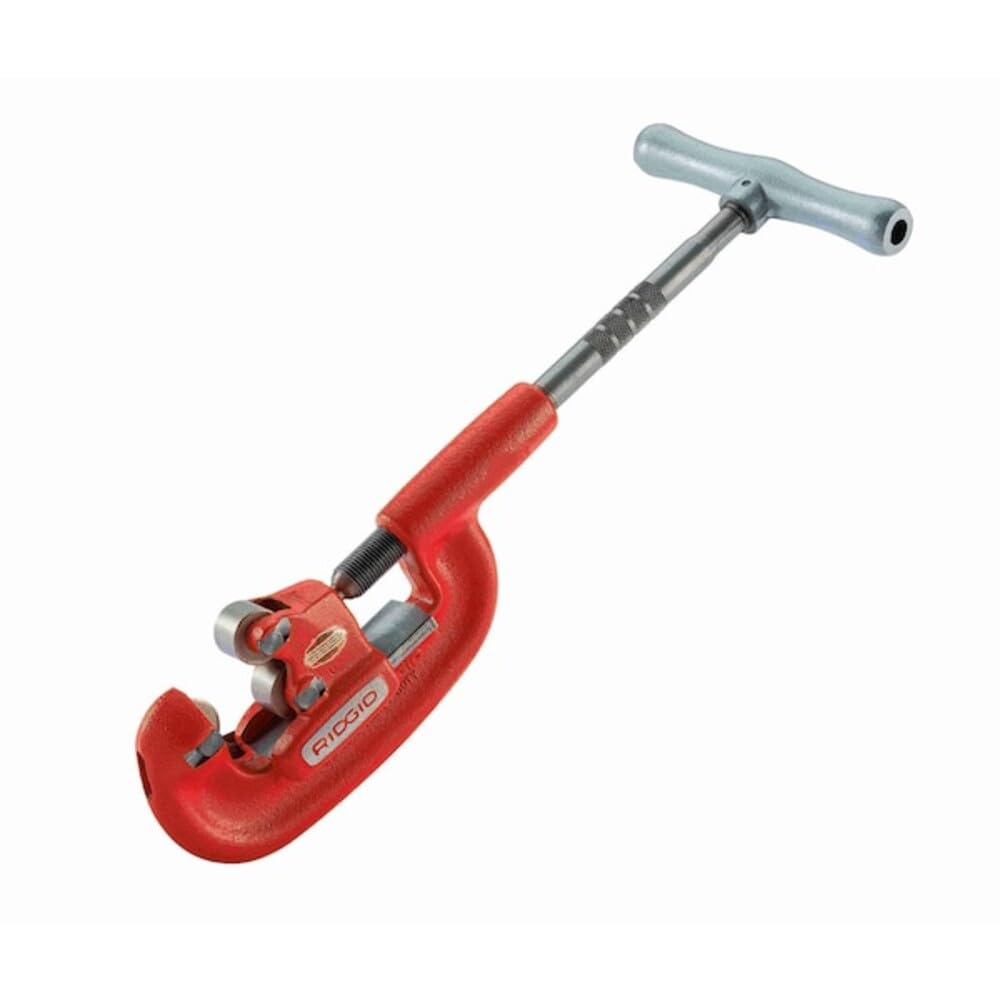
1. RIDGID 32820 Model 2-A Pipe Cutter
Our pick — 4.5+★ from 250+ verified ratings; the strongest balance of quality and price.
The shop-standard cutter that keeps a square line on black pipe and stainless.
This is the cutter most working plumbers reach for by habit. It handles 1/8-inch to 2-inch pipe, so it covers black pipe, galvanized, and heavy-wall steel in one tool. The extra-long shank (the threaded body that carries the adjusting screw) guards the adjustment threads from knocks on the job site, which is a small thing until the threads get bent and the knob stops feeding evenly.
Owners keep this cutter because it holds up. Buyers report it is well-made and durable, and owners mention it cuts 1/2-inch and 3/4-inch black pipe especially well — the sizes behind most gas and water rough-in work. Customers note: “Customers find this pipe cutter to be well-made and durable, with one mentioning it works particularly well on 1/2″ and 3/4″ black pipe.” That cutting action is why it stays in a toolbox for years instead of a season.
Here is the part worth knowing before you commit. It is a single-wheel cutter, so you need room to swing a full turn around the pipe. In a tight chase or against a joist, that room is exactly what you do not have. The weight reads as 3.52 ounces in the listing, which does not match how a cutter this size feels in the hand — treat the listing figure with suspicion and expect a substantial tool. When a full turn is impossible, the four-wheel RIDGID 32870 further down is the better fit.
What earns it the top spot
- Covers 1/8-inch to 2-inch pipe, so one tool handles black, galvanized, and heavy-wall steel
- Extra-long shank protects the adjustment threads from site damage
- Owners consistently report clean square cuts on 1/2-inch and 3/4-inch black pipe
- Covered by a lifetime warranty from Ridge Tool against defects
Where it asks more of you
- Single wheel needs space for a full swing around the pipe
- Premium-tier cost puts it out of reach for one-off DIY jobs
- Heavier in the hand than the listing weight suggests
Reach for this if: you cut steel or black pipe often enough that a tool you trust matters more than saving at the register.
Think twice if: your work happens in tight chases where you cannot complete a full rotation.
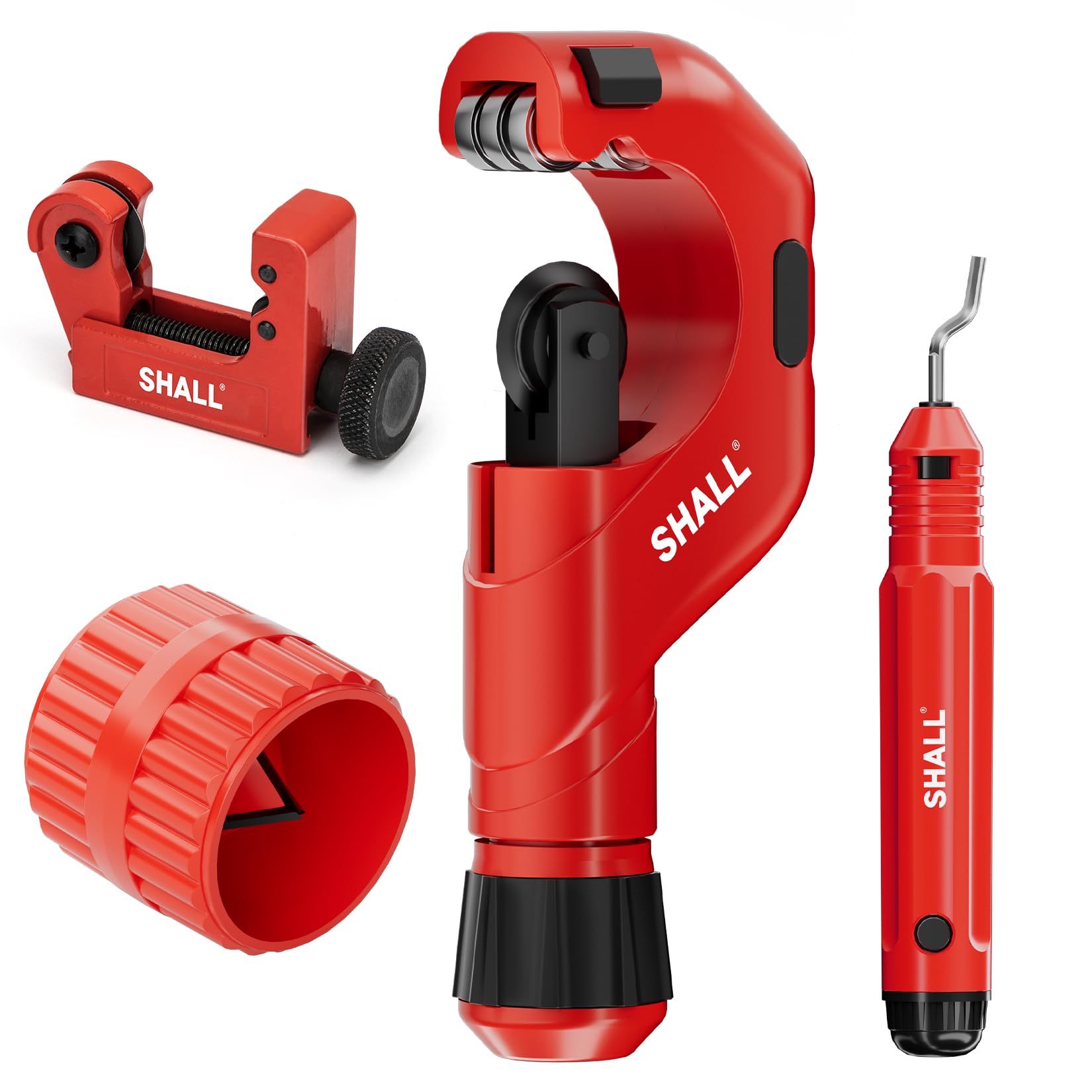
2. SHALL 4-Piece Tubing Cutter Set
Four tools in one bag: a big cutter, a mini cutter, a deburring tool, and a reamer.
Buy this one if your work is mixed rather than pure steel. The main cutter spans 1/4-inch to 2-inch outside diameter and is rated for copper, aluminum, stainless steel, and PVC. The mini cutter handles 1/8-inch to 7/8-inch tube and gets into narrow spaces the full-size body cannot reach. You also get a deburring tool and a pipe reamer, so the cut end gets cleaned up without a second trip to the toolbox.
The cutting performance is the honest wrinkle. The blades do go through steel — reviewers point out cutting steel pipe with ease — but a few note the big cutter can crimp or indent instead of slicing cleanly on larger diameters. That is the nature of an aluminum-alloy body feeding a single wheel under hand pressure; it works, but it rewards a light, patient feed over forcing the knob. The reamers are the quiet win here, and shoppers say they clean the cut edges of copper pipe well.
You can carry the whole kit in a tool bag and barely notice it, because it weighs 1.61 pounds. It is also the most compact option on this list by a wide margin: the listing dimensions read 1 x 1 x 1 inches, against 17.72 x 7.87 x 3.27 inches for the RIDGID 32820. That tells you the kit is built to pack flat, not to win a leverage contest.
The kit logic: four pieces means you stop buying a second tool the moment the pipe size changes. For a homeowner running copper and the occasional stainless, that is the whole argument.
The honest limit: the aluminum-alloy frame and single feed wheel are not built for a steady diet of heavy-wall steel. Feed it gently and it cuts; crank it and it crimps.
Best fit: mixed-material jobs where copper, PVC, aluminum, and light steel all show up in the same afternoon.
Not the tool for: production steel cutting where every cut is heavy-wall and speed counts.
3. Pipe Cutter Tool 1/8-2″
A long-handled cutter that leans on leverage to speed up galvanized and iron work.
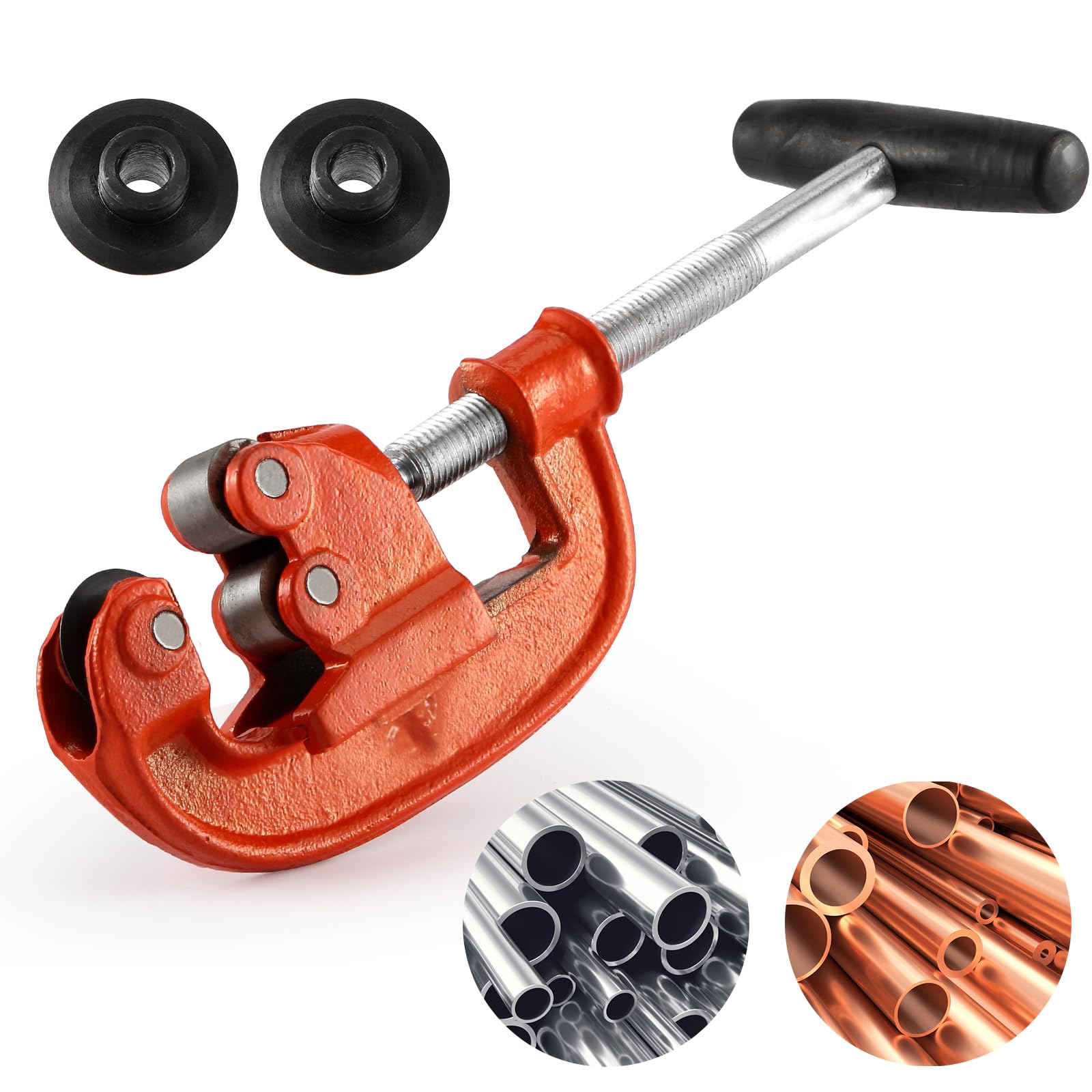
The T-style handle is the design decision that defines this cutter. It gives you leverage to tighten the blade down against the pipe, and the extra-long handle lets you apply real force without fighting the tool. A steel ball thrust bearing feed mechanism carries that load so the rotation stays smooth — that is the mechanism that keeps the wheel tracking instead of walking. It covers 1/8-inch to 2-inch pipe and ships with two additional blades, so you are not stuck mid-job when a wheel dulls.
At 3.19 pounds it is close to twice the weight of the SHALL kit at 1.61 pounds, and that mass is the point: a heavier body resists flex when you lean into a cut. Buyers report it cutting stainless steel cleanly, and it handles 1/2-inch to 1-inch EMT and IMC conduit, so it covers electrical work as well as plumbing.
The catch is consistency at the frame. Some units arrive with the steel pin that should run through the threaded shaft out of place, and the handle can twist off if you overpower it. Feed it steadily rather than horsing it, and it behaves. Treat this as a workhorse for lighter steel and conduit, not as a replacement for a shop-grade cutter on heavy-wall pipe.
The leverage story: the long handle and ball bearing feed are what let you cut galvanized and iron without resetting the wheel every few turns.
Size it honestly: the build holds up for standard steel and conduit. Push it past that and the frame is where you will notice it.
Go with this one for: galvanized pipe and EMT conduit where the long handle saves your forearms on a long run.
Pass if: you need a cutter that shrugs off being forced — this one asks for a steady hand instead.
4. QWORK Heavy Duty Pipe Cutter
One job, done deliberately: rigid iron and steel from 1/8 inch to 2 inches.
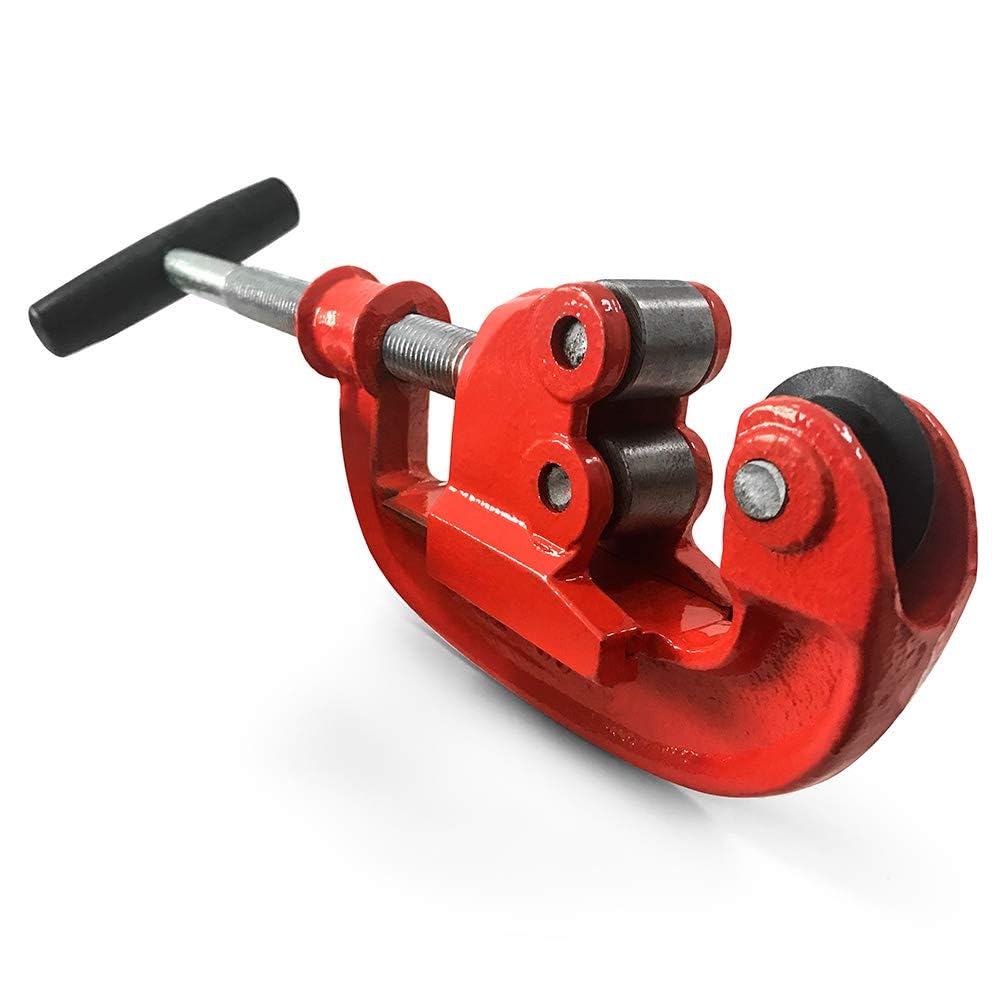
Read the spec sheet carefully before you buy this one, because it is not a general-purpose cutter. The maker states plainly that it is designed for tough iron and steel tubing and is not suitable for aluminum or copper pipes. That narrowness is the point — a wheel and frame tuned for rigid pipe tracks differently than a cutter built to handle soft copper without crushing it.
The frame uses wide rollers and a reinforced steel body to keep the pipe from spiraling, plus a steel ball thrust bearing feed for square, burr-free cuts. The extra-long handle gives you torque to tighten and rotate with less effort, and a spare blade is in the box. Owners cutting iron and steel report straight, smooth cuts repeatedly — one noted roughly twenty cuts, all square.
The honest caveat is consistency. Some units arrive with the guide wheels loose enough on their pins that the cutter spirals instead of tracking, and one buyer found it out of alignment on the first ½-inch galvanized cut. It is also a big tool with a large turning handle — no surprise there, and the leverage is welcome. Check the rollers for play before you start, and it does its job on iron and steel.
Why iron workers like it
- Wide rollers and reinforced steel frame resist spiraling on rigid pipe
- Extra-long handle delivers torque with less hand strain
- Spare blade included so a dull wheel does not stop the job
- Owners mention straight, square cuts on repeated use
The fine print
- Not for copper or aluminum — this is iron and steel only
- Guide wheel play varies unit to unit, so check alignment before cutting
- Large body and handle need more clearance around the pipe
The right buyer: someone cutting black iron and galvanized steel and nothing else.
The wrong buyer: anyone who also runs copper — this cutter will not do that job.
5. Godora 1/8–2″ Pipe Cutter
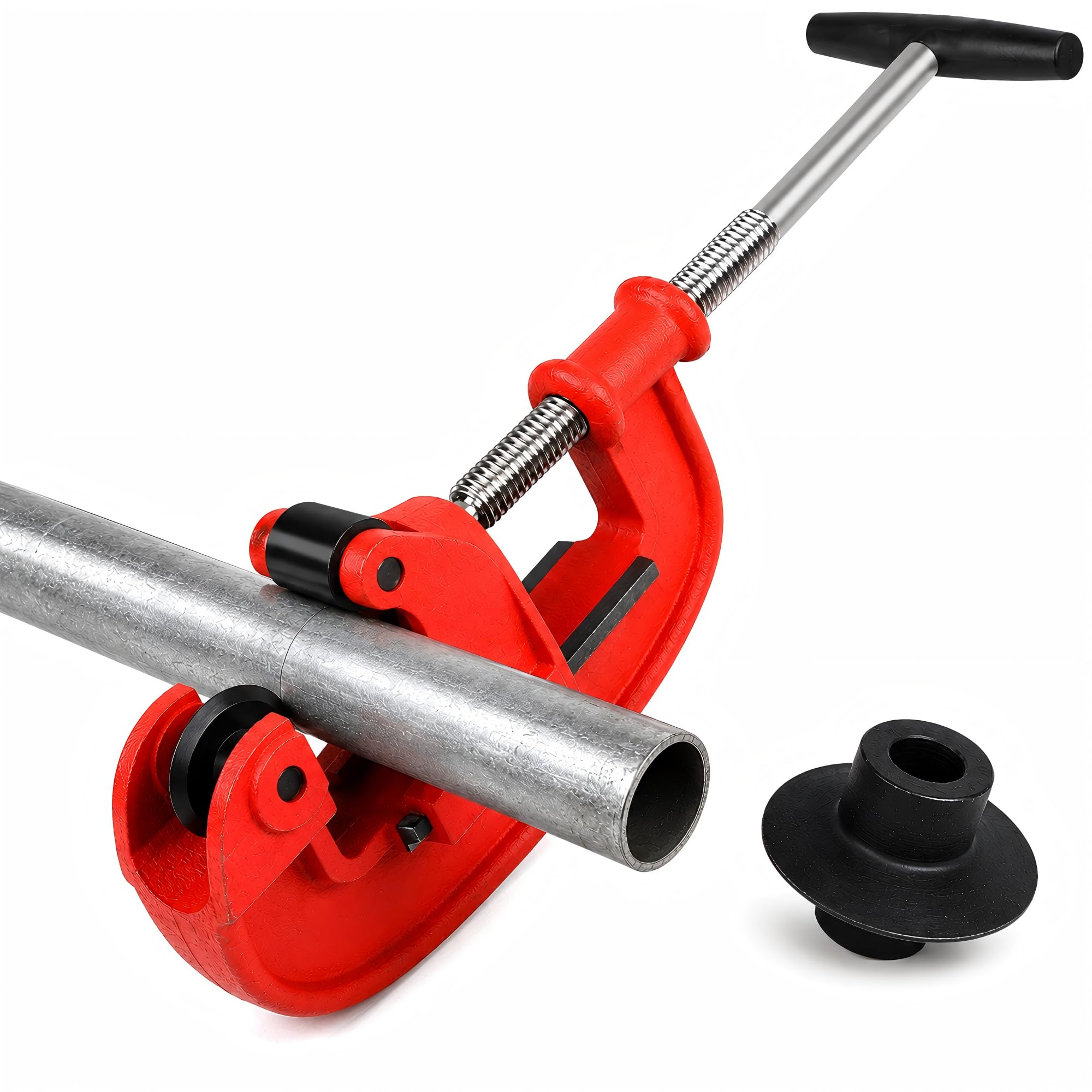
A 3-pound steel body that takes big galvanized tube and exhaust pipe in stride.
Build quality is what this cutter sells on, and the weight backs it up at 3 pounds. The frame is high-quality steel with a ball thrust bearing feed and a sharp cutter head, all aimed at flat, clean, burr-free straight cuts. It covers 1/8-inch to 2-inch iron and galvanized pipe, and it ships with an extra cutter wheel and an instruction manual.
Owners take it to places a lighter tool struggles. Customers note it cutting heavy galvanized 2-inch tube and black 3/4-inch pipe for a run of 30 woodworking clamps. It also cuts stainless steel exhaust pipe, with one report of a cut through in about three to four minutes. For a hobbyist who needs to cut exhaust tubing without dragging out a chain cutter, that is the real use case.
The trade-off shows up in the wheel and the opening. Some users find the cutter wheel dulls quickly and the cut starts wandering, and the frame does not open wide enough for some large-diameter work. The extra blade in the box covers the first part; the second is a hard limit, so measure your pipe before you order. It is also on the heavy side, which is exactly what you want when leaning into a cut and exactly what tires your arm after the twentieth one.
Where it shines: heavy galvanized and stainless exhaust work, where the 3-pound body keeps the wheel planted instead of chattering.
Where it stops: the jaw opening has a ceiling. If your pipe sits near the top of the range, check the opening against your diameter first.
Pick it when: you want a substantial steel frame for galvanized tube and exhaust pipe and do not mind the mass.
Look elsewhere when: your work is overhead or one-handed — 3 pounds gets old fast.
6. Steel Dragon Tools 32820 Model 2A Pipe Cutter

A 2A-pattern cutter that takes RIDGID parts and can grow a third wheel.
This is the value play on the 2A pattern. Every part is compatible with RIDGID 2A pipe cutters, so the wear items and the extra-long shank follow a known design rather than a one-off. It runs manually or machine-powered, and it can be converted to a three-wheel cutter for a faster cut — a real option if you plan to put it on a power drive later.
At 7.85 pounds it is by far the heaviest tool on this list, which is the price of a cast body built to the 2A pattern. Owners who get a good unit report clean straight cuts and better value than the store-brand equivalents. The appeal is straightforward: you get the geometry of a proven cutter without the flagship markup.
The thing to go in with your eyes open about is the cutting wheel. Reports of wheels chipping on the first use and snapping after a few cuts show up more than once, and the machining on the slide is described as having play. If you buy this, budget for a quality replacement wheel and check the slide for slop before the first cut. A good wheel on a straight frame is where the cut quality actually comes from.
The compatibility angle: RIDGID 2A parts fit, so upgrades and replacements are easy to source and the tool stays serviceable.
The wheel reality: the included cutting wheel is the weak link. Factor a better one into the plan and the frame does its part.
Worth it for: anyone who wants 2A-pattern geometry and RIDGID parts compatibility without the flagship price.
Reconsider if: you want a cutter that works flawlessly from the start with the supplied wheel.
7. Steel Dragon Tools 74227 H4 Hinged Pipe Cutter

The big-iron answer: a hinged 2-inch to 4-inch cutter for cast and ductile iron.
This is the pick for cast iron soil pipe and ductile iron, because it starts at 2 inches and runs to 4. Everything else on this list tops out around 2 inches. It uses a full-closed frame, which the maker says gives maximum efficiency under minimal effort, and guide fingers hold the wheel in alignment for an even cut. That alignment guide is what keeps a 4-inch cast iron cut square instead of walking.
It accepts compatible Reed cutting wheels, and it cuts cast iron and ductile iron with Steel Dragon Tools H4I 03122 cutter wheels. Reviewers point out it cutting 4-inch cast iron cleanly. Against the flagship hinged cutters, shoppers say it performs as well as the more expensive brands. When a single cut on a cast iron stack is the job, that gap is worth noticing.
Weigh the size before you commit. It is a hinged tool built for large pipe, so it takes up real space in a truck box and it is not the tool you grab for 1/2-inch black pipe. Buy it for the one job that needs it — a cast iron stack replacement is exactly the scenario where a tool earns back its keep on the first use.
What it delivers on big iron
- 2-inch to 4-inch capacity covers cast iron soil pipe and ductile iron
- Full-closed frame and guide fingers hold the wheel aligned for even cuts
- Accepts compatible Reed cutting wheels and ships with H4I 03122 wheels
- Buyers report performance on par with pricier hinged cutters
What to plan around
- Built for large pipe only — too big for everyday small-diameter work
- Takes up substantial room in a toolbox or truck bed
- Premium-tier cost makes sense only if large iron is in your future
Buy this when: cast iron or ductile iron in the 2-inch to 4-inch range is the job on your list.
Leave it on the shelf when: your pipe tops out at 2 inches — the smaller cutters handle that for far less bulk.
8. RIDGID 32870 Model 42-A Heavy-Duty 4-Wheel Pipe Cutter

Four wheels and a stubby handle for the closet where nothing else fits.
This cutter exists for one scenario: a pipe you cannot walk a full turn around. The four heavy-duty wheels let you cut in short arcs instead of a continuous swing, and the short handle keeps the body compact enough to work in confined areas. It covers 3/4-inch to 2-inch pipe, the balance for residential steel and black pipe, and it carries the same lifetime warranty from RIDGID against defects in material or workmanship.
Owners point to exactly that use case — pulling plumbing that will not unthread, or reaching a fitting where a wrench will not fit. The four-wheel layout is more technique-sensitive than a single wheel, though. The first few cuts take patience to follow the guide and get square, and you will feel the learning curve before the rhythm clicks.
One point worth flagging honestly: not every report lands on the same side. The tool works for most buyers in its intended tight-space role, but there is at least one account of it not performing as advertised. Given the narrow job it is built for, that is the kind of risk you weigh against the alternative — cutting by hand in a space where no single-wheel cutter will fit.
The reason it exists: four wheels plus a short handle means you can make a cut where a full rotation is physically impossible.
The learning curve: a four-wheel cutter tracks differently than a single wheel. Give the first couple of cuts the time to get square, and the rhythm comes.
Worth owning for: tight chases, close-to-joist cuts, and any pipe where a full swing is off the table.
Hold off if: you have open access to your pipe — a single-wheel cutter is simpler to run and cheaper to buy.
Know the Specs
Pipe capacity in inches
This is the outside diameter range a cutter can wrap, written as something like 1/8-inch to 2-inch. Match it to the pipe you actually handle. A 1/8-inch to 2-inch cutter covers most residential steel and black pipe; cast iron soil pipe in the 2-inch to 4-inch range needs a hinged cutter instead. Buying a cutter that tops out below your pipe size is the most common mistake here.
Ball thrust bearing feed
The feed is the screw that pushes the cutting wheel into the pipe as you turn the knob. A steel ball thrust bearing puts a ring of steel balls under that load so the knob turns freely under pressure. That steady feed is what produces a square cut instead of a wandering groove, and it is why the better cutters feel smooth rather than gritty as you tighten down.
Number of cutting wheels
A single-wheel cutter needs room for a full turn around the pipe and is the standard for open work. A four-wheel cutter lets you cut in short arcs, which is what makes it usable in a tight closet or against a joist. The trade-off runs both ways: four wheels cost more and take more technique to track square, while a single wheel is simpler but needs clearance.
Spare blades and wheel durability
The cutting wheel is the part that wears, and it is the first thing to dull or chip. Some cutters ship with one extra blade, some with two, and the 2A-pattern tools accept replacement wheels from compatible brands. A worn wheel is what makes a cut wander, so keeping a spare in the box is the difference between finishing a job and making a trip to the store.
Common Questions
Will a standard pipe cutter work on stainless steel?
Can I use a steel pipe cutter on copper pipe?
What pipe size can a 2-inch pipe cutter handle?
Why does my pipe cutter keep spiraling off the line?
Do I need a four-wheel cutter or a single-wheel one?
How do I get a square cut on black pipe?
What is the difference between a pipe cutter and a tubing cutter?
Will a hinged pipe cutter cut cast iron?
How often should I replace the cutting wheel?
The Bottom Line
For most buyers working steel pipe, the pipe cutters for steel pipe winner is the RIDGID 32820 Model 2-A. Its 1/8-inch to 2-inch range covers black pipe, galvanized, and heavy-wall steel in one tool, and the extra-long shank protects the threads that make the feed work. If you cut mixed materials including copper and PVC, grab the SHALL 4-Piece Tubing Cutter Set for its reamer and mini cutter. And for cast iron soil pipe in the 2-inch to 4-inch range, reach for the Steel Dragon Tools H4 hinged cutter.
The honest nudge: buy the cutter that matches the pipe you actually cut, not the one with the longest feature list. A tool that fits your range and holds its line is worth more than any spare blade in the box.
How we choose
We do not accept paid placement. Every pick is matched to a real buyer and a real use-case; we do not hands-on test units.
Sources
Specifications: manufacturer listings and product documentation. Review insights: verified customer reviews, as of November 2026. Pricing: not shown on this page (it changes often); check the current price via the retailer link.
As an Amazon Associate, Tactical Gear Guy earns from qualifying purchases. This does not affect which products we feature.