Specs are compiled from manufacturer listings and verified buyer reviews and can change over time — please confirm the key details on the product page before buying.
You want a pH reading you can actually trust — one that tells you whether your sourdough starter is in range, your pool water is safe to swim in, or your canned salsa is acidic enough. The quick answer: a digital meter with automatic temperature compensation (ATC — a built-in sensor that corrects your reading for the sample’s temperature) and replaceable probe beats pH paper every time, because paper only gets you within a rough colour guess. Below are seven meters that real owners keep coming back to, split by what they actually measure.
This guide is built by comparing the manufacturers’ published specifications and the patterns across verified customer reviews, so you get each pick’s real strengths and trade-offs instead of marketing spin.
Some meters here are built for semi-solid food, some for water and hydroponics, and a couple are lab-grade instruments you calibrate once and rely on for years. The right pick depends on what you are dipping the probe into — a spear tip for dough and meat, a glass bulb for water and wort. That single decision separates a meter you use weekly from one that sits in a drawer.
Top Picks

How To Choose The Best pH Measuring Devices
A pH meter is only as good as the match between its probe and your sample. Pick the wrong tip and you get slow, drifting readings no matter how much you paid. So work through these four decisions in order before you look at any model.
Probe shape decides what you can measure
A spear tip (a pointed electrode you push into the sample) is what you want for dough, cured meat, cheese, and sushi rice, because it penetrates semi-solid food instead of sitting on the surface. A standard glass bulb works for liquids — water, wort, pool water, nutrient solution. Buying a bulb meter for bread is the most common first mistake.
Accuracy figures and what they mean in the kitchen
Look for the ± figure in the listing — that is how far off a single reading can be. A ±0.01 pH meter (like the premium food kits here) resolves finer differences, which matters when you are tracking a sourdough starter across hours. A ±0.1 pH meter is fine for pool checks and general water monitoring where a tenth of a point changes nothing.
Calibration: the routine that keeps readings honest
Every digital meter drifts and needs calibrating against buffer solutions (liquids with a known, fixed pH). Two-point calibration covers most home use; three-point covers a wider acidic-to-alkaline span. A meter that ships with its own buffer sachets and a storage cup saves you buying solutions separately.
Probe care and the replaceable-electrode question
Glass probes dry out and slow down when stored dry — storage solution keeps the bulb wet and responsive. If a probe is replaceable, you swap just the electrode when it wears out instead of the whole unit, which stretches the life of a meter you already like.
Side-by-Side Comparison
| Model | Best For | Accuracy | pH Range | Probe Type | Amazon |
|---|---|---|---|---|---|
| Apera PH20 Combo Kit (AI209-T)★ Best Overall | All-round home testing | — | — | Glass bulb | Amazon |
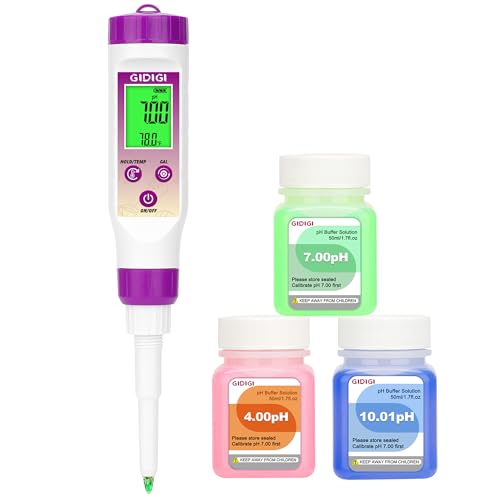
| GIDIGI Food pH Meter (GX-pH03P)Best for Fermentation | Fermentation and canning | 0.01 pH | — | Replaceable spear | Amazon |
| Bluetooth Food pH Meter | Data logging bakers | — | — | Glass bulb | Amazon |
| DANOPLUS 2 in 1 pH & Temp Meter | Hydroponics and pools | 0.1 pH | 0.0 – 14.0 pH | Replaceable BNC | Amazon |
| AC Infinity pH Pen (AC-PHM3) | Garden and aquarium | ±0.1 pH | — | Glass membrane | Amazon |
| Apera PH60S Food Kit (AI313) | Serious food work | ±0.01 pH | -2.00 – 16.00 pH | Swiss spear | Amazon |
| Milwaukee MW102 | Lab and brewing | ±0.02 pH | -2.00 – 16.00 pH | Double junction | Amazon |
Detailed Reviews
1. APERA INSTRUMENTS AI209-T PH20 pH Tester
Our pick — 4.5+★ from 850+ verified ratings; the strongest balance of quality and price.
A complete starter kit with auto-calibration, a CalPod buffer holder, and ATC from 32 to 122˚F.
You get a whole calibration routine in one box — the PH20 tester plus a maintenance set and Apera’s CalPod solution holder, which keeps your buffer liquids organised and cuts down on how much you buy. The probe carries Apera’s low-impedance sensor (a design that responds faster to the sample), so readings settle quickly instead of creeping for a minute. For kombucha, soil runoff, or a weekly homebrewing batch, that fast settling is what makes it easy.
Calibration does itself once you drop the probe into the buffer — the meter recognises the solution and auto-calibrates, and automatic temperature compensation (ATC) keeps results accurate across 32 to 122˚F. That range covers a chilly garage or a warm kitchen counter without you adjusting anything. The combo also ships with four AAA batteries so it works the moment it arrives, and the cleaning brush makes pulling contaminants off the probe a thirty-second job rather than a soak-and-scrub.
Owners praise build quality first and how consistently it holds calibration second. It has earned 4.5+ stars across 850+ ratings. The honest trade-off: this is a glass-bulb probe made for liquids and soft samples, so push it into dense dough or cured meat and it will not give you the clean read a spear tip does. Buyers do flag durability as the split opinion — treat the bulb gently, keep it wet in storage solution, and it holds up fine.
Why owners keep it on the bench
- Auto-calibration with buffer recognition takes the guesswork out of the routine
- CalPod holder and buffer kit keep your solutions organised and stretch how far they go
- ATC accurate from 32 to 122˚F, so cold or warm samples read true
- Cleaning brush and included batteries mean it is ready on day one
Where it asks for care
- Glass-bulb probe is not the right tool for dense semi-solid food — a spear tip handles that better
- At 3.3 pounds the kit is the heaviest pick here, so it lives on a shelf rather than in a pocket
The right call if: you want one reliable meter for liquids and light testing with calibration handled for you.
Look past it if: your main job is pushing a probe into dough, meat, or cheese — you need the spear tip further down.
2. pH Meter for Food Fermentation Spear Probe
A pointed probe built to stab straight into dough and cured meat, not sit on top of them.
The spear electrode is the story here. It penetrates sourdough, sausage, and cheese rather than resting on a surface, and it reads in about 30 seconds — fast enough that you actually test mid-process instead of skipping it. Accuracy runs to 0.01 pH with ATC correcting across 32 to 140˚F samples, so a warm ferment and a fridge-cold one both give you numbers you can trust. If you are canning salsa or hot sauce and need to confirm acidity before the jar goes in the bath, this is the tool shaped for that job.
Compared with the Apera kit above, this meter is a fraction of the bulk at 1.01 pounds and it is the one you can carry to the kitchen counter, the brew bench, or a skincare batch without a second thought. Three 1.7 fl oz buffer solutions (pH 4.00, 7.00, and 10.01) come in the box for three-point calibration, plus a carrying case. Buyers report it recalibrates in under five minutes, which keeps the whole routine short.
Owners praise accuracy most, and it holds across sourdough starters, kombucha, wine, and even lotion and soap making. The replaceable spear electrode is the quiet win: when the probe wears out you swap the tip, not the whole unit. One thing to size honestly — the calibration step draws mixed reactions, with the buffer routine occasionally fussing on some units. Follow the two-minute procedure in the manual and it settles down.
The case for the spear: semi-solid food is exactly what trips up bulb meters, and this electrode is purpose-built for bread yeast, curing meat, and cheese.
The catch to know: calibration feedback is not unanimous — a few find the buffer step fiddly, so plan to calibrate before a canning session rather than mid-recipe.
Reach for this if: canning, charcuterie, or sourdough is your main use and you want a light meter that stabs into the food.
Leave it if: you only ever test clear liquids — a bulb meter covers that without a spear tip.
3. Food pH Meter Digital
For the baker who tracks a starter’s pH curve over hours, not just a single reading.
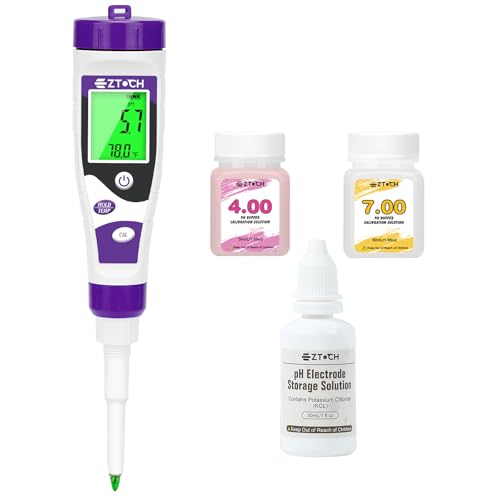
Bluetooth is the differentiator. This meter pairs with the YINMIK app, saves each reading as you take it, and auto-stores up to 1,000 data points so you can look back at how a ferment progressed. If you monitor sourdough (the listing points to the 3.5 to 5 pH range for yeast) and want the history rather than a scribbled note, that logging is what separates it from every other pick here. A backlit display means dim light in a kitchen or brew room does not slow you down.
It arrives calibrated and ready, and two buffer solutions (pH 7.00 and 4.00) are included for future calibration so a drift does not mean a new purchase. The 30ml probe protective solution keeps the bulb wet between uses, which is what protects the reading quality you paid for. Canning guidance is spelled out too — high-acid foods below 4.6 pH suit a water bath, low-acid foods above it call for pressure canning — so the meter doubles as a safety check before any jar goes in the pot.
Functionality earns the most praise, and the Bluetooth app logging is why people call it a kitchen staple. It has the highest rating of the food-focused picks at 4.5+ stars, and it weighs 1.04 pounds, so it moves from shelf to counter easily. One honest limit: this is a glass-bulb body, so the same care applies — keep the bulb in its solution and do not jam it into a dense, sticky dough. The package footprint is the larger 11.46 x 6.14 x 2.05 inches, which is worth knowing if kitchen drawer space is tight.
Standout feature: Bluetooth plus 1,000-point auto-save turns your pH checks into a record you can actually analyse later.
Trade-off to note: it is a liquid-and-soft-sample body, and the box is one of the bulkier ones here — plan a shelf and treat the bulb like glassware.
Built for: bakers and brewers who want their readings logged in an app rather than jotted on paper.
Not for: anyone who wants a spear tip for pushing into meat or dense cheese.
4. 2 in 1 pH & Temperature Meter

The one that hangs on the wall and watches your tank around the clock.
Most handheld pH meters sit in a drawer until you reach for them. This one is designed to stay put — a tripod holder, a hang option, and a wall-mount option mean it can live beside a hydroponic reservoir, an aquarium, or a pool and read at a glance. The dual display shows pH and temperature together, and the backlit screen stays legible in a dim grow room or a shaded pool shed. It reads 0.0 to 14.0 pH at 0.1 pH accuracy, which is the right resolution for water work.
Calibration is a one-key affair against pH 4.00, 7.0, and 10.01 buffers, so even a stand-mounted unit is quick to bring back to spec. The pH electrode is replaceable via a standard BNC connector — the same twist-lock fitting used across lab equipment — so a worn probe is a swap rather than a new meter. Temperature is measured by a separate probe with 0.5°C accuracy across -5.0 to 60.0°C, and you can switch between Fahrenheit and Celsius on the display.
If your job is monitoring rather than sampling, the mounting flexibility beats a handheld every time. The catch is straightforward — 0.1 pH accuracy is coarse next to the 0.01 pH food kits here, so it is the wrong tool if you are chasing fine acidity changes in a ferment.
What it solves: continuous, hands-free monitoring with pH and temperature side by side, mountable three ways.
Its honest ceiling: 0.1 pH resolution suits water quality checks, not the fine-grained acidity tracking a brewer or baker wants.
Best when: you want a meter that lives near the tank or pool and reads without being held.
Skip for: precise fermentation work where a tenth of a pH point is too coarse.
5. AC Infinity Digital pH Meter Kit, Precision pH Pen
A pen that shrugs off splashes, dust, and sand while you check the garden or aquarium.
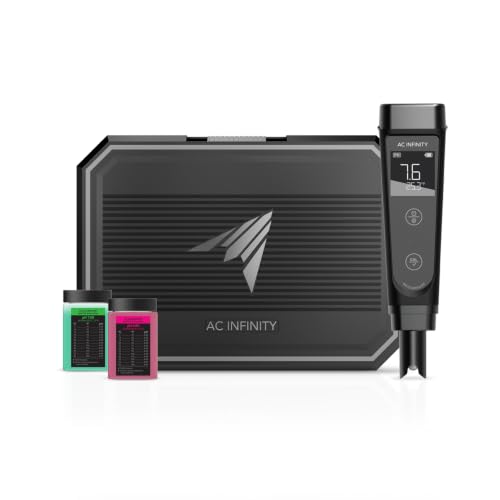
IP67 is the number to know. That rating means the body is sealed against high-volume moisture, dust, and sand — so a splash from a reservoir, a dusty greenhouse shelf, or wet hands does not end the day. It measures pH plus temperature, and the sensitive glass membrane gives instant pH readings. Accuracy holds ±0.1 pH, which is the practical standard for gardens, aquariums, and pools where a tenth of a point is plenty.
The kit arrives with ready-to-use 4.00 and 7.00 buffer solutions, so calibration is a two-bottle, ten-minute task you can repeat whenever a reading looks off. The pen form at 7.01 x 1.65 x 1.18 inches tucks into a pocket or a pocket of a grow bag. In a head-to-head with the monitor-ready DANOPLUS above, this one is the better travel companion — you dip, read, and cap it, and the sealing means you are not babying it in a wet environment.
Overall the meter reads as reliable and good value, with calibration described as straightforward. The one split in feedback is accuracy — some find it on point, some report calibration issues — so calibrate before trusting a borderline reading, especially for a nutrient reservoir where you are deciding whether to adjust. It is the tool for people who want the job done without fuss, not for anyone chasing lab-grade 0.01 resolution.
Where this pen earns its keep
- IP67 sealing stands up to splashes, dust, and sand in a real working environment
- Ships with 4.00 and 7.00 buffers for repeatable two-point calibration
- Pocket-sized at 7.01 x 1.65 x 1.18 inches for garden or aquarium duty
What to plan around
- Accuracy feedback is mixed, so recalibrate before any borderline decision
- ±0.1 pH is coarse for fine fermentation tracking
Pocket this one if: your testing happens in a wet, dusty, or outdoor setting and durability matters more than sub-tenth precision.
Pass if: you need 0.01 pH resolution for a sourdough or brewing log.
6. Apera Instruments PH60S Food pH Meter

The food-grade spear for cheese, sushi rice, and yogurt, with a range nothing else here matches.
Start with the electrode: it is a food-grade Swiss spear, replaceable, built for cheese, sushi rice, fruit, milk, yogurt, sauce, and skincare products — and it works for general water solutions too. Accuracy runs to ±0.01 pH across a -2.00 to 16.00 pH range, the widest span in this guide. That range goes beyond ordinary pH 0–14 territory, which matters in dairy and specialty food work where readings can push toward the extremes. Calibration is automatic with temperature compensation handled for you.
The display does more than show numbers. It has three backlit colours for three different modes, a dual pH and temperature readout, and a high/low alarm that flashes red when a result crosses the limits you set. For someone making cheese or monitoring a delicate sauce, that instant visual warning is the difference between catching a drift and losing a batch. The kit is complete — calibration solutions, calibration bottles, storage solution, AAA batteries, and a lanyard, all in a carrying case — and at 5.1 ounces it is light enough to keep in a kitchen drawer.
Quality is what owners talk about first, with accuracy close behind. It has 4.5+ stars, and the consistent theme is stable, accurate readings with a quick setup. Against the GIDIGI spear above, this is the step up in precision — ±0.01 pH versus 0.01 pH both aim fine, but the Apera adds the wider range, the three-mode display, and the alarm function the other lacks. The real consideration is whether your work justifies the premium tier: for a casual canner testing a few salsas a year, the mid-range spear does the job.
The precision argument: ±0.01 pH accuracy and a -2.00 to 16.00 range make this the most capable food meter here.
The honest question: it costs more than the mid-range spear, so the alarm and wide range have to matter to your workflow to be worth it.
Choose it if: cheese-making, dairy, or precision food work is a serious hobby and you want the widest range with a visual warning.
Scale back if: occasional canning is all you need — the mid-range spear covers that at less.
7. Milwaukee Portable pH/Temperature Meter – MW102

The pro-lab instrument with a 300-hour battery and a gel-filled electrode built for the long haul.
Battery life is the figure that sets this apart in daily use. A single 9V battery runs the MW102 for 300 hours — a season of brew-day checks without thinking about power. Accuracy holds ±0.02 pH across a -2.00 to 16.00 pH range, and the electrode is a gel-filled, double-junction lab-grade design (two reference chambers that resist contamination from the sample), which is what gives it low-maintenance stability across many readings. Temperature compensation comes from a stainless probe for fast, automatic correction.
Calibration is automatic up to two points, and the large digital LCD is built to be read at a glance. The package includes the meter, an SE 220 pH probe, a temperature probe, and a carrying case, so it is a working kit rather than a bare pen. Against the Apera food kits above, this is the pick for brewing and lab-style testing rather than dough and cheese — the double junction handles messy samples while keeping the reference stable, and 300 hours between battery changes is a workload the handhelds here cannot match.
Accuracy is by far what owners value most, with reliability a close second — the recurring picture is a professional-grade instrument that works the same way every time. Versatility shows up too, with homebrewing a common use. The honest note: calibration draws mixed feedback, and reading speed splits opinion too, so expect to spend time on setup and to give the probe a few seconds to settle. At 12.4 pounds with the case, this is bench equipment, not a pocket tool.
Why the pros reach for it
- 300 hours on one 9V battery — power stops being part of your routine
- ±0.02 pH across a -2.00 to 16.00 range with fast automatic temperature compensation
- Gel-filled double-junction electrode for low-maintenance, contamination-resistant readings
- Full kit with SE 220 probe, temperature probe, and carrying case
The realistic downside
- Calibration and reading speed draw split reactions — budget time for setup and settling
- 12.4 pounds with the case makes it a bench instrument, not a portable one
Made for: homebrewers and lab-style testers who want a professional instrument that holds accuracy over long sessions.
Think twice if: you need a pocket meter for quick kitchen dips — the case and weight say bench, not pocket.
Know the Specs
Accuracy (±pH)
The ± number tells you how far a single reading can stray from the true value. A ±0.01 pH meter resolves small changes, which suits fermentation tracking and dairy work. A ±0.1 pH meter is fine for pools, aquariums, and gardens where a tenth of a point does not change your decision. Match the accuracy figure to how fine a decision you are making, not to the biggest number.
Automatic Temperature Compensation (ATC)
pH shifts as a sample warms or cools, so a meter without ATC can report a change that is really just temperature. ATC reads the sample’s temperature and corrects the result automatically. Meters here correct across ranges like 32 to 122˚F or 32 to 140˚F, so cold ferments and warm sauces both read true without you adjusting anything.
Probe Type: Spear vs Glass Bulb
A spear tip pushes into dough, meat, cheese, and semi-solid food for a reading inside the sample. A glass bulb reads liquids — water, wort, pool water, nutrient solution. Match the tip to what you test most. A bulb jammed into dense food reads slowly and risks damage; a spear dipped in clear water works but is overkill.
Range and Calibration Points
Range tells you the pH span the meter can read. Standard water meters cover 0.0 to 14.0 pH; food and lab meters here stretch to -2.00 to 16.00 pH. Calibration points are how many buffers you check against — two-point (often 4.00 and 7.00) covers home use, three-point adds 10.01 for a wider alkaline span.
Common Questions
Will a glass-bulb pH meter work for testing bread dough or cured meat?
How often do I need to calibrate a pH meter?
What is the difference between 0.01 pH and 0.1 pH accuracy?
Can I use a water pH pen to test my canning salsa?
How long do the buffer calibration solutions last?
Do I need a replaceable probe?
Is a pH meter better than pH test strips?
Can these meters measure temperature as well as pH?
How should I store the probe between tests?
Will a portable pH meter survive outdoor or wet use?
The Bottom Line
For most home testers, the ph measuring devices winner is the Apera PH20 Combo Kit — it handles calibration for you, corrects across 32 to 122˚F, and arrives with everything organised in one box. That combination is why it sits at the top of this guide with 4.5+ stars across 850+ ratings, earning the crowd’s trust. If your real work is food, reach for the GIDIGI spear meter for dough and canning, or step up to the Apera PH60S if you want ±0.01 pH accuracy with an alarm and the widest range. Brewers and lab-style testers should look at the Milwaukee MW102 for its 300-hour battery and gel-filled electrode. Whatever you pick, calibrate it against fresh buffers before a session you care about — a well-kept probe is what keeps every one of these meters honest.
How we choose
We do not accept paid placement. Every pick is matched to a real buyer and a real use-case; we do not hands-on test units.
Sources
Specifications: manufacturer listings and product documentation. Review insights: verified customer reviews, as of November 2026. Pricing: not shown on this page (it changes often); check the current price via the retailer link.
As an Amazon Associate, Tactical Gear Guy earns from qualifying purchases. This does not affect which products we feature.