Specs are compiled from manufacturer listings and verified buyer reviews and can change over time — please confirm the key details on the product page before buying.
Buying a cue tip is the cheapest way to change how your cue feels — and the easiest way to waste money if you grab the wrong hardness. The fix is simple: match the tip hardness to the shot you actually play, then check the diameter against your ferrule before you order. This guide sorts the laminated tips from the handy repair kits, and it tells you which one suits your game instead of which one has the loudest label.
This guide is built by comparing the manufacturers’ published specifications and the patterns across verified customer reviews, so you get each pick’s real strengths and trade-offs instead of marketing spin.
Every pick below is a cue-stick part you can actually fit, from a 13 mm Kamui tip to a 39-piece repair kit, and each one carries a plain-English note on what it changes at the table. Read on for the cue-stick parts that keep your shaft shooting straight and your tip holding shape.
Top Picks


How To Choose The Best Parts for Cue Stick
The mistake most players make is buying a tip by reputation instead of by fit. A cue tip only plays well when three things line up: the diameter matches your ferrule, the hardness matches your stroke, and the material lasts long enough to be worth gluing on. Get those three right and even a budget tip seats flush, holds chalk and plays sharp.
Match the diameter to your ferrule, not the other way around
You want a tip that sits flush on the ferrule (the white collar at the end of your shaft), so measure across its face in millimeters. A 13 mm tip on a 13 mm ferrule trims cleanly and looks right. A 14 mm tip on a narrower shaft leaves an overhang you have to sand down, and too much sanding rounds the edge that holds chalk. Measure your ferrule with calipers or check your cue’s spec sheet before you order — the tip sizes here run from 10 mm up to 14 mm, and the soft, medium and hard versions usually share the same diameter.
Pick hardness by the shot you play most
Soft tips grab the cue ball and let you load spin with a shorter stroke, which suits players who work the ball around the table. Medium tips split the difference and stay predictable on both draw and follow. Hard tips hold their shape longest and punch through a break without flattening, but they give less bite on delicate spin shots. If you are unsure, a medium is the safe landing spot — it is why so many of the laminated tips here come in a medium build.
Laminated versus single-layer leather
A laminated tip is stacked from several thin layers of leather pressed together, so it resists mushrooming (the squashed lip that forms around the edge) and holds its shape longer than a solid leather tip. Single-layer tips are cheaper and simpler but need more trimming. If you hate reshaping your tip every few weeks, laminated is the build to look for.
Don’t forget the small hardware
Tips wear out, but a chipped joint collar or a bent pin can sideline a cue for good. Joint protectors screw onto the pin and the shaft thread to keep dust and knocks off both. A replacement pin and insert lets you swap a worn joint. And a repair kit with clamps, shapers and spare tips means you can re-tip at home instead of paying a shop every time. Think of these as the cheap insurance that keeps a chipped collar or bent pin from sidelining the cue.
Side-by-Side Comparison
| Model | Best For | Type | Size | Hardness | Amazon |
|---|---|---|---|---|---|
| KAMUI Clear Black Laminated Cue Tip★ Best Overall | All-round play, easy install | Laminated tip | 13 mm | Medium | Amazon |
| 6pcs 14mm Black Multiple Layer Pigskin Cue TipsStock-Up Value | Stocking up on spares | Laminated tip set | 14 mm | H / M / S mix | Amazon |
| CRICAL 5-Piece Pool Cue TipsSize Range Pick | Custom cue fits | Laminated tip set | 10.5 mm | Soft / Medium / Hard | Amazon |
| Vefungyan Billiard Pool Cue Repair Kit | Full home re-tipping | Repair kit | 13 mm tips | — | Amazon |
| Colaxi 3X Joint Protector | Protecting the joint | Joint protector | 3/8 x 10 joint | — | Amazon |
| Tiger Everest Laminated Cue Tip | Heavy-use cues | Laminated tip | 14 mm | Hits medium | Amazon |
| TIGER SNIPER Laminated Cue Tip | Draw and spin control | Laminated tip | 13 mm | Soft-Medium | Amazon |
| Cuefits QR Joint Pin Screw & Insert | Joint repair and swaps | Joint pin + insert | Uniloc QR compatible | — | Amazon |
| Predator Victory Medium Cue Tip | Long-lasting shape | Laminated tip | — | Medium | Amazon |
Detailed Reviews
1. KAMUI Clear Black Laminated Pool Billiard CUE TIP – 1 pc
Our pick — 4.5+★ from 250+ verified ratings; the strongest balance of quality and price.
The 13 mm medium that installs flat and plays the same every time
The Kamui Clear Black earns the top spot for one reason: it takes the guesswork out of gluing on a tip. The glue side of the tip arrives flat, so you skip the sanding step that ruins more tips than bad leather ever does. At 13 mm it is the standard size for most common shafts, and at 2 g it adds almost nothing to the end of your cue — your balance stays exactly where it was before the change.
What wins people over is the quality of the leather itself, by a wide margin over every other point in the feedback. Players describe a firm, clean feel at contact with the kind of feedback that tells you where you struck the ball. The build also limits how much glue soaks into the bottom layer, which keeps the tip from going spongy over time. It is a medium, so it handles draw, follow and spin without the mushy edge of a soft tip or the stingy grip of a hard one.
Here is the honest catch: this is one tip, and it is priced like a premium single rather than a multipack — the 6-piece pigskin set below gives you six tips and six hardnesses, if volume matters more to you than one clean install. skip it if you want to experiment across three hardnesses in one order. Pick it if you already know medium is your hardness and you want the install to go right the first time.
Why players keep coming back
- Flat glue side means no sanding and a perfectly aligned install.
- Glue shield keeps the bottom layer from soaking up adhesive.
- 13 mm medium handles spin and control across the whole game.
- Only 2 g, so cue balance barely shifts.
Where it stings
- One tip per order — no spare if you fumble the install.
- Premium single-tip pricing compared with multipacks.
Reach for this if: you play medium, want a flat glue-side install, and value consistency over buying in bulk.
Look elsewhere if: you want six tips and three hardnesses in one purchase.
2. 6pcs 14mm Black Multiple Layer Pigskin Pool Cue Tips H M S
Six tips in one bag, so a bad install never ends your night
If your cue tip habit runs to re-tipping often, this six-pack is the sane buy. Each tip is a 14 mm, six-layer pigskin build, and the set splits across hard, medium and soft so you can feel the difference on your own cue before committing to one. Six tips here against the one Kamui above is exactly the trade — volume versus a single premium install.
Value and quality are what pull people in, with the solid build of the leather drawing the most praise of anything in the feedback. The tips shape easily, which matters if you do your own maintenance at the table, and players note the fresh tip cuts miscues down once it is shaped and chalked. The 14 mm face suits wider ferrules and trims down easily if your shaft is a touch narrower.
Before you buy, sort out hardness feel and install fit — the softness gets mixed reactions, with some loving the give and others finding the harder options stiffer than expected, and installation feedback is split too. Neither is a defect; it is a matter of matching the tip to your stroke. Start with the medium, shape it to your ferrule, and keep the hard and soft for when your game shifts.
Best for bulk buyers: six tips across three hardnesses makes this the practical pick for a home table and a regular re-tipping habit.
Sizing note: at 14 mm these suit wider ferrules; trim carefully if your shaft runs narrower so you keep a clean edge.
Suits you if: you want spare tips on hand across all three hardnesses without paying premium single-tip money.
Think it over if: you need a specific single hardness dialed in and dislike sorting through a mixed set.
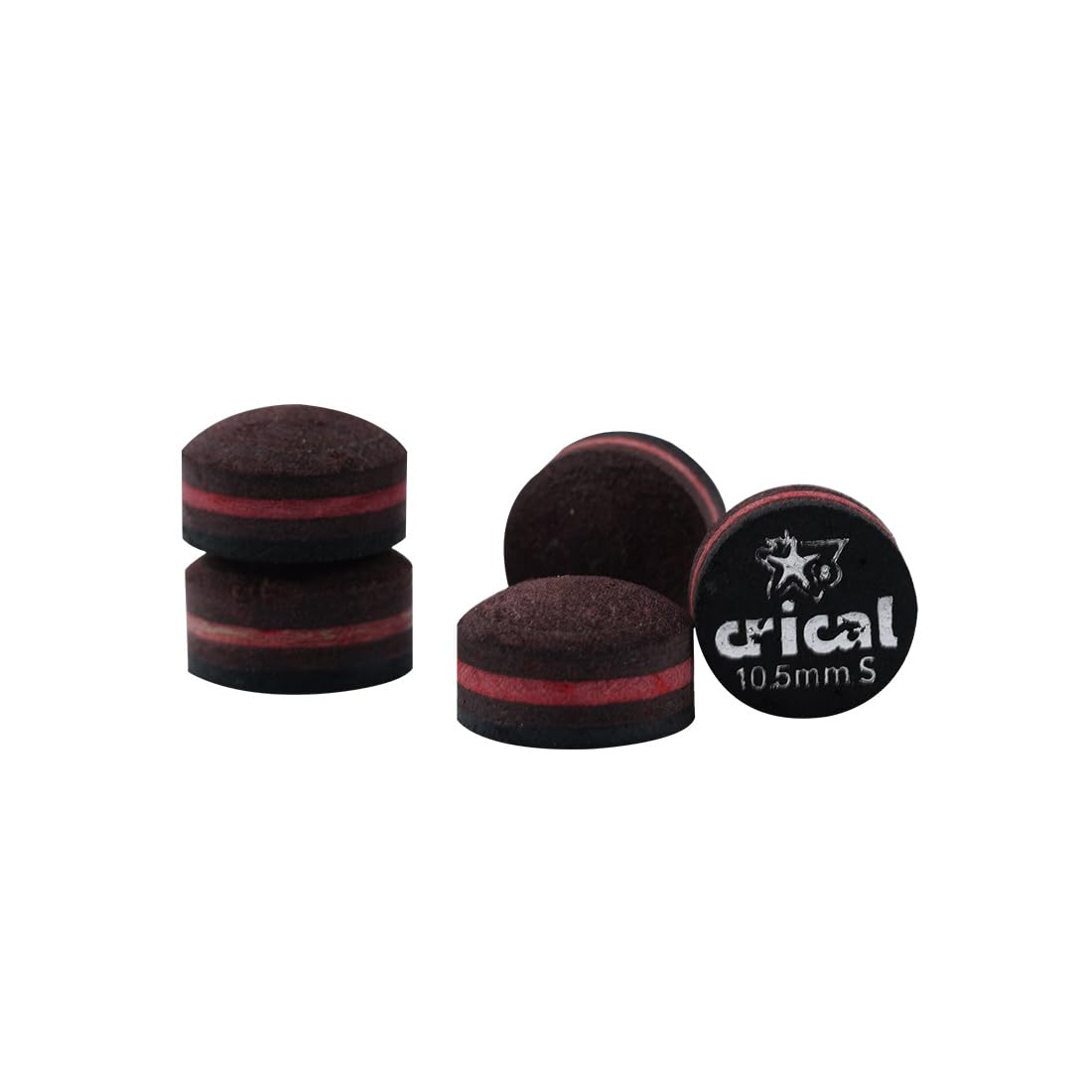
3. CRICAL 5-Piece Pool Cue Tips
Built-in wear indicator that tells you when to swap, not guess
The smart bit here is the wear indicator — a marker inside the tip that shows when the leather has been shaped down enough to replace. That takes the guesswork out of re-tipping. These are six-layer Japanese pigskin tips built with high-strength microfiber, which is what helps them resist mushrooming and hold their shape shot after shot.
Reach for the CRICAL set when your shaft is not a stock width. It comes in six diameters — 10 mm, 10.5 mm, 11 mm, 11.5 mm, 12 mm and 13 mm — so a custom cue or a slimmer ferrule gets an exact fit instead of a 14 mm tip trimmed down. The tip listed here is the 10.5 mm, the slimmest in the range, so a custom or slim ferrule gets an exact match instead of a trimmed-down oversize tip.
Quality lands as the strongest point in the feedback, with the tip build itself close behind. Reliability is more of a mixed read — many say the tips work fine for them, and it is worth shaping and seating each one carefully rather than assuming every tip in a five-pack plays identically. Read the listing closely for the size you ordered, since the range is broad and the option you pick decides the fit.
Fit-first appeal: six diameter choices mean a slimmer or custom shaft gets an exact match rather than a trimmed-down oversize tip.
Do this one thing: check the size option against your ferrule before ordering, and seat each tip with care — consistency across the pack is where the mixed notes land.
Pick this when: your ferrule is not standard and you want a tip that physically matches it plus a wear marker to guide the swap.
Choose another if: your shaft is a plain 14 mm and you just want the simplest fit possible.
4. Vefungyan Billiard Pool Cue Repair Kit

Everything to re-tip at home, including the clamp that holds it steady
This kit is less a tip and more a small workshop in a bag. The 39 pieces cover 20 cue tips at 13 mm by 0.51 inch diameter and 5 mm thickness, 2 pool cue tip clamps, 5 shapers, 5 chalk cubes, 5 pool cue ferrules and 2 planers. The clamps are the piece most people miss — made of solid aluminium alloy, they hold the tip down on the ferrule while the glue sets, so it seats flat instead of curling up at one edge.
The 13 mm tips are the general size for common cues, and the 5 ferrules slip onto the bottom of the cue and screw on without tools — handy if a worn ferrule is the reason your tip keeps coming loose. The two shapers and two burnisher files let you rough up a new tip so chalk grabs, which is the bit many first-time re-tippers forget. For a home table or a club cue that gets re-tipped often, the 20 included 13 mm tips and the clamps pay for themselves in saved shop trips.
It is comprehensive — buyers describe it as having everything needed for repairs and maintenance in one box. The trade-off is that the components are basic rather than premium: the tips are a plain 13 mm general fit, not a laminated competition tip, and you are buying quantity and variety over a single high-end leather. Great as the toolbox anchor; not the pick if you want one standout tipping tip.
The reason to grab it
- 39 pieces cover tips, clamps, shapers, chalk, ferrules and planers in one box.
- Aluminium clamps hold the tip flat while glue sets.
- 20 general-fit 13 mm tips keep you re-tipping for a long stretch.
Where it holds back
- Tips are plain general-fit rather than premium laminated leather.
- It is a starter toolbox, not a single high-end competition tip.
Good match for: anyone tired of paying a shop to re-tip and who wants the clamps and shapers to do it properly at home.
Better off with a single tip if: you only want one premium leather and do not need the tool set.
5. 3X 2Pcs Joint Protector Billiard Pool Cues

Cheap insurance for the threads your tip sits on top of
A tip is worthless if the joint it screws into gets dinged, and that is exactly what these protectors stop. They are made of plastic with a glossy finish, sized for a 3/8 x 10 joint, and roughly 56 mm long — short enough to leave in a case pocket and grab when you break the cue down. The set fits both the shaft thread and the joint pin separately, so each side gets its own cover.
The install takes seconds: push the joint into the grooved side, cap the other end over the shaft, and the protector stays put without working loose in the bag. That stops the pin from bending, the collar from chipping, and the threads from picking up grit that grinds them down over time. For a cue you carry to league nights or pack into a hard case, it is the least expensive way to protect the part everything else depends on.
Just confirm your joint is 3/8 x 10 before you order — these are sized for that thread specifically and will not fit a different pin. If your cue uses a different joint, match the protector to that spec instead. For the standard 3/8 x 10 crowd, it is a straightforward grab-and-go item.
Worth it for: any 3/8 x 10 cue that travels — protecting the pin and collar is far cheaper than replacing a joint.
Check first: the joint thread, because a 3/8 x 10 protector will not fit a different pin size.
Grab these if: you shoot a 3/8 x 10 cue and want the pin and threads shielded between sessions.
Skip if: your cue uses a different joint thread — these are cut for one size only.
6. Tiger Everest Laminated Pool Billiard CUE TIP

Shapes like a hard, hits like a medium, controls like a soft
The pitch on the Everest is unusual and worth knowing: it shapes like a hard tip, hits like a medium, and gives the control of a soft. That is the feel players chase — the crisp contact of a firm tip without losing the grab on spin. It is a 14 mm laminated tip at 5 g, built from vacuum-laminated pigskin layers, and the red warning layer tells you when the leather is worn down to the last useful layer.
The tip itself is the standout — owners rate the tip and its quality above everything else, with many calling it ideal for a heavily used cue and praising it for tournament play. Control is another recurring theme, with players able to work English on all shots once it is seated. Installation goes smoothly for most, which is the bare minimum a laminated tip should deliver.
One practical note: at 14 mm it is built for a wider ferrule, so a slim shaft will need the edge trimmed, and you should shape it before your first session to get the feel dialed in. Other than that, it is the pick for a player who wants a firm-but-controlled medium and a built-in reminder of when to change it.
The standout: the hard-shape, medium-hit, soft-control blend is a genuinely useful middle ground for players who want power and bite at once.
Match your ferrule: the 14 mm face suits a wider shaft; trim it clean on a slim cue before you glue.
Reach for this if: you play a heavy-use cue and want a medium feel with a hard tip’s shape retention.
Look past it if: you prefer the exact same play from a slim 13 mm ferrule from the start.
7. TIGER SNIPER Laminated Pool Billiard CUE TIP

The boar-hide soft-medium tuned for maximum spin control
The Sniper is a soft-medium laminated tip made from boar hide tanned the slow, old-fashioned way — buried, treated without chemicals, and left up to a year to cure. That process is the marketing backbone, but the usable claim is simpler: Tiger tunes this leather for maximum control, consistency and the least deflection a soft-medium tip can offer. If you load spin with a smooth stroke and want the cue ball to answer predictably, this is the profile.
The black layer under the leather is a wear warning for when to think about a change, and the 13 mm size listed here is the go-to for standard ferrules, with a 14 mm option for wider shafts. At 5 g it sits in the same weight class as the Everest. Quality is what owners prize most, with the tip build right behind it and a good number putting it down as solid value for the money.
The trade-off is that it plays soft-medium — a break-heavy player who wants a hard, punchy tip will find less bite on a full-power break. But for working the cue ball and shaping shots with control, it is among the most consistent soft-mediums in this list.
What it delivers
- Soft-medium construction tuned for control and low deflection.
- Slow-tanned boar hide with a black wear-warning layer.
- 13 mm standard fit, with a 14 mm option for wider ferrules.
The honest limit
- A hard-break player gets less kick from the soft-medium build.
Made for: players who spin the ball and want consistent control from a soft-medium tip.
Not the one for: heavy breakers who want a hard, punchy face on the break cue.
8. Quick Release Pool Cue Shaft Joint Pin Screw & Insert

The joint pin that brings a stripped cue back to life
Some cue problems are not about the tip at all — a worn or damaged joint pin is what makes a cue wobble or fail to lock tight. This is a quick-release joint pin screw plus a brass insert, built to the Uniloc QR spec that fits Predator and LUCASI cues. The metal screw and brass insert are the repair path when the original hardware is the weak link, and the brass holds the thread far better than a soft replacement.
It is a three-piece-style hardware set (the listing lists the style as 3PCS, with the screw and insert as the core), and it ships light at 2.4 ounces. That makes it an easy spare to keep in the case. Rather than swapping the whole shaft, you restore the joint so the cue locks up quick-release tight again — the boring fix that saves an otherwise good cue.
The one caveat is fit: this is Uniloc QR specific, so it will not drop into a 3/8 x 10 cue or any other non-QR joint. Confirm your cue uses Uniloc QR before ordering, and if it is a different thread, the joint protectors above or a matching pin is the right route. For a Predator or LUCASI QR cue, it is a clean, targeted fix.
Repair value: a Uniloc QR pin and brass insert restores a wobbling cue’s lock without replacing the shaft.
Confirm the joint: Uniloc QR only — a 3/8 x 10 or other thread will not fit this hardware.
The right fix for: Predator or LUCASI quick-release cues with a worn pin or insert that needs replacing.
Wrong part for: any cue on a different joint thread, so match your pin before you buy.
9. Predator Victory Medium Cue Tip

Eight layers of leather built to hold shape through a long season
The Victory is an eight-layer medium built to hold its compression for the whole life of the tip, which is the quiet advantage over tips that go flat after a few months. The high-contrast color is a practical touch too — it reads clearly in low light, so sighting and shaping your tip does not turn into a squint. As a medium it gives you spin and control without the soft tip’s short lifespan.
What players rave about is the tip quality and the feel of the leather, with the medium hardness hitting the right mark for players who want bite without a mushy strike. The control is what stands out for spin players, who can work the full range of English with a normal stroke. It is the kind of medium that keeps a premium cue feeling crisp at contact instead of flat and dead after a few months.
Where it gives up ground: it is a medium single, so a player who prefers soft or hard has to look at the Sniper or the Everest above. And like any leather, it needs a fresh shape and chalk to settle in. If you want a long-lived medium with control that holds, this is the pick.
The long game: the eight-layer build holds compression through the tip’s whole life, so you shape it less and re-tip less.
Fit note: it is a medium only, so a soft or hard loyalist should look elsewhere in this list.
Choose this if: you want a medium that keeps its feel and shape over many sessions.
Choose another if: you need soft or hard hardness, since this leather comes in medium.
Know the Specs
Tip diameter in millimeters
The number on a tip — 10 mm, 13 mm, 14 mm — is the width of the face that glues to your ferrule. A wider tip covers more of the cue ball and suits a thicker shaft, while a narrower tip fits a slim or custom ferrule. Measure your ferrule across the end before you buy, and match the tip to it. A tip that is too wide hangs over the edge and needs sanding, which can round off the lip that holds chalk.
Hardness: soft, medium, hard
Hardness is how much the leather gives when it strikes the ball. A soft tip grips longer, so you can load spin with a shorter stroke. A medium splits control and power, which is why it is the most common default. A hard tip holds its shape longest and pushes through a break without flattening, but it gives less bite on fine spin. Pick the hardness that matches the shot you play most, then let the tip settle in after a light shaping.
Laminated versus single-layer
A laminated tip is stacked from several thin layers of leather pressed together. That build resists mushrooming — the squashed lip that forms at the edge — and holds its shape longer than a single piece of leather. Single-layer tips cost less and are simpler, but need more trimming. If you like a tip that stays crisp between re-shapes, laminated is the one to look for.
Joint hardware and fit
Joint parts are measured by their thread size, such as 3/8 x 10 or the Uniloc QR spec. A protector or pin only works if the thread matches your cue, so confirm your joint before ordering. The right fit keeps dust off the pin, stops the collar chipping, and lets the cue lock tight every time you screw it together — the cheap parts that decide whether the expensive ones last.
Common Questions
How do I know what size cue tip my shaft needs?
What is the difference between a soft, medium and hard cue tip?
Is a laminated cue tip better than a single-layer leather tip?
Will a 14 mm tip fit my 13 mm ferrule?
How often should I change my cue tip?
Can I install a cue tip myself at home?
What do cue joint protectors actually protect?
Will a Uniloc QR joint pin fit my cue?
Do I need to shape a new cue tip before playing?
Does a heavier cue tip change how the cue feels?
The Bottom Line
For most players, the parts for cue stick winner is the KAMUI Clear Black Cue Tip because its flat glue side installs cleanly and its 13 mm medium build plays consistently across spin and control. If you want spare tips across all three hardnesses without premium pricing, grab the 6pcs 14mm Pigskin Cue Tips. And for re-tipping at home, the Vefungyan Repair Kit is the one to reach for. The single honest nudge: the Kamui’s strength is a clean single install, so if you re-tip often, buy a spare — the flat glue side is too good to waste on a fumbled job.
How we choose
We do not accept paid placement. Every pick is matched to a real buyer and a real use-case; we do not hands-on test units.
Sources
Specifications: manufacturer listings and product documentation. Review insights: verified customer reviews, as of November 2026. Pricing: not shown on this page (it changes often); check the current price via the retailer link.
As an Amazon Associate, Tactical Gear Guy earns from qualifying purchases. This does not affect which products we feature.