Specs are compiled from manufacturer listings and verified buyer reviews and can change over time — please confirm the key details on the product page before buying.
If your workout happens on a board, width and stiffness decide whether you actually finish the session. A narrow or flexing deck turns every plank into a balance drill, and you spend the hour fighting the water instead of working your core. The picks below are the inflatables and one hardshell that hold a stable platform under a moving body, with the deck space and weight capacity to match. The crowd favorite is the Roc, a 4.5+ star board across 18,000+ owners, and it earns that spot on a 33-inch deck and a 350-pound capacity that suits most riders.
This guide is built by comparing the manufacturers’ published specifications and the patterns across verified customer reviews, so you get each pick’s real strengths and trade-offs instead of marketing spin.
You will see how deck width, thickness and weight limit change what you can do on the water, then eleven boards sorted by who they fit. Every pick here is a genuine stand-up paddle board, so the only job left is matching one to your body and your routine with the right paddle board for exercise.
Top Picks
How To Choose The Best Paddle Board for Exercise
When you work out on a paddle board, it stops being a vehicle and becomes a gym floor. That flips your priorities. You want a deck wide enough to stand with your feet apart. You want a surface that grips when your hands go down for a push-up. And you want enough stiffness that the board does not bow under your weight mid-pose.
Start with deck width, not length
Width across the board is the number that decides whether a wobble throws you. Standard boards often sit near 32 inches, while the extra-wide picks here run 33 to 36 inches. Going from a 32-inch deck to a 35 or 36-inch deck widens your stance enough to hold a side plank without tipping.
Check the weight limit against your real load
Weight capacity in pounds covers you plus anything you bring aboard. If you plan to add a child, a dog, or a cooler, you want headroom above your own body weight. A board loaded near its limit sits lower and moves slower through the water.
Stiffness is the workout multiplier
Inflatable boards get firm as you pump them up, and the listed maximum pressure in PSI is where that firmness peaks. Inflated to that pressure, a quality drop-stitch deck feels closer to a hardboard and deflects less under a plank or a lunge.
Think about how it lives between sessions
An inflatable rolls into a backpack you can store in a closet or a car trunk. A hardshell needs a rack or a wall mount and usually two hands to move. Your storage situation can rule out an otherwise excellent board faster than any spec.
Side-by-Side Comparison
| Model | Best For | Deck Size | Weight Limit | Thickness | Amazon |
|---|---|---|---|---|---|
| Roc Inflatable Stand Up Paddle Board★ Best Overall | Most riders on a budget | 126″L x 33″W | 350 lbs | — | Amazon |
| ZLX 11’6″x35″ Inflatable Paddle BoardBiggest Deck | Yoga and family paddling | 138″L x 35″W | 550 lbs | 6 in | Amazon |
| Tigerxbang Polar CollectionMost Versatile | Switching between sit and stand | 35″W | 220 kg | 6 in | Amazon |
| FLYPARK 11’x34 Inflatable Paddle Board | Gear-heavy sessions | 132″L x 34″W | 420 lbs | 6 in | Amazon |
| CETANA Extra Wide Inflatable Paddle Board | Two-person stability | 138″L x 35″W | 450 lbs | 6 in | Amazon |
| Retrospec Weekender | Carrying to the water solo | 126″L x 32″W | 300 lbs | 6 in | Amazon |
| ATPROSS Inflatable Paddle Board | Long sessions with a seat | 35″W | 450 lbs | 6 in | Amazon |
| Niphean 12’6″ Touring SUP | Distance and speed work | 33″W | 550 lbs | 6 in | Amazon |
| Solstice SolFit Yoga Board | Mat-style floor work | 94″L x 36″W | 275 lbs | 6 in | Amazon |
| Atoll New Cove 11ft | All-around daily paddling | 144″L x 34″W | 400 lbs | 6 in | Amazon |
| Lifetime Horizon 100 Hardshell | Beginners who hate pumping | 120″L x 34″W | 230 lbs | — | Amazon |
Detailed Reviews
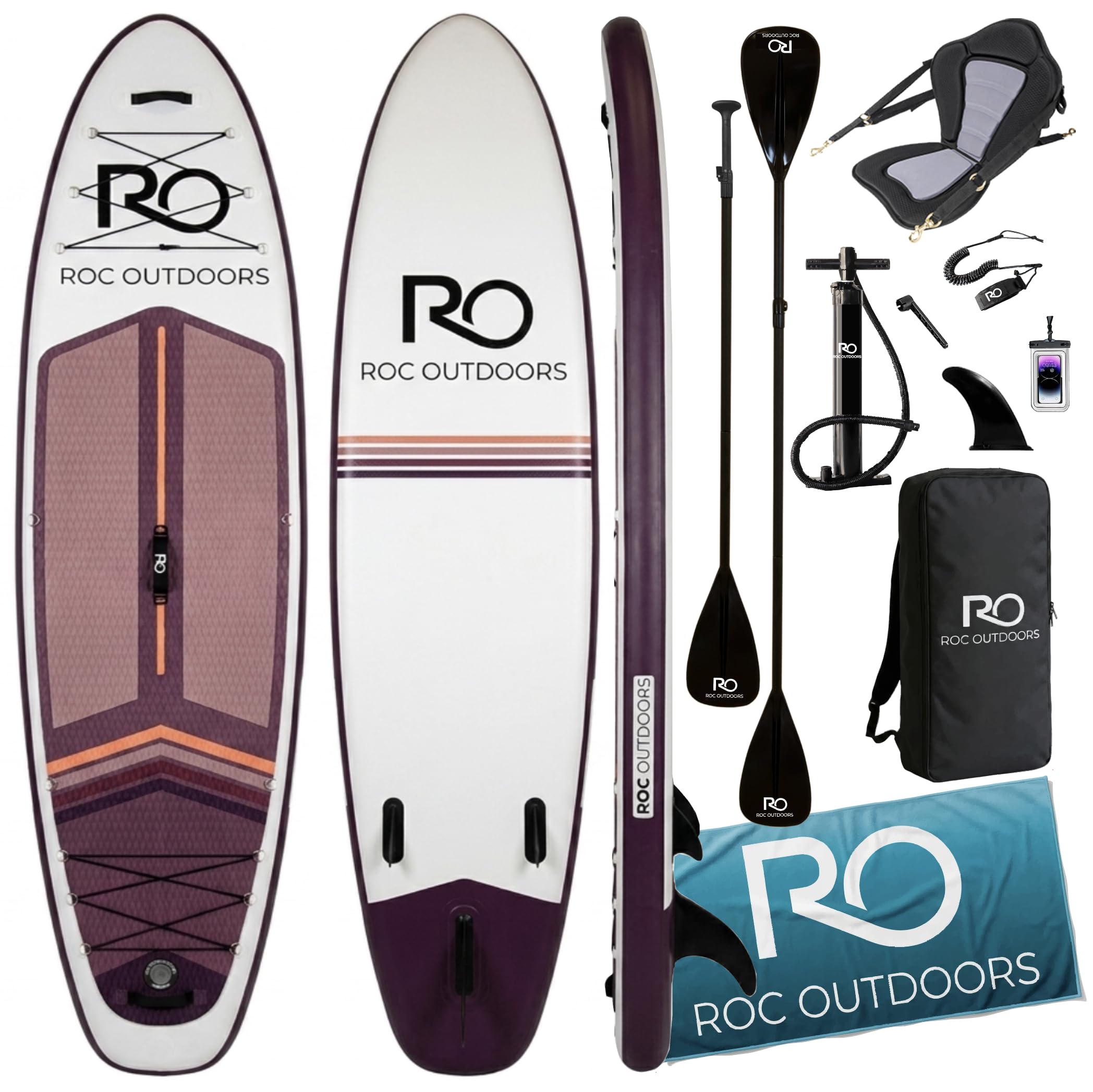
1. Roc Inflatable Stand Up Paddle Board 10′ 6″
Our pick — 4.5+★ from 18,000+ verified ratings; the strongest balance of quality and price.
A 33-inch deck and 350-pound capacity make this the default pick for paddling plus deck workouts.
The Roc runs 126 inches long and 33 inches wide, which is wide enough that your feet land naturally apart for a squat or a lunge. That width, plus a 350-pound weight limit, gives a solo adult real headroom for a water bottle, a dry bag and a paddling vest. Owners describe the deck as balanced and easy to stand up on, and that is exactly the quality you want when a workout asks you to hold still.
Where it pulls ahead of most inflatables is setup time. The pump and valve get the board to its working pressure in about ten minutes, so a lunch-break session is realistic rather than a weekend-only event. Deflating is just as quick, and the whole thing rolls down into the included backpack that fits in a car trunk or a hall closet. A ten-minute inflate and deflate is short enough to fit a lunch-break session rather than a weekend-only one.
On the water, stability carries the most weight in what buyers report, followed closely by inflation and portability — the three things a repeat exerciser actually touches every session. The trade-off to know up front is the 10’6″ length: it turns easily and rides well on calm water, but a longer touring board will track straighter over distance. If your session is a mix of paddling and bodyweight work close to shore, that shorter nose is a feature, not a flaw.
What earns it the top slot
- 33-inch deck gives a wide, planted stance for standing poses
- 350-pound capacity leaves room for gear on top of the rider
- Ten-minute inflate and deflate keeps short sessions practical
- Backpack packing makes it a closet-storable board
Where it gives ground
- The 10’6″ length tracks less straight on long open-water paddles
- Maxes out at 350 pounds, so a two-adult load is off the table
Reach for this if: you want a proven, wide, quick-to-pump board for solo paddling plus deck workouts.
Pass it by if: you need to carry two adults or a very heavy gear load and want a higher weight ceiling.
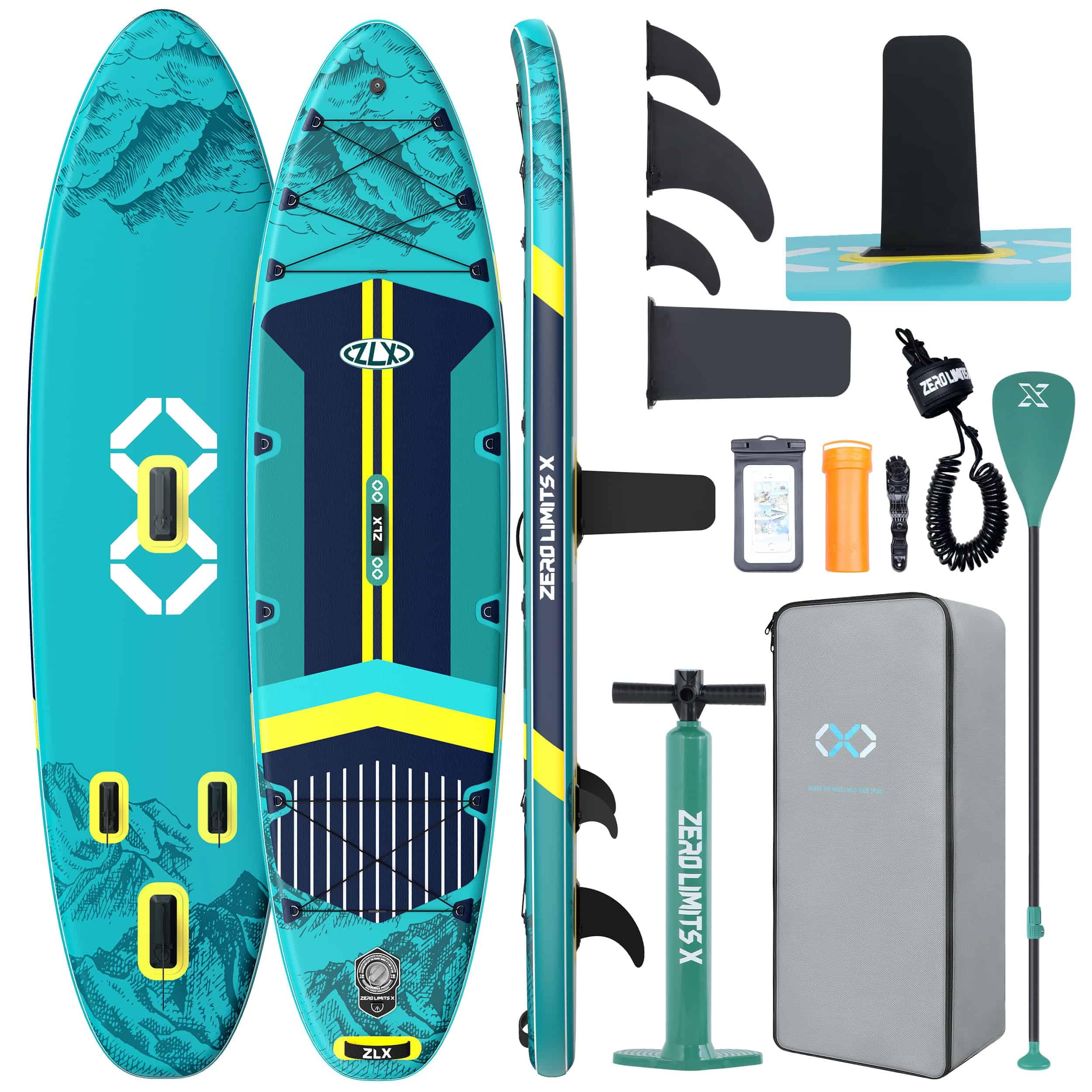
2. ZLX 11’6″x35″ Inflatable Paddle Board
A 35-inch platform with a 550-pound ceiling — this one is built to carry the whole family.
The ZLX measures 138 inches long by 35 inches wide, and it out-sizes the Roc on both counts — the extra length and width show up as genuinely more room to move. Its 550-pound weight limit is well above the Roc’s 350-pound figure, so a second rider, a dog or a cooler full of drinks does not drop the rails into the water. That width is the number to focus on if you plan to do standing work, because a wider deck means your feet spread out and the board resists a roll sideways.
Steady handling comes from a centered stabilizer fin (a middle fin designed to counter sideways drift), and owners back the feel of it — the board reads as steady on the water with that middle fin doing supporting work. A non-slip deck pad runs across the standing area, so your hands stay put when you drop into a plank. The package includes a paddle, ankle leash, repair kit, pump and a carry backpack, so you are not buying extras on top.
The honest caveat sits with the pump and the long-run durability of those included parts. Some units arrive with a gauge that fails early, and the air pump itself has drawn complaints, so treat the pump as the weak link in an otherwise stout package and keep the receipt handy. The board body itself holds up well enough that the stability is what most people remember.
Room to spread out: the 35-inch width and 550-pound capacity make this the pick for tandem paddling or gear-heavy sessions.
Watch the pump: reported gauge failures mean a backup hand pump is cheap insurance.
Best fit: a paddler who wants maximum deck space and a high weight ceiling without stepping up to the premium tier.
Look elsewhere if: you want a small, light board to toss in a hatchback, since this one leans large.
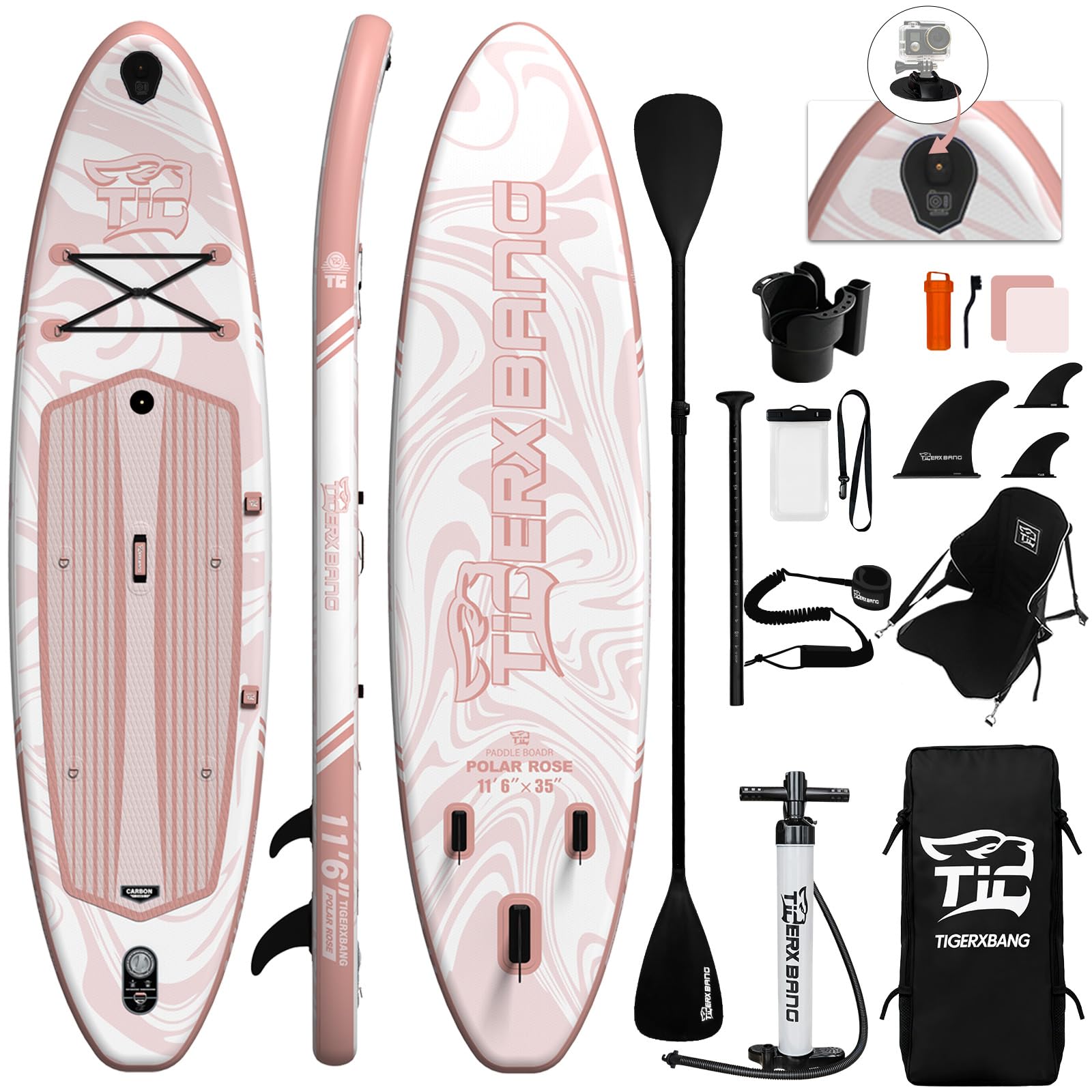
3. Tigerxbang Polar Collection Inflatable Paddle Board
Sit for the paddle out, stand for the workout — this board switches shape with you.
Most boards ask you to choose between a seated cruise and a standing session. This one ships with a kayak seat that clips in, so you can rest your legs on the way out and stand up when it is time to move. The deck is 35 inches wide with six inches of thickness, and the body is rated to 220 kg, which is the spec that matters when two people share the ride.
Long hours on the water are easier thanks to small details. A cup holder base sits at the center of the deck for your drink. A camera mount at the nose holds an action cam. And a Velcro paddle holder keeps the paddle out of your hands when you pause to stretch. A waterproof phone bag, double-blade paddle, three detachable fins and a backpack round out the kit, so a first session does not need a shopping trip.
The recurring gripe is the fins, which have broken off on some boards, so treat the detachable fin setup with care when you pack it away. Beyond that, the report from the water is that this makes a welcoming first board — easy to set up and inflate, with a deck wide enough to balance on. If seated paddling is part of your plan, the included kayak seat swings the decision here.
Two boards in one: the kayak seat turns a stand-up session into a seated cruise whenever your legs need a break.
Fin care is on you: the detachable fins have snapped on some units, so pack them carefully between trips.
Worth grabbing if: you want the option to sit and paddle without buying a separate seat.
Skip the upgrade if: you only ever paddle standing and would rather spend on a stiffer touring shape.
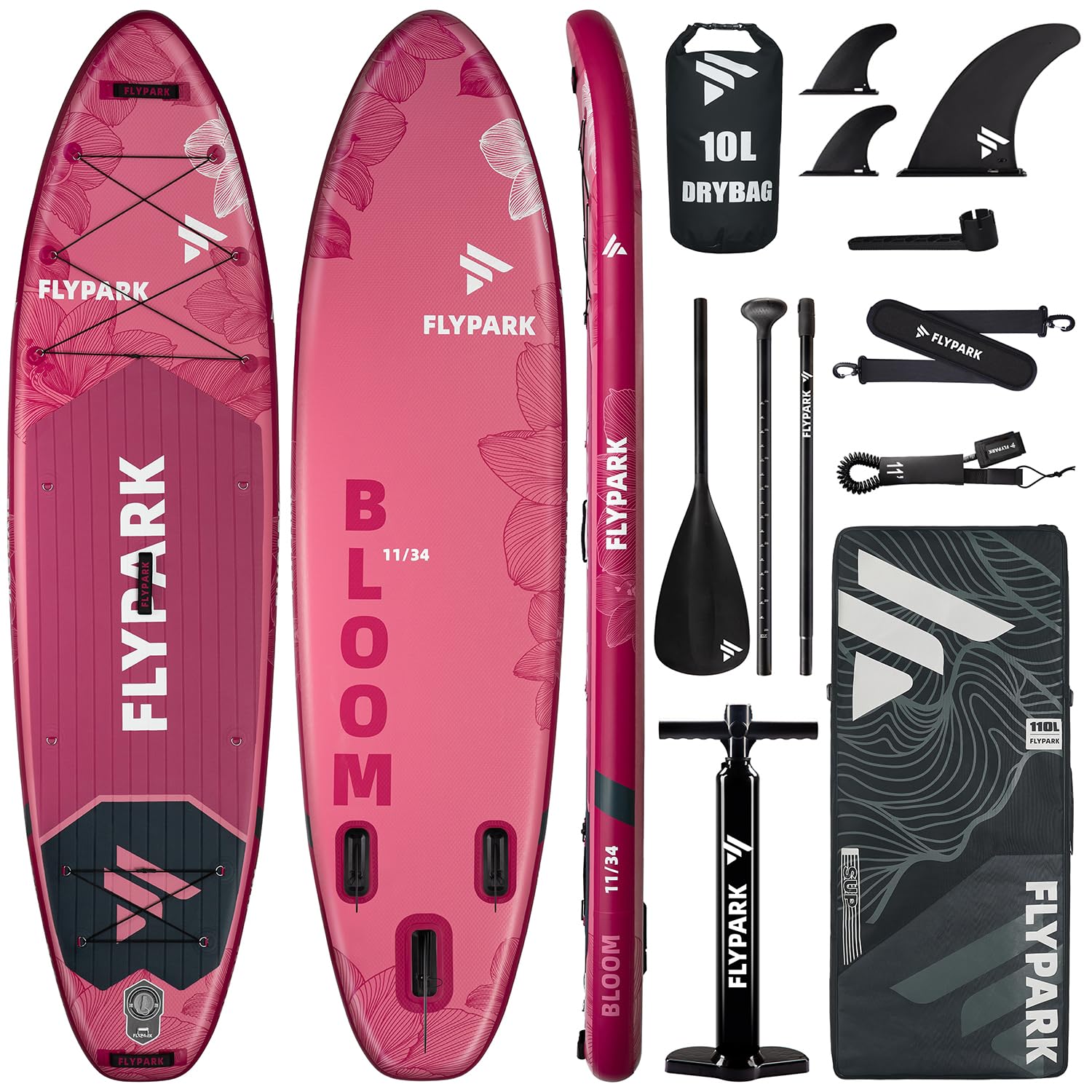
4. FLYPARK 11’x34 Inflatable Paddle Board
A 420-pound workhorse with three handles, so two people can carry it or one can drag it.
You get room to move at 132 inches long and 34 inches wide — a middle ground between the 33-inch standard decks and the super-wide 35s. The 420-pound capacity is the real headline, though. It is meant to take two adults, kids, or a pair of big dogs without the deck sinking under the load. The deck itself is a 5mm EVA pad (a foam grip layer) with a square-cube pattern, which gives grip under bare feet and hands during a set of push-ups on the water.
Carrying it is what separates this board from the pack. There are three padded handles: front and rear for lifting with a partner, and a center handle balanced for carrying alone. The board comes in at 19 pounds, and the package includes an 110L backpack, a 10L dry bag, a triple-fin setup and an adjustable aluminum paddle that stretches from 67 inches to 77 inches, so tall and short users can both find a comfortable grip.
Owners describe the board as stable and easy to live with — it inflates in about ten minutes and disassembles the same way. The self-inflating deck finish and bright pink color are the parts people mention with affection, which for a family board matters. The honest note is that a 34-inch deck gives up a fraction of width to the 35-inch picks, so beach-ball-and-push-up drills with a partner standing nearby are slightly tighter. The extra capacity buys you the load margin instead.
Carry it like luggage: three handles plus a 19-pound weight and 110L backpack make getting to the water a two-person or one-person job, your choice.
Capacity over width: the 420-pound limit beats the standard boards, but a 35-inch deck will feel a touch more planted for side-by-side poses.
Made for: family paddling with dogs or gear, where the load limit and the dry bag matter more than a fraction of an inch.
Think twice if: your workout is all standing balance work and you want the widest deck you can get.
5. CETANA Extra Wide Inflatable Paddle Board
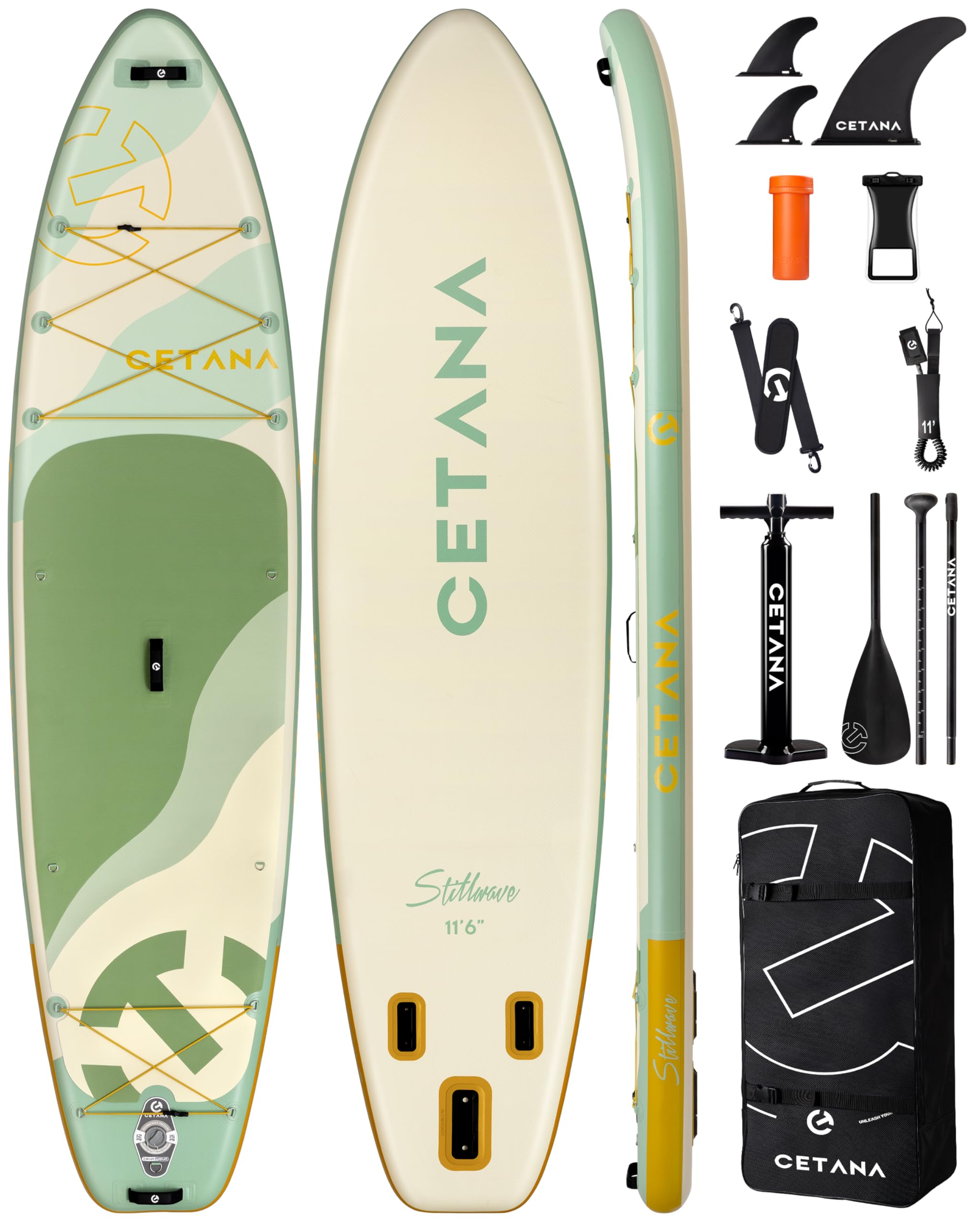
A 35-inch deck rated to 450 pounds, built so two people can share the same board.
The CETANA is 138 inches long and 35 inches wide with a 450-pound capacity, which gives you a genuine two-person platform or one rider plus a kid and a cooler. A three-fin setup keeps the track straight when you are moving at speed, and the wide deck holds steady when you stop to stand and pose. If you are doing partner work on the water, or teaching someone to balance, that width and capacity are the reason to buy it.
The storage layout is unusually generous for the tier — a front 6-point bungee plus a rear 4-point bungee, and 15 D-rings for clipping on a leash, a camera, or a shoulder strap when you carry it. Three reinforced handles let you lift it between two people or grab it yourself. It pumps up on a 15 PSI rated deck and rolls back into a backpack that holds everything with room left over, which owners consistently mention as the reason it travels well.
What people notice first is the look — the soft color palette is a deliberate part of the design, and the board matches its photos. The honest limit is that 15 PSI maximum: it feels firm and stable at pressure, but it is not as stiff at the top end as a woven drop-stitch board built for long-distance touring. For paddling and deck work on a lake, that trade-off does not cost you much.
The case for the CETANA
- 35-inch width and 450-pound limit carry two riders comfortably
- 15 D-rings and dual bungees hold cameras, bags and a leash
- Three-fin setup keeps tracking straight at paddling speed
- Packs down into a backpack you can lift and store alone
Where it stops short
- 15 PSI ceiling means it is firm but not touring-board stiff
- Soft color finish is a look — if you want a neutral board, this is a bold one
Grab it if: your workouts involve a partner, a child or a dog on the deck with you.
Leave it if: you need the hardest possible surface for competitive balance drills.
6. Retrospec Weekender Inflatable Paddle Board
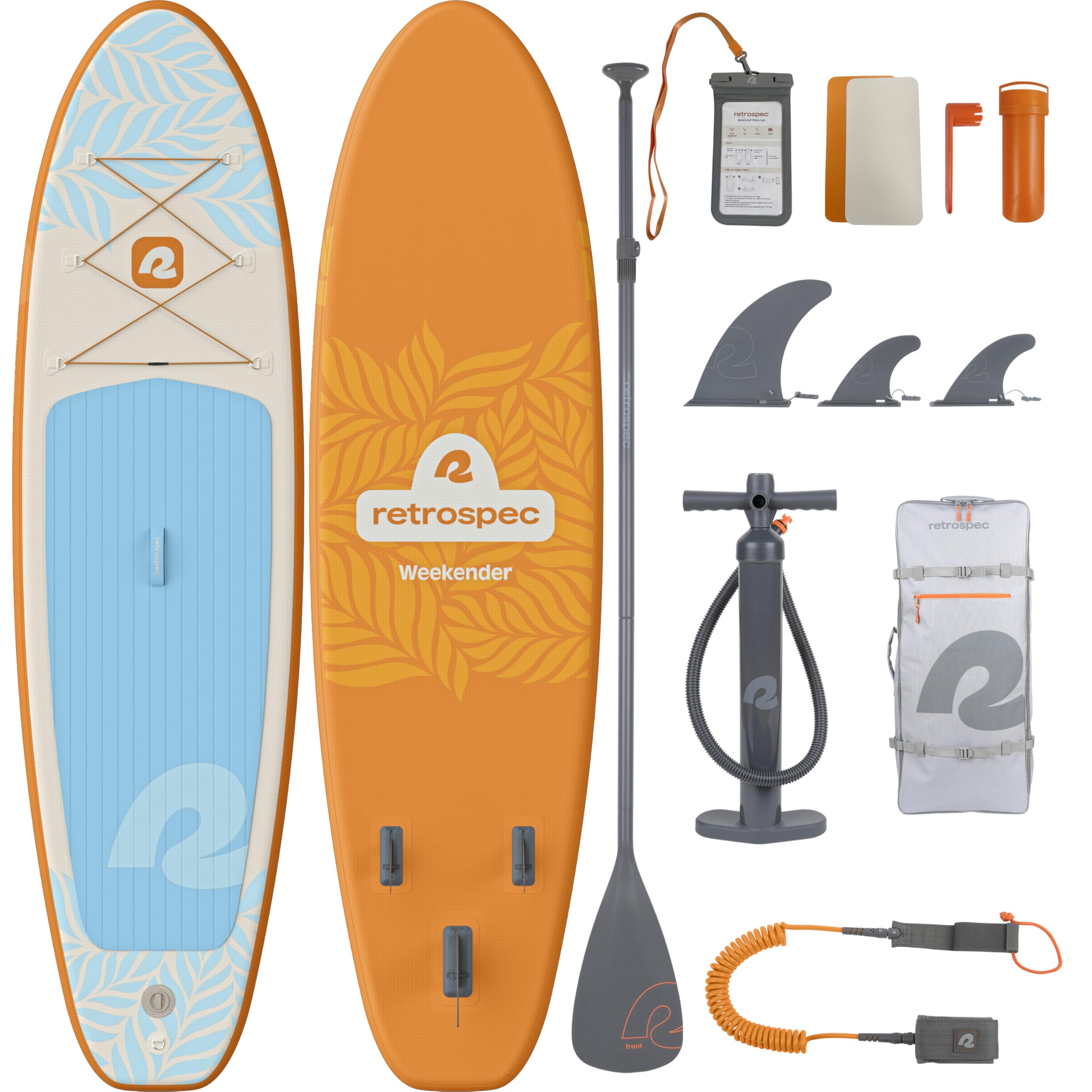
At 17.5 pounds, this is the board you will actually bother to walk to the water.
The number that decides whether an inflatable gets used is its carry weight, and this one lands at 17.5 pounds when packed. That is light enough to hike down a trail or haul up a beach alone, and the included backpack keeps your hands free on the way. The board itself is 126 inches long with a 32-inch deck — narrower than the 34 and 35-inch boards here, which costs a little standing stability but buys a quick-turning, playful feel on flat water.
The construction is a PVC layer the maker calls AerGlide-Lite, and the deck is a brushed EVA pad that stays grippy underfoot while going easy on bare feet during a set of squats. Three removable fins let you tune the tracking for the conditions, and front bungees hold a dry bag. A dual-action pump, waterproof case and safety leash are in the box, so the first trip is fully equipped.
The owner report is warm on portability and looks, with the color scheme getting steady praise, and most find it simple to inflate and get on the water. The fair caveat is the weight ceiling: at 300 pounds it sits below several boards here, so a heavy rider plus gear will feel it. Treat it as a solo board for a lighter paddler who values an easy carry over extra capacity.
The carry wins: 17.5 pounds and a backpack mean the board comes with you instead of staying in the garage.
A lighter-duty ceiling: a 300-pound limit is the lowest among the inflatables here, so pack light.
Pair it with: a short solo trip and a paddler who wants a board that fits in the trunk without a struggle.
Not for you if: you plan to share the deck or carry a heavy gear load.
7. ATPROSS Inflatable Paddle Board
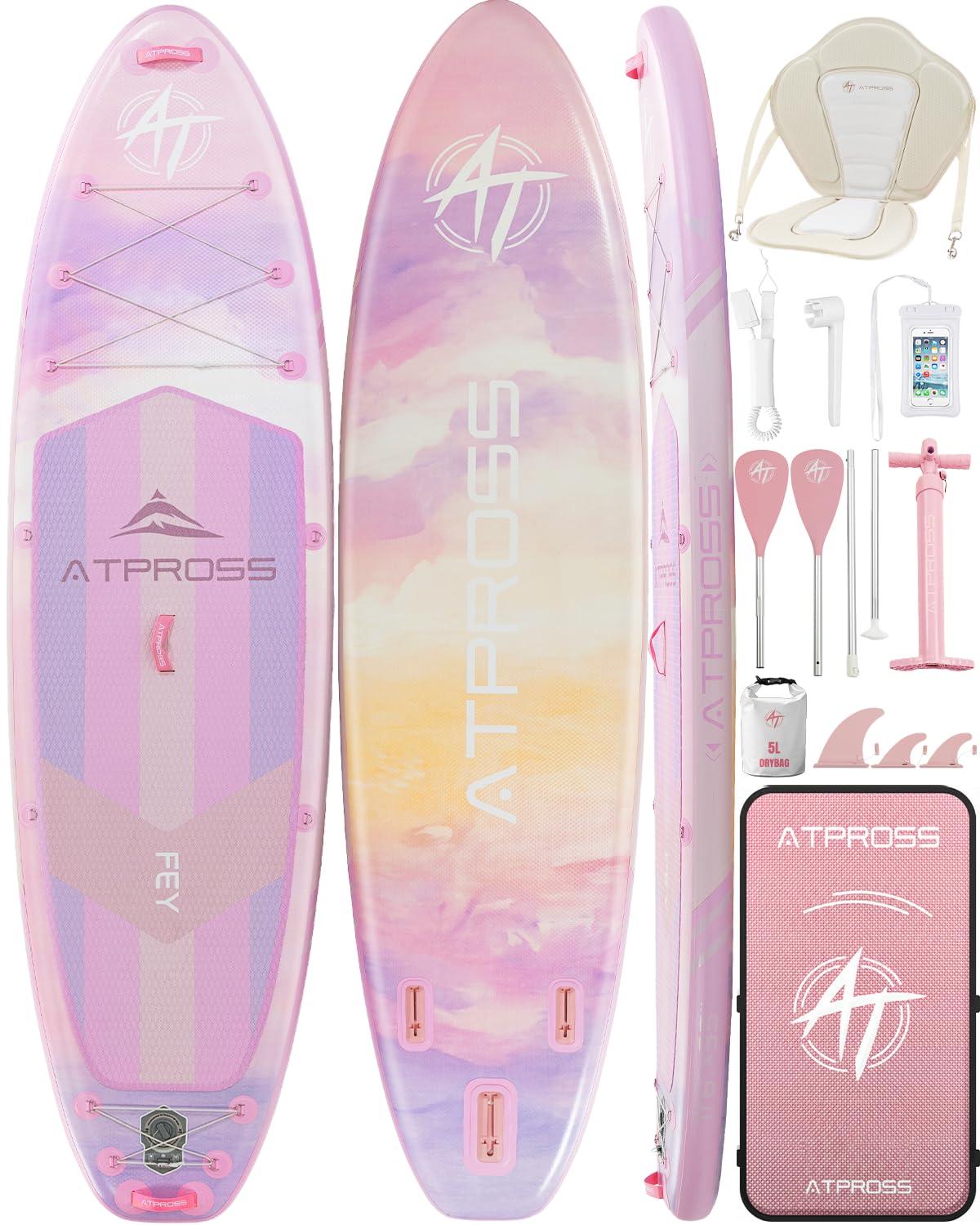
A padded seat that clips on and off, so a long paddle does not wreck your back.
The ATPROSS runs 35 inches wide with a 6-inch thickness and a 450-pound weight limit, giving a broad, steady standing surface for a beginner. That extra width is 3 inches beyond a standard 32-inch board, and on the water it reads as a platform you can walk across rather than a strip you balance on. For a board that doubles as a workout deck, that width is doing the most work.
Long outings are easier on your hips and back thanks to the inflatable seat, which uses a high-density cushion to ease fatigue. A tool-free clip system lets it attach and detach in seconds, so you can sit for the paddle out and stand for the exercise. The whole kit ships complete with a 600D Oxford backpack, single and dual paddles, a kayak seat, a waterproof phone bag, a 5L dry bag and a repair kit — that is a full day-trip load without a second purchase.
The durability picture is uneven in owner experience — most boards hold up through a season of use, while a few report fasteners breaking off. The 32.7-pound packed weight is the heavier side for carrying, so plan on a short walk or a cart rather than a long hike with it on your back. If the seat is what sells you, no other pick here combines a full accessory kit with a padded seat at this level.
Sit or stand on demand: the clip-on seat converts the board between paddling modes in seconds.
Heavier to haul: 32.7 pounds is the most packed weight on this list, so keep the walk to the water short.
Choose it for: all-day outings where you want a seat for the paddle out and a wide deck for the workout.
Leave it behind if: you carry the board a long way by hand or want the lightest possible pack weight.
8. Niphean 12’6” Touring Inflatable Paddle Board
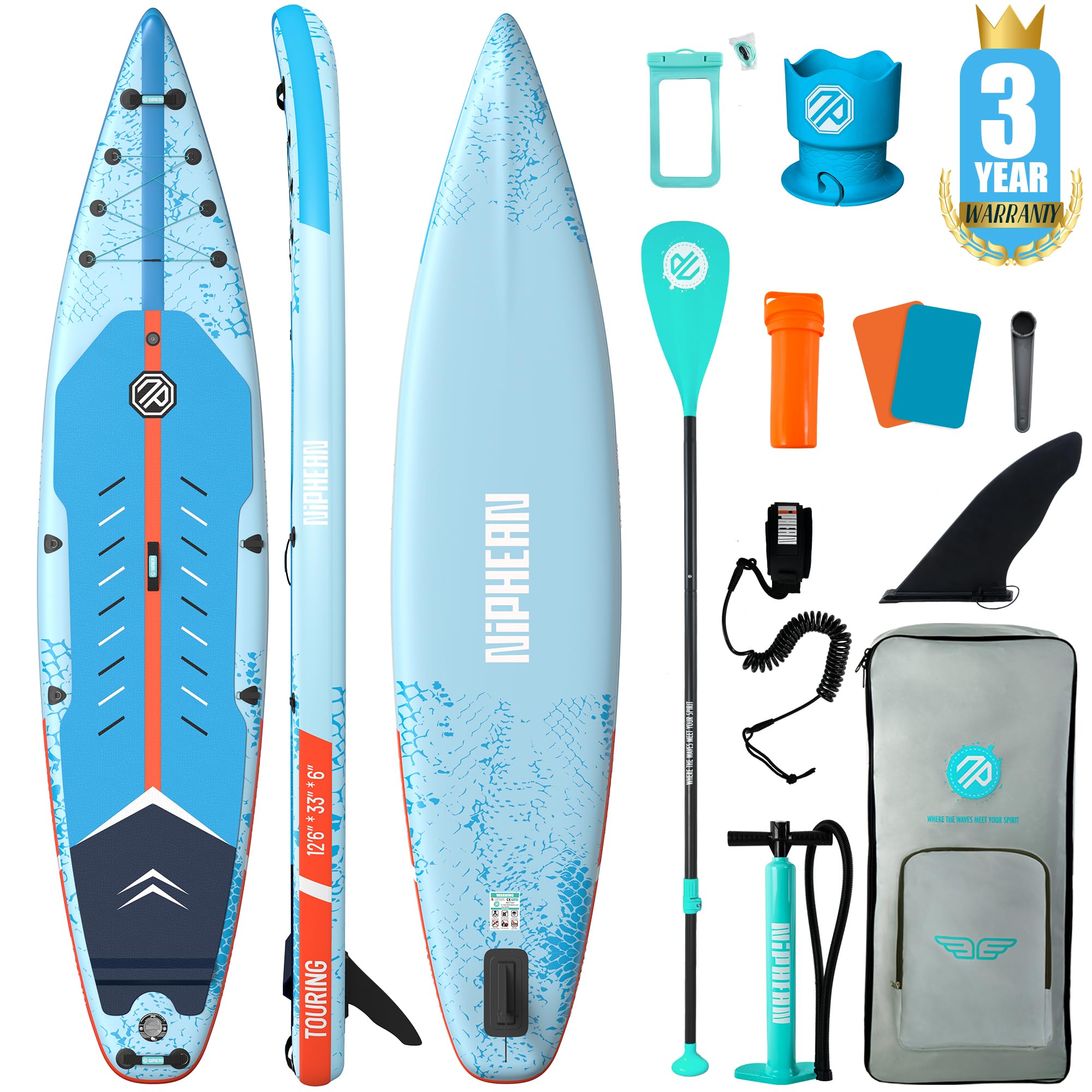
A 12’6″ touring nose for distance — this is the board for paddling as cardio.
This Niphean runs 12’6″ with a streamlined touring nose and a V-hull, a design that cuts cleanly through water so each stroke carries you farther. The deck is 33 inches wide with a 550-pound capacity, so it stays stable loaded with dry bags, a cooler or a second rider while still gliding. That combination — long and narrow enough to track, wide enough to stay steady — is why it leads the distance category here.
The stiffness story is the second reason it earns its place. It uses a woven drop-stitch construction the maker says makes the board up to 160% stiffer when inflated than a standard build, giving it a hardboard feel underfoot. At 20.4 pounds it is lighter than many 12’6″ touring boards, which makes carrying it to the water less of a chore. A kick pad and anti-slip deck surface help with pivoting and standing work, and a 3-year manufacturer warranty backs it.
The trade-off is that a longer touring board is less nimble for tight turns and standing drills in one spot — it wants open water and a forward rhythm. Owners on the water describe it as stable and fast, with performance landing where a touring shape should. If your exercise is a steady distance paddle, the 12’6″ touring nose and V-hull turn each stroke into forward progress.
Built for the long pull: the touring nose and V-hull turn each stroke into forward progress, which is what a cardio paddle rewards.
Less of a playground: a 12’6″ shape is slower to pivot than the shorter boards, so tight-space drills feel clumsier.
Pick it if: your workout is distance paddling and you want the glide to do the work.
skip it if: you mostly stand and pose rather than travel across the water.
9. Solstice SolFit Inflatable Yoga Board
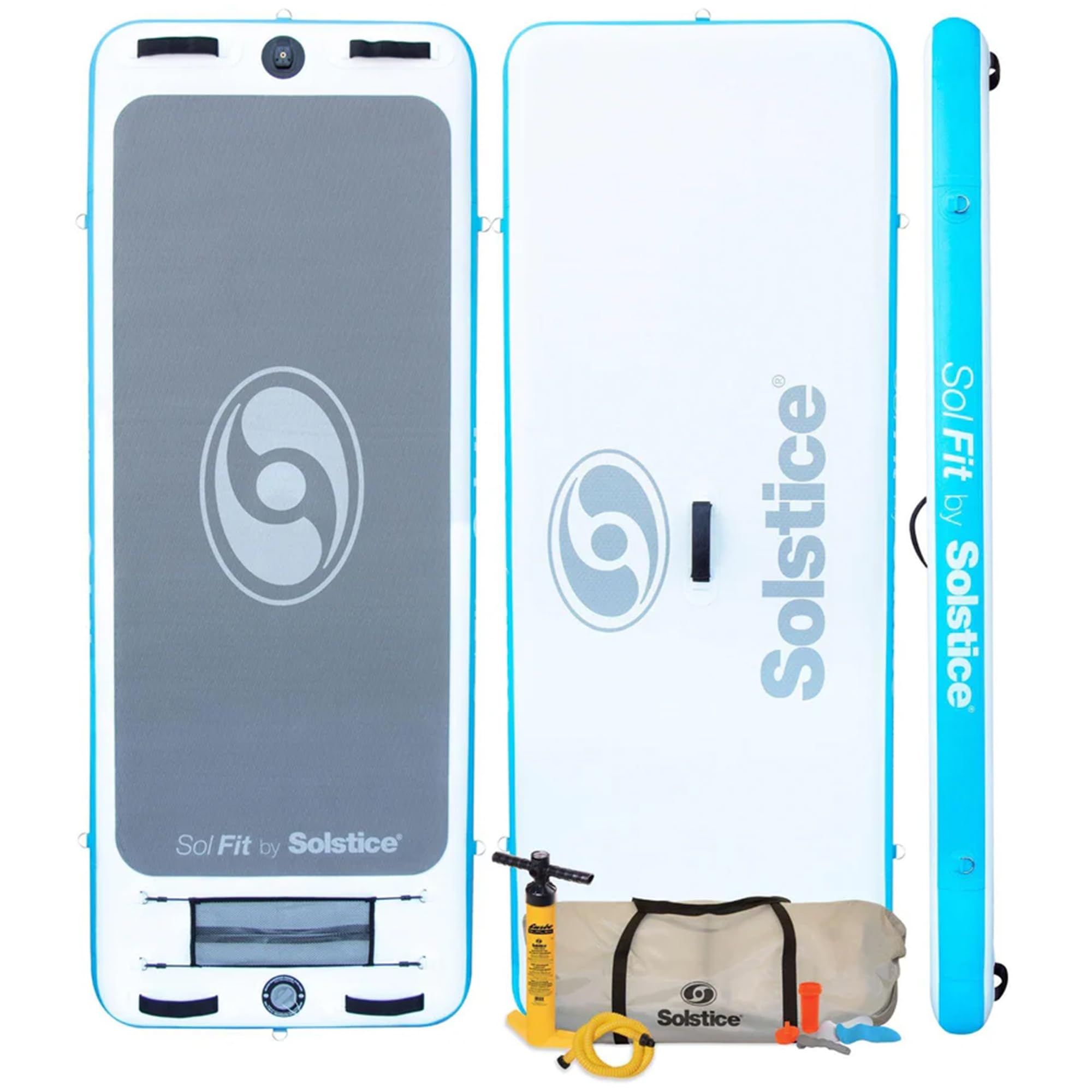
A 36-inch floating mat with resistance band points — this board is a yoga studio on water.
This board was designed around the mat, not the paddle. It measures 94 inches long and 36 inches wide with a 6-inch thickness, and it is rated to 275 pounds. The deck surface is a non-slip yoga mat finish, so hands and feet stay put when the board dips, and the shorter, wider footprint makes it easier to reach the edges of a pose without the board tipping. Inflated to its 15 PSI suggestion, it takes on a hard-feel surface that supports standing balance work.
The features are the giveaway that this one is built for exercise. There are five strong reinforced neoprene handles for carrying and for anchoring poses, plus resistance band attachment points so you can add band work to a floating session. The whole board deflates, folds and stores in its included bag, which makes it a viable indoor mat as well as an outdoor platform. It deflates and folds into its included bag, so the same 36-inch mat deck works for indoor floor work between paddles.
What owners respond to is the solidity — the board is described as solidly made and genuinely sturdy underfoot. The honest limits are real: a 275-pound capacity is the second-lowest on this list, and 20 pounds of packed weight is not the easiest carry. It is also a yoga-specific shape, so if you want a board that paddles long distances well, look at the touring pick instead.
Exercise-first design: the 36-inch yoga mat deck and resistance band points make it the only board here built around floor work.
A narrower weight range: 275-pound capacity limits it to a lighter solo rider.
A natural fit for: yoga, Pilates and meditation sessions that happen on water or indoors.
Not the one for: distance paddling or carrying a second person.
10. Atoll New Cove 11ft Inflatable Paddle Board

Heat-welded seams and a 17.5-pound carry weight — premium build without the bulk.
The Cove is 11 feet long and 32 inches wide, weighing 17.5 pounds, and its build quality is where the premium tier shows. Instead of glued seams, it uses heat-welded seams that create a strong bond designed for long-term use on the water. That matters for a board that lives in a car and gets pumped up twice a week. A 400-pound weight limit gives a solo adult solid headroom for gear while keeping the deck stable.
The 32-inch width is narrower than the 34 and 35-inch boards here, which gives it a quicker, more responsive feel for cruising — but if pure standing stability is your goal, those wider decks plant more firmly. Where it shines is the all-around balance: owners describe it as sturdy once inflated, with the width making it feel secure, and it carries a full-sized dog on deck without drama. It inflates quickly and packs into a backpack, so portability does not suffer for the build quality.
This is the board for someone who wants a premium daily driver — one that paddles, cruises and handles a workout session without being fussy. The honest note is the width: at 32 inches it is the narrower side of this list, so a beginner who wobbles may prefer a 35-inch deck. If you value the welded construction and lighter weight, that inch or two is the trade.
Why the premium tier is worth it here
- Heat-welded seams instead of glued ones for a lasting bond
- 17.5-pound weight with a backpack for easy transport
- 400-pound capacity carries a dog or gear on deck
- Quick inflation gets you on the water fast
What you give up
- The 32-inch width is narrower than the widest boards here
- A premium build is a bigger spend than the value picks
Best for: the paddler who wants one premium board for cruising, workouts and travel.
Think twice if: you are a true beginner who needs maximum width to feel confident standing.
11. Lifetime Horizon 100 Hardshell Stand-Up Paddleboard

A plastic hardshell that skips the pump entirely — grab it off the rack and go.
The Horizon 100 is the one board here that needs no inflation, no valve and no pump. It is a 10-foot plastic hardshell, 120 inches long and 34 inches wide, with an EVA deck covering for traction and hull rails shaped for stability on the water. The 230-pound weight capacity suits an entry-level or intermediate solo paddler. Its front deck bungee holds a dry bag or a water bottle, and the center carry handle makes walking it to the shore a one-hand job.
For exercise use, the appeal is instant readiness — there is no ten-minute pump-up before a session, so a short workout is genuinely short. The stable hull and EVA deck make it forgiving for a beginner finding their balance. The catch is transport: at 44 pounds this is not a board you carry far on foot or strap to a small car without a rack, and the weight shows up in every move.
Owners praise the stability and the beginner-friendliness, and the value lands well. The mixed notes are scratches on the surface and the weight, both expected of a plastic hull. If your routine is a quick workout at a nearby lake with a launch point close to where you park, the no-pump convenience is a real advantage. If you hike to remote water or have limited storage, an inflatable serves you better.
Why a hardshell still wins
- No inflation at all — move it to the water and start
- Hull rails designed for stability on calm water
- 34-inch deck with EVA traction covering
- Front bungee and center handle for carrying gear
The honest costs
- 44 pounds is a two-hand lift and needs a rack or wall space
- 230-pound capacity is the lowest on this list
Right for: a beginner with nearby water, a place to store it, and no patience for pumping.
Wrong for: a paddler who hikes to the launch or lives in an apartment.
Know the Specs
Deck Width and Stability
Width across the board, measured in inches, is the closest thing to a stability number. A 32-inch deck is common and quicker underfoot, while a 35 or 36-inch deck spreads your feet apart so a sideways wobble has less leverage. When you plan to stand for a whole session, the wider deck is the one that keeps you dry.
Weight Capacity in Pounds
Weight capacity is the total load the board is rated to float. It covers you plus gear, a second rider or a dog. A board close to its ceiling will sit lower and paddle slower. Matching capacity to your real load with headroom left gives you the most stable ride.
Inflation Pressure in PSI
Inflatable boards list a maximum pressure in PSI, and that figure tells you how stiff the deck can get. Pumping to the listed maximum makes the drop-stitch material firm and close to a hardboard feel. Under-inflating leaves it soft and bouncy, which makes balance work harder.
Fins and Tracking
Fins are the blades under the tail that keep the board going straight. A large center fin holds a line in wind or chop, and side fins reduce tipping during turns. Three-fin setups track straighter, which matters when you paddle for distance rather than posing in place.
Deck Surface and Grip
The deck pad is the textured layer you stand and kneel on. A brushed or patterned EVA pad gives grip under bare feet and hands, which is what you want for push-ups, planks and lunges. On a mat-textured deck, the pad is the entire standing surface, so its grip matters as much as width.
Packed Weight and Portability
Packed weight decides how often you actually use the board. An inflatable at 17.5 pounds rolls into a backpack and fits a closet. A hardshell at 44 pounds needs a rack and a helper. A 17.5-pound inflatable that rolls into a backpack gets more sessions per season than a 44-pound hardshell that needs a rack.
Common Questions
Will a paddle board support my weight for exercise?
How long does an inflatable paddle board take to pump up?
Is a wider board always better for yoga and balance work?
Can I do a full workout on a paddle board without falling in?
Do I need to inflate an inflatable SUP to its maximum PSI?
Can I carry a dog or a second person on these boards?
Is a hardshell paddle board more stable than an inflatable?
Where should I store an inflatable paddle board between sessions?
What size paddle board fits a taller or heavier paddler?
Will a paddle board fit in the trunk of a car?
Do inflatable paddle boards come with a paddle and pump included?
The Bottom Line
For most people, the strongest paddle board for exercise is the Roc Inflatable Stand Up Paddle Board. Its 33-inch deck and 350-pound capacity give a stable platform for standing work, and a ten-minute inflate keeps a short session realistic. Need maximum room for a partner, a dog or gear? The ZLX 11’6″x35″ pushes the width to 35 inches and the capacity to 550 pounds. And if your workout is really distance paddling, the Niphean 12’6″ Touring stretches the length for a smoother glide.
Before you commit, remember that the board is only as useful as it is convenient. A 33-inch deck that inflates in ten minutes and packs into a backpack gets used weekly; a 44-pound hardshell that needs a rack and a two-hand lift tends to stay stored. The Roc wins on the combination that matters for exercise: 33 inches of width, 350 pounds of capacity and a ten-minute inflate.
How we choose
We do not accept paid placement. Every pick is matched to a real buyer and a real use-case; we do not hands-on test units.
Sources
Specifications: manufacturer listings and product documentation. Review insights: verified customer reviews, as of November 2026. Pricing: not shown on this page (it changes often); check the current price via the retailer link.
As an Amazon Associate, Tactical Gear Guy earns from qualifying purchases. This does not affect which products we feature.