Specs are compiled from manufacturer listings and verified buyer reviews and can change over time — please confirm the key details on the product page before buying.
If your truck wanders across the lane on the highway, or you hear a clunk over every bump, the worn part is often the small joint at the end of your steering arm — the outer tie rod end. Buy the wrong one and you will be back under the truck in a year. Buy a greaseable MOOG with the right fitment and you can pump fresh grease into the joint at every oil change instead of replacing it in a year. This guide covers nine real outer tie rod ends for the trucks and cars people actually own, from Silverados and F-250s to Altimas and CR-Vs.
This guide is built by comparing the manufacturers’ published specifications and the patterns across verified customer reviews, so you get each pick’s real strengths and trade-offs instead of marketing spin.
Fitment is the whole game here, because one wrong thread count or a CR-V built outside North America turns a twenty-minute job into a return. Here is how to spot a solid outer steering tie rod before you order one.
Top Picks
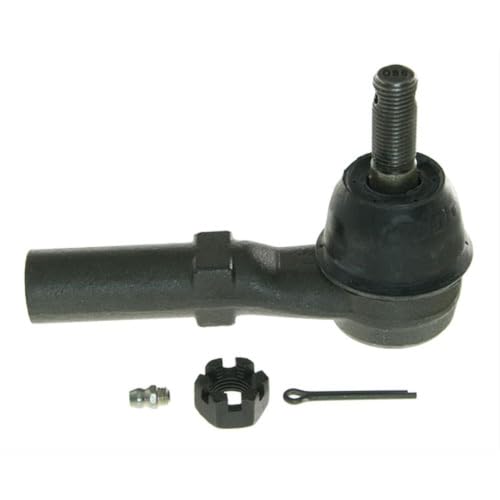


How To Choose The Best Outer Steering Tie Rod
The outer tie rod end is the pivot that connects your steering rack to the wheel hub. When it wears, you feel it as vague steering and hear it as a clunk. The single most important decision is fitment, not brand or price.
Match the part number, not just the vehicle
Every tie rod end carries a code like ES3609 or ES800717. Your old part has that code stamped on it, so read it before you order. Two trucks in the same model year can take different ends depending on suspension package. A-Premium’s Impala listing, for example, splits further by FE1, FE2 and FE3 suspension codes.
Greaseable versus sealed sockets
A greaseable socket has a fitting you pump grease into, which pushes old lubricant and debris out of the joint. A sealed socket is set at the factory and never serviced. Greaseable ends are the ones you can keep alive for years by adding a pump of grease at each oil change.
Check the thread spec on your steering knuckle
The threads at each end of the rod must match your steering knuckle. HHCM’s CR-V end uses an M14x1.5 female thread on one end and an M12x1.25 female on the other. Measure before you install, because the wrong thread will thread on but never seat.
Side-by-Side Comparison
| Model | Best For | Position | Pieces | Greaseable | Amazon |
|---|---|---|---|---|---|
| MOOG ES3609★ Best Overall | 2001-2010 Silverado 2500 HD | Outer | 1 | Yes | Amazon |
| A-Premium Front OuterBudget Pick | GM sedans (Impala, Grand Prix) | Front Outer L/R | 1 | No (pre-greased) | Amazon |
| MOOG ES2836RLOld Truck Fix | 1988-1999 Chevy K1500 | Outer | 1 | Yes | Amazon |
| HHCM ES800303 | 2007-2011 CR-V (US built) | Front Outer | 2 | — | Amazon |
| ETS ES800717/718 Kit | Hyundai / Kia models | Front Outer L/R | 2 | — | Amazon |
| X AUTOHAUX Altima Pair | 2007-2015 Altima, Maxima | Front Outer L/R | 2 | — | Amazon |
| TRQ PSA55352 Set | 2-piece driver/passenger set | Front Outer L/R | 2 | — | Amazon |
| TRQ PSA55535 Set | 2-piece Toyota-fit set | Front Outer L/R | 2 | — | Amazon |
Detailed Reviews
1. MOOG ES3609 Steering Tie Rod End
Our pick — 4.5+★ from 850+ verified ratings; the strongest balance of quality and price.
A heavy-duty joint for the half-ton HD trucks that actually tow, and the reviews back it up.
If you drive a 2001-2010 Silverado 2500 HD or a 1500 HD and tow regularly, the ES3609 was built for you. It measures 9.75 inches long and 4.5 inches wide — physically the largest single-piece tie rod end on this page — so it fills the bigger knuckle on the HD trucks. At 1.7 pounds it is heavier than the K1500 end below, and that extra metal is the point: it is a real truck part, not a car part stretched to fit.
The build quality is what owners single out, and the 4.5+ star rating backs it. The pressed-in cover plate seals out road debris, which keeps the bearing from getting loose. The Belleville preload washer (a spring washer shaped to hold tension) keeps the bearing package tight even as it wears. The greaseable socket lets you pump fresh grease through the ball stud and flush out the old — the single thing that separates a MOOG from a sealed budget joint.
Installation is straightforward for a driveway job. The precision tolerances mean it lines up with the OE steering arm without modifications, and the heat-processed ball stud is built to the same spec as the factory part. It sits at 4.5+ stars across 800+ ratings on this exact part number. The one caveat: if your truck is a 1500 (not HD), this is not the right part, so check the trim before ordering.
What earns its spot
- Largest single-piece end here at 9.75 inches long, sized for the HD trucks
- Greaseable socket lets you service the joint yourself
- Pressed-in cover plate and Belleville washer hold tension as it wears
- 4.5+ stars across 800+ ratings on the exact model
What to know first
- Fitment is specific to 1500 HD and 2500 HD trucks, not standard 1500s
- Ships as one piece, so a two-sided repair means buying twice
The verdict: the best pick if you tow with a Silverado or Sierra HD and want a joint you can grease and keep tight for years.
Also needed: a grease gun and a torque wrench, because the job is not finished until both are used.
2. A-Premium Front Outer Tie Rod End, Compatible with Chevrolet
The cheapest way to fix vague steering on a GM sedan, if you read the trim codes first.
This one is for the driver of a Buick LaCrosse, an Impala or a Grand Prix who just wants the wheel to stop drifting. It fits the 1997-2009 Buick sedans, the 2000-2016 Impala lines and the 2004-2008 Grand Prix. It arrives 2.27 pounds heavy, steel-bodied, pre-greased and with a castle nut in the bag. Note the cotter pin is not included, so buy one before you start.
The honest catch is that quality is a coin toss. Some owners find OEM-grade fit, and others end up with a joint that feels loose or lopsided. That split shows up in how owners talk about it — the part works, but it does not command the same confidence as the MOOGs above. If you deal with a warranty claim, A-Premium backs it for one year.
The trim code is the real trap. Impala fitment splits by FE1 Soft Ride, FE2 Ride and Handling and FE3 Sport Suspension, and the listing changes on those codes. Get it right and you save money. Get it wrong and you are ordering again.
What to weigh: at 2.27 pounds it is heavier than the K1500 MOOG end below, so you get metal, but the quality is mixed and the value is debated. It works and it fits, and that is the fair summary.
Reach for this if: you drive a GM sedan on a tight budget and you have already matched your suspension code.
Look elsewhere if: you want a greaseable joint that will last a decade, because this one is sealed and pre-greased only.
3. MOOG ES2836RL Steering Tie Rod End
A tiny all-steel joint for the OBS trucks — small, but tough enough to survive a farm.
At 2.7 inches long, 1.9 inches wide and 1.5 inches tall, this is a fraction of the ES3609 above — the length difference alone is 9.75 inches versus 2.7 inches. That is not a defect; it is the shape the GMT400 steering arm needs. It weighs in at 1.4 pounds, so it is the lightest part here, which is also why it is a straightforward one-hand install.
The same MOOG engineering runs through it. The pressed-in cover plate keeps debris out, the greaseable socket lets you flush the joint, and the Belleville washer holds the bearing tight as it wears. The ball stud is heat-processed to match or exceed OE spec, and the body is alloy steel. Owners consistently praise the build quality in the reviews. It fits the 1988-1999 C1500 and K1500, and buyers report a plain, easy install.
The recurring gripe is that it is small and specific — it will not fit the newer trucks, and it will not fit a K3500 unless you check the interchange. Buy it for the OBS trucks and it does its job quietly.
Who it fits: anyone keeping an 1988-1999 Chevy or GMC 1500 on the road, where OEM-grade steering is the goal.
The one limit: the small 2.7-inch body rules it out for the newer trucks and larger axles, so match your model year first.
4. Outer Tie Rod ES800303

A CR-V pair that only fits if your VIN starts with 1 through 5 — check that first.
This is the pick for a 2007-2011 Honda CR-V built in North America. The listing is specific: VIN starting digit 1, 2, 3, 4 or 5, and not international-spec models. The threads are M14x1.5 female on one end and M12x1.25 female on the other, both clockwise, so confirm your steering knuckle before ordering. It comes as a two-piece kit, so both sides of the front get replaced for one round of work.
What wins people over is fit — it lines up like the factory part and several owners call it beefier than the OEM piece. The kit is backed by a 12-month warranty. Durability is the honest catch: a handful of reviews report the parts do not hold up over the long term, so inspect them at each oil change.
For a daily-driver CR-V, replacing both sides at once makes sense. The 3.54-inch height on each piece means it threads into the knuckle cleanly. Just verify your VIN before you pay, because a Japan-built CR-V takes a different part and this kit will not fit it.
Fit note first: the VIN restriction is the whole story here. Domestic-built CR-V only, threads to match, or it goes back.
What you get: two ends, a 12-month warranty, and a straightforward install that owners call beefier than stock.
Why it earns the spot: a two-piece kit for a domestic CR-V at a price that undercuts buying one side at a time.
Check before you buy: your VIN first digit and that the threads match, or this pair will not seat.
5. ETS 2Pc Front Outer Tie Rod End Kit ES800717, ES800718
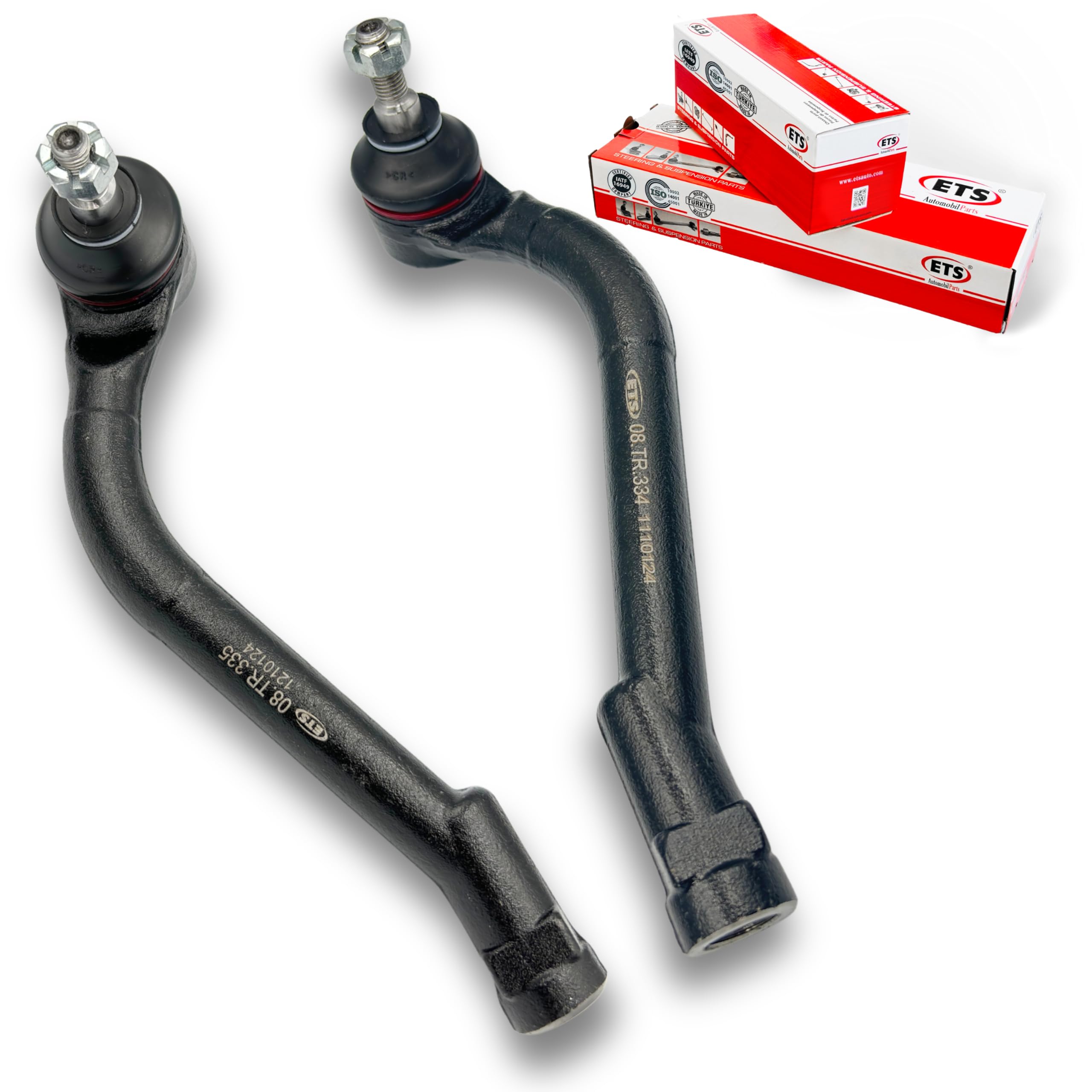
A two-piece kit that covers the Korean cars other listings skip, with a three-year warranty.
The ETS kit fits a long list: 2010-2015 Tucson plus the 2016-2017 Fuel Cell EV, the 2011-2014 and 2015 hybrid Sonata, the 2011-2015 Optima plus the 2016 hybrid, the 2011-2016 Sportage, the 2012-2017 Azera, the 2014-2016 Cadenza, the 2014-2017 Rondo and the 2015 Mexico-market ix35. The kit has both front outer ends, left and right, so you can replace both sides in one job.
What separates it is manufacture and coverage. It is made in Türkiye and engineered and assembled in the USA, and it carries a 3-year manufacturer’s warranty — longer than any other product here. That is the part that matters on a newer model: the part is often sold alone, with no guarantee, and this one has the backing.
The listing has no customer reviews yet, so there is nothing to cross-check. That is a real limitation on a new part. Treat it as a risk you accept in exchange for the three-year coverage and a kit that fits several models other makers do not stock.
The trade you are making: a 3-year warranty and a two-piece kit against a listing with no owner reviews yet. The warranty is the cushion if the fit is not quite right.
Best for: Hyundai and Kia owners who want both sides in one box with the longest warranty here.
Not for: drivers who will not buy a part without a stack of verified reviews to read first.
6. X AUTOHAUX 2pcs Front Outer Tie Rod End Links

Both sides of a Nissan front end in one box, for a price less than some single ends.
If you drive a 2007-2015 Altima, a 2009-2018 Maxima or a 2009-2012 Murano, this kit covers you. It comes with one ES800357 driver-side end and one ES800358 passenger-side end, so both front corners get fresh joints in one order. The OE numbers to cross-check are ES800357, ES800358, D8640JA00A and D8520JA00A. If your old part has one of those codes, this fits.
The core job is straightforward. The suspension cushions the road impact, and a worn tie rod end turns that into steering wander and uneven tire wear. Owners most often praise the fit and the build quality. Installation runs clean if you follow the sequence — loosen the pinch nut, pull the cotter pin, unbolt the castle nut, then remove the old end. There is no manual in the box, so watch a video first.
The honest limit is that a two-piece kit does not include the inner tie rods. If the inner is worn too, this fixes half the problem. Check play at the inner joint before ordering.
What you get: two ends (driver and passenger), both OE-numbered (stamped with the original factory part number), at the cheapest per-side cost in this guide.
What to plan for: no printed manual, so line up a repair video before you start and confirm the inner tie rods are still tight.
Pick this for: a Nissan Altima, Maxima or Murano owner who wants both sides done at once.
The catch: if the inner rod is also worn, you will be under the car a second time.
7. TRQ Outer Left and Right Tie Rod Set 2 Piece

For the beginner who wants a video to follow and a lifetime warranty as backup.
TRQ’s angle is support. The company claims the largest catalog of DIY videos for replacement parts, and the set ships with pre-assembled components that are a direct replacement for the original. It carries a limited lifetime warranty against defects in materials and workmanship. The fitment is confirmed through the Amazon Garage “confirmed fit” tool, so punch in your vehicle before buying.
The parts are correct standard threads and install cleanly, which is what matters for a first attempt. Owners most often praise the fit and the build quality. Where the story splits is durability — a portion of the review pages report a break after roughly 11 months of use. That is a real risk, and it is the reason this is positioned as a DIY-friendly set rather than a long-life fix.
At 2.56 pounds, it is the lighter of the two TRQ sets here.
Where this set delivers
- Two ends included, driver and passenger side, pre-assembled
- Correct standard threads and a direct-fit, no-modification install
- DIY video library makes a first job less intimidating
- Limited lifetime warranty against material and workmanship defects
Where it asks you to accept risk
- Durability is a known split — part of the review page reports breakage around 11 months
- The lifetime warranty excludes normal wear and tear, so a worn joint is not covered
Best fit for: a first-time DIYer who wants a video and both sides in one box.
Think twice if: your truck hauls heavy loads and you need the joint to last more than a couple of seasons.
8. TRQ Outer Driver and Passenger Side Tie Rod Set 2 Piece
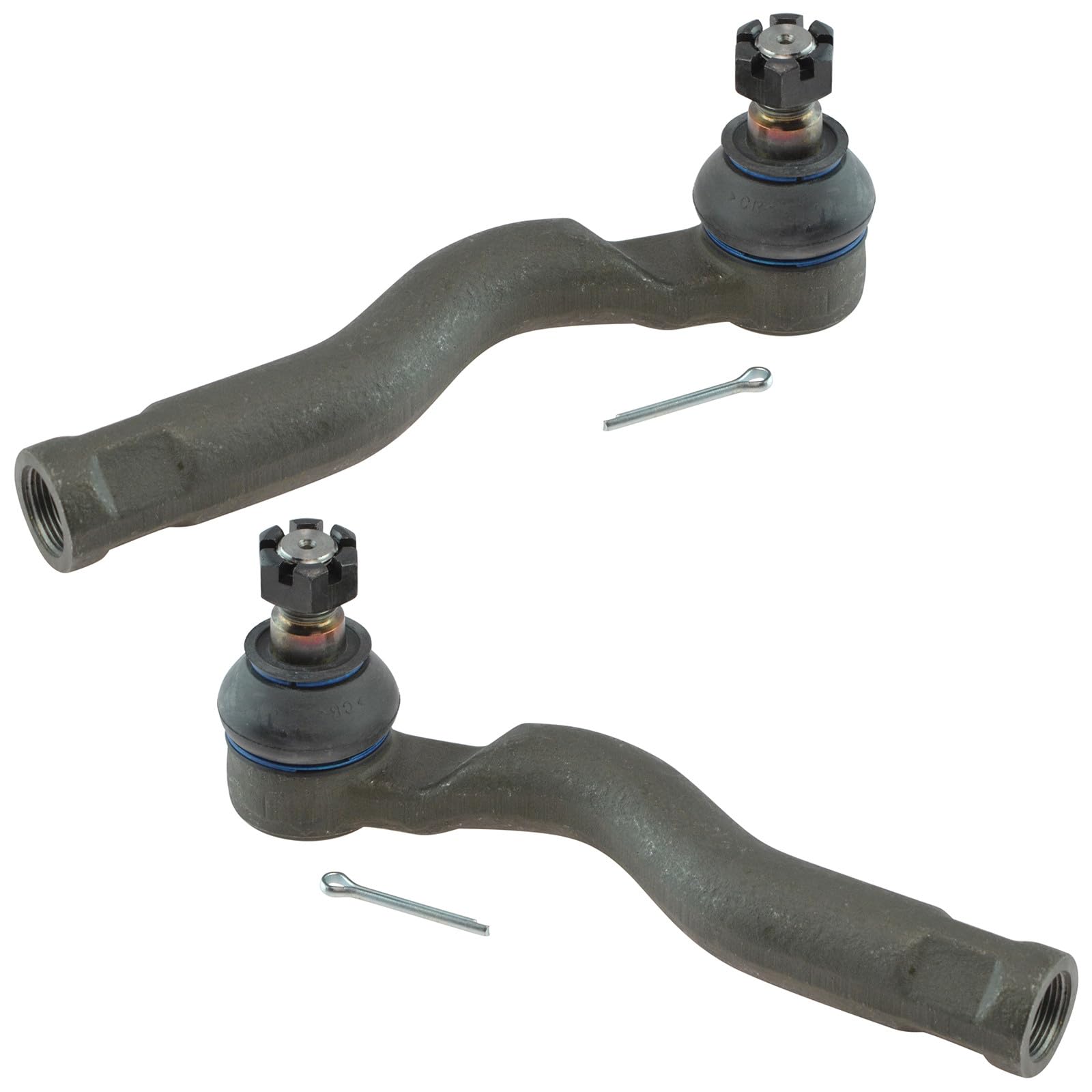
The heavier TRQ set, with Toyota-fit reference numbers and a lifetime warranty too.
This is the second TRQ set and the heavier of the two at 5.61 pounds. It covers the Toyota interchange numbers 45046-09560, 4504609560, 45047-09260 and 4504709260, and the reference list runs to ES4509, ES4510 and ES800326. If you drive a truck or SUV that crosses those codes, this is the pair to fit. It has the same DIY video support and limited lifetime warranty against material and workmanship defects.
Performance is where owners point when steering wander goes away — the front end tracks straight again. Owners praise the fit and build quality most often. Durability is mixed, though: part of the review page says it holds up great, and another part says it is not built to last. Greasiness is a smaller split, since the set does not arrive pre-greased, so add a grease gun to the job.
It weighs roughly double the lighter TRQ set at 5.61 pounds versus 2.56 pounds, which is the size difference you feel when handling the parts. That matters on a heavier truck front end. Confirm your Toyota reference number first, because the two TRQ sets do not interchange.
Buy this one when: your old part carries one of the Toyota reference numbers and you want both sides plus the video support.
Add to the job: a grease gun, because the set arrives ungreased and needs to be filled before it goes on.
Reach for this if: you want the heavier of the TRQ pairs and the Toyota-fit code on your old part matches.
Skip if: you assume it is pre-greased — it is not, and a dry joint wears fast.
Know the Specs
Greaseable vs. Sealed Sockets
A greaseable socket has a fitting that lets you pump fresh lubricant into the joint, which flushes out old grease and debris. A sealed socket is set at the factory and never serviced. Greaseable ends can be kept tight for years, while sealed ends typically live as long as their factory fill allows.
Ball Stud Material and Heat Treatment
The ball stud is the poll that pivots inside the socket. MOOG heat-processes its ball studs to match or exceed OE requirements, which helps them resist fatigue. The A-Premium stud is plain steel. Heat-treated studs are the better long-term bet on a truck that hauls.
Common Questions
How do I know which outer tie rod end fits my truck?
Is a greaseable tie rod end better than a sealed one?
Can I replace just one outer tie rod end or should I do both?
What does the VIN check mean on the Honda CR-V tie rod kit?
What is a Belleville preload washer?
Do tie rod ends come pre-greased?
How long does an outer tie rod end last?
Does the steering need realigning after replacing a tie rod?
What is the difference between an outer tie rod end and an inner one?
Can I install an outer tie rod end myself?
The Bottom Line
The best outer steering tie rod for most people is the MOOG ES3609, because it pairs the largest single-piece body here with a greaseable socket (a joint you can re-grease) and a pressed-in cover plate that keeps the joint tight as it wears. If you want a two-piece kit and a warranty to back it, grab the ETS ES800717/718 kit for Hyundai or Kia. And for a Super Duty or a CR-V, the matching MOOG ES80755 and HHCM ES800303 pair are the ones that fit. Order by the part number on your old end, fit them, and book the alignment.
How we choose
We do not accept paid placement. Every pick is matched to a real buyer and a real use-case; we do not hands-on test units.
Sources
Specifications: manufacturer listings and product documentation. Review insights: verified customer reviews, as of November 2026. Pricing: not shown on this page (it changes often); check the current price via the retailer link.
As an Amazon Associate, Tactical Gear Guy earns from qualifying purchases. This does not affect which products we feature.