Specs are compiled from manufacturer listings and verified buyer reviews and can change over time — please confirm the key details on the product page before buying.
You want a stove that lights on the first try, boils water fast, and doesn’t quit when the wind picks up at camp. Simple. The trick is matching the burner and fuel type to how you actually cook — a tailgate spread, a backpacking trip, and a power-outage backup need different tools. This guide breaks down nine real outdoor stoves so you can pick the one that fits your setup instead of guessing in the aisle.
This guide is built by comparing the manufacturers’ published specifications and the patterns across verified customer reviews, so you get each pick’s real strengths and trade-offs instead of marketing spin.
Wind is the enemy most buyers underestimate, and a good windscreen matters as much as raw heat. Below you get the exact BTUs, burner counts, and fuel options side by side, plus the honest trade-offs that owners run into. Here is how to find the right outdoor stove for your cooking style, fuel preference, and pack space.
Top Picks


How To Choose The Best Outdoor Stove
You want a stove that boils fast, runs on fuel you can actually buy, and fits in your trunk. Three things decide that: how much heat you need, what fuel is easy to find, and how much space and weight you can carry. Get all three right and the rest is small details. Get one wrong and you end up with a stove that boils water slowly, runs out of fuel at the wrong moment, or takes up half your trunk.
Heat Output and Burner Count
BTU stands for British thermal unit — a measure of how much heat the burner puts out. More BTUs means faster boiling and better searing. A single-burner stove in the 7,650 to 15,000 BTU range handles coffee and one-pan meals. A two-burner model at 25,516 to 60,000 total BTUs lets you run a pot of chili and a skillet at the same time. Think about how many dishes you actually cook at once before paying for extra burners.
Fuel Type and Cold-Weather Performance
Propane is the most common fuel for camp stoves and works well in mild to cool weather. Butane stoves deliver strong heat but lose pressure in freezing temperatures. Isobutane mixes like the Jetboil’s blend perform better in cold conditions and are the standard for backpacking canisters. Check what cartridges you can buy locally — a stove that takes a fuel nobody stocks near your campsite is a headache.
Windscreen and Flame Stability
A windscreen shields the flame from gusts that steal heat and waste fuel. Three-sided folding windscreens on camp cooktops do double duty as side tables and wind blocks. A built-in windblocker around the burner head protects the flame at lower profile. If you cook in open areas or on windy ridge lines, this feature matters as much as the BTU rating.
Portability and Weight
A backpacking stove should slip into a pack and weigh ounces — the Jetboil Zip 0.8L comes in at 12 ounces. A two-burner camp stove like the XtremepowerUS tips the scale at 13 pounds and is designed to stay at base camp or in the truck. Match the stove’s weight to how far you carry it. If you drive to the campsite, a heavier steel unit with more cooking area is fine. If you hike in, every pound counts.
Side-by-Side Comparison
| Model | Best For | Total BTUs | Burners | Fuel Type | Amazon |
|---|---|---|---|---|---|
| Camp Chef Explorer 2-Burner★ Best Overall | All-around camp cooking | 60,000 | 2 | Propane | Amazon |
| Coleman Bottletop Propane StovePocket-Size Power | Compact & power outages | 10,000 | 1 | Propane | Amazon |
| GasOne 15,000 BTU Dual FuelMost Versatile Fuel | Dual-fuel versatility | 15,000 | 1 | Propane / Butane | Amazon |
| Bonnlo 2 Burner 150,000-BTU | Heavy-duty & big pots | 150,000 | 2 | Propane | Amazon |
| Jetboil Zip 0.8L | Backpacking & fast boils | — | 1 | Isobutane / Propane | Amazon |
| XtremepowerUS Double Burner | RV & tailgating | 25,516 | 2 | Propane | Amazon |
| Iwatani 35FW Butane Cooktop | Indoor / outdoor wok cooking | 15,000 | 1 | Butane | Amazon |
| Coleman Classic 3-Burner | Family-size cooking surface | 28,000 | 3 | Propane | Amazon |
| Camp Chef Everest 2X | High-output camper upgrade | 40,000 | 2 | Propane | Amazon |
Detailed Reviews
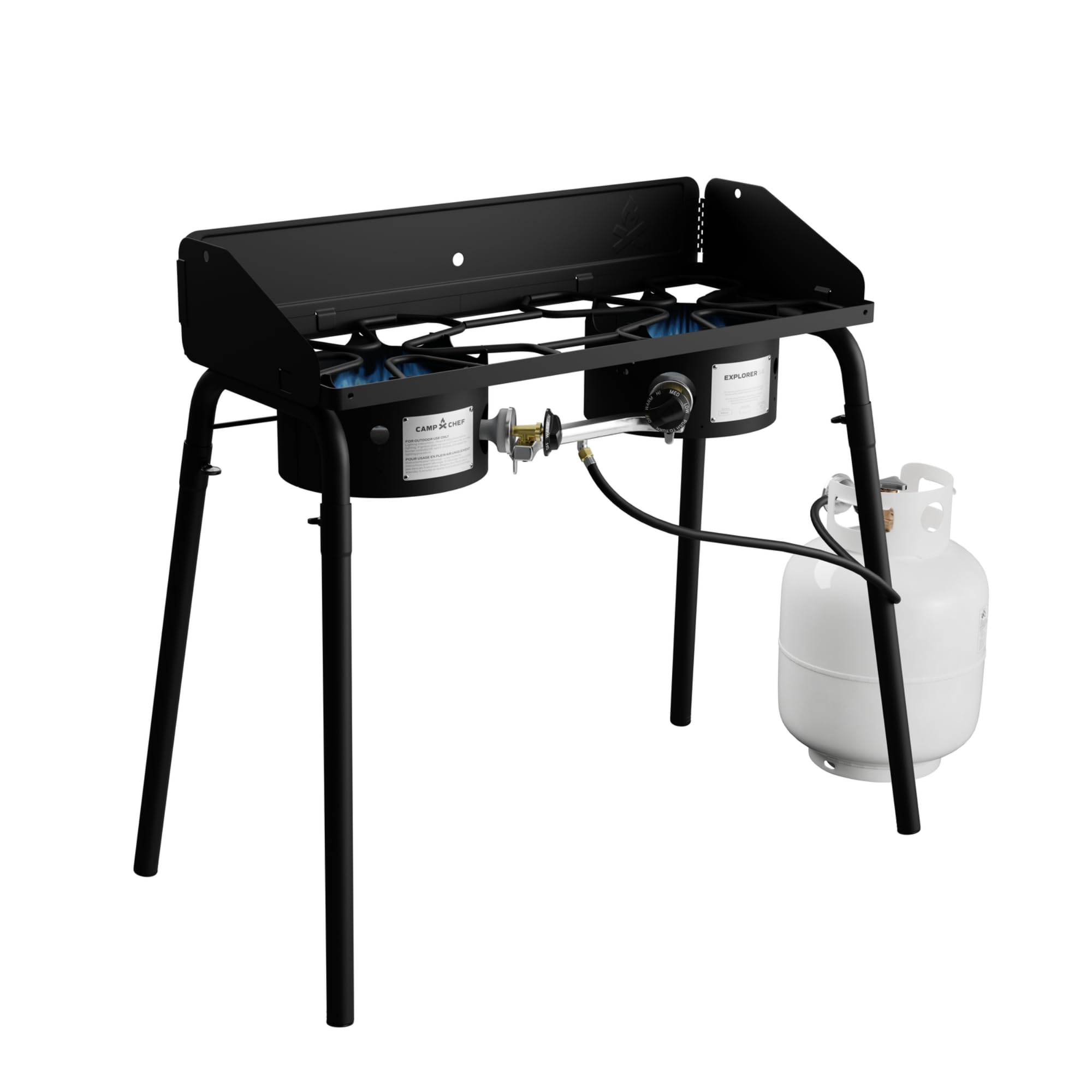
1. Camp Chef Explorer 2-Burner Stove
Our pick — 4.5+★ from 9,500+ verified ratings; the strongest balance of quality and price.
Sixty thousand BTUs of twin-burner power on legs that pop off for the drive home.
The Camp Chef Explorer takes the top spot because it gives you two 30,000 BTU cast-aluminum burners — 60,000 total BTUs (BTU is a heat-output unit, so higher means more fire). That is enough to run a big pot of water on one side and a screaming skillet on the other, so a canner heats fast. The top gives you a 448 sq in cooking area (about the size of a large baking sheet). Detachable steel legs swap it from tabletop to freestanding in minutes, so it works at a campsite, a tailgate, or your own back patio with equal ease.
What wins owners over is the build quality, backed on the spec sheet by an alloy steel frame and a three-sided windscreen that folds up to block gusts. The appliance-style knobs give you steady, dial-it-in heat control instead of a touchy on-or-off tap. Owners say the 448 sq in grate holds two pressure canners at once, so it handles canning-day loads, not just weekend breakfasts. Set against the compact Coleman Bottletop’s 10,000 BTUs, the Explorer’s 60,000 british thermal units is a different class of cooking power entirely.
The honest trade-off is weight and footprint. At 2.5 kg and measuring 34″L x 14″W x 29″H with the legs on, it is a car-camping unit, not something you haul down a trail. There is also no way to make it taller, which a couple of owners note when they want a higher cooking position. For a base-camp kitchen where you drive in and cook real meals for a group, neither point is a problem.
What Earns It the Crown
- Two 30,000 BTU burners give a combined 60,000 total BTUs for side-by-side cooking
- 448 sq in cooking area fits large canners, cast iron, and big pots
- Three-sided windscreen keeps the flame steady in breezy weather
- Compatible with most 14″ Camp Chef accessories for flexible setups
Where It Asks You to Adjust
- 2.5 kg plus the 34″L frame makes it a car-camping stove, not a pack stove
- No height adjustment — cooking surface stays fixed
The big-kitchen pick: reach for this if you drive to camp and cook full meals for a group on a stable two-burner surface.
Before you commit: it takes up real trunk space with the legs attached and sits at a fixed height.
2. Coleman Bottletop Propane Stove, 7,650 BTU Camping Cooker
Screws straight onto a propane bottle and boils coffee in the time it takes to find the coffee.
This is the stove that lives in the trunk for power-out nights and quick car-camping mornings. It pushes up to 10,000 total BTUs through a single adjustable burner that fits an 8 inch pan, and it separates from its base so it stows compact against a propane bottle. The 7,650 BTU rating in the specs pairs with a pressure regulator that keeps performance steady in extreme conditions — that regulator is why it keeps a consistent flame when the temperature swings.
The recurring win is performance, and it delivers where it counts: heats food and boils water fast, makes coffee in seconds, and the propane flow knob is easy to dial. Wind baffles shield the burner so the flame holds up in a stiff breeze. As one set of owners put it, it handles “regular sized pots and pans” outdoors and still stows away small at home. Side by side with the more compact and far heavier Camp Chef Explorer — 0.01 kg versus 2.5 kg on the spec figures — this one is the grab-and-go option.
Understand the limits before you buy. Runtime tops out at up to 2.5 hours on high on one 16.4 ounce propane cylinder (sold separately), so a long cook day needs a spare can. Cleaning can be a little fiddly when food spills into the burner area. It also arrives as a burner-plus-base kit you screw together, so it is a simple camping tool rather than a full cooktop.
The outage-ready read: a light, compact single burner that earns its keep as a car-camping and emergency-backup stove, with a pressure regulator that holds a steady flame when conditions turn rough.
The catch: a single burner and a 2.5-hour high runtime on one 16.4 ounce cylinder mean it is built for quick meals, not all-day cooking.
Made for the trunk: a smart grab when you want one compact burner for car camping, coffee at a tailgate, or a power-out backup.
Skip it for group feasts: one burner and a 2.5-hour high-burn runtime can’t keep pace with a multi-dish camp kitchen.
3. GasOne Dual Fuel Portable Camping Stove
Runs on butane or propane, fires up without a match, and packs into its own case.
The GasOne GS-3900PB solves a real camping annoyance: fuel availability. It runs on a single 8oz camping fuel cartridge or a 16.4oz (1lb) propane cylinder, and a propane adapter comes in the box so you are not stuck hunting for one fuel type. Output is 15,000 BTUs through a brass burner head with a dual spiral flame, and a piezo-electric ignition lights it without a match or lighter — handy when your hands are cold and full.
What earns it a spot is the safety and convenience package for the size. A built-in pressure sensor cartridge ejection system and a gas flow cut-off mechanism give you two layers of protection, and a heavy-duty windblocker on all four corners of the burner head fights flame blowout. It weighs 6 pounds with stainless steel construction and measures 12.9″L x 10.9″W x 4.5″H, so it fits a car-camping kit or an emergency-preparedness bag without crowding it. Owners lean on it as a power-outage backup and report the 15,000 BTU brass burner heats a pan much faster than an electric burner.
The catch is the case. The carrying case is on the flimsy side, and one of the sliding lock tabs can pop off early. The stove itself is the sturdy part — treat the included case as a dust cover rather than a hard shell. If you want a dual-fuel burner that starts instantly and travels easily, this delivers; just don’t expect premium luggage around it.
Why it earns the slot: dual-fuel flexibility, matchless piezo ignition, four-corner windblocking, and a gas cut-off safety mechanism in a 6-pound stainless package.
The honest note: the included carrying case is the weak link — the sliding lock tabs are light-duty, so plan to store it a little more carefully.
Best for the flexible camper: choose this when you want one stove that sips either butane or propane and lights without a match.
Fair warning: the carrying case feels light-duty, so the stove travels better than its shell.
4. Bonnlo 2 Burner Propane Stove
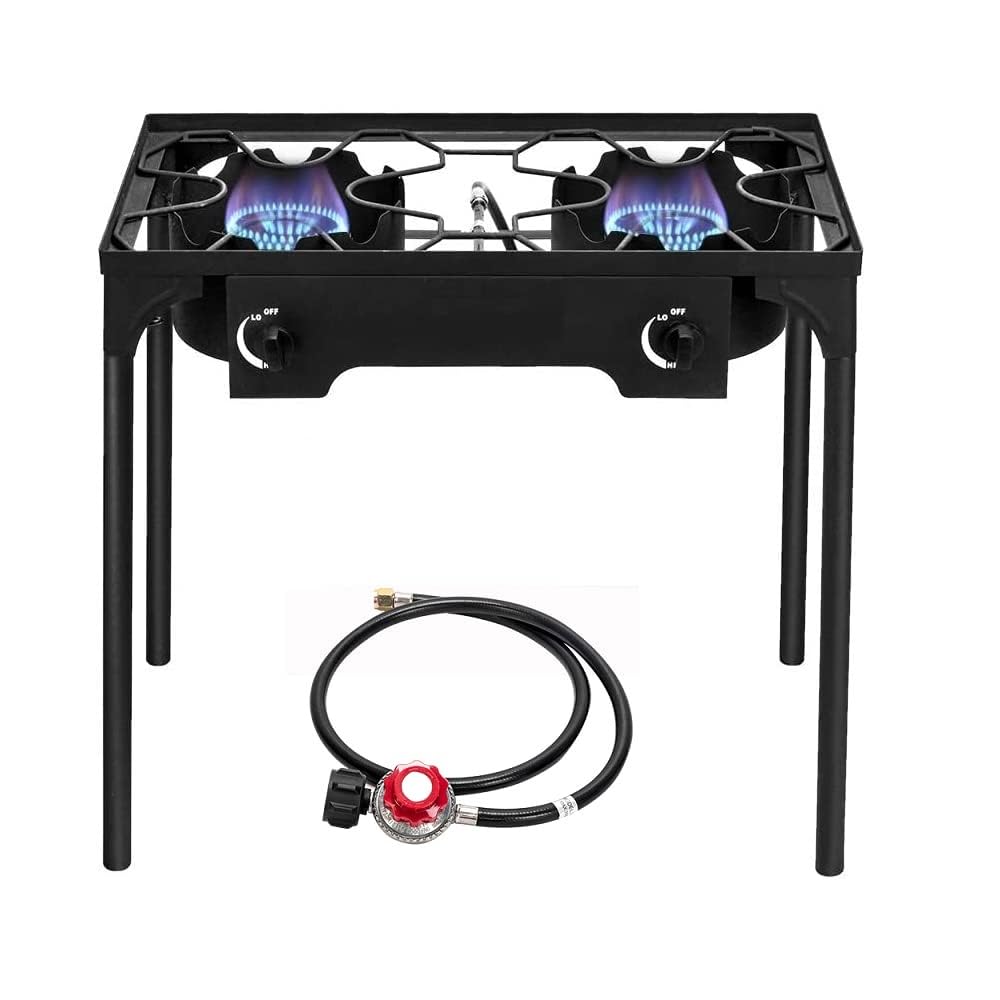
Cast-iron muscle built for crawdad boils, crab pots, and a cauldron of chili.
When your cooking involves a pot the size of a small car, this is the burner that steps up. The Bonnlo two-burner unit is rated at 150,000 BTUs and made from cast iron, so it handles the heavy jobs that overwhelm a lightweight camp stove. Knobs at the front let you dial the flame and a CSA-listed regulator handles the gas flow, and the legs come off in minutes so it travels to a tailgate or a backyard boil. For outdoor parties, brewing, camping, and fishing trips, it is a serious standalone cooker.
Durability is the draw here. It is described as built like a tank, and buyers report it holds steady footing on uneven ground. Flame control earns genuine praise — you can run it anywhere from a shimmering low to a full blown torch, so a delicate simmer and a rolling boil can happen in the same cook. Owners repeatedly call out the cast-iron sturdiness and value, and the flame-control remarks confirm it dials from a shimmer to a full torch.
One thing to weigh: it is a large, heavy cast-iron unit measuring 29.92″D x 15.75″W x 29.92″H, so it is a patio-and-base-camp stove rather than a pack item. A small number of owners mention a broken arm on arrival, so inspect the stand when it lands. For big-pot cooking where stability and raw output matter more than portability, those points are easy to live with.
Where it delivers: a 150,000 BTU two-burner cast-iron cooker with a flame that ranges from a gentle shimmer to a full torch.
The trade to plan around: it is a big, fixed cast-iron stand — great at a base camp or patio, awkward to haul far.
For the boil crowd: the right tool when your menu is crab pots, clam boils, and a giant batch of stew.
Look elsewhere if: you need something to carry on a hike — this iron body belongs near the car.
5. Jetboil Zip 0.8L Portable Fast Boil Stove

Boils 16 ounces of water in 2 minutes and packs itself into its own cup.
Speed is the whole story here: the Jetboil Zip brings 16 ounces of water to a boil in 2 minutes, which is why dehydrated meals and trail coffee stop being a chore. It runs on an isobutane/propane mix canister and packs down so the stove components and a 100 g JetPower canister (sold separately) nest into the 0.8 liter cook cup. An insulated cozy keeps water hot longer, and the bottom cup doubles as a measuring cup or a bowl when you want to eat straight from it.
The build is what owners keep coming back to: 12 ounces on the scale, a 0.8 liter cup big enough that many meals need only one boil, and a nested pack that saves space. The improved locking system adds three locking points with visual indicators so the pot-to-burner connection feels secure, and rubberized Safe-Touch zones stay cool while you cook. A three-sided comparison: the Camp Chef Everest 2X tops out at 40,000 BTUs for two burners, but it weighs 15 pounds — this Jetboil is built for the weight you carry on your back, not the tailgate.
Know the two things that will decide it for you. There is no built-in igniter — you turn the Easy-Turn knob and light it with a match or lighter, and some owners wish a piezo lighter were included at this build level. The orange base is another wear point that a few buyers have had to replace. It is also a boil-and-rehydrate tool, not a simmer-and-saute cooktop. For backpackers whose meal plan is hot water, those are small trade-offs.
Why Trail Cooks Pick It
- Boils 16 ounces in 2 minutes — fast enough for quick trail meals
- 12 ounces and nests into its own 0.8 liter cup to save pack space
- Insulated cozy keeps water hot longer while you eat
- Three locking points with visual indicators secure the pot to the burner
What You Give Up
- No built-in igniter — you supply a match or lighter
- Built for boiling and rehydrating, not low-and-slow cooking
For the ounce-counters: the stove to grab when you hike in and your dinner is a pouch of dehydrated food and a hot drink.
Rule it out if: you want to simmer sauces or skip bringing a lighter — this one needs an outside flame source.
6. XtremepowerUS Double Burner Propane Stove, 25,516 BTU
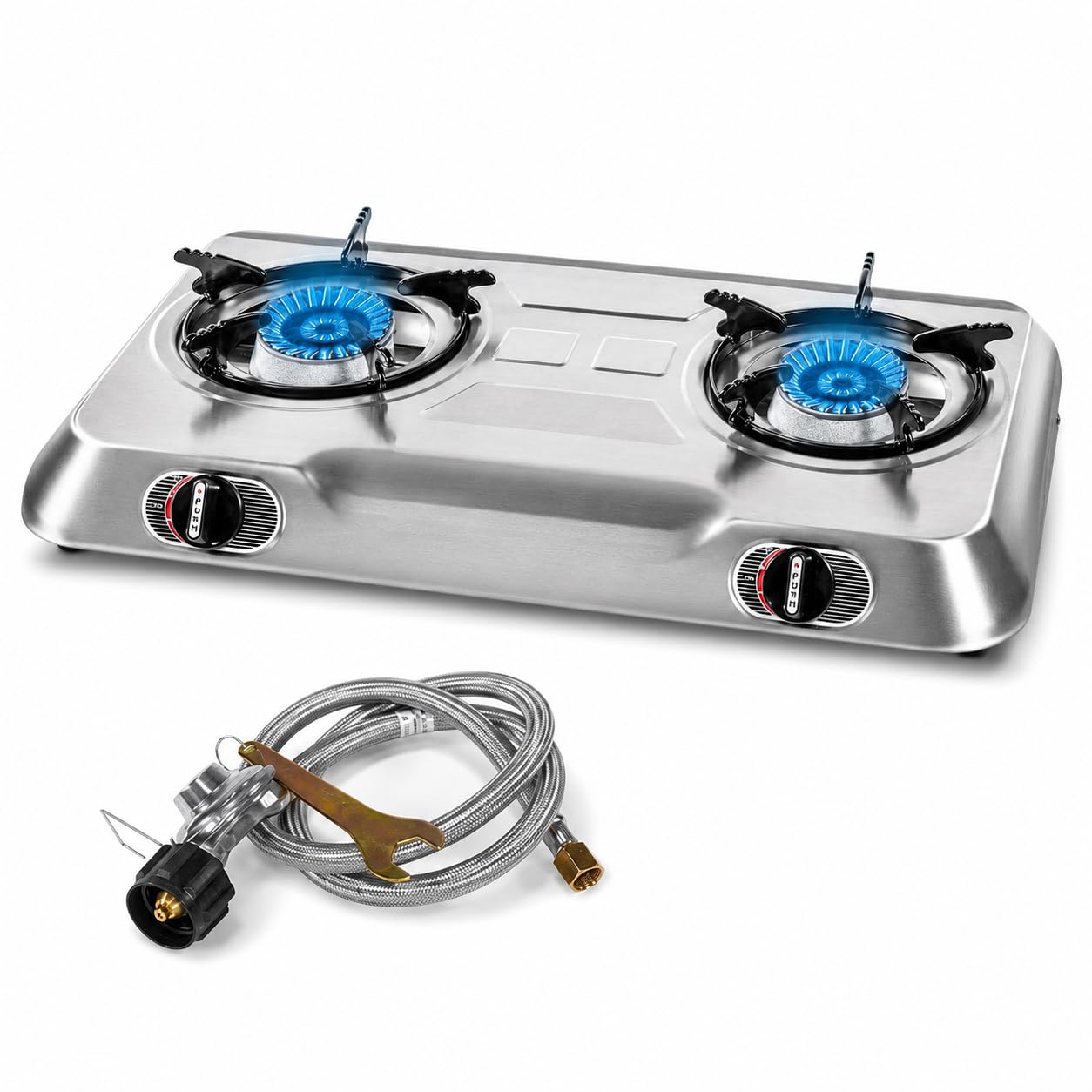
A stainless two-burner cooktop that drops into an outdoor kitchen or RV galley.
Two independently controlled burners totaling 25,516 BTUs (12,758 per burner) make the XtremepowerUS a natural fit for an outdoor kitchen, an RV cooktop, or a tailgate setup. A built-in piezo ignition eliminates the match hunt, and independent knobs let you run one burner at a gentle simmer while the other sears. The stainless steel body wipes clean fast, and a regulator with hose comes included so setup is straightforward. It measures 27.5″L x 16″W x 4.75″H and weighs 13 pounds — a tabletop or built-in unit rather than a backpack stove.
Owners find the two independent burners reliable for outdoor cooking and easy to use as a temporary stovetop, and the stainless body wipes clean between cooks. That combination of a low, wide profile and two separate burners is what makes it shine as a semi-permanent outdoor kitchen fixture. It is smooth, easy to set up, and built to sit at a cooking station rather than travel in a pack.
Here is the honest part: flame intensity and build quality draw mixed reactions. Some buyers want the flame hot enough for stir-fry and report a strong yellow center flame or a whole unit that runs hot on the outside. The metal is on the thin side, so a dent is possible if it gets knocked around. Treat it as a well-priced outdoor cooktop that does its job, and keep an eye on the hose connection — a waterproof cover is not included, so shelter it from rain.
The outdoor-kitchen angle: a low-profile stainless two-burner with auto ignition and independent knobs that fits a built-in or tabletop cooking station.
The catch: thin metal and a hot-running surface mean it wants careful handling and a sheltered spot, and the hose deserves a check before each season.
Built for a fixed station: the pick if you are outfitting an RV galley, outdoor kitchen, or tailgate setup that stays put.
Think twice if: you boil over often or cook in rain — the thin steel and exposed hose ask for care.
7. Iwatani 35FW Single-Burner Butane Portable Cooktop

A brass-burner butane cooktop with the heat to blacken a wok, made in Japan.
The Iwatani 35FW is the pick if you want one stove for the kitchen and the campsite. It packs 15,000 BTUs through a durable brass burner and is built to run equally well indoors and out. Loading fuel is nearly simple to use — there are no locking levers, you just push the can onto the magnet and it locks safely, so it is almost impossible to seat the canister wrong. An advanced heat panel uses the entire butane can while holding maximum heat output, which stretches each can farther. At 4.4 pounds and 13.3″L x 11.9″W x 3.7″H, it pulls duty as a kitchen backup and a camp cooktop.
Heat output is the star. Owners describe the brass burner as powerful and well-built, with one noting it doubles the heat output of an electric stove and sears wok dishes beautifully. The built-in double windbreaker protects the flame from wind and air conditioning, and an automatic safety stop shuts off the butane and kills the flame if canister pressure climbs to unsafe levels. What wins people over is the overall quality — the brass burner and magnet-loaded canister feel like a serious appliance rather than a flimsy camp gadget.
The trade-off is finesse and fuel. The flame is hard to fine-tune at the low end, and the heat is strong enough that some cooks add a separate diffuser to tame it. It runs on butane only, which loses pressure in freezing cold, so it is a three-season tool. A few owners also wish the included case had padding to protect the finish. None of that stops it from being an excellent hot-and-fast cooktop.
The sear specialist: a 15,000 BTU brass-burner cooktop with a magnet-loaded canister, double windbreaker, and an automatic pressure safety shutoff.
The honest limit: precise low-heat control is tricky and it is butane-only, so plan around cold weather and delicate simmering.
For high-heat cooks: the one to own if you stir-fry, wok-sear, or want a kitchen-grade burner for picnics and camping.
Not your match if: you cook in freezing temperatures or need a razor-fine low simmer.
8. Coleman Classic 3-Burner Propane Stove, 28,000 BTUs

Three burners and room for two 12-inch pans means pancakes for the whole crew.
If your camp breakfast is a production line, the Coleman Classic 3-Burner gives you the surface to run it. Three adjustable burners deliver up to 28,000 total BTUs, and the large cooking area fits two 12 inch pans or three 8 inch pans at once. Push-button ignition lights it matchless, and wind-blocking panels shield the burners while folding down into side tables for prep space. A pressure regulator keeps performance consistent in extreme conditions, and a 3-year limited warranty covers it.
The wide surface is the reason people choose it — cooking pancakes, big skillets, and multiple pans in one go without crowding. Functionality holds up well, and cleaning is easy because the grate lifts off completely. It is the stove you set up once at camp and leave standing, cooking alongside a big pot without needing a second unit.
The honest catch is flame control. The temperature knobs are stiff, and the low end is where owners run into trouble — the gap between a hot flame and off is narrow, so a true low simmer takes some patience. The middle burner is also the coolest of the three. Runtime is up to.75 hours with all burners on high on one 16.4 ounce propane cylinder (sold separately), so bring a spare can for a long breakfast. Cook hot and big and it shines; fine-dining simmer control is not its job.
The group-cook surface: three burners and space for two 12 inch pans, with wind panels that turn into side tables and a 3-year limited warranty.
The low-heat caveat: the knobs are stiff and the low setting is coarse, so delicate simmering takes extra care.
For the crowd at breakfast: grab this when volume and surface area beat delicate control — family camping, group meals, big skillets.
Not the pick for: sauces and long slow simmers where fine low-heat control decides the result.
9. Camp Chef Everest 2X 2-Burner Stove

Twin 20K burners with the flame control to actually hold a low simmer.
The Everest 2X splits its 40,000 BTUs across two 20,000 BTU cast-aluminum burners, and that per-burner power is what makes it feel like a real kitchen stove out in the field. Matchless ignition fires it without a match, a folding lid with a windscreen keeps the flame steady in breezy weather, and the 215 sq in surface fits two pans plus accessories. A drip tray and carry handle make cleanup and transport easy at the end of the cook.
Here is where it beats the pricier, heavier competition on control: owners say it simmers at low heat rather than forcing you to choose between full blast and off. Paired with the Camp Chef Explorer’s 60,000 total BTUs and two burners above, this one trades a bit of peak output for that fine flame control and lighter 15-pound build. Reliability is another strength — it keeps boiling a pot with wide burners that fit two large pots side by side.
The knobs are the weak point: they can fall off easily, so expect to reseat them or be gentle. It is also a 15-pound unit measuring 27″L x 15.5″W x 8.25″H, so it is a car-camping stove, not a pack item. For anyone who wants high output with genuine low-heat finesse in a portable folding cooker, those are small flaws against a strong core.
Best of the flame-control crowd: dual 20,000 BTU burners, matchless ignition, and confirmed low-heat simmering on a 215 sq in folding surface.
The small gripe: the knobs are loose enough to pop off, so a little care keeps them seated.
The control-first camper: pick it if you want high output plus a true low simmer in a stove you fold up and carry to camp.
The compromise: at 15 pounds and with looser knobs, it is a car-camping tool that wants a gentle hand.
Know the Specs
BTU Output
A BTU, or British thermal unit, measures how much heat a burner produces — more BTUs generally means faster boiling and stronger searing. A single-burner stove in the 7,650 to 15,000 BTU range handles coffee and one-pan meals. A two-burner camp cooktop climbing into the 40,000 to 60,000 total BTU range lets you run two pots down quickly. Match the BTU figure to your cooking volume, not just the biggest number on the box.
Burner Count
One burner keeps the stove small and light for backpacking and quick meals. Two burners let you cook a main and a side at the same time. Three burners add cooking surface for pancakes, griddles, and big family breakfasts. More burners usually means more weight and a larger footprint, so think about how many dishes actually need to cook simultaneously before you size up.
Fuel Type
Propane is the most common camp stove fuel and works well in mild to cool weather. Butane delivers strong heat but loses pressure in freezing temperatures, so butane stoves are best for three-season use. Isobutane and mixed canisters perform better in the cold and are the backpacking standard. Always confirm what cartridges your local stores stock before committing to a stove.
Windscreen and Ignition
A windscreen or wind baffle shields the flame from gusts that steal heat and waste fuel, and it is the single most useful feature on a windy day. Matchless piezo or push-button ignition saves you hunting for a lighter in the dark, while stoves without a built-in igniter need an outside flame source. Both features matter most when conditions get rough, which is exactly when a camp cook fires up.
Common Questions
How many BTUs do I need for an outdoor stove?
Can I use a butane stove in cold weather?
What is the difference between propane and isobutane in a camp stove?
Do these outdoor stoves come with an igniter?
How long does a propane cylinder last on a camp stove?
Is a two-burner stove worth it over a single burner?
Can I use these stoves indoors?
What does a windscreen actually do on a camp stove?
How much do these outdoor stoves weigh?
The Bottom Line
The best outdoor stove for most people is the Camp Chef Explorer 2-Burner, because its two 30,000 BTU burners and 448 sq in cooking area give you genuine two-pot power for group camp cooking. If fast backpacking boils are your goal, the Jetboil Zip is the one to reach for. And when you want high output with true low-heat control in a fold-up stove, the Camp Chef Everest 2X delivers both on a 215 sq in surface.
Whichever you pick, match the BTU rating and fuel type to how you actually cook. That one decision keeps you away from a stove that boils too slow, runs dry too fast, or is too heavy to haul — and it is why the Explorer tops this list.
How we choose
We do not accept paid placement. Every pick is matched to a real buyer and a real use-case; we do not hands-on test units.
Sources
Specifications: manufacturer listings and product documentation. Review insights: verified customer reviews, as of November 2026. Pricing: not shown on this page (it changes often); check the current price via the retailer link.
As an Amazon Associate, Tactical Gear Guy earns from qualifying purchases. This does not affect which products we feature.