Specs are compiled from manufacturer listings and verified buyer reviews and can change over time — please confirm the key details on the product page before buying.
If you are running a camera or access point to the far end of a yard, the thing that sinks the job is almost never the device — it is the injector that quits at the first hard frost. You want one that sends power and data down a single cable and keeps doing it through rain, dust and snow. The three picks below cover the whole spread: the highest-power unit, the tough 24V workhorse for older gear, and the premium name-brand midspan.
This guide is built by comparing the manufacturers’ published specifications and the patterns across verified customer reviews, so you get each pick’s real strengths and trade-offs instead of marketing spin.
Outdoor networking gear lives or dies on two numbers — the IP rating on the enclosure and the wattage it can actually push down the line. Below you will find the real figures for each unit, plus the compatibility traps that catch first-time buyers. Here is how the leading outdoor poe injector options stack up when you need power to survive the weather.
Top Picks
How To Choose The Best Outdoor PoE Injector
An outdoor PoE injector takes power from a wall supply and pushes it down the same Ethernet cable that carries your data. That saves you from running a separate power line to a camera on a pole. Four specs decide the purchase: IP sealing, PoE wattage, active-versus-passive voltage standard, and cable category.
Get the IP rating right first
An IP rating is a two-digit score for how well a case keeps out solids and water. IP67 means the unit is sealed against dust and can survive brief immersion. If your injector sits under an eave or inside a garage, a sealed metal case with a waterproof cable cap still earns its keep. Look for a housing where the RJ45 connection is protected, not just a plastic lid.
Match the PoE standard, not just the wattage
Active standard PoE (802.3af, at and bt) negotiates with the device before sending power. Passive PoE sends forced voltage with no negotiation at all. A bt injector will happily run a modern standard camera. A passive injector will only work with gear that expects a fixed voltage. Put a passive unit on a standard-only device and you risk damaging it.
Check your input voltage before you order
Some injectors take a wide DC input and boost it to a PoE output. Others need a specific supply to reach full output. If your DC feed runs below the unit’s minimum, the PoE output drops with it. Read the input range on the spec sheet and confirm your power supply clears it.
Know how far your cable will carry the speed
Speed falls off with cable quality over distance. Higher categories of cable hold speed further, and the fastest rates need the best cable. Cat7 is what a 10-gigabit run wants. Cat6 or better covers gigabit. Pick the cable category for your speed and distance before you pick the injector.
Side-by-Side Comparison
| Model | Best For | PoE Out Max | Data Speed | Weather Rating | Amazon |
|---|---|---|---|---|---|
| MokerLink IP67 10G Injector★ Best Overall | High-power long runs | 90 W | 10 Gbps | IP67 | Amazon |
| Elenzk Industrial 24V Passive | Legacy 24V cameras | 18 W | 1000 Mbps | Aluminum case, -40°C to 75°C | Amazon |
| Axis 5900-334 T8134 Midspan | Axis camera installs | 60 W | 480 Mbps | -40°C to 65°C | Amazon |
Detailed Reviews
1. MokerLink IP67 Outdoor 10 Gigabit PoE Injector
Our pick — 4.0+★ from 60+ verified ratings; the strongest balance of quality and price.
One sealed box that pushes 90 watts of power and 10 gigabits of data down the same cable.
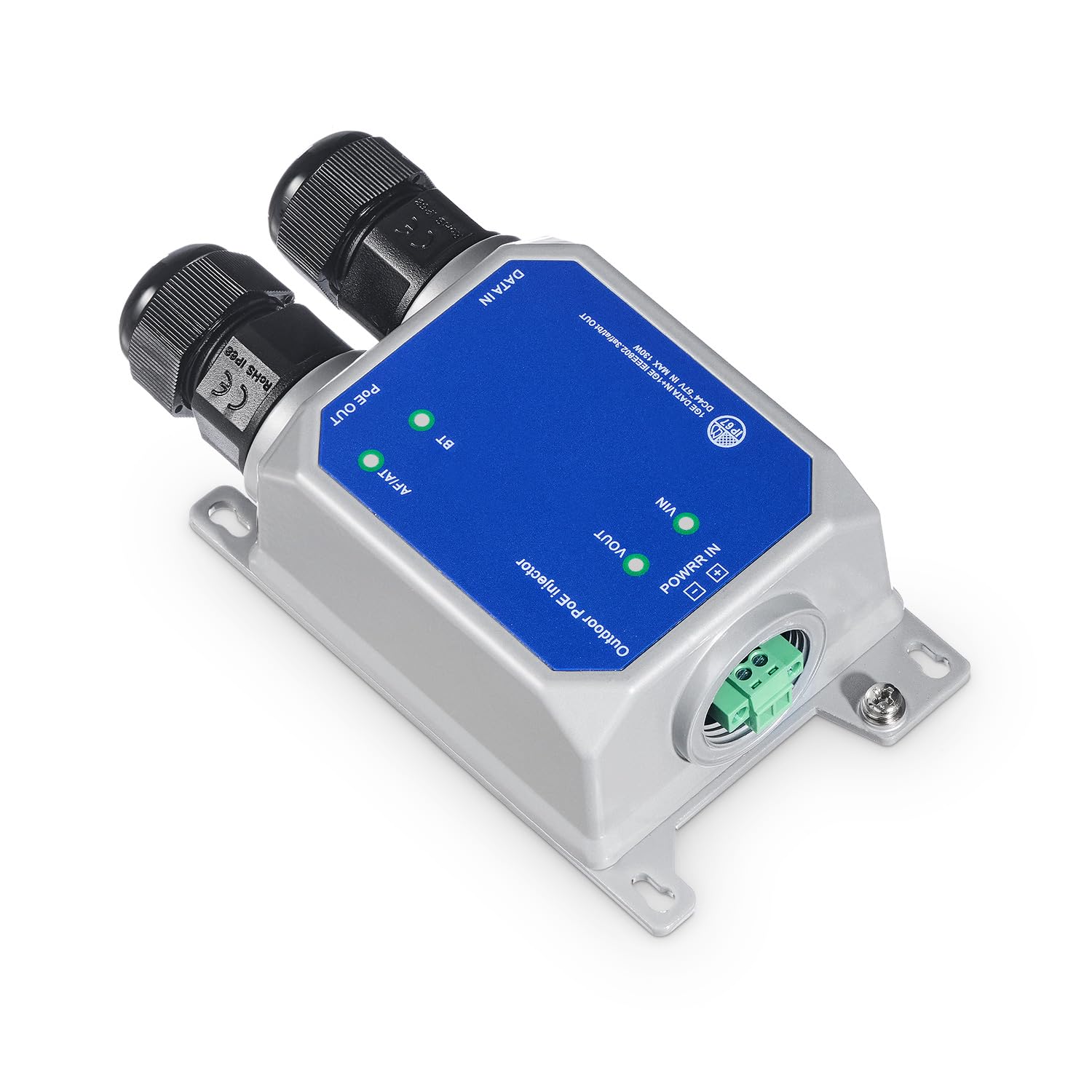
This is the unit to buy when the run is long and the device is hungry. It pushes 90 watts of PoE out from a DC48-57V input that can draw as much as 120W, so it can feed a power-hungry pan-tilt camera, an outdoor access point or a heated enclosure. That 90W figure beats the Axis 5900-334 at 60W, which matters once you add a device that needs every watt of an 802.3bt supply.
The 10-gigabit port is the other reason it sits at the top. It runs 10/100M/1G/2.5G/10Gbps and shifts data far faster than the Axis 480 Mbps unit — 1000 megabits per second against 480. Distance scales with the cable you feed it: a Cat6 run reaches 150 meters at gigabit, Cat6 holds 100 meters at 2500BASE-TX, Cat5 or later carries 150 meters at 100BASE-TX, and the full 10G needs Cat7 or later at 50 meters. Factor that cable into the install before you buy.
Sealing is where this pick earns its keep for a pole or mast. The metal housing funnels every cable through a waterproof cap, so the RJ45 joint sits inside the shell rather than exposed to rain and snow — buyers report the sealed housing holding up in oceanfront salt air. The recurring gripe is compatibility, not build: some buyers found their equipment would not talk to it, and a few questioned how watertight the wire connection stays over time. Confirm your device’s PoE behavior first, and thread the cable through the cap before you crimp the RJ45 on.
What wins people over
- IP67 metal case with a waterproof cable cap over the RJ45 joint
- 90W PoE out feeds heavy 802.3bt devices that 60W units stall on
- 10-gigabit ports future-proof the run, with Cat7 holding full speed to 50 meters
- Plug-and-play with power detection — no configuration needed
Where it can trip you up
- Needs at least 48V DC at the input to reach its full 48V PoE output
- Some owners mention devices that would not negotiate with it
- Waterproof cap takes a step of care — cable goes through the cap before the RJ45 goes on
Reach for this if: you are powering a high-wattage camera or access point on a long outdoor run and want headroom to spare.
Think twice if: your supply cannot clear 48V DC — under that threshold the unit drops its PoE output below 48V.
2. Elenzk 24V Passive PoE Injector

The one that takes a 12V feed and lifts it to 24V for older cameras.
Most of the outdoor gear sitting on fences and barns runs 24V passive PoE, not the modern standard. This injector solves the power-up problem when you only have a 12V supply on hand: it accepts a 12~24V DC input and boosts it to a 24V PoE output. That single trick turns a spare 12V brick into a working camera feed.
The build is where it justifies its mid-range place. An aluminum case handles -40°C to 75°C, so it lives through a hard winter or a summer attic without complaint, and the compact 3.74 x 2.76 x 1.18-inch body tucks into tight cabinet space. It ships with a 35mm DIN-rail clip and wall-mount bracket, so you can bolt it to a rack rail or a wall. Its gigabit port (1000 Mbps) outpaces the Axis 5900-334 at 480 Mbps, though it trails the MokerLink’s 10-gigabit ceiling and tops out at 18W of output power.
Here is the catch that decides whether this unit fits your install. It pushes non-standard passive PoE as forced power — there is no IEEE negotiation with the device. That is exactly what older 24V cameras expect, but a standard-only 802.3af/at device may not tolerate it. Use it only with gear explicitly rated for passive 24V PoE; on standard 802.3af/at devices it can underpower or damage the unit.
The install flexibility: DIN-rail and wall-mount hardware in the box means it fits a rack, a cabinet or a garage wall without extra parts.
Voltage to watch: forced passive output with no negotiation — the device has to be built for 24V passive PoE or it will not behave.
Pick it when: your camera lineup is older 24V passive gear and your power source is a 12V supply you want to reuse.
Look elsewhere when: your device needs standard 802.3 negotiation — this one sends voltage whether the device asks or not.
3. Axis Communications 5900-334 T8134 Midspan

A name-brand midspan built to run cold, from a maker whose cameras it is designed to feed.
If your camera is an Axis unit, this is the midspan that matches it. Axis builds this injector for its own network video gear, so compatibility is a given rather than a coin flip. It delivers 60W of PoE — enough for a power-drawing dome or bullet camera, though well short of the MokerLink’s 90W when you start adding heaters or pan-tilt motors.
Cold weather is its strong suit. It is rated to run from -40°C to 65°C, so it shrugs off a deep-freeze install on a pole. The trade-off sits in the data throughput: its 480 Mbps rate is the slowest of the three, so a multi-camera 10-gigabit backbone is not what this unit is for. Pair it with a single 1080p or similar fixed camera and the bandwidth ceiling never bites.
The compliance list is unusually deep for an injector — RoHS, REACH, WEEE, CE, FCC Part 15 Subpart B Class B, VCCI, KC, CCC and IEC/EN/UL 60950-1 among them. For a professional install where the spec sheet has to clear a review, that paper trail is a genuine reason to choose it. It is the premium-priced option here, and the value is the brand-backed compatibility and certification rather than raw power.
Built for its own ecosystem: designed by Axis to power Axis network video products, so the pairing is dependable.
Speed ceiling: 480 Mbps is the slowest data rate in this lineup — fine for a single camera, tight for many.
Best fit: a professional Axis camera install where certified compatibility and a documented compliance list matter more than peak wattage.
skip it if: you need maximum power or throughput — the 60W output and 480 Mbps rate leave the high end to the MokerLink.
Know the Specs
IP Rating (IP67 and Friends)
An IP rating tells you how well a case keeps out solids and liquids. The first digit covers dust, the second covers water. IP67 means sealed against dust and protected against brief immersion. For a mast or pole install, the number to look for is a sealed housing with the RJ45 joint protected, plus a waterproof cable cap.
PoE Wattage (802.3af/at/bt)
The PoE standard sets how much power a port can hand a device. 802.3af, at and bt are active standards that negotiate with the device before sending power. Higher-wattage devices need the higher standard. Match the output watts to the device’s needs, and leave headroom — a camera with a heater or motor can draw far more than a fixed one.
Active vs Passive PoE
Active PoE negotiates: the injector asks the device what it needs, then delivers. Passive PoE forces a fixed voltage with no negotiation. Passive units are for older gear that expects a set voltage. Active units work with modern standard devices. Mixing them can leave a device underpowered or damaged, so check which type your camera expects.
Data Rate and Cable Distance
Speed and distance are tied to cable category. Gigabit holds further over Cat6 than the fastest rates do over lower-grade cable. 10-gigabit wants Cat7 or better and a shorter run. The injector’s port rating sets the ceiling, but your cable sets the real distance you can reach before speed drops.
Common Questions
Will a 24V passive injector work with a standard 802.3af camera?
What does IP67 actually protect the injector against?
How far can I run the Ethernet cable from an outdoor injector?
Does a 90W PoE injector work with a 60W device?
Why do some injectors need a 48V input to output 48V PoE?
What cable do I need for 10-gigabit PoE?
Can I mount an outdoor injector on a DIN rail?
Do I need to configure an outdoor PoE injector?
Is a premium brand injector worth it over a cheaper one?
The Bottom Line
For most outdoor installs, the winning outdoor poe injector here is the MokerLink IP67 10 Gigabit Injector because it pairs a sealed IP67 metal case with 90W of PoE output and 10-gigabit ports — more power and speed than the others in this lineup. If your cameras are older 24V passive gear and you are powering from a 12V supply, the Elenzk Industrial 24V Passive is the one to reach for. And if a documented compliance list and Axis-to-Axis compatibility matter more than peak wattage, the Axis 5900-334 T8134 Midspan is the premium call.
How we choose
We do not accept paid placement. Every pick is matched to a real buyer and a real use-case; we do not hands-on test units.
Sources
Specifications: manufacturer listings and product documentation. Review insights: verified customer reviews, as of November 2026. Pricing: not shown on this page (it changes often); check the current price via the retailer link.
As an Amazon Associate, Tactical Gear Guy earns from qualifying purchases. This does not affect which products we feature.