Specs are compiled from manufacturer listings and verified buyer reviews and can change over time — please confirm the key details on the product page before buying.
Most outdoor pan tilt zoom cameras fail on one point: the zoom is only as good as the tracking that drives it. A camera that lags a second behind a walking figure gives you a close-up of empty driveway. This guide sorts that out by what actually holds a lock on a moving subject, what survives rain, and what keeps working without a monthly bill.
This guide is built by comparing the manufacturers’ published specifications and the patterns across verified customer reviews, so you get each pick’s real strengths and trade-offs instead of marketing spin.
A pan tilt zoom camera is a motorized eye that swivels left and right, tilts up and down, then squeezes in on the detail you care about. Below are the picks that do all three without giving up weatherproofing, night vision, or local storage.
Top Picks

How To Choose The Best Outdoor Pan Tilt Zoom Camera
The first decision is how far away your subject sits. A camera pointed at a mailbox two metres from the door needs almost no zoom. One watching a gate at the far edge of a lot needs real optical reach.
Optical zoom versus digital zoom
Optical zoom moves glass to magnify — the detail is real, and a plate stays legible. Digital zoom simply crops and enlarges pixels, so a 20X digital crop turns a face into a smudge. Look for the optical figure, which is the one that carries the work.
Tracking that keeps up with the subject
Auto-tracking is the motorised lens following movement on its own. A good implementation locks on as someone crosses the frame and keeps them centred. A weak one drifts, loses the target, and returns to a parked position mid-event, which leaves you with a recording of nothing.
Power and wiring outdoors
PoE (Power over Ethernet) sends both electricity and data down one cable, so a single run to the eaves does everything. Battery and solar models skip the cable entirely, which suits a fence post far from any socket — but you trade continuous recording for power management.
Weather rating and night vision
IP66 means the housing is sealed against dust and strong water jets, the minimum you want on an exposed wall. Night vision range is a separate number, and it is where budget models quietly fall short of the claim on the box.
Side-by-Side Comparison
| Model | Best For | Resolution | Zoom | Power | Amazon |
|---|---|---|---|---|---|
| Tapo C675D KIT★ Best Overall | Wide yard plus auto-track | 4K dual lens | 6mm telephoto lens | Battery + solar | Amazon |
| Jennov 6MP PoE PTZBest Zoom Reach | Long-range plate reading | 6MP | 20X optical + 10X digital | PoE | Amazon |
| Tapo C575DBest Wired Value | Wired stability, wide view | 4K dual lens | 18× digital | DC or PoE | Amazon |
| REOLINK OMVI 3i | One-camera full scene | 18MP triple lens | 8MP PT camera | PoE | Amazon |
| ONWOTE 4K 20x PTZ | Long-throw night watch | 4K 8MP | 20X optical | PoE | Amazon |
| REOLINK RLC-823S2 | Deep zoom on a wired run | 4K 8MP | 16X optical | PoE | Amazon |
| eufyCam S4 | Cordless triple-lens coverage | 4K + 2K PTZ | 8X auto zoom | Solar + battery | Amazon |
| SV3C 4K 36X | Reach on a WiFi budget | 4K 8MP | 18X optical + 18X digital | Dual-band WiFi | Amazon |
| Ubiquiti G5-PTZ | Low-latency snap control | 2K 4MP | 2x optical | PoE+ | Amazon |
Detailed Reviews
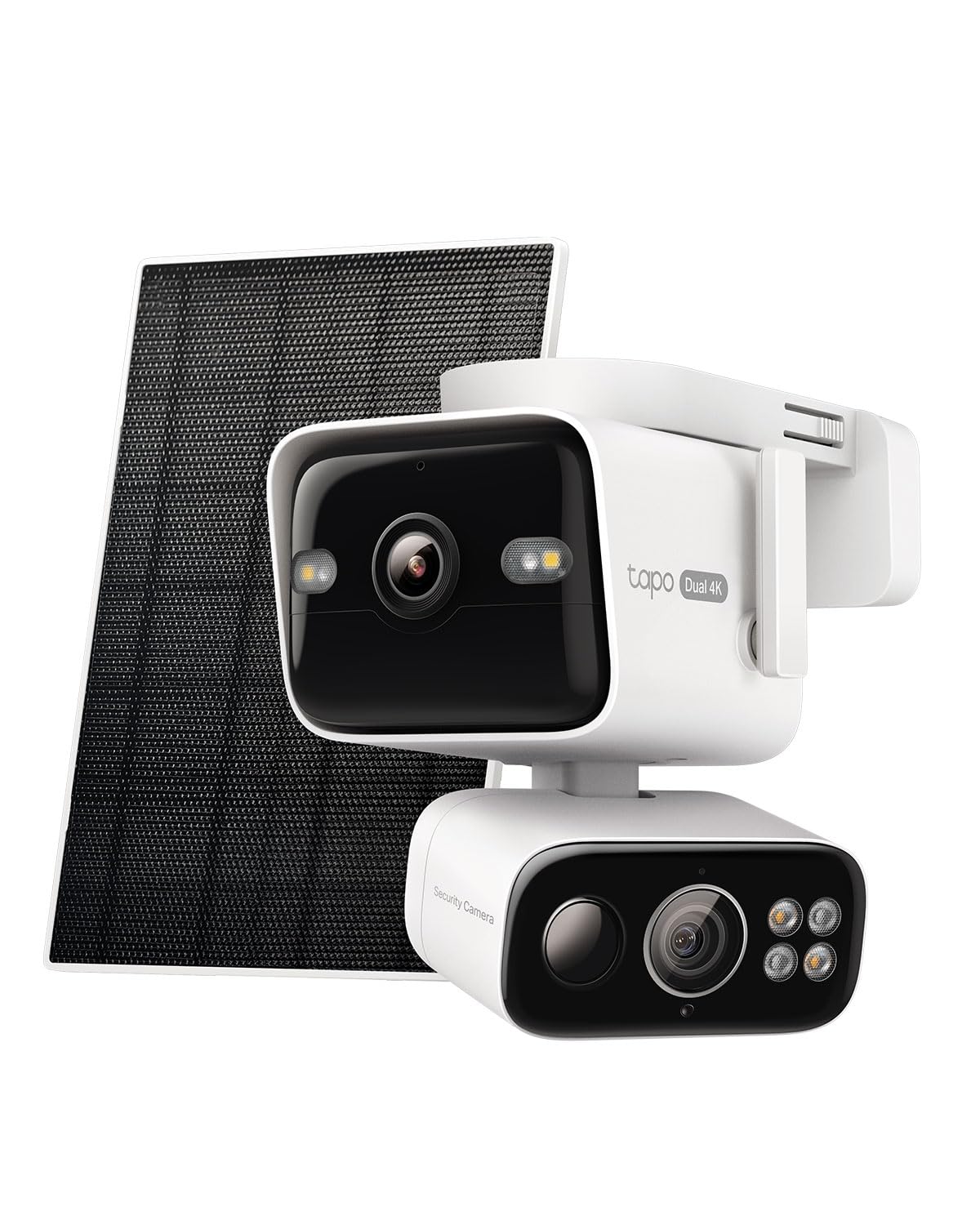
1. Tapo C675D KIT
Our pick — 4.0+★ from 150+ verified ratings; the strongest balance of quality and price.
Two lenses, one screen, and a solar panel that means you never climb a ladder to recharge.
This is the rare wireless PTZ that does not force you to choose between seeing the whole yard and seeing the detail. One lens holds a 169° field of view across your front lawn or patio. The second lens, a 6mm telephoto, swings across 360° and follows whatever moves, with both feeds sitting side by side on the same screen in the Tapo app.
That 169° figure is the widest coverage in this lineup — the Tapo C575D sits just behind at 170°, and the difference is a rounding error you will never notice on a phone screen. What matters is that the wide view gives the tracking lens somewhere to aim. Coverage also exceeds the mechanical pan and tilt range, so a subject walking past the edge of the mount still gets followed.
Where this camera quietly wins is power. Tapo rates 90 minutes of direct sunlight as a full day of running, and the built-in battery stretches to up to 3 months on a single charge through cloudy stretches. Solar charging needs temperatures above 32°F, which is worth knowing if you live somewhere the panel will sit under snow for weeks. Local storage is on microSD up to 512GB with no monthly fee, and the dual-band Wi-Fi lets you pick 5 GHz near the router or 2.4 GHz for reach.
The honest catch is at the edges of the feature set rather than the core. Motion tracking and battery life are the two areas where satisfaction splits, so placement matters — get the camera angled away from swaying branches and passing cars. Connectivity to the Tapo hub is the other recurring friction point, so plan on running it through the Tapo app rather than folding it into a mixed-brand hub setup.
What earns its keep
- Dual 4K lenses give you wide view and zoomed-in detail on one screen at once
- 169° field of view with a telephoto that tracks across 360°
- Free on-device AI for people, vehicles, and pets — no subscription to spot them
- 90 minutes of sun covers a full day, with up to 3 months of battery behind it
- Starlight color night vision and a CISA Secure-by-Design pledge behind the software
Where it asks for patience
- Solar charging stops below 32°F, so cold-climate winters need battery planning
- Continuous recording needs a microSD or the H500 CentralHub, sold separately
- Tapo hub integration is the shakiest part of the setup
Reach for it if: you want full-yard coverage and auto-tracking without running a single cable.
Plan around this: the solar panel needs above-freezing sun to earn its keep.
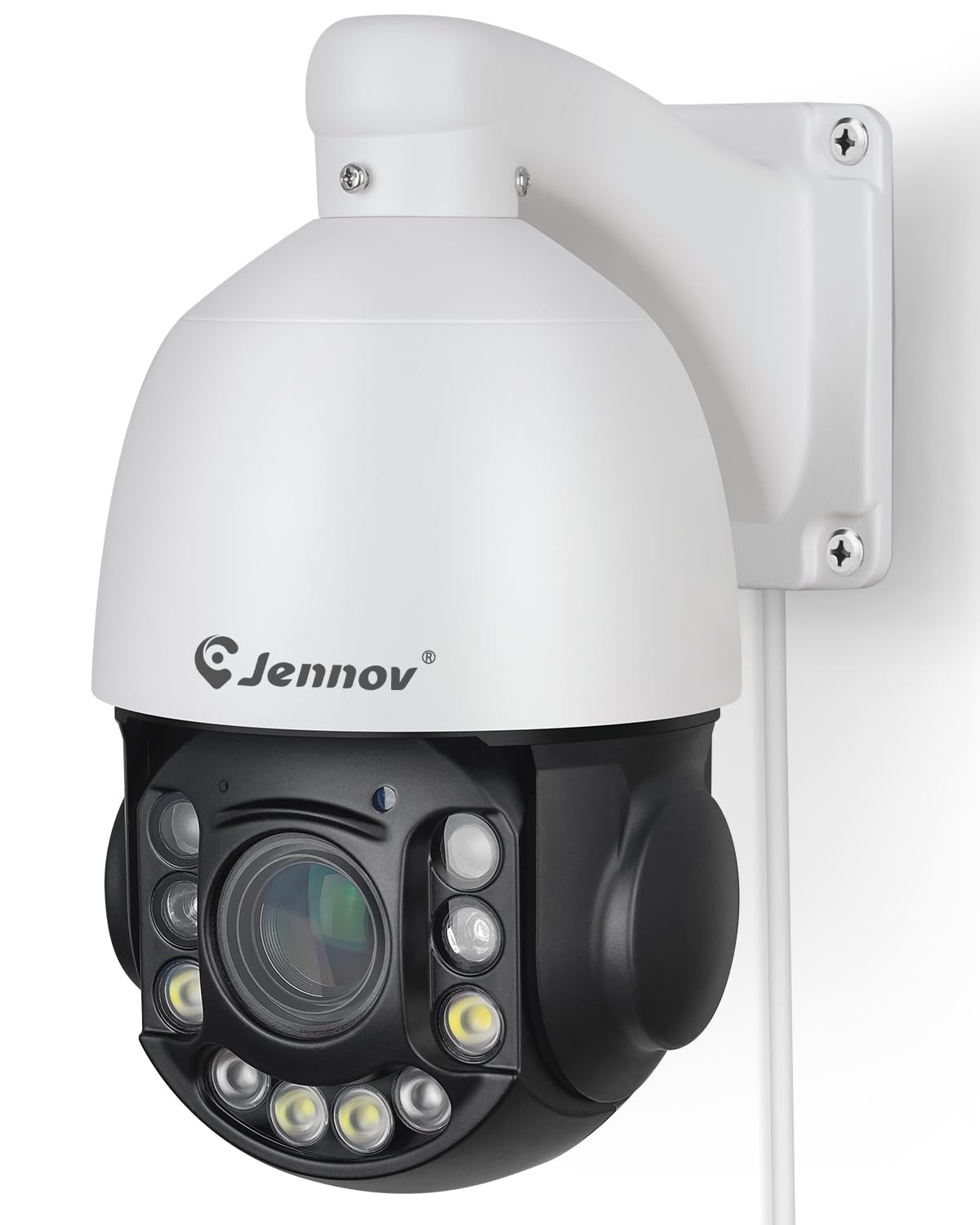
2. Jennov 6MP PoE IP Camera
A motorized 4.7–94mm lens that pulls a licence plate out of a distant parking bay.
Twenty times optical zoom on a 6MP sensor is the whole reason to buy this one. The 94mm end of that motorized lens magnifies real glass rather than cropping pixels, so a plate across a lot stays readable instead of turning into a smear. That puts it well ahead of the 2x optical zoom you get from the Ubiquiti G5-PTZ further down, and ahead of the hybrid-zoom dual-lens models too.
The tracking side is built for a perimeter rather than a doorway. Eight cruising routes can each hold 16 preset positions, and the camera cycles through them on patrol, so you are covering a long fence line instead of one fixed angle. When a humanoid enters the zone, it follows and fires a real-time snapshot to your phone.
Night coverage comes from 6 infrared lights plus 4 white LEDs switching modes automatically within 50m. Three modes give you infrared, white light, or intelligent switching, and a suspicious event triggers an audio alarm while the white LEDs come on. PoE means one Ethernet cable carries both power and data — no second run, no electrician. IP66 sealing and a metal-and-plastic housing handle the weather.
It is a wired camera, and it wants a recorder or an app you are willing to learn, since there is no solo cloud service here. Budget the time for the NVR side. For a large lot where the point is reading detail at distance, this is the sharpest reach per connection in the list.
The zoom is the argument: 20X optical on a 4.7–94mm motorized lens plus 10X digital keeps distant detail intact, and the 8-route, 16-preset patrol covers a long perimeter rather than a single angle.
Sized fairly: the daily weakness is the app ecosystem rather than the optics — this is a camera that wants an NVR or a dedicated recorder.
Right match for: parking lots, long driveways, and roadside placements where the detail lives far from the wall.
Less ideal if: you want a camera that works alone from a phone with no recorder behind it.
3. Tapo C575D
The cabled twin of our top pick, built for anyone who would rather bury a wire than charge a battery.
Dual 4K again, but the split of labour is different. A 170° wide lens covers the front yard, driveway, or back patio, while an 8mm telephoto lens pans and tilts to follow motion with up to 18× digital zoom. Both views land on the same screen, and the wide field stays lit while the close-up does the work.
The part that changes daily life is the wiring flexibility. You can run it from the included DC adapter or hand it PoE over a single Ethernet cable at 802.3af/at and a max 11.5W draw. Long-distance runs to a far corner of the property are stable that way, and there is no solar panel to think about in February. IP66 handles rain and dust, and night vision reaches up to 98 ft.
One-Tap Smart Focus is the sleeper feature. Tap anywhere in the wide view inside the Tapo app and the telephoto snaps to that spot, which is far quicker than dragging a joystick around while something is happening. Free AI detection for people, pets, and vehicles cuts the false alerts, and local microSD storage up to 512GB avoids a subscription.
Worth stating plainly: this needs power at the mount, whether that is a socket for the adapter or a PoE switch. If you have neither, the battery-and-solar C675D above covers the same ground without the cable run.
Why the wiring matters: PoE at 802.3af/at with a max 11.5W draw means one cable does power and data, so a far driveway corner stays rock-steady with no panel to maintain.
Buy this one when: a socket or PoE switch is within reach and you want the dual-lens view with zero battery management.
Think twice if: the mount point has no power at all — that job belongs to the solar model.
4. REOLINK TrackFlex

Three lenses on one mount: an 18MP system that watches the panorama and zooms at the same time.
The OMVI 3i splits 18MP across a 10MP dual-lens panoramic camera covering 180°, plus an 8MP PT camera for the close-up. The breakdown is 10MP + 8MP on the pixel composition, and the result is full-scene and detail on a single display with no blind spots. SyncTrack is the mechanism: when the panoramic lens spots motion, the PT camera locks on instantly and keeps tracking even after the target leaves the panoramic field.
This is a PoE camera and it does not support Wi-Fi, which is a deliberate trade. One Ethernet cable carries power and data for a stable connection, and it plugs in and plays with two-way talk included. Storage goes to microSD up to 512GB, a Reolink NVR, FTP, or NAS, with H.264/H.265 compression keeping the files manageable.
One firmware note that will save you a frustrating evening: your Reolink NVR needs to be on version 3.6.5 or later. Older firmware shows only the dual-lens footage and hides the PT camera view entirely. The current Reolink client on Windows and Mac supports the dual-screen display when connected through an NVR, Home Hub, or Home Hub Pro.
Night vision switches between full-color white light and IR automatically, with motion-triggered white light and alarms added on top. Where the wired Tapo models ask you to accept a single wide lens plus a telephoto, this one effectively replaces two separate cameras on one mount.
Why it replaces a pair of cameras
- 18MP across three lenses — 180° panorama plus an 8MP dedicated PT view
- SyncTrack keeps following a target after it leaves the panoramic field
- PoE single-cable install with two-way talk and metal housing
- Custom virtual fences and non-motion zones cut false alerts
Things to line up first
- No Wi-Fi support at all — a cable run is mandatory
- Older Reolink NVR firmware hides the PT view until updated
Choose it for: a wired install where two camera angles on one mount beats two separate holes in the wall.
Look elsewhere if: running Ethernet to the mount is off the table.
5. ONWOTE 4K 8MP PoE IP Camera

Black-and-white night vision that reaches 262ft to 328ft — further than anything else on this list.
Most cameras advertise night vision and deliver a pale circle of lawn. ONWOTE puts the numbers on the page: 8 array IR LEDs produce black-and-white night vision from 262ft to 328ft, and 4 pieces of 3000K warm light switch on AI detection to give color night vision from 131ft to 164ft. On a long driveway or a field edge, that throw decides the purchase.
The 20X optical zoom pairs with 360° pan and 95° tilt, plus 8 groups of auto cruising for patrol coverage across a wide property. Smart human tracking kicks in automatically when a person is detected during a cruise, so the camera is already following before you open the app. A built-in microphone and speaker handle two-way talk, and the metal housing carries an IP66 weatherproof rating for exposed outdoor mounting.
Ecosystem compatibility deserves a straight answer. This is an add-on to an ONWOTE system — it works with an ONWOTE 12MP or 8MP PoE NVR, or a PoE switch supplying 48V-54V. If you already run ONWOTE gear it is close to plug-in. If you do not, budget for the recorder as part of the job. ONWOTE also offers 24/7 technical support by message or phone, which matters more on a camera with this many settings.
What the numbers buy: 20X optical zoom with IR night vision out to 262ft–328ft and warm-light color vision from 131ft–164ft, paired with 8 cruising groups and automatic human tracking.
Built for: long dark sightlines on big properties where the far fence needs to be visible after midnight.
Check first: you are pairing it with an ONWOTE NVR or a PoE switch at 48V-54V.
6. REOLINK RLC-823S2
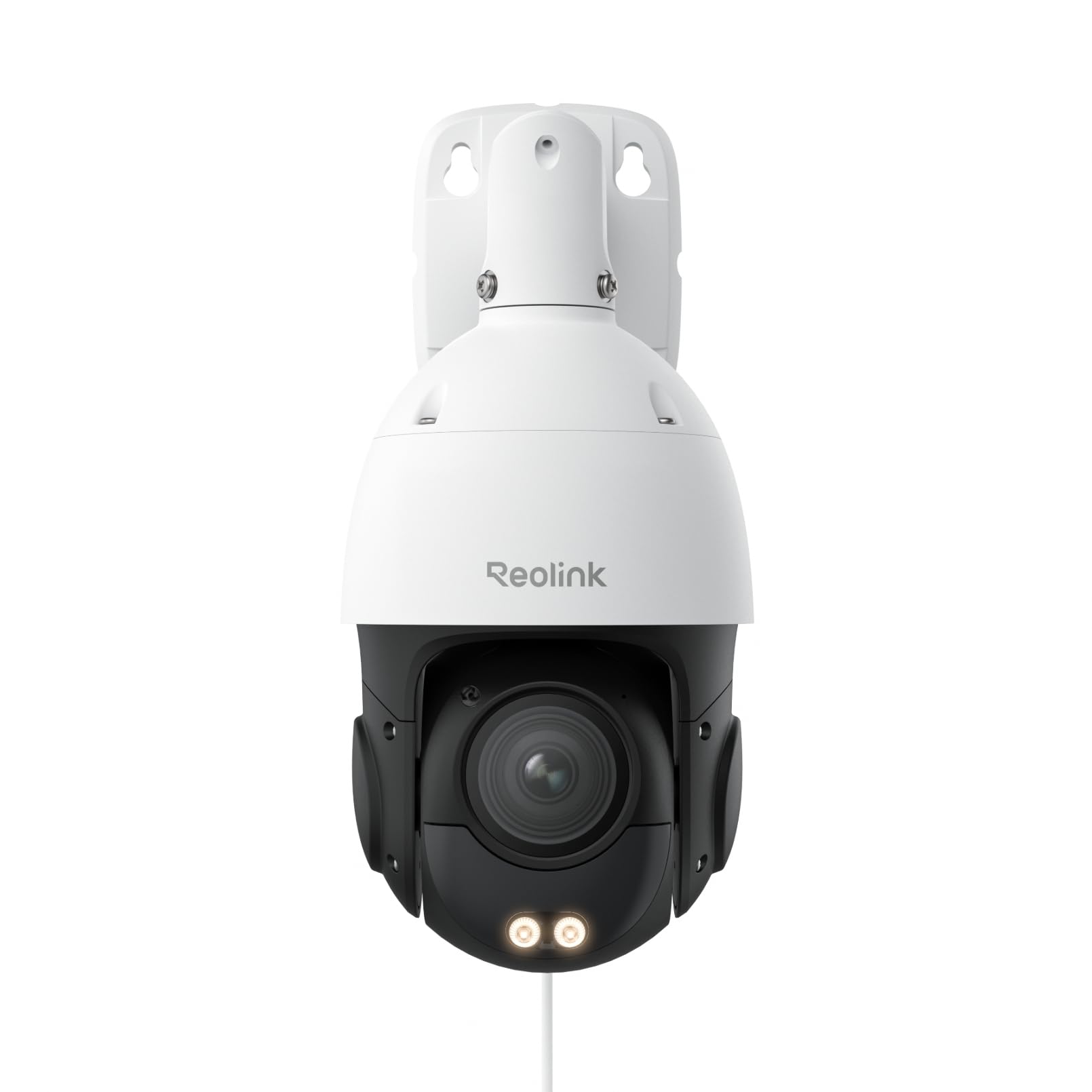
A 16X optical lens with a 3D zoom that centres the target in one click instead of five.
Sixteen times optical zoom is the headline, and the 3D zoom function is what makes it usable. Instead of clicking repeatedly to creep toward a subject, you designate an area and the camera centres the target on screen in one move. That matters when you are framing a car moving through a gate in real time.
The mount does 360° pan and 90° tilt with auto-tracking that follows activity across large areas. Night viewing offers both colour with spotlights and infrared, so you can pick detail or stealth depending on what you are watching. Smart detection separates people, vehicles, and animals — including a wide range beyond cats and dogs — and two-way talk is built in.
Power is PoE over a single cable carrying both video and electricity, and Reolink recommends an IEEE802.3at PoE switch for the best result. It records at 25 frames per second on the 8MP sensor. It does not support Wi-Fi, so this is a cabled installation by design.
Be clear-eyed about two things. The field of view is the recurring limit — 16X of zoom on a narrow angle means you see far but you see less wide, which is the opposite of the 169° Tapo C675D. And the auto-tracking does not satisfy everyone, with the zoom called not automatic by some. If you want a wide sweep, look at the dual-lens models. If you want to reach deep into one sightline, this delivers.
Where it shines: 16X optical zoom driven by 3D zoom centring, 360° pan and 90° tilt, and 25 frames per second on an 8MP sensor over a single PoE cable.
The honest trade: a narrow field of view and tracking that splits opinion — reach over width, every time.
Pick it when: one long sightline needs deep magnification and you can run Ethernet to it.
skip it if: wide coverage of a yard corner is the goal.
7. eufyCam S4
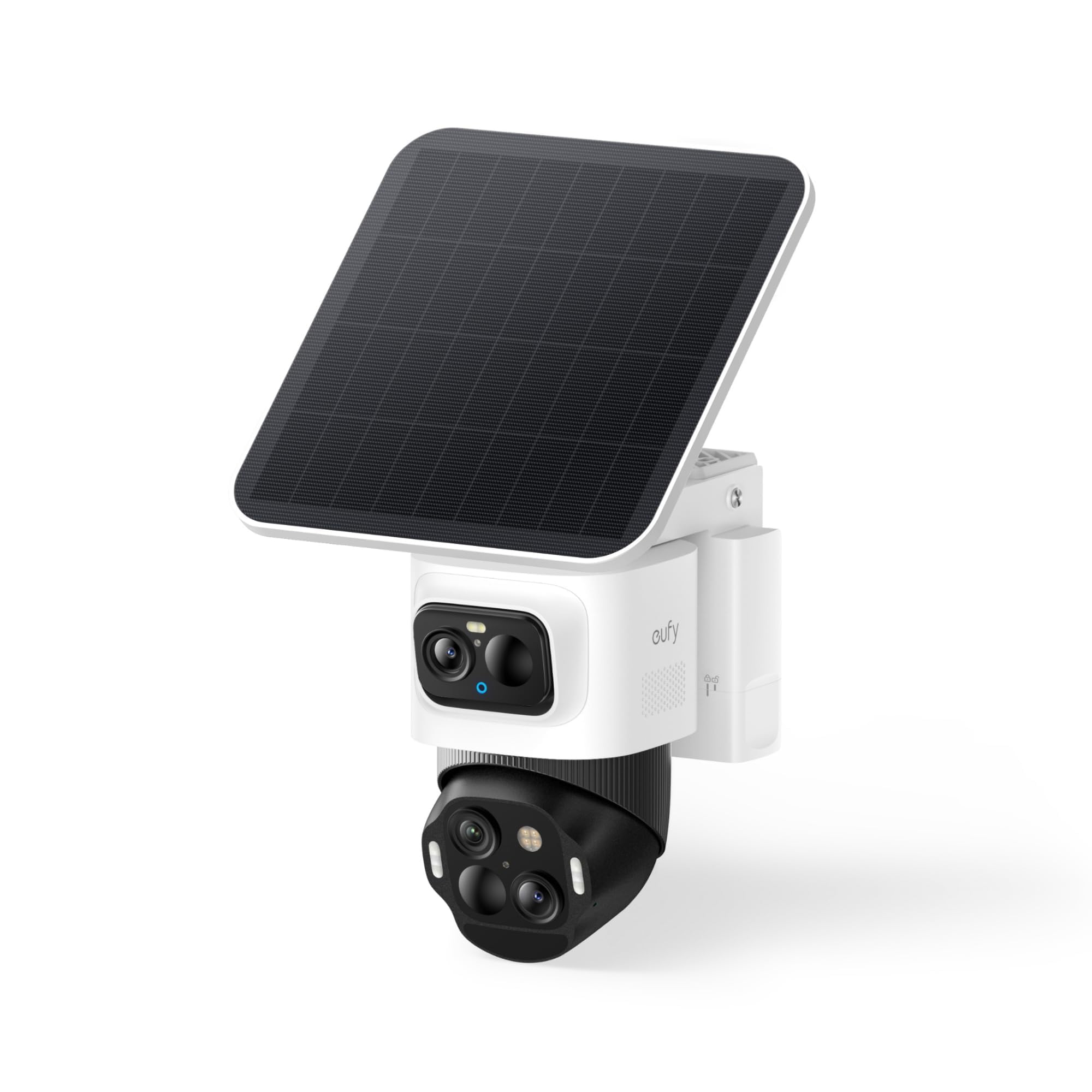
A fixed 4K bullet on top, a 2K twin-lens PTZ underneath, and a solar panel doing the charging.
The design is genuinely unusual. The upper 4K bullet lens holds a fixed 130° wide view. The lower 2K dual-lens PTZ handles 360° smart tracking and zoom. When the bullet catches a subject, the PTZ locks on, follows, and zooms for detail up to 164 ft away. Add more people to the frame and it automatically zooms back out to keep them all visible.
Power comes from a 5.5W ultra-large solar panel running SolarPlus 2.0, rated so that 1 hour of direct sunlight a day keeps the camera running. The panel detaches, which makes mounting far simpler than wrestling a fixed assembly onto a fascia board. A 44.3 watt-hours battery sits behind it.
It works without a HomeBase, which is the appeal for a lot of buyers. On-device AI handles human, vehicle, and pet detection, and there is 32 GB of built-in storage expandable to 256 GB via microSD. Radar and PIR sensors together cut false alerts, and a set zone or schedule triggers red and blue warning lights with a 105 dB siren. Add a HomeBase S380 and BionicMind AI can separate family from strangers.
Two practical notes before you buy. The full feature set needs the latest eufy app and HomeBase S380 firmware at 3.7.2.8 or later for 24/7 recording and Snapshots; other HomeBases and the eufy NVR are not supported. And functionality, motion tracking, and battery life are the areas where feedback splits most, so this is a camera to set up patiently and place where the panel gets real sun.
The case for it
- Three lenses: fixed 130° 4K bullet plus a 2K PTZ that tracks to 164 ft
- Auto-framing zooms out when extra subjects enter the shot
- 5.5W solar panel with 1 hour of sun covering a day, and a detachable mount
- 32 GB built-in storage and no HomeBase required to start
The fine print
- Full features need HomeBase S380 on firmware 3.7.2.8 or later
- Motion tracking and battery life split opinion, so placement and panel angle matter
- Not compatible with other HomeBases or the eufy NVR
Reach for this if: you want a cordless triple-lens setup that runs on its own without a hub.
Only worth it if: the panel gets real daily sun and you are willing to read the app carefully.
8. SV3C 4K 36X Zoom PTZ Camera

The longest zoom number here, and the only one pairing it with dual-band Wi-Fi.
Thirty-six times zoom is the figure everyone reads first, so here is exactly what it is: 18X optical zoom plus 18X digital zoom, driven by an auto-focus lens and an IMX415 CMOS sensor recording up to 3840 × 2160. The optical half is the part that keeps detail real. The digital half enlarges what is already there, so treat the last stretch as a convenience rather than genuine reach.
Pan runs 350° and tilt 93° in a dome structure, which trims blind spots around the mount. Humanoid detection and motion detection trigger automatic tracking that follows a person until they leave the monitoring zone. The alarm is genuinely upgraded — text notifications, email with snapshots, an alert sound, white light during darkness, and recording to microSD or cloud or FTP.
Night vision is unusually well thought out for the bracket. Nine array infrared lights and 6 LED lights switch intelligently: below 10X zoom, 5 IR lights run; at or above 10X zoom, those 5 switch off and the other 4 take over, and all 6 LEDs come on for full colour. The full aluminium case carries an IP66 waterproof rating for snow, frost, and sun. Dual-band Wi-Fi at 2.4GHz and 5GHz lets you trade range against speed.
Where it asks for patience is the software. Setup and viewing run through the CamHi CamHipro app and the HiP2P PC client, which works but is not as polished as the Tapo or Reolink apps. MicroSD tops out at 128GB here — smaller than the 512GB ceiling on most rivals. Reliability over the long haul is the split in owner experience, so buy from a seller with an easy return path.
The zoom case: 18X optical with 18X digital on an IMX415 sensor at 3840 × 2160, with 350° pan, 93° tilt, and an aluminium IP66 case — and no cable run needed thanks to dual-band Wi-Fi.
Set expectations on: the app is the weak link, and microSD storage stops at 128GB.
Choose it when: you need long zoom but cannot run Ethernet to the camera position.
Look elsewhere if: a polished app and large local storage top your list.
9. Ubiquiti UniFi Protect G5-PTZ

The one that answers the joystick instantly, which is what makes a PTZ worth having.
Ultra-low latency pan-tilt-zoom control is the reason this camera exists. When you nudge the control, the lens moves now, not a beat later. That responsiveness is what makes a PTZ usable for following something in real time, and it is a different virtue from raw magnification.
On magnification, this is the modest one: 2x optical zoom on a 2K (4MP) sensor, with IR night vision reaching 20 m (65 ft). Compare that to the 20X optical on the Jennov and ONWOTE models and the gap is enormous. What you give up in reach, you get back in AI event detections with automatic person tracking, an integrated LED spotlight for colour night vision, and audio captured through a built-in microphone.
The build is compact and all-weather for exposed outdoor mounting, in aluminium alloy and polycarbonate, with wall and pole mount hardware included. Power and connection run on PoE+ over a single cable. At 1.28 pounds it is the lightest camera in this lineup to hang, which matters when you are up a ladder on your own.
Be honest about what you are buying. This is a UniFi Protect camera, which means it is designed to live inside a UniFi Protect system rather than stand alone. If you are not already running that ecosystem, factor in the cost of the recorder and the setup. If you are, this snaps straight in and the control feel is worth the modest pixel count.
Why it feels different: ultra-low latency control with 2x optical zoom, AI event detection with automatic person tracking, and PoE+ over one cable at 1.28 pounds.
The honest trade: 2K resolution and 2x zoom sit well below the high-optical rivals here — this is a response camera, not a distance camera.
Best for: someone already inside a UniFi Protect setup who wants a compact, instant-response PTZ.
Not for: long-distance detail work or a standalone install with no Protect recorder.
Know the Specs
Optical zoom versus total zoom
Optical zoom moves glass inside the lens, so the magnified image contains real detail — a plate stays readable. Digital zoom crops the existing pixelsand enlarges them, which means the last stretch of any combined number adds convenience rather than detail. When a listing says 36X, check whether that is 18X optical plus 18X digital, as on the SV3C, or a true 20X optical lens, as on the Jennov.
Pan and tilt range
Pan is the horizontal sweep and tilt is the vertical one, both driven by motors. A 350° or 360° pan with a 90° or 93° tilt reaches almost everything around the mount. Anything less leaves a permanent blind spot behind the bracket, which is why the mounting corner you choose matters as much as the numbers.
PoE and PoE+ explained
Power over Ethernet sends electricity and data down the same cable, so one run to the eaves does both jobs. Standard PoE covers most cameras here. PoE+ carries more power for models that need it, such as the Ubiquiti G5-PTZ, which is why its listing specifies PoE+ rather than plain PoE.
IP66 and night vision reach
IP66 seals the housing against dust and strong water jets — the minimum for an exposed wall. Night vision range is a separate figure measured in feet or metres, and it varies widely. The ONWOTE reaches 262ft to 328ft in black and white, while the Ubiquiti covers 20 m (65 ft), so match the number to your sightline.
Common Questions
Will a PoE pan tilt zoom camera work without an internet connection?
How much optical zoom do I need to read a licence plate?
What is the difference between auto-tracking and auto-cruising?
Do these cameras need a subscription to store recordings?
Will a solar PTZ camera keep running through winter?
Can I view a pan tilt zoom camera on my phone and Alexa?
Does pan tilt zoom movement work at night?
Why does my PTZ camera lose the subject while tracking?
Is WiFi or PoE better for an outdoor PTZ camera?
How high should I mount an outdoor pan tilt zoom camera?
The Bottom Line
The outdoor pan tilt zoom camera that gets the balance right is the Tapo C675D KIT, because it pairs a 169° wide lens with a 360° tracking telephoto and adds solar charging so there is no cable and no monthly fee. If your target sits far away and you can run a wire, the Jennov 6MP PoE gives you 20X optical zoom for genuine plate-reading distance. And for a dark rural lot with no socket in sight, the REOLINK TrackMix runs on sun alone across a 355° pan.
One nudge before you close the tab: the top pick holds 4.0+ stars across 150+ ratings, and its dual-lens design is why it sits there. Whichever you choose, match the zoom to your sightline and the power to your wall.
How we choose
We do not accept paid placement. Every pick is matched to a real buyer and a real use-case; we do not hands-on test units.
Sources
Specifications: manufacturer listings and product documentation. Review insights: verified customer reviews, as of November 2026. Pricing: not shown on this page (it changes often); check the current price via the retailer link.
As an Amazon Associate, Tactical Gear Guy earns from qualifying purchases. This does not affect which products we feature.