Specs are compiled from manufacturer listings and verified buyer reviews and can change over time — please confirm the key details on the product page before buying.
If your phone works fine in the driveway and dies the moment you step inside, the problem is not your carrier — it is that the tower signal never reaches your walls. An outdoor mobile phone signal booster catches that weak outside signal on a roof or pole antenna, pulls it down a cable, and re-broadcasts it indoors so your phone stops hunting for bars. The picks below cover a weekend off-road rig, a single-room cabin, and a whole two-story house, and they range from mid-range kits to premium ones. The HiBoost 10K SL is the one most people should start with, because it does 5G and 4G on all major U.S. carriers and installs without drilling a single hole.
This guide is built by comparing the manufacturers’ published specifications and the patterns across verified customer reviews, so you get each pick’s real strengths and trade-offs instead of marketing spin.
Every kit here pairs an outdoor antenna with an indoor unit, and the difference between them is coverage, gain, and how much help you get during setup. Here is how to pick the right outdoor mobile phone signal booster without overspending on coverage you will never use.
Top Picks


How To Choose The Best Outdoor Mobile Phone Signal Booster
The kit does not create signal. It takes whatever weak signal already exists outside your building and multiplies it. That single fact explains almost every disappointment people have with boosters, and almost every success, so start there before you compare any numbers.
Find the outdoor signal before you buy anything
Walk your property with your phone in field-test mode and note where the bars are strongest. Point your outdoor antenna there. If the outside of your building has nothing at all, a booster will amplify nothing, and no amplifier rating changes that. Every manufacturer in this list states the same condition — there has to be at least a bar of usable signal somewhere outside for the kit to work with.
Match the bands to your carrier
Your carrier broadcasts on specific slices of radio spectrum called bands, and a booster that ignores your carrier’s band does nothing for you. The bands that keep showing up across these kits are 2, 4, 5, 12, 13, 17, and 25 — these carry the bulk of 4G LTE in the U.S. If your carrier is Verizon, AT&T, or T-Mobile, check that the kit lists your operating bands before anything else.
Understand what 5G support really means here
Several kits describe 5G support through DSS, or Dynamic Spectrum Sharing — a method carriers use to run 5G on spectrum that was already allocated to 4G. In practice that means the booster handles the 5G your phone sees in those same bands. It does not mean the kit picks up the very high-frequency 5G that travels only a few hundred feet and barely penetrates a wall. Treat “5G compatible” as a good sign, not a guarantee of full 5G speed.
Size the coverage to the rooms you actually use
A quoted coverage figure assumes strong outside signal and an ideal antenna position. Real homes get less. If you only need one room, a smaller kit with a couple of indoor antennas is plenty. If you have a two-story house or a shop floor, the higher-gain units with dual indoor antennas are the ones built for it. Buying more coverage than your outside signal supports is wasted hardware.
Decide between a home kit and a vehicle kit
Home kits use an outdoor directional antenna aimed at a fixed tower, and they broadcast through panel or dome antennas inside. Vehicle kits trade that large outdoor antenna for a low-profile one that mounts on a truck or camper and a small indoor antenna that reaches your handset from a few feet away. Choose by where you lose the signal most — cab of a rig, or couch in the living room.
Side-by-Side Comparison
| Model | Best For | Quoted Coverage | Carriers | Mount Type | Amazon |
|---|---|---|---|---|---|
| HiBoost 10K SL★ Best Overall | Most homes with weak bars | 5500 sq ft | All U.S. carriers | Fixed home kit | Amazon |
| weBoost Drive Reach OverlandRugged Pick | Off-road and overland rigs | — | All U.S. carriers | Vehicle mount | Amazon |
| SureCall Fusion4Home | Aiming at a distant tower | 5000 sq ft | All U.S. carriers | Fixed home kit | Amazon |
| HiBoost 15K Mate | Large multi-room homes | 12,000 sq ft | All U.S. and Canadian | Fixed home kit | Amazon |
| HiBoost Smart Link 15K | Big houses with hard installs | Up to 15,000 sq ft | All U.S. and Canadian | Fixed home kit | Amazon |
| CEL-FI GO G41 | Whole-home, one carrier | 15,000 sq ft | AT&T, Verizon, T-Mobile | Fixed home kit | Amazon |
Detailed Reviews
1. HiBoost 10K SL Cell Phone Booster (5500 sq ft)
Our pick — 4.5+★ from 650+ verified ratings; the strongest balance of quality and price.
A 5500 sq ft home kit that goes up without putting a hole in your wall
You get a working install in an afternoon, with no hole in the wall, because the cable runs through the window. Instead of drilling through siding or brick, you tuck the flat cable under the window frame and into the room — so a renter, or anyone wary of drilling, gets set up fast. Quoted coverage is 5500 square feet, the smallest of the three full home kits here, which suits an apartment or a single-floor house well.
Carrier support is uncommonly broad for a mid-range kit: Verizon, AT&T, T-Mobile, Sprint, U.S. Cellular and Straight Talk all work, over bands 2, 4, 5, 12, 13, 17 and 25. It handles 5G through DSS on those same 4G bands, so if your phone already shows 5G out front, this kit should carry it inside. The outdoor antenna is directional — it aims at a specific tower rather than listening in every direction — which the manufacturer says reaches distant towers better than an omni antenna. If your nearest tower is miles away, that aim is the difference between a usable signal and none.
What wins people over is the consistency of the boost after install. The recurring story is a home stuck at zero or one bar coming up to three or four bars of LTE after install, with rural users getting the best connection their location allows. The AGC, or automatic gain control — a circuit that self-adjusts the amplifier output so it stays stable — helps keep the boost consistent. Setup gets easier with the LCD panel and the “Signal Supervisor” app, which walks you through aiming the outdoor antenna and shows live status from your phone. The separate window cable kit is a small extra step if your window sill is thick, so measure the gap first; the trade-off is a fussier cable run in exchange for no drilling.
Where it earns the top slot
- Through-window cable means no wall drilling
- Runs on bands 2, 4, 5, 12, 13, 17 and 25 for all major carriers
- Directional outdoor antenna reaches distant towers
- App and LCD together make the aim easy to dial in
What to weigh before you commit
- 5500 sq ft is the smallest home coverage here, so a two-story house may need more
- Window sill gap must be wide enough for the through-window cable
Reach for this if: you have a single-floor home or apartment, at least a bar outside, and you want a clean install without drilling.
Pass on it if: you need to cover a whole two-story building, where the bigger kits below make more sense.
2. weBoost Drive Reach Overland
Built to ride on a truck bed, not to sit on a shelf
At 1.8 pounds it is the lightest kit in this lineup, and the size tells you what it is for — a 6″D x 4.5″W x 1.5″H booster that fits under a seat or behind a panel. Put it beside the SureCall kit here and the gap is stark: the SureCall weighs 10.1 pounds and measures 1.19″D x 5″W x 1.19″H. Those numbers read like a home unit that stays put versus a vehicle unit that goes where the road does. The Overland ships with a 3-way mount with spade stud, an antenna spring, thread lock packets, and a coil of LMR-195 coax, all aimed at surviving a rough ride.
Your phone keeps its bars on Verizon, AT&T, T-Mobile and U.S. Cellular, because the kit runs on bands 12/17 and 13 at 700 MHz, band 5 at 850 MHz, band 4 at 1700/2100 MHz, and band 25/2 at 1900 MHz (bands are the slices of radio spectrum each carrier uses). The 50 dB max gain (how hard the amplifier pushes the signal) comes with an FCC ID, so you know the amplifier was tested against interference rules. A 12V DC power supply runs it from the vehicle, and the outdoor antenna is a low-profile design plus an overland antenna with its own mount — no wiring into the cab for a permanent install, though you can hide it. Owners describe getting the whole run fitted under a backseat in about an hour.
To be clear, it will not conjure signal where none exists. If the truck is parked in a true dead zone with nothing to catch, the booster has nothing to amplify. Where there is one bar and texts will not send, it is the difference between a call and a roadside wait. On a 5500-mile desert and mountain trip, buyers report holding at least one bar of usable 4G throughout. An antenna that cracked off its mount after a few months of use is the honest risk of a sticky install — torque the thread lock down and check the mount after hard ground.
The vehicle-first build: light, low-profile, and powered from a 12V socket in the cab, so it suits a rig that leaves the driveway rather than a house that stays put.
What to watch: this is not a whole-cabin solution — the indoor antenna reaches your handset over a short distance, so expect coverage around the vehicle, not through the front door.
The right call for: overland, camper and work-truck owners who lose signal on the road and want one unit that lives in the cab.
Look elsewhere for: a full-home install — this is built for a moving vehicle, not a two-story house.
3. SureCall Fusion4Home Yagi Panel

The heavy metal kit that aims at one tower and holds on
It pulls a usable signal out of a tower miles away, thanks to the Yagi antenna on the roof. A Yagi is a directional antenna — think of it as a funnel pointed at one tower rather than an ear listening in all directions — and that narrow aim is what does the work. At 10.1 pounds this is a serious lump of hardware, and the roof antenna is the reason. The main body sits at just 1.19″D x 5″W x 1.19″H, so the bulk is in the outdoor antenna and cabling, not the indoor box. Against the 1.8-pound weBoost Overland above, the gap tells you which one stays on a house and which one rides on a truck.
Coverage is quoted at 5000 square feet, and the manufacturer’s claim is that it amplifies the signal at its strongest point outside the building for a larger indoor area. That is the right strategy for a rural plot where the nearest tower is far off. Every major U.S. carrier is supported, including Mint Mobile and Boost Mobile, and it works without WiFi or a monthly subscription. What earns it a place is the basement result: one bar of LTE climbing to four bars four floors down.
The honest catch is that the specs and the experience do not always line up. Signal quality, value, data speed and coverage all come in with mixed feelings across the review base. The kit is priced at the top of the mid-range, and reviewers who paid it split on whether it delivered. What is not in doubt is the construction — a solid metal case and connectors that stay tight. Small homes are its balance; a two-story building pushed its limits. That is a fit question, not a fault — if your tower is close and your house is small, this delivers. If you need multi-story reach, you want a bigger unit.
Built for: a rural or semi-rural single home where the nearest tower is a long way off and a directional antenna earns its keep.
Think twice if: you have a large multi-story house — the modest coverage here will run thin upstairs.
4. HiBoost 15K Mate Multiroom Booster
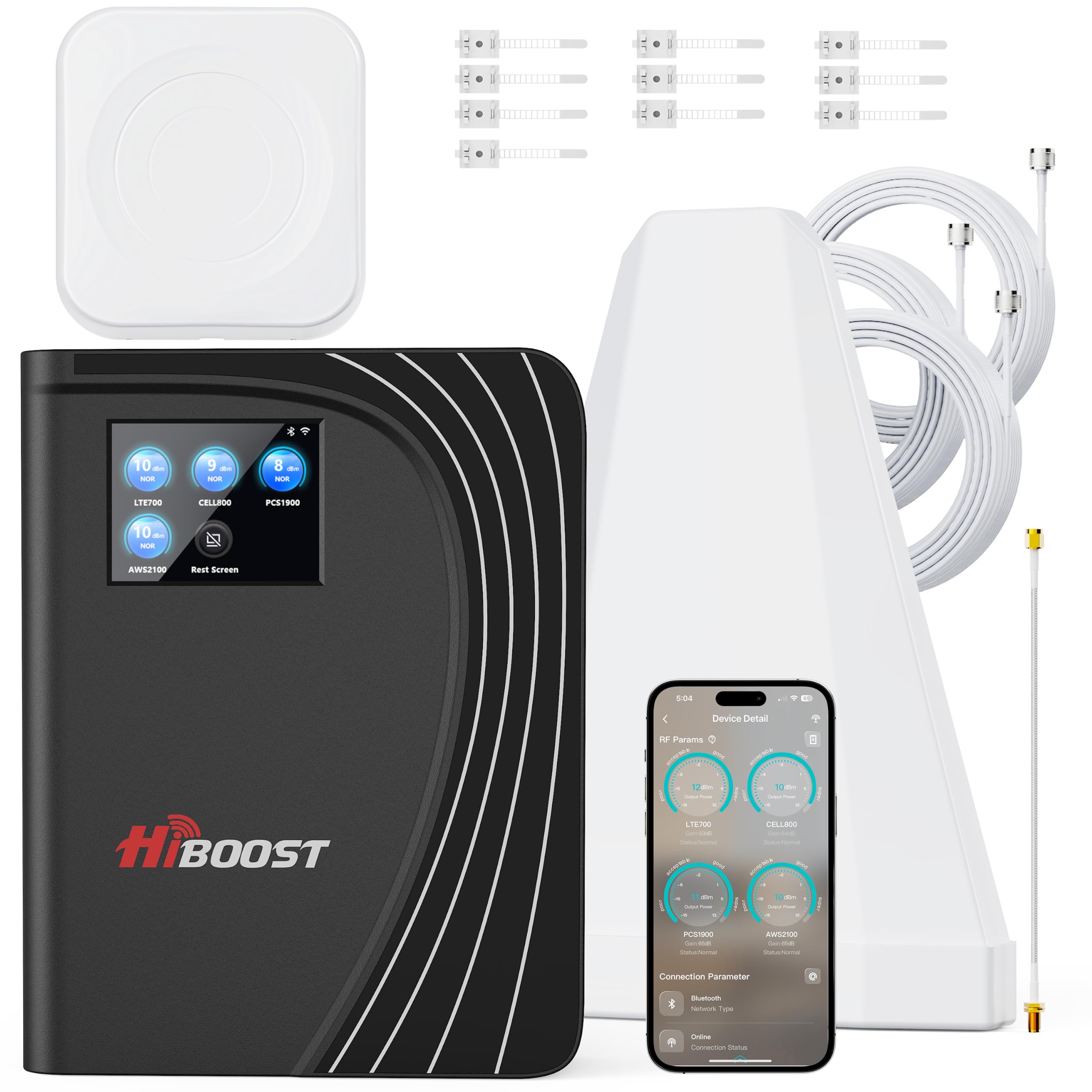
Twelve thousand square feet, two indoor antennas, and one touchscreen
It reaches the far corners of a large space, and the number that separates it is 12,000 square feet — more than double the 5500 square feet of the HiBoost 10K SL above, and the highest quoted coverage in this list outside the two premium units. That range is quoted for homes with at least one bar outside. The 72dB gain figure (how hard the amplifier pushes the signal) is what helps it cover that much ground. Two indoor antennas do the work: one built into the main unit and one separate, so you can light up a second room without running an extra panel antenna.
That built-in antenna design is a real convenience. Many kits want a second panel on a second wall, which means a second hole and a second cable run. Here the main unit works on its own when you need it to, and the separate antenna joins in alongside it. AGC keeps the output stable automatically, and the color LCD touchscreen lets you watch real-time gain and tap to adjust rather than reading a blinking LED. The “Signal Supervisor” app handles aiming the outdoor antenna, and a through-window wire feeds in under the sill so you can skip drilling entirely.
Carrier support reaches U.S. and Canadian networks — AT&T, Verizon, T-Mobile, Straight Talk, U.S. Cellular — across bands 2, 4, 5, 12, 13, 17 and 25, with 5G handled over existing 4G bands through DSS. What the install produces is the story: zero or one bar outside turning into three or four bars inside, a whole house getting service with two indoor antennas, and streaming that stops stalling. One caveat from the review base is coverage in a large multi-story building, where the farthest rooms may need the second antenna repositioned. The 3-year warranty and FCC certification give the hardware a solid footing, and the support team has a strong reputation among buyers.
Why it stands out: 12,000 square feet of quoted coverage and a second indoor antenna for a wide house, all without a second wall hole.
The fair warning: coverage is quoted and it does not reach the far corners of a very large multi-story building without tuning the second antenna.
The one for you if: you have a big single-floor home or an office floor and need several rooms lit up, not just one.
Skip if: your building is tight on outside signal — the 12,000 sq ft number assumes at least a bar out there.
5. HiBoost Smart Link 15K
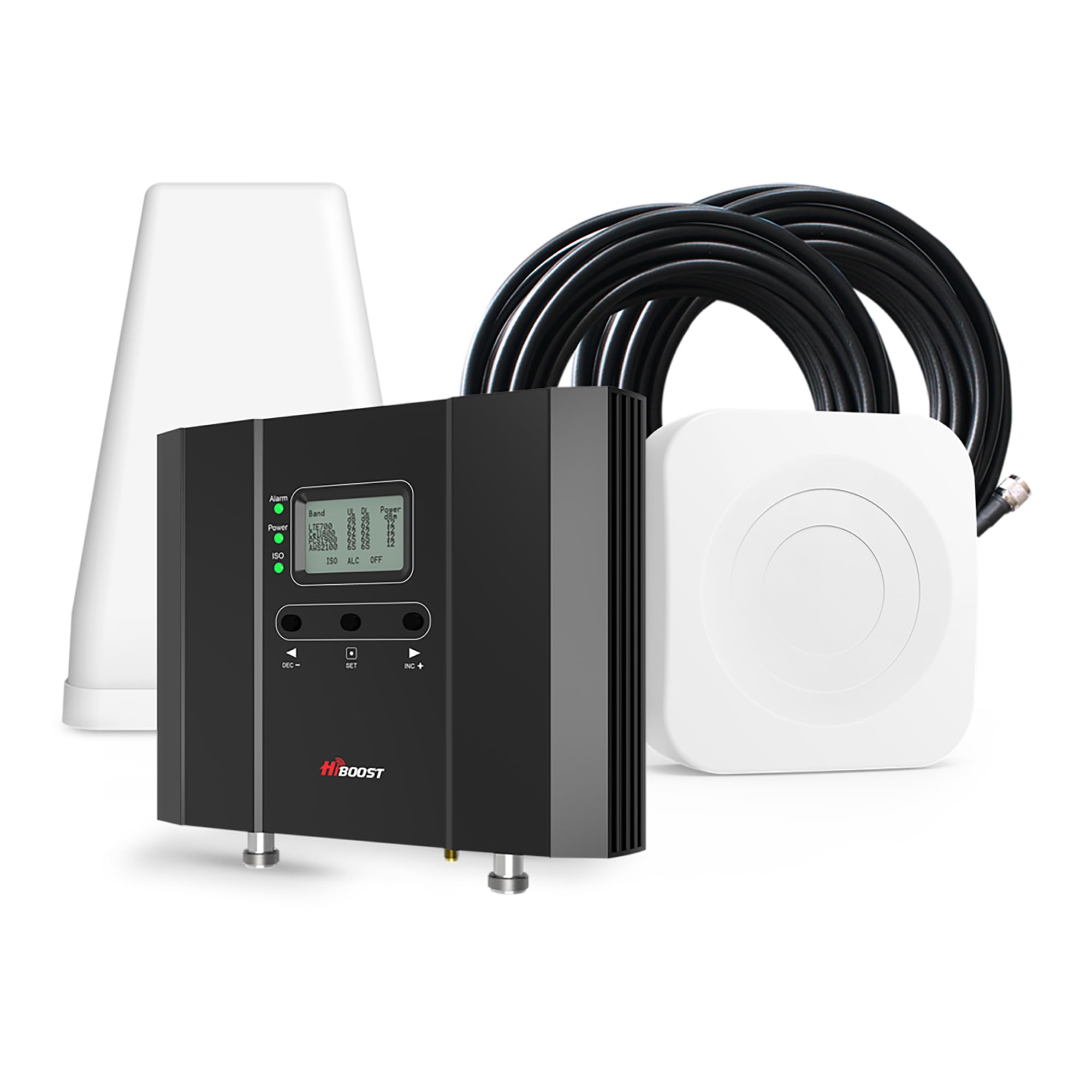
A wide-band kit that wants a roof and rewards you for finding the right spot
You can put the outdoor antenna well away from the indoor panel and still keep the signal strong, because two 50ft HiBoost400 low-loss cables are included. Coverage is the headline here — up to 15,000 square feet, though the manufacturer is upfront that it can land between 10,000 and 15,000 depending on outside signal. That is an honest range, and it tells you the outdoor antenna placement is the whole game. A long cable run with cheap coax loses the boost before it reaches the room.
Carrier support covers U.S. and Canadian networks including AT&T, T-Mobile, Verizon, Sprint, Straight Talk and U.S. Cellular, on a wide list of bands — 700 MHz, 850 MHz, 1900 MHz, 2100 MHz, 1700/2100 MHz and more. The app-guided install is where this one earns its keep: rather than pointing the outdoor antenna and hoping, the app and LCD show real-time data so you adjust the aim until the gain peaks. The manufacturer makes a point that even 1dB more power matters when you are at the edge of coverage. The metal case is built for heat dissipation, so a summer roof install is less likely to overheat the amplifier over time.
Expect “most of the house,” not every corner — the big 15,000 square foot number is a best case, and a real result lands lower. Coverage comes in mixed across the review base. A home getting good service in three rooms with two interior antennas, and a 3300 square foot house and basement going from 2 bars outside to 3-4 bars throughout, are both typical. Signal strength and build quality are praised most, and the reliability story is strong enough that the 3-year warranty holds up to it. The one effort item is the roof run, which is where owners say the app guidance pays off.
Strengths worth noting
- Two 50ft low-loss cables let you place the outdoor antenna far from the indoor panel
- App plus LCD show real-time gain so you aim the antenna accurately
- Supports a long band list for U.S. and Canadian carriers
- Metal case built to dissipate heat on a sunny roof
Honest trade-offs
- The full 15,000 sq ft needs strong outside signal; expect less in practice
- Roof installation is the hard part, so set aside an afternoon
Good match for: a large house with a safe roof access point and decent outside signal, where you want the app to be your map.
Not the pick if: you cannot get on the roof — the coverage here depends on antenna placement you have to dial in.
6. CEL-FI GO G41 Smart Signal Booster
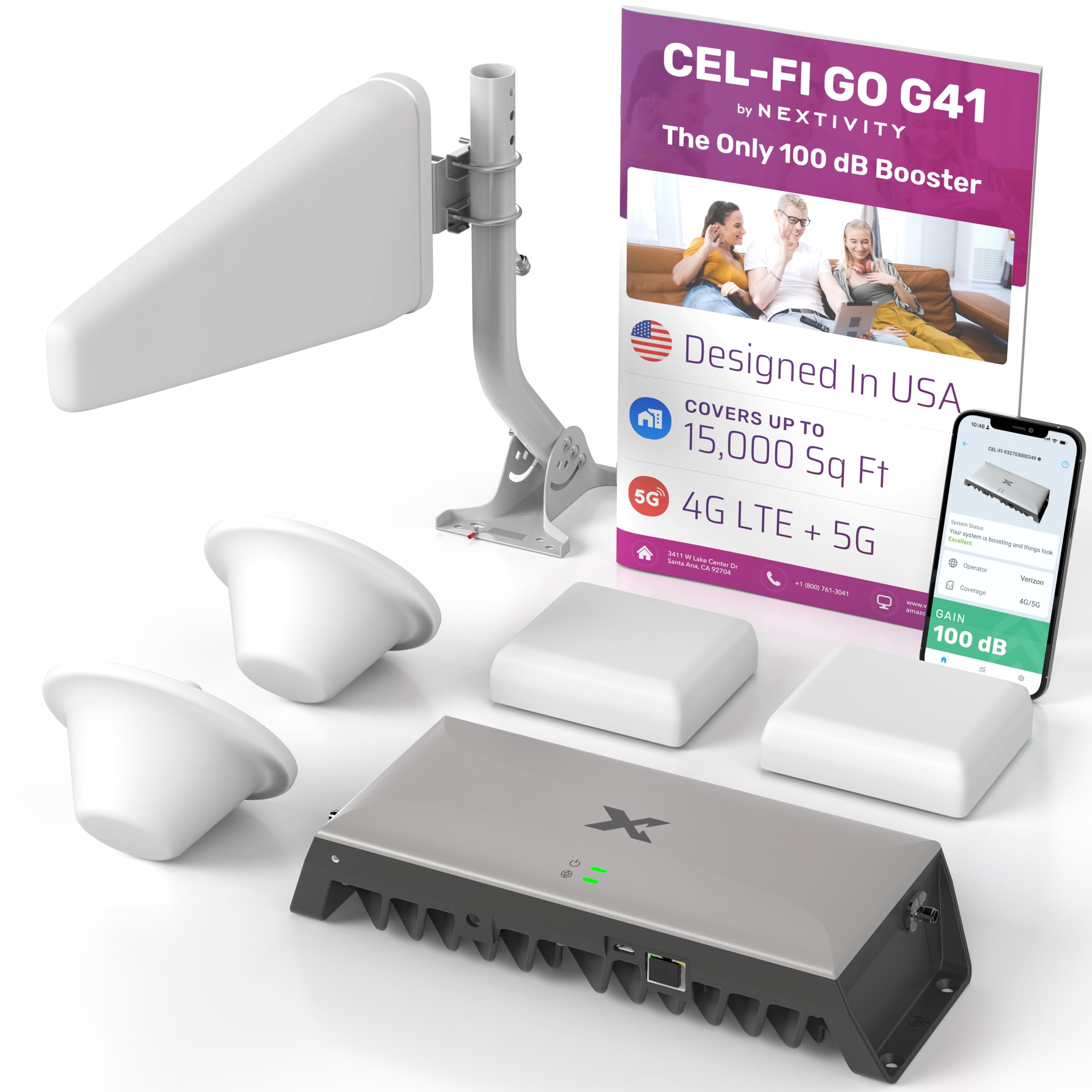
The 100 dB ceiling of this lineup, with antennas coming from the start
One amplifier covers a whole home rather than one room, and the 100 dB gain rating is the highest on this list. The manufacturer claims that is 30 dB more than competing boosters, and that it would take over 11 of another maker’s units to cover the same area as a single G41 at that gain. That is the maker’s figure rather than a test result, but it frames what you are buying. Quoted range is 15,000 square feet, matching the HiBoost Smart Link above on paper, with a different amp and a different setup.
The chipset matters here. The 4th generation IntelliBoost chip handles 4G LTE, 5G-DSS and 5G NR, so it covers the 5G your phone uses on those bands as well as the 5G built from scratch. Being 5G ready, it can support a network’s newer spectrum as it rolls out. The kit includes 2x dome and 2x panel antennas — you install the pair that fits your ceiling and keep the spares, so no buying a second antenna to finish the job. It is fully FCC certified, designed in California, and built for the three major U.S. carriers — AT&T, Verizon and T-Mobile.
Owners mention homes at one barely-usable bar climbing to four full bars in every room. One cabin owner reports full bars inside and downloads climbing from below 5 Mbps to 10-15 Mbps, with another measuring a jump from about 2 MBps to 55 MBps. Support gets the same warmth, with a live person reachable and weekend responses. The one caution is value: this is the top of the price range, and it is priced like the premium unit it is. Expect the support to hold after purchase, since the manual and the app both make an unfamiliar install manageable.
Why it earns its price: 100 dB of gain, dual antenna types in the box, and a chipset that handles 5G NR rather than only the 4G bands.
The honest caveat: it is the premium pick and priced like it, and it is built around single-carrier use rather than spreading one signal across several carriers.
The match for: a large home where you want the strongest amp, spares in the box, and support that answers on a Sunday.
Not the one if: you run two carriers on one property — this unit is built around a single carrier.
Know the Specs
Gain in dB
Gain is the amount of amplification the booster adds to a weak signal, measured in decibels (dB). Higher gain can push a faint outside signal far enough to cover a larger area indoors. It is not a promise about any one room, though — the outside signal, the antenna aim, and the quality of the cable all shape what you actually get. A 100 dB kit and a 50 dB kit can both deliver in the right house.
Directional vs. omni antennas
A directional antenna, like a Yagi or a panel aimed at one tower, concentrates its reception in one direction, so it reaches a distant tower and rejects interference from the sides. An omni antenna listens in every direction at once, which is easier to set up but weaker at a distance. For a building with one strong tower, directional usually wins; the kit makers here say as much.
Inside vs. outside antennas
The outdoor antenna catches the signal and the indoor antenna re-broadcasts it inside. A kit with one indoor antenna lights up roughly one room’s worth; two indoor antennas spread it across more rooms or floors. Where you place the indoor antenna matters as much as the outdoor one — keep it high and central to reach the most space.
FCC certification and interference
Every FCC-certified booster carries an ID and has been tested to avoid interfering with the carrier’s tower signal. A booster that is not certified can cause trouble with the network. When you install, carefully aim the outdoor antenna for maximum gain, because a poorly aimed kit can shut itself down to protect the network rather than push signal.
Common Questions
How much outside signal do I need for a booster to work?
Will this booster actually give me 5G speed or just 4G?
Can I use one booster for multiple phones on different carriers?
Do I need to drill a hole in my wall to run the cable?
Why does my booster cover less area than the quoted square footage?
Can a booster fail and shut itself down?
Will it help in a basement or cabin with almost nothing outside?
Is a truck-mounted kit like the weBoost Overland worth it over a home kit?
Does the FCC certification matter for installation?
The Bottom Line
For most people, the outdoor mobile phone signal booster winner is the HiBoost 10K SL, because it covers a normal house with quoted 5500 square feet of reach, runs on every major carrier, and installs through a window without drilling. If you want the biggest amp in the lineup, the CEL-FI GO G41 brings 100 dB of gain and both dome and panel antennas in the box. And for the rig that leaves the driveway, the weBoost Drive Reach Overland is the one that fits under a seat at 1.8 pounds. Start with the outside signal — the kit that matches it is the one worth buying.
How we choose
We do not accept paid placement. Every pick is matched to a real buyer and a real use-case; we do not hands-on test units.
Sources
Specifications: manufacturer listings and product documentation. Review insights: verified customer reviews, as of November 2026. Pricing: not shown on this page (it changes often); check the current price via the retailer link.
As an Amazon Associate, Tactical Gear Guy earns from qualifying purchases. This does not affect which products we feature.