Specs are compiled from manufacturer listings and verified buyer reviews and can change over time — please confirm the key details on the product page before buying.
You want finished compost without wrestling a pitchfork every weekend, and the honest answer is that a tumbler only works if the drum actually turns when it’s full. That single point separates the bins worth buying from the ones that end up as expensive yard furniture. Everything below is organized around how each drum actually behaves under a real load.
This guide is built by comparing the manufacturers’ published specifications and the patterns across verified customer reviews, so you get each pick’s real strengths and trade-offs instead of marketing spin.
Below you’ll find nine rotating bins compared on capacity, chamber layout, and turning effort. You’ll also see what each one really asks of you during assembly and through the season — a practical read on the best outdoor compost bin tumbler.
Top Picks


How To Choose The Best Outdoor Compost Bin Tumbler
Most people buy a tumbler expecting the turning to be the hard part. In practice the hard parts are assembly, chamber layout, and whether the drum still spins once it’s carrying a full load of wet kitchen scraps. Sort those three out and the rest is detail.
Dual chamber versus single drum
A dual-chamber bin splits the barrel into two sides. You fill one while the other finishes curing, so you never have to stop adding scraps to let a batch mature. A single-chamber drum like the Compost Wizard Jr. holds one batch at a time — simpler, but you wait out the whole cycle before starting again.
Capacity in gallons, and what it means for you
Capacity tells you how much material you can process per cycle, not how much finished compost you get in one go — compost shrinks substantially as it breaks down. A 37-gallon bin suits a small yard and a couple of people. Something in the 50-to-65-gallon range gives a bigger household room to keep adding scraps without constantly filling a chamber.
Turning effort once the drum is loaded
A smooth spin on an empty drum tells you nothing. What matters is the gearing, the handle design, and how the fins inside break up clumps as the barrel rotates. Deep fins do double duty — they mix the material as it tumbles, and they stop a heavy wet mass from sliding around as one lump.
Assembly before you commit
Panel-and-bolt construction is standard across this category, and it is also where most frustration lives. Some bins ship fully assembled, others arrive as a stack of interlocking panels. Read the assembly notes in each review below before you assume a Saturday afternoon is enough.
Side-by-Side Comparison
| Model | Best For | Capacity | Chambers | Turning Method | Amazon |
|---|---|---|---|---|---|
| RSI MCT-MC Maze Compost Tumbler★ Best Overall | Big households with a cart to haul finished compost | 65 gallons | Dual | Geared handle | Amazon |
| Outsunny Tumbling Compost Bin 360°Best Value | First-time composters on a tight budget | 42.3 gallons | Dual | 360° rotation | Amazon |
| Large Compost Tumbler with ThermometerBest with Thermometer | Composters who want to read the temperature | 43 gallons | Dual | Manual rotation | Amazon |
| East Oak Compost Tumbler Outdoor | Buyers who want a light bin to reposition | 43 gallons | Dual | 360° rotation | Amazon |
| VEVOR Compost Tumbler 53 Gallon | Continuous supply with precise turn control | 53 gallons | Dual | Hand crank with ratchet | Amazon |
| Miracle-Gro Dual Chamber Compost Tumbler | Small yards and two-person households | 37 gallons | Dual | Manual rotation | Amazon |
| Marcytop 45 Gallon Dual Chamber | Beginners who dread the build | 45 gallons | Dual | Manual rotation | Amazon |
| FCMP Outdoor HOTFROG Dual Body | Fast cycles in hot sunny climates | 37 gallons | Dual | Manual rotation | Amazon |
| Compost Wizard Jr. Tumbler | Backyard composters who want zero setup | 50 gallons | Single | Wheeled base | Amazon |
Detailed Reviews
1. RSI MCT-MC Maze Compost Tumbler, Black
Our pick — 4.5+★ from 600+ verified ratings; the strongest balance of quality and price.
The only pick here that hauls its own finished compost to the beds.
The drum size is why this one sits at the top. The Maze holds 65 gallons in its rotating chamber — the largest capacity on this list — so you can keep feeding kitchen and yard waste without the drum hitting its limit after a couple of weeks.
The second piece is the cart underneath. It carries 12 gallons on its own and sits low to the ground, so you can roll finished compost across the yard instead of lifting a full barrel. A geared handle turns the drum even when it’s fully loaded, which is the failure point on cheaper tumblers. Built-in adjustable air vents let you tune airflow, and the framework is designed not to rust over time.
What buyers fixate on is the build quality — the material feels like it will outlast the season, and the turning handle is what wins people over on a full drum. The honest catch is the build itself: assembly draws mixed reactions, and a few owners have run into a handle that snapped under load. Set aside real time for the put-together, and treat the handle mechanism with some care rather than horsing it around.
Why it takes the top spot
- 65-gallon drum, the largest capacity in this lineup, so you feed it longer between harvests
- Low-profile rolling cart handles 12 gallons of finished compost without lifting
- Geared handle keeps the drum turning even when it’s fully loaded
- Adjustable air vents in the drum let you manage airflow through the cycle
What to plan around
- Assembly is the most divisive point — budget an afternoon
- A handful of buyers report the handle giving out during use
Reach for this if: you generate a lot of kitchen and garden waste and want the finished compost to move by wheel, not by shovel.
Look elsewhere if: you’d rather not spend the build time — a bin that arrives closer to ready is a better fit.
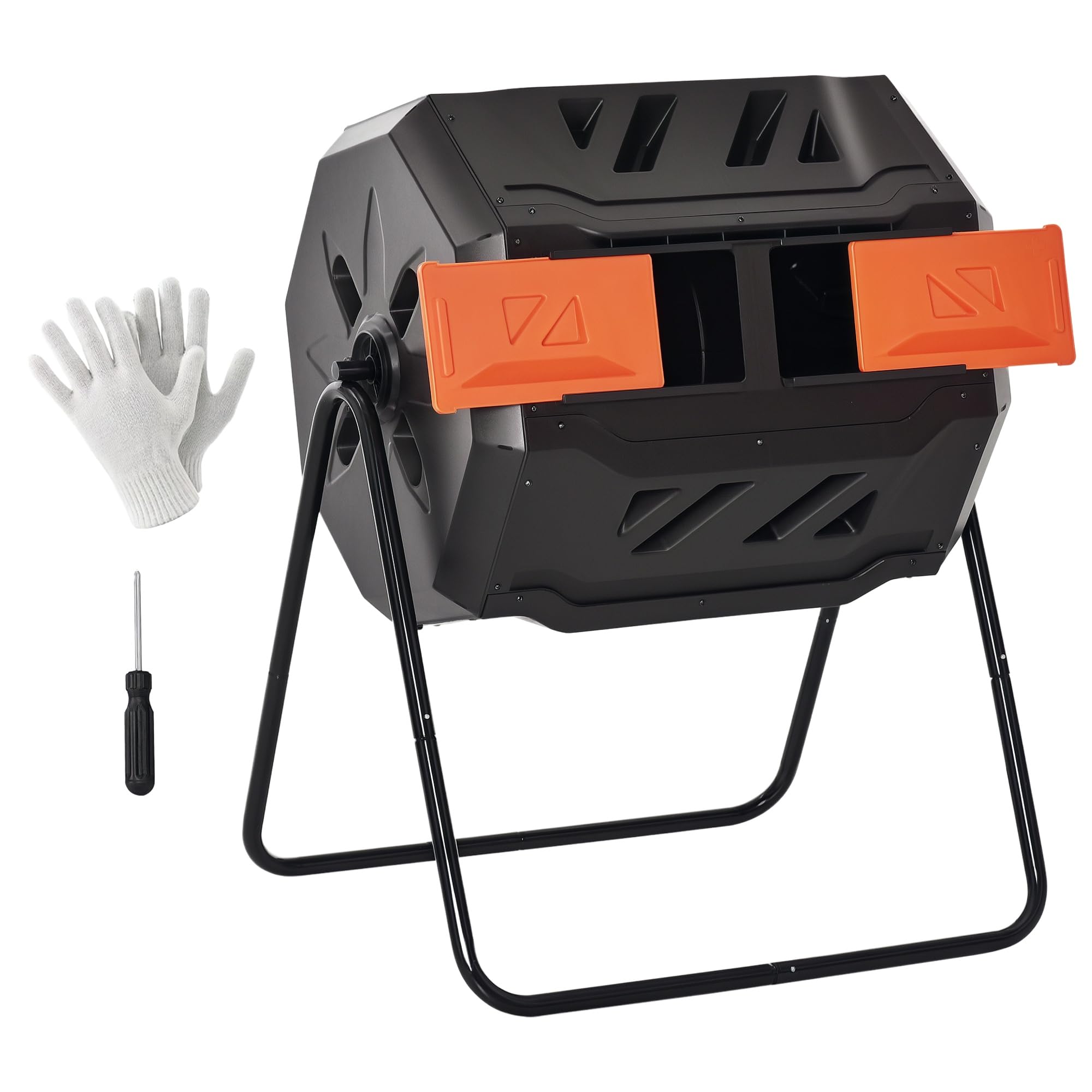
2. Outsunny Tumbling Compost Bin 43 Gallon
A two-sided drum for the price of a single-chamber unit.
The number that defines this pick is 42.3 gallons split across two chambers. That means one side cures while you keep adding fresh scraps to the other, so you never have to pause the whole operation to let a batch finish. Sixteen ventilation holes run through the drum to keep air moving, which is what decomposition organisms need to break material down.
It weighs 22 pounds, compared with the East Oak’s 12 pounds — noticeably more heft on the same 43-gallon class of drum. That extra weight comes from the steel and polypropylene build, and it pays off in how planted the bin feels when you spin it. Sliding doors on both sides open for loading and unloading.
Assembly is the mixed part here. Some owners find the pieces fit nicely and go together quickly; others hit a fiddly hour or two. Rotation gets the same split verdict — smooth spinning when the drum is light, stiffer once it’s carrying a full wet load. The doors are on the small side too, so chopping scraps down before they go in makes loading easier.
Build where the value sits: steel frame plus polypropylene plastic at this capacity is a genuinely sensible starting point, and the dual-chamber layout is the feature most first-time composters underrate until they need it.
The honest trade-off: small loading openings demand that you cut scraps smaller, and the drum stiffens once it’s full.
Pick this one if: it’s your first tumbler and you want two chambers without moving up a tier.
Keep looking if: you plan to dump in whole melon rinds and coffee filters — the doors ask for smaller pieces.
3. Compost Tumbler Bin 43 Gallon
The one bin here that tells you whether the pile is actually cooking.
Most tumblers ask you to guess. This one puts a visible thermometer on the drum, so you can read the internal temperature whenever you walk past and judge whether the batch is working or stalling.
The drum is 43 gallons across twin chambers, built from modified polypropylene on an upgraded steel frame rated to a maximum load of 352 lb. The maker notes this version uses 28% fewer screws than the older one to shorten the build. In practice you open the sliding door, add scraps, and rotate six or seven times every few days.
Owners describe this one as a workhorse that does its job — the recurring word is “beast.” Assembly splits down the middle, with some finding it genuinely quick and others frustrated by vague directions. Nine owners flag leakage, which is the practical thing to watch: keep the moisture level right and set the bin on a surface you don’t mind staining.
The thermometer earns its place
- Visible temperature readout on the drum so you can track the cycle in real time
- Steel frame rated to a maximum load of 352 lb
- Twin chambers let one batch cure while you keep adding fresh material
- 28% fewer screws than the previous version, per the maker
Read before you buy
- Assembly instructions are vague enough that some owners stall on them
- Leakage comes up — placement and moisture control matter
Go here if: you want data on your pile and a frame that won’t sag under a heavy load.
Think twice if: the bin will sit on a deck or patio where drips would be a problem.
4. East Oak Compost Tumbler Outdoor, 43-Gal Dual Chamber
Twelve pounds of drum you can shift to follow the sun.
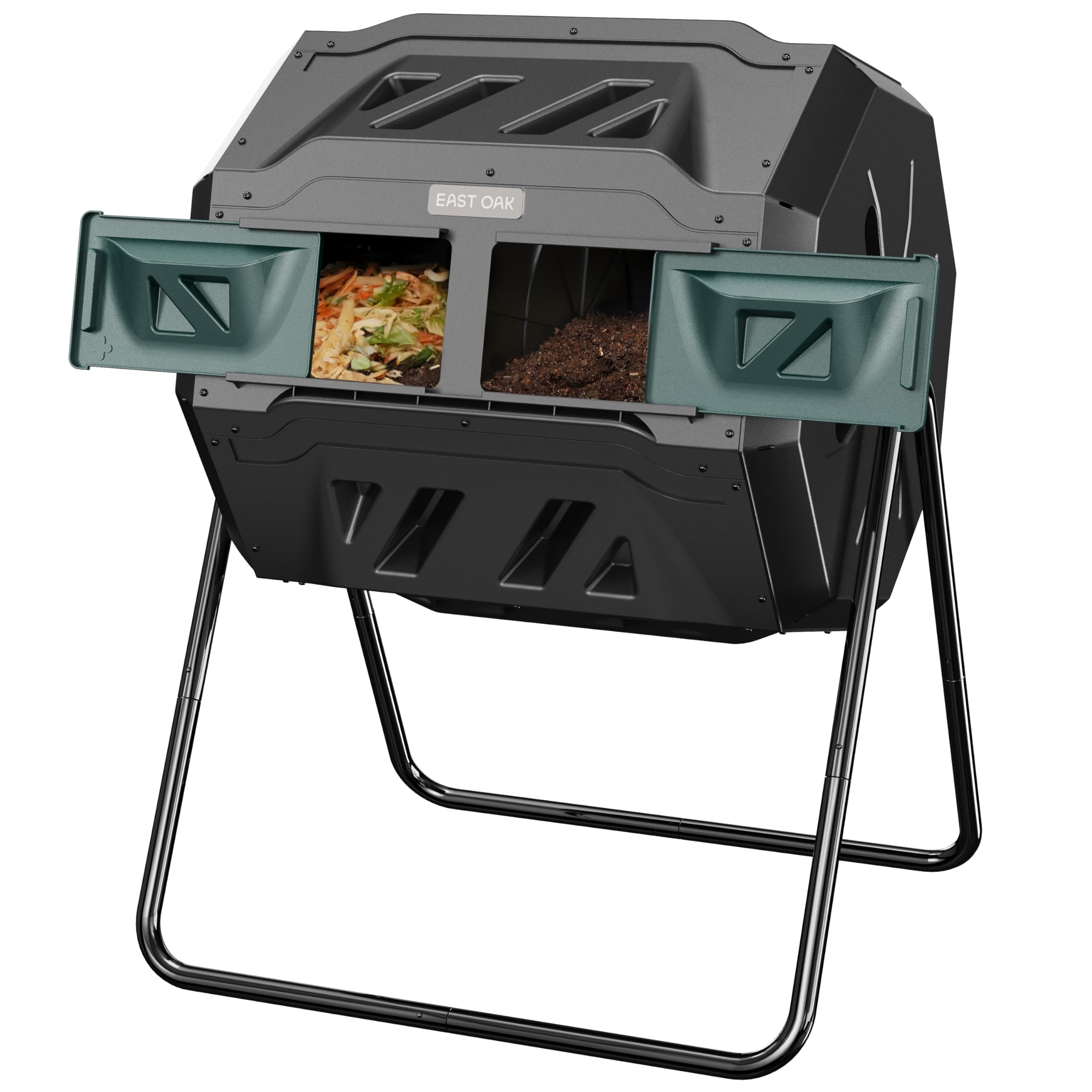
At 12 pounds this is the lightest dual-chamber bin in the lineup, and that’s the practical advantage. You can drag it around the yard yourself, move it into a sunnier spot mid-season, or stash it out of sight when guests come over. The Outsunny in the same 43-gallon class weighs 22 pounds — a full 10 pounds more to shove around.
Two chambers work the same alternating system as the rest here: fill one, cure the other. Aeration holes run through the panels to prevent pressure building up inside, and deep fins on the eight panels break up clumps as the drum spins. The build is BPA-free PP plastic with a powder-coated steel frame, and the interlocking panels are what give it rigidity. The East Oak’s black drum absorbs sunlight, which the maker says speeds the process up.
Durability is where this one earns its keep — owners consistently find it sturdy and the compost breaking down nicely. Two things to know going in. The center divider is fussy to line up during the build, and the doors are on the small side. A few owners also find the drum tough to spin once it’s packed, so don’t overfill the chambers.
Where it shines: light enough to relocate on your own, with a black drum that soaks up heat and deep fins that keep the material breaking apart as it turns.
Where it bites: the center divider needs patience to align during assembly, and a packed drum turns harder than you’d expect.
Best fit for: renters, small yards, and anyone who moves the bin with the seasons.
Not the one for: you if you want to load big armfuls at once — the door openings are small.
5. VEVOR Compost Tumbler 53 Gallon
A crank and ratchet instead of a grab-and-heave handle.
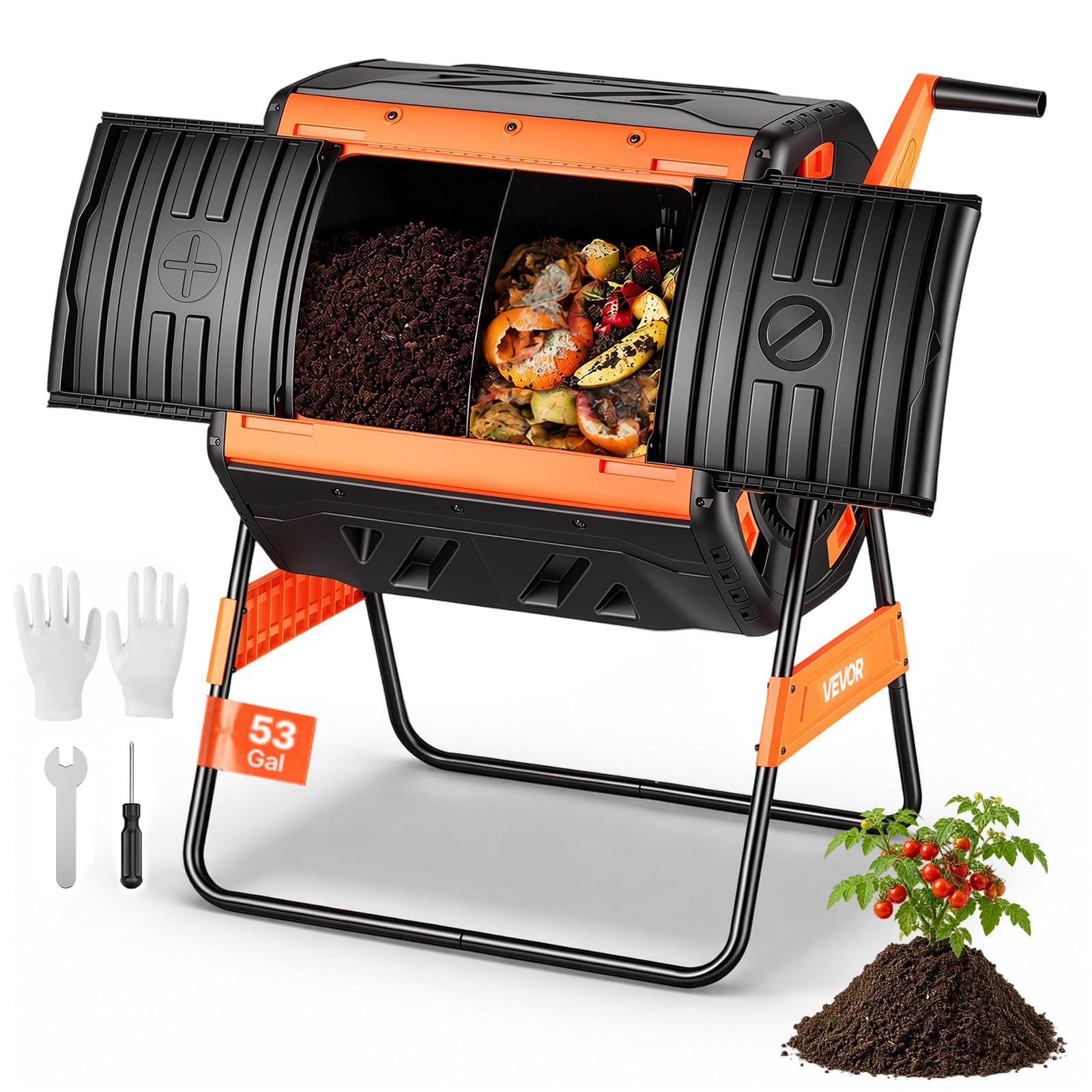
Fifty-three gallons split into two chambers, and the turning is done with a hand crank rather than your arms wrapped around a barrel. Deep fins inside break up clumps as it goes.
Adjustable air vents keep airflow balanced and head off pressure buildup, which is where a lot of smell problems start. The wide sliding door makes loading and unloading straightforward, and the raised base keeps critters out from underneath. The barrel is heavy-duty plastic on a powder-coated steel frame, and the maker lists the cycle at about 4-6 weeks.
The build is genuinely the sticking point on this one. Owners rate the bin’s quality highly, and the size lands well for small-scale gardening. But assembly is the most-discussed topic by a wide margin, and turning effort splits down the middle — the crank helps, yet a full drum still resists. If you’d rather not think about the build, this isn’t the pick.
The case for the crank
- Lockable ratchet gives precise control over how far and how often you turn
- 53 gallons across two chambers, so one side can cure while the other fills
- Raised base keeps pests out and the barrel off wet ground
- Adjustable air vents manage airflow and reduce odor buildup
Where it slows you down
- Assembly is the single most-complained-about part of ownership
- Turning effort is divisive once the drum is full
Worth it for: composters who like the idea of cranking a set number of turns and walking away.
Skip the crank if: you want a bin that’s simple to build — this one asks for patience with the hardware.
6. Miracle-Gro Dual Chamber Compost Tumbler, 2×18.5 Gal

Small, simple, and sized for a couple with a modest garden.
This is the smallest drum in the lineup at 37 gallons, and that’s a deliberate fit rather than a compromise. Owners point to it as well-matched to small yards and households of about two and a half people — enough capacity to keep a steady trickle of compost going without the drum sitting half-empty for weeks. Two 18.5-gallon chambers mean one side cures while the other takes scraps.
The Miracle-Gro’s rotation is manual, and the maker lists a 4-6 week cycle. Side-locking mechanisms hold the panels together, the base is galvanized steel, and the plastic is BPA-free and UV-protected so it holds up across seasons. Tight seals are meant to keep pests out. No digging, no hand-mixing — just a few rotations every few days.
What wins people over is how easy it is to turn and understand; the simplicity is the product. The trade-off is durability on the long timeline. The clips holding the panels together are the weak point, with some owners reporting them failing after a couple of months, and sturdiness splits down the middle. If you buy this one, go easy on the clips when opening and closing and expect to keep an eye on them.
The strong suit: simple enough to hand to a beginner, with two chambers and a 4-6 week cycle on a footprint that fits a small yard.
The recurring gripe: the panel clips are the part that wears first — treat the seams gently and it serves you well.
Right for: a two-person household with a couple of beds and no appetite for a complicated system.
Wrong for: a big garden that needs volume — 37 gallons will feel tight fast.
7. Marcytop Compost Tumbler 45 Gallon
The build is the headline here, and owners actually agree on it.
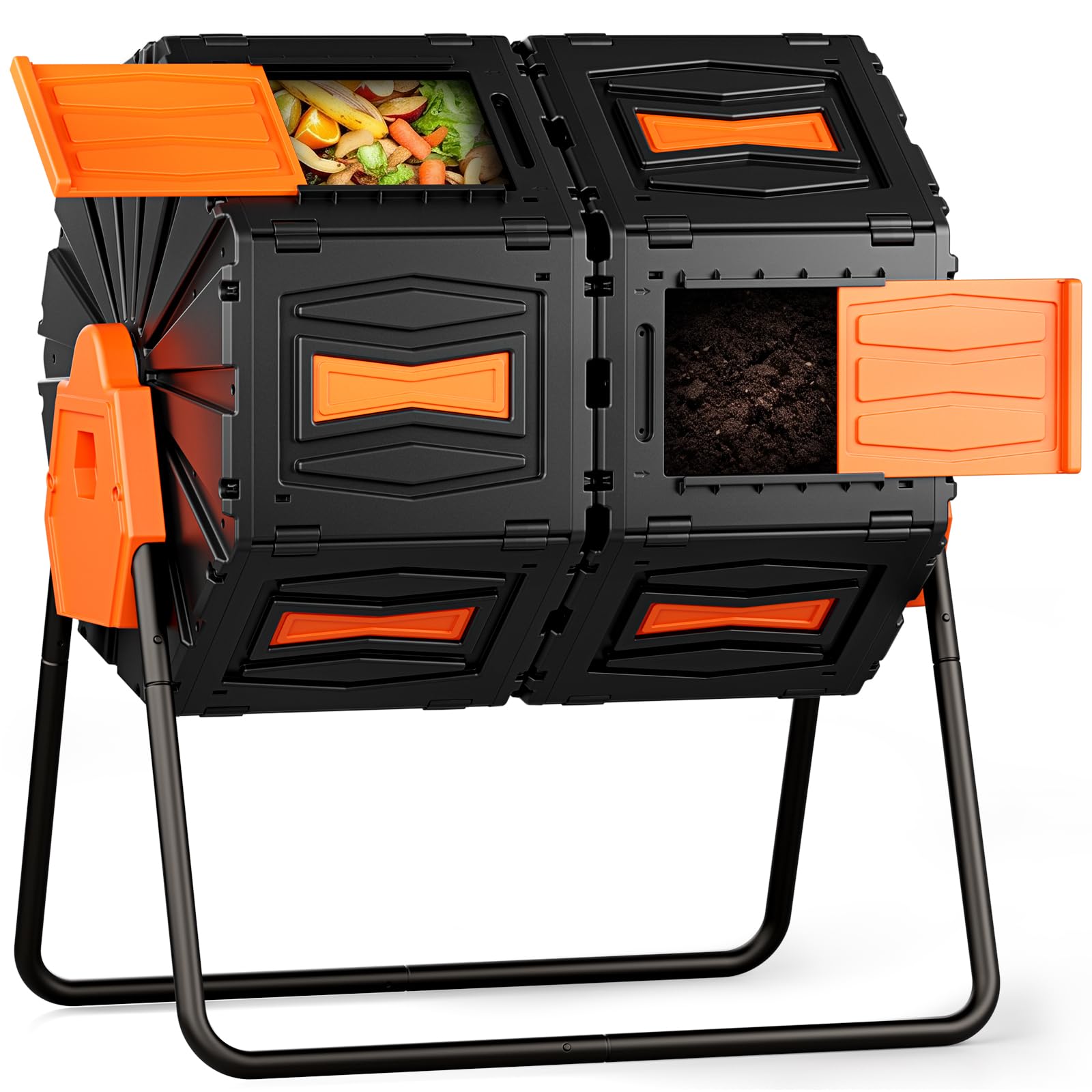
Two chambers of 22.5 gallons each give you 45 gallons total in a drum that goes together with buckles and fewer screws than the panel-and-bolt crowd. The maker puts the Marcytop build at about 30 minutes, and assembly is what owners praise most — clear instructions and parts that line up. That’s rare enough in this category to be a real selling point.
Once it’s up, the layout is the familiar alternating system: start a fresh batch in one chamber while the other finishes. Aeration holes and deep fins on each panel break up waste and pull oxygen through the drum as it turns. The drum is extra-thick polypropylene on a powder-coated steel frame, and the maker notes it won’t rock while you rotate it. Big openings and a removable door make loading and unloading easy.
The honest note on the Marcytop is turning effort — some owners find it spins easily, others find it stiff. And a handful of owners question how many years it will last. Neither is a reason to walk away, but if you’re the type to pack a chamber to the brim, expect to work a little harder on the turn.
Where it beats the field
- Assembly is the standout — buckles and fewer screws, roughly a half hour per the maker
- 45 gallons across two 22.5-gallon chambers
- Deep fins and aeration holes mix and aerate as you turn
- Removable door and wide openings for easy loading
What to keep in mind
- Turning effort splits — a packed chamber takes muscle
- Long-term durability is the open question
Choose this if: assembly frustration is the thing that stops you from buying a tumbler at all.
Best to pass if: you plan to fill a chamber to the top and expect a featherweight spin.
8. FCMP Outdoor HOTFROG Dual Body Tumbling Composter, 37-Gallon
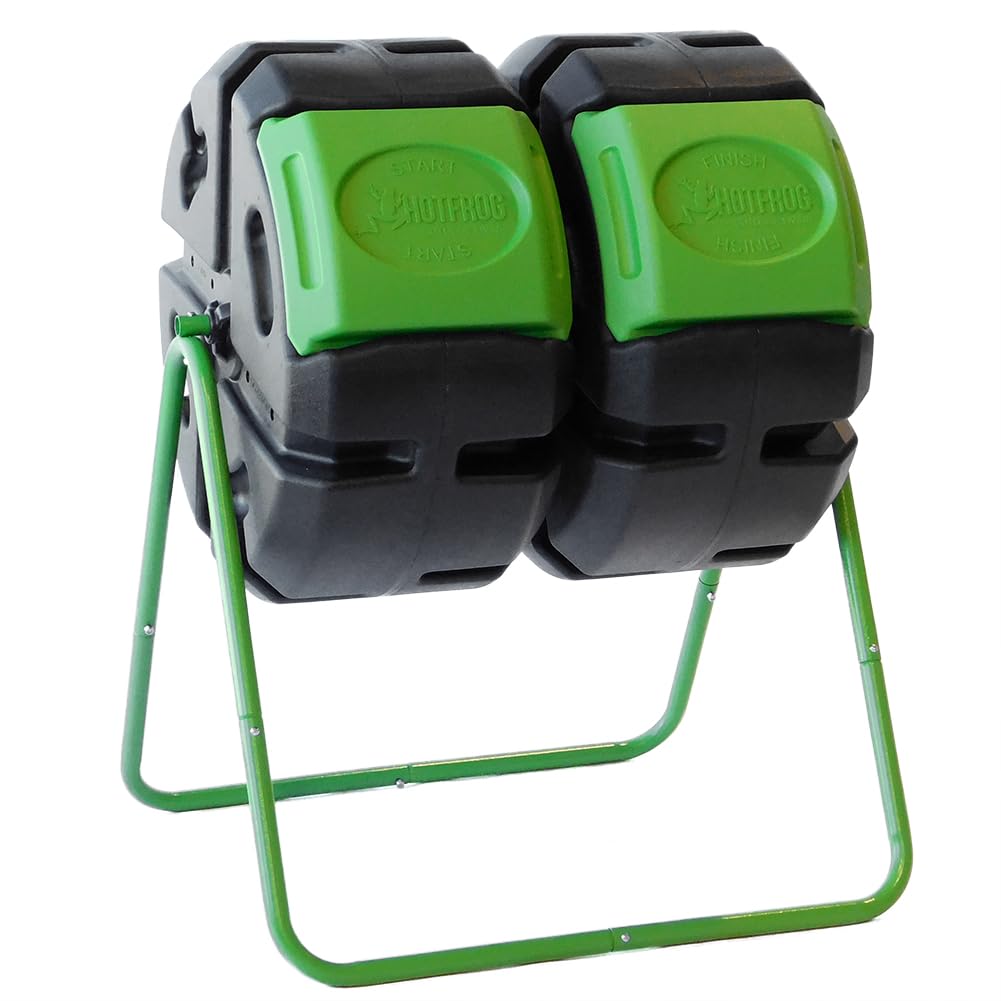
The maker’s claim of a two-week finish in hot, sunny conditions is the whole pitch.
FCMP says that in hot, sunny conditions with the right ingredient balance, compost can finish in as little as two weeks when you close the doors and rotate five or six turns every two to three days. That’s the fastest figure in this lineup, and it comes with a real caveat — “hot” and “right balance” are doing a lot of work in that sentence. In a cool climate or a wet pile, expect longer.
Total capacity is 37 gallons (5 cubic feet) split into two bodies, so the alternating system still applies. Aeration holes assist oxygen flow through the drum. The drum is molded polyethylene, and the maker notes it’s molded in one piece, which is part of why owners mention it holding up without corrosion.
Assembly and ease of turning are where this one earns its keep — both are consistently praised, and the one-piece molded construction means fewer joints to fail. Customers note the construction is well made and the bin shows no signs of wear. The size is the divisive part: some like that it fits on a back porch, others find it genuinely small. Know your waste volume before committing.
what separates it: a one-piece molded drum that resists corrosion, and the maker claims a two-week cycle in hot conditions.
The size question: 37 gallons is a porch-friendly footprint and a tight capacity — light loads suit it, big households will outgrow it.
Fits you if: you live somewhere hot and sunny and want compost back fast.
Not your pick if: you generate a lot of green waste — 37 gallons fills quickly.
9. Compost Wizard Jr. Tumbler, 7 Cubic Foot Capacity

Rolls from the start already built, with a 50-gallon drum.
Every other pick on this list arrives as panels and hardware. This one arrives assembled, and that single fact changes the whole first day of ownership — you can start filling it the afternoon it shows up. The chamber holds 50 gallons (7 cubic feet), which is generous for a single drum and enough to process a steady stream of kitchen scraps and yard waste in one cycle.
The design is a horizontal barrel on a wheeled base, so tumbling is done by rotating the barrel on its stand rather than lifting a handle. Molded handholds give you a grip on the outside and double as agitators on the inside, breaking up material as it turns. Two 12-inch twist lids seal the chamber to lock in heat and moisture, and the black exterior absorbs sunlight to push the process along.
What people like is how little it asks of you — the base rotation is simple to handle and the barrel turns smoothly, which is why ease of use ranks near the top of what owners talk about. The honest limits: some owners find it smaller than expected once they start filling it, and the wheels are on the small side. Cracking at the cap seams has come up over long-term use, so keep it out of punishing sun and don’t over-torque the lids.
The draws
- Arrives fully assembled — no panels, no bolts, no lost afternoon
- 50 gallons (7 cubic feet) in a single chamber with a compact footprint
- Wheeled base rotates the barrel with a simple push
- Molded handholds double as internal agitators
Be aware
- Small wheels make rolling over rough ground a chore
- Long-term seam cracking comes up among heavier users
This is your bin if: you want zero build time and a single-drum setup that starts working today.
Look past it if: you need two chambers running at once, or your ground is uneven.
Know the Specs
Capacity in gallons and cubic feet
Capacity is how much raw material the drum can hold at the start of a cycle, not how much finished compost comes out — material shrinks substantially as it breaks down. Bins here range from 37 gallons up to 65. Bigger drums mean fewer interruptions but a heavier turn once loaded.
Dual versus single chamber
Two chambers let you cure one batch while filling the other, so you keep adding kitchen scraps without pausing. A single chamber like the Compost Wizard Jr. is simpler but forces you to wait out a full cycle before starting the next batch.
Aeration holes and deep fins
Aeration holes let air move through the drum, which decomposition organisms need and which prevents pressure and odor building up. Deep fins are the ridges inside that break up clumps as the drum turns, so a full load mixes rather than sliding around as one wet lump.
Turning method: crank, geared handle, or wheeled base
A geared handle (RSI), a hand crank with a lockable ratchet (VEVOR), or a barrel that rotates on a wheeled base (Compost Wizard Jr.) — each trades effort for control differently. The real test is how each one behaves with a full drum, not empty.
Common Questions
How long does it take to get finished compost from a tumbler?
Does the drum get harder to turn when it’s full?
How often should I rotate a compost tumbler?
Will a tumbler keep animals out of my compost?
Can I add compost to one chamber while the other is curing?
Do I need to assemble the tumbler, and how hard is it?
Why does my tumbler smell or leak?
How much capacity do I actually need?
Will a black drum really speed up composting?
Can I leave a tumbler outside in winter?
The Bottom Line
For most people, the strongest pick among these is the RSI MCT-MC Maze Compost Tumbler — its 65-gallon drum dwarfs the rest, and the rolling cart means a full load of finished compost rolls to the beds instead of being shoveled and lifted. If a smaller footprint and a two-person household are your reality, the East Oak gives you dual chambers at just 12 pounds, so you can move it around the yard yourself. And if assembly is the thing keeping you from buying a tumbler at all, the Marcytop earns its place on the ease of the build alone.
How we choose
We do not accept paid placement. Every pick is matched to a real buyer and a real use-case; we do not hands-on test units.
Sources
Specifications: manufacturer listings and product documentation. Review insights: verified customer reviews, as of November 2026. Pricing: not shown on this page (it changes often); check the current price via the retailer link.
As an Amazon Associate, Tactical Gear Guy earns from qualifying purchases. This does not affect which products we feature.