Specs are compiled from manufacturer listings and verified buyer reviews and can change over time — please confirm the key details on the product page before buying.
You want to glance out the kitchen window and know the actual temperature on the porch — no app, no battery, no dead display. Dial size decides whether you can read it from inside the house. The printed temperature range decides whether it survives a hard winter. And the housing material decides whether the numbers on the face still mean anything after a season of sun and rain.
This guide is built by comparing the manufacturers’ published specifications and the patterns across verified customer reviews, so you get each pick’s real strengths and trade-offs instead of marketing spin.
A pretty face does not guarantee an honest needle — the range printed on the dial is your first real clue. Below you will find the pick that survives real weather, with every range, dial size, and build material compared side by side so you can choose the right outdoor analog thermometer in a single sitting.
Top Picks

How To Choose The Best Outdoor Analog Thermometer
An analog thermometer is a mechanical gauge: a coiled metal spring inside expands and contracts with temperature and drags a pointer around the dial. No batteries, no pairing, no firmware. With no electronics to fail, the coil, housing, and lens are the only things standing between a true reading and a drifted one. Here is what actually separates a gauge that still reads true next spring from one that drifts by ten degrees.
Start with dial size, because distance is the enemy
A 12-inch or 13.25-inch dial lets you read the temperature through a window instead of walking outside in socks. A 12-inch or 13.25-inch dial is a comfortable viewing size from across a porch or room. A 10-inch or 8-inch dial still works, but it suits a spot you pass close to — a shed door, a greenhouse shelf, a balcony rail.
Check the printed temperature range against your climate
The range is the two numbers marking the ends of the dial. A gauge rated from -60°F to 120°F covers deep-freeze mornings and desert afternoons alike. A gauge rated from -40°F to 120°F is fine for most of the country but will peg out on the coldest nights. If you live where winter bites hard, the wider range is worth hunting for.
Decide between metal and plastic housing
A metal enclosure resists cracking, warping, and sun fade better over years of exposure. A plastic case with an acrylic lens is lighter and more affordable, and modern acrylic does not yellow the way old plastics did. Both work — but plastic asks for a bit more care in direct sun and heavy hail.
Plan where it hangs before you buy
Almost every analog gauge hangs from a keyhole slot on the back, so you need a nail, screw, or hook — often not included. Mount it on a north-facing wall protected from heavy rain and out of direct sunlight. Direct sun heats the housing itself and pushes the needle above the true air temperature, which is the single most common reason a new gauge “reads wrong.”
Side-by-Side Comparison
| Model | Best For | Dial Size | Temperature Range | Housing | Amazon |
|---|---|---|---|---|---|
| La Crosse 104-67667MV-INT Margaritaville★ Best Overall | Porch personality | 13.25 inches | — | Plastic frame, shatter-resistant lens | Amazon |
| Springfield Winter DeerCabin Classic | Cabin and hunting lodge walls | 13.25 inches | -60°F to 120°F | Weather-resistant, shatterproof | Amazon |
| CHIVENIDO 10-Inch HygrometerBest Two-In-One | Temperature plus humidity | 10 inches | -40°F to 140°F | Plastic case, acrylic lens | Amazon |
| AcuRite 01597 Cardinals | Bright garden décor | 12.5 inches | -60°F to 120°F | Plastic, weather resistant | Amazon |
| MEINV 10.5-Inch White Hygrometer | Clean white wall look | 10.5 inches | -40°F to 140°F | Plastic case, acrylic dial | Amazon |
| Headwind 12-Inch Antique Aluminum | Industrial metal look | 12 inches (12.5-inch body) | — | Antique aluminum metal | Amazon |
| Taylor 12-Inch Big Read Dial | Reading from 25 to 30 feet | 12 inches | -60°F to 140°F | Metal housing | Amazon |
| Aowutus 8-Inch Stainless Hygrometer | Small greenhouse corner | 8 inches (12-inch item length) | -40°F to 120°F | Stainless steel, glass lens | Amazon |
| CHIVENIDO 12-Inch Bronze | Big bronze statement piece | 12 inches | -60°F to 140°F | Stainless steel, glass lens | Amazon |
Detailed Reviews
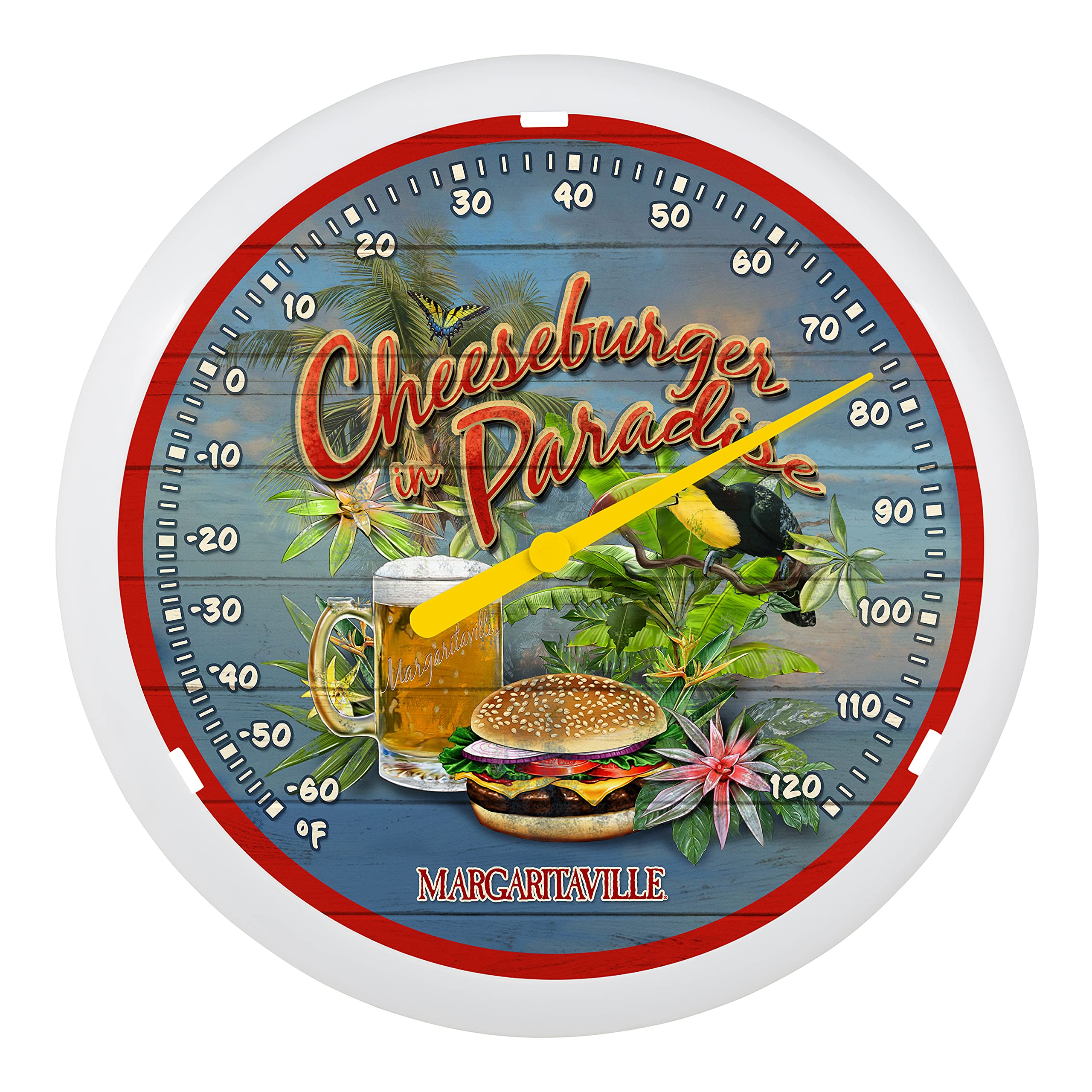
1. La Crosse 104-67667MV-INT Thermometer
Our pick — 4.0+★ from 100+ verified ratings; the strongest balance of quality and price.
A 13.25-inch dial that turns a patio wall into a conversation and still tells you the temperature.
If your thermometer is going to hang where guests can see it, this is the one that earns the spot. The face is a full 13.25 inches across, so the printed markings are readable before you are close enough to read the branding — which happens to be the Margaritaville “Cheeseburger in Paradise” artwork. It is weather resistant for outdoor duty, and the lens is shatter resistant, which matters when a dial this size is bolted to a wall that catches wind and stray branches. The frame is plastic, so it stays light on the mounting point.
Hanging it is a one-nail job, because the back carries a keyhole bracket that slots over a nail or screw you supply. La Crosse is upfront about placement: for the best accuracy, mount it on a north-facing wall protected from heavy precipitation. That single instruction solves most “why does mine read high” complaints before they start, since sun hitting the dial itself pushes the needle up. The “Fast Reading System” is the mechanical coil inside doing the work — no battery bay, no wires, nothing to charge.
The one comparison worth making is weight: at 15.36 ounces this La Crosse is the heavier build next to the 9.6-ounce Headwind metal gauge, so it sits steadier on a windy porch. It is rated 4.0+ stars across a modest pool of 100+ ratings, which is strong for a novelty-branded gauge. The trade-off is honest and simple — this is a decor piece first and a precision instrument second, and the dial prints no published temperature range, so do not expect documented sub-zero performance. What wins people over is the personality plus that big readable face, which is exactly what a poolside or tiki-bar porch wants.
Where it pulls ahead
- 13.25-inch face reads from across a deck or through a window
- Shatter-resistant lens handles knocks and weather
- Keyhole bracket makes mounting a one-screw job
- Battery-free coil movement — nothing to charge or replace
What to keep in mind
- No published temperature range on the spec sheet
- Placement matters — needs a north wall out of heavy rain
Reach for this if: you want a big, playful dial on a patio, pool deck, or covered bar wall where guests will actually look at it.
Think twice if: you need documented accuracy across a brutal winter — a gauge with a stated -60°F floor is the safer bet.
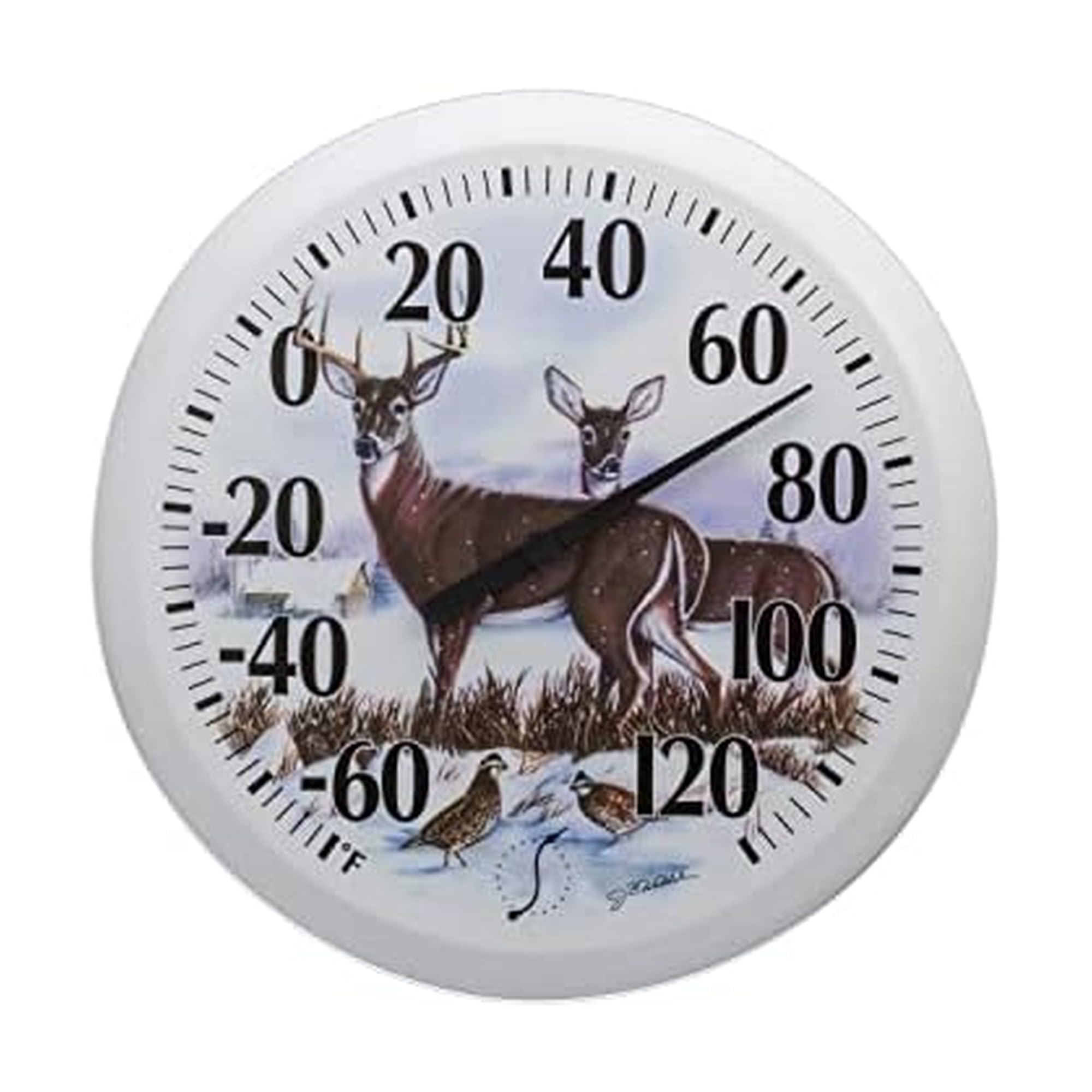
2. Springfield 13.25-Inch Winter Deer Thermometer
Factory-calibrated from -60°F to 120°F, with bold numbers you can read from inside the cabin.
The number that sells this gauge is the range: it is factory calibrated to measure from -60 degrees Fahrenheit to 120 degrees Fahrenheit, which in Celsius terms is -50 to 50. That floor means a January morning that would peg a cheaper dial still gets a real reading here. The 13.25-inch dial pairs with bold black lettering and a black pointer, so the contrast does the work of legibility. The fade-resistant Winter Deer artwork suits a hunting cabin or lodge wall, and the build is weather resistant and shatterproof.
No batteries are involved, which is the whole point of a mechanical dial — you hang it and forget it. Springfield’s own placement tip is to keep it out of direct sunlight for the most accurate readings, and a one-year limited warranty backs the unit. Compare its length to the CHIVENIDO 10-inch hygrometer and the size logic gets obvious: 13.25 inches versus 10 inches means meaningfully bigger numerals and an easier read when you are scanning through a window at a distance.
Owners consistently praise the readability and the look of the deer scene, and the practical takeaway is that it lives happily on a cabin porch viewed through glass. The honest catch is accuracy — it is the most-discussed topic on this model and the verdict is mixed, with some owners finding temperature readings drift from other thermometers. A few note the housing can arrive scratched. Treat that as a shipping-care note rather than a design flaw, and buy from a seller with a straightforward return path. Best for the cabin wall where atmosphere and big numbers matter together.
Reading the dial size: 13.25 inches is genuinely big — the difference between walking outside to check and simply glancing up from the couch.
The calibration caveat: factory calibration is a starting point, not a guarantee; mounting out of direct sun is the cheapest accuracy insurance you have.
Fits best: hunting cabins, deer-camp porches, and any wall where the scene is half the reason you bought it.
Not your match if: you plan to use it as a reference instrument in a greenhouse — buy one with a documented calibration instead.
3. Outdoor Thermometer Hygrometer 10Inch
Temperature and humidity on one 10-inch dial, with a coil that settles itself in a few hours.
Two readings for the price of one dial is the pitch, and it holds up. This 10-inch gauge reads temperature across -40 to 140°F (which is -40 to 60°C) and separately tracks humidity from 0 to 100%RH — the wetness of the air, measured as a percentage of what the air could hold. The Fahrenheit and Celsius scales both live on the face. The housing is a sturdy plastic bottom case, an acrylic lens, a plastic dial, and an aluminum pointer, and a keyhole on the back lets you hang it on a wall.
You set it up and walk away — no screwdriver, no batteries. A precision-made thermometer coil inside (a metal spring that moves with temperature) settles into ambient conditions on its own in roughly 2-3 hours. That makes this the pick for a greenhouse, a baby’s room, a lab bench, or a balcony where the humidity number matters as much as the temperature — condensation, mold risk, and comfort all hang on that second reading.
What buyers praise most is the readability — the large numbers cut through at a distance, and the appearance earns steady compliments. The honest side: accuracy is the most-discussed topic here and it splits, with some finding it true and others finding the temperature off by 10 degrees or more. Note that the spec sheet lists a “Battery Powered” power source in one field, yet the description clearly states no batteries are needed — trust the mechanical-coil description. This is the value end of a two-in-one dial, and for most people watching humidity in a greenhouse it does the job.
The second reading: humidity tracking from 0 to 100%RH is the feature you cannot get on a plain temperature dial, and it is the reason to pick this one.
How to read the accuracy chatter: dial thermometers live or die by placement; give it a few hours in a shaded spot before you judge the needle.
Go for this: greenhouses, grow rooms, and balcony setups where humidity matters as much as heat.
Look past it: if you want a single temperature number and nothing else competing for dial space.
4. AcuRite 01597 12.5-Inch Wall Thermometer, Cardinals

A cardinal portrait wrapped around a -60°F to 120°F dial, hung from a single nail.
AcuRite built this 12.5-inch dial around James Hautman artwork, and the cardinal design is what ends up on the garden wall in front of the bird feeder. The engineering underneath is the same mechanical coil used across quality analog gauges: coil inner workings give battery-free operation and dependable accuracy, with no power source to fail. It measures from -60 to 120 degrees Fahrenheit, so it covers both a hard freeze and a hot afternoon. The construction is weather resistant, and an integrated hang hole in the back makes mounting simple.
Owners talk about the cardinal face most — it is the bright, cheerful focal point of a porch or terrace, and it holds up visually season after season. Readability comes second, with the numbers doing their job up close. Plan around calibration: this is a coil gauge (a dial driven by a metal spring), and if it arrives reading a few degrees off, you can gently twist the “spring” behind the dial to nudge the pointer. Owners describe that trick as surprisingly easy once you try it.
The trade-off is real but manageable: accuracy is mixed, and some units read 10 degrees or more below the actual air temperature. At 15.36 ounces it is the heaviest dial here — versus the 9.6-ounce Headwind — so it holds steady on a windy wall. Delightful for a bird-lover’s garden; less so if you need a certified reference gauge.
For the bird-watcher: the Hautman cardinal artwork turns a plain dial into a garden feature, which is the whole reason to hang this one instead of a utility gauge.
The calibration adjustment: a gentle twist on the internal spring can bring a drifting needle back into line — a small skill worth learning on any coil dial.
Made for: the bird lover’s garden wall, the covered terrace, and anywhere the artwork earns its place.
Skip if: you need a factory-guaranteed reading straight from the start — coil dials ask for a small calibration check.
5. 10.5 Inch Indoor Outdoor Thermometer
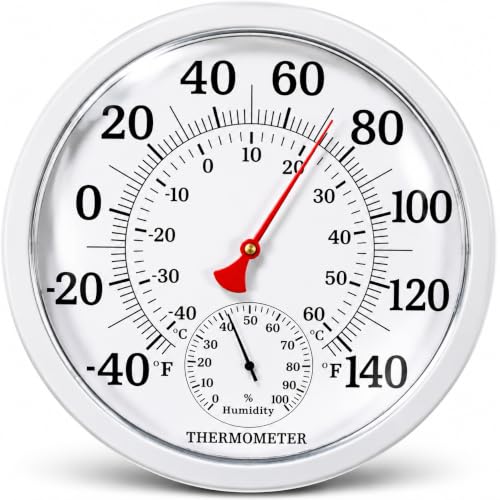
A bright white 10.5-inch dial that tracks -40°F to 140°F and humidity in one glance.
Some walls want subtlety. This MEINV dial answers that with a clean white plastic case, an acrylic dial that the maker says will not yellow over time, and bold black numerals paired with a red pointer. It reads from -40 to 140°F and -40 to 60°C, and separately tracks humidity from 0 to 100%RH. A keyhole on the back means you hang it and steady it with one screw — no wobble.
The self-sensing setup is the practical bit: a built-in mechanical chip reacts to ambient air, and the pointer settles into local conditions within about 2 hours of hanging. Nothing to calibrate by hand, no batteries to buy, and the waterproof plastic case is built to shrug off rain without rusting. That makes it at home in a three-season room, a porch, a garden shed, or any spot where you want temperature and humidity answered in one look.
What people rave about is the legibility — the numbers are large and the red hands read at a glance from the front door. Accuracy is the topic that splits opinion, though, and the fix is patience: give it the full 2-hour settle time before judging it. One honest note from the design: the numbers are big but could be a touch bigger for a dial this size, and the 20-degree increments (where used) make fine reading trickier than a 10-degree scale. Still a solid, clean-looking choice for a three-season porch.
The look: white housing and a non-yellowing acrylic lens keep it crisp against light-colored siding.
Give it time: 2 hours of settling plus a shaded spot is the difference between “off” and “spot on.”
Suits: a white-sided house, a three-season room, or any porch where a bright dial fits the trim.
Pass it over: if you need decimal-precise readings — the dial is a glance tool, not a lab instrument.
6. Headwind 12″ Aluminum Thermometer
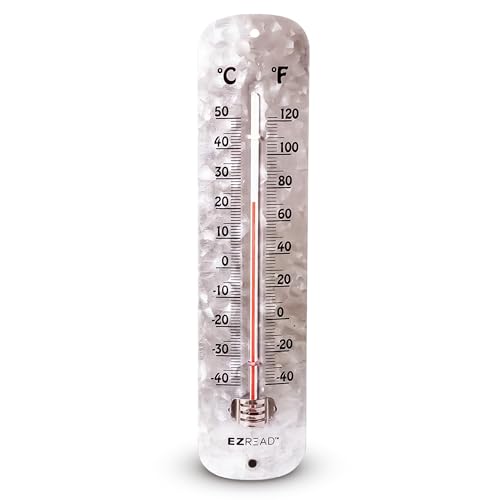
An antique-aluminum tube gauge that looks like it came off an old ship’s bridge.
This is the pick for the person who would rather a thermometer tell a story than shout a number. The Headwind is a 12-inch vertical metal thermometer with an antique aluminum finish — a cool gray metallic tone with softened, weathered shading, so it reads as aged industrial metal instead of brushed plastic. The outer body is metal, it is rated weather resistant, and the maker lists it as waterproof. It reads both Fahrenheit and Celsius on the printed markings.
It is heavier than most dials here, tipping the scale at 2 pounds, and that weight is part of the appeal: it feels substantial in the hand and stays put. Compact enough to fit on a post, a fence rail, or a shed wall, it is happy indoors or out. The 12-inch vertical layout keeps the markings large, which helps you read it from a distance on a patio or porch.
The antique finish and metal construction win people over, and one buyer notes it has a “good weight to it.” The trade-off is legibility from afar: this is a tube gauge with a fairly narrow temperature reading window, so you need to stand more or less straight in front of it. Reading it from a distance is harder than on a wide dial. That is not a defect — it is the nature of a slim metal tube. Expect to walk up to it rather than glance from the door.
Reasons to hang this one
- Antique aluminum metal body with real heft at 2 pounds
- Weather-resistant and listed waterproof for year-round outdoor use
- Reads Fahrenheit and Celsius on the printed markings
- Vertical 12-inch layout fits a narrow post or fence rail
Set expectations here
- Narrow read window — you need to stand in front of it
- No published temperature range on the spec sheet
A clear yes for: industrial, farmhouse, and loft-style exteriors that want a real metal dial on the wall.
A no for: anyone wanting to read the temperature from inside the house through a window.
7. Taylor 12 Inch in/Out Round Dial Thermometer
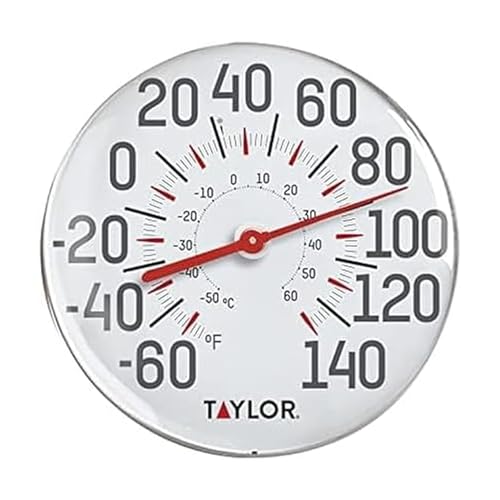
Readable from 25 to 30 feet away, across a patio, without squinting once.
You can read the Taylor 12-inch dial from across the yard — that is where it separates itself. Bold, clearly printed numbers and a sharp-pointed pointer hold up at 25 to 30 feet, the sort of distance from a far end of a yard or across a pool deck. The metal housing is designed to take rain, humidity, and direct sun, and it is rated for a -60°F to 140°F range, covering true winters and hot summers with room to spare. The Big Read name is accurate: bold numerals and a sharp-pointed pointer stay legible at 25 to 30 feet.
Taylor has been in precision measurement since 1851, and the metal housing backs up the durability claim. The face reads F and C, it hangs easily, and the metal build avoids the hollow feel of all-plastic gauges. It suits a patio, a garage, a sunroom, or a fence post equally well.
Accuracy is the most-discussed topic, and the split is honest: many owners find it accurate, while some find it reading about 5 degrees high. The other recurring gripe is scale granularity — the numbers sit in increments of 20 instead of 10, so fine changes take a careful look. Some note the materials feel light for a metal dial. For a large, bright, high-visibility dial at a mid-tier price, that is the set of trade-offs to accept.
Why the range matters: -60°F to 140°F means it will not peg out in deep winter or a heat wave, which few dials can promise.
The accuracy note: a roughly 5-degree high read shows up for some owners — enough to notice, not enough to break everyday use.
Best for: large yards, pool areas, and anyone who wants a bright read from far away.
Not for: folks who need 1-degree increments — the 20-degree scale is coarse by design.
8. 8 in Stainless Steel Analog Thermometer

An 8-inch bronze stainless dial with a glass lens, tracking heat and humidity at a glance.
Small spaces get their own answer here. This Aowutus gauge is an 8-inch dial with a stainless steel body, a glass lens, and a bronze finish, and it doubles as a thermometer and a hygrometer (a humidity reader): temperature from -40 to 120°F (-40 to 50°C) and humidity from 0 to 100%RH (relative humidity, the share of moisture the air holds). The glass lens is the standout — unlike acrylic, it will not yellow, and the manufacturer says the steel enclosure resists corrosion. Red hands on a white dial keep the reading clear.
It self-calibrates on a built-in mechanical movement within 2-3 hours and needs no battery, so it suits a greenhouse shelf, a kitchen counter, or a small balcony where a big 12-inch dial would crowd the space. Stand it on a desk or hang it from the keyhole slot on the back, and it moves wherever the reading matters most.
The strongest theme among owners is build quality — the stainless and glass construction gets called out as solid and good-looking. Accuracy is the split topic, with low-temperature readings being the specific complaint for some. Treat it as a room-and greenhouse tool rather than a lab reference, and give it the full settle time. The red color band on the dial is a small detail note for anyone drawn to the bronze look. A tidy pick for a compact space that wants both readings.
Highlights
- Stainless steel with a glass lens that resists yellowing
- Dual reading: -40 to 120°F plus 0 to 100%RH humidity
- Self-calibrating in 2-3 hours, battery-free
- 8-inch size fits greenhouses and small counters
Worth knowing
- Low-temperature accuracy is a recurring mixed point
- Smaller face means a closer look than a 12-inch dial
Perfect for: a greenhouse shelf, a plant corner, or a kitchen window where both heat and humidity matter.
Not ideal for: reading across a big yard — an 8-inch face is a close-up dial.
9. 12″ Indoor Outdoor Thermometer
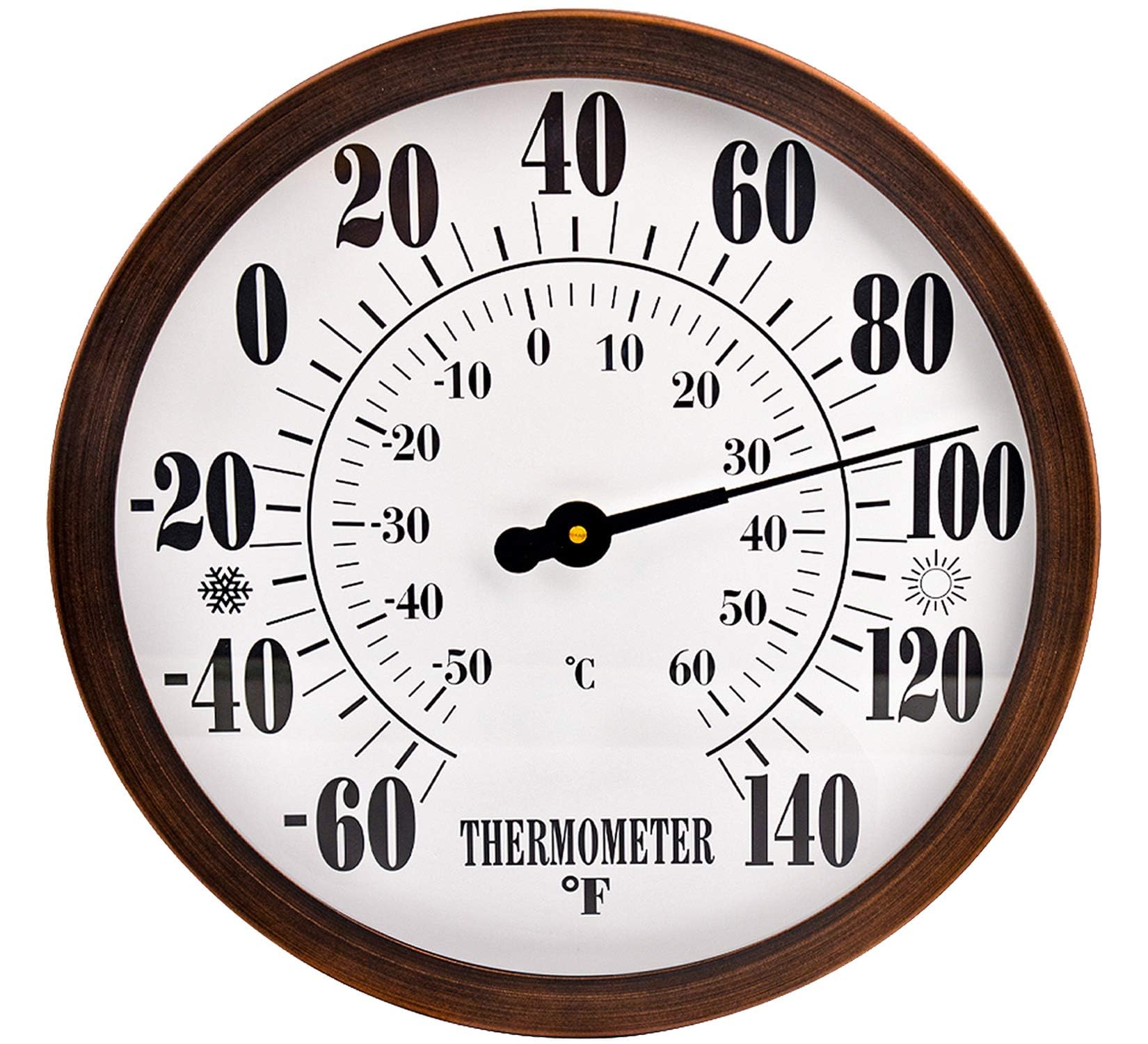
A big bronze stainless 12-inch dial, reading -60°F to 140°F with sun and snow icons.
This CHIVENIDO dial leans hard on looks, and the bronze-finished stainless steel casing and glass lens do the heavy lifting. Underneath it is a serious gauge: a -60°F to 140°F range, dual Celsius and Fahrenheit scales, and a precision-wound thermometer coil that self-calibrates within about 2 hours of mounting. The 12-inch face uses bold black graphics plus sun and snow icons, so even a quick glance tells you whether it is a warm or cold day. No batteries anywhere.
It is built to sit outside — steel housing, a durable glass lens, and a corrosion-resistant metal enclosure. The size is exactly right for a patio, a garden, a porch, or a living room wall, and the bronze look reads more expensive than a plastic dial ever will. That is the aesthetic pitch, and it works.
The honest limit is durability under long exposure. Reliability is the topic that draws the most mixed notes here, with a few owners finding the mechanism faltered after several months rather than years. The appearance and readability hold up, and most owners are simply happy with the look and the big numbers. If you want a bronze statement dial, this one delivers the look — just hang it somewhere sheltered from the worst of the weather to help it last.
The look-to-function ratio: bronze stainless and sun/snow icons make this a feature piece, not a utility gauge.
The longevity caveat: a sheltered mount and gentle handling are the best insurance on a mechanical coil over time.
Choose this for: a bronze-accented patio or garden wall that wants a big, attractive dial with a wide temperature range.
Think again if: you need a dial guaranteed to run for a decade — treat this as a quality piece with a finite service life.
Know the Specs
Temperature Range and the Coil
The printed range — say -60°F to 140°F — is the span the dial can physically read. A mechanical coil inside (a metal spring that expands and contracts with heat) drags the pointer, so a wider range usually means a more robustly built movement. Pick a gauge whose range comfortably covers your coldest and hottest outdoor days, and mount it out of direct sun so the housing itself does not skew the reading.
Dial Size vs. Read Distance
Bigger faces put bigger numbers in front of your eye, which is the single biggest factor in how far away you can read the gauge. A 12- to 13.25-inch dial works through a window from across a room; an 8- to 10-inch dial wants a closer look. Size also affects bulk and mounting — a large plastic dial stays light, while a large metal dial needs a firmer mount.
Metal vs. Plastic Housing
A metal case or a glass lens tends to last longer outdoors, resisting cracking, warping, and yellowing. Plastic with an acrylic lens is lighter and often cheaper, and modern acrylic holds up well. For coastal air, stainless steel with a glass lens and a corrosion-resistant enclosure is a safer long-term bet than plain plastic.
Humidity and Calibration
A hygrometer adds a second scale, usually 0 to 100%RH, which tracks how much moisture is in the air. Many dials self-calibrate on a precision coil within roughly 2-3 hours, meaning you hang it and wait rather than adjust a screw. If a needle drifts, some coil dials can be nudged back into line by gently turning the internal spring.
Common Questions
Do these thermometers need batteries?
Why does my new thermometer read higher than the weather app?
What does a -60°F to 120°F range actually mean for me?
How long does it take a self-calibrating dial to settle?
Can I adjust a dial that reads a few degrees off?
Is stainless steel really better than plastic outdoors?
Where should I mount an outdoor thermometer for the truest reading?
What is the difference between a thermometer and a hygrometer?
Will a big 12-inch dial fit on my fence post?
Do these work indoors too?
The Bottom Line
For most porches, the outdoor analog thermometer worth starting with is the La Crosse Margaritaville — a 13.25-inch shatter-resistant dial that is big, readable, and full of personality, and it holds the top slot at 4.0+ stars across 100+ ratings despite the pool being modest. If you want a documented temperature range and a cabin-friendly look, grab the Springfield Winter Deer, which reads down to -60°F. And for greenhouse duty where humidity matters as much as heat, the CHIVENIDO 10-inch hygrometer is the one to reach for. Whichever you pick, hang it out of direct sun and give it a couple of hours to settle — that single habit is what turns a dial into a dependable everyday gauge.
How we choose
We do not accept paid placement. Every pick is matched to a real buyer and a real use-case; we do not hands-on test units.
Sources
Specifications: manufacturer listings and product documentation. Review insights: verified customer reviews, as of November 2026. Pricing: not shown on this page (it changes often); check the current price via the retailer link.
As an Amazon Associate, Tactical Gear Guy earns from qualifying purchases. This does not affect which products we feature.