Specs are compiled from manufacturer listings and verified buyer reviews and can change over time — please confirm the key details on the product page before buying.
You already have a socket set that will not fit, a bolt tucked behind a brake caliper, and about ten minutes before the job turns into a whole afternoon. An open-end wrench solves exactly that problem: it slides in from the side of the nut instead of needing room above it. The picks below are ranked by how well they actually reach, how much force the jaws survive, and how honest the sizing is. The Capri Tools Super-Thin set wins because its heads measure 2.2 to 4.6 mm thick and stay stiff under load.
This guide is built by comparing the manufacturers’ published specifications and the patterns across verified customer reviews, so you get each pick’s real strengths and trade-offs instead of marketing spin.
When clearance is the thing standing between you and a finished repair, thin heads, correct size stampings, and steel that resists spreading matter more than brand names. Every pick here was screened for those traits first. Here is my honest shortlist of the open-end wrench options that do the job.
Top Picks


How To Choose The Best Open-End Wrench
Most people buy an open-end wrench for one job and then keep it for fifteen years, so the decision deserves five minutes of thought. The wrench either fits into the space or it does not, and no amount of polishing changes that.
Measure the gap before you measure the nut
Head thickness is the number that makes or breaks a purchase. A standard open end runs around 10 mm or more at the head, while a super-thin design drops into the 3 mm range so it can slip between a brake caliper and its bracket. Grab a ruler and check the clearance around the fastener you are fighting. If you have less than 6 mm of room, you need a thin-profile set. The Capri Tools set goes as slim as 2.2 mm on its smallest sizes, and the 19-piece ELEAD and SEDY sets both run 3 mm across the range.
Know if you need SAE, metric, or both
A 13 mm nut and a 1/2 inch nut look nearly identical and are not interchangeable. Modern cars mix both under the same hood, so a dual-system set saves a second purchase later. The 19-piece sets here cover 9 SAE and 10 metric wrenches, and because each wrench is double-ended they reach 38 distinct opening sizes. Check the size chart’s actual range: some sets skip sizes rather than running continuous, and the ironcube 16-piece set tells you outright that its ranges are not continuous.
Match the jaw style to the work
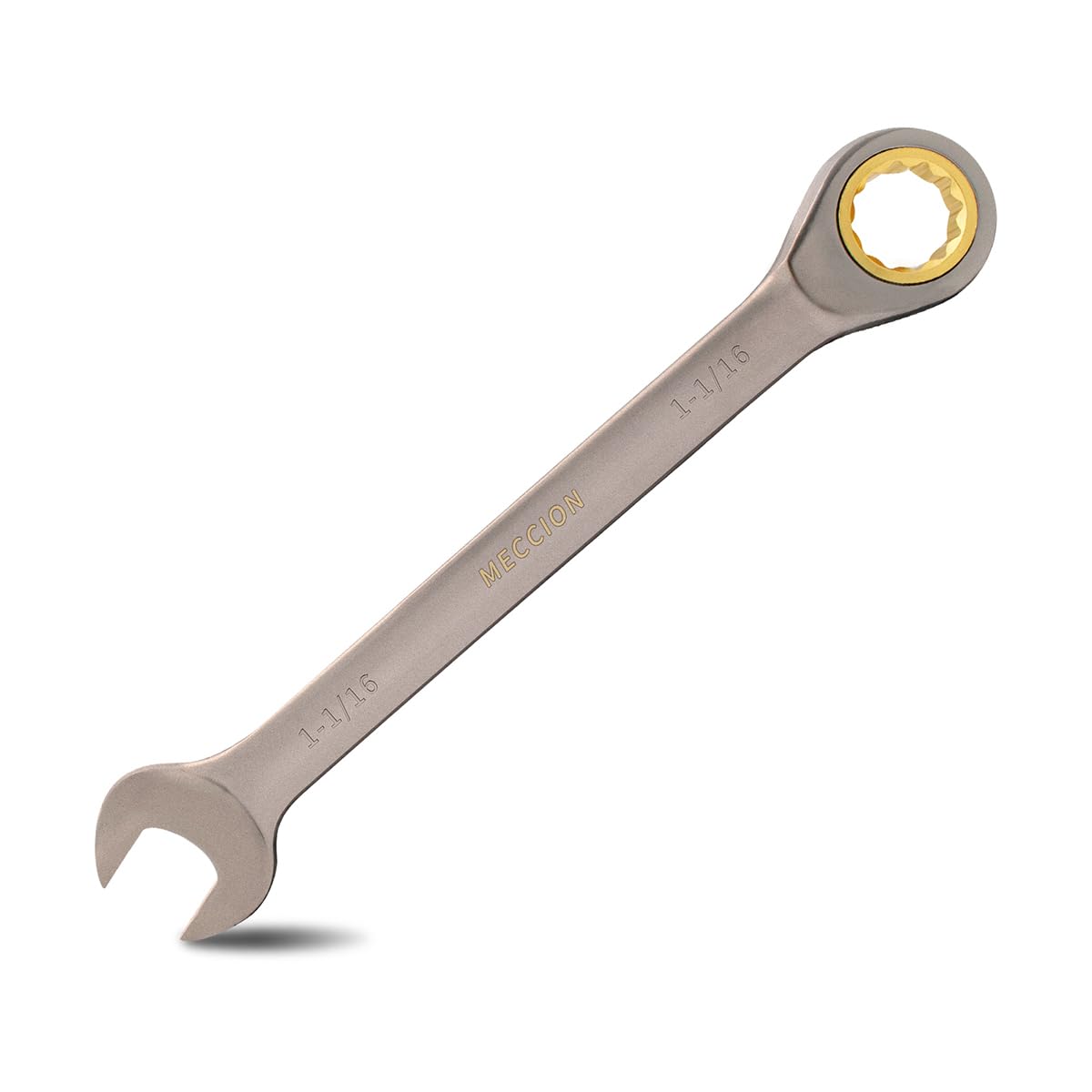
A plain open end grips two flats of the nut and slides on from the side — perfect for tubing, brake lines, and anything with no room overhead. A ratcheting jaw with 12 points still slides on from the side but lets you swing the handle back and forth in a short arc. The Meccion wrench needs only a 5° swing, which matters when the handle travel is blocked by an engine block. The trade-off is more moving parts inside the head, which is exactly where the weakest reviews land.
Look at steel and finish, not just shine
Chrome vanadium steel is forged and heat-treated, so it flexes rather than cracks under a hard pull. Nickel plating and mirror chrome both fight rust, but neither survives a tool bag that lives in a damp garage. Wipe the wrench down after a job and store it in the roll-up pouch most of these sets include. A pouch is not a luxury here — loose thin wrenches bend against each other in a drawer.
Side-by-Side Comparison
| Model | Best For | Pieces | Head Thickness | Size Standard | Amazon |
|---|---|---|---|---|---|
| Capri Tools Super-Thin 11850-7MRK★ Best Overall | Tight-clearance brake and engine work | 7 wrenches, 14 sizes | 2.2 to 4.6 mm | Metric 6–19 mm | Amazon |
| Meccion 1-1/16 Inch RatchetingTop Performer | One-hand ratcheting in confined spaces | 1 wrench | — | SAE 1-1/16 in | Amazon |
| ELEAD 19-Piece Super-ThinBest Coverage | Full dual-system coverage in one roll | 19 wrenches, 38 sizes | 3 mm | SAE 1/4″–1-1/16″ and Metric 5.5–27 mm | Amazon |
| SEDY 19-Piece Super-Thin | Color-coded SAE and metric separation | 19 wrenches, 38 sizes | 3 mm | SAE 1/4″–1-1/16″ and Metric 5.5–27 mm | Amazon |
| GRENPRO 7PC SAE Large | Big nuts on suspension and hitch hardware | 7 wrenches | — | SAE 15/16″–1-1/4″ | Amazon |
| ironcube 16-Piece Thin | Clean stainless steel set in a canvas bag | 16 wrenches, 32 sizes | 3 mm | SAE and Metric | Amazon |
| CRAFTSMAN OVERDRIVE CMMT87811 | Rescuing rounded fasteners | 11 wrenches | — | Metric | Amazon |
| EFFICERE 14-Piece Angle Head | Angled access around obstructions | 14 wrenches | — | SAE 3/8″–1-1/4″ | Amazon |
| Wera 6005 Joker 4 Set 1 | Compact metric set for the tool bag | 4 wrenches | — | Metric | Amazon |
Detailed Reviews
1. Capri Tools Super-Thin Open End Wrench Set 11850-7MRK
Our pick — 4.5+★ from 800+ verified ratings; the strongest balance of quality and price.
Seven metric wrenches that slide into gaps a standard open end will never see.
The number that earns this set the top spot is 2.2 mm — the head thickness on the 6 mm and 7 mm wrenches. That is thinner than a coin, so the head slips behind a brake caliper or between an engine mount and its bracket where a conventional wrench simply cannot enter. The larger wrenches in the set step up to 2.6 mm on the 8 through 11 mm sizes, 3.6 mm on the 12 through 15 mm sizes, and 4.6 mm on the 16 through 19 mm sizes. Even the thickest head stays slim enough for jobs that stall a normal wrench.
Each head is tipped at a 15-degree angle, which changes how you work rather than just how it looks. You turn the nut until the handle hits something, then flip the wrench over and the angled jaw re-engages on the flats for the next bite. In a narrow spot that flip-and-turn rhythm is the whole technique, and it takes about two bolts to become automatic. Steel is forged chrome vanadium that goes through a ten-step heat treatment, then gets a polished chrome plate to keep rust off the surface.
The reputation here is built on build quality above everything else, and the thin profile is the next thing people single out. Buyers report these breaking loose brake caliper pins that are already rusted solid, a job where a flexing jaw would round the nut instantly. What you give up is coverage: seven wrenches carry 14 metric sizes from 6 to 19 mm, so there is no SAE and nothing above 19 mm. The 19-piece ELEAD set carries 19 wrenches to this set’s 7, but it spreads that across both standards rather than doubling down on metric precision.
Where It Pulls Ahead
- 2.2 mm head on the small sizes reaches fasteners no standard wrench can touch
- 15-degree tipped head lets you flip and re-engage in a cramped arc
- Ten-step heat-treated chrome vanadium holds its shape under a hard pull
- Polished chrome plating resists corrosion on brake and engine work
What It Asks You To Accept
- Metric only, 6 to 19 mm — no SAE sizes in the roll
- Seven wrenches cost more per piece than the big dual-system sets
- Thin heads demand care; do not use them as a pry bar
Reach for this if: you work on modern metric vehicles and clearance is the recurring enemy — this is the set that keeps earning its place at the top.
Think twice if: your garage mixes SAE hardware into the same jobs, because you will need a second set.
2. Meccion Combination Wrench 1-1/16 Inch SAE
A single 1-1/16 inch wrench built to work an arc so short the handle barely moves.
Five degrees. That is the swing this wrench needs to grab the next tooth of its 72-tooth ratchet, and it is the reason to buy it over a plain open end. Picture the handle pinned against a frame rail with almost no travel — you can still ratchet the nut off a few degrees at a time instead of unseating and resetting the jaw. The 12-point head engages the fastener from more angles, and the grey nickel plating over chrome vanadium steel handles rust protection.
At 12.99 inches it is a full-length wrench, though it runs slightly shorter than the 13.77-inch GRENPRO large wrenches — a difference you notice only when you are leaning on a stubborn fastener. One SAE size, 1-1/16 inch, means this is a targeted purchase rather than a kit. Owners have used it on excavator tracks and other heavy equipment, a fair sign the handle and jaw survive real torque.
Here is the honest part: the ratchet mechanism draws mixed reports. Owners mention that “the ratchet performance receives mixed feedback, with one customer reporting it stopped working after two minutes of use.” That is the nature of a ratcheting jaw — more parts inside a small head. If you plan to hammer on it daily, a solid one-piece open end is the safer shape. As an occasional heavy-nut tool in the bag for home, bicycle, and automotive repair, it does what it promises.
The short-arc advantage: 5° of handle travel is all this needs to keep turning a nut, which saves you from fighting for room every single bite.
The fair warning: the ratchet internals are the part that reports vary on, so treat this as a convenience tool rather than an impact-grade workhorse.
Buy it when: you want ratcheting speed in one specific SAE size and the space around it is almost nonexistent.
Pass when: you need a set of sizes or a tool that shrugs off daily abuse without a moving part to worry about.
3. ELEAD 19-Piece Super-Thin Open End Wrench Set
Nineteen wrenches, thirty-eight sizes, one 3 mm profile that covers both standards.
If you want to stop thinking about which set you own, this is the one. Nineteen wrenches break into 9 SAE sizes from 1/4 inch to 1-1/16 inch and 10 metric sizes from 5.5 to 27 mm. Every wrench is double-ended, so the set actually delivers 38 opening sizes from one roll. That is 19 wrenches versus 7 in the Capri Tools set above — a real difference if your work crosses between a metric car and an SAE trailer hitch in the same afternoon.
Head thickness sits at a uniform 3 mm, which is the balance between the Capri’s ultra-thin small ends and a conventional wrench you could never squeeze in. The jaws are precision-machined to boost torque and keep a nut from rounding under load. High-strength chrome vanadium steel with a polished nickel plate keeps the surface from rusting through a season of garage work. The roll-up pouch has clear size labels plus copper hanging holes, so the set hangs on a pegboard rather than living in a heap.
What earns this set its following is the thin profile in real tight spots — the kind of narrow passage where a normal wrench head is simply too fat to enter. Its span of work runs from bike and automotive jobs to machinery repair and everyday home maintenance, so it earns a place in a general toolkit. The catch is that a set this broad goes deep rather than wide on any one size; the thin heads are not meant for a breaker bar, and a cheater pipe will do them no favors.
Why mechanics keep it: one roll covers both standards and the 3 mm head gets into passages a standard open end cannot follow.
The limit to respect: precision-machined thin jaws are for steady hand torque, not for extension bars and pipe cheaters.
Your pick if: you want a single set that covers metric and SAE and lives neatly in a pouch you can carry to a job site.
Look past it if: you only ever touch one standard and prefer to spend on fewer, heavier jaws.
4. SEDY 19-Piece Super Thin Open-End Wrench Set
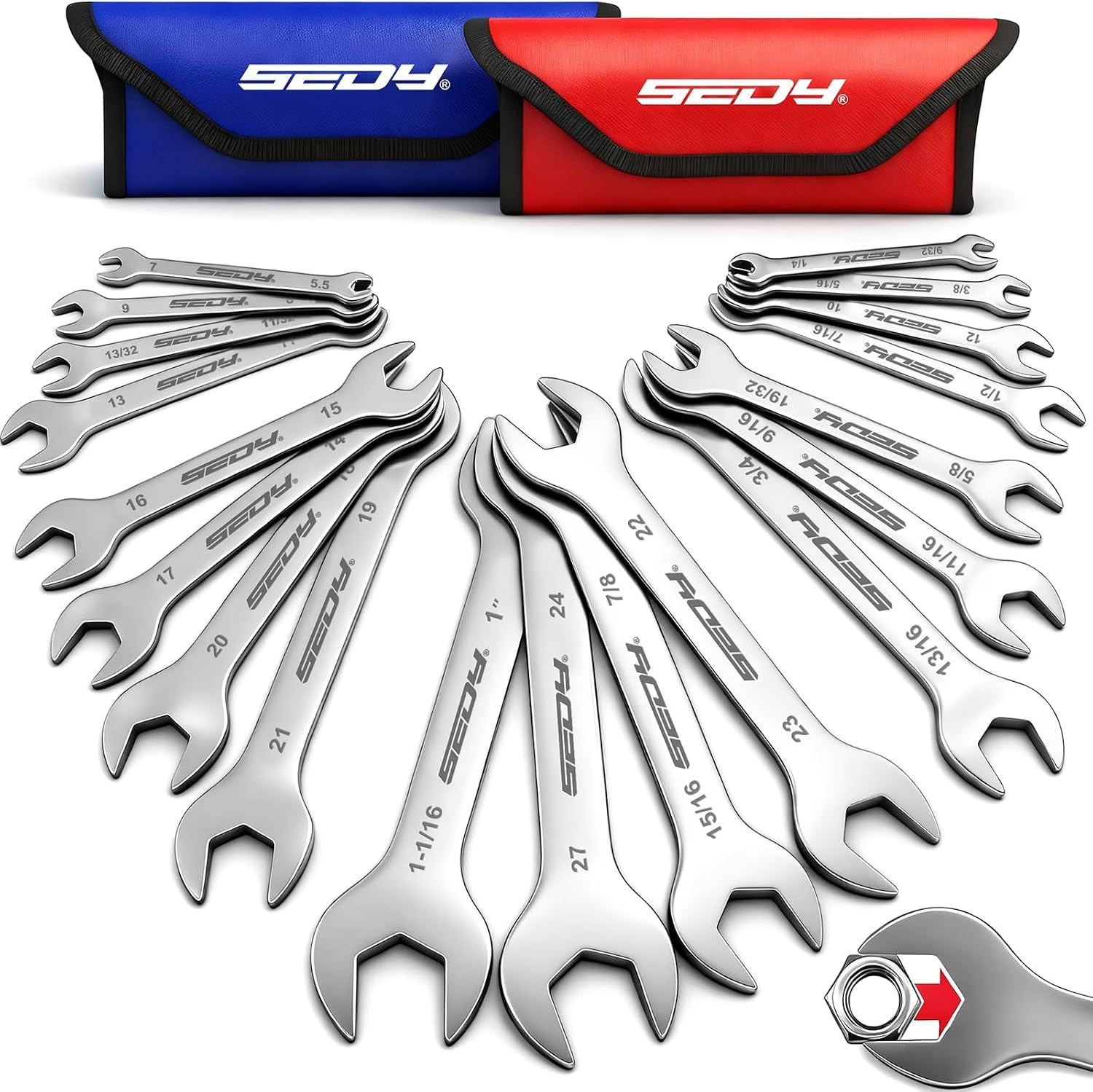
Two color-coded rolls so you grab SAE or metric without unrolling the wrong one.
Same coverage as the ELEAD set — 19 double-ended wrenches, 9 SAE from 1/4 inch to 1-1/16 inch and 10 metric from 5.5 to 27 mm, for 38 total opening sizes at 3 mm thickness. The difference is how it stores. You get two separate roll-up pouches, red for SAE and blue for metric, each printed with the sizes. When you are under a truck and need a metric wrench, you reach for blue and skip the hunt entirely.
The steel choice is the other split. This set is built from 3Cr13 stainless steel rather than chrome vanadium, with a polished nickel plate over it for rust resistance. Stainless has its own character — it resists corrosion well and machines into a clean jaw, and customers note the wrenches hold up well enough to make a lifetime of use sound plausible. The precision-machined jaws grip on multiple flats to spread the load and resist rounding.
Owners describe these fitting into narrow passages and seating firmly, and the pouch itself gets called out as handy for keeping both standards straight. Where I would set expectations: this is a broad, thin set built for steady torque, not the tool for a breaker bar on a seized suspension bolt. If your fasteners fight back hard, a thicker wrench with more meat at the head is the right answer instead.
What Buyers Keep Coming Back To
- Red and blue rolls separate the two standards at a glance
- 38 opening sizes from 19 double-ended wrenches
- 3 mm profile reaches fasteners standard wrenches miss
- 3Cr13 stainless steel with polished nickel resists rust
The Honest Drawbacks
- Two pouches take more drawer space than a single roll
- Thin jaws suit hand torque, not breaker bars
- Sizes stay inside 1-1/16 inch and 27 mm, nothing bigger
Best suited to: the organized garage where SAE and metric jobs both show up weekly and you want each set to live in its own roll.
Not the one for: anyone who needs oversized jaws past 27 mm or 1-1/16 inch.
5. GRENPRO 7PC SAE Large Wrench Set Combination Open End Wrench

Seven oversized SAE wrenches for the suspension and hitch nuts nothing else fits.
The sizes tell you everything: 15/16 inch, 1 inch, 1-1/16 inch, 1-1/8 inch, 1-3/16 inch, and 1-1/4 inch, on 13.77-inch handles. That length is 13.77 inches versus 12.99 inches on the Meccion wrench, and that extra reach is leverage when a nut has not moved in a decade. Heat-treated chrome vanadium steel with a mirror finish keeps corrosion off, and the open-end jaws are clearly stamped so the size reads at a glance even after years in a bag.
There is one genuinely useful extra in the box: a bolt gauge. You hold it against the nut, read the size, and grab the matching wrench instead of testing three in a row. Combined with the size print on the tool roll, it turns a hunting exercise into a single motion. Reviewers point out this set pulling a stripped 3/4 inch hitch bolt that a smaller wrench had already chewed up — exactly the job oversized jaws exist for.
Where the value shows up most is the ratio of jaw size to spend — large wrenches usually cost noticeably more per piece, and this set lands in mid-range territory for six big sizes. The trade is narrowness: no metric, and nothing below 15/16 inch. This is a second set, not a first one, and it earns its space only if you work on trailers, motorcycles, or heavy hardware.
The practical win: the included bolt gauge plus printed sizes means you stop guessing which wrench fits a big nut.
The scope limit: SAE only and all sizes above 15/16 inch, so small fasteners and metric jobs need another set.
Worth adding if: your work involves trailer hitches, suspension hardware, or heavy equipment with big SAE nuts.
Leave it for later if: your fasteners are all small or all metric — the sizes will never come out of the roll.
6. ironcube 16-Piece Thin Open-End Wrench Set

A black stainless set that fits narrow gaps and hangs in a canvas tool bag.
Sixteen double open-end wrenches, 8 SAE and 8 metric, giving 32 opening sizes at 3 mm of head thickness. That 3 mm figure is the entire point: it is the number you check against the gap around a fastener before you buy. The listing is refreshingly blunt about this — check the clearance and the fastener size first, because a thin head still needs somewhere to go.
Construction is black-finish stainless steel, which sidesteps the rust question that plagues chrome-plated tools left in a damp garage. The open-end shape lets you come at a nut from the side, seat the jaw fully, and turn. Storage comes as a wax canvas tool bag rather than a synthetic roll, which holds up better when it gets tossed into a truck bed. Buyers describe the steel as stiff enough to resist bending open under load — the real test of a thin wrench.
The one thing to read carefully is spacing. The maker states the size ranges are not continuous, so there are gaps between sizes rather than a smooth run. Pull up the included-size chart and confirm the nuts you actually work on are listed before you commit. Sizes also get mixed reactions — the stampings do the job, but the set does not carry every size in a neat sequence.
What the bag buys you: a wax canvas roll plus stainless steel construction means this set survives a truck bed without rust blooms.
Read before you buy: the size ranges skip numbers, so match the chart to your actual fastener list first.
Good match for: mobile work where the set rides in a vehicle and rust resistance beats a mirror finish.
Check first if: you need continuous sizing — confirm your exact nut sizes appear on the chart.
7. CRAFTSMAN OVERDRIVE 11-Piece Metric Wrench Set (CMMT87811)

Eleven metric wrenches engineered to bite fasteners that have already started to round.
Here is the spec that separates this set: the open end is designed to remove fasteners rounded up to 50 percent, and the box end handles fasteners rounded up to 70 percent. That is a real design choice aimed at the worst day in a garage — a nut somebody else already chewed up with the wrong size. The tight torque technology also works to prevent rounding on normal jobs, which matters just as much on soft hardware.
Leverage gets attention too. The long panel design gives you more turning force than CRAFTSMAN’s raised panel wrenches, which is the difference between a stuck bolt moving and your knuckles meeting the frame. Each wrench carries easy-to-read size markings so you can spot the right one fast, and the gunmetal-chrome finish resists rust while looking sharp in the tray. Alloy steel construction meets or exceeds ASME specifications.
Owners point to the solid construction and the finish first, and the long shafts come up as a genuine plus when a bolt is tight. The limitation is scope and bulk: 11 metric wrenches, no SAE, and these are full-thickness heads that will not go where the thin-profile Capri or ELEAD wrenches fit. If your problem is clearance, buy thin. If your problem is a rounded nut that refuses to budge, this is the right tool.
What Makes It Different
- Open end removes fasteners rounded up to 50 percent
- Box end handles fasteners rounded up to 70 percent
- Long panel design adds leverage over raised panel wrenches
- Size markings stay readable under a work light
Where It Stops Short
- Metric only, so SAE hardware needs a separate set
- Full-thickness heads will not fit tight clearance spots
- Eleven pieces is a focused set rather than full coverage
Choose this when: your job involves removing bolts that are already damaged and you need jaws that grab what is left.
Skip the swap if: your real obstacle is space — a thin-profile set solves that problem and this one does not.
8. EFFICERE 14-Piece Angle Head Open End Wrench Set

Two different head angles on one wrench so you can walk a nut out of an obstruction.
Most open-end wrenches give you a single 15-degree offset and call it a day. This one puts a 15-degree end on one side and a 60-degree end on the other, which means you can swap ends and approach the same nut from a steeper angle when something is in the way. On a fastener buried behind a hose or a bracket, that second angle is often the only path to a full turn.
The set covers 14 SAE sizes from 3/8 inch through 1-1/4 inch in chrome vanadium steel with a rust-preventative mirror chrome finish, and rates to 150 N m of torque. Sizes are stamped on both ends and both sides of the body, so you can read the marking no matter how the wrench sits in your hand. The organizing rack has a folding handle and non-slip grippers that hold the wrenches in place while you carry the whole set.
Value is the strongest signal here — buyers consistently treat this as money well spent, and the mirror finish gets praised as looking better than the price implies. It is built for heavy equipment work as much as garage jobs, and the lifetime warranty backs the claim. The honest note: some sets arrive with sizes that do not match perfectly between the two ends, so check your critical sizes against a known nut before you trust one on a tight bolt.
The dual-angle trick: a 60-degree end alongside the standard 15-degree end gives you a second approach angle when an obstruction blocks the first.
The check to run: verify critical sizes against a known fastener, since the two ends do not always read identically.
Pick it for: SAE-heavy work on equipment and vehicles where obstructions keep blocking a straight approach.
Look elsewhere for: metric fasteners or ultra-thin clearance — this set offers neither.
9. Wera 6005 JOKER 4 Double Open-Ended Wrench Set

Four metric wrenches on a clip that disappears into a tool bag until you need them.
At 6.69 inches long and 271 g for the whole set, this is the one that rides along without complaint. Four metric double open-end wrenches sit in a clip meant for space-saving storage in a tool bag. Wera shapes the mouth geometry specifically to expand the placement options, so the wrench can seat on a nut from positions where a plain open end simply cannot start.
The return angle is the working detail: the mouth takes the screw every 15 degrees, so you get a fresh bite with a short handle movement. That is the difference between a wrench that works in a tight engine bay and one that just sits there waiting for room. The powder-coated finish and metal construction hold up to bag life, and the hang hole means the clip can go up on a wall when you get home.
Be clear about what four pieces means. This is not a full set. It is a compact metric kit for people who already own the big roll and want a light carry option, or for someone working on bicycles and small machinery where four sizes cover the job. The build is solid and the storage is smart, but if you need broad coverage, count this as a supplement rather than the main purchase.
The carry case for it: 271 g and 6.69 inches means this set adds almost nothing to a bag you already haul around.
Know the scope: four metric wrenches is a supplement, not a replacement for a full roll.
Best for: the rider or mechanic who wants a light metric kit on a clip for on-the-go jobs.
Not for: anyone buying their first wrench set and expecting to cover every size on the car.
Know the Specs
Head Thickness
This is the measurement that decides whether a wrench slides into a gap or gets stuck at the door. Measured across the head in millimeters, it tells you the space the wrench needs between the fastener and whatever is blocking it. Thin sets run around 3 mm, while a super-thin set like the Capri Tools goes down to 2.2 mm on its smallest sizes. Measure the clearance around the nut before you buy, because a 3 mm wrench needs at least that much room to seat flat.
Jaw Capacity and Size Range
The jaw capacity is the largest nut the wrench opening can grip, and it is the number to match against your actual hardware. A set listing a 19 mm jaw capacity tops out there, so a 21 mm nut needs a different wrench. Dual-standard sets list both SAE and metric ranges, and double-ended wrenches multiply the size count. Always check whether a set’s sizes run continuously or skip numbers, since a gap can leave you with no wrench for the one nut in front of you.
Head Offset Angle
The offset is how far the jaw sits off the handle’s centerline, measured in degrees. A 15-degree offset lifts the handle away from the surface so your knuckles clear it on the turn. A 60-degree angle on the other end lets you approach the same nut from a much steeper angle when an obstruction blocks the standard path. Combined with the flip-the-wrench-over technique, the offset is what lets you keep turning a nut in a cramped space.
Steel Type and Finish
Chrome vanadium steel is forged and heat-treated so it flexes under load rather than cracking, which is why most serious wrenches use it. Stainless steel resists rust well in damp storage, and alloy steel is common in sets engineered to meet ASME specifications. The finish — polished chrome, nickel plate, or powder coat — handles corrosion resistance on the outer surface. None of it survives a tool bag that lives in a wet garage, so wipe the wrench down and store it in the pouch.
Common Questions
How thin does an open-end wrench need to be to reach a brake caliper bolt?
Can I use an open-end wrench on a nut that has already rounded?
What is the difference between a ratcheting open end and a plain open end?
Do I need both SAE and metric open-end wrenches?
What does the 15-degree offset on a wrench head actually do?
Will a thin open-end wrench bend or spread under a hard pull?
How do I keep an open-end wrench set from rusting in a garage?
Can an open-end wrench reach a fastener a socket cannot?
What size open-end wrench do I need for a 3/4 inch hitch bolt?
The Bottom Line
For most garages, the winner is the Capri Tools Super-Thin 7-Piece set, because 2.2 mm of forged chrome vanadium at the head is the difference between a finished brake job and an afternoon of frustration, and it sits at 4.5+ stars across 800+ ratings. If you want one roll that covers SAE and metric in a single pouch, grab the ELEAD 19-Piece Super-Thin set — 38 opening sizes at 3 mm thickness, and it is the other crowd favorite. And for a rounded nut that refuses to move, the CRAFTSMAN OVERDRIVE set is the one to reach for, since its open end is designed to remove fasteners rounded up to 50 percent.
One honest nudge before you decide: pick by the gap you actually measure, not by piece count. A 19-piece set will not help you if the head is 3 mm too thick for the fastener in front of you. A single 1-1/16 inch ratcheting wrench beats a full roll when the handle has 5° of travel and not an inch more. Measure the clearance, match the standard, and buy the wrench that fits the job you have.
How we choose
We do not accept paid placement. Every pick is matched to a real buyer and a real use-case; we do not hands-on test units.
Sources
Specifications: manufacturer listings and product documentation. Review insights: verified customer reviews, as of November 2026. Pricing: not shown on this page (it changes often); check the current price via the retailer link.
As an Amazon Associate, Tactical Gear Guy earns from qualifying purchases. This does not affect which products we feature.