Specs are compiled from manufacturer listings and verified buyer reviews and can change over time — please confirm the key details on the product page before buying.
Cold fingers slow your typing long before you admit the office is freezing. A desk heater fixes that in seconds — but only if it fits your desk, won’t trip a shared breaker, and runs quietly enough that your calls still sound professional. The picks below cover every desk situation, from a cubicle shared with three other power strips to a home office you control entirely.
This guide is built by comparing the manufacturers’ published specifications and the patterns across verified customer reviews, so you get each pick’s real strengths and trade-offs instead of marketing spin.
Wattage, cord behavior, and noise are the three things that decide whether a desk heater actually lives on your desk or ends up in a closet. This breakdown of the best office desk heater keeps every pick to those practical terms. It also flags which units want a socket of their own.
Top Picks


How To Choose The Best Office Desk Heater
The wrong desk heater creates three problems at once: a cold patch around your knees, a breaker that flips when the printer wakes up, and a whine that leaks into every video call. Getting the right one starts with matching the unit’s wattage to the outlet you actually have, then working outward to size, noise, and controls.
Match the wattage to your outlet, not to the room
Wattage is the power the heater draws while it runs. A 1500W unit pulls heavy current — the DREO, for example, is rated at 12.5 A — so it wants a circuit with room to spare. A 400W unit like the Lasko MyHeat Mini draws about 2 A and can share a strip with your monitor and lamp. On a shared office circuit, that difference decides whether you get warmth or a blown fuse.
Measure the footprint against your actual desk
A heater has to sit somewhere that doesn’t crowd your keyboard or block your mouse hand. Corner footprints cluster around 6 by 4 inches on the small end and up to about 7 by 6 inches on fuller-featured units. Put a tape measure on your desk before you buy — a tower that looks compact in photos can still swallow the space beside your monitor.
Decide if you need a thermostat or just a switch
A thermostat lets you set a target temperature and lets the heater cycle on and off to hold it. Without one, you get a simple on/off element and you manage the heat yourself. For a full workday at a desk, a thermostat in the 41–95°F range with 1°F steps keeps the space comfortable without you reaching over every twenty minutes.
Side-by-Side Comparison
| Model | Best For | Heat Output | Footprint (D x W x H) | Weight | Amazon |
|---|---|---|---|---|---|
| DREO Portable Electric Heater★ Best Overall | Cold offices and quiet overnight use | 1500 watts | 6.69″D x 5.51″W x 10.31″H | — | Amazon |
| Chikit Small Space HeaterBest Value | Desk-side personal warmth on a knob | 1500 watts | 6.3″D x 4.73″W x 8.66″H | 2.6 pounds | Amazon |
| Lasko 6″ MyHeat MiniLowest Draw | Shared power strips and tiny desks | 400 watts | 4.28″D x 3.77″W x 6.2″H | 1.1 pounds | Amazon |
| FLANUR 1500W Desk Heater | Remote and timer control at a desk | 1500 watts | 7.44″D x 6.93″W x 11.42″H | — | Amazon |
| Lutntc Portable Ceramic Heater | Under-desk leg warmth with touch controls | 1500 watts | 7.2″D x 5.31″W x 8.66″H | 2.2 pounds | Amazon |
| BREEZOME Space Heater | Quiet desk heating with a wide thermostat range | 1500 watts | 6.22″D x 6.22″W x 9.65″H | 3.1 pounds | Amazon |
| Lasko Mini Space Heater (754200) | Full-day desktop heat with dial control | 1500 watts | 6″D x 3.7″W x 9.2″H | — | Amazon |
| Vornado VH202 | Whole-air circulation in a tiny footprint | 120 °F | 7.2″D x 7.85″W x 7.1″H | 2 pounds | Amazon |
| Sendowtek Portable Mini Heater | Cubicles and small enclosed spaces | 600 watts | 4.13″D x 5.59″W x 10.15″H | 2 pounds | Amazon |
Detailed Reviews
1. DREO Space Heater
Our pick — 4.5+★ from 29,000+ verified ratings; the strongest balance of quality and price.
A 1500W PTC ceramic tower that 29,000+ owners have rated 4.5+ stars.
You feel warmth the moment you switch the DREO on, thanks to 1500 watts of PTC ceramic heat — a heating element that warms a plate and blows air across it. That output is enough to reach a comfort temperature right away, so it works as a floor unit by your feet, a desktop tower beside your monitor, or a carry-around piece for a cold room.
What wins people over is raw performance: it puts out heat across a 200 sq.ft. coverage area, and the noise stays at 37.5 dB thanks to a brushless DC motor and 9 aerodynamic blades. That’s a hair above a library whisper, so you can take a call in the same room. The remote control lets you set the digital thermostat from 41 to 95°F in 1°F steps without getting out of your chair. ECO mode adjusts the heat level on its own to hold your target. The 70° wide-angle oscillation sweeps warm air across the desk rather than pinning it to one spot, and the 12H timer shuts things down when your shift ends.
The honest catch is on the electrical side. At 12.5 A, this heater is a serious draw — the Lasko MyHeat Mini sips 2 A and the two sit at opposite ends of the desk-heater spectrum. That makes the DREO best suited to a home office on its own circuit. On a shared power strip it will fight the printer. A few long-term owners have also had units stop powering on after several months of use, which is worth knowing for a heater you plan to run every cold day.
What earns it top spot
- 1500W PTC ceramic element covers 200 sq.ft. — enough for a full office
- Runs at 37.5 dB, quiet enough for calls and overnight use
- Remote plus 41–95°F thermostat in 1°F steps
- 70° oscillation and 12H timer for set-and-walk-away heat
Trade-offs to know
- 12.5 A draw demands its own circuit — shared strips will trip
- A small slice of long-term buyers report units failing after months
- Element runs hot; keep it clear of papers and legs
Worth it for: anyone with a dedicated outlet who wants set-and-forget heat and quiet enough to stay on a call.
Think twice if: your desk shares one power strip with a monitor, printer, and phone charger — the 12.5 A load is the wrong fit there.
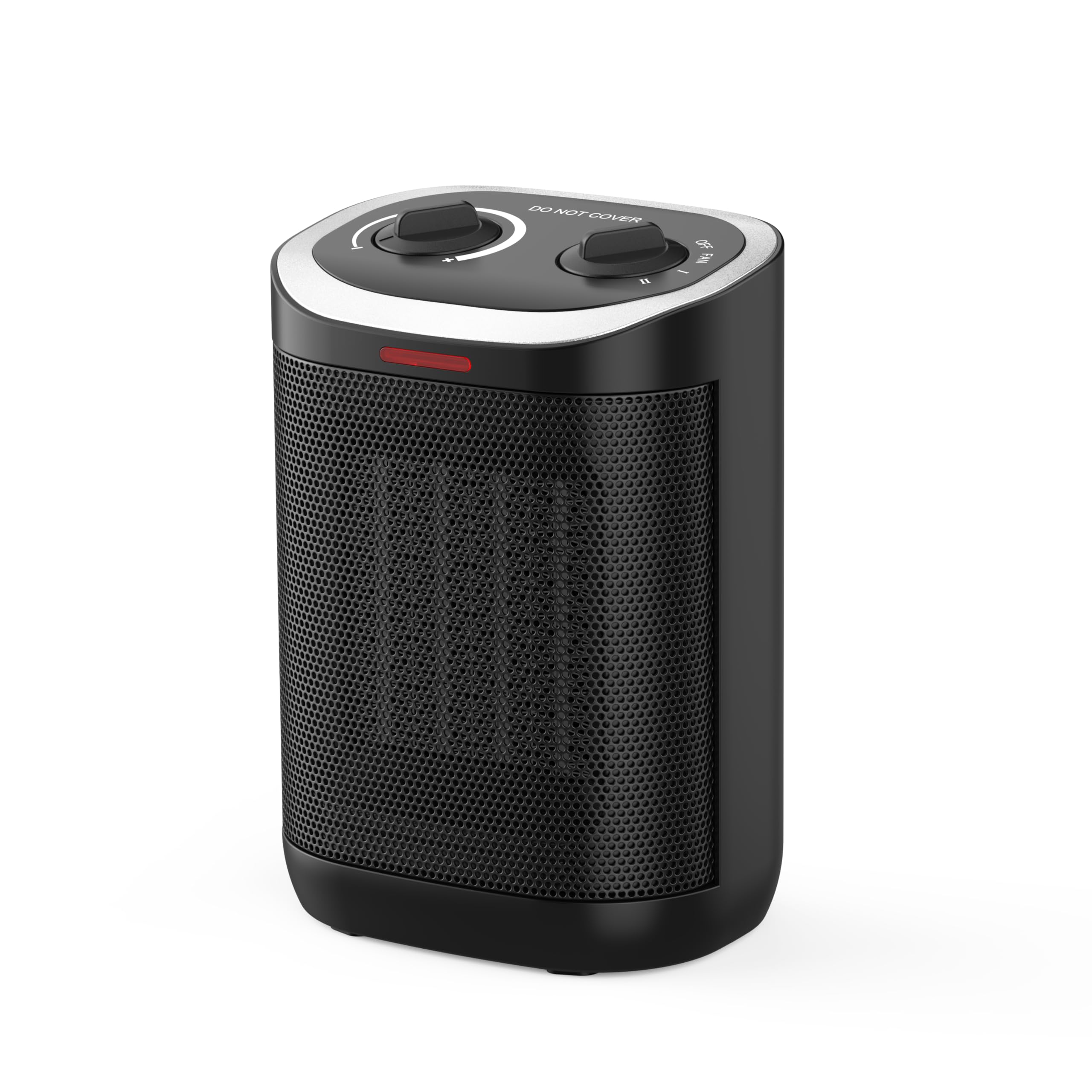
2. Small Space Heater
Two knobs, three modes, and the smallest learning curve on this list.
The defining feature here is simplicity: a left knob sets the thermostat, a right knob picks fan-only, 900W warm, or 1500W warmer. There’s no app, no remote, no display to decode. That suits a desk where you’d rather keep your eyes on the screen and your hand on a dial.
It stands 8.66 inches tall on a footprint of 6.3 by 4.73 inches and weighs 2.6 pounds, so it fits beside a keyboard and moves to a nightstand without drama. Safety is handled with flame-retardant material, ETL certification, tip-over protection, and an overheat shutoff that cuts the unit if it gets too hot. The recurring gripe is the missing remote — reaching over to adjust means breaking your typing rhythm, which is exactly what the fan setting on the Chikit eliminates if you’re fine without one.
Owners run it in a chill office, a bedroom, or a bathroom on a cold morning, and it warms a small enclosed space quickly. The wider output is where it stumbles: it heats a smaller area than many buyers picture, so think of it as a personal heater rather than a room-heating solution. Set your expectations to “warm the person sitting next to it,” and it delivers.
The honest read: this is a no-fuss, budget-strong pick for a single seat at a desk or table. If you want a remote and a digital readout, the DREO above covers that ground — this unit trades those features for simplicity and a low entry point.
Reach for this if: you want a heater that a coworker or family member can operate without a manual.
skip it if: you’re trying to heat an open-plan office — it’s a personal warmer, not a room circulator.
3. Lasko 6″ MyHeat Mini Ceramic Space Heater
400 watts, 1.1 pounds, and no reason to hog the office breaker.
This is the pick for the desk where every outlet is already spoken for. It draws 2 A off 400 watts of ceramic heat — that’s about a sixth of what the FLANUR pulls at 1500W and 12.5 A, and a fraction of what the DREO pulls at the same amperage. You can plug it into a strip alongside your monitor and not think twice.
At 4.28 by 3.77 by 6.2 inches and 1.1 pounds, it fits nearly anywhere and disappears into a drawer when summer comes. The controls sit on the front of the unit, so you reach over and switch it on without turning it around. Cool-touch housing and overheat protection make it a sensible choice in a home with kids or pets around the desk.
Where it asks something of you: there’s one heat setting, so warmth is either on or off, and the noise lands in mixed territory depending on who’s using it. As a personal warmer for a small area — a bathroom in winter, a dorm desk, a nightstand — the format works. Owners mention it takes 10-15 minutes to warm a front room, which is the pace you’d expect from 400W.
Where it shines: the tiny amperage footprint means it works on the most crowded desk setup on this list.
Where it asks patience: one heat level and no thermostat mean you manage the warmth yourself — a step down in convenience from the Lutntc’s digital control.
Pick it for: a shared cubicle, dorm room, or bathroom where circuit headroom is tight and you want a targeted warm-up.
Not the pick if: your office is genuinely cold and you need room-wide heat — 400W warms a person, not a floor.
4. FLANUR Space Heaters
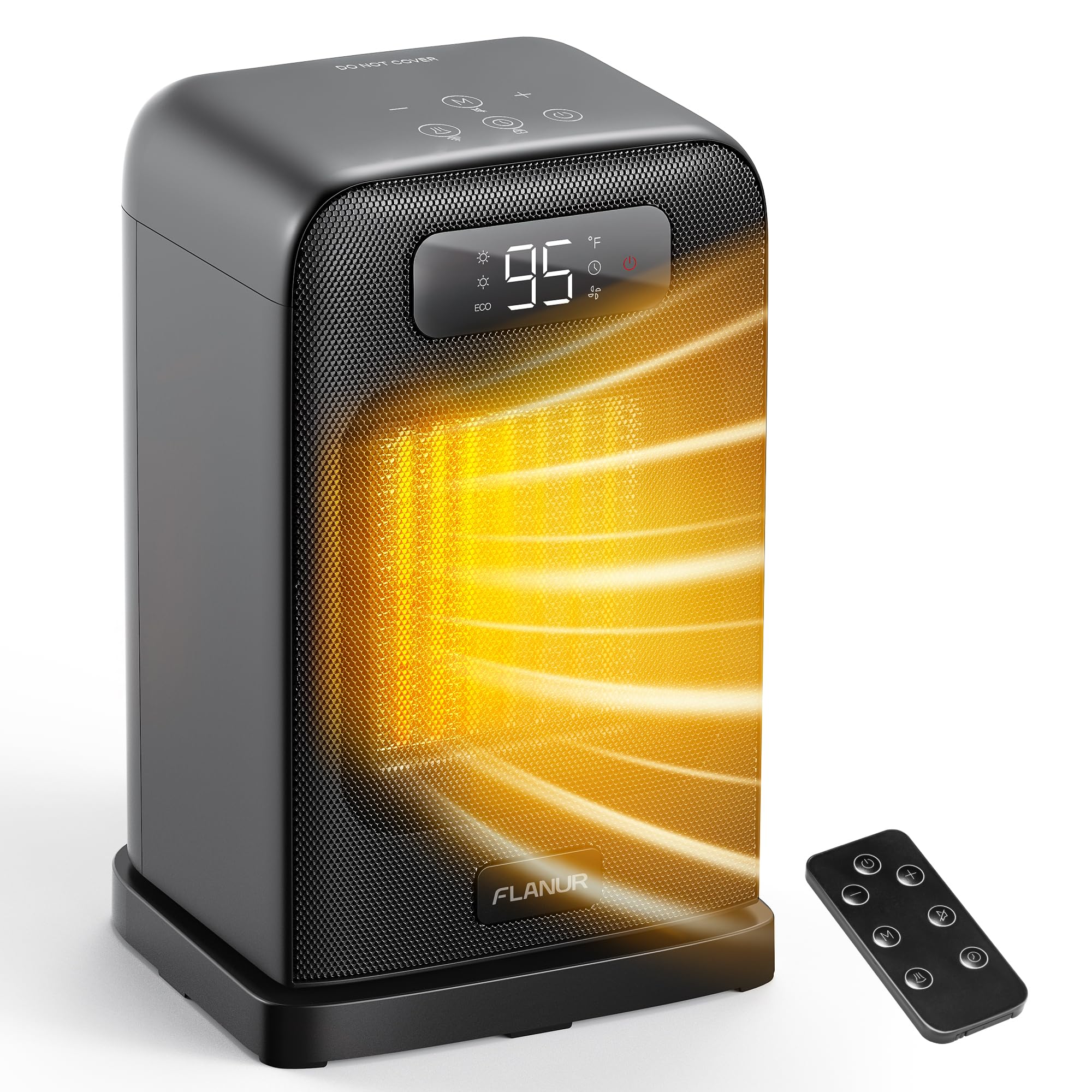
A remote, a 12-hour timer, and a 41–95°F thermostat on one desk tower.
The thing buyers talk about most here is how much control sits on one desk tower. You get 1500W and 900W heating modes, a fan function, and an ECO mode that adjusts power output as the room’s temperature shifts inside a 41–95°F band. That’s the broadest function set on this list — and it’s paired with a multifunctional remote that runs power, temperature, timer, and oscillation from across the room.
At 7.44 by 6.93 by 11.42 inches, it’s the largest tower here on the footprint side, so measure your desk before committing. The 70° oscillation spreads heat across a small room, and operation stays below 35 decibels — quiet enough that it won’t leak into a video call. Safety covers overheat protection, automatic tip-over shutoff, and a 24-hour auto-power-down on continuous operation, plus a 30-second residual heat dissipation cycle after the LED display goes dark.
The honest limit is electrical: at 12.5 A and 1500W, this is a loud draw in the breaker sense, and the manufacturer’s own note warns against sharing the socket with other appliances. Treat it as the heater your outlet was built for and it rewards you. The size also means it’s a tower you commit desk space to rather than a pocket warmer you tuck away.
Controls worth having
- Remote plus 4 modes and an ECO thermostat from 41 to 95°F
- Below 35 dB — the quietest spec on this list
- 70° auto oscillation spreads warmth across a small room
- 12H timer and 24-hour auto-shutoff for unattended use
Honest limits
- 7.44″D x 6.93″W footprint — the largest desk commitment here
- 1500W / 12.5 A wants a socket to itself
- No memory for a thermal setting across power cycles
Go for it when: you want to set a temperature once and control everything from the remote without leaving your chair.
Look elsewhere when: your desk is already crowded — the FLANUR needs the most footprint of any pick here.
5. Lutntc Portable Ceramic Space Heater
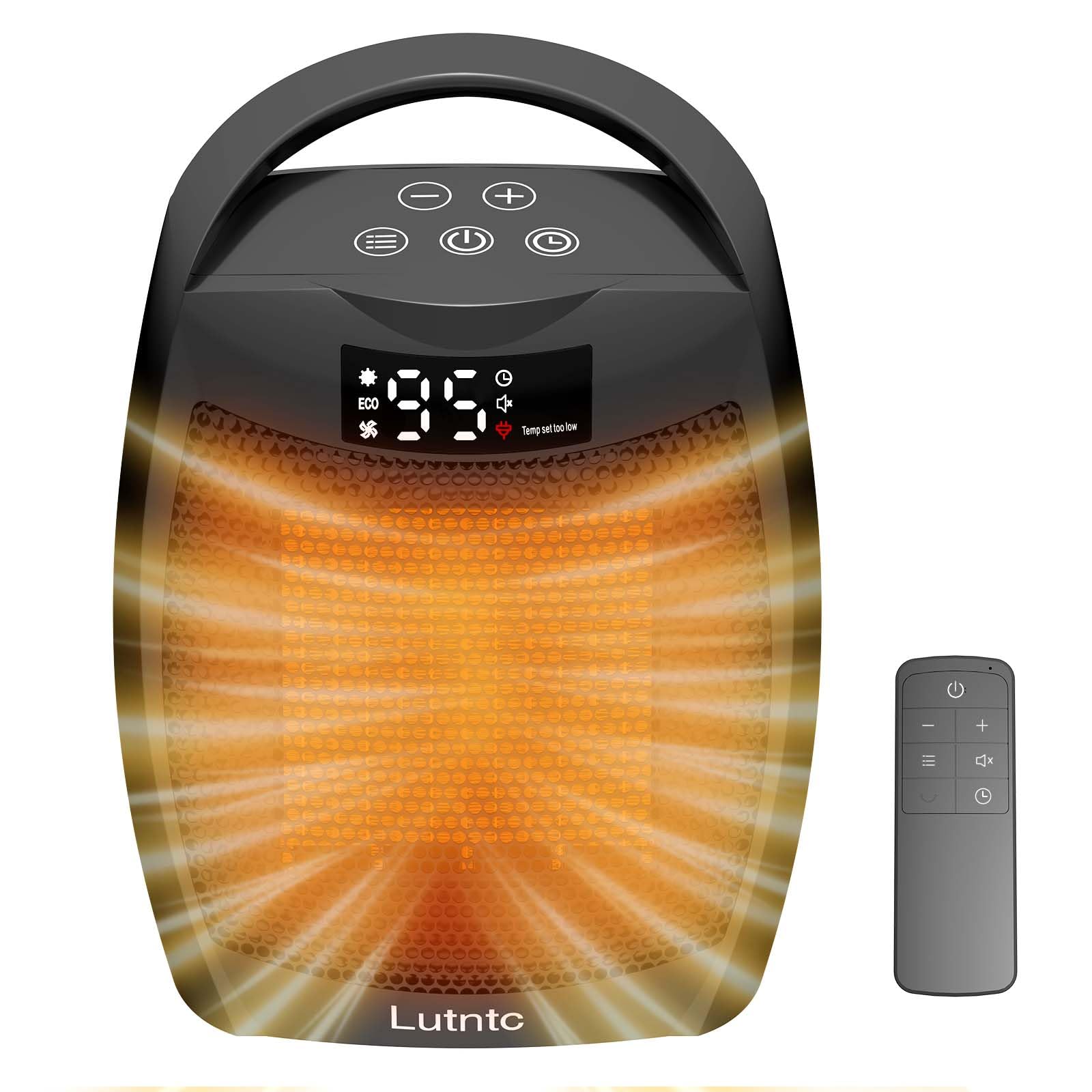
Built to warm the legs under a desk on cold mornings.
The Lutntc’s defining spec for a desk is its 200 sq.ft. coverage off 1500W of PTC ceramic heat — enough to fill a small office and enough to keep a pair of cold legs warm from below. Owners point to exactly that use: legs kept warm under a desk at work, and a kitchen warmed on a cold morning. If your office runs cold from the floor up, this is the angle that matches.
Touch buttons control the modes, and a digital display shows the temperature and the operating mode in real time so you can watch the number rather than guess. A built-in handle makes it easy to lift the 2.2-pound body between rooms. Safety covers overheat protection, tip-over auto shutoff, and ETL certification, and the manufacturer backs it with a 12-month warranty.
The parts that need flagging are small but real. The cord is short, so plan where your outlet sits — moving it further away means an extension. The touch buttons don’t light up, which makes them harder to find in a dark room. And a few owners have found the power button’s physical location not matching the diagram. As a dedicated heater for one person at one desk, though, it earns its place: the heat output is the thing buyers come back to in the reviews.
The strongest argument: 200 sq.ft. coverage and 2.2 pounds of carry weight mean it travels from desk to kitchen without help.
Best match for: the desk worker whose legs are the first thing to get cold and who wants a display they can read at a glance.
Consider another if: your outlet sits far from where you want the heater — the cord is on the short side.
6. BREEZOME Space Heater

A 34 dB denoise motor and a screen that dims to half brightness on its own.
The BREEZOME’s headline is quiet: a denoise motor rated at 34 dB on the low H1 setting, which is close to background hum. The display screen can be switched off entirely, and the indicator light auto-dims to 50% brightness so a dark home office stays dark. Pair that with three heat levels (H1, H2, H3) and a Smart ECO mode that holds a set temperature from 59 to 95°F, and you have a heater designed to stay out of the way.
Heat output is where buyers focus their attention. The 1500W maximum setting reaches temperature fast, and customers note it warming two large rooms on one unit. There’s also a Breeze mode that moves cool air, plus a 24-hour timer and automatic 24-hour shutdown in case you forget it. The 6.22 by 6.22 by 9.65 inch body weighs 3.1 pounds, which is heftier than the 2.2-pound Lutntc but still a desktop-carry weight.
Two things to plan for. The controls are hard to read — a recurring note that comes up as a frustration. And the power draw, at 12.5 A on 1500W, is serious enough that one buyer described the plug running warm on a loaded outlet. Put it on its own circuit and the warmth is what stands out. The Smart ECO thermostat holds your set temperature from 59 to 95°F and cycles off on its own, so a long desk day needs no fiddling.
What makes it livable
- 34 dB on the low setting with a dimmable display
- Three heat levels plus a 59–95°F Smart ECO mode
- 24-hour timer and automatic 24-hour shutdown
- Breeze mode for cool-air circulation off-season
What to weigh up
- Controls are hard to see — a common frustration in the reviews
- 12.5 A on 1500W wants its own outlet
- At 3.1 pounds it’s a desktop fixture, not a pocket heater
Choose it if: noise is your top priority and you want a heater that dims itself so it disappears in a dark room.
Pass on it if: you want to see the controls clearly at a glance — the labeling is faint by design.
7. Lasko Mini Space Heater
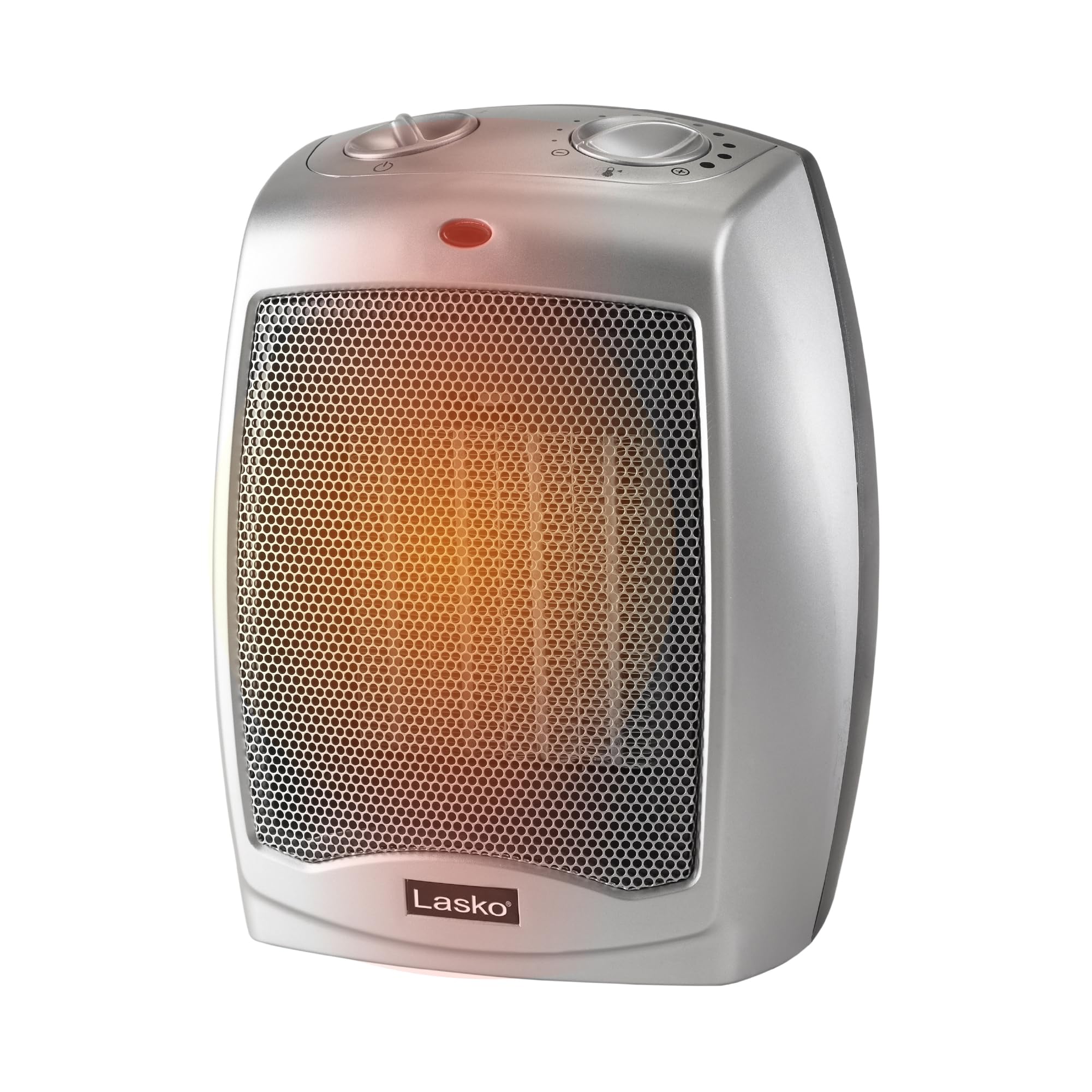
The 9-inch desktop heater with a 6-foot cord and a carry handle built in.
Its spec is doing the heavy lifting: 1500W of ceramic heat in a 9.2-inch tower with 300 sq.ft. of coverage, three modes (1500W high, 900W low, fan-only), and 11 thermostat settings on a top-mounted dial. No app, no remote — you turn the dial and the room responds. The fan-only mode makes it useful in summer too, which is a rare thing on a desk heater list.
Plenty of owners are on their second or third unit for the office, and the 300 sq.ft. coverage keeps it practical for a home desk too. A 6-foot cord means you don’t need an extension for a nearby outlet. The trade-offs surface in the quiet corners: the fan noise is noticeable on low, the thermostat dial isn’t precise, and one long-time owner flagged that the unit doesn’t shut off when tipped over. Tip-over protection matters on a desk, so treat that as a spec to check in your unit against the manual.
For all its simplicity, it covers 300 sq.ft., which is the widest claimed coverage on this list — wider than the 200 sq.ft. DREO or Lutntc. On a desk, that headroom means quick comfort rather than strained airflow.
The trust factor: a model sold in enough volume that most people know someone who owns one — and the design hasn’t needed reinvention.
The ask: accept the dial’s imprecision and confirm tip-over safety on arrival before you lean on that feature.
Right for: a desk worker who wants a dial, a broad heat range, and a unit they can move to the garage on a cold night.
Look past it if: you need precise thermostat control or a guaranteed tip-over shutoff.
8. Vornado VH202 Personal Space Heater, 2 Heat Settings, Black
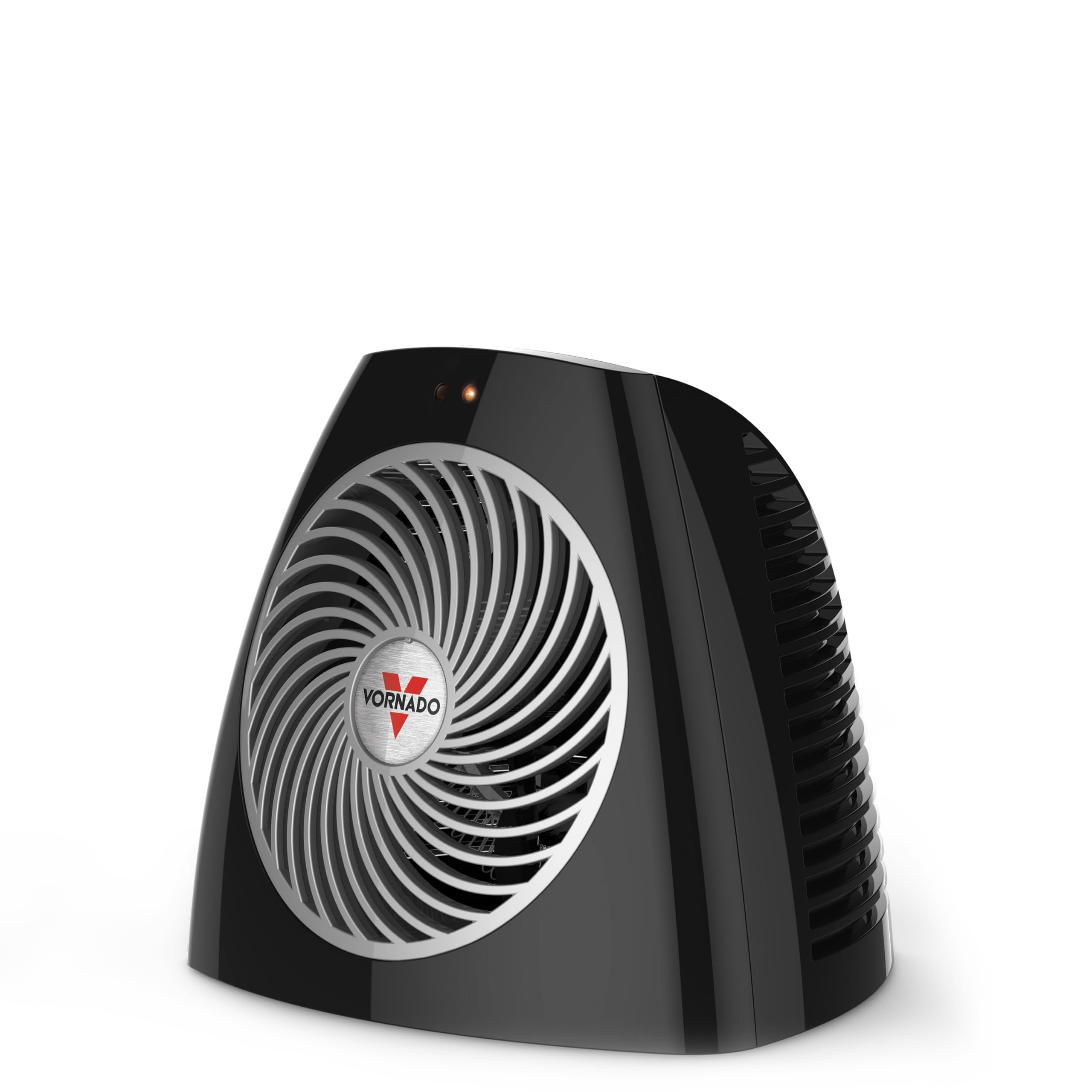
Small heater, whole-room air movement — a different approach to warming a desk.
The thing Vornado sells is Vortex Heat Circulation: it moves air around the whole space to warm it gently rather than pushing a blast of hot air at one spot. On a desk that reads as softer, more even warmth, with two quiet heat settings and a fan-only mode for circulation. At 7.2 by 7.85 by 7.1 inches and 2 pounds, its footprint is square and compact enough to sit under a monitor or beside a keyboard.
Safety features are the area this unit takes seriously: cool-touch exterior, tip-over protection, and an automatic safety shut-off. Vornado backs it with replaceable support for up to 3 years — a longer promise than most heaters on this list make. Quiet operation is the other consistent theme; owners find it easy to have running beside them without noticing.
Here’s where the VH202 asks for judgment: heat output is the most-discussed topic in the reviews and it’s mixed. Some say it heats up a small bathroom quickly; others say the warmth is barely noticeable in an average-size room. Size gets flagged too — some find it too small for what they pictured. This is not a heater for a large open office. Used as a personal heater at close range, in a small, enclosed space, it does the job people buy it for.
Where it earns its keep: quiet circulation in a tight personal space, plus a 3-year support window that is longer than the rest of the field.
Match it to: a small, enclosed home office or desk where even, gentle air movement beats a hot blast.
Not a fit for: a big open-plan space or a room that needs warming fast — its output is gentle, not aggressive.
9. Sendowtek Portable Space Heater Indoor Mini 10″ Tall

Ten inches tall, two pounds, built for a cubicle and a cold pair of hands.
The Sendowtek’s livable spec is its 107 sq.ft. coverage off a PTC ceramic module rated to 600 watts — modest heat, deliberately sized for the space around one person. Three levels (cool air, low hot air, high hot air) let you pick intensity, and the body stands 10.15 inches tall at a 2-pound carry weight, so it fits beside a monitor and moves in a bag.
Safety is handled with tip-over protection, overheating protection that shuts the unit off when the ceramic chip reaches 130℃ / 266℉, and V0 flame-retardant material. Noise sits around 54 dB averaged — livelier than the quietest picks on this list, so it’s better suited to a solo workspace than an open floor. Owners use it exactly at that boundary: cubicles, small bathrooms, under the desk, anywhere the office freeze lands on one person.
What you should expect from a 600W heater, though: on some units owners have found only cool air coming out, so confirm warmth in the first few minutes and use the overheat circuit as the backstop. At 4.13 by 5.59 inches and 2 pounds, it fits a cubicle shelf or a spot under the desk.
For the cubicle crowd: 107 sq.ft. and 2 pounds make this the most packable heater here, and the three levels let you tune down to cool air on warmer afternoons.
One check on arrival: run it for a few minutes and confirm it’s blowing warm air, given the variable output reports.
Best for: an office cubicle, a small bathroom, or a spot under the desk where one person needs warmth and nothing else.
Not the one if: your space is a large room — 600W and 107 sq.ft. of coverage are sized for a personal bubble.
Know the Specs
Wattage and amperage — your circuit’s real limit
Wattage is how much power a heater draws while it runs, and amperage is the current it pulls from the outlet. A 1500W unit on a 12.5 A rating wants a circuit with headroom; a 400W unit at 2 A can share a strip. Before you buy, check what else is on the outlets at your desk. If the printer, monitor, and phone charger live on the same circuit, a 1500W heater is the wrong neighbor.
Heating coverage in square feet
Square-foot coverage is the area a heater is intended to warm. A unit rated for 107 sq.ft. is a personal warmer; one rated for 300 sq.ft. is built for a small room. The number is a guide, not a promise — an open plan with foot traffic will feel cooler than an enclosed office of the same size. Match coverage to the space you actually sit in, not the whole floor plan.
Noise in decibels
A decibel is a measure of sound, and on a desk heater the number matters because you’ll be on calls and video meetings. Some units are rated below 35 dB — near a whisper — while others average around 54 dB, which is conversational. Lower is better for shared workspaces, but a fan-only mode on a slightly louder unit can often be used during calls while the heat cycles in gaps.
Thermostat range and step size
A thermostat keeps your room at a set temperature by cycling the heat on and off. A wide range like 41–95°F covers cold mornings and warm afternoons, so you don’t reset it all day. Finer steps like 1°F let you dial in precisely, so the room stays exactly as warm as you like. A simple knob thermostat is less exact but easier to use without reading a display. Decide if you want numbers to control or a dial to turn — that’s the real trade-off.
Safety features to look for
Tip-over protection shuts the heater off if it’s knocked over. Overheat protection cuts power when the internal element gets too hot. Cool-touch housing means the outside doesn’t burn fingers. ETL listing means an independent lab tested the unit to recognized safety standards. On a desk, these features matter more than on a floor unit because the heater sits next to your hands, your keyboard, and cups of coffee.
Oscillation and where the heat lands
Oscillation sweeps the heater back and forth so warm air spreads across your space instead of pinning to one spot. A 70° sweep is a comfortable arc for a desk, so your hands and keyboard both stay warm. Without oscillation, all the heat lands on your knees or fingers — fine for a quick warm-up, less pleasant for a full workday. Consider if you want the heat concentrated on one body part or spread across the area you occupy.
Common Questions
Can I plug a desk heater into the same power strip as my monitor and printer?
Will a 1500W desk heater trip an office breaker?
How much space do I need on my desk for a heater?
What does ETL listing mean on a space heater?
Is tip-over protection important on a desk heater?
How quiet is a desk heater in decibels?
Can a desk heater keep a small office warm all day?
How long does a desk heater typically last?
Is it safe to leave a desk heater running overnight?
Does a cheaper heater heat as well as a more expensive one?
The Bottom Line
For most desk setups, the office desk heater winner is the DREO Space Heater because it covers 200 sq.ft., holds a 41–95°F thermostat in 1°F steps, and runs at 37.5 dB — quiet enough that a call or a night’s sleep isn’t disturbed. If you want maximum control in one desk tower, grab the FLANUR, which pairs a remote, four modes, and a 12H timer. And for a shared cubicle or tight power strip, the Lasko MyHeat Mini pulls only about 2 A while still warming a small space. Match the wattage to your outlet and the footprint to your desk, and you’ll have warm hands by the time the coffee goes cold.
How we choose
We do not accept paid placement. Every pick is matched to a real buyer and a real use-case; we do not hands-on test units.
Sources
Specifications: manufacturer listings and product documentation. Review insights: verified customer reviews, as of November 2026. Pricing: not shown on this page (it changes often); check the current price via the retailer link.
As an Amazon Associate, Tactical Gear Guy earns from qualifying purchases. This does not affect which products we feature.