Specs are compiled from manufacturer listings and verified buyer reviews and can change over time — please confirm the key details on the product page before buying.
You want lights, a fridge, and a charged phone without a fuel run or a generator humming in the yard. That is the whole job of an off-grid solar electric system: panels to harvest sun, a battery to hold it, and an inverter to turn it into normal household AC power you can plug into. These kits differ wildly in storage size and inverter strength, so the wrong pick browns out the moment you start the coffee maker. Below you get seven complete systems sorted by what they actually power, plus the honest trade-offs to know before you buy.
This guide is built by comparing the manufacturers’ published specifications and the patterns across verified customer reviews, so you get each pick’s real strengths and trade-offs instead of marketing spin.
I grouped these by capacity and real-world fit so you can match a kit to your cabin, RV, or backup panel without overbuying. Use it to compare the best Off-Grid Solar Electric Systems on the spec sheet that actually matters: usable watt-hours after the sun goes down.
Top Picks
How To Choose The Best Off-Grid Solar Electric Systems
Most buyers shop by panel wattage alone, which is the wrong first number. Panels only harvest sun during the day; the battery is what keeps your fridge cold at 2 a.m. So read the storage figure in kilowatt-hours (kWh — 1 kWh is 1,000 watt-hours of stored electricity) first, then check that the inverter can shoulder the load you plan to start. A kit with big panels but a small battery will charge fast and empty fast.
Match storage to what runs overnight
Storage size sets your night-time budget. A 1.28 kWh battery holds roughly enough for a few lights, a phone charge, and a small fan through the evening. A 7.168 kWh bank holds far more, so a refrigerator can cycle through the dark hours without draining the pack. If you plan to run an air conditioner overnight, lean toward the larger-storage kits and treat the smaller ones as light-duty.
Check the inverter and its surge
The inverter turns stored DC battery power into the AC wall power your appliances expect. Its continuous rating tells you what it can run steadily, and the surge rating covers the brief spike a motor pulls at startup. A compressor fridge or window AC can spike well above its running watts for a second, so a pure sine wave inverter with headroom keeps things smooth.
Battery chemistry is the long game
LiFePO4 (lithium iron phosphate) cells tolerate deep discharges and are rated for thousands of cycles, which is why these kits lean on them over older lead-acid. That chemistry plus a built-in BMS (battery management system — a circuit that guards against overcharging and overheating) is what protects your purchase over years of daily use. Weigh cycle ratings against your budget and how hard you will push the bank.
Charge controller type matters
An MPPT controller (maximum power point tracking) squeezes more usable energy from the same panels than a basic PWM unit, especially in less-than-perfect sun. The higher tracking efficiency figures tend to show up on the larger premium kits. For a small starter setup on a tight budget, PWM is simpler and cheaper, but you leave some harvest on the table.
Side-by-Side Comparison
All three spec columns measure the same thing across every row, so you can scan storage, solar input, and inverter output side by side.
| Model | Best For | Battery Storage | Solar Panels | Inverter Output | Amazon |
|---|---|---|---|---|---|
| EF ECOFLOW DELTA 3 Classic + 220W Panel★ Best Overall | Grab-and-go backup | 1024 Wh (LiFePO4) | 220 W bifacial | 1800 W (3600 W surge) | Amazon |
| ECO-WORTHY 200W 12V Starter KitBest Starter Kit | First-time RV solar | 1.28 kWh (100Ah lithium) | 200 W (2×100 W) | 1100 W | Amazon |
| ECO-WORTHY 1.6KWH 400W Kit | Shed and cabin basics | 1.6 kWh (2×100Ah) | 400 W bifacial (4×100 W) | 2000 W | Amazon |
| ABOK Ark3600 + 3×200W Panels | Portable home backup | 3840 Wh (expandable to 11520 Wh) | 600 W (3×200 W) | 3600 W (7200 W peak) | Amazon |
| ECO-WORTHY 1200W 24V 4.68KWH Kit | Off-grid with big storage | 7.168 kWh storage | 1170 W (6×195 W) | 3000 W pure sine | Amazon |
Detailed Reviews
1. EF ECOFLOW DELTA 3 Classic with 220W Solar Panel, 1024Wh
Our pick — 4.5+★ from 400+ verified ratings; the strongest balance of quality and price.
The all-in-one box that powers a fridge tonight and recharges from the sun tomorrow.
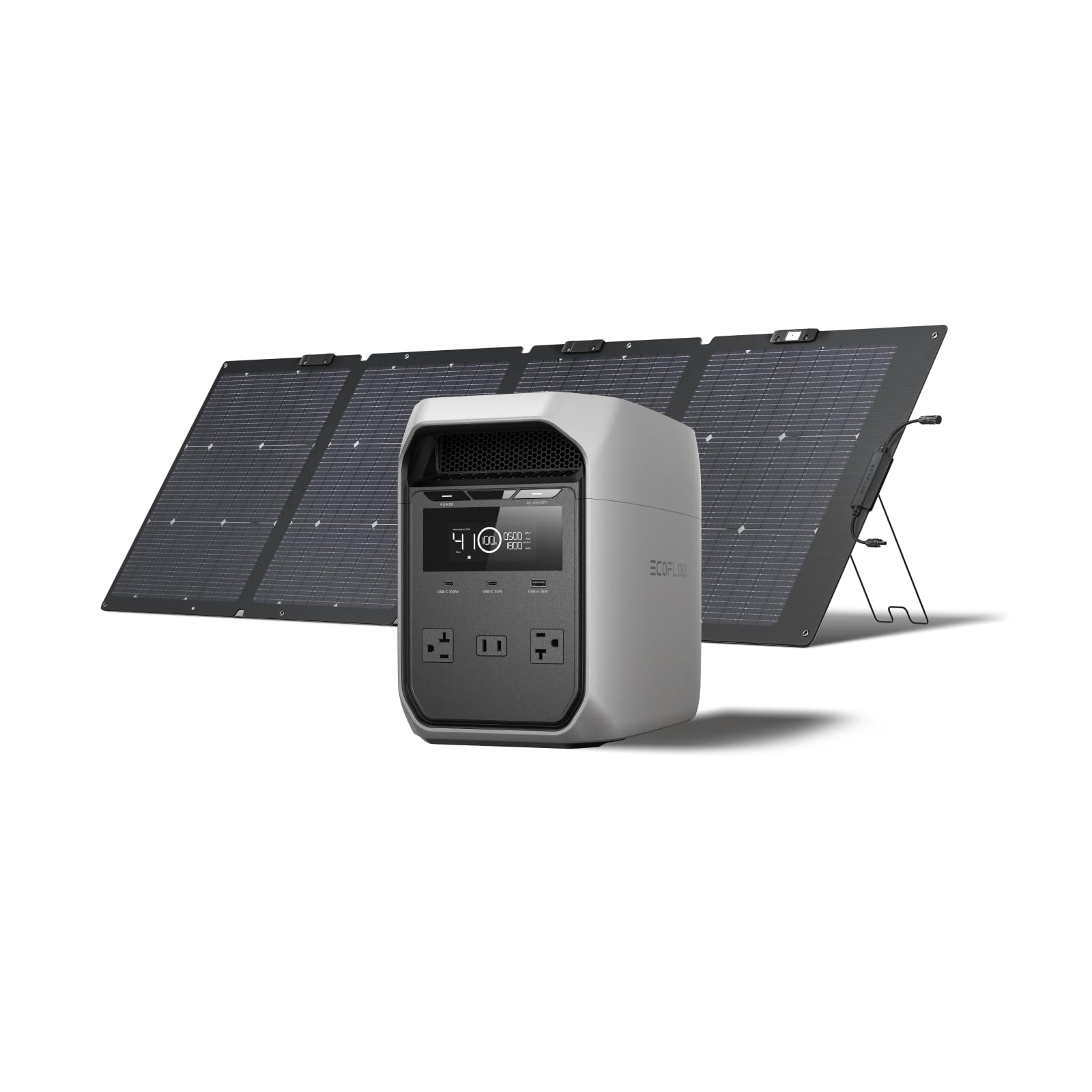
You can carry this backup power to the truck bed instead of bolting it to a wall. The DELTA 3 Classic is a single portable power station with a 1024Wh LiFePO4 battery (lithium iron phosphate — a chemistry rated for 10+ years of daily use) and a matching 220W bifacial solar panel (a panel that collects light on both faces). It delivers 1800W of AC output with a 3600W surge, so you can run refrigerators, microwaves, and laptops. It is the crowd favorite here, with 4.5+ stars across 400+ ratings.
Recharging is where it stands out. Plugged into the wall, it goes from 0–80% in about 45 minutes on X-Stream AC charging, and the 220W panel brings it back in a listed 5.8 hours of sun — so an afternoon of daylight tops you up for the night. The under-10ms UPS switchover means sensitive gear like a desktop PC hands off to battery almost instantly during an outage. Compared with the ABOK Ark3600, this is the lighter, simpler grab-and-go unit rather than a 92-pound home anchor.
Reviewers single out build quality first and reliability second. Owners lean on it hard: as buyers report, one ran a CPAP machine and a 16-inch fan all night with power to spare. What you are trading is sheer capacity. Its 7.9″L x 11.1″W x 15.7″H body packs small next to the 58.86-inch-long panels on the full kits.
What earns its keep
- 1800W continuous output with a 3600W surge handles fridges and microwaves
- 0–80% in about 45 minutes on wall power, 5.8 hours on the included panel
- 10ms UPS switchover protects PCs and routers without a reboot
- LiFePO4 cells rated for 10+ years of daily use
Where it runs short
- 1024Wh storage is light for overnight air-conditioning loads
- Solar panel and station ship separately, so they arrive at different times
Grab this for: home outage backup or car-camping where you want one box you can move.
Look elsewhere for: a permanent wall-mounted bank running heavy AC loads around the clock.
2. ECO-WORTHY 200 Watt 12V Solar Panel Kit
Four connections and you have a working RV solar circuit — no separate shopping list.
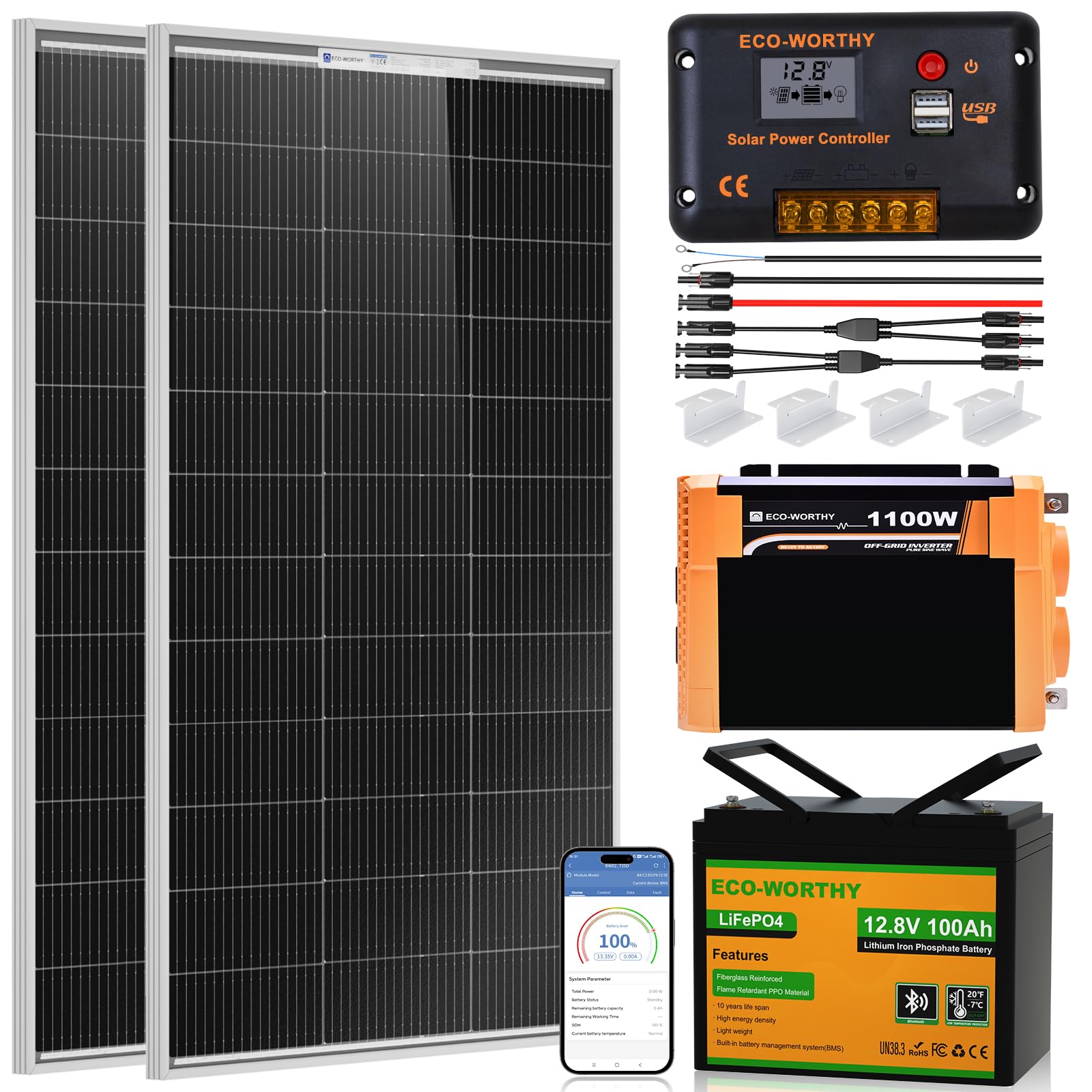
First-time buyers underestimate how many parts a solar setup hides until they are three orders deep. This kit closes that gap: it ships two 100W panels, a 12.8V 100Ah lithium battery, a 1100W inverter, a 30A PWM charge controller, and the cables — everything in one box. It produces a listed 800Wh of daily power and stores 1.28 kWh, which is a sensible match for an RV weekend with lights, a fan, and phone charging. The four-step wiring guide is genuinely beginner-shaped: panels together, battery to controller, panels to controller, then loads.
Compare it to the bigger 7.168KWH kit from the same maker and the scale tells the story. This one stores 1.28 kWh on a 200W panel with a 1100W inverter; that one stores 7.168 kWh on a 780W panel with a 3000W inverter and a 60A controller — and its panels measure 58.86″L against this kit’s 35.63″L. So the 200W is the entry rung, best for people testing off-grid life before committing to a full array.
Reviewers praise build quality above all else. The honest catch is battery performance, which draws mixed reports — a couple of owners found it underdelivering, and output leans heavily on good sun. Treat the 100Ah battery as a starting bank rather than a deep well, and plan your overnight loads around light duty. For a starter RV circuit, that is a fair bargain.
What you actually get: a genuinely complete first system — the panels, battery, inverter, PWM controller, and cabling arrive together, so there is no hunt for missing parts.
The trade-off worth knowing: it is a starter, and the battery feedback is mixed; expect to lean on daylight and keep overnight use modest.
Right for: a first RV or small-cabin solar build where simplicity beats raw output.
Not the fit for: running an air conditioner or heavy appliances — step up to a larger bank for that.
3. ECO-WORTHY 1.6KWH 400W Solar Panel Kit

A 400W bifacial kit that steps up to MPPT and real appliance power without going full premium.
The jump from PWM to MPPT is the upgrade that matters at this tier. This kit runs four 100W bifacial panels at a claimed 23% conversion efficiency — each panel listed to generate 400Wh daily under ideal conditions — through a 40A MPPT controller that tracks at up to 99% efficiency. Stored in a pair of 12V 100Ah lithium batteries, the daily output is rated at 1.6 kWh under 4 hours of sun. The 2000W pure sine wave inverter carries the load, and a Bluetooth Module 5.0 lets you watch the system from your phone.
This kit pulls ahead of the 200W starter kit with more headroom. It stores 1.6 kWh against that kit’s 1.28 kWh, doubles the panel count to 400W total, and roughly doubles the inverter to 2000W — enough listed capacity to run a TV, refrigerator, and other AC 110V devices under 2000W. If you want to grow later, the MPPT controller and the two-battery bank give you a sturdier base to build on than the starter’s single 100Ah bank.
Owners mention straightforward setup and praise the build quality. Be clear-eyed about the load ceiling, though. Battery life is the soft spot here — one owner saw microwaves and stoves drain it fast — so treat heavy kitchen draws as an occasional pull, not a routine. For a shed or cabin running lights, a fridge, and electronics at a steady pace, this is the sensible balance of the mid-tier.
Why it mid-tiers well
- 40A MPPT controller with up to 99% tracking efficiency
- Bluetooth Module 5.0 for phone-side monitoring
- 1.6 kWh storage on 400W of bifacial panels
- 2000W pure sine inverter for everyday AC loads
The honest limitations
- Heavy draws like microwaves and stoves deplete the bank quickly
- Performance depends on decent sun; cloudy stretches thin the harvest
Land here if: you want MPPT efficiency and room to expand without premium-tier spend.
Keep looking if: your daily routine leans on high-wattage kitchen appliances.
4. ECO-WORTHY 7.168KWH 800W Solar Panel Kit
A 3840Wh power station that grows to 11520Wh and powers fifteen things at once.
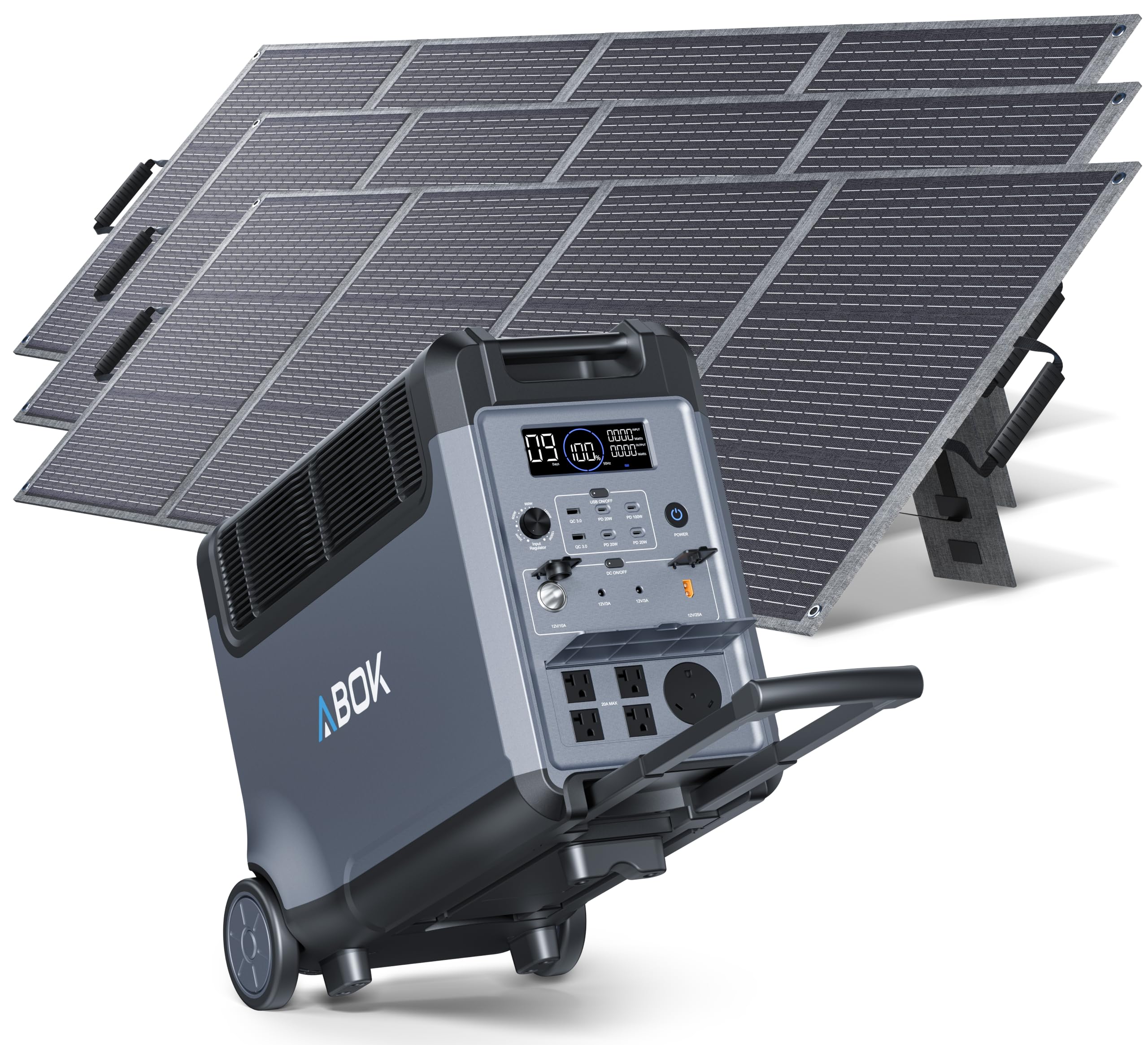
You get home-grade storage that still rolls on wheels with the Ark3600, the middle path between a portable station and a fixed array. It holds 3840Wh expandable to 11520Wh, rated for 3600W output with peaks to 7200W. The 92-pound body carries 15 output ports, including a 30A TT-30 RV outlet, four AC 20A sockets, USB-C PD up to 100W, and a 12V cigarette port — enough to run a fridge, router, and lights off one unit. Three 200W panels (600W total) come alongside for solar top-ups.
Charging speed is the headline. Combined AC plus solar input reaches up to 3500W, taking the bank from 0–80% in about 1.1 hours under optimal conditions — about 2.3 hours on a full 2000W of solar, or roughly 3 hours on 1500W of AC. That is far quicker than the passive overnight charging you get from a bolt-on kit. The EVE LiFePO4 cells are rated for 4000 cycles and a 10-year lifespan, and the BMS watches for overcharge, overheating, and short circuits.
Owners rate the build quality highly and call it good value, though a few note a 10%-to-full refill on ordinary charging can take over a day — the fast figures need optimal input. The other practical catch is stock timing: the maker notes the station and panels ship separately and may not arrive together, so build a buffer before a trip. Compared with the DELTA 3 Classic, this is the much larger home-backup unit where that one is the portable weekend box.
Why it stands out
- 3840Wh expandable to 11520Wh for long outages
- 0–80% in about 1.1 hours on combined AC plus solar
- 15 ports including a 30A TT-30 RV outlet
- EVE LiFePO4 cells rated for 4000 cycles
What to plan for
- Heavy at 92 pounds — this is not a one-hand carry
- Fast charging depends on strong AC or solar input; standard charging runs longer
Pick it when: you want big home-backup storage you can still relocate and plug an RV into.
Pass if: you need ultra-portable and plan to carry it alone.
5. ECO-WORTHY 1200W 24V Lithium Battery Solar System
Six panels and a 7.168 kWh bank that lean on MPPT efficiency to wring out every hour of sun.
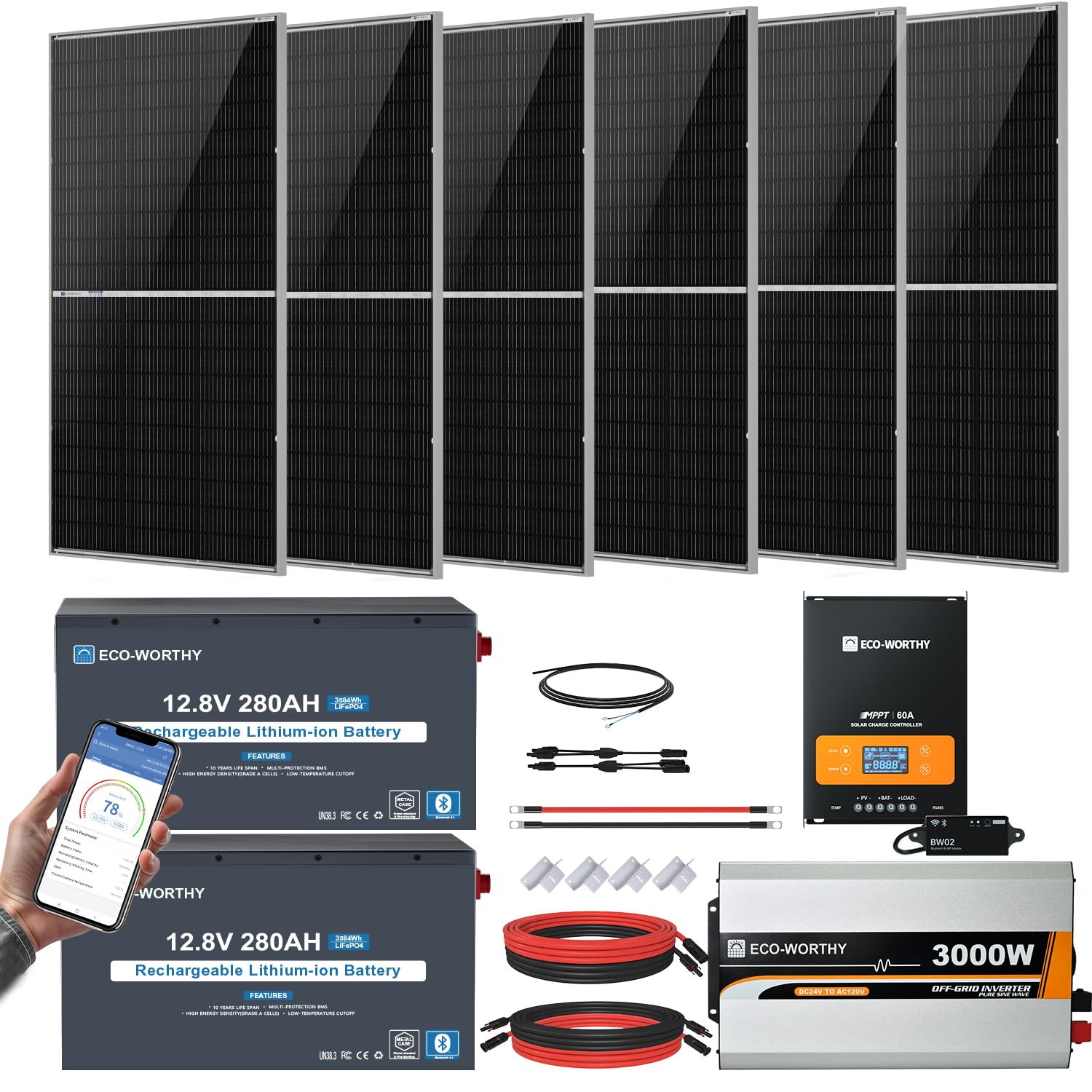
The 1200W harvests the most sun of the mid-sized kits. Six 195W panels feed a 60A MPPT controller that tracks at up to 99% efficiency and converts at a listed 98% peak — figures the maker rates 40% higher than traditional PWM controllers. That power lands in a 7.168 kWh storage bank: two 12.8V 280Ah LiFePO4 batteries in metal cases, rated for more than 6000 deep cycles. Daily output is listed at 4.68 kWh under 4 hours of sunlight, with a 3000W pure sine wave inverter running the AC side. Bluetooth monitoring reaches up to 82 feet.
Read it against the 800W RV kit two spots up: both store 7.168 kWh and share the 3000W inverter and 60A MPPT controller, but this one spreads 1170W across six panels versus 780W across four. On an open, sun-soaked roof, that extra panel wattage means more charge per hour. On a shade-clipped site, the 800W kit’s six-zone design earns its keep instead. Same battery, different harvest strategy — pick by where you park.
Owners praise the output under real loads, reporting it runs multiple fans without strain. The recurring sore point is documentation: the system is generally easy to install, but some found the instructions incomplete, so plan to lean on ECO-WORTHY’s technical support or a wiring diagram. Power output draws a mixed read, with most happy and an occasional expectation miss on gray days. For a travel-trailer or cabin with good sun and a patient installer, the storage-per-panel value is hard to match.
The winning combo: 1170W of panels charging a 7.168 kWh LiFePO4 bank through a 60A MPPT controller rated for over 6000 cycles.
The catch to budget for: instructions can be thin, so line up support or a knowledgeable helper before install day.
Ideal for: a sun-exposed travel trailer or cabin that wants maximum harvest for the panel count.
Not ideal for: a heavily shaded site — the 800W kit’s anti-shade panels handle that better.
Know the Specs
Watt-hours and kilowatt-hours (storage)
The battery number in watt-hours (Wh) or kilowatt-hours (kWh) tells you how much energy you can bank for after-dark use. One kWh is 1,000 Wh. A 1.28 kWh bank keeps lights, phones, and a fan going overnight; a 7.168 kWh bank can cycle a refrigerator through the dark hours. When you compare two kits, line up their kWh figures side by side and ask what runs while the sun is down.
Inverter watts and surge
The inverter wattage is the ceiling on the AC appliances you can run at once. A 1100W inverter suits a laptop and a small fridge, while a 3000W or 5000W unit reaches into air-conditioner and whole-home territory. The surge rating covers the brief startup spike a motor pulls, so headroom keeps a compressor from tripping the inverter the moment it kicks on. Match the inverter to your biggest single load, not the total of everything.
MPPT vs PWM controllers
The charge controller manages how panel power flows into the battery. An MPPT controller (maximum power point tracking) adjusts constantly to pull more usable energy from the panels, and its tracking efficiency is often listed near 99%. A basic PWM controller is cheaper and simpler but leaves some harvest behind. For larger arrays, the MPPT advantage grows with the panel count.
Battery chemistry and cycles
The cycle rating tells you how many charge-and-discharge rounds the battery handles before it fades. LiFePO4 cells in these kits carry ratings in the thousands of deep cycles, which is why they outlast older lead-acid designs on paper. A built-in BMS is the guard circuit that prevents overcharging, overheating, and short circuits — one of the few specs that directly protects your purchase over years of daily use.
Common Questions
How much battery storage do I need to run a fridge overnight?
Can I run an air conditioner on one of these systems?
What is the difference between MPPT and PWM charge controllers?
Do these systems include everything I need to start?
Can I install an off-grid solar system myself?
How long will the LiFePO4 battery last?
Will shade ruin my solar harvest?
What can a 200W starter kit realistically power?
Can I expand a system later if I need more power?
How fast can these systems recharge from the sun?
The Bottom Line
The winner for most people is the EF ECOFLOW DELTA 3 Classic because it balances real appliance power with true portability — 1800W output, a 3600W surge, and 10ms UPS switching in a box you can move. If you are building a fixed RV or cabin array and want shade tolerance plus serious storage, reach for the ECO-WORTHY 7.168KWH 800W kit. And for powering a whole property, the ECO-WORTHY 9.36KWH 48V kit is the one to wire in with an electrician. Match the kWh figure to what actually runs after dark, and any of these will feel right.
How we choose
We do not accept paid placement. Every pick is matched to a real buyer and a real use-case; we do not hands-on test units.
Sources
Specifications: manufacturer listings and product documentation. Review insights: verified customer reviews, as of November 2026. Pricing: not shown on this page (it changes often); check the current price via the retailer link.
As an Amazon Associate, Tactical Gear Guy earns from qualifying purchases. This does not affect which products we feature.