Specs are compiled from manufacturer listings and verified buyer reviews and can change over time — please confirm the key details on the product page before buying.
You want power that keeps running after the sun drops and the grid goes down, and you do not want to discover the weak link on night four of an outage. The real dividing line in this category is simple: a system that ships with a battery and an inverter in the same box, sized honestly for what you actually run, beats a bigger pile of panels that leaves you hunting for the rest. Below you get ten complete off-grid setups, sorted by what each one is genuinely good at, so you can match one to your cabin, trailer, or breaker panel.
This guide is built by comparing the manufacturers’ published specifications and the patterns across verified customer reviews, so you get each pick’s real strengths and trade-offs instead of marketing spin.
Storage capacity, inverter size, and battery chemistry decide whether a kit carries your loads or folds under them, and the picks below are grouped by exactly those numbers — the full breakdown of the best off-grid power system choices follows.
Top Picks
How To Choose The Best Off-Grid Power System
The mistake almost every first-timer makes is shopping by solar panel wattage alone. Panels only gather energy while the sun is up; the battery is what carries you through the night, and the inverter is what turns stored energy into the 110-volt power your fridge and tools expect. Get those three pieces sized together and the system works. Size them apart and you end up with a kit that charges all day and dies by dinner.
Start with watt-hours, not watts
A watt-hour is one watt of draw for one hour, so a 7.168 kWh battery bank holds roughly 7,168 watt-hours of energy. Add up what you want to run overnight and compare that total to the stored capacity on the spec sheet. If your fridge, lights, and router draw a combined few hundred watts through the evening, a modest bank covers it — a whole-house plan needs a much larger one.
Match the inverter to your hardest-starting appliance
The inverter rating tells you how much AC power the system can push at once. Motors are the trap here: a well pump or air conditioner can pull several times its running wattage for a second or two at startup. That is why you see a surge rating beside the continuous one, and why a 3000W inverter and a 12000W inverter suit very different households.
Lithium chemistry and cycle life
LiFePO4 (lithium iron phosphate) is the battery chemistry most of these kits use, and the number worth reading is the deep-cycle count — how many full charge-and-discharge rounds the cells survive. Lead-acid batteries typically manage a few hundred cycles, while the LiFePO4 packs here are rated into the thousands. That cycle figure, not the amp-hour label, tells you how long the bank stays useful.
Beginner kit or electrician territory
Portable units and small starter kits are built for someone with basic tools and patience. Larger 48-volt systems that wire into a breaker panel explicitly call for a professional installer, and that labour cost belongs in your planning. Read the manufacturer’s installation note before you assume a big kit is a weekend project.
Side-by-Side Comparison
| Model | Best For | Battery Storage | Inverter Output | System Voltage | Amazon |
|---|---|---|---|---|---|
| EF ECOFLOW Delta 3 Classic + 220W Panel★ Best Overall | Portable backup and camping | 1024Wh LiFePO4 | 1800W (3600W surge) | — | Amazon |
| ECO-WORTHY 200W Starter KitBudget Champion | First-time RV and camper builds | 12V 50Ah LiFePO4 | 600W pure sine wave | 12V | Amazon |
| ECO-WORTHY 1.6KWH 400W KitBest for Cabins | Cabins and sheds with AC loads | 2 × 12V 100Ah lithium | 2000W pure sine wave | 12V | Amazon |
Detailed Reviews
1. EF ECOFLOW Delta 3 Classic
Our pick — 4.5+★ from 400+ verified ratings; the strongest balance of quality and price.
The suitcase-sized box that runs your fridge and tops itself up from a folding panel.
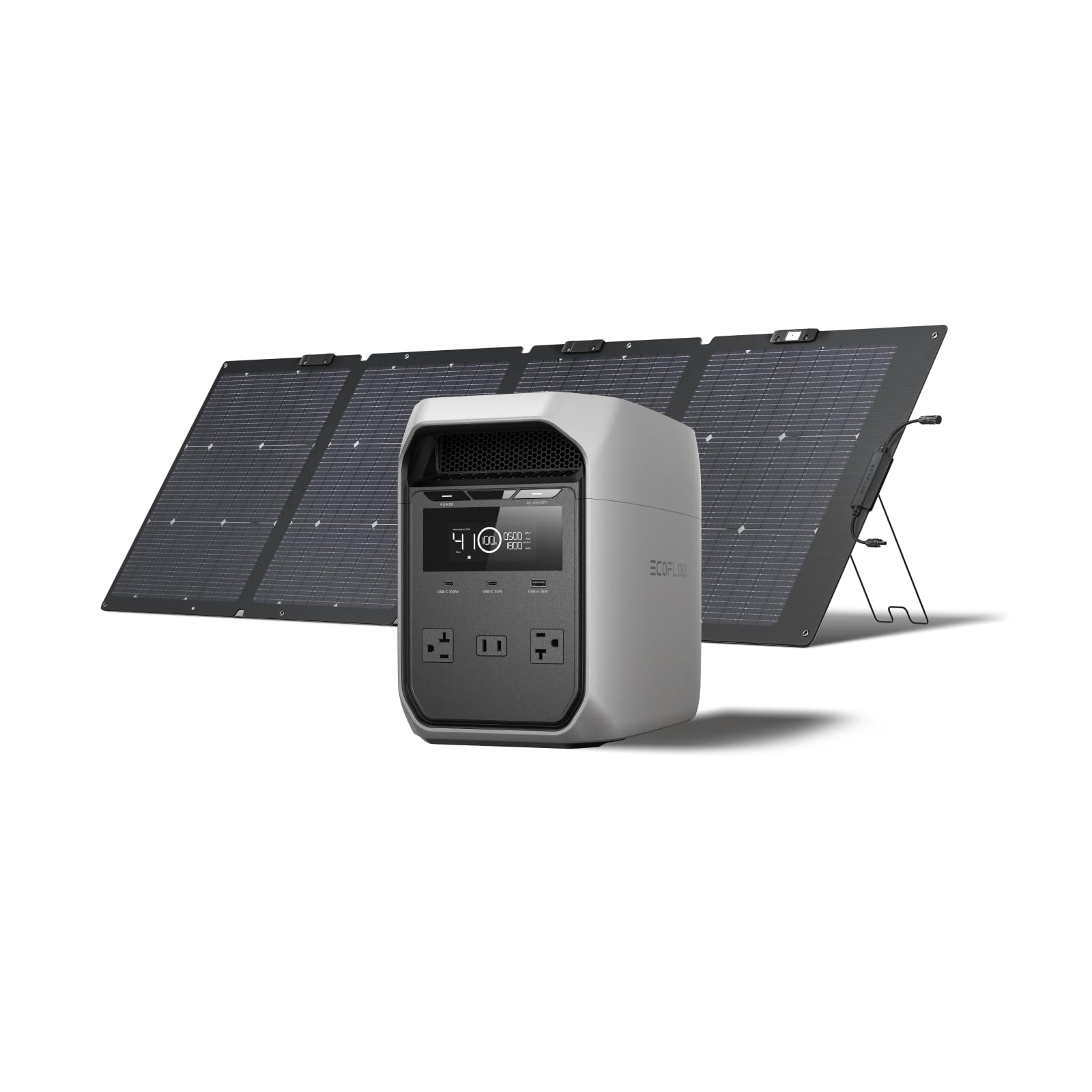
Here is the pick for anyone who wants off-grid power without touching a breaker panel. The Delta 3 Classic carries a 1024Wh LiFePO4 battery (lithium iron phosphate — the chemistry that survives thousands of charge cycles) inside a case you can lift and move. Paired with the included 220W bifacial solar panel, it is a complete loop: gather daylight, store it, use it. The whole thing is the crowd favourite here at 4.5+ stars across 400+ ratings, and it earns the top spot on portability plus real output rather than raw capacity.
The power side is where it punches above its size. It delivers 1800W of continuous AC output with a 3600W surge, which is the short burst a fridge compressor or a microwave needs on startup. X-Boost pushes the ceiling to 2600W for heavier loads. Getting the battery from empty to 80% takes about 45 minutes on grid power via X-Stream charging, and the 220W panel refills the whole unit in about 5.8 hours of decent sun. Add the under-10ms UPS switchover (uninterruptible power supply — it jumps to battery almost instantly when grid power drops) and you can keep a desktop PC or router alive through a flicker.
What owners consistently value is build quality — the thing feels premium rather than plasticky, and the reliability and charging speed come up again and again. The honest hesitation is durability: a share of the feedback reports a unit that failed after first use, which is why that topic splits evenly in the review pages. It is also a compact 7.9″L x 11.1″W x 15.7″H, so it fits in a truck bed or a closet corner, and it is markedly smaller than a full solar kit such as the ECO-WORTHY 1.6KWH 400W kit at 35.63″L x 23.03″W x 1.18″H. Note that the generator and the panel ship separately, so do not panic if one box lands first.
Where It Earns The Crown
- 1800W continuous with a 3600W surge handles fridges and microwaves
- 0–80% in about 45 minutes on AC and roughly 5.8 hours on the 220W panel
- Under-10ms UPS switchover protects computers and routers
- LiFePO4 cells rated for 10+ years of daily charging cycles
What To Weigh First
- 1024Wh is a day or two of light use, not a whole-house bank
- Some units fail early — the durability topic is genuinely split
- Generator and panel arrive as two separate shipments
Grab this if: you want one portable box that covers an outage or a campsite and can run a fridge.
Look elsewhere if: you need multi-day whole-home storage — that is 48V territory.
2. ECO-WORTHY 200 Watt Solar Panel Starter Kit
The learn-the-ropes kit that hands you every wire, bracket, and box on day one.
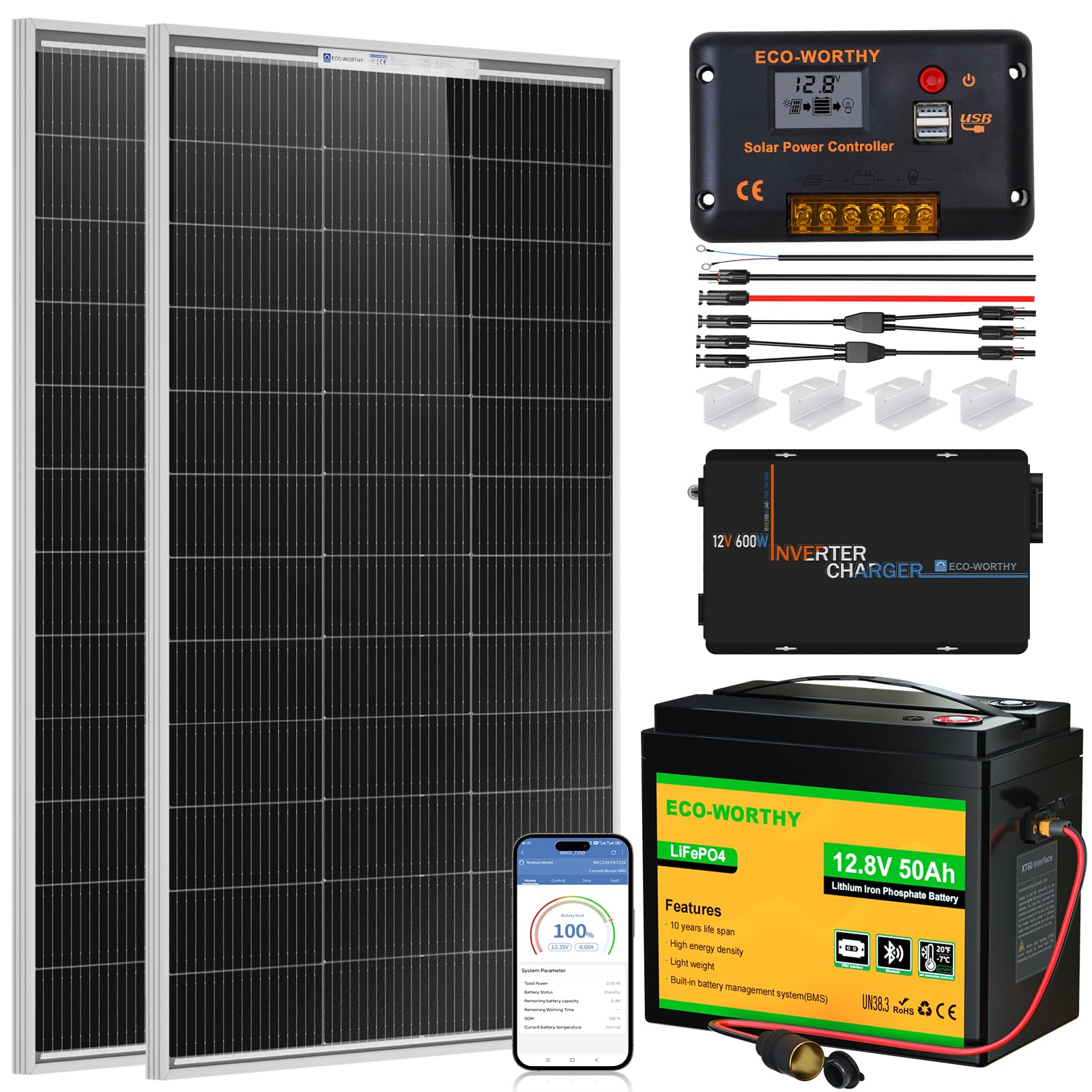
If you have never wired a solar setup before, this is the friendliest starting point on the list. The box arrives complete: two 100W N-Type panels, a 12V 50Ah LiFePO4 battery, a 30A PWM charge controller (the box that stops the panels from overcharging the battery), a 600W inverter charger, and the mounting brackets. Nothing is sold separately. That completeness is exactly what the feedback praises — the starter-kit experience is the most-discussed positive, with installation ease right behind it.
The numbers are modest but honest. The 800Wh daily output figure assumes four hours of peak sunlight. The 600W pure sine wave inverter (pure sine wave — the smooth AC waveform sensitive electronics prefer) also carries a 20ms UPS auto-switch and a smart charger adjustable from 5A to 40A. Each 100W panel reaches 25% conversion efficiency and the dual-sided design captures reflected light for up to 15% extra output. The battery itself is rated for 4,000 to 15,000 deep cycles, so the cells outlast the rest of the hardware by a wide margin.
Set expectations on the inverter, because this is where the kit divides opinion. Some units run fine for months; others stop inside a week, and inverter lifespan is the one topic that leans negative across the review pages. The manual also draws mixed notes — some say there is plenty of guidance, others say it is thin. Treat this as a first system to learn on and to expand, not a permanent power plant. A 600W ceiling runs lights, a laptop, a small fan, and a TV comfortably; it will not start an air conditioner.
Straight read on value: the panels, battery, controller, and inverter together are the cheapest honest way to learn off-grid wiring with real components.
The caveat that matters: the inverter is the soft spot — plan on adding your own better unit later if you push it hard.
Reach for this if: you are outfitting a camper, trailer, or boat for the first time and want every part in one order.
Pass if: you expect to run heavy AC appliances from day one.
3. ECO-WORTHY 1.6KWH Solar Panel Kit
Twice the panel power of the starter kit, and a 2000W inverter to actually use it.
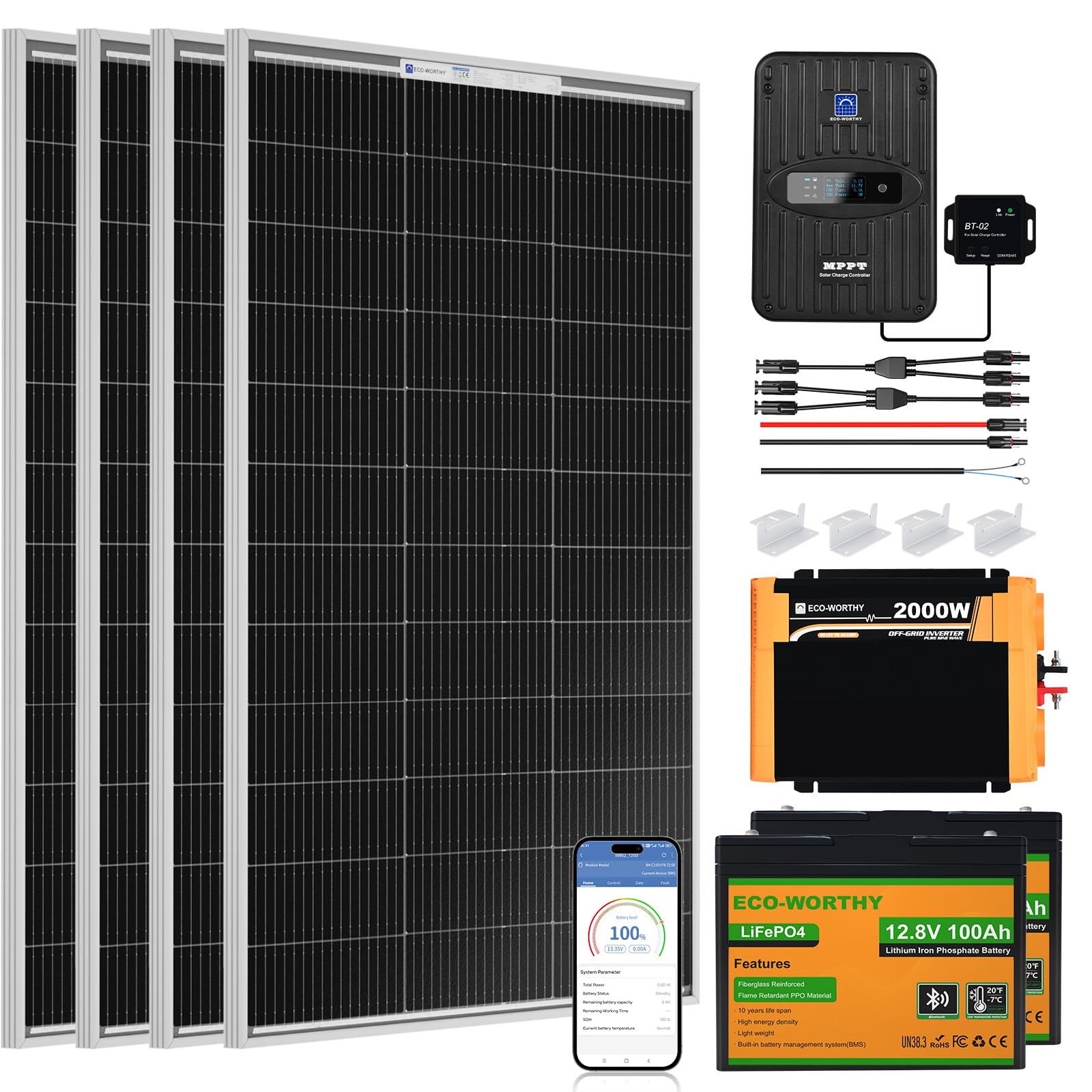
This kit doubles down on the starter formula and lands squarely in cabin and shed territory. Four 100W bifacial panels feed a 40A MPPT controller (maximum power point tracking — it squeezes the most usable power out of changing sunlight) rated at up to 99% tracking efficiency. Two 12V 100Ah lithium batteries store the charge, and a 2000W pure sine wave inverter pushes it out to your 110V devices. That is a step up in both charging and output next to the ECO-WORTHY 200W starter kit’s 600W maximum power — the 1.6KWH kit’s 2000W is the number that lets you run a fridge or a small AC unit.
Under four hours of sun the system is rated for 1.6kWh of daily production — the exact figure the model name carries. There is also a Bluetooth 5.0 module for keeping an eye on the system from your phone. The batteries add a built-in BMS (battery management system — the circuit that guards cells from overcharge and over-discharge) and are rated for more than 3,000 deep cycles.
Owners describe the build as top quality and the setup as manageable, with the manuals occasionally thin on detail for first-timers. The recurring concern is battery life, which trends negative in the feedback — a handful report poor longevity or an early failure. The performance topic is the highest-counted one and it is genuinely mixed, with some systems running beautifully and a few shutting down at random. This is a solid cabin kit from a maker with a long track record here, but keep the receipts and register the three-year battery warranty when the boxes land.
Best-fit buyer: a cabin or workshop owner who wants 2000W of inverter headroom and a panel count that recharges a real battery bank.
The honest snag: battery longevity is the softest point, so buy from a seller with a clean return path.
Choose this if: you need more inverter muscle than a starter kit offers without jumping to 48V.
Think twice if: you want a system you can forget about for years with no monitoring.
4. ECO-WORTHY 7.168KWH Solar Panel Kit
Full-time RV power with storage that dwarfs the starter kits — and shade resistance built in.
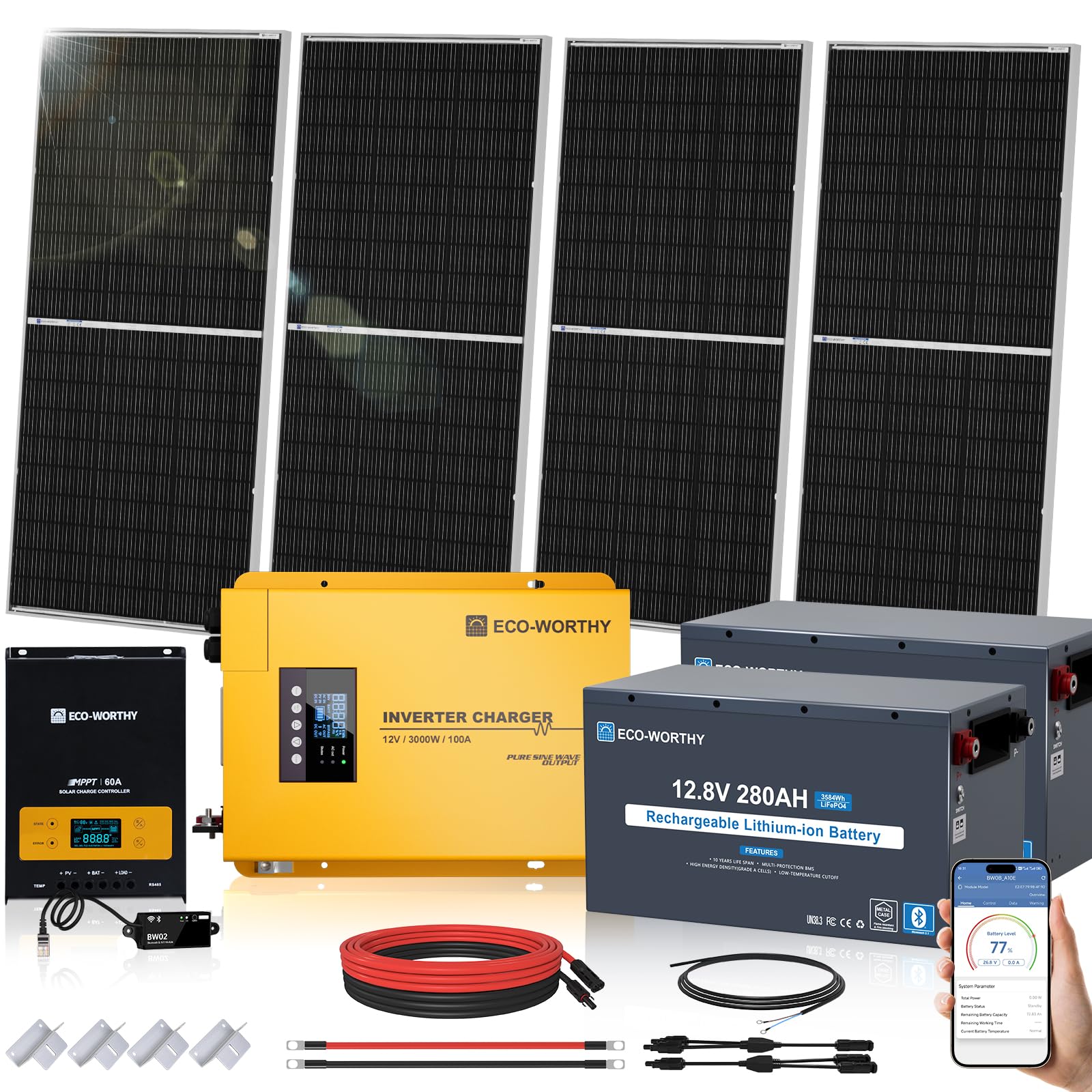
Storage is the headline, and it is not close. This system pairs a 7.168 kWh bank (two 12.8V 280Ah LiFePO4 batteries in a metal case instead of the usual plastic) with four 195W bifacial panels at 25.2% efficiency and a 12V 3000W inverter charger. Compare that to the ECO-WORTHY 1.6KWH 400W kit, which is rated at 1.6KWH of daily output: the 7.168KWH kit is rated at 3.2 kWh daily from four hours of sun. That is the difference between running a fridge overnight and running a fridge, microwave, TV, and coffee maker without and shade that only kills the covered zone. A 60A MPPT controller tracks at up to 99% efficiency, pairing with a 3000W pure sine wave inverter. Bluetooth monitoring reaches 82 feet, so you can check the system from inside the trailer. The metal-cased batteries are rated for more than 6,000 deep cycles and carry a built-in BMS.
Feedback on this system is largely warm: performance and quality both come up positive, and owners describe installation as straightforward. Two honest friction points show up. Some buyers get good power generation and some see less than expected, and the installation instructions are the one topic that reads negative — the paperwork is often incomplete. The manufacturer backs the batteries for three years and cites 25 years of after-sales support for parts and service. If you are handy and can follow a wiring diagram, the missing paperwork is manageable; if you are not, plan on a helper.
Its strong suit: a 24V system with 7.168kWh of storage is a comfortable match for a trailer’s fridge, lights, and entertainment load.
The wrinkle: instructions are often incomplete, so line up your own wiring reference before you start.
Pick it if: you are building out a travel trailer or fifth-wheel and want storage that outlasts a cloudy stretch.
Think twice if: you need every wire explained step by step in the box.
5. ECO-WORTHY 48V Home Backup Power 10240Wh with 5000W Inverter
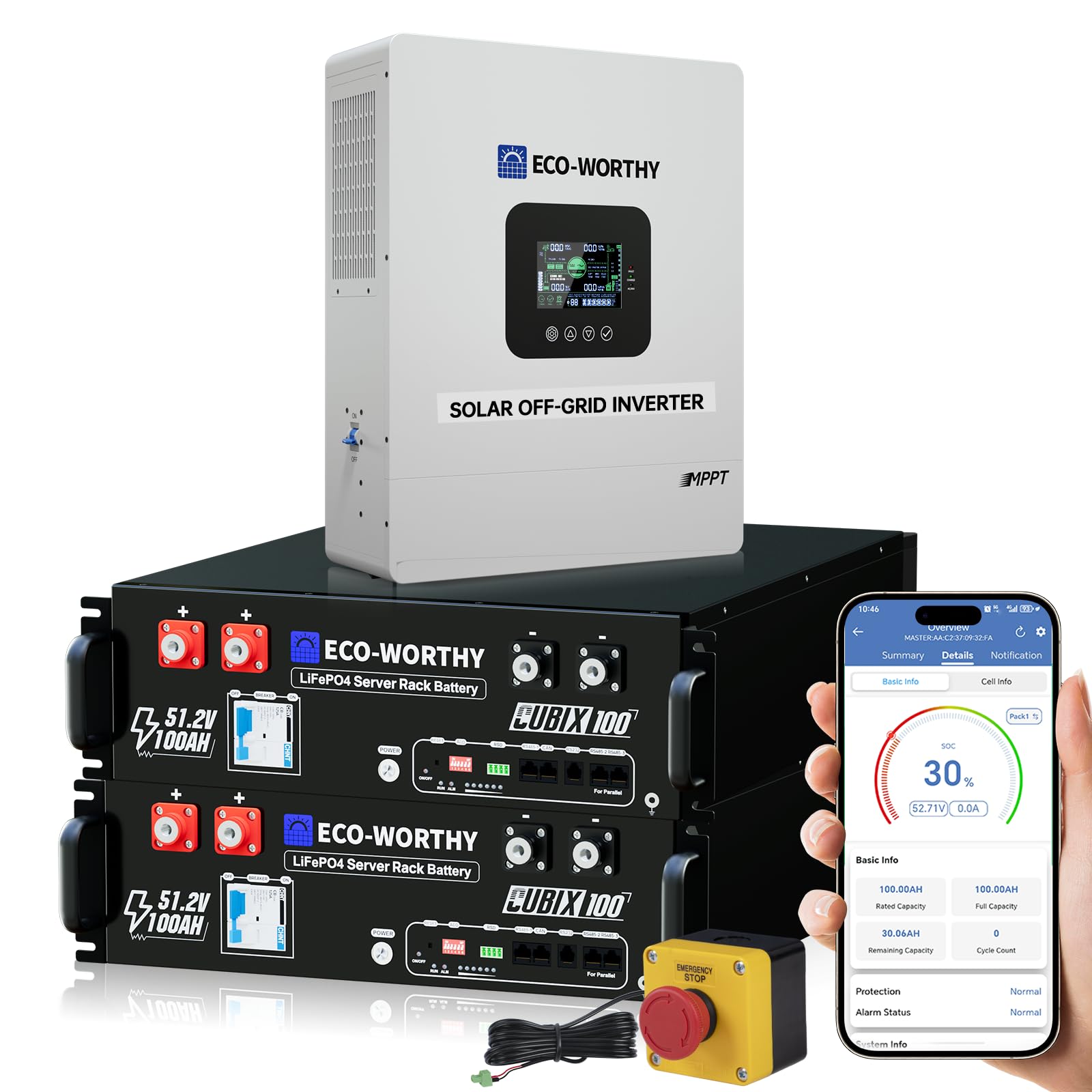
A 15.36kWh battery and a 12000W split-phase inverter that expects a breaker panel.
Here is the pick for a home that wants to shrug through a long outage with the heating and cooling running. The HumsiENK pairs a 48V 300Ah LiFePO4 battery — 15.36kWh of storage — with a 12000W hybrid inverter. That output runs refrigerators, lighting, electronics, and well pumps, and the inverter’s native 120/240V split-phase means it can power 240V loads directly with no external transformer. The ≤10ms UPS switchover keeps computers, routers, and medical devices running through a grid blink.
The battery uses Grade-A LiFePO4 cells rated for over 6,000 deep cycles at 80% depth of discharge, and its 200A BMS actively balances cells to keep the pack consistent. Heavy-duty wheels let you roll the battery into place, which helps when a piece of equipment this size needs to land somewhere specific. The package includes the battery, the inverter, all necessary power and communication cables, and mounting hardware, with a 5-year warranty behind it.
The one catch the manufacturer says out loud matters: the 200A BMS supports up to 10,000W of continuous output, so the 12000W inverter is built for standard household load and motor-start surges. If you plan to run continuous loads over 10,000W — say a central AC plus an electric oven plus heavy machinery at once — you need a second battery in parallel to open up the inverter’s full continuous capacity. Expansion is there when you want it, up to 15 batteries in parallel for 230.4kWh, and 6 inverters for 72kW. With 4.5+ stars and a 15.36kWh starting point, this is a serious option for a serious household.
Where It Pulls Ahead
- 15.36kWh of storage in a single battery, with 6,000+ deep cycles
- 12000W split-phase inverter handles 240V loads without a transformer
- ≤10ms UPS switchover protects electronics during grid failures
- Expandable to 230.4kWh of storage and 72kW of inverter output
Read The Fine Print
- The 200A BMS caps continuous output at 10,000W unless you add a second battery
- Heavy equipment — plan a spot and help for installation
- Full use of the inverter’s 12000W needs an honest load audit first
Best for: a whole-home backup plan with 240V loads and a clear spot for a rack of equipment.
Look past it if: you need light, portable power rather than a breaker-panel installation.
Know the Specs
Watt-Hours And Amp-Hours: The Storage Number
A battery’s watt-hours tell you how much total energy it holds, while amp-hours tell you how much current it can deliver at a given voltage. The 12V 50Ah battery in the ECO-WORTHY starter kit and the 48V 314Ah battery in the Powermega system are both LiFePO4, but they hold wildly different amounts of usable energy. When you compare kits, start with the watt-hour figure — it is the one that answers “how many hours can I run my fridge?”
Inverter Watts And Surge Watts
Continuous watts is what the inverter can push all day; surge watts is the temporary burst it can handle for a few seconds when a motor kicks on. The ECO-WORTHY 5000W home backup inverter has a 10,000W peak, and the HumsiENK 12000W inverter peaks at 20,000W. Read both numbers — a high continuous rating with a weak surge will still trip on a well pump.
MPPT Versus PWM Controllers
MPPT stands for maximum power point tracking, a controller that constantly adjusts to pull the most usable power from the panels as light changes. PWM is simpler and cheaper but wastes more energy. Most of the ECO-WORTHY kits use MPPT with tracking efficiency stated up to 99%, while the 200W starter kit uses a PWM controller. For any system you plan to grow, MPPT is the better long-term choice.
LiFePO4 Cycle Life And Depth Of Discharge
Cycle life is how many full charge-and-discharge rounds a battery survives before capacity drops off. The ECO-WORTHY 1.6KWH kit is rated for more than 3,000 cycles, the ECO-WORTHY 1200W system for more than 6,000, and the Powermega battery for 9,000+ at 80% depth of discharge. Lead-acid batteries typically manage only a few hundred cycles, which is why LiFePO4 dominates this category.
Common Questions
Can an off-grid power system run my refrigerator and air conditioner together?
What is the difference between a portable power station and a full solar kit?
Will a 200W solar starter kit keep up with an RV fridge?
Do I need a licensed electrician to install a 48V home backup system?
How long will a LiFePO4 battery last in an off-grid system?
Can I add more batteries or panels to these systems later?
How much sunlight do these kits need to hit their daily output?
Is a pure sine wave inverter better than a modified sine wave one?
The Bottom Line
For most people who want the best off-grid power system without touching a breaker panel, the winner is the EF ECOFLOW Delta 3 Classic because it packages a 1024Wh LiFePO4 battery, 1800W of output, and a 220W panel into one portable case — and the review pages back it up with a 4.5+ star record across 400+ owners. If you are wiring a full trailer or cabin and need real storage, the ECO-WORTHY 7.168KWH kit gives you a 3000W inverter and shade-resistant panels for a permanent install. And if your backup plan includes 240V appliances and a breaker panel, the HumsiENK 15.36kWh system is the one that runs them without an external transformer. Whatever you choose, size the battery bank to your overnight load and the inverter to your hardest-starting motor first — the rest follows.
How we choose
We do not accept paid placement. Every pick is matched to a real buyer and a real use-case; we do not hands-on test units.
Sources
Specifications: manufacturer listings and product documentation. Review insights: verified customer reviews, as of November 2026. Pricing: not shown on this page (it changes often); check the current price via the retailer link.
As an Amazon Associate, Tactical Gear Guy earns from qualifying purchases. This does not affect which products we feature.