Specs are compiled from manufacturer listings and verified buyer reviews and can change over time — please confirm the key details on the product page before buying.
That amber check engine light is the most expensive question mark in your driveway. You can pay a shop to read it, or you can plug in an OBD2 scan tool (a device that plugs into your car’s diagnostic port to read fault codes), see the fault code in plain English, and decide for yourself whether it is a loose gas cap or a failing oxygen sensor. For most home mechanics, the Autel MaxiCheck MX808S is the right tool because it reads every computer on the car, not just the engine, and can command components on and off to confirm a bad part before you swap it. The nine tools below split into pocket-size code readers and full-system diagnostic tablets, so you can pick the depth of access you actually need.
This guide is built by comparing the manufacturers’ published specifications and the patterns across verified customer reviews, so you get each pick’s real strengths and trade-offs instead of marketing spin.
Some readers just want the light off and a smog check passed; others want dealer-level diagnostics in their garage. Your choice mostly depends on one thing: does the tool read only the engine, or every module in the car? That engine-only versus full-system split is the deciding factor when you choose an OBD2 scan tool.
Top Picks
How To Choose The Best OBD2 Scan Tool
Start by deciding how deep into the car you want to look. A basic code reader talks to the engine computer, turns off the check engine light and checks emission readiness. A full-system tool also reaches the ABS, airbag, transmission and body computers, which is where a lot of modern warning lights actually live.
Engine codes versus every module
Almost every tool here reads and clears engine trouble codes. Far fewer scan ABS, airbag or transmission modules. If your dashboard light says “ABS” or “SRS” rather than “Check Engine”, you need a full-system pick like the Autel MX808S or the XTOOL AD20 Pro. A basic reader will simply show nothing.
Wired dongle or Bluetooth to your phone
Wired units plug into the port and power themselves from the car, so there is nothing to charge. Bluetooth picks like the GEARWRENCH GWSMARTBT and TOPDON AD800BT 2 stream data to an app and reach about 33 feet, which lets you watch live data from the driver’s seat while blipping the throttle.
The spec buyers skip and regret
Screen resolution decides whether a live-data graph is readable or a blur. A 320×240 screen shows codes fine but squeezes multi-line graphs. Higher-resolution panels like the 1024×600 on the Autel or the 1280×720 on the TOPDON AD600 Pro make sensor waveforms genuinely useful for spotting a misfire.
Side-by-Side Comparison
| Model | Best For | System Access | Screen Resolution | Connection | Amazon |
|---|---|---|---|---|---|
| Autel MaxiCheck MX808S★ Best Overall | Full-system shop-grade diagnostics | Full system + bidirectional | 1024×600 | Wired | Amazon |
| VDIAGTOOL VD30 ProBudget Champion | Simple check-engine code reading | Engine (all 10 modes) | 320×240 | Wired | Amazon |
| XTOOL AD20 ProBest for Phones | Phone-based full-system scanning | Full system + CAN FD | Read Live Data | Bluetooth 5.0 | Amazon |
| VDIAGTOOL VD31 | Code reading plus key fob battery test | Engine (all 10 modes) | 2.8-inch screen | Wired | Amazon |
| FOXWELL NT301 | Beginner-friendly daily driver scan | Engine (all 10 modes) | 320×240 | Wired | Amazon |
| GEARWRENCH GWSMARTBT | Reset functions on a small budget | Full system + bidirectional | — | Bluetooth | Amazon |
| INNOVA 5310 | ABS and airbag code reading | Engine + ABS + SRS | 2.8-inch screen | Bluetooth app | Amazon |
| TOPDON AD600 Pro | Resets and modern CAN FD vehicles | Full system + 16 resets | 1280×720 | Wi-Fi | Amazon |
| TOPDON AD800BT 2 | Wireless bidirectional work | Full system + bidirectional | 720×1440 | Bluetooth 4.0 | Amazon |
Detailed Reviews
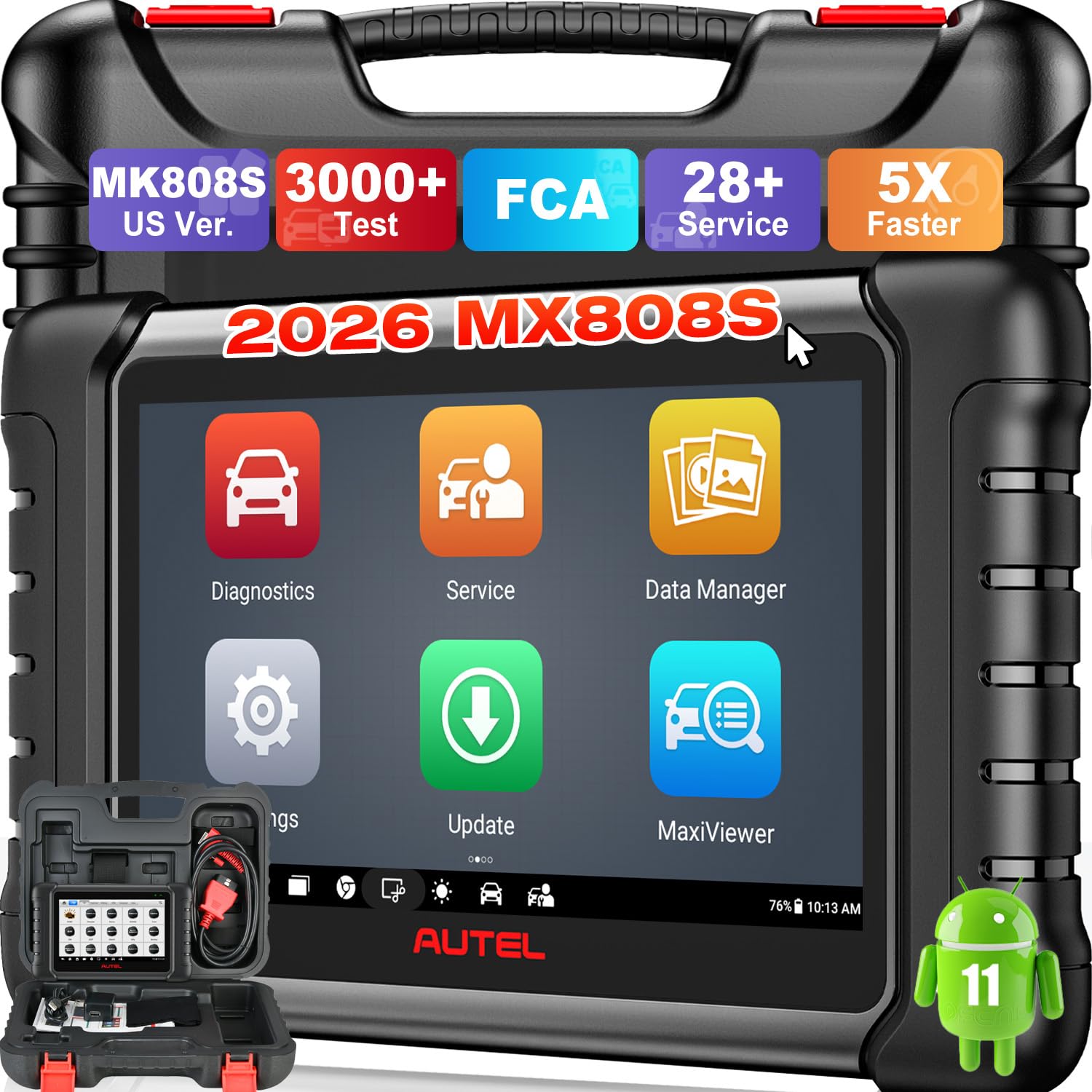
1. Autel MaxiCheck MX808S
Our pick — 4.5+★ from 800+ verified ratings; the strongest balance of quality and price.
The workshop tablet that presses buttons on the car itself, not just reads it.
If your driveway has become a small repair shop, this is the tool that stops the guessing. It reaches every computer in the car — engine, transmission, ABS, airbag, tire pressure and battery among them — instead of only the engine light. The display is a 1024×600 panel, which makes the five live-data view modes (graph, text, column, meter and waveform) actually readable when you are chasing a misfire. Compare that to the VDIAGTOOL VD30 Pro at 320×240: the Autel’s screen carries more than three times the pixel width, so sensor graphs stay legible at a glance.
The part that changes how you work is the 3000+ active tests. Those let the tool send a command straight to a component — buzz an injector, trigger the fuel pump, spin the cooling fan — so you can confirm a part is dead before buying a replacement. Under that sits an RK3566 4-core processor, 4GB of RAM, 64GB of storage and Android 11, which keeps menu switching and auto scans brisk. Vehicle coverage runs to 10,000+ US, Asian and EU models from 1996 on, plus FCA access for 2018 and newer Chrysler, Jeep, Dodge and Fiat vehicles.
Daily life with it centers on 28+ service functions: oil reset, ABS brake bleeding, EPB reset, battery registration, steering-angle calibration and DPF service among them. Owners praise its build quality most, with functionality a close second. The honest catch is the learning curve and the price of entry — this is a professional-grade tablet, and Wi-Fi connectivity is the feature owners rate most cautiously. Cars older than 2000 need a compatibility check before you order.
Why it earns the top slot
- Reads every module, so ABS, airbag and transmission codes show up too
- 3000+ active tests confirm a bad part before you replace it
- 1024×600 screen keeps five live-data formats easy to read
- 28+ service resets cover oil, brakes, steering and DPF jobs
- 10,000+ vehicle coverage from 1996 to today
What to weigh first
- Near the top of the range — a serious outlay for one car
- Dense menu system takes a session or two to learn
- Wireless connectivity is the least-loved feature
- Pre-2000 cars need a compatibility check first
Buy it if: you fix multiple cars and want dealership-level reach without a dealership visit.
Think twice if: you only want the engine light off on one vehicle — a handheld reader handles that for far less.
2. VDIAGTOOL VD30 Pro
The plug-in reader that explains the code instead of leaving you to Google it.
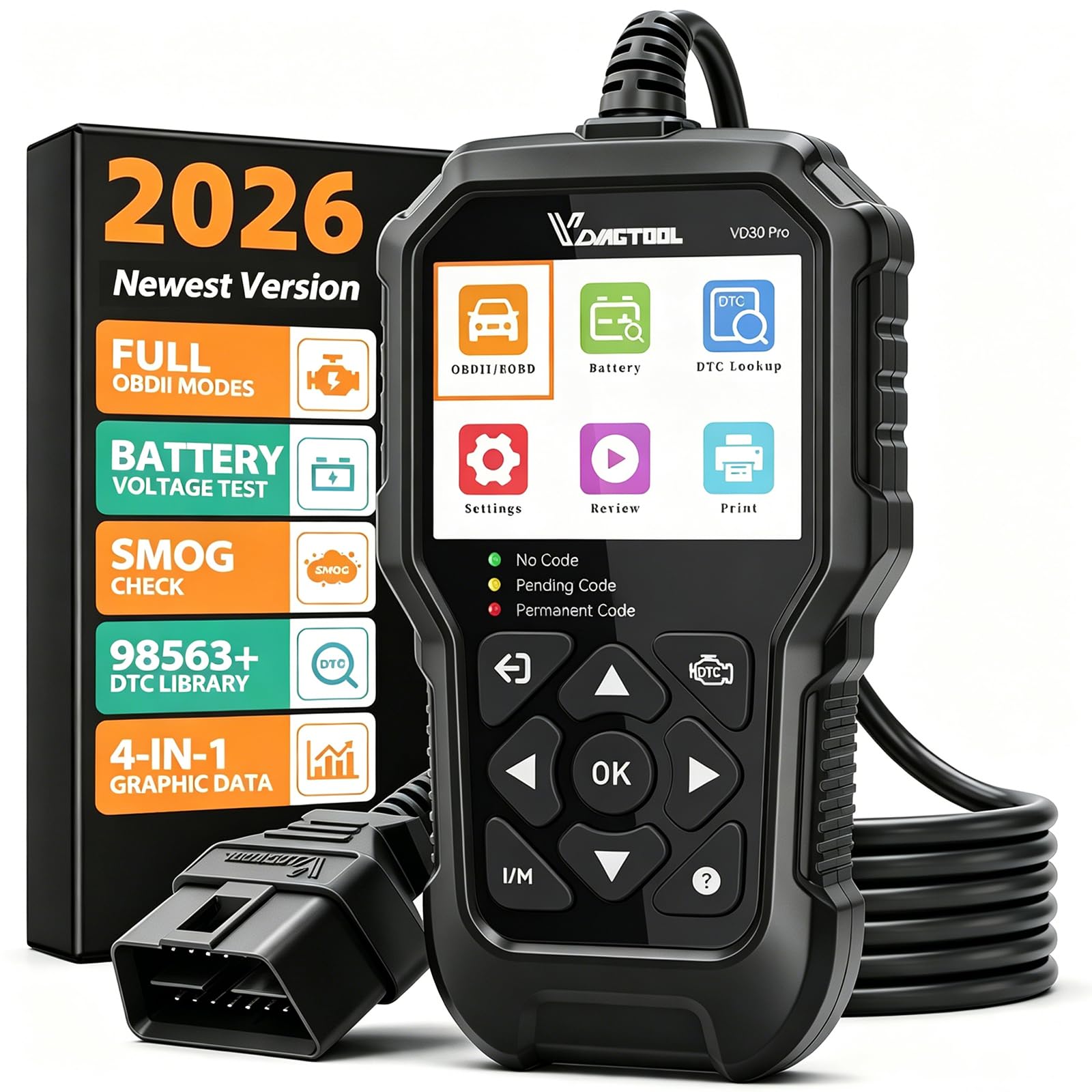
For a first-time buyer who just wants the check engine light sorted, this is the sensible entry point. It runs all 10 essential OBD2 modes — read, clear, live data, freeze frame, O2 sensor and the rest — and turns off the Check Engine Light once the repair is done. The 2.8-inch screen boots straight to clear menus, so the workflow is plug in, tap “Scan”, and read the fault in full text rather than decoding a blinking light.
Where it earns its keep is the built-in library of more than 98,000 DTC (diagnostic trouble code) definitions. That means the tool spells the fault out in plain English on the screen, so you skip the phone lookup most cheap readers force on you. Live data graphs four points at a time, which is enough to watch a sensor response, and the one-click I/M readiness hotkey shows emission monitor status on a single screen before a smog test. A voltage reading also warns you about a weak battery before it strands you.
The recurring gripe is vehicle communication — a few cars simply refuse to connect, which is the nature of a single-protocol reader. It also does not touch TPMS, ABS, SRS or airbag systems, so those lights need a different class of tool. Owners praise its functionality by a wide margin, with build quality second. Lifetime free updates run over USB from a Windows PC, and it ships ready to use with no firmware download first.
The real-world trade: you get genuine full-text code explanations and free updates at entry-level money, but the screen is 320×240 — fine for codes, tight for long graphs.
Keep in mind: the three-year warranty and lifetime updates make this a low-risk first scanner, as long as your car agrees to talk to it.
Right call for: a single-car owner who wants the engine light diagnosed and cleared without a shop bill.
Not the tool for: ABS, airbag or tire-pressure lights — those need a full-system scanner.
3. XTOOL AD20 Pro
A palm-size dongle that turns your phone into a full-system dashboard.
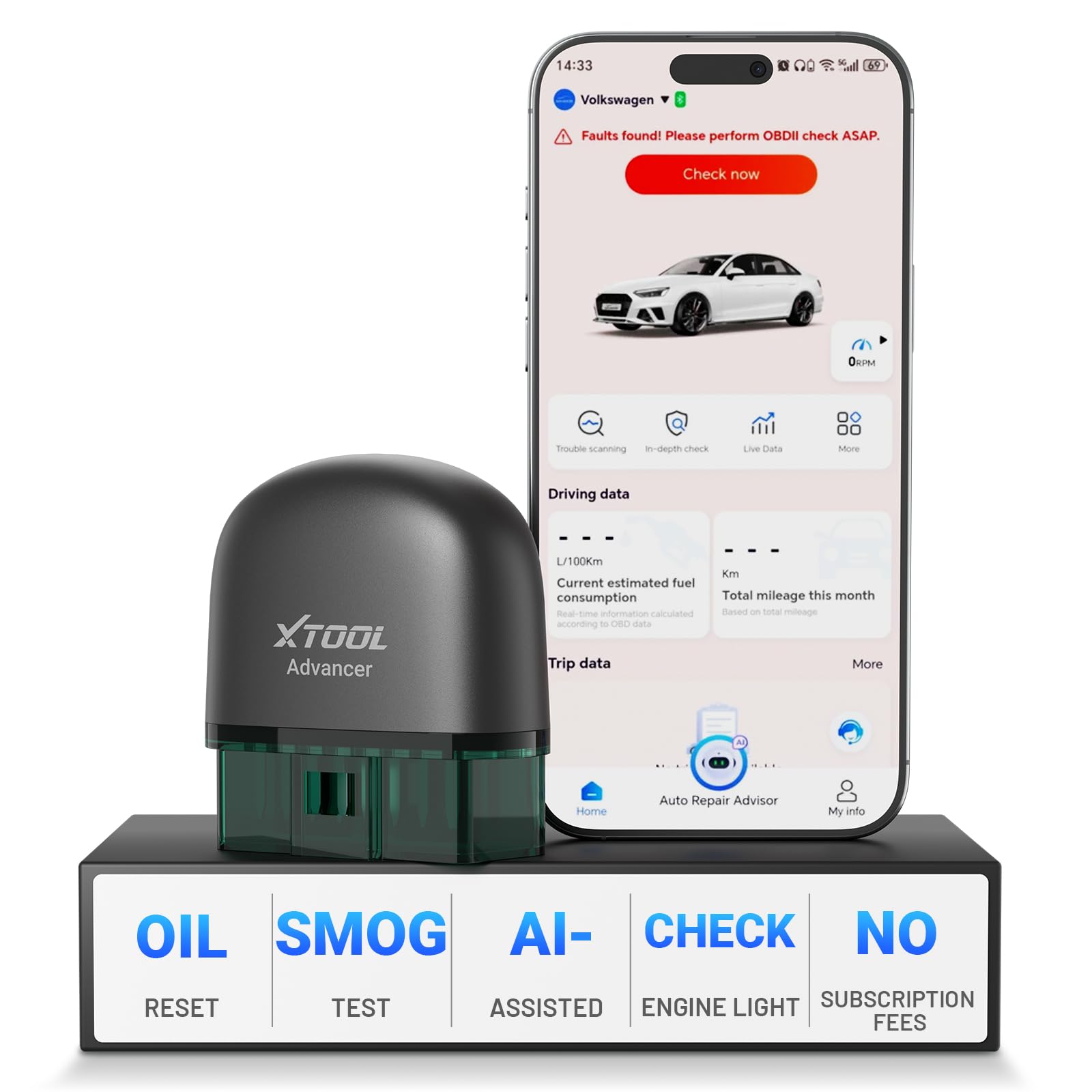
This is the pick for the driver who wants deep scanning without a tablet in the glovebox. It is a Bluetooth 5.0 dongle that talks to iOS and Android from up to 33 feet away, so you can watch live data from the driver’s seat while someone blips the throttle. At 1.13 ounces it disappears in a console pocket, and AutoVIN reads your make, model and year the moment you plug it in.
The access goes well beyond the engine. It scans ABS, SRS, transmission, TPMS and A/C, and adds CAN FD hardware so it can talk to newer 2020+ GM, GMC and Chevrolet vehicles that older readers cannot reach. The AI diagnostic engine analyzes sensor data and suggests likely fixes in plain English, and Oil Reset clears the maintenance light after a DIY change. There is no subscription for standard diagnostics — you get free updates and unlimited vehicles on one purchase.
Owners praise its functionality most, with effectiveness right behind it. The app also logs trips and runs a performance test that measures 0-60mph acceleration and braking distance. The honest catch is that it depends on your phone: connection is the feature owners rate most cautiously, and the display defaults to kilometers for some owners. A screen-free design means you are always holding your own interface.
Strongest angle: full-system reads on a battery-friendly dongle that sleeps when the engine is off, so it can stay plugged in without draining the car.
The honest limit: your phone is the screen — a dead phone battery means a dead scanner.
Reach for it if: you want full-system diagnostics and no annual fee on multiple family cars.
Look elsewhere if: you prefer a self-contained screen over a phone app.
4. VDIAGTOOL VD31
A code reader that also checks the two batteries most likely to strand you.
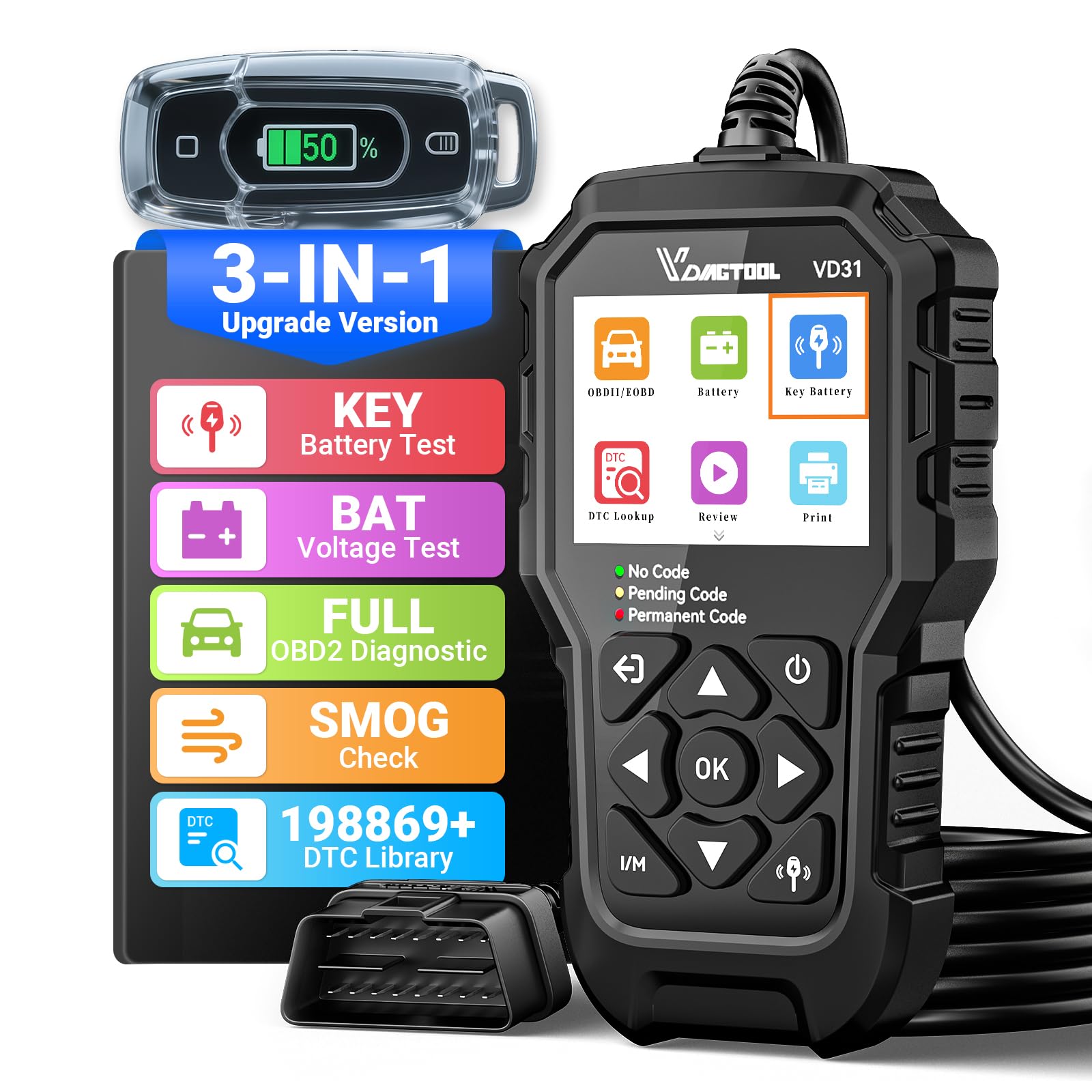
Most scanners stop at the engine. This one bundles three jobs into a 2.8-inch handheld: engine code reading, car battery testing, and a key fob battery tester that reads your remote’s voltage from a dedicated hot key. You enter the key’s frequency or pick your car model, and it gives an instant reading — handy before a dead remote leaves you locked out.
The engine side runs all 10 OBD2 modes: read and clear fault codes, four-in-one live data graphing, freeze frame, O2 sensor test and a one-click I/M readiness key for smog checks. It plugs into the port and powers itself, so there is nothing to charge. The key fob tester runs on the included 9V battery as a standalone. Coverage spans 1996 US, 2000 EU and Asian cars, light trucks and SUVs on all OBD2 protocols.
Owners praise its functionality most, with build quality close behind. The mixed signals are code accuracy and compatibility — a subset of owners find it will not connect to particular cars, and the printed manual is thin on code definitions. It also does not touch TPMS, ABS, SRS or airbags, so treat it as a check-engine specialist. Lifetime free updates arrive over USB from a Windows 7, 8 or 10 PC.
Where it shines: the key fob tester plus car battery voltage check make it a proactive tool, not just a fault-finder — you can spot a dying battery before it dies.
Fair caveat: a few owners hit cars it will not communicate with, so confirm your model’s protocol before relying on it.
Best match for: the owner who wants engine codes plus battery health checks in one small unit.
Skip if: you need ABS or airbag diagnosis — this one stays in the engine bay.
5. FOXWELL NT301

The household-name reader that trades screen size for pure simplicity.
The NT301 is the scanner that barely needs explaining — plug it into the 16-pin port, it powers on from the car, and the 2.8-inch color screen shows the code and its meaning. The one-click I/M readiness key uses red, yellow and green LEDs plus an audible alert to tell you if monitors are ready for an inspection at a glance. It supports CAN, ISO9141, KWP2000 and J1850 protocols across most 1996-and-newer US-market cars, SUVs and light trucks.
Owners praise its build and breadth of functions, with ease of use close behind. The menus are the kind of thing you stop thinking about inside a week. Live data covers supported parameters like engine RPM, coolant temperature, fuel trims and oxygen sensor readings, and the tool also runs O2 sensor and EVAP tests where your vehicle supports them. No batteries, no charging — the port does all the work.
The honest catch sits in its scope. Code recognition is the most-discussed weak spot, and some buyers report it does not communicate with certain European models despite the listing. This is an engine-only reader, so ABS, SRS and TPMS lights are out of reach. For a first scanner on a daily driver, though, it is the tool most people reach for.
The straightforward verdict: a no-frills code reader that turns the check engine light from a mystery into a readable fault code, powered entirely by the car.
Worth knowing: coverage is engine only, and certain European models fall outside what it will talk to.
Pick it when: you want a simple, dependable code reader for a domestic car or truck.
Hold off if: your garage holds European vehicles or you need ABS and airbag reads.
6. GEARWRENCH GWSMARTBT

A phone-based tool that undercuts full-system scanners on price while adding resets.
This is a Bluetooth module that works through your smart device and covers 185+ car manufacturers, with full bidirectional control and live actuation tests. It also handles 23 vehicle reset and relearn functions, including throttle matching, ABS bleeding and TPMS reset. Add free software updates with no subscription, live data mapping and freeze frame capture, and it is a genuinely broad tool for a mid-range price.
What makes it stand out is the depth of control versus the cost. Owners describe it doing the same reset functions and reading the same modules a big shop scanner reads. The catch is activation: the software requires a serial number to set up, and reliability is the feature owners rate most cautiously — a few setups stall at activation, while many others connect smoothly to Android phones. Compatibility, ease of use and features each draw mixed reactions too, so a small amount of patience up front is part of the deal.
The value play: bidirectional control and 23 resets in a palm-size module with lifetime free updates.
Set expectations: your phone is the screen and the app needs activating — budget a few minutes on setup before your first scan.
Fits you if: you want reset functions and actuation tests without paying full-system tablet money.
Not ideal if: you want a screen built in and a zero-setup first scan.
7. INNOVA 5310
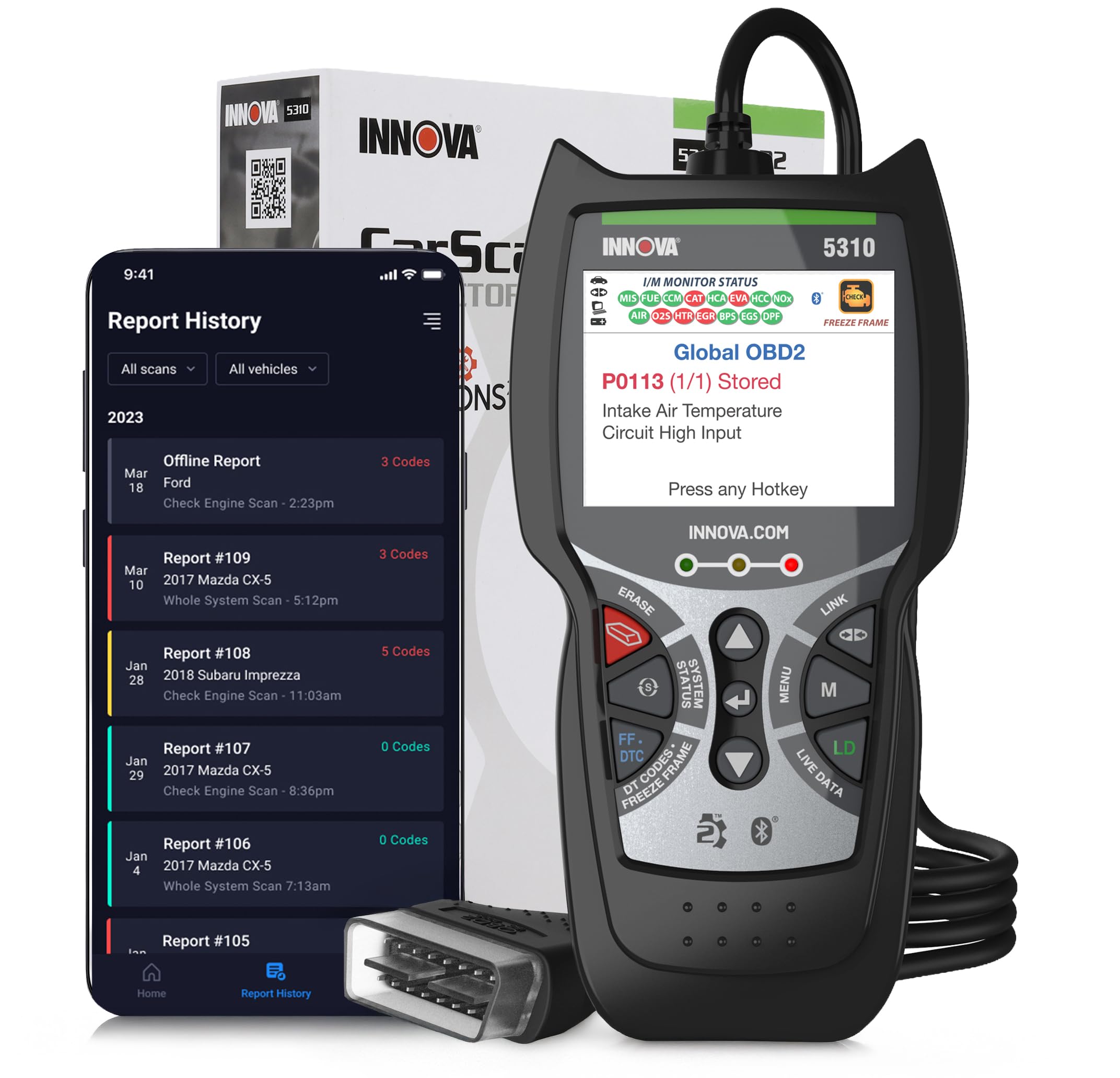
The reader that finally explains why your airbag or brake light is on.
When the light on the dash says ABS or SRS rather than Check Engine, most cheap readers leave you stuck. This 12.8-ounce handheld reads those systems as well as engine codes, so a seat-belt or airbag fault stops being a mystery. It pairs with the RepairSolutions2 app over Bluetooth for real-time fixes, verified solutions and exact repair parts on iOS and Android, and it supports English, Spanish and French.
Owners praise its functionality most, with build quality a close second. It reads and clears OBD trouble codes plus total module scans, runs battery and alternator tests, and shows live data like RPM, speed and oil temperature. It also checks emission status before a smog test and displays oil life. What you get is a diagnostic tool that flags a real fault early — like a seat-belt tensioner instead of an airbag failure — before a shop charges you to look.
The honest catch is that coverage varies by car. A couple of owners could not get it to communicate with a specific model, so Innova’s coverage checker before ordering is worth the two minutes. The instructions are also a weak point — the paper quick start is thin, and reading the online manual while Bluetooth is connected is clunky.
Why it matters: ABS and SRS codes are exactly the ones people get charged to diagnose, and this tool reads them at home.
The trade-off: Bluetooth coverage depends on your specific model — verify compatibility before you buy.
Worth grabbing if: a brake, airbag or seat-belt light is the reason you are shopping.
Consider something else if: you only ever see plain check-engine codes.
8. TOPDON AD600 Pro
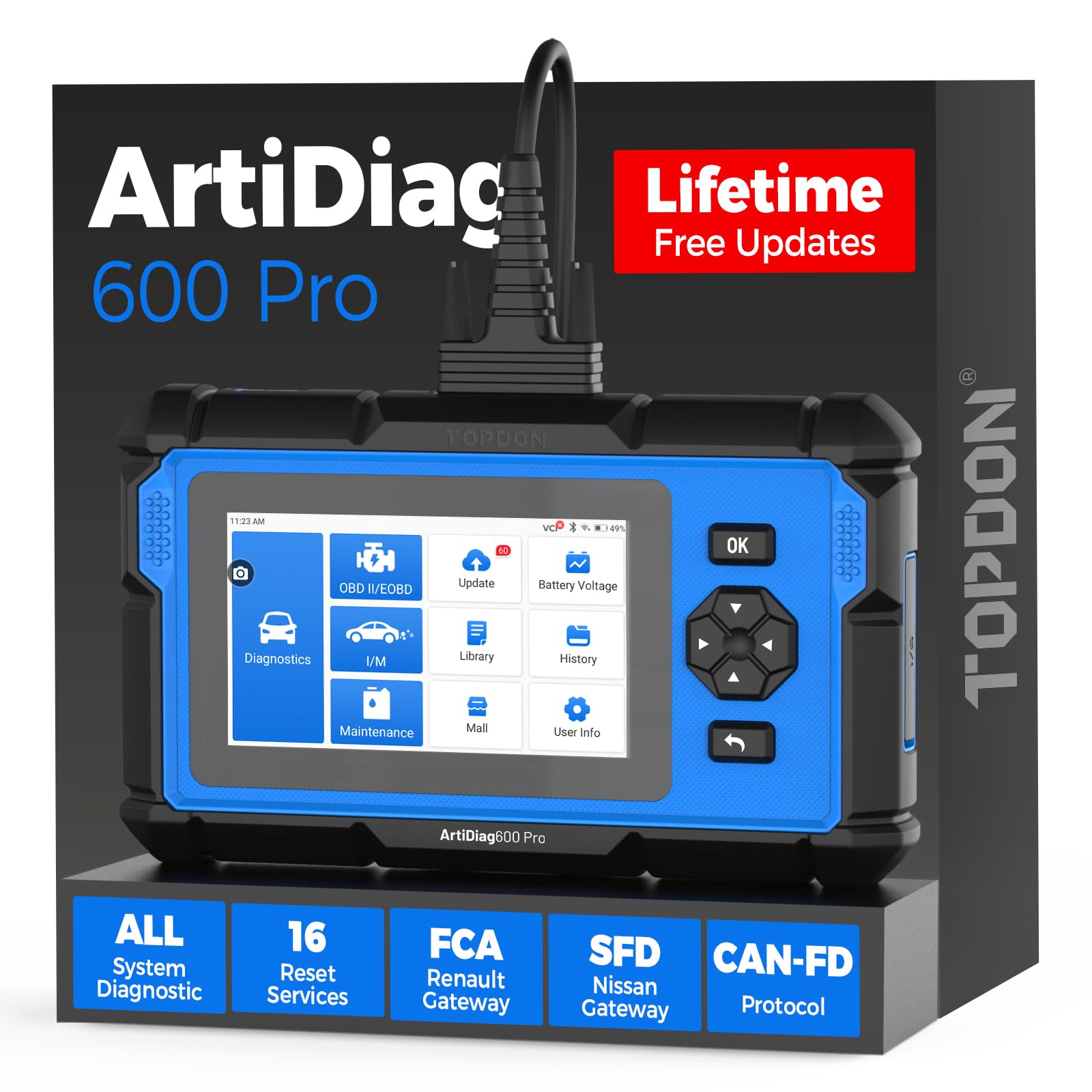
A full-system tablet whose 5-inch 1280×720 screen makes live data genuinely watchable.
Modern cars need modern protocols, and this is where the AD600 Pro earns its place. It reads every system — engine, transmission, ABS, body control, airbag, chassis and powertrain — and adds CAN FD plus FCA, Renault, NISSAN and SFD gateway access for newer vehicles. The Android 11 interface runs on 2GB of RAM and 32GB of storage, and the 5-inch touchscreen at 1280×720 shows up to four live data streams at once without squinting.
The reset list is the headline: 16 core services stay free for life, covering oil, ETS, brake, DPF, TPMS, SAS, BMS, ABS bleeding, injector coding, window calibration, gearbox, airbag, suspension and AdBlue. AutoVIN reads the vehicle automatically and AutoScan sweeps every system, and lifetime updates download over Wi-Fi. The tool covers 90+ brands and over 10,000 models from 1996 onward, including 12V diesel and light trucks.
Functionality is what wins people over, with value for money right behind. The honest catch is connectivity — the tool needs to be within Wi-Fi range to work as intended, and some newer models can be fussy to connect. A handful of makers also require an extra purchase for certain protocol access. Budget for a few minutes of first-setup downloading before your first scan.
The big win: 16 free-for-life resets and a 1280×720 screen at a mid-range price — professional coverage without the annual fee.
The caveat: Wi-Fi matters to how it runs, and a few gateway protocols cost extra.
Best fit for: the home mechanic with a newer car who wants resets and a sharp screen without a subscription.
Look past it if: your vehicle is older and needs only basic engine codes.
9. TOPDON AD800BT 2
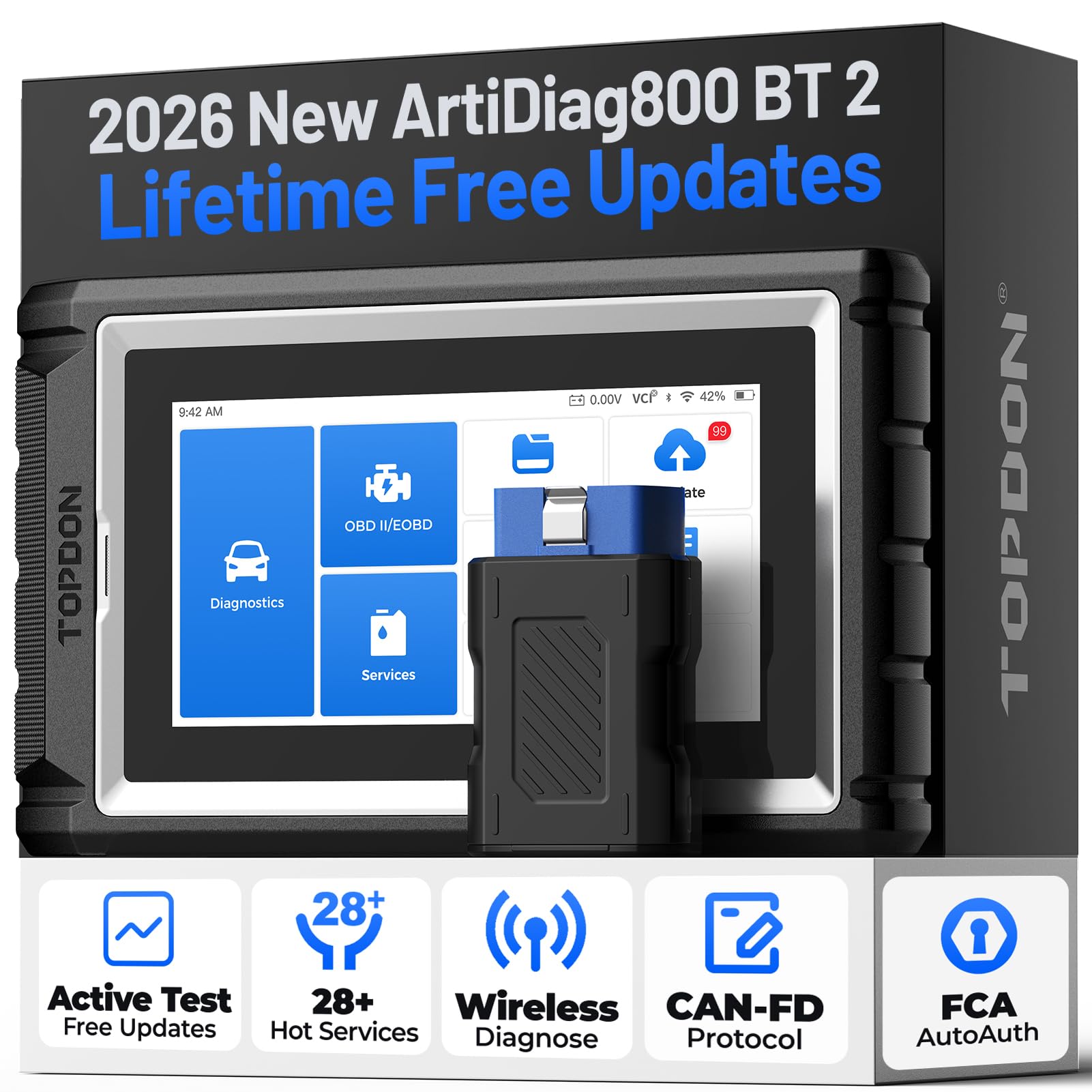
Wireless bidirectional control that walks around the car with you.
If you want to command a window, mirror, door lock or wiper from outside the car, this is the tool for it. The included Bluetooth 4.0 dongle reaches 33 feet (10m), and bidirectional control sends instructions straight to the ECU so you can make a component act and confirm whether it works. The screen runs at 720×1440, which keeps live data crisp, and the 64GB of storage plus AutoVIN handling keeps each job quick to start.
The reset list covers 28 hot services with pop-up guidance, spanning oil, steering angle, electric parking brake and tire pressure resets, injector coding, ABS bleeding, DPF regeneration, battery and throttle, plus sunroof initialization and EGR adaption. All-system access pulls engine, ABS, DPF, EVAP, TPMS, BMS and EPB codes so you see the full picture rather than just the engine light. It works on 96 vehicle brands, and the FCA gateway access handles Chrysler, Jeep and Dodge. Updates are free for life with no recurring fee.
What wins people over is the build and the breadth, with value and ease of use close behind. The honest catch is setup time: the first update pull is long — one batch ran to 97 updates — and the bidirectional menu takes some hunting before it clicks. A handful of buyers hit a communication snag on a specific model. None of that changes the core verdict, but plan the first download for a quiet afternoon.
The strength: wireless bidirectional control plus 28 resets and lifetime free updates makes this a genuine shop tool for home use.
The one to note: the initial update download eats time before your first real scan.
This is your tool if: you want to actuate components and read every module from your phone or tablet-free setup.
Go a step simpler if: you rarely need anything past engine codes.
Know the Specs
Full System vs. Engine-Only
An engine-only reader talks to the powertrain computer and covers the check-engine light. A full-system tool reaches ABS, airbag, transmission, body and tire-pressure modules too. If a brake or airbag light is your reason for shopping, you need full-system access — a basic reader will show nothing for those.
Bidirectional Control
Bidirectional means the tool can send a command to a component, not just listen. You can trigger a fuel pump, buzz an injector or cycle a cooling fan to confirm it works. That confirms a bad part before you spend money on a replacement, and it is the dividing line between a code reader and a diagnostic tool.
Screen Resolution and Live Data
Resolution decides whether a sensor graph is readable. A 320×240 panel shows codes fine but crams multi-line graphs, while a 1024×600 or 1280×720 screen keeps waveforms clean. If you plan to chase an intermittent misfire with live data, spend for the sharper panel.
I/M Readiness and Smog Checks
The I/M readiness function shows whether your emission monitors are set and ready for a state inspection. A one-click hotkey makes this a single press instead of digging through submenus. It saves a wasted trip to the test station if a monitor is still “not ready”.
Common Questions
Will an OBD2 scan tool work on my car?
Can a scan tool turn off the check engine light for good?
Do I need bidirectional control or just a code reader?
Will these tools read ABS, airbag and transmission codes?
Do these scanners need a battery or a charge?
Are software updates really free?
Can a scan tool help me pass a smog check?
What is a DTC and why does the definition matter?
Can I leave a Bluetooth dongle plugged in all the time?
Will a scan tool reset an oil or service light?
The Bottom Line
The Autel MaxiCheck MX808S wins the obd2 scan tool shortlist because it reads every module and runs 3000+ active tests that confirm a bad part before you replace it. If a brake or airbag light is your reason for shopping, the INNOVA 5310 reads ABS and SRS codes where basic readers go silent. And if you want wireless bidirectional control with lifetime free updates, the TOPDON AD800BT 2 is the one to reach for. Pick the depth of access your car actually needs, then let one avoided shop visit pay for the tool.
How we choose
We do not accept paid placement. Every pick is matched to a real buyer and a real use-case; we do not hands-on test units.
Sources
Specifications: manufacturer listings and product documentation. Review insights: verified customer reviews, as of November 2026. Pricing: not shown on this page (it changes often); check the current price via the retailer link.
As an Amazon Associate, Tactical Gear Guy earns from qualifying purchases. This does not affect which products we feature.