Specs are compiled from manufacturer listings and verified buyer reviews and can change over time — please confirm the key details on the product page before buying.
Choosing the right motor for your electric bike is really about two things: how much push you want on the hills, and whether the motor physically bolts onto the bike you already own. Get the axle width and voltage wrong and the kit sits in its box. Get them right and a plain bike becomes a daily commuter in an afternoon of wrenching.
This guide is built by comparing the manufacturers’ published specifications and the patterns across verified customer reviews, so you get each pick’s real strengths and trade-offs instead of marketing spin.
You will see hub kits that replace your rear wheel and mid-drive kits that pull through your pedals, with the exact torque, voltage and fitment figures spelled out in plain terms. The goal is simple: pick the one motor for electric bicycle that matches your dropout width, your hills and your mechanical confidence.
Top Picks
How To Choose The Best Motor for Electric Bicycle
Start with the bike, not the motor. Measure the gap between your rear frame dropouts where the wheel axle sits, then check which chainring style your bottom bracket accepts. A 1000W hub motor with the wrong dropout width is a very expensive paperweight.
Hub motor or mid-drive — pick your side first
A hub motor lives inside the wheel and pushes the bike directly, which means fewer moving parts and a simpler install. A mid-drive motor sits at the cranks and sends power through your chain, so it can use your gears to climb. Hub kits suit riders who want to keep their drivetrain untouched; mid-drive kits suit riders who want the motor to feel like part of the pedalling.
Read torque before you read wattage
Wattage tells you roughly how much electrical power the motor draws. Torque, measured in newton-metres (N·m), tells you how hard it pushes. This is why a motor rated 160 N·m pulls away from traffic differently than one rated 45 N·m, even when both are sold as high-power kits. On a flat commute, 45 N·m is plenty. If your route ends on a steep grade, that 160 N·m mid-drive figure is the whole story.
Check the connector and the controller
Most hub kits end in a multi-pin plug that must match your controller, and a mismatched plug means cutting and soldering. Look for the pin count and the plug shape in the listing. The 20-inch kit here uses a 9-pin threaded connector, for example, and that detail decides whether it plugs straight in or needs an adapter.
Weight, spokes and load rating
A wheel-and-motor assembly is heavy by nature, and that weight sits at the back of the bike where it affects handling. Spoke count and lacing pattern carry the load, so a 36-spoke wheel rated to around 120 kg is built for a different rider than a forged one-piece rim. Match the wheel’s stated capacity to your own weight plus whatever you carry.
Side-by-Side Comparison
| Model | Best For | Motor Type | Voltage & Power | Torque | Amazon |
|---|---|---|---|---|---|
| KPATH 20 x 4.0” Fat Tire Rear Wheel★ Best Overall | Fat-tire riders who want a bolt-on wheel | Rear hub, one-piece mag wheel | 48V, 1000W | 85 N·m | Amazon |
| Mahugde 48V 1000W 26″ Hub Motor Wheel KitBest Value | First-time converters on a standard 26-inch bike | Rear hub, 36-spoke wheel | 48V, 1000W | 45 N·m | Amazon |
| GOSHET 72V 2000W Rear Wheel Kit | Riders chasing top speed and an LCD dash | Rear hub, 7-speed flywheel | 72V, 2000W | 60 N·m | Amazon |
| Varstrom TSDZ2B / Z8 / TSDZ16 Mid Drive Kit | Climbers who want the motor to use their gears | Mid-drive, torque sensor | 48V, 250W–1000W | Up to 160 N·m | Amazon |
| LTIGOAW 26″ 48V 1000W Rear Wheel Kit | Budget DIY builds on a 26-inch frame | Rear hub, brushless | 48V, 1000W | 45 N·m | Amazon |
Detailed Reviews
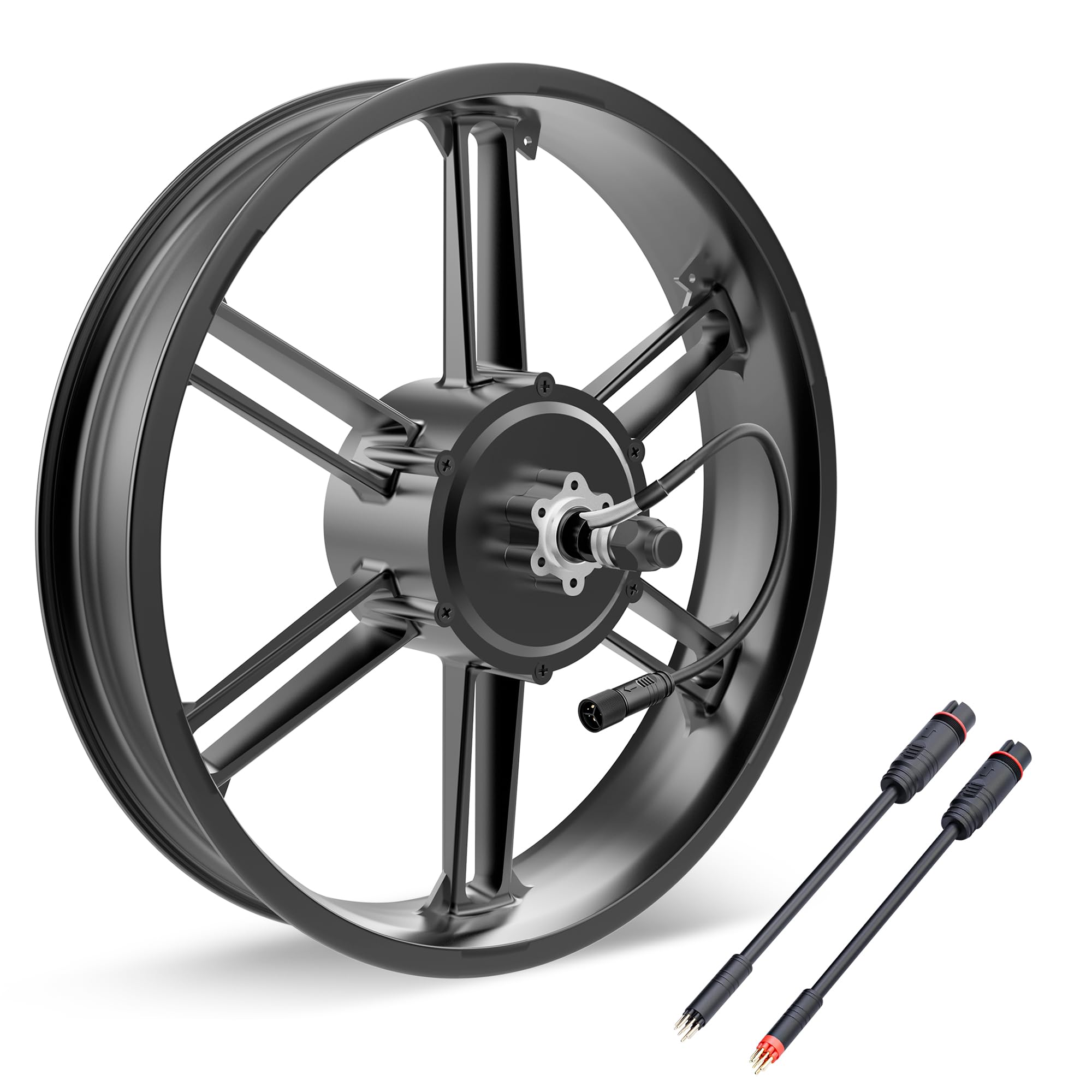
1. KPATH 20 x 4.0” Fat Tire E-bike Rear Wheel, 48V 1000W Motor
A fat-tire rear wheel you bolt on and ride, with nothing to true and no spokes to tighten.
The headline figure here is 85 N·m of torque from a 48V 1000W brushless DC motor, which is the kind of shove that turns a heavy fat-tire frame into something that actually pulls away from a stop. Top speed is listed at 55 km/h (34 mph). For a 20-inch wheel that is a serious turn of pace, so treat the first ride as a bedding-in lap rather than a lap record attempt.
What makes this the overall pick is the wheel itself. The rim is integrally forged aluminium alloy with no weak joints, so there is no spoke tension to drift and no truing to learn. Less weight hanging off the back axle makes a small-wheeled bike feel far less tail-heavy.
The fitment is narrow, and you need to know that before you buy. It takes 20×4-inch tires only, and the frame dropouts must measure between 170 mm and 175 mm (6.69–6.89 inches). It ends in an L915 9-pin threaded connector, so check your controller interface matches. Disc brakes are supported, which keeps your stopping setup intact.
Where it earns its keep
- 85 N·m of torque moves a heavy fat-tire bike off the line with real authority
- Forged one-piece rim means no spoke truing, ever
- At 10.5 pounds it is the lightest motor-and-wheel assembly here
- Disc-brake compatible, so you keep the brakes you already trust
What to check first
- Locked to 20-inch fat-tire frames with 170–175 mm dropouts
- Needs a matching 9-pin controller interface before it will run
- Sold as one drive wheel plus adapter cable, so nothing spare in the box
Reach for this if: you run a 20-inch fat-tire bike and want the simplest path to strong assist with zero wheel maintenance.
Think twice if: your dropouts fall outside that 170–175 mm window, because there is no adjustment here.
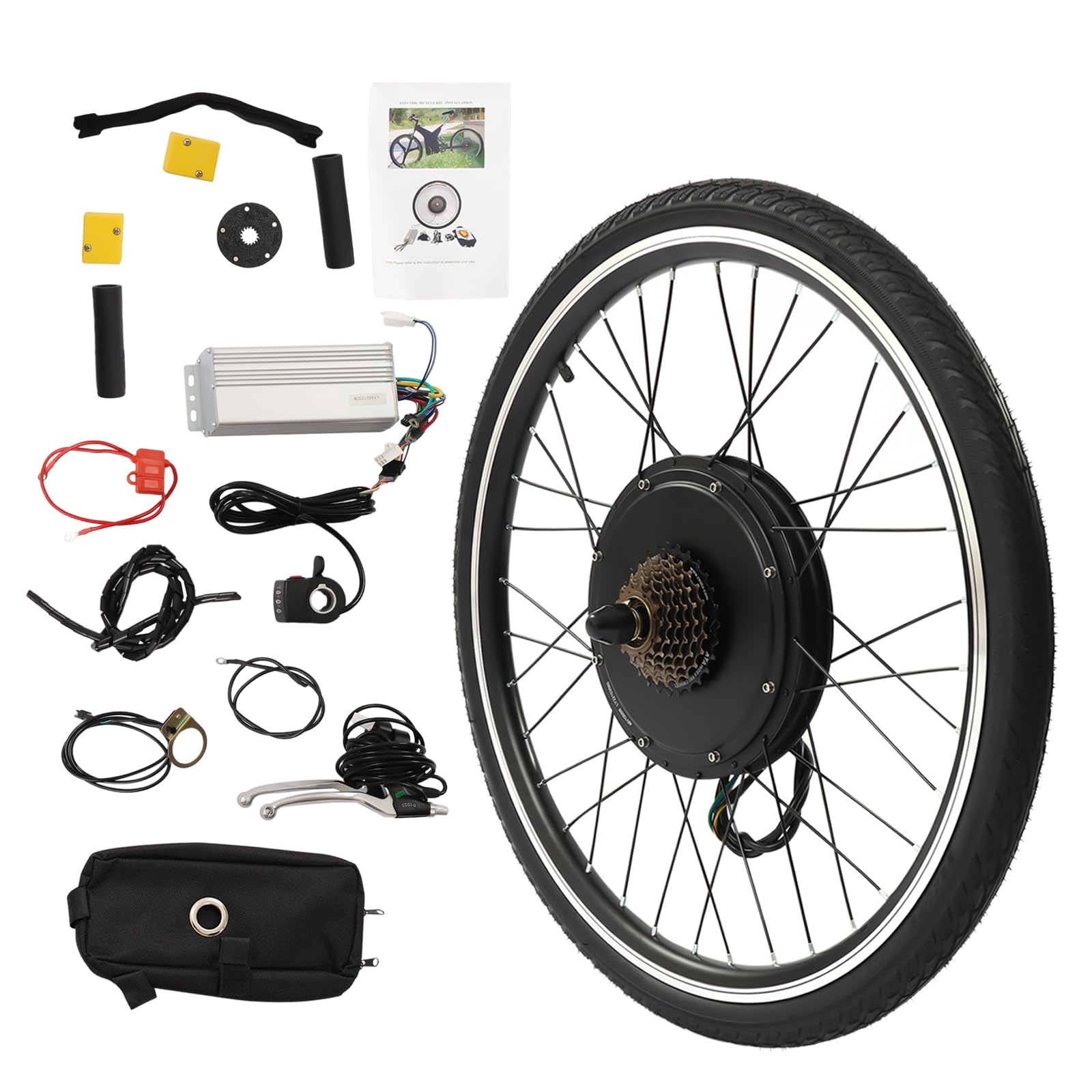
2. Mahugde 48V 1000W 26″ E-Bike Hub Motor Wheel Kit
The straightforward conversion kit for anyone with an ordinary 26-inch bike and no wish to overthink it.
Two ways to ride come built in here: a thumb throttle you press to add speed, and a pedal assist sensor that reads your cranking and adds power as you go. The motor turns at 440 rpm with 45 N·m of torque and is listed for 53 km/h. Against the 2000W GOSHET kit’s 60 N·m, this one gives up 15 N·m — noticeable on a long climb, fine on a flat commute.
The build answers the load question properly. Thirty-six spokes in a staggered weaving pattern spread the stress evenly and are rated for about 120 kg, or 264.55 lbs. That covers most adult riders plus a bag or two. A power-off brake handle cuts motor power during emergency braking, which is the sort of detail that matters most on the day you actually grab a handful of brake.
What works well: The throttle-and-pedal-assist pairing suits riders who want to choose between cruising and actually pedalling, and the 36-spoke wheel carries its load without drama.
The honest catch: At 22.9 pounds this is the heaviest assembly on the list — 12.4 pounds more than the KPATH wheel — so lifting it onto a rack is a two-hand job.
Pick this one if: you have a 26-inch bike, paved-road riding ahead of you, and you want throttle and pedal assist in the same box.
Look elsewhere if: you ride off-road often, since this kit is listed for paved surfaces only.
3. GOSHET 72V 2000W E-Bike Rear Wheel Hub Motor
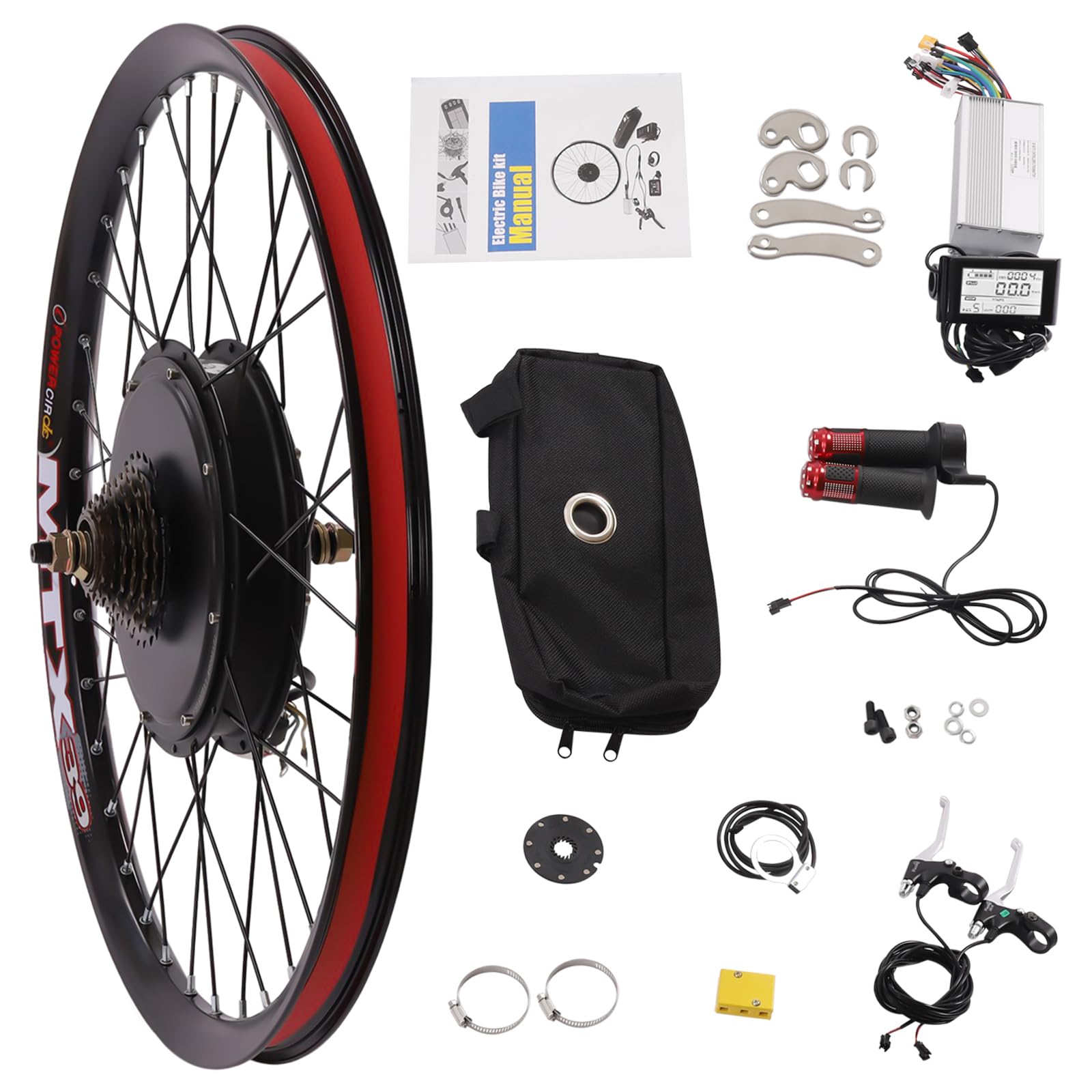
Double the voltage of the 48V kits and double the wattage, with a dashboard to watch it all on.
Read the numbers in order and the appeal is obvious. This runs a 72V system against the 48V of every other kit here, and a 2000W motor against their 1000W. It is a rear hub, so the install still means swapping the wheel rather than touching the cranks.
The extras are where it pulls ahead of a bare hub kit. A multi-function LCD shows speed, mileage and faults, so you can see a problem rather than guess at it. There is a 7-speed flywheel, nine-speed adjustment and a cruise control function. The controller and wiring come in the box with a controller bag and an installation manual, so you are not chasing separate parts.
Why riders want it: A higher-voltage, higher-wattage motor with a display that reports speed and faults turns a conversion into something you can actually monitor.
Before you commit: A 72V system carries more punch than a 48V one, so plan your braking and your first few rides with real care rather than treating it like the tamer kits.
Built for: the rider who wants maximum power and an on-board readout, and who is happy to install a full conversion set with a manual in hand.
Not ideal for: anyone who wants a plug-and-go wheel swap, because this is the most involved kit of the five.
4. Varstrom TSDZ2B Z8 TSDZ16 48V Mid Drive Kit for Ebike
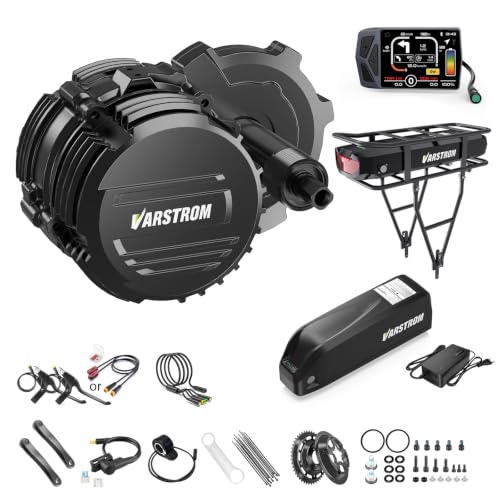
The one kit here that pushes through your pedals, so your own gears multiply the climb.
That only means something because of where the motor sits. A mid-drive sends power through your chainring and cassette, so the motor benefits from the same gear you would drop into on a hill. A hub motor spins the wheel directly and cannot do that.
Three versions let you match the kit to your riding: the 500W offers 80 N·m and 45 km/h, the 750W offers 140 N·m and 50 km/h, and the 1000W gives 160 N·m and up to 55 km/h. Chainrings differ by version too — 42T on the TSDZ-2B, 44T on the Z8 and 46T on the TSDZ16. All three fit bottom brackets measuring 68–73 mm.
The engineering detail worth understanding is the bidirectional free-wheeling clutch. In plain terms, it lets the motor spin freely when you are pedalling with the power off, instead of dragging against a one-way clutch. The maker also cites 15% stronger contact on the 1T4 main wiring and a nylon gear built for higher torque with an external clutch. The box includes a display of your choice, throttle, speed sensor, brake levers and the tools to fit it.
Standout strengths
- 160 N·m on the 1000W build is the highest torque figure in this lineup
- Uses your bike’s gears, so steep streets are easier than with a hub motor of equal rating
- Free-wheeling clutch means pedalling with power off does not fight the motor
- Torque sensor reads how hard you push and responds to your effort
Know before ordering
- Needs a bottom bracket between 68 mm and 73 mm, so measure yours first
- Mid-drive install involves the cranks and chainline, not just a wheel swap
The right call for: a rider with hills on the route who wants the motor to feel like an extension of pedalling rather than a wheel spinning behind them.
Worth noting: you have to confirm your bottom bracket width before ordering, because the 68–73 mm range is fixed.
5. LTIGOAW 26″ 48V 1000W Rear Wheel Electric Bicycle Conversion Kit
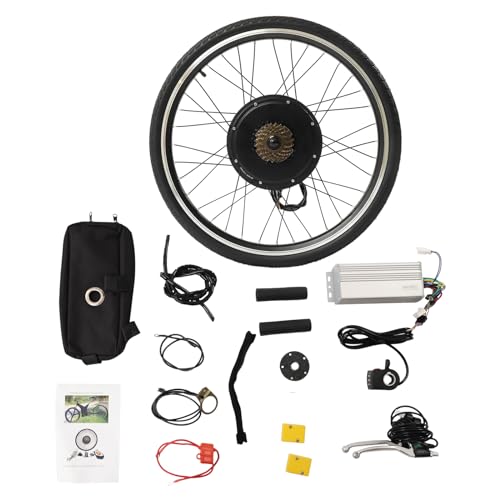
A low-cost entry into 48V power for the rider who is willing to build it themselves.
Look at the materials list before anything else: aluminium, iron, copper, magnetic steel, aluminium alloy and rubber butyl. That mix is the reason this kit is described as resistant to rust and built to avoid frequent replacement. The motor itself is brushless and toothless, meaning no brushes to swap out later, and it is rated for more than 80% efficiency with three LED lights for visibility.
You get solid performance for the money. The motor spins at 440 rpm (revolutions per minute — how fast the motor turns) and pushes 45 N·m of torque (twisting force that climbs hills and carries weight). It is listed for 53 km/h (about 33 mph) and a 120 kg (264.55 lbs) load capacity, so it can haul a rider plus cargo. Those numbers match the Mahugde kit exactly — same rpm, same torque, same speed — so the real difference between the two depends on the rim and the support, not the motor output.
What most impresses in the feedback is that it does what a conversion kit is supposed to do: it works, and it goes on without a fight. Reliability earns the most discussion and installation is the second theme, both landing on the positive side overall. A small number of riders report motor trouble, which is note for a budget-tier kit rather than treating as the norm.
The value read: A brushless motor needing no brush replacement, plus a two-year warranty, is a sensible safety net for a first DIY build.
Room to grow: The motor output is honest but modest, so do not expect the punch of the 72V GOSHET or the climbing character of the mid-drive.
Go for it when: you have a 26-inch frame, a limited budget and the patience to assemble a kit yourself.
Pass on it if: you want a motor rated above 45 N·m or a kit with a display already in the box.
Know the Specs
Voltage and wattage
Voltage and wattage describe the electrical side of the motor, not how hard it pulls. A 48V 1000W kit draws less than a 72V 2000W kit, which is why the 72V GOSHET sits at the top of this list for raw power. Wattage alone rarely tells you how a bike will feel on a hill — for that you need torque.
Torque in N·m
Torque in newton-metres is the turning force the motor applies to the wheel or the chain. Higher numbers mean stronger pull from a standstill and better climbing. In this lineup the range runs from 45 N·m on the Mahugde and LTIGOAW kits up to 160 N·m on the 1000W mid-drive, which is a wide spread in real riding feel.
Dropout width and fitment
Dropouts are the slots in your frame where the rear axle sits, and their width decides whether a hub wheel fits at all. The KPATH fat-tire wheel needs 170 mm to 175 mm. Mid-drive kits avoid that question entirely and instead need a bottom bracket measuring 68 mm to 73 mm. Measure your dropout gap or bottom bracket shell before you order, every time.
Hub drive versus mid-drive
A hub motor replaces your rear wheel and drives it directly, keeping your chainring untouched. A mid-drive mounts at the cranks and feeds power through your existing gears, which is why a mid-drive can climb better than a hub motor of similar rating. Hub kits are simpler to fit; mid-drive kits reward a rider who wants the motor to work with the pedals.
Common Questions
Will a 48V hub motor kit fit my existing 26-inch bike?
Is a mid-drive motor better than a rear hub motor for climbing hills?
What does 85 N·m of torque actually feel like on a ride?
Do I need a specific controller for a 9-pin hub motor connector?
How much weight does a rear hub motor wheel add to my bike?
Can I pedal an e-bike with the motor switched off?
What bottom bracket size does a mid-drive kit need?
Does a higher wattage motor always mean a faster bike?
How much weight can a 36-spoke conversion wheel carry?
Should I buy a kit with an LCD display or a bare hub wheel?
The Bottom Line
For most riders, the strongest all-round pick is the KPATH 20 x 4.0” Fat Tire Rear Wheel. It pairs 85 N·m of torque (strong twisting force for hills and loads) with a forged one-piece rim that never needs truing (wheel straightening) and a 10.5-pound weight that keeps the back end manageable. If your route is all hills and you want the motor working through your gears, reach for the Varstrom mid-drive kit at up to 160 N·m. And if you want maximum voltage and a display on the bars, the GOSHET 72V 2000W kit delivers both.
Before you click buy on any of them, put a tape measure to your dropouts or your bottom bracket shell. Dropout width and bottom bracket size cannot be worked around, and they are the difference between a bike that rides tomorrow and a kit that sits in the garage.
How we choose
We do not accept paid placement. Every pick is matched to a real buyer and a real use-case; we do not hands-on test units.
Sources
Specifications: manufacturer listings and product documentation. Review insights: verified customer reviews, as of November 2026. Pricing: not shown on this page (it changes often); check the current price via the retailer link.
As an Amazon Associate, Tactical Gear Guy earns from qualifying purchases. This does not affect which products we feature.