Specs are compiled from manufacturer listings and verified buyer reviews and can change over time — please confirm the key details on the product page before buying.
Your boat sits outside all winter, and the cover you bought last spring is already sagging, pooling water, or flapping itself apart in the wind. That is the real problem with most mooring covers — not the fabric itself, but whether it fits your boat’s exact length and beam width. Get the fit wrong by a foot and no amount of heavy-duty denier will save the cover from tearing at the strap points. This guide breaks down eight covers that actually hold up, starting with the one that gets the fit right for the widest range of bass boats.
This guide is built by comparing the manufacturers’ published specifications and the patterns across verified customer reviews, so you get each pick’s real strengths and trade-offs instead of marketing spin.
Denier ratings, PU waterproof coating, and strap counts all sound impressive on a listing, but they only matter if the cover clings to your hull correctly. This breakdown covers how to read those specs so you pick the right mooring cover for boat the first time.
Top Picks

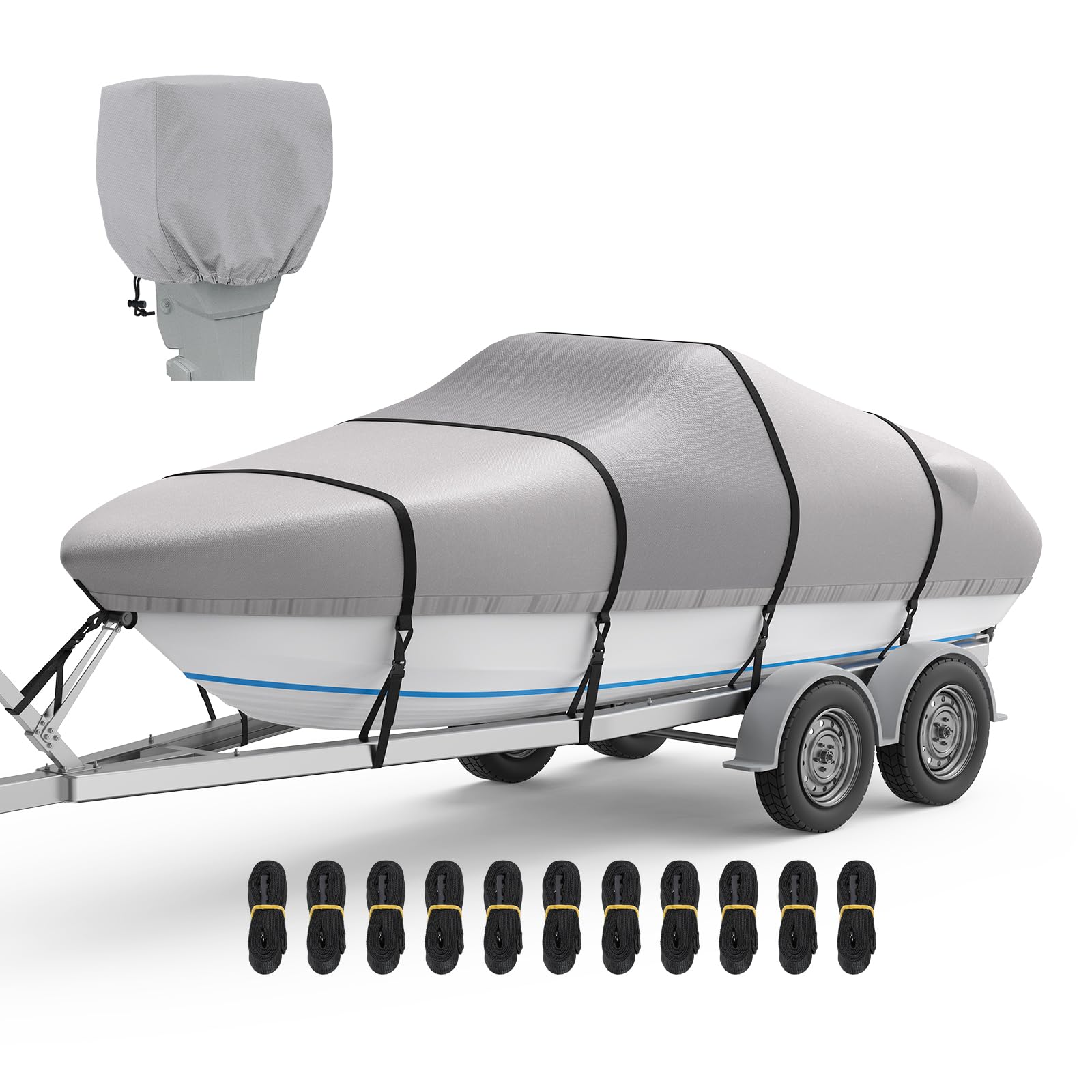

How To Choose The Best Mooring Cover for Boat
A mooring cover has one job: stay on your boat through rain, wind, and sun without letting water inside. The covers that fail are almost always the ones bought by length alone. Measure your boat’s beam width (the widest point across the hull) and check it against the cover’s stated beam limit before anything else.
Denier And Seam Construction
Denier is the weight of the fabric threads, and higher numbers mean a thicker, heavier weave. A 1200D oxford fabric resists tearing better than a 900D basic cover, but the real weak spot is the seam where the fabric meets the strap. Look for double-needle stitching (two parallel rows of thread) and bar-tack stitches at the strap connections. Those reinforcements are what keep the cover attached when a gust hits at highway speed.
Waterproof Rating And Ventilation
Waterproof ratings like 12000 PA or 14000 PA measure how much water pressure the coating holds back before it seeps through. Higher is better for long-term storage, but a fully sealed cover traps moisture underneath. That is why rear air vents matter — they let humid air escape so condensation does not collect on your seats and electronics. A vented cover with a strong waterproof rating protects better than a sealed one without airflow.
Trailerable Versus Mooring Only
If you tow your boat on a trailer, the cover needs reinforced straps that wrap under the hull and buckles rated to stay locked in wind. Some covers state a towing speed limit on the packaging. A cover built for mooring only may not hold through highway speeds even if it fits perfectly at the dock.
Side-by-Side Comparison
| Model | Best For | Fabric Denier | Boat Length Fit | Max Beam Width | Amazon |
|---|---|---|---|---|---|
| Solim 20-22FT Bass Boat Cover★ Best Overall | Best overall | 1200D | 20-22 ft | 100 in | Amazon |
| RVMasking 1400D Center ReinforcedBest Value | Trailering on a budget | 1400D | 17-19 ft | 96 in | Amazon |
| Caminor 14-16ft Bass Tracker CoverMooring Kit Included | Mooring kit included | 1200D | 14-15.8 ft | 90 in | Amazon |
| Solim 17′-19′ Center Console Cover | Center console boats | 1300D | 17-19 ft | 102 in | Amazon |
| Tuszom 1600D+1200D V-hull Cover | Highway towing | 1600D/1200D | 16-18.5 ft | 98 in | Amazon |
| RVMasking Pontoon Boat Cover | Pontoon boats | 1400D | 17-20 ft | 102 in | Amazon |
| RVMasking 1600D Waterproof Cover | Thickest fabric | 1600D | 20-22 ft | 100 in | Amazon |
| RVMasking T-Top Boat Cover | T-top center consoles | 1400D/1200D | 20-22 ft | 106 in | Amazon |
Detailed Reviews
1. Solim 20-22FT Bass Boat Cover,1200D Waterproof Trailerable
Our pick — 4.5+★ from 450+ verified ratings; the strongest balance of quality and price.
Built for bass boats that live outside through every season, not just the fair-weather months.
The 1200D oxford fabric with a thickened PU coating is the foundation here, rated to a 9600 PA water-resistance standard. That means the fabric holds back driving rain before moisture ever reaches the stitching. Double stitching and waterproof strips taped over the seams close the gap most covers leave open at the top, so water runs off instead of soaking through.
Where this cover pulls ahead of the shorter 17′-19′ options is elbow room: it fits 20-22 feet of boat length with a beam up to 100 inches, which is noticeably more coverage than the Caminor’s 90-inch limit. It also accommodates bass boats right around 19 feet with room to spare, based on how owners describe the fit. Fourteen quick-release buckles and an elastic hem sewn into the bottom edge work together to lock the cover down tight.
What wins people over is the fabric quality — it is the single most-praised feature, with owners calling it a killer cover for the money. Dual rear air vents with PE panels keep air moving under the cover without breaking the waterproof seal, which is what stops moisture and heat from cooking your interior. The strap system is detachable at each point, so a damaged strap gets replaced without buying a whole new cover.
What makes it the top pick
- 1200D fabric with waterproof seam strips rated to 9600 PA
- Wide 100-inch beam limit and 20-22 ft length coverage
- 14 quick-release buckles plus elastic hem for a tight fit
- Detachable straps replace individually instead of the whole cover
- Dual rear vents manage moisture without letting rain in
Where the fit runs tight
- Beam tops out at 100 inches, so wider-hull boats need a different size
- Fabric this heavy is slower to stretch over the hull by yourself
The confident call: This is the one for a 20-22 foot bass boat or V-hull runabout that sits out through real storms and still needs to look clean in spring.
The honest limit: If your beam measures past 100 inches, step up to the Solim Center Console or the T-Top cover instead.
2. RVMasking Boat Cover 17′-19′
Thicker fabric where the wind attacks, so the middle holds its shape on the highway.
RVMasking runs a two-tier fabric strategy: 1400D polyester down the middle stress zone and 900D at the ends. That means the part of the cover most exposed to wind flapping gets the tougher weave, where a basic 900D cover would be uniform and weaker in that spot. The double-layer PU coating hits a 12000 PA waterproof standard, with a water-repellent outer treatment that sheds raindrops and an inner PU layer that blocks seepage into the cabin.
Eleven adjustable tie-down straps with quick-release buckles plus an elastic hem around the bottom edge produce a 360-degree fit on boats from 17 to 19 feet with a beam up to 96 inches. Both tail vents stop water vapor from gathering under the fabric. Sharp corners at the bow and stern carry extra 900D reinforcement, and the strap connections add bar-tack stitches specifically to keep the webbing from pulling free in wind.
The construction earns solid respect for how it is put together, and the fit accommodates many medium-sized boats well. Durability and water resistance split owner opinion — some units hold up through sun and wind, while a share report tearing within about six months. Treat the fabric with reasonable care and check the straps before long tows, and this one earns its place for the middle of the market.
Construction read: The mid-panel 1400D weave and bar-tack stitches at the stress points are the smart details here — this is where economy covers usually cut corners and pay for it in the wind.
What to watch: Water resistance is the recurring caution in owner feedback, so pair it with a support pole to keep water from pooling in the first place.
Reach for this if: You tow a 17-19 foot bass tracker or V-hull regularly and want the reinforced midsection without the premium price.
Look elsewhere if: You need a mooring cover for permanent wet dock duty where a sealed, higher PA rating is non-negotiable.
3. Caminor Boat Cover 14-16ft with Sand Bag Mooring Kit
The one that throws in the sandbags, so you stop hunting for weights on a windy dock.
Most covers leave you improvising anchors. This one ships with 11 sandbags alongside 11 buckle straps, sized for mooring instead of just trailering. The 1200×1200 denier marine-grade polyester fabric gets two-layer reinforcement at the bow and stern, plus double-stitched interlock seams. A thickened 6mm elastic cord runs the bottom edge for a snug fit, and two rear vents let heat escape so the inside stays drier.
The fit range is 14 to 15.8 feet of boat length with a beam up to 90 inches — the tightest beam coverage on this list, and the reason the Solim above it fits wider hulls. That narrower beam is also why some owners find it barely accommodates the main hull on a 14-footer while others say it drapes perfectly. Measure your actual beam before ordering rather than trusting the length number alone.
Quality is what earns the praise here, with owners calling it one of the best covers they have owned. Installation goes on quickly, and the tie-down loops and straps get consistent credit. The trade-off shows up in long-term durability — straps can snap if you over-tighten them, and the fabric thickness divides opinion between owners who find it heavy and those who call it thin. The storage bag doubles as a motor cover, which saves both money and garage space.
Mooring-first thinking: The included sandbag set is the detail that sets this apart from every trailer-focused cover here — on an open dock, weights are the difference between a cover that stays put and one that swims.
Skip if: Your boat measures wider than 90 inches at the beam, or you are covering a 16-foot hull, since the stated range stops at 15.8 feet.
Built for: Small bass and runabout boats kept on a mooring where wind shifts and you need weights, not just straps.
Second thought if: You expect a decade of service from one cover — the fabric thickness and strap durability have room to improve.
4. Solim Center Console Boat Cover 17′-19′

Cut tall enough to drape over a center console, not just lay flat on the deck.
A center console boat has a steering station sticking up in the middle, and a flat bass-boat cover will not clear it. This Solim cover accommodates a console as high as 54 inches from the deck, which is the measurement that decides whether it works on your boat. It covers 17 to 19 feet of length with a beam up to 102 inches, so it handles wider hulls than the RVMasking 1400D’s 96-inch limit.
The fabric is 1300D marine-grade oxford in a four-layer build — the oxford weave, a waterproof coating, an anti-UV coating, and a PU coating — rated to 9600 PA. Every seam is triple-folded and double-stitched with waterproof strips over the overlapped stitching, which extends the cover’s outdoor life against scratching and tearing.
You get plenty of places to tie down, thanks to 18 integrated buckles and straps. The elastic hem pulls tight like a custom fit, so strong wind has less to grab. Buyers report high quality overall, and owners mention the heavy fabric earns particular praise. One honest note on fit: it stays secure even without all straps tensioned, which says a lot about the hem design. But some owners with unusual hull shapes report fit issues, so measure your beam (the boat’s widest width) and console height carefully.
Why center-console owners pick it
- Clears a console up to 54 inches tall from the deck
- 102-inch beam limit handles wider hulls than most competitors
- 18 buckling straps plus elastic hem hold firm in wind
- Four-layer 1300D fabric rated to 9600 PA
- Seams triple-folded and double-stitched with waterproof strips
Fit notes to know
- Only fits 17-19 foot center consoles, not taller T-top setups
- Non-standard hull shapes may need extra strap adjustment to sit right
Made for: A 17-19 foot center console that needs a cover tall enough to clear the helm and beam-wide enough for a 102-inch hull.
Not the one for: T-top rigs — that roof needs a dedicated T-top cut like the RVMasking T-Top cover below.
5. Tuszom V-hull Boat Cover
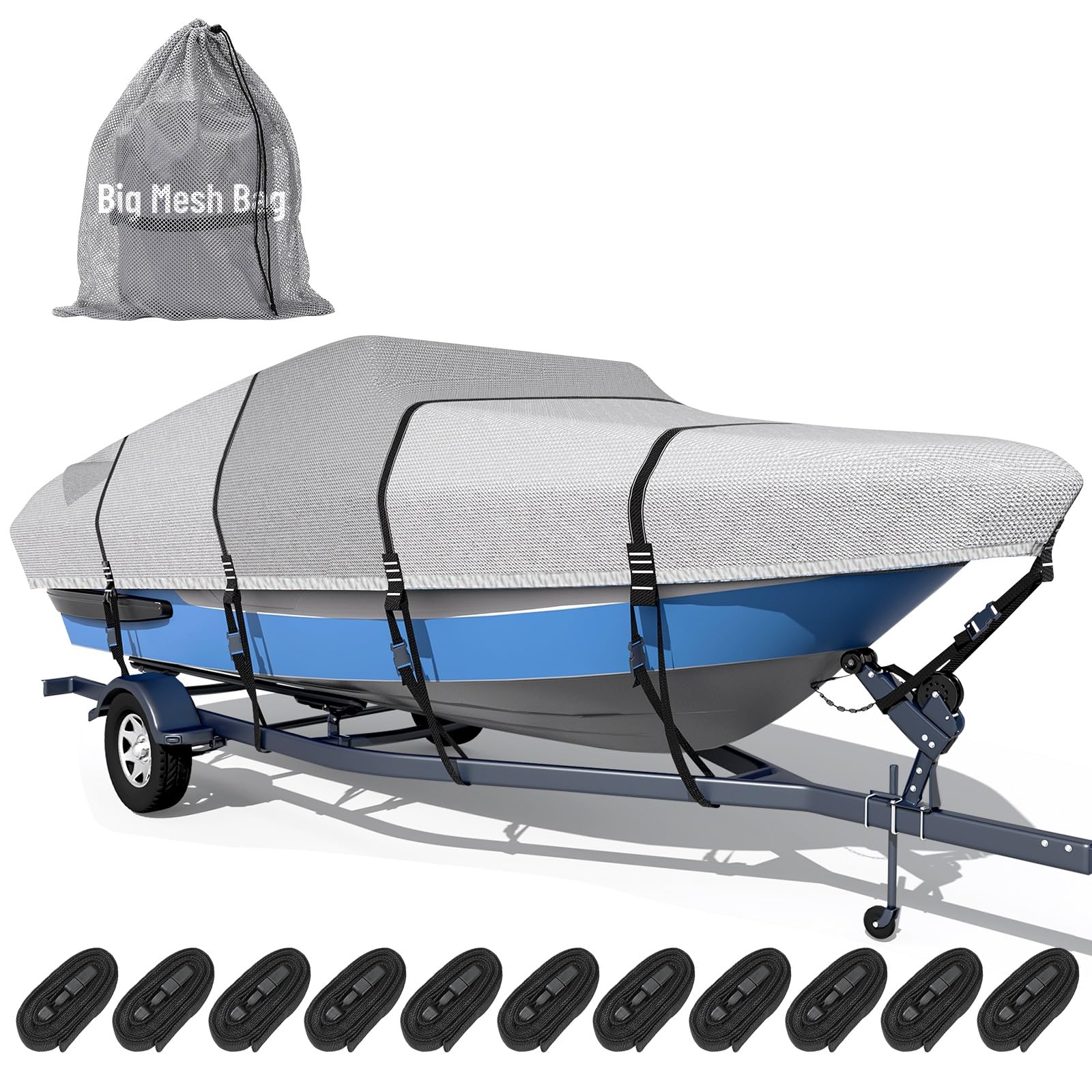
Two-inch tie-down loops built for highway towing, not just a quiet mooring slip.
Standard tie-down loops run about one inch wide. These run 2 inches, double the width, reinforced with backing cloth and four-thread bar-tacking at each attachment point. Combine that with 11 high-tension adjustable straps rated to a 250 lbf load capacity, and you have a cover built to stay put at towing speeds. The high-stress middle uses a 5-layer 1600D fabric with 650 lbf tension strength, while the rest of the cover uses 5-layer 1200D.
Water protection runs to 12,000 Pa through a three-part build: the 5-layer fabric, double stitching at six stitches per inch, and waterproof tape over the seams. Solution-dyed fabric locks color at the fiber level so it will not surface-fade, and UPF 50+ blocks 98% of UV rays to keep boat paint and interior from aging. Two 13-inch arched PP vents move air strongly enough that they pair well with support poles to stop water and snow pooling.
The fit covers 16 to 18.5 feet of boat length with a maximum beam of 98 inches. Owners rate the fabric quality above what the spec sheet suggests, and the drape over both deck and hull gets repeated credit. The adjustable strap length is another point owners bring up as a plus, though a few find the straps run short for their setup. It is a tight package for the mid-range tier.
Tow-tested thinking: The real upgrade here is the 2-inch webbing loops with 4-thread bar-tacking (stitching that locks the loop in place). That is double the width of standard 1-inch loops, so the tie-down point holds up on the highway — the spot that fails first when a cover blows off.
Where it falls short: A handful of owners find the straps too short for their trailer setup, so check your tie-down distance before towing far.
The standout: A 1600D mid-panel with 2-inch reinforced loops and a 12,000 Pa waterproof rating — the spec sheet reads like a cover that costs more.
Check first: If your boat runs longer than 18.5 feet, this size will not reach the stern, and the wider 20-22 foot covers are the fix.
6. RVMasking Pontoon Boat Cover 17-20ft

A pontoon is wide and boxy, and this cover is cut to drape over that deck, not a V-hull.
Pontoons sit low and wide with a flat deck and furniture sticking up, which is why a standard V-hull cover is the wrong shape entirely. This cover fits 17 to 20 feet of pontoon with beam widths up to 102 inches, and the 1400D polyester mid-panel handles the wind that hits a broad, tall boat. The same 12000 PA dual-layer waterproof treatment applies here — a water-repellent outer surface and an inner PU layer that blocks moisture from reaching the seats.
Twelve adjustable tie-down straps with quick-release buckles make installation straightforward, and the elastic cord around the bottom hem pulls the cover snug for a 360-degree fit. A multi-use storage bag doubles as a motor cover, which is a useful second protective piece rather than just packaging. Extra reinforcement at each strap connection and tighter stitching are the durability details RVMasking built into the seams.
Fit is where this cover works — customers note pontoons up to 21 feet sitting inside it with room to spare, a forgiving margin if your deck measures near the limit. Quality earns high marks and the straps draw their own praise. Durability and water resistance are where feedback splits, though — some units hold up to strong wind, others tear early. Add a support pole to keep water from pooling, and this handles pontoon mooring well.
Why pontoon owners choose it: You measure less on a wide deck, because the 102-inch beam and generous fit cover boats up to 21 feet. It is cut for the pontoon shape specifically, not adapted from a V-hull pattern.
What to plan for: Water resistance is the recurring caution in owner reports, so budget for a support pole to keep rain from pooling on that broad flat deck.
Right for: A 17-20 foot pontoon that needs a 102-inch-beam cover with a motor cover thrown in and enough drape to clear the furniture.
Wrong for: A fishing boat or V-hull runabout — the pontoon cut is too boxy to pull tight on a narrow pointed bow.
7. RVMasking Boat Cover 20-22ft

The heaviest denier and highest waterproof rating on this list, for boats that live outside.
Fabric weight climbs to 1600D here — well above the 600D, 900D, and 1200D covers that make up the economy class, and the reason it holds up better against wind rip and scrubbing branches. Water protection reaches over 14000 PA through PU coating on both the outer and inner surfaces. Rain beads and rolls off the outside, while the inner layer stops moisture from creeping into the cabin. Across 20-22 feet of length and a 100-inch beam, that is the most sealed setup here.
Eleven adjustable tie-down straps with quick-release buckles and an elastic hem give a 360-degree fit. The bow and stern corners are reinforced with a double layer of fabric to resist wear where the cover bends against the sharp hull edges. Double-needle stitching runs the length, and extra bar-tack stitches at each strap connection hold the rope steady against wind. Tail vents on both sides stop water vapor from collecting underneath.
Reviewers point out the cover stretches to fit boats up to a foot longer than its stated size, a forgiving margin when your hull measures near the upper limit. The thickness and quality of the material draw steady praise. The straps are the part with mixed feedback: plenty of tie-downs, but the attachment system sometimes needs adjusting. It is the cover to grab when fabric weight and water rating are your top two criteria.
Standout specs
- 1600D fabric — the thickest denier reviewed here
- Over 14000 PA waterproof rating, highest in this lineup
- Fits boats up to a foot longer than the stated size
- Double-layer bow and stern reinforcement at the sharp corners
- Bar-tack stitches at strap connections hold against wind
The honest catches
- Strap attachment system gets mixed feedback — needs adjustment sometimes
- All that fabric makes it harder to wrestle over the hull alone in wind
Match it to: A 20-22 foot bass boat stored outdoors through hard winters, where thick fabric and a 14000 PA rating decide how the spring cleanup goes.
Pass if: You want a lightweight cover you can throw on solo in a breeze — 1600D fabric is not the easy-on pick.
8. RVMasking T-Top Boat Cover 20′-22′
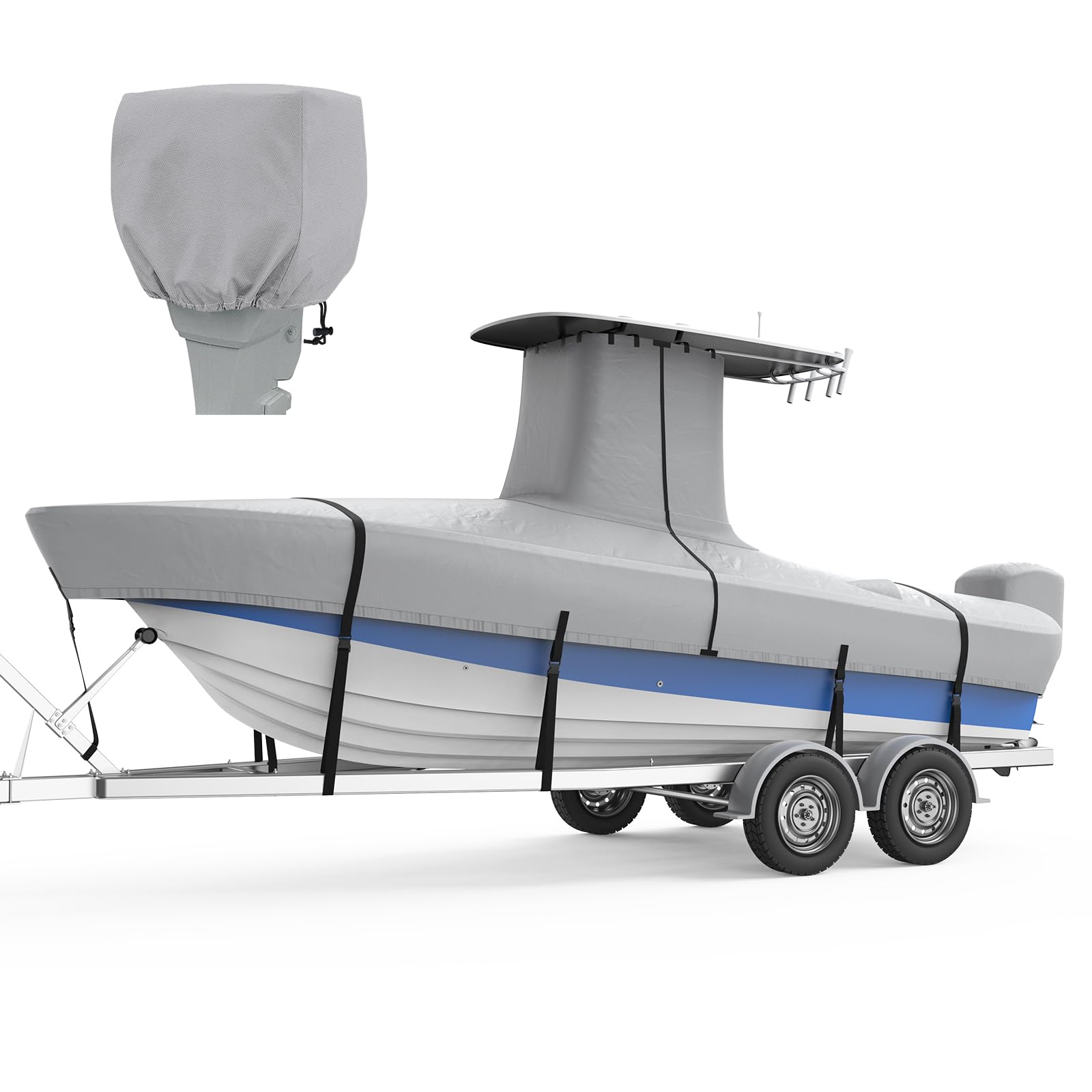
Built around the T-top roof, with a zipper door so you can step into the console without pulling the cover.
A center console with a T-top roof (the open hardtop over the helm) has a completely different silhouette, and this cover is shaped to clear it. It fits 20 to 22 feet of length with a beam up to 106 inches — the widest beam on this list. The top uses 1400D fabric (a dense, heavy weave) rated to withstand the force of storing and trailering under 35 MPH. The bottom uses 1200D marine-grade waterproof fabric with an anti-UV composite and a PU (polyurethane) waterproof backing, so sun and rain protection lasts year-round.
Matching 13 top and 11 bottom quick-release buckles with adjustable strap tightening make installation quick, and the all-around bottom elastic hem pulls to a 360-degree custom fit. The center console cover has a convenient zipper closure, so you can get in and out of the boat without unfastening the entire cover — a real time-saver at the ramp.
Eight vents in total, split between both tails, let wind blow through so vapor does not gather underneath. Fit earns strong praise, and owners note it sits well over a variety of center console models. Durability and water resistance split opinion — some units shrug off weather, while others show tears within about five months and pooling in low spots. Strap length is the other caution; they run short for some setups, so check the distance from your tie-down points before towing far.
Where it earns the premium: The 35 MPH trailer rating up top and the 106-inch beam are both the highest figures in this group. That makes it the only cover here that clears a full T-top roof with that much hull width to work with.
The honest trade-off: Strap length and long-term durability both come up as concerns, so inspect the straps and webbing before any long trip on the highway.
Pick this when: Your boat has a T-top roof on a 20-22 foot hull and you want a zipper door plus a 106-inch beam limit.
Look elsewhere if: You run a flat-deck bass boat or pontoon — the T-top cut wastes fabric on a boat that has no roof to clear.
Know the Specs
Denier (Fabric Weight)
Denier measures the thickness of the fabric threads, and higher is heavier and tougher. A 1600D cover resists tearing and wind rip better than a 900D economy cover. But denier alone does not decide how long the cover lasts — a 1400D cover with reinforced seam stitching can outlast a thicker one with weak stitches. Look at denier together with seam reinforcement and bar-tack stitching at the strap points.
Waterproof Rating (PA)
PA stands for the water pressure the coating holds back before water seeps through. A 12000 PA cover handles serious rain, while 14000 PA covers add extra headroom for pooling snowmelt. The rating means little if the seams leak, which is why waterproof strips taped over the stitching matter as much as the coating itself.
Boat Length And Beam Width
Length and beam width are the two numbers that decide whether a cover fits. Length sets coverage from bow to stern, and beam width sets coverage across the widest part of the hull. A cover that matches your length but runs narrower than your beam will pull tight and leave the rub rails exposed. Measure both before ordering, and when in doubt between sizes, measure the widest point of your hull plus any bow rails or trolling motors that stick out.
Ventilation And Support Poles
Air vents at the tail let humid air escape so condensation does not gather under the cover — which is what turns trapped moisture into mold on your cushions. A support pole props the middle of the cover up so rain and snow slide off instead of pooling and stretching the fabric. A vented cover paired with a support pole is the combination that keeps your boat dry all winter.
Common Questions
Will a 20-22 foot cover fit my 19 foot bass boat?
How do I measure my boat for a mooring cover?
What does the PA number on a boat cover mean?
Is a 1600D cover better than a 1200D cover?
Can I trailer my boat with a mooring cover on?
Why does water pool on the top of my boat cover?
Do I need a motor cover separate from the boat cover?
How long should a boat cover last outdoors?
Will a V-hull cover fit a pontoon or T-top boat?
What is the difference between a mooring cover and a storage cover?
The Bottom Line
Two numbers decide the best mooring cover for your boat: your hull’s beam width and your boat’s length. Get those right, and the fabric specs do the rest. For most bass boats in the 20-22 foot range, start with the Solim 20-22FT Bass Boat Cover. It is a 1200D PU build (a dense, waterproof-backed weave) rated to 9600 PA (a water-pressure resistance measure), with 14 quick-release buckles and a 100-inch beam that covers wide hulls.
If you tow regularly and want a reinforced midsection, the RVMasking 1400D Center Reinforced cover puts tougher fabric where wind attacks at a mid-range price. For a center console that needs to clear the helm, the Solim 17′-19′ Center Console cover handles a 54-inch console height and a 102-inch beam.
And if your boat lives on a windy mooring, the Caminor cover with its 11 included sandbags removes the guesswork of anchoring. The one honest nudge: measure your beam and length before you order, because a cover that fits loosely will never protect as well as one that clings to the hull.
How we choose
We do not accept paid placement. Every pick is matched to a real buyer and a real use-case; we do not hands-on test units.
Sources
Specifications: manufacturer listings and product documentation. Review insights: verified customer reviews, as of November 2026. Pricing: not shown on this page (it changes often); check the current price via the retailer link.
As an Amazon Associate, Tactical Gear Guy earns from qualifying purchases. This does not affect which products we feature.