Specs are compiled from manufacturer listings and verified buyer reviews and can change over time — please confirm the key details on the product page before buying.
Buy the radio that still transmits after it goes over the side. That is the whole decision with a marine VHF, and it is why a floating, IPX8-rated handheld should be your first purchase before any fixed-mount unit. Below you will find the handhelds that survive a dunk and the fixed-mount units that give you real transmit power — sorted by what each one is actually good at.
This guide is built by comparing the manufacturers’ published specifications and the patterns across verified customer reviews, so you get each pick’s real strengths and trade-offs instead of marketing spin.
Waterproofing claims and wattage numbers are the two places buyers get burned, so every pick here is checked on both. Here is how to spend your money once on a marine VHF that keeps transmitting when the weather turns ugly.
Top Picks


How To Choose The Best Marine VHF Radio
Start with where the radio lives, because that answer decides everything else. A handheld you clip to your life jacket and a fixed-mount bolted under the windshield solve two different problems, and buying the wrong type is the most common mistake on this shelf.
Handheld or fixed-mount
A handheld runs on its own battery pack and travels with you — into the dinghy, onto the dock, over the side. A fixed-mount draws power from the boat and transmits at higher wattage, so it reaches farther. Most serious boaters end up with both.
The wattage gap is the real story. Handhelds in this group top out at 6 watts, while fixed-mount units run up to 25 watts, which is the difference between talking to a nearby marina and reaching a station across open water.
Waterproofing is not a marketing word
An IP rating (Ingress Protection — how well a sealed case keeps water out) tells you exactly how much abuse a radio takes. IPX7 means it survives a meter of water for 30 minutes. IPX8 means it goes deeper or longer, and it is the rating to hunt for on a handheld.
Floating matters just as much, and it is a separate feature from waterproofing. A heavy radio that sinks is a waterproof brick at the bottom of the bay, so check that the case is buoyant before you trust it offshore.
The safety channels you will actually use
Channel 16 is the hailing and distress channel, and every radio here covers it. Tri-Watch or Dual Watch lets you monitor Channel 16, Channel 9 and one working channel at the same time, so you never miss a distress call while chatting on a secondary channel.
DSC (Digital Selective Calling) sends an automated distress message with your identity attached when you press the button — but it only works on fixed-mount class D radios, and only with a registered MMSI number. A handheld without DSC still gets you heard; it just requires you to speak.
Side-by-Side Comparison
| Model | Best For | Transmit Power | Water Rating | Floats? | Amazon |
|---|---|---|---|---|---|
| Uniden Atlantis 275★ Best Overall | All-round handheld | 6W / 2.5W / 1W | IPX8 / JIS8 | Yes | Amazon |
| Retevis RM15Offshore Specialist | Offshore fishing | 6W / 3W / 1W | IP68 | Yes | Amazon |
| Retevis RT55Budget Floater | Kayak and dinghy | 6W | IP67 | Yes | Amazon |
| Standard Horizon HX210 | Sailboat racing | 6W / 2.5W / 1W | IPX7 | Yes | Amazon |
| Cobra BlueBound 350 | Easy retrieval | 6W / 3W / 1W | IPX7 | Yes | Amazon |
| Uniden UM725G | Text messaging | 25W / 1W | IPX8 | No | Amazon |
| Icom IC-M330 | Tight helm spaces | — | — | No | Amazon |
| Standard Horizon GX1400 | Class D DSC value | — | IPX8 | No | Amazon |
| Icom M330G | GPS built in | — | — | No | Amazon |
Detailed Reviews
1. Uniden Atlantis 275 Handheld Two-Way VHF Marine Radio
Our pick — 4.5+★ from 550+ verified ratings; the strongest balance of quality and price.
The pocket handheld that floats, strobes, and lights your way back to the boat.
The Atlantis 275 is the handheld to buy if you want one radio that covers the whole trip. It transmits at a selectable 6W, 2.5W, or 1W — three power levels (watts measure transmit strength) so you can dial up the reach offshore and drop to 1W to stretch the battery at the dock. At 1.5 pounds with a 9.6″D x 6.6″W x 2.9″H body it is compact enough to tuck in a console or clip to a life jacket, yet it carries the largest LCD screen in its class at 25mm tall by 40mm wide — big enough to read a channel number at a glance with spray on the glass.
That screen does something genuinely useful: a paper-white backlight for daylight and a red backlight for night runs, so you are not blinding yourself on a dark helm. Uniden also builds in an emergency strobe light and a flashlight, which is the sort of feature you forget about until the night you need it. Waterproofing is rated IPX8 / JIS8 — submersion-tested — and the speaker clears itself of water after a dunk so your audio comes back instead of crackling.
Two things earn it the top spot. It floats, and it receives all USA, Canada, and International marine channels including the newer 4-digit channels and Canadian “B” channels, plus every NOAA weather channel and alert. The included lithium battery pack, AC and DC charging cables, and charging cradle mean it works from the start on boat power or shore power. Buyers find it easy to operate with good reception and range for a handheld, and it is backed by a 3-year waterproof warranty — a long commitment for a small radio.
The honest note is battery stamina. It is the single most divided point in owner feedback, with some getting a full day and others running it down faster, and running 6W constantly drains it quickest. Treat the 1W and 2.5W settings as your battery-saver and the 6W setting as your emergency reach.
Why it takes the crown
- Floats and carries an IPX8 / JIS8 submersion rating
- Selectable 6W / 2.5W / 1W power for reach or runtime
- Built-in strobe and flashlight for night recovery
- Largest LCD in its class with day and night backlights
- All USA, Canada, and International channels plus NOAA alerts
What to plan around
- Heaviest handheld here at 1.5 pounds
- Battery life splits opinion — especially on full 6W
Buy this one if: you want a single do-everything handheld with a strobe, a screen you can read at night, and a 3-year waterproof warranty behind it.
Look elsewhere if: you need days of runtime without recharging — the flashlight and strobe are welcome, but they cost you battery.
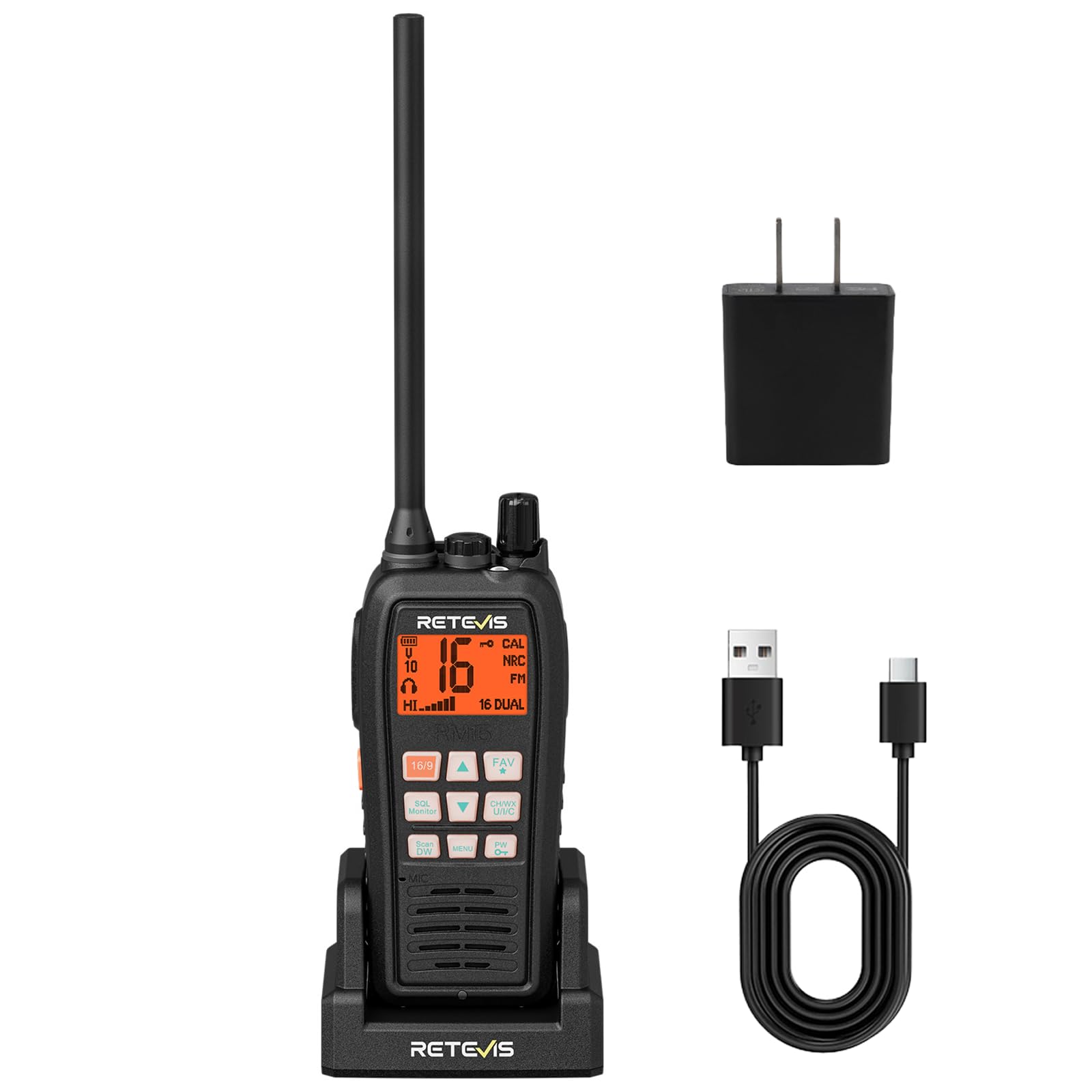
2. Retevis RM15 Marine Radio
The tiny fishing handheld with a 2000mAh battery and a USB-C port on the radio itself.
If you fish from a boat, in salt, in spray, this is the pick that says so. The RM15 carries the highest water rating in this group — IP68, which means it survives immersion to 1.5 meters for 30 minutes and uses corrosion-resistant charging contacts. That level of sealing is a step beyond the IPX7 handhelds further down this list.
The battery is the standout number. It runs a 2000mAh pack (milliamp-hours, a measure of battery capacity) good for over 10 hours of operation and up to 100 hours of standby, so a full day offshore fits inside one charge. The Type-C port (a common USB charging plug) sits on the radio itself, so you can charge it from a power bank or a dash socket instead of hunting for a proprietary dock. Compare that to the Retevis RT55 below, which runs a 1200mAh pack — the RM15 carries meaningfully more reserve for a long day offshore.
Range is quoted at 16km with selectable 1W/3W/6W transmit power, and the noise-reduction system works on both transmit and receive to clean up audio in wind. The 1000mW (1W) speaker is genuinely loud. There is a water-activated emergency strobe for locating the radio overboard, vibration-based water drainage that shakes trapped water out of the speaker, and Triple Watch monitoring CH16, CH9 and your working channel. NOAA alerts and Part 80 compliance round it out. It measures just 1.57″D x 2.44″W x 5.35″H at 302.3 g — a genuinely small radio versus the Atlantis 275’s 9.6″D x 6.6″W x 2.9″H body.
What lets it down is documentation and the odd menu quirk — Retevis gear rarely ships with the depth of manual a first-timer wants, so budget an evening with it before you rely on it. Function is what wins buyers over, and the value is the reason this one ranks so high.
The 2000mAh advantage: this is the biggest battery pack in the handheld group, and the on-radio USB-C port means a power bank tops it up between trips.
Small print worth knowing: the waterproofing is the best here, but the manual and menu learning curve are the cost of a budget-brand price.
Reach for this if: you are fishing offshore, want the toughest water rating on this list, and want to charge from USB-C instead of a cradle.
Pass if: you want a large, information-dense screen — this is a compact, utilitarian layout.
3. Retevis RT55 6W Marine Radio VHF IP67 Floating
A bare-bones floating six-watter that does the Channel 16 job without fuss.
Kayakers and dinghy sailors need three things: it floats, it survives spray, and it hits Channel 16. The RT55 handles all three. IP67 waterproofing means it survives a meter of water for 30 minutes, and the body is buoyant, so a dropped radio bobs where you can grab it.
The 1200mAh rechargeable battery charges through a desktop charger and is rated for 10 hours of average life, which is the shortest reserve in this handheld lineup — the RM15 above carries a 2000mAh pack, so if long days offshore are your norm, that is the trade. For a morning paddle or an afternoon sail, it is plenty. The backlit LCD auto-adjusts brightness so you can read it in sun or after dark, and NOAA (the US National Oceanic and Atmospheric Administration) weather alerts come through automatically when a front moves in.
There is also a vibration water-draining function, so a dunked speaker gets shaken clear rather than left muffled. Owners praise its straightforward operation, and the 156.025–157.425MHz range covers standard marine traffic. It comes with the radio, battery, antenna, belt clip, sling, screws, and charger — a complete kit with nothing else to buy.
One caveat to weigh: the value proposition divides opinion, so check what you are getting against the more capable Retevis above before you commit. The RT55 is the honest budget choice rather than the do-everything one.
Where it fits: a floating, IP67-rated six-watt handheld for kayak and small-boat use where a replacement battery pack and a desktop charger are all you need.
Where it stops: 1200mAh is the smallest pack in the handheld group here, so heavy users should step up.
Worth it for: casual paddlers and day sailors who want float-and-survive protection on a tight budget.
Step up if: you are regularly out for full days — the bigger RM15 battery serves you better.
4. Standard Horizon HX210 Marine VHF Transceiver
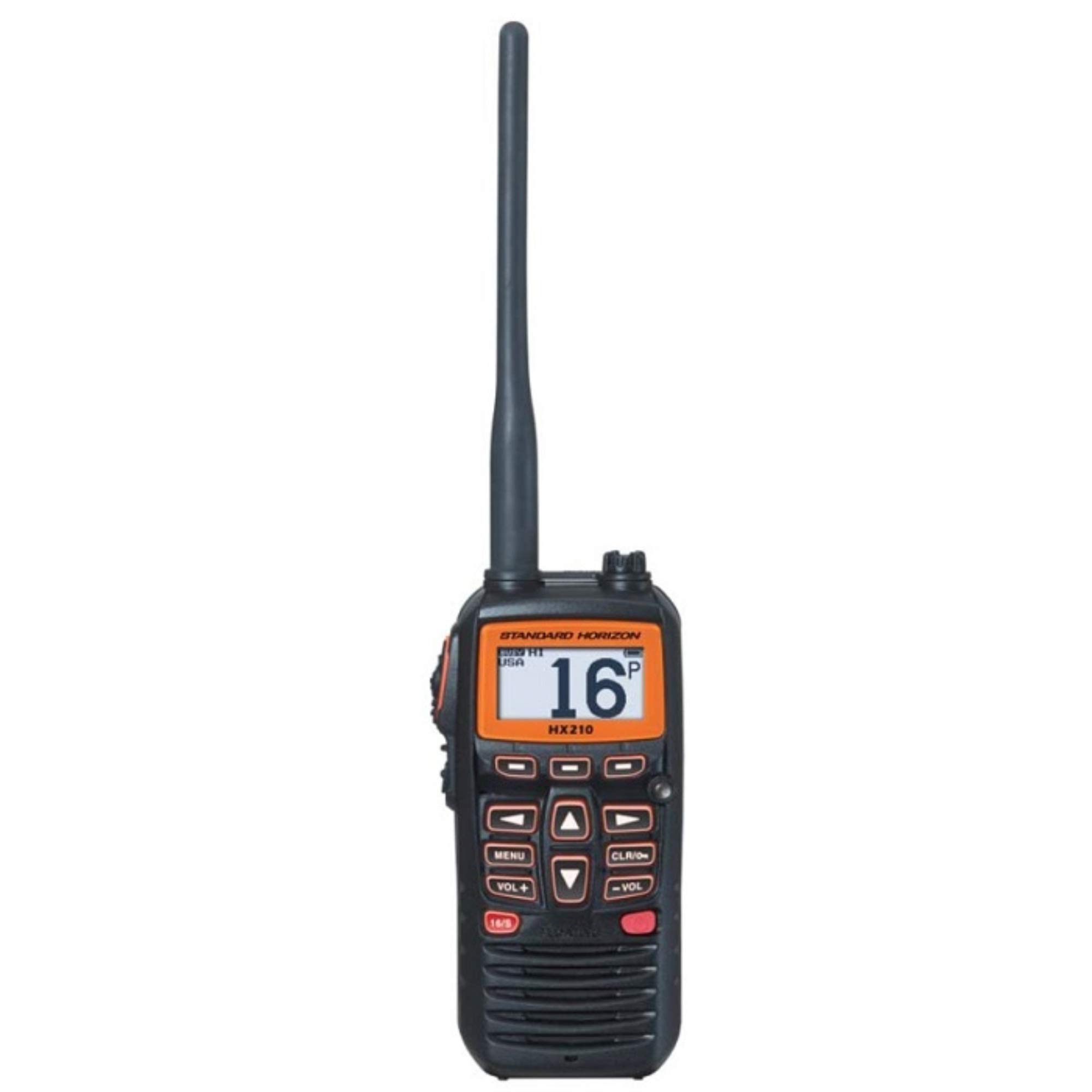
The handheld that doubles as a broadcast FM radio when the racing is over.
Audio is the thing that gets talked about most with this radio, and it is easy to hear why. Standard Horizon gives the HX210 an oversized full dot matrix display and a menu system they call E20, but the feature most owners notice first is simply how well it sounds on the water. Reliability is the second recurring theme, which matters more than any spec sheet.
Then there is the odd extra that makes it unique here: a built-in FM broadcast band receiver covering 76MHz to 108MHz. You get your marine channels and your music from one radio, which is a small luxury on a long motor home. The case is compact at 1.57″D x 2.36″W x 5.2″H and 16 ounces, and it carries IPX7 waterproofing — good to 3.3 feet or 1 meter for 30 minutes — plus a water-activated emergency strobe.
Power is selectable across 6W, 2.5W, and 1W, and the 1850mAh Li-Ion pack charges on a 3-hour desktop rapid charger with both 12VDC and 110VAC cables in the box. You also get all USA, International, and Canadian channels, 200 channels total, programmable function keys, and a speaker mic jack. Sailboat racers in particular get on with this radio, and it is backed by a 3-year waterproof warranty.
The one real split is the battery: plenty of owners get a long run per charge, others find it needs more frequent charging than they’d like. It is a mixed picture rather than a defect, and the 1850mAh pack is healthy-sized, so plan on a charge cycle before a long race day.
Signature trait: sound is the most-praised thing here, and the FM broadcast receiver means one radio covers chatter and music.
The honest split: battery endurance reads differently depending on how hard you push transmit power — a mixed report, not a flaw.
Top choice for: racers and cruisers who care about how a radio sounds and want FM radio in the same case.
Consider twice if: you want a screen as large as the Atlantis 275’s — this one prioritizes audio over display size.
5. Cobra BlueBound 350 VHF Handheld Marine Radio
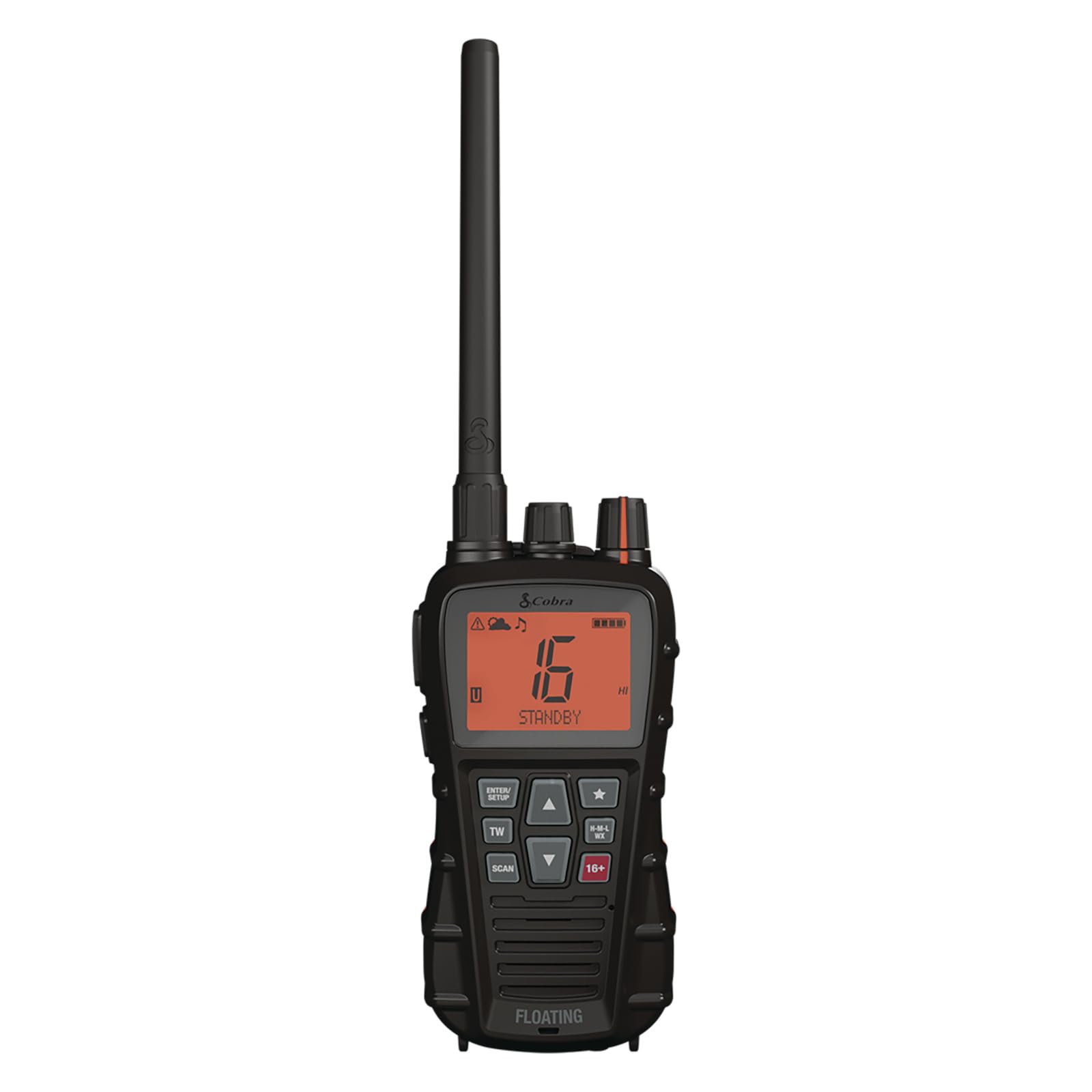
A high-visibility orange core that floats face-up so you can find it fast.
Every floating radio solves half the overboard problem. The BlueBound 350 solves the other half with a high-visibility orange floating core that makes the radio easy to spot and grab before it drifts. At 9.44 ounces it is the lightest handheld here, so clipping it to a life jacket does not drag you down.
The power is selectable across 1W, 3W, and 6W, and the battery is rated for 12 hours of average life — the longest quoted runtime among the handhelds in this guide, so it can outlast a full day on the water. You get a day-night selectable LCD that stays readable whatever the weather, Tri-Watch (a mode that scans three channels at once) for instant access to Channels 9, 16 and your chosen working channel, and 12 NOAA weather channels plus the emergency broadcast channel. The chassis handles full immersion to IPX7 standard (survives being dunked in 1 meter of water for 30 minutes).
Owners praise the simple controls and rugged build, and at 9.44 ounces it clips to a life jacket instead of living in a locker. It ships with a battery, belt clip, cable, charger, and lanyard, and covers 98 channels.
Two honest notes. Range reports are genuinely split — some owners find it reaches well, others find it shorter than expected — so treat it as a solid line-of-sight radio rather than a long-haul one. Charging options are the other weak spot that comes up, so know how you plan to top it up before you buy.
The case for the Cobra
- Orange floating core makes it easy to spot overboard
- 12-hour rated battery — the longest here
- Lightest handheld on this list at 9.44 ounces
- Tri-Watch on Channels 9, 16 and a working channel
Where it gives ground
- Range experience divides owners
- Charging setup draws criticism
Pick it for: the lightest, brightest handheld here, with the longest quoted runtime for a full day on the water.
Think again if: you need proven long-distance reach — this suits line-of-sight coastal use best.
6. Uniden UM725G Marine VHF Radio with GPS Built-in

The fixed-mount that can text another boat privately instead of broadcasting to the whole harbor.
This is the first marine VHF to offer text messaging, per Uniden, and it is a genuinely useful trick. You and your crew can message boat-to-boat rather than keying the mic and telling every vessel in the area your business. Add DSC distress send and receive, a speaker microphone, and built-in GPS, and you have a full helm station in one box.
Power jumps to a whole different league. The UM725G transmits at 1 or 25 watts — against the 6-watt ceiling of every handheld above — so it reaches station-to-station in a way a pocket radio simply cannot. It covers all USA, Canada, and International marine channels, carries an IPX8 submersible rating, and packs NOAA weather channels with alerts. The LCD is the largest in its class at 68mm wide by 38mm tall, which is a lot of screen to read at a glance.
Installation is the thing owners single out as a pleasure rather than a chore, and quality is what gets praised most. The box includes a DC power cord, NMEA0183 data cord, extension speaker cord, mounting bracket and knobs, microphone hanger, and mounting hardware — everything for a clean install. It also weighs just 2 pounds.
Set expectations on one thing: this is a permanent, wired, bolted-in radio, so you need a helm or console to mount it to and boat power to feed it. It is not the radio you carry to the dinghy — that is the handheld job.
The 25-watt case: four times the transmit ceiling of the handhelds here, plus GPS and private texting in one box.
Who shouldn’t buy it: anyone without a fixed mounting spot and a 12V feed — this is a permanent install, not a grab-and-go.
Made for: skippers with a helm station who want 25 watts, DSC, GPS and private messaging in one install.
Not for: small-boat owners with no mounting console — the handhelds serve you better.
7. Icom IC-M330 Ultra Compact VHF Marine Transceiver

A helm-sized transceiver built for consoles where every square inch is already spoken for.
If your dashboard is crowded, this is the radio that fits. The IC-M330 uses a palm-sized chassis designed for flexible installs in small consoles and tight helm spaces, so you get a fixed-mount radio without giving up your whole panel. It weighs 2.8 pounds.
The audio engineering behind it is real. A new speaker design pushes loud, clear sound with rich bass and crisp treble, tuned to stay distortion-free even at full volume — so you can hear a call over a running engine and rising wind. Receiver performance is where Icom leans hardest: more than 70 dB selectivity (a measure of how well it rejects nearby signals) and IMD (intermodulation distortion resistance) keep channels clean in RF-busy places like marinas and harbors, where a weaker radio gets swamped by nearby signals.
Safety comes built in as Class D DSC, which continuously monitors Channel 70 for distress, individual, group, all-ships, safety, position request/report, polling, and test calls. The directional keypad and soft keys are the Icom marine interface, with frequently used functions on one-touch keys. It is made in Japan and tested to in-house and environmental standards. Icom builds this one to stay on the helm for years.
One thing to know up front: this is a fixed-mount radio and Icom does not publish a water rating or a listed wattage in the specs provided here, so confirm both for your install before you buy. It also has no GPS onboard — that is the M330G below.
Where it wins: the smallest fixed-mount footprint here, plus 70 dB-plus selectivity for crowded marinas.
What to confirm first: no GPS and no published water rating in the spec listing — check the manual for your setup.
Right for: tight helm spaces where a compact chassis and clean receiver audio matter more than onboard GPS.
Wrong for: you need GPS built into the radio — the M330G is the version with it.
8. Standard Horizon GX1400 Eclipse Fixed Mount VHF Radio

The fixed-mount that puts every control on the microphone so you never leave the wheel.
Here is the fixed-mount to buy if you want real DSC safety without the flagship price. The GX1400 is an ultra-compact Class D DSC radio, and that DSC support is the important part: a dedicated separate receiver for Channel 70 means it hears digital distress calls even while you are monitoring another channel. It replaces the older Eclipse+ and Eclipse DSC models.
Controls sit on the microphone, so you can change channels and settings with the mic in hand instead of reaching for the body. The oversized full dot matrix display measures 31mm x 55mm, and the E2O icon and menu system keeps navigation simple. It carries an IPX8 submersible rating — 1.5M or 4.92 feet for 30 minutes — so it handles a wet, open cockpit.
There is real navigation utility here. Connected to a GPS receiver, it shows position and time on the display, and the NMEA input and output connections link to a compatible GPS chart plotter. You can also automatically poll the GPS position of up to 4 ships using DSC, and preset keys recall up to 10 favorite channels. Coverage includes all USA, International and Canadian channels, with NOAA weather selection and alerts, programmable scan, priority scan, and dual watch.
Where it stumbles is consistency. Some units run flawlessly, others reportedly go intermittent, and the value read splits along the same lines — this is a mixed picture rather than a universal one, but worth knowing before you install. Quality, though, is the thing owners praise most.
The mic-control advantage: DSC on a separate Channel 70 receiver, with all your channel changes handled from the microphone.
The one to watch: buyers report mixed reliability, so buy from a seller with a low-maintenance exchange policy.
Best when: you want Class D DSC, chart-plotter integration, and all controls at the end of a mic cable.
Hesitate if: you want rock-solid field reports before you buy — the reliability picture here is divided.
9. Icom M330G Compact Basic VHF with GPS

The same compact Icom, but with the GPS antenna in the box so DSC knows where you are.
Take the IC-M330 above and add GPS, and you get this. The M330G is a compact basic VHF with an external GPS antenna on a 5-meter cable included — which is the piece that lets a DSC distress call transmit your position to rescue services. If you ever plan to press that button, this is the version that makes it count.
The box includes the M330G VHF, mounting bracket, power cord, external GPS antenna with its 5-meter cable, and user manual. It weighs 3 pounds and lists 16 channels. Owners value its reliability and build quality, which matches Icom’s reputation for fixed-mount radios that keep working season after season.
One design choice draws mixed reactions: the squelch and volume controls share a single knob. Some find it neat and compact; others would rather have separate dials so they can adjust one without nudging the other. It is a preference, not a fault, but it is worth knowing before you buy.
What you are paying for is the GPS integration and the Icom build, and the 5-meter antenna cable gives you the length to route it out for a clean sky view. For a compact fixed-mount that puts your position on the airwaves when it matters, this is the tighter, more capable version of the Icom pairing here.
The GPS argument: the included external antenna and 5-meter cable put position data into your DSC calls.
The quirk to accept: squelch and volume live on one knob — fine for many, fiddly for some.
Choose it when: you want a compact Icom fixed-mount with GPS onboard for accurate DSC position reporting.
skip it if: you already feed GPS from a chart plotter — the lower-cost M330 does the same job.
Know the Specs
Transmit power in watts
Watts measure how hard the radio pushes its signal out. A handheld at 6W reaches nearby stations and boats; a fixed-mount at 25W goes considerably farther, which is why offshore boats carry one. Higher wattage also drains a battery faster, so selectable power levels let you drop to 1W for close-in chatter.
IP ratings explained
IP stands for Ingress Protection — two digits that tell you how sealed the case is. IPX7 survives a meter of water for 30 minutes; IPX8 goes deeper or longer. IP67 means it survives dust and a meter of water. Higher is more forgiving, and on a boat it is the single spec that decides whether a radio survives a capsize.
Battery capacity (mAh)
A milliamp-hour (mAh) figure tells you how much energy the pack holds. More mAh means more runtime between charges. A 2000mAh pack gives more reserve than a 1200mAh pack, though how hard you transmit affects real runtime far more than the raw number.
DSC (Digital Selective Calling)
DSC sends an automated digital distress message with your boat’s identity and, if GPS is connected, your position — no voice needed. It runs on dedicated Channel 70 and only appears on fixed-mount Class D radios. A handheld without DSC still calls for help; you just do it by voice on Channel 16.
Common Questions
Do I need a license to operate a marine VHF radio?
What is the difference between a handheld and a fixed-mount VHF radio?
Will a floating VHF radio actually float if I drop it overboard?
What is DSC and do I need it on my boat?
How far can a 6-watt handheld marine radio reach?
Should I buy a handheld or a fixed-mount if I only sail inland lakes?
What is Tri-Watch and why does it matter?
Can a waterproof marine radio survive saltwater and still work later?
Do fixed-mount VHF radios need a separate GPS antenna?
How long does a handheld marine radio battery last per charge?
The Bottom Line
The marine vhf radio that gets my vote is the Uniden Atlantis 275 — it floats, carries an IPX8 submersion rating (survives being dropped in the water), and gives you selectable 6W / 2.5W / 1W power plus a night-readable screen and a 3-year waterproof warranty. If you fish offshore and want the toughest water rating and a USB-C port, grab the Retevis RM15 with its 2000mAh pack. And if you have a helm station and need real reach plus DSC safety (Digital Selective Calling, a one-button distress signal), the Uniden UM725G transmits at 25W with GPS and private texting built in.
Buy the floating handheld first, then add the 25-watt fixed-mount when your cruising grounds get bigger — that order keeps you on the air on every trip in between.
How we choose
We do not accept paid placement. Every pick is matched to a real buyer and a real use-case; we do not hands-on test units.
Sources
Specifications: manufacturer listings and product documentation. Review insights: verified customer reviews, as of November 2026. Pricing: not shown on this page (it changes often); check the current price via the retailer link.
As an Amazon Associate, Tactical Gear Guy earns from qualifying purchases. This does not affect which products we feature.