Specs are compiled from manufacturer listings and verified buyer reviews and can change over time — please confirm the key details on the product page before buying.
If you split firewood by hand, the question is not which tool looks toughest — it is which one gets a round broken down before your shoulders quit. Some buyers want a fixed wedge you hit with a mallet so your hands never go near a blade. Others want a long-handled maul that turns a big round into quarters in a few swings. Both approaches work, and this list covers both.
This guide is built by comparing the manufacturers’ published specifications and the patterns across verified customer reviews, so you get each pick’s real strengths and trade-offs instead of marketing spin.
You get a clean split instead of a stuck blade based on three things: head weight, handle length, and whether the wedge moves or stays fixed. Here is how the best manual wood splitter options sort out for real firewood work.
Top Picks

How To Choose The Best Manual Wood Splitter
Two tools share this shelf, and they are not interchangeable. A fixed-wedge splitter holds the blade still and you drive the log down onto it with a mallet. A splitting axe or maul swings a heavy head into the round. Pick the wrong one for your firewood and you will fight every log.
Fixed wedge or swinging head
A fixed-wedge tool keeps both hands away from the blade at all times, because nothing swings past your knuckles. That makes it the choice for kindling, small rounds, and anyone who wants the work to feel controlled. A swinging head is faster on volume — but only when your log diameter suits the weight behind it.
Head weight against handle length
Heavier heads break dense wood but tire you out. Longer handles add leverage so a lighter head still lands hard. The two numbers work as a pair: a 5-pound head on a long handle behaves very differently from the same head on a short one. Match the pair to the size of your typical round, not to the biggest log you ever expect to meet.
Hand shock and handle material
Every strike sends vibration up the handle into your palms and wrists. Wood handles absorb a little and eventually crack under overstrikes. Steel handles with a molded grip and a shock-control layer cut that vibration down and survive a missed swing. If you split for hours, this is the spec you will feel by evening.
The sharpness question
A splitting tool does not need a razor edge to work — it needs the right wedge geometry to push wood apart. Convex and bevel edges release from the log more easily than a thin flat grind, which is why they resist sticking. A fixed-wedge cast iron tool has no edge to sharpen at all.
Side-by-Side Comparison
| Model | Best For | Head Weight | Handle / Length | Type | Amazon |
|---|---|---|---|---|---|
| Kindling Cracker Original★ Best Overall | Safe kindling with no swing | 10 lb (cast iron ring) | 6.5-inch opening | Fixed wedge | Amazon |
| ESTWING Timber Titan EB-TT4Best Compact Swing | Small logs one-handed | — | 16.3″L | Splitting maul | Amazon |
| Fiskars A-Series Super Splitting AxeBest for Taller Users | Taller users, medium to large logs | — | 36-inch FiberComp | Splitting axe | Amazon |
| Fiskars Pro IsoCore 6 lb Maul | Hardwood and dense rounds | 6 lb | 36-inch | Splitting maul | Amazon |
| Husqvarna S2800 | Long swinging sessions | 5 lb | Fiberglass, 27.6″L | Splitting axe | Amazon |
| Scheppach Manual Wood Splitter | Small logs and kindling, wall-mounted | — | 560 mm lever | Lever wedge | Amazon |
| 1844 Helko Werk Saxon Splitter | Large rounds and difficult logs | 6-1/4 lb | 31-inch hickory | Splitting axe | Amazon |
| 1844 Helko Werk Vario | Heavy trunks and interchangeable heads | 5 lb | 36-inch hickory | Splitting maul | Amazon |
Detailed Reviews
1. Kindling Cracker Original Firewood Kindling Splitter
Our pick — 4.5+★ from 14,500+ verified ratings; the strongest balance of quality and price.
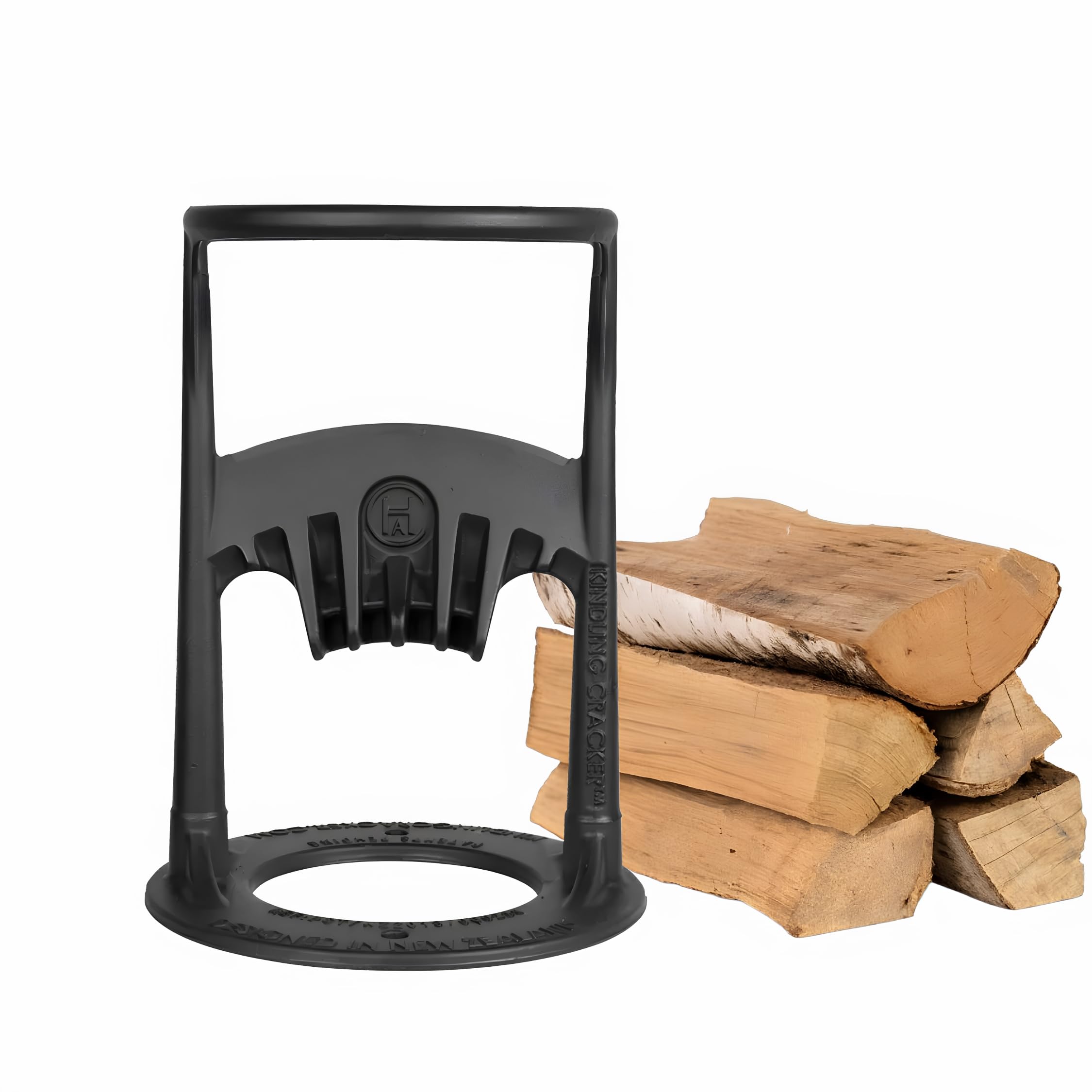
A fixed ring of cast iron that makes kindling while your hands stay clear of the blade.
Here is the odd one out on this whole list: nothing swings. You drop a log into the 6.5-inch cast iron safety ring and strike the top with a mallet, a hammer, or even another piece of wood. The fixed splitting wedge does the separating. Your fingers never cross the blade path, which is the entire point.
You get the heaviest head in this lineup at 10 pounds of cast iron — the Husqvarna S2800 carries a 5-pound head by comparison — but almost none of that weight ever travels. It holds the wedge steady while the mallet supplies the force, so the tool splits far more gently than an axe of the same mass. It is forged as one smooth piece in an Australian foundry, with no welds, no joints, no moving parts, and no blade to sharpen.
What wins people over is the safety ring and the low effort — it turns out a pile of kindling with startlingly little force, and the cast iron feels built to outlast the woodpile. Built-in bolt holes let you mount it to a stump or workbench, and the base is stable enough to use freestanding. The honest catch is capacity: the 6.5-inch opening caps you at smaller logs, and this tool makes kindling rather than quartering big rounds. If your firewood starts as full rounds, you still need an axe alongside it.
Where it earns its keep
- No swinging blade, so your hands stay behind the safety ring the whole time
- One-piece cast iron with no blade to sharpen and nothing to maintain
- Approachable force level — a mallet replaces a heavy overhead swing
- Mounts to a stump or works freestanding indoors or out
Where it stops
- The 6.5-inch opening limits you to small logs and kindling
- Still needs a mallet, hammer, or striking block you supply yourself
Go this way if: you want fireplace or fire pit kindling without a blade near your hands, or you are buying for someone who should not be swinging an axe at all.
Keep looking if: your woodpile is full rounds that need quartering — you need a maul for that job.
2. ESTWING Timber Titan Splitting Maul EB-TT4
A short, forged steel maul for tight spaces and logs you can handle one-handed.
At 16.3 inches long and 4.5 pounds, this is the smallest swinging tool here — the Fiskars A-Series stretches to 37.75 inches, so the Estwing gives up a lot of leverage for a lot of control. That trade suits splitting at a campfire, on a tailgate, or anywhere you do not have room to finish a full overhead arc.
Forged from a single piece of American steel, it has no castings or welds to fail, and the black molded shock reduction grip is built to cut impact vibration. Estwing claims 70% vibration reduction, a manufacturer figure rather than an independent test result. The convex blade edge and powder-coated finish hold up to regular use, and the whole thing is made in Rockford, Illinois.
Quality is the headline — it is the most-praised trait in the feedback for this tool, with splitting ability right behind it. It does best on small logs: the compact handle lets you place a strike precisely and split modest rounds with a single hand if your grip is strong. Pair it with a small sledgehammer and it drives through bigger rounds too. The follow-up question every buyer asks is whether 16.3 inches is enough swing — on large hardwood, no, and that is what the long-handled picks below are for.
What the compact size buys you: precision and portability, backed by one-piece forged steel that has nothing to come loose. The Timber Titan is the pack-along splitter, not the woodpile workhorse.
The limit to weigh: 4.5 pounds on a 16.3-inch handle simply cannot generate the head speed of a 36-inch maul, so treat it as a small-log and campfire tool.
Reach for this if: you split small rounds, pack a maul to a campsite, or want a second short tool for awkward angles.
Look elsewhere if: your logs are large and dense — you will want the leverage of a 36-inch handle.
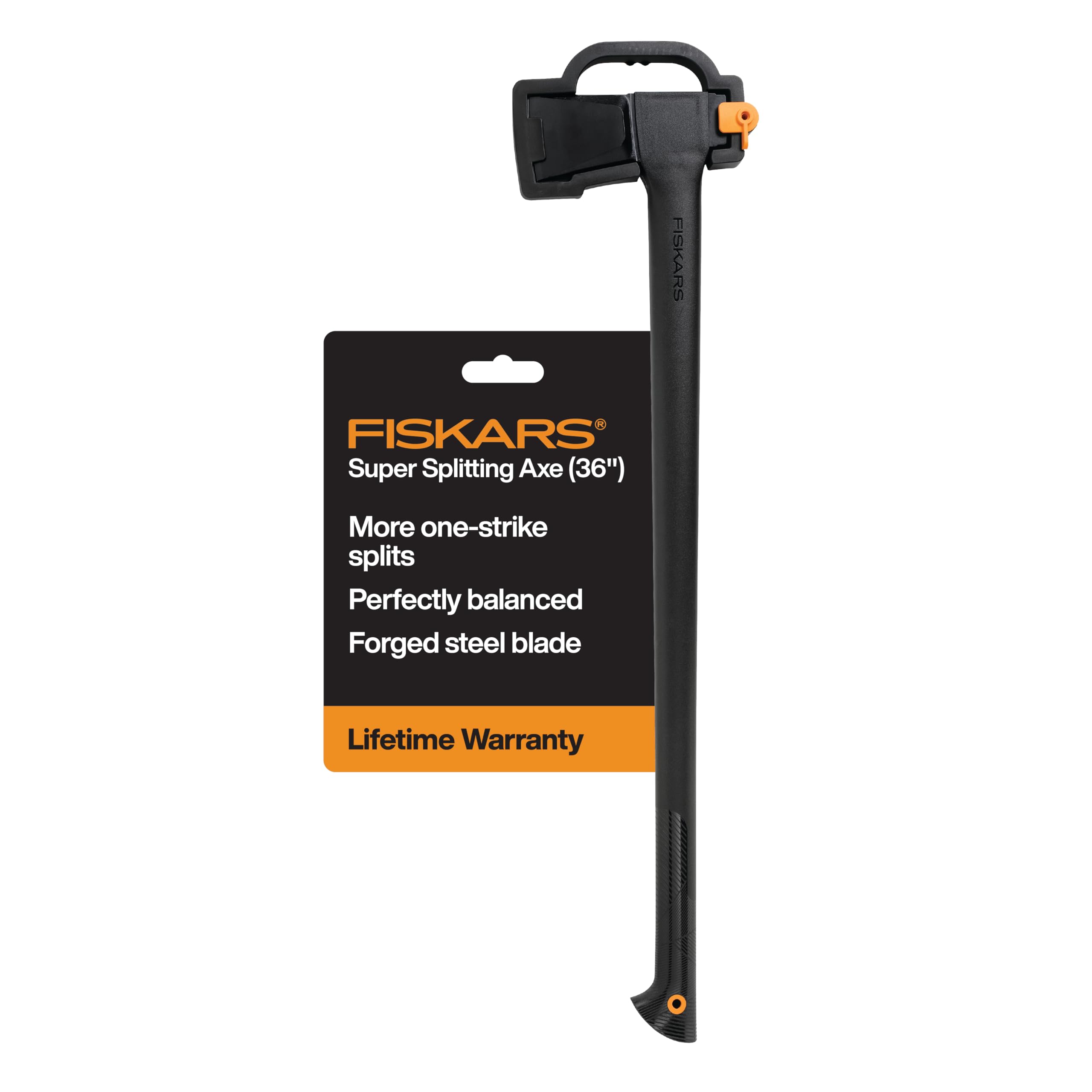
3. Fiskars A-Series Super Splitting Axe 36″
Thirty-six inches of leverage aimed squarely at medium and large rounds.
Start with the number that decides the swing: 37.75 inches of overall length. That is 21.45 inches longer than the Estwing Timber Titan’s 16.3 inches, and those extra inches of arc are exactly where one-strike splits come from. If you are tall, the reach keeps you from stooping over the block all afternoon.
The FiberComp handle — a fiber-reinforced composite — is built to be lighter than a comparable steel handle and to absorb shock, while resisting the overstrike damage that cracks wood. The hardened forged steel blade keeps its edge through repeated use. A convex bevel blade geometry with a low-friction coating helps the head power in and then release cleanly, which is what stops the blade from lodging halfway down the round.
Buyers report clean one-strike splits on medium rounds, and the axe stays light enough in hand for a full day of swinging. The comfort and ergonomics hold up — no stinging palms at the end of a session. Nothing here is a compromise on the swing itself; the thing to know is that a lightweight composite handle trades some of the heavy, dead-blow feel that hickory purists prefer.
The leverage story: 36 inches of handle plus balanced head weight does the work, and the convex bevel with low-friction coating keeps the blade moving through and out of the log.
If feel matters most: the composite handle is shock-absorbing and durable, but it will not give you the traditional heft of a wooden handle.
Made for: taller splitter with a steady supply of medium to large rounds who wants more one-swing splits and less bending.
Not your tool if: you split from a low block or prefer the classic resonance of a wood handle.
4. Fiskars Pro IsoCore 6 lb Splitting Maul
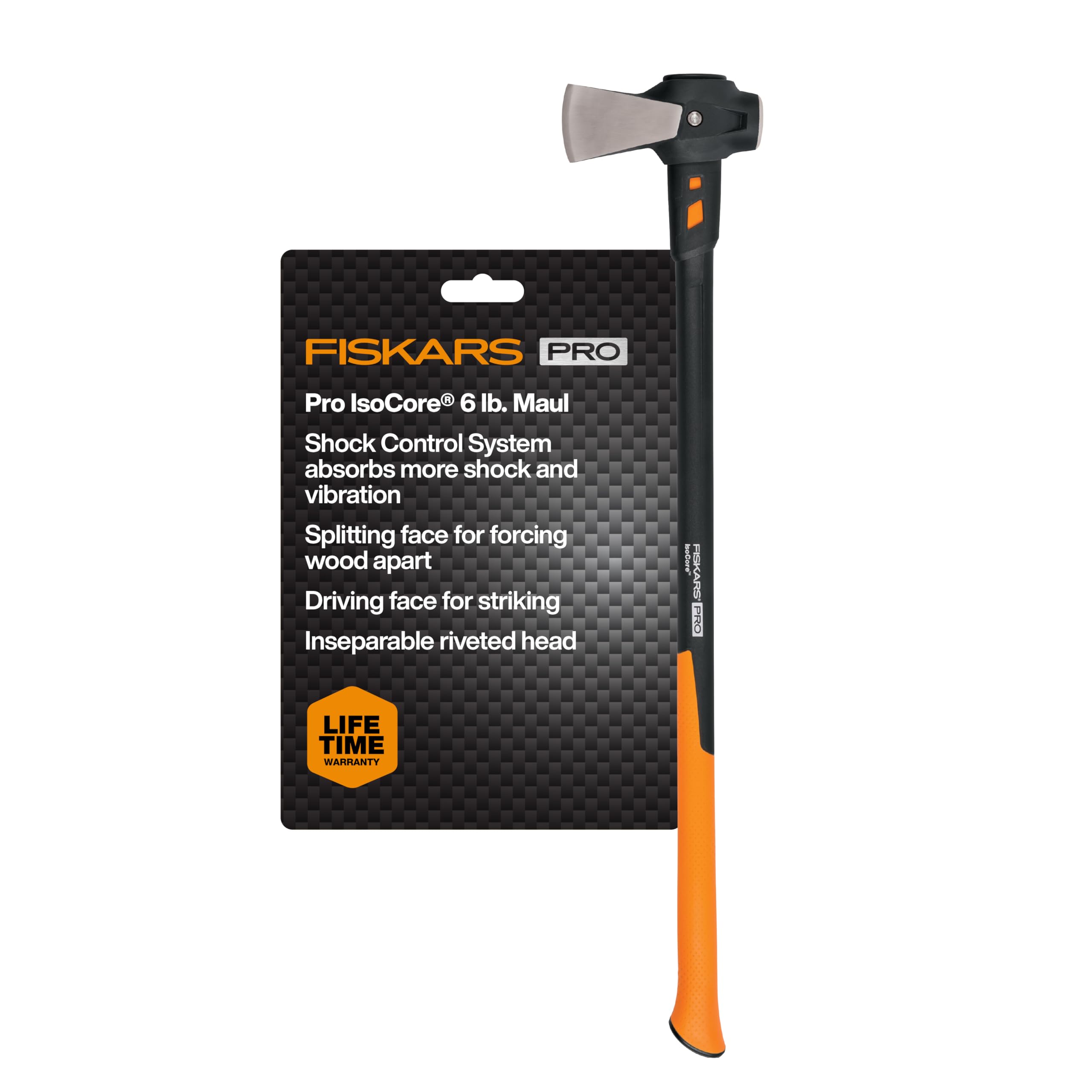
Six pounds of forged steel with a handle built to swallow the shock it delivers.
When the round is oak, hickory, or anything that laughs at a light head, this is the answer: a 6-pound forged, heat-treated steel head with a rust-resistant coating and a chisel edge.
The IsoCore Shock Control System is the part your wrists will thank you for. Fiskars rates the IsoCore handle as transferring half the shock and vibration of a wood-handled maul, and its dual-layer construction spreads impact across the grip instead of concentrating it in your palms. Build quality is the most-praised trait in owner feedback, with the head weight and splitting performance close behind. Owners mention clean splits through white oak, red oak, and hickory, and several say it hits like a far heavier maul.
There is an integrated driving face, so you can strike wedges and stakes with it or drive the head deeper into a stubborn round. The riveted head will not loosen or detach under force, and a steel-reinforced sleeve guards the top of the handle against overstrikes. The trade-off is simply the weight: at 8.6 pounds carried, this is a tool for serious rounds and shorter sessions, not an all-day kindling chore.
Why it handles tough wood
- 6-pound forged head built for dense hardwood rounds
- IsoCore system cuts shock to roughly half of a wood-handled maul
- Integrated driving face doubles as a wedge driver
- Riveted head and steel sleeve resist overstrike damage
What to expect
- 8.6 pounds carried means fatigue builds on long splitting days
- More mass than you need for softwood or small kindling
Pick it for: hardwood rounds and stubborn logs where a light head just bounces.
Pass if: you split softwood kindling all day — the weight will wear you down before the wood does.
5. Husqvarna Wood Splitting Axe S2800

A 5-pound head on a fiberglass handle — light enough to keep swinging.
Here is where the weight math flips. The 5-pound head on this axe is half the mass of the Kindling Cracker’s 10-pound cast iron body, but it moves, and that is the point. Total carry is 6.2 pounds over a 27.6-inch length, so the balance sits somewhere between a camp maul and a full-size splitting axe.
Sturdiness is the trait this tool is known for, and durability follows right behind it — this is a head and handle built to take repeated impact without loosening. The premium 5-pound steel head is coated to improve cutting and resist corrosion, and the fiberglass composite handle soaks up shock while staying light in hand. It arrives with a sheath, which matters for a sharp splitting axe you store or carry.
The cutting geometry is designed for larger firewood, and the balance and weight distribution are tuned so you are not fighting the head on the way through. The one thing to know going in is that a 27.6-inch handle offers less leverage than the 36-inch options here, so on very large rounds you will swing harder than you would with a longer tool.
what separates it: you can swing this splitting axe for long stretches without your arms calling time, thanks to a 5-pound coated head paired with a fiberglass handle.
The leverage limit: shorter than the 36-inch mauls, so monumental rounds want a longer handle.
Worth it for: sustained firewood sessions where fatigue, not power, is the enemy, and for splitting larger firewood with a coated head.
Think twice if: your rounds are enormous — you will want the extra arc of a full-length maul.
6. Scheppach Manual Wood Splitter for Logs 90 – 340 mm

A wall-mounted lever that pushes a blade through the log, never through the air.
Most of this list swings something. This one does not. You mount it to a wall, set a log between 90 and 340 mm against the cast iron chip knife, and pull the 560 mm lever. The cutting force comes from the lever, and the blade only moves through the wood, which keeps the whole process under control at all times.
The 220 mm blade is resharpenable, so the edge is a maintenance item you can bring back rather than a throwaway. An ergonomic wooden handle sits at the end of that 560 mm lever, and the compact body measures 135 x 85 x 590 mm — small enough for a shed wall without eating your floor space. Total weight is 12.1 pounds, which is heavy to hang but light to use.
This is a small-log and kindling tool, and it is honest about that. It suits steady, controlled splitting where you would rather lean into a lever than swing overhead. The trade-off is throughput: you will not process a cord with a single-lever tool the way you would with a maul. What it gives back is control, a fixed blade you can resharpen, and a footprint that lives on a wall.
The safe-over-fast angle: a fixed cast iron chip knife and a 560 mm lever put the cutting force entirely in the handle, so your arms and hands stay clear of the blade path.
What you give up: one log at a time, and the blade tops out at 340 mm logs — big rounds belong elsewhere.
Built for: shed or workshop owners splitting small logs and kindling who prefer a lever over an overhead swing, and who value a blade they can resharpen.
Not for: large rounds or high-volume firewood processing.
7. 1844 Helko Werk Saxon Heavy Log Splitting Axe

A hand-forged German axe with a maul’s power and an axe’s sense of balance.
This is a splitting axe that punches like a maul. The 6-1/4 pound head delivers the striking force of a heavier tool, but the 31-inch length keeps the balance and control of an axe in your hands. Helko Werk designed the head profile to drive deep without getting pinched in the wood — that stuck-blade problem is the one most people dread.
The head is drop-forged individually by hand from German C50 high carbon steel and hardened to 53-56 HRC, which is a measure of hardness on the Rockwell scale. The handle is sustainably sourced grade A American hickory, hand-finished with boiled linseed oil and sanded to 150 grit, and each is selected for grain orientation and density. A full grain leather sheath and a 1 oz bottle of Axe Guard protective oil come in the box, plus a small turnaround hook on the blade heel for moving logs.
Total weight lands at 8.5 pounds. Customers note splitting large-diameter rounds in about three chops and out-performing an 8-pound maul, praising the balance, factory edge, and fit and finish. The honest note is that this is a heavy axe reserved for large rounds and difficult logs — for light kindling, it is more tool than the job needs.
The craft you’re paying for
- Hand drop-forged C50 carbon steel head at 53-56 HRC
- Maul-level power with axe-like balance and control
- Grade A American hickory handle, linseed-oil finished and 150-grit sanded
- Full grain leather sheath and protective oil included
Honest notes
- 8.5 pounds total makes it a tool for serious rounds, not steady light work
- Wood handle needs the included oil to keep the steel protected
Your match if: you face large rounds and difficult logs and want the power of a maul in a balanced, hand-forged axe — and you value a tool worth caring for.
Overkill if: you only ever split small kindling.
8. 1844 Helko Werk Germany Vario Heavy Log Splitter (10058)

A bolt-on head and a 36-inch handle, built to swap rather than replace.
The Vario’s trick is the fastening system: the head bolts through the handle and locks under a butt-plate retainer cap, so every Vario head, handle, and fastening piece in the line is interchangeable. Buy one and you can change the head rather than the whole axe. That is a different ownership model from every fixed-head tool here.
Power-wise it is no compromise. The 5-pound C50 high carbon steel head at 53-56 HRC is set in a deep wedge profile, and the overall tool weighs 8.5 pounds on a 36-inch handle. That handle length is the leverage story — the 36 inches let the head build momentum through the swing, which is what lets a 5-pound head tackle trunks and heavy rounds. Grade A American hickory, lightly lacquered with a black-dipped grip, keeps the platform solid.
Reviewers point out it splitting 8- to 12-inch diameter logs with ease, and praise the solid construction and the sharp edge it arrives with. A full grain leather sheath and 1 oz bottle of Axe Guard oil come included. The thing to know: with a 5-pound head on a 36-inch handle, the longest and heaviest swings here reward technique — a mis-hit carries more momentum. This is the pick for someone who splits heavy wood and wants room to adapt the tool later.
The flexibility angle: the patented bolt-on system makes this the only tool here you can re-head instead of replace, and the 36-inch handle gives the 5-pound head room to build momentum.
What it asks of you: big swings on heavy rounds demand solid technique, and the hickory handle wants the included oil to stay in shape.
Best for: heavy-wood splitters who want a long-handled, hand-forged German axe they can reconfigure as their needs change.
Not the pick if: you want a set-and-done fixed-head tool and never plan to swap parts.
Know the Specs
Head weight and total carry weight
Head weight is the mass that actually strikes the wood; total weight is what your arms carry. They are different numbers and both matter. A 6-pound head on an 8.6-pound maul breaks dense hardwood but tires you faster than a 5-pound head on a 6.2-pound axe. Match the head to your typical log diameter, then check total weight for how long you plan to swing.
Handle length and leverage
A longer handle turns a lighter head into a harder strike. A 36-inch handle builds more momentum through the swing than a 16-inch one, which is why tall users and big rounds pair with long tools, while compact and campfire work favors short ones. Longer is not automatically better — it costs control in tight spots and asks for more room to swing.
Fixed wedge versus swinging head
A fixed wedge, like a cast iron ring or a wall-mounted lever, keeps the blade steady and puts the force in a mallet or a handle. Nothing swings past your hands. A swinging head generates its own force from momentum. Fixed wedges win on control and safety; swinging heads win on volume and log size.
Shock control and handle material
Every strike sends vibration into your hands and wrists. Wood handles absorb some and can crack at the top from overstrikes. Steel or composite handles paired with a shock-reduction grip cut that vibration down and resist overstrike damage. If you split for hours, a shock-control system is the spec you will notice most the next morning.
Common Questions
Is a fixed-wedge splitter safer than a swinging axe?
What size logs can the Kindling Cracker take?
Do I need a mallet to use a fixed-wedge splitter?
How much does head weight really change the split?
Does handle length matter more than head weight?
Will a wood handle crack from overstriking?
Do splitting axes need sharpening?
Can I mount a manual splitter permanently?
What is an interchangeable axe head good for?
Do these tools come with a sheath or case?
The Bottom Line
For most people, the manual wood splitter worth starting with is the Kindling Cracker Original — it makes a pile of kindling with almost no effort and keeps your hands well clear of the blade. If your woodpile is medium to large rounds, grab the Fiskars A-Series Super Splitting Axe for its 36-inch leverage. And for dense hardwood that a light head will not touch, the Fiskars Pro IsoCore 6 lb Maul is the one to reach for. Whichever you choose, let your typical log size pick the tool — that single decision saves more effort than any other.
How we choose
We do not accept paid placement. Every pick is matched to a real buyer and a real use-case; we do not hands-on test units.
Sources
Specifications: manufacturer listings and product documentation. Review insights: verified customer reviews, as of November 2026. Pricing: not shown on this page (it changes often); check the current price via the retailer link.
As an Amazon Associate, Tactical Gear Guy earns from qualifying purchases. This does not affect which products we feature.