Specs are compiled from manufacturer listings and verified buyer reviews and can change over time — please confirm the key details on the product page before buying.
You want thin, even meat slices for jerky, stir-fry, or a sandwich — and you want to keep your fingertips while you cut. The catch is that most mandolines are built for potatoes and carrots, so you have to check how low the blade actually goes before you buy. A slicer that starts at 4mm will give you planks, not deli slices. A slicer that drops to paper-thin can turn a beef roast into jerky strips in minutes. That single thickness number decides whether the tool works for meat at all, and it is the first thing worth checking on every model below.
This guide is built by comparing the manufacturers’ published specifications and the patterns across verified customer reviews, so you get each pick’s real strengths and trade-offs instead of marketing spin.
Blade material, setting range, and hand protection matter more than brand names here, and each pick below is measured against those. This is the practical shortlist for anyone hunting a mandoline slicer for meat that actually goes thin enough. Each pick below is weighed on thickness range, blade material, and hand protection.
Top Picks
How To Choose The Best Mandoline Slicer for Meat
Meat is not a cucumber. Muscle fiber resists a blade differently, and a setting that shaves a potato into translucent rounds can still chew a beef roast into ragged strips if the blade is dull or the platform wobbles. Three things decide whether a mandoline earns a place in your kitchen for protein work: how thin the blade goes, what the blade is made of, and how well the tool holds still.
The lowest thickness setting sets the ceiling on what you can do
For jerky, carpaccio, or paper-thin deli-style slices, you need a mandoline that reaches roughly 1mm or below. A 1mm setting turns a chilled roast into consistent strips you can marinate evenly — every piece dries at the same rate. The OXO below starts at 1mm, which is why it tops this list. Models whose thinnest setting sits around 0.55mm go even finer; models that stop at 2mm or 3mm are really vegetable tools.
Blade material: stainless, ceramic, or high-carbon stainless
Stainless steel blades hold an edge well and resist rust, which is why they dominate this category. Ceramic stays sharp and won’t transfer a metallic taste to food, but it is brittle and you cannot sharpen it at home. A high-carbon stainless blade like the 4CR15 on the Gramercy is a middle path — harder than basic stainless, still tough enough for regular use on firm proteins.
Hand protection is not optional when you slice meat
Cold meat is slippery, and a slick surface plus a thin blade is how people end up in urgent care. Look for an included food holder, a cut-resistant glove, or a full safety carriage that keeps your palm off the deck. A glove is a backstop, not a shield — the food holder does the real work. If a mandoline ships without one of these, add the cost of a cut-resistant glove to your mental budget.
Stability and cleanup decide whether you reach for it daily
Non-slip feet or rubberized legs keep the slicer from skating across a wet counter. A wider platform gives you more room to push a longer cut of meat through in one steady stroke. Dishwasher-safe parts make cleanup a rinse-and-load job instead of a hand-scrub over an exposed blade. A folding design saves drawer space if your kitchen is tight.
Side-by-Side Comparison
| Model | Best For | Lowest Slice Setting | Blade Material | Hand Protection | Amazon |
|---|---|---|---|---|---|
| OXO Good Grips Large Adjustable Handheld★ Best Overall | Everyday thin slicing | 1mm | Stainless Steel | Food holder | Amazon |
| -BINGBING- Adjustable MandolineWidest Range | Wide thickness range | 1mm | Stainless Steel | Food holder + gloves | Amazon |
| Upgrade Safe Mandoline (ChinKc)Safest Blade | Hidden-blade safety | 0.1mm | 420 Stainless Steel | Hidden blade + feed drum | Amazon |
| XAYCDEHN Adjustable Stainless Slicer | Countertop stability | Paper-thin | Stainless Steel | Food holder + gloves | Amazon |
| Gramercy Adjustable Waffle Slicer | Built-in blade dial | Paper-thin | 4CR15 Stainless Steel | Food holder + gloves | Amazon |
| KYOCERA Ceramic Mandoline | No metallic taste transfer | 0.55mm | Ceramic | Handguard | Amazon |
| Microplane V-Blade Mandoline | Bowl-hook setup | Not listed | Stainless Steel | Hand guard | Amazon |
| Vollum Wide Japanese Mandoline | Wide platform slicing | Not listed | Stainless Steel | Protective design | Amazon |
| Bron Coucke Stainless Steel Mandoline | Restaurant-kitchen build | Paper-thin | Stainless Steel | Safety carriage | Amazon |
Detailed Reviews
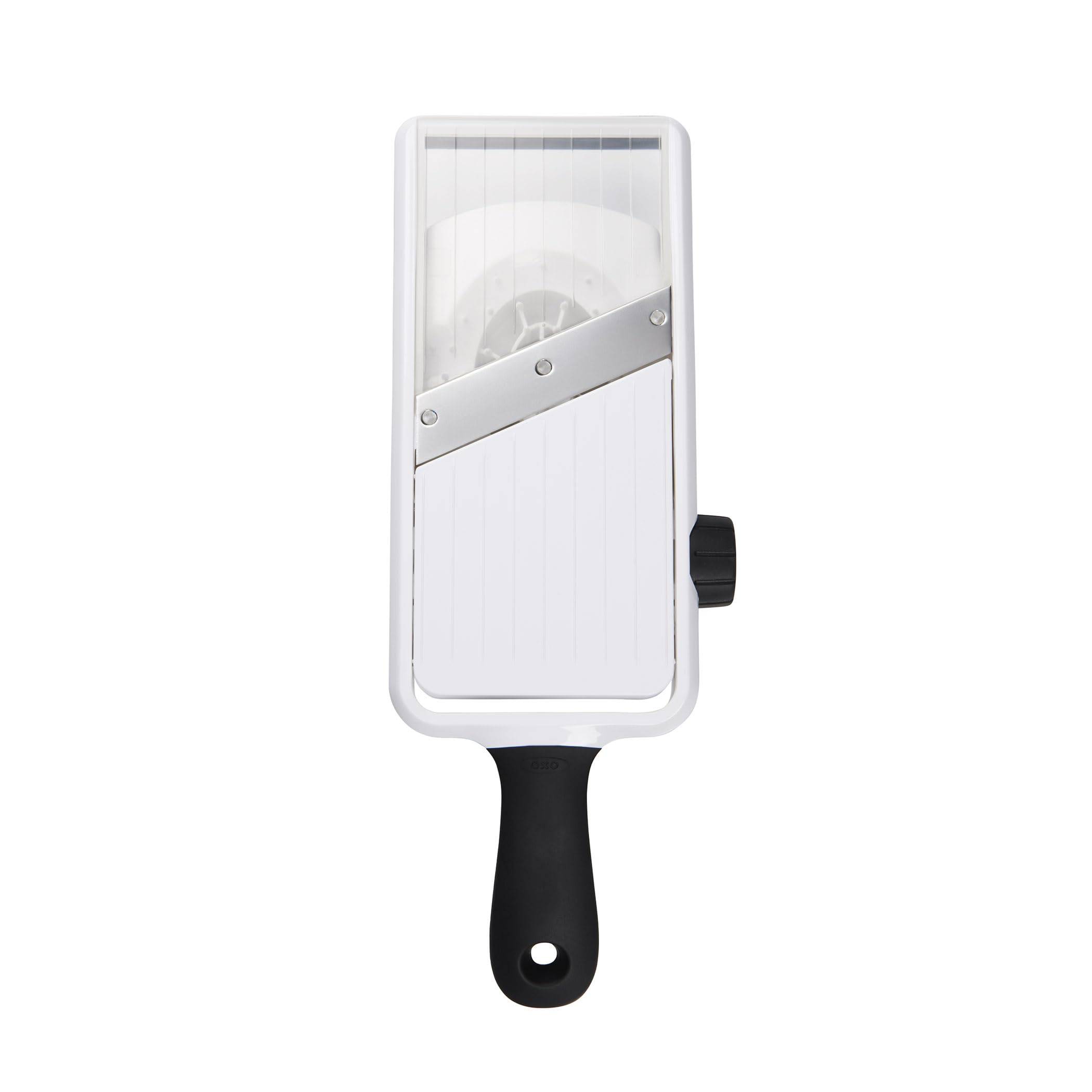
1. OXO Good Grips Large Adjustable Handheld Mandoline Slicer
Our pick — 4.5+★ from 20,000+ verified ratings; the strongest balance of quality and price.
The 1mm setting is what makes this a meat tool, not just a salad gadget.
Three settings do the work here: 1mm, 2.5mm, and 4mm. That 1mm bottom end is the whole reason this slicer belongs in a meat conversation — it is thin enough for jerky strips, carpaccio, and deli-style layers, and the 2.5mm and 4mm steps give you thicker cuts for stir-fry or sandwich fillings. A stainless steel blade handles the cutting, and the included food holder is your finger barrier while you push a chilled roast through. At 0.07 kg, this is the lightest tool on this list by a wide margin — it is a handheld slicer, not a counter-mounted rig, and that lightness is exactly what makes it easy to store and quick to set over a bowl.
The platform hooks over a bowl or sits flat on a plate or cutting board, and the window lets you see the slices stacking below so you can judge thickness without stopping. The non-slip handle, knob, and foot keep it from sliding while you push. What owners respond to most is the sheer quality of the build — it feels like a serious tool, and it performs alongside pricier models. Functionality is the next thing people talk about, and the routine love letter in the reviews is about hard vegetables like carrots and celery, which tells you the blade has the backbone for dense food. Onions, jalapeños, and cucumbers come up as favorites too, and it is dishwasher safe, which matters when you are slicing raw meat and want a proper clean afterward.
Here is the honest catch: the sharpness feedback is split, and some users find the blade dulls with time. The thickness range is also a two-way street — plenty of people love the thin slices, while others wish the 4mm top setting were thicker and find the 1mm setting almost too thin for everyday use. For meat work, though, almost too thin is the feature, not the bug. Hand-dry the stainless blade after each wash and store it dry to slow the edge dulling buyers report. It holds 4.5+ stars across 20,000+ owners, the highest score of any pick here.
Where it earns its keep
- 1mm bottom setting reaches jerky-and-carpaccio territory
- Food holder keeps fingers off the deck
- Non-slip handle, knob, and foot resist sliding on wet counters
- Dishwasher safe for easy cleanup after raw meat
- Light 0.07 kg build stores in a drawer
What to weigh first
- Sharpness is the most-debated point — some report the blade dulls over time
- 4mm top setting feels thin to cooks who want thicker planks
- Handheld format needs a bowl or board to rest on
Top of the shortlist: the everyday buyer who wants one mandoline that handles thin meat slices and weeknight veg without fuss.
Think twice: if you want a thick 4mm-plus plank or a counter-mounted rig with a carriage.
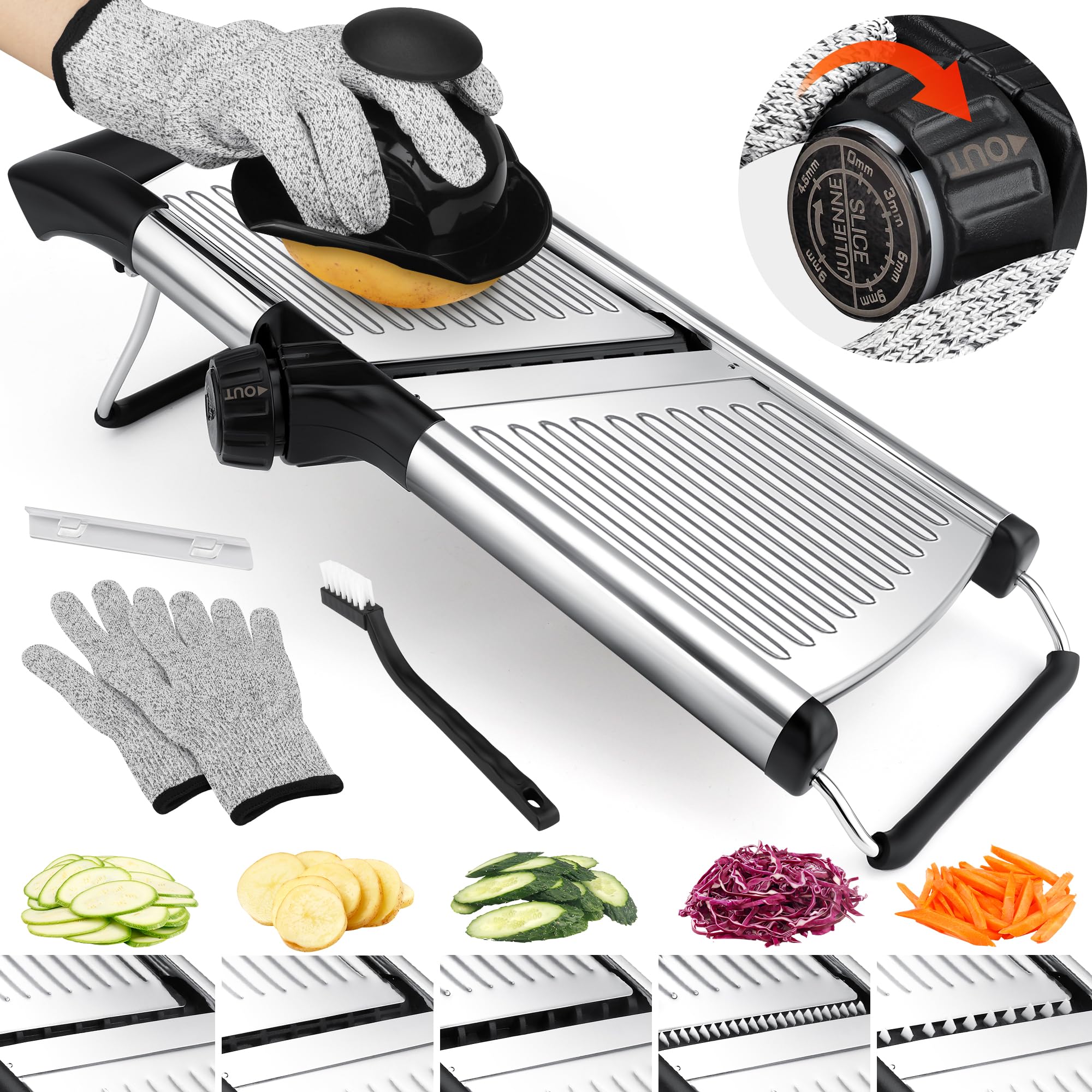
2. BINGBING- Mandoline Slicer
Nine thickness steps from 1mm to 9mm make this the most adjustable tool in the lower tier.
Dial in a 1mm slice for jerky and a 9mm slice for chunky stew cuts without swapping a blade — the knob on this model runs the full 1 to 9 millimeter range in 1-millimeter increments. That is the widest spread of any pick here. The straight blade cuts hard foods like carrots and potatoes, while the serrated blade is the one to reach for with tomatoes, bell peppers, and onions. Both a julienne set and a French-fry cutter are built in and stay covered when not in use, so you are not hunting through a drawer for a loose accessory.
What you get in the box matters for meat prep: a food holder, a pair of gloves, a cleaning brush, and a blade guard for storage. The sturdy legs hold the platform at a comfortable angle, and rubberized grips on the base and kickstand keep it from walking across the counter. Note the manufacturer’s own caveat — the included gloves offer limited protection and are meant as a supplementary measure, so use the food holder and keep your hands clear of the blade. Stainless steel throughout, and it is dishwasher safe, though the maker asks you to dry it completely before storage.
Owners praise the sturdy build, and the 1–9mm dial covers jerky-thin slices through 9mm stew cuts. The sharpness side of the ledger is split, with some finding it extremely sharp and others learning the hard way how much respect the edge demands. At 0.99 kg it has real heft, and its 16.5-inch length gives you a longer platform than the shorter ChinKc below. The recurring gripe is that the experience varies — some users find it very easy, others less so.
Who it is for: a cook who wants one adjustable tool covering everything from jerky-thin to 9mm stew cuts, with gloves and a brush included.
The honest limit: the glove is not a guarantee, so treat the food holder as the primary safety measure and keep the blade covered in storage.
Worth grabbing if: you want the biggest thickness spread in the entry tier and like having gloves and a brush bundled in.
Pass if: you want a featherweight handheld — this one is the heaviest in the value group.
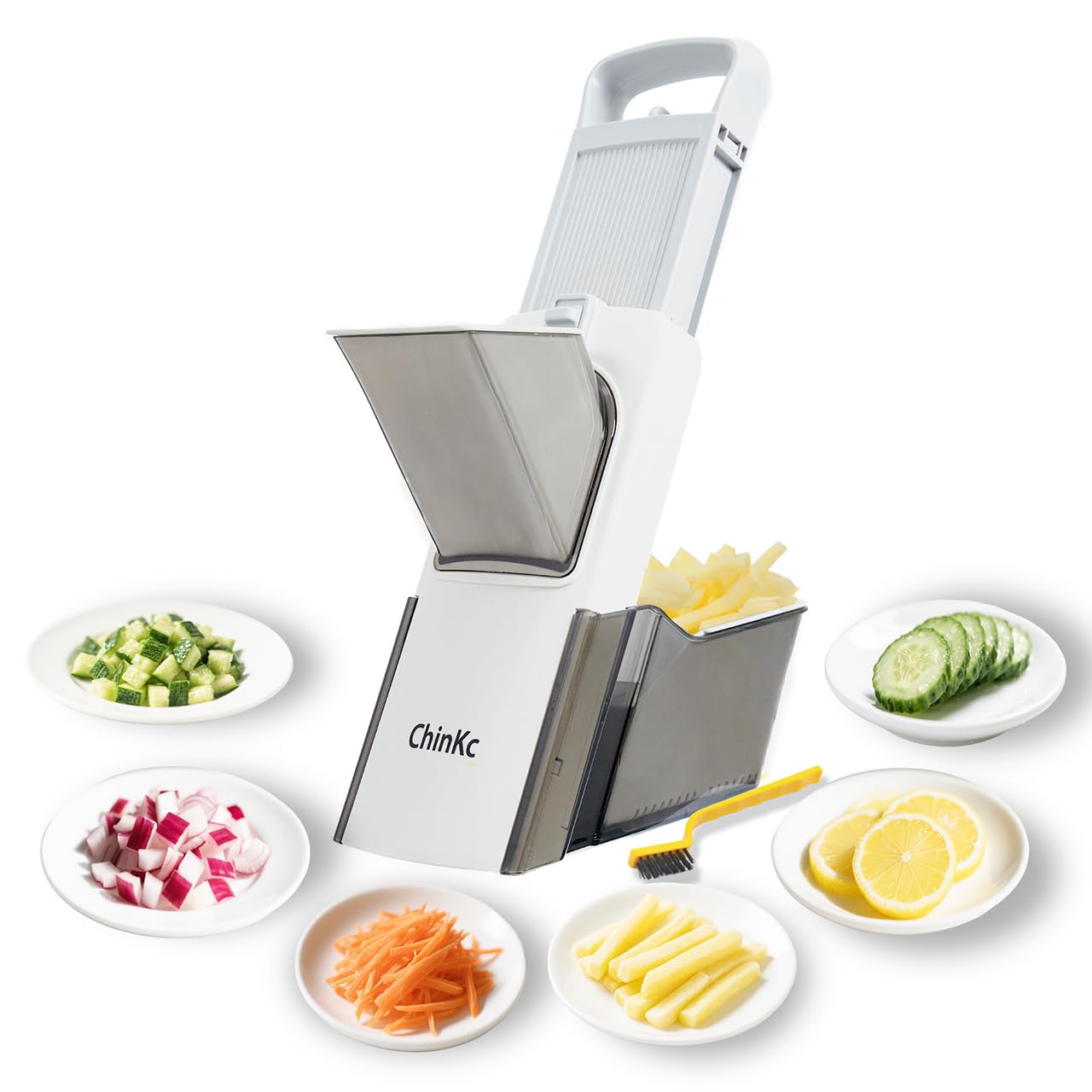
3. Upgrade Safe Mandoline Slicer
The blade hides inside the drum, so you never bare your fingers to set the thickness.
Most mandolines make you reach over a naked blade to change a setting. This one puts the blade behind a drum and sets thickness from 0.1mm to 8mm with a dial, which means you can go from paper-thin meat slices to chunky cuts without ever exposing the edge. Four cutting modes — julienne, strips, slicing, and dicing — are available at once without changing a blade, and the 420 stainless steel blades are the cutting surface. A feed drum, filter basket, main body, pickup box, and pushing bucket come with the unit, plus a small cleaning brush.
The feature nobody else here has is the draining basket. Once your vegetables or fruit are cut, you can rinse them right in the basket and use them directly — no extra colander to wash. The whole tool collapses for storage and is dishwasher safe, so cleanup stays short. Build is plastic and stainless steel, at 2.4 pounds it holds its own on the counter, and it stands 17 inches tall as a framed drum slicer, not a flat deck you hook over a bowl. The maker backs it with 90 days of no-cost returns and exchanges.
Owners rate slice quality highest, and the 0.1mm dial setting delivers the thinnest cuts on this list. Cleanup earns its own praise because the unit comes apart for a rinse. The feature to weigh carefully is stability: the blade unit can catch on the tabs, and a few cooks find the operation fiddly when the unit is not fully locked in. There is a two-pass rule for dice — slice first, then set the food flat and turn one knob for larger dice or two for smaller. For meat, the 0.1mm bottom setting is the headline; no other slicer on this list goes thinner.
Why meat preppers like it
- 0.1mm bottom setting is the thinnest on this list
- Hidden blade means no exposed edge during thickness changes
- Draining basket lets you rinse cut food in place
- Collapses flat and is dishwasher safe
- 90-day no-cost returns and exchanges from the maker
Setting expectations
- Blade unit can catch on the tabs if not seated properly
- Drum-style frame takes more counter space than a flat deck
- Dicing needs a deliberate two-pass routine
Reach for this if: you slice chilled meat often and want the fine end of the range without ever touching an exposed blade.
Look elsewhere if: you want a small handheld that tucks into a drawer next to a cutting board.
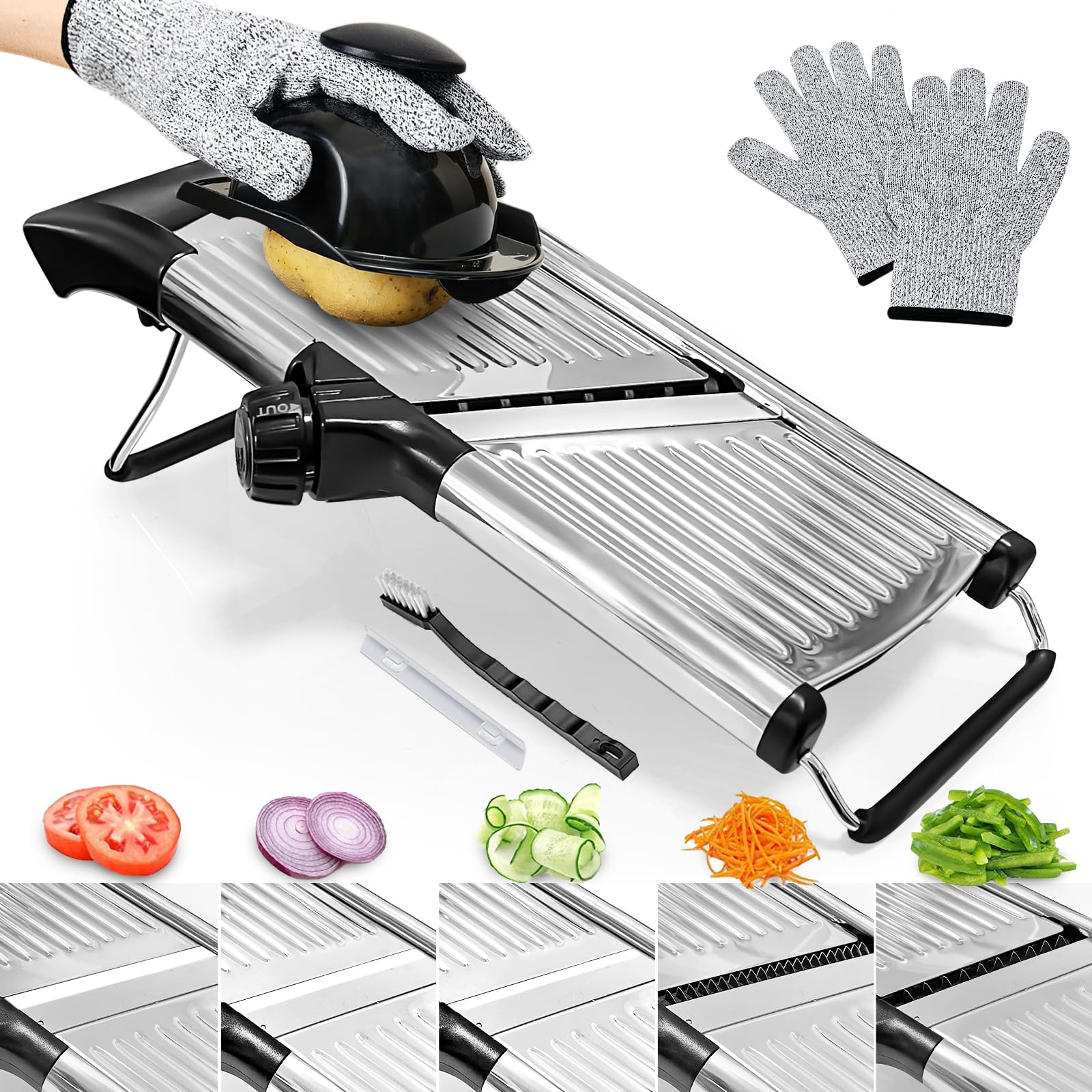
4. Adjustable Stainless Steel Slicer
A long, low deck with non-slip feet that holds its ground on a wet counter.
Thickness runs from paper-thin to thick cuts, with julienne options for fries and stir-fry veg. The paper-thin end is the part that matters for meat — it shaves a chilled roast into slices thin enough to marinate evenly and dry at a consistent rate. The deck is stainless steel, and the round blade shape gives you a clean, even cut rather than the ragged tear a dull straight edge can leave. A food holder and cut-resistant gloves come in the box, and a 12-month warranty covers the build.
What sets this apart from the two slicers above is the footprint and the grip. At 1.02 kg, it is the heaviest tool in the value group — a substantial platform that stays put rather than skipping across the counter. The non-slip handle and feet are the reason, and they make a real difference when you are pushing a cold, slippery piece of meat through the blade. The low, wide deck gives you a longer stroke, which means fewer repositionings mid-cut. It rinses easily and stows in a drawer or cabinet, though the length asks for a roomy one.
Precision is where owners rate this one highly — it handles vegetables, fruit, and cheese with an even hand, and the adjustability gets steady praise because the thickness really does change cleanly. Ease of use and quality both land well. The split verdict is on blade sharpness, where some find it extremely sharp and others find it less so from the start. The 12-month warranty softens that risk. Weigh that against the fact that this tool is built to sit still and cut straight — which is what a meat slicer needs above all else.
The real draw: a heavy, low platform with non-slip feet that stays planted through a long slice, plus gloves and a 12-month warranty in the box.
The trade-off: blade sharpness is the most divisive point, so plan to hone or replace the blade if yours arrives dull.
Best match: cooks who push long cuts through and want the deck to stay glued to the counter.
Better elsewhere: if drawer space is tight and you need a slicer that folds flat.
5. Gramercy Adjustable Mandoline Waffle Slicer

A built-in dial with 24 settings means no hunting for a blade when you want a thinner cut.
Twenty-four slice settings run from paper-thin up to 9mm thick, all on a single adjustable dial. Two julienne settings at 4.5mm and 9mm handle fries and matchsticks, and the blade also cuts waffle fries and ruffled chips. The point of the dial is that every blade is built into the tool — you never touch a cutting edge to change the setting. That is a meaningful safety advantage for anyone slicing cold meat, since you are not swapping a blade with wet hands. The blade itself is professional 4CR15 stainless steel, a harder grade than basic stainless.
Safety gear is where this kit stands out. Cut-resistant gloves, a blade guard for storage, a food holder, and a cleaning brush all come with the unit, so you have a full barrier between your hand and the edge. The platform is top-rack dishwasher safe, and the whole thing folds flat for a drawer. It is also the heaviest tool in the mid-tier at 1.9 pounds — you feel the build when you set it down, and it does not slide while you push. A generous replacement-and-refund promise backs the purchase.
The honest split on this one is sharpness and durability. The blade arrives sharp for plenty of cooks, but others report it dulls and struggles even with carrots and tomatoes. The blade guard and dial have drawn complaints from a minority who found them flimsy or prone to breaking after repeated use. Quality and the dial-driven function are what keep the score respectable, with a huge base of owners behind it. For meat, the paper-thin end works well if you keep the blade fresh; inspect the blade guard when it arrives and store the unit carefully.
What the dial buys you
- 24 settings from paper-thin to 9mm, all built in
- 4CR15 stainless blade holds an edge well
- Cut-resistant gloves, blade guard, food holder, and brush included
- Folds flat for drawer storage and is top-rack dishwasher safe
- 1.9-pound build stays put on the counter
Read before buying
- Sharpness feedback is split — some blades dull and struggle on firm food
- A minority of cooks report the blade guard and dial being flimsy
- Heavier and bulkier than a basic handheld slicer
Pick it for: the most settings in one tool, with gloves and a food holder bundled in and no blade swaps ever.
skip it if: you want the lightest possible handheld and don’t need waffle or ruffled cuts.
6. KYOCERA Adjustable Ceramic Mandoline Soft Grip Slicer

A ceramic edge that will not transfer a metallic taste to the meat you are slicing.
Ceramic blades are the reason to look at this one. Kyocera’s advanced ceramic stays sharp and will not brown food or leave a metallic taste, which matters if you are slicing raw meat you plan to eat rare or cure. Four thickness settings — 0.55mm, 1.3mm, 2.0mm, and 3.0mm — are set with a dial on the back, and the 0.55mm bottom end goes thinner than the OXO’s 1mm. A handguard guides fruit and vegetables through the blade, and the soft-grip texture helps you keep even, straight slices under control. At 4.59 ounces, it is the lightest tool here after the OXO.
The design is deliberately compact: a soft-grip handle, a V-shaped ceramic blade 10 inches long, and a dial you can reach without stopping. It cleans easily because ceramic does not hold onto food residue the way some steel surfaces do. The handguard is your primary safety element, so treat it as essential equipment rather than an accessory. The manufacturer warrants the ceramic against defects in material and craftsmanship.
Owners call it a fantastic tool for small slicing jobs, crediting the ceramic blade for holding its edge and cutting clean. Functionality and ease of use both score well. The thickness settings are the split point: the four options are appreciated, but several cooks find the slices too thin, especially at the 0.55mm setting. If you are slicing meat for jerky, that thinness is the goal rather than the complaint. Durability draws mixed notes, with some finding the build sturdy and others calling it flimsy, so handle it gently and store it where it won’t get knocked around.
Why it stands out: a ceramic blade that stays sharp and will not transfer a metallic taste, with a 0.55mm bottom setting for fine meat slices.
The honest limit: the build draws mixed notes on durability, so it rewards careful handling and storage away from hard edges.
Worth it for: cooks who slice meat they plan to eat rare or cure and want a blade that will not alter the flavor.
Not the pick if: you want a heavy build that can take knocks on the counter.
7. Microplane Adjustable Mandoline Slicer
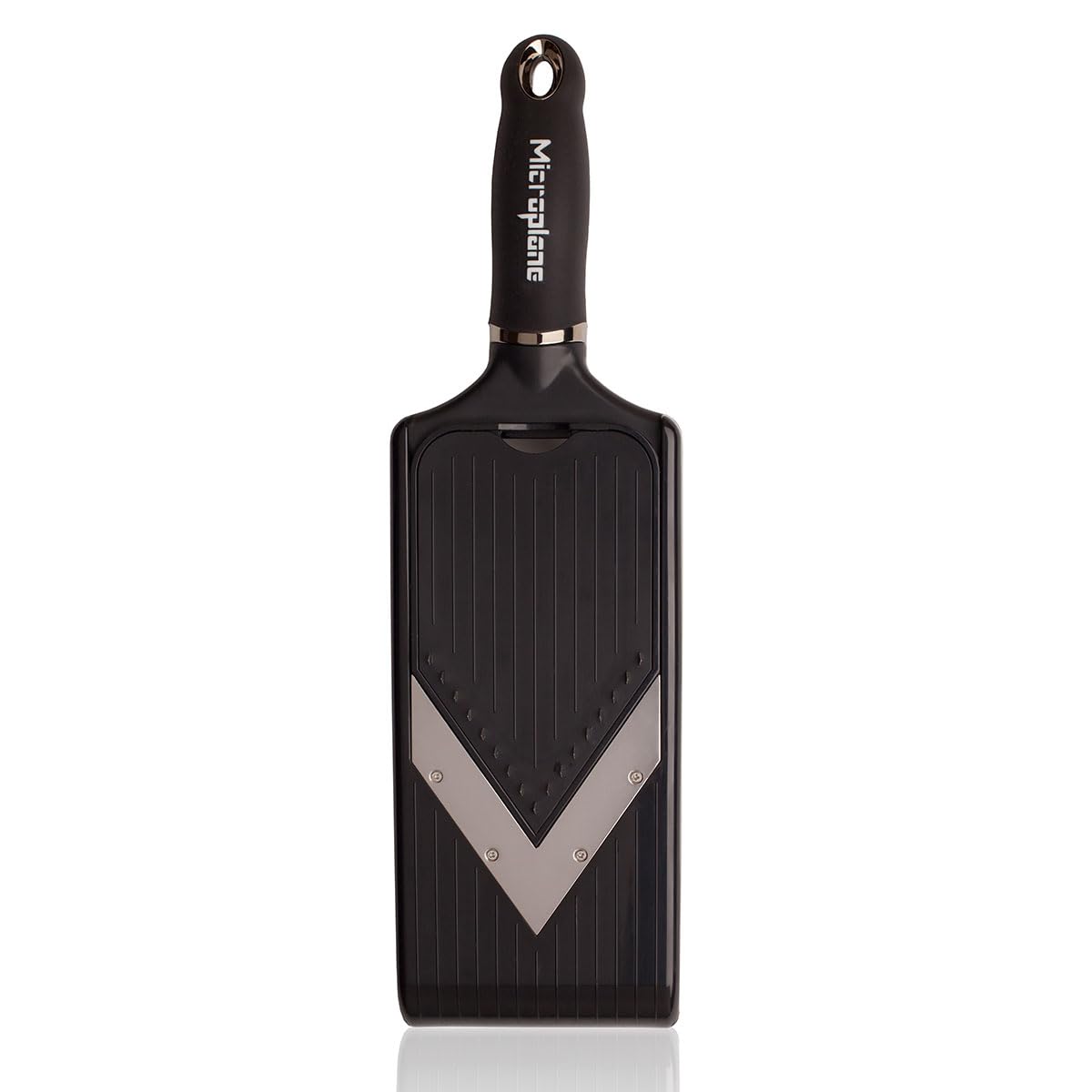
The reversible deck flips between slicing and julienne without storing a spare blade.
A reversible deck is the trick here — switch between a slicing face and a julienne face without digging for a spare blade. The Infinity soft-touch dial adjusts thickness for slicing, and the V-shaped stainless steel blade gives you a clean cut. A hand guard keeps your fingers away from the edge while you push. At 12.8 ounces, the tool is light enough to hold over a bowl or set on a board.
Nonslip feet give you stability on a flat surface, and the bowl hooks on the base let you rest the unit over the rim of any bowl so it stays put while you slice into it. The soft-touch handle keeps your grip comfortable through a longer cutting session. For meat work, the dial sets the slice thin, and the V-blade handles the fiber with a clean draw rather than a ragged tear. It rinses easily and stows on a shelf without taking much room.
Blade quality is what owners rate most highly — a clean, well-made edge that does the job. Cleanup earns solid marks too. The split verdict is on thickness and adjustability: several cooks find the settings very thin and the adjustability less than they hoped for. Functionality is mixed, with some units working great and others refusing to do the job at all, and durability draws concern from a few cooks who found the build flimsy. Those concerns land hardest on the adjustability and durability side, so treat the dial gently and test the setting range as soon as the unit arrives.
Reach for this if: you want a light slicer that hooks over a bowl and flips between styles without a blade swap.
Look elsewhere if: you need marked, wide thickness steps for precise meat portions.
8. Vollum Wide Japanese Mandoline Slicer

A 5.5-inch-wide platform gives you room to push a broad cut of meat through in one stroke.
The deck measures 5.5 inches wide, which is meaningfully more room than a typical handheld slicer gives you. That width matters for meat because you can run a broader piece of protein through without repositioning. Three interchangeable stainless steel blades — fine, medium, and coarse serration — switch out depending on the job, and the adjustable thickness lets you set the slice you want. The frame is a combination of heavy-duty non-BPA food-grade plastic and rustproof dishwasher-safe stainless steel metal. A special protective design keeps your fingers and palm away from the blade edges.
Construction is the selling point. The tool is built to withstand intensive use, and the wide deck feels substantial in the hand rather than flimsy. It rinses clean and is dishwasher safe, so the cleanup after raw meat is quick. The maker markets it as a gift for a wedding registry or anniversary as well as a working kitchen tool. A single slicer ships in the box, with the three blades the working parts. At 15.2 ounces, it is light for its width, which makes it easy to lift and rinse.
Owners praise the build quality and the three interchangeable fine, medium, and coarse blades. Versatility gets steady approval, and ease of use scores well. The split verdict lands on blade sharpness, with some finding the blades very sharp and others less impressed. The most consistent complaint is the thickness adjustment — cooks report poor control and difficulty with the width settings, so test yours on arrival and return it if the lever does not hold its position. Given how much a meat slicer depends on a repeatable setting, that is the thing to check first.
The case for the wide deck
- 5.5-inch-wide platform handles broader cuts in one pass
- Three fine, medium, and coarse stainless steel blades included
- Non-BPA food-grade plastic and rustproof stainless steel build
- Protective design keeps fingers and palm clear of the blades
- Dishwasher safe and light at 15.2 ounces
The honest concerns
- Thickness adjustment draws consistent criticism for poor control
- Blade sharpness is a split verdict
- Interchangeable blades need careful storage so you don’t lose one
Buy it for: the wide platform and interchangeable blades, especially if you slice broad cuts and like the reach a 5.5-inch deck gives.
pass on it if: a dial that holds a precise thickness matters most and you cannot return a wobbly unit.
9. Bron Coucke Stainless Steel Mandoline Slicer
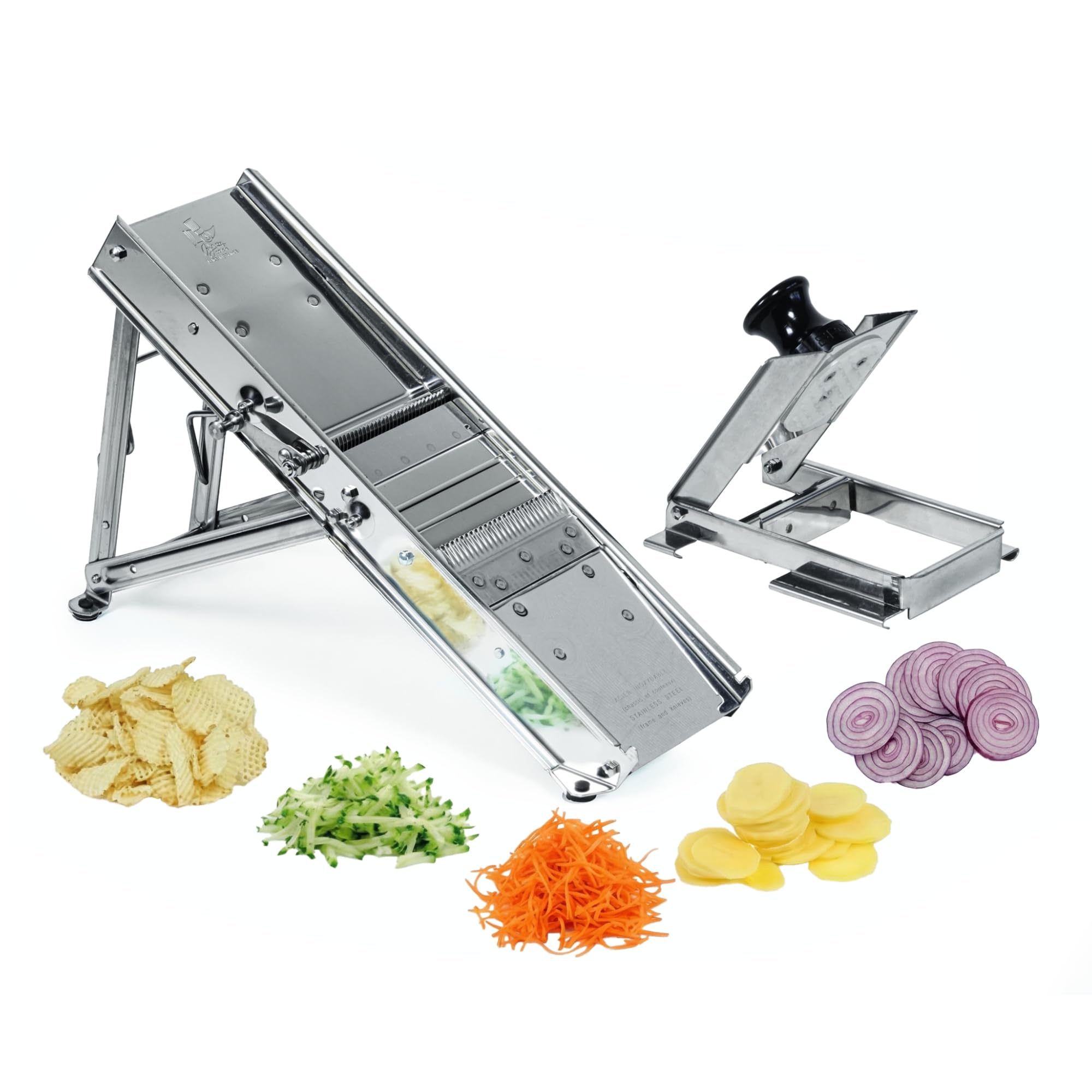
A heavy stainless frame built for restaurant kitchens, with a carriage that keeps your fingers back.
This is the heaviest tool here — a 1800 gram stainless steel frame, made in France by Bron Coucke, built for daily use in restaurant kitchens. Four cuts come in one tool: a straight blade for even slices, a waffle blade for crinkle and gaufrette cuts, and two julienne combs at 1/8″ and 3/8″ for shoestring and French fries. An adjustment lever sets the cut from paper-thin to thick slices for potatoes, onions, cucumbers, zucchini, lemons, and limes. The stainless steel carriage holds the food and keeps your fingers off the blade, and rubber feet plus a table-edge support stop the whole rig from shifting.
For meat, the paper-thin lever setting and the rigid frame are the draw — a heavy, braced tool does not skip when you push a chilled roast through. The legs fold out for use and flat for storage, and the unit is dishwasher safe. A note from the maker: use the carriage with the upper blade, and keep the waffle blade fully lowered when using the straight blade. That is the kind of instruction you follow once and then remember.
Owners rave about the 1800-gram stainless frame, which stays planted through a long slice. The split verdicts show up on sharpness and ease of use: the blade is incredibly sharp to some and dull to others, easy to set up to some and a learning curve to others. The recurring gripe is smooth operation — the blade can stick and the sliding rail can bind, so a careful eye on the rail when it arrives is worth the two minutes. The carriage and table-edge support are what let a heavy frame do its best work, so set the tool up properly before the first slice.
Built for the long haul: a made-in-France stainless frame with a full safety carriage and folding legs, meant for daily restaurant-style use.
The honest catch: operation draws mixed notes, with the rail and blade sticking on some units, so check the slide before your first big job.
The right call for: serious home cooks and anyone who wants a carriage-style rig that can take years of use.
Better elsewhere: if you want a light handheld that tucks away and costs far less.
Know the Specs
Lowest thickness setting
This is the number that decides whether a mandoline can work for meat at all. A slicer that bottoms out at 2mm or 3mm makes planks, not slices. Look for a tool that reaches roughly 1mm or below — the OXO starts at 1mm, the ChinKc at 0.1mm, and the Kyocera at 0.55mm. Anything thinner than about 0.5mm is really for jerky and carpaccio rather than everyday portions.
Blade material
Stainless steel is the default because it resists rust and handles regular use on firm proteins. High-carbon stainless grades like 4CR15 hold an edge better than basic stainless. Ceramic stays sharp and won’t transfer a metallic taste, but it is brittle and you cannot sharpen it at home. If you slice meat you plan to cure or eat rare, ceramic is worth a look; if you want a blade you can touch up yourself, stainless is the practical choice.
Hand protection
Look for one of three barriers: an included food holder, cut-resistant gloves, or a full safety carriage. A food holder does the real work by keeping your palm off the blade. Gloves are a backstop, not a guarantee — the -BINGBING- listing is explicit that its gloves offer only limited protection. A carriage like the Bron Coucke’s is the strongest of the three because it moves the food, not your hand, past the blade.
Stability
Non-slip feet, rubberized legs, or a table-edge support keep the slicer from sliding when you push a cold, slippery piece of meat through. A heavier frame like the Bron Coucke’s 1800 gram build or the XAYCDEHN’s 1.02 kg sits more firmly than a featherweight handheld. On a lightweight tool, look for a bowl hook or textured base to add grip.
Common Questions
Can a mandoline really slice raw meat thin enough for jerky?
Is it worth chilling meat before slicing it on a mandoline?
Ceramic or stainless steel blade for slicing meat?
Do the included cut-resistant gloves actually stop a blade?
Will a mandoline handle cheese as well as meat?
How do I clean a mandoline after slicing raw meat?
What is the difference between the ChinKc hidden blade and a standard mandoline?
Can I sharpen a mandoline blade at home?
Why does the thickest setting feel thin on some mandolines?
The Bottom Line
For most kitchens, the mandoline slicer for meat winner is the OXO Good Grips Large Adjustable Handheld Mandoline Slicer, because its 1mm bottom setting is thin enough for jerky and carpaccio and the whole tool weighs only 0.07 kg. If you want the widest spread of thickness settings in the entry tier, the -BINGBING- Adjustable Mandoline runs a full 1 to 9mm in 1mm steps and ships with gloves. And for anyone who wants the blade hidden during thickness changes, the Upgrade Safe Mandoline (ChinKc) goes down to 0.1mm with the edge tucked behind a drum.
What separates a mandoline that works for meat from one that does not is one number — the lowest thickness setting — plus a food holder or carriage that keeps your fingers clear. The OXO holds 4.5+ stars across 20,000+ owners and the highest score here, making it the safe default.
How we choose
We do not accept paid placement. Every pick is matched to a real buyer and a real use-case; we do not hands-on test units.
Sources
Specifications: manufacturer listings and product documentation. Review insights: verified customer reviews, as of November 2026. Pricing: not shown on this page (it changes often); check the current price via the retailer link.
As an Amazon Associate, Tactical Gear Guy earns from qualifying purchases. This does not affect which products we feature.