Specs are compiled from manufacturer listings and verified buyer reviews and can change over time — please confirm the key details on the product page before buying.
If you want the sharpest, cleanest look at the Moon and planets for the least fuss, a Maksutov-Cassegrain is the telescope that gets out of your way. These scopes squeeze a long focal length into a short tube, so you get high-magnification views of Saturn’s rings and lunar craters without hauling a metre-long refractor into the garden.
This guide is built by comparing the manufacturers’ published specifications and the patterns across verified customer reviews, so you get each pick’s real strengths and trade-offs instead of marketing spin.
The short version: a Mak trades a narrow field of view for crisp, colour-free detail on bright targets. Below you’ll find the strongest options sorted by use case — including the full breakdown of the best Maksutov Cassegrain telescope for planetary viewing.
Top Picks


How To Choose The Best Maksutov Cassegrain Telescope
A Maksutov-Cassegrain is a folded telescope: light comes in through a curved glass disc called a meniscus corrector, bounces off a mirror at the back, and travels up to a small secondary mirror that sends it out through the eyepiece. That folded path is why a 1300mm focal length can hide inside a tube you can carry with one hand.
Start with aperture, then work backwards
Aperture is the width of the light-gathering opening. A 90mm tube pulls in enough light for lunar craters and Jupiter’s cloud bands; a 180mm tube pulls in far more and reaches fainter deep-sky objects. Bigger glass always means a heavier tube and a heavier mount, so pick the aperture you will genuinely carry outside on a weeknight.
Understand the focal length squeeze
Long focal length is the reason a Mak shines on planets: a 2700mm tube magnifies hard with an ordinary eyepiece. The trade-off is a narrow field of view — you see a small circle of sky, so finding targets by hand takes patience unless a computerized mount does the hunting for you.
Decide if you want the mount or just the tube
Some Mak packages arrive as a bare optical tube, meaning you supply your own mount and tripod. Others ship with a GoTo mount that slews to targets automatically. Read the box contents carefully — an “OTA only” listing is a bargain only if you already own a mount that fits a Vixen-style dovetail.
Side-by-Side Comparison
| Model | Best For | Aperture | Focal Length | Mount Included | Amazon |
|---|---|---|---|---|---|
| Celestron NexStar 4SE★ Best Overall | Complete GoTo starter kit | 4″ | 1325 mm | Yes — computerized single fork arm | Amazon |
| SVBONY MK105Best Tube Value | Optical tube on a budget | 105 mm | 1365 mm | No — OTA only | Amazon |
| SVBONY MK127Astro-Ready Tube | Astrophotography-ready tube | 127 mm | 1495.6 mm | No — OTA only | Amazon |
| Celestron NexStar 90SLT | Camping and travel | 90 mm | 1250 mm | Yes — computerized SLT | Amazon |
| Sky-Watcher AZ-GTi with SkyMax 102 | App-controlled grab-and-go | 102 mm | 1300 mm | Yes — WiFi Alt-Az mount | Amazon |
| BRESSER First Light Mac 100/1400 | City viewing with phone photos | 100 mm | 1400 mm | Yes — EQ3 | Amazon |
| Sky-Watcher Skymax 150 | Serious planetary aperture | 150 mm | 1800 mm | No — OTA only | Amazon |
| Sky-Watcher Skymax 180 | Maximum Mak aperture | 180 mm | 2700 mm | No — OTA only | Amazon |
| Bresser Messier MC-152/1900 | Premium focuser and reach | 152 mm | 1900 mm | No — OTA only | Amazon |
Detailed Reviews
1. Celestron NexStar 4SE Maksutov-Cassegrain GoTo Telescope
Our pick — 4.0+★ from 750+ verified ratings; the strongest balance of quality and price.
The orange tube that finds the planets for you, so you spend the night looking instead of hunting.
A 1325mm focal length inside a 4-inch Maksutov body is the whole pitch here. Point it at Jupiter and the long focal length magnifies hard, which is why the view of Jupiter’s larger moons and Saturn’s rings is what people describe over and over. The folded Maksutov design also keeps colour fringing out of the picture, so the lunar terminator looks crisp rather than smeared with a rainbow edge.
Where this one earns its place is the electronics. The NexStar+ hand control carries a 40,000+ object database, and the mount slews to your target and tracks it while you look. SkyAlign asks you to centre any three bright objects — you don’t need to know their names — and the system works out where it is. For a first scope, that removes the single hardest part of astronomy: finding things.
The honest catch is the 0.11-degree field of view. At 0.11 degrees, the 4SE gives you a keyhole view of the sky, which is superb for a planet and awkward for a sprawling open cluster. Compare that with the wider 1.7 degrees of the NexStar 90SLT below and you can see how much sky the extra magnification costs you. Alignment also frustrates a portion of buyers; the Mount is fussy about a clear, unobstructed view of those three alignment stars. The maksutov cassegrain telescope crowd that sticks with it tends to be planetary-focused and happy to trade sky width for sharpness.
What earns the top spot
- 1325mm focal length delivers tight planetary magnification straight from the start.
- SkyAlign alignment takes three bright objects, not a star chart.
- A built-in wedge lets you polar align for longer-exposure astrophotography later.
- Maksutov optics keep the view free of colour fringing on the Moon and planets.
Where it will test you
- 0.11 degrees of field is a tight keyhole — wide clusters barely fit.
- Alignment needs a clean view of the sky, and it stumbles when it doesn’t get one.
- It is a GoTo kit, so it carries a higher sticker than a bare optical tube.
Who should buy: someone who wants the software to find Saturn while they stand back and look.
The trade-off: a narrow 0.11-degree field means you are buying a planet specialist, not a wide-field sweeper.
2. SVBONY MK105 Maksutov-Cassegrain Telescope
The optical tube for the astronomer who already owns a mount and wants clean glass without the electronics bill.
Here is the number that shapes everything: 105mm of aperture and a 1365mm focal length, squeezed into a tube that weighs 2.19kg (about 4.83lb). That weight is the reason this scope lives by your back door instead of in a cupboard — you can sling it onto a mount and be outside in one trip. A 160mm dovetail plate slides straight onto a standard Vixen-style saddle.
The optical design is what makes it a Mak. A reflective mirror system means no chromatic aberration — no colour fringing on bright objects — and the mirrors carry multi-layer aluminium and electroplated coatings quoted at up to 99.99% reflectivity, which is a maker figure rather than an independent lab result. A tapered baffle tube inside the barrel cuts stray light coming in at an angle, so a streetlight at the edge of your garden helps less than you would fear.
What wins people over is how well-built the tube feels, with the smooth focuser drawing specific praise. The catch is the 0.08mm exit pupil, against 1.88mm on the NexStar 90SLT. In plain terms, that pinhead light funnel makes low-magnification, wide views dim, so this is a tube for high-power lunar and planetary work. There is also no finderscope in the box, and no mount, so plan the extra gear before you commit.
The buying maths: a bare-tube price gets you 105mm of Maksutov glass, a 1.25″ eyepiece interface, and an M42x0.75 thread for T-ring camera adapters — but you supply the mount, tripod, and finder yourself.
Fit note: the f/13 ratio is the slowest here, versus f/11.8 on the MK127, which reinforces its role as a high-magnification tube rather than a light-hungry deep-sky rig.
Reach for this if: you already have a mount with a Vixen saddle and want a compact, colour-free planetary tube.
Look elsewhere if: you need a first-scope package with a tripod and finder included — this is tube-only.
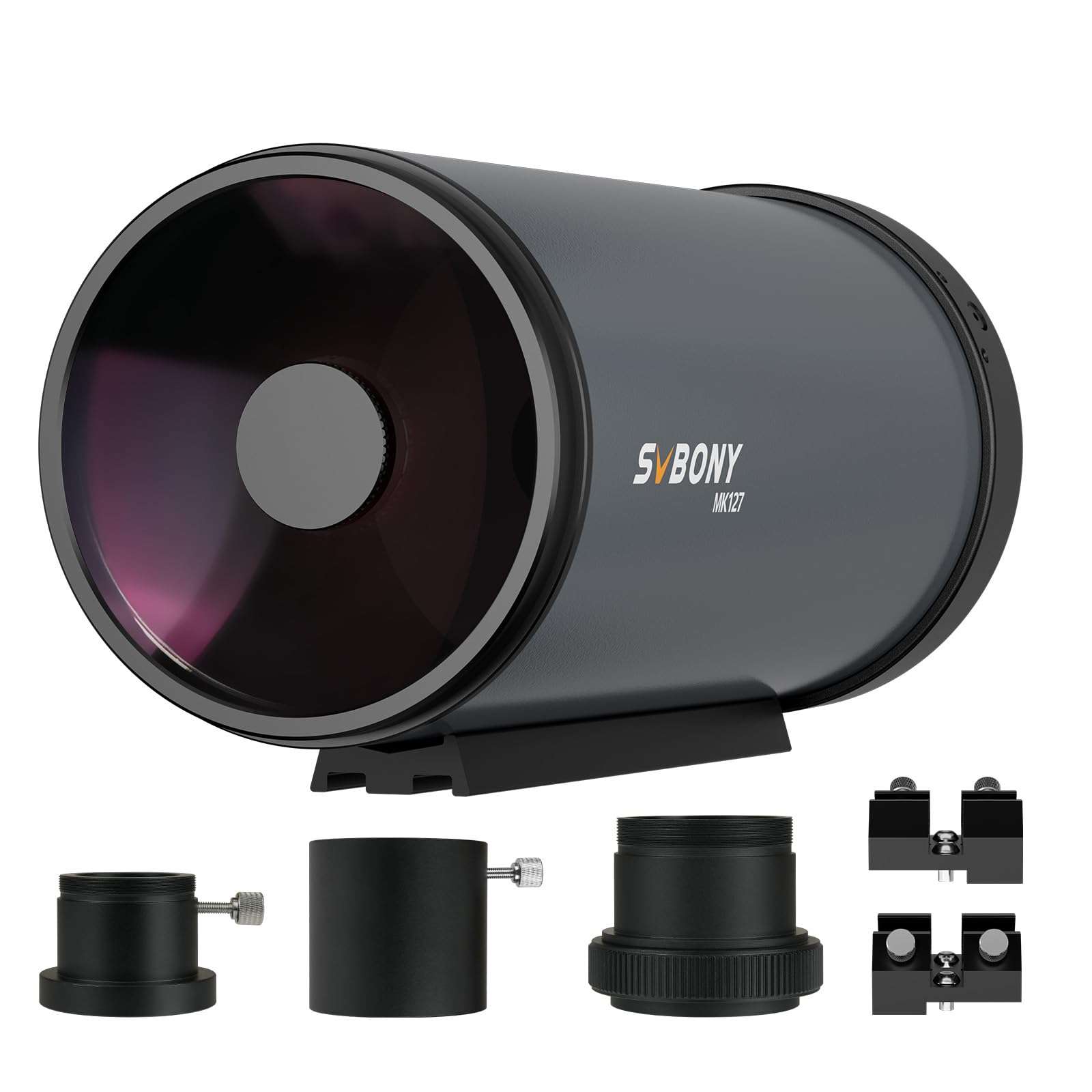
3. SVBONY MK127 Telescope
More aperture, a faster ratio, and a focal reducer in the box — the tube built for nebula photographers.
Weigh this against the NexStar 90SLT and the gap is real: 127mm of aperture against 90mm, and 1495.6mm of focal length against 1250mm. More glass gathers more light, which is what lets you pull faint objects out of a dark sky. The f/11.8 focal ratio is also quicker than the f/13 on the MK105 below it in this list, so it needs less exposure time to reach the same brightness.
The kit is where this one pulls ahead of a plain tube. You get a 0.65x flat-field reducer, which widens and flattens the image for photography, plus both 2-inch and 1.25-inch eyepiece interfaces so you can use whichever eyepieces you already own. A dual-speed focuser separates coarse racking from fine adjustments, so you can nail critical focus at high magnification instead of nudging past it.
The trade-off to know about is the meniscus cell’s field alignment. Field alignment draws a cluster of complaints, with reports of misaligned saddles, skewed diffraction rings, and gaps in the meniscus itself — a problem that shows up in star tests rather than in daylight use. The dual-speed focuser also has a mixed reputation at high power. Buy from a seller with an easy return path and check the collimation on the first clear night. When the sample is good, the optics get strong marks.
The honest read: a 0.8-degree field of view and 1450g of tube make this a manageable imaging platform, and the included reducer plus SCT-to-2-inch adapter saves you a separate shopping trip.
Best for: anyone planning to bolt a camera onto a Mak and wanting the reducer already in the box.
Think twice if: you are not ready to inspect collimation on arrival — misalignment on this model is a documented risk.
4. Celestron NexStar 90SLT Maksutov-Cassegrain Telescope
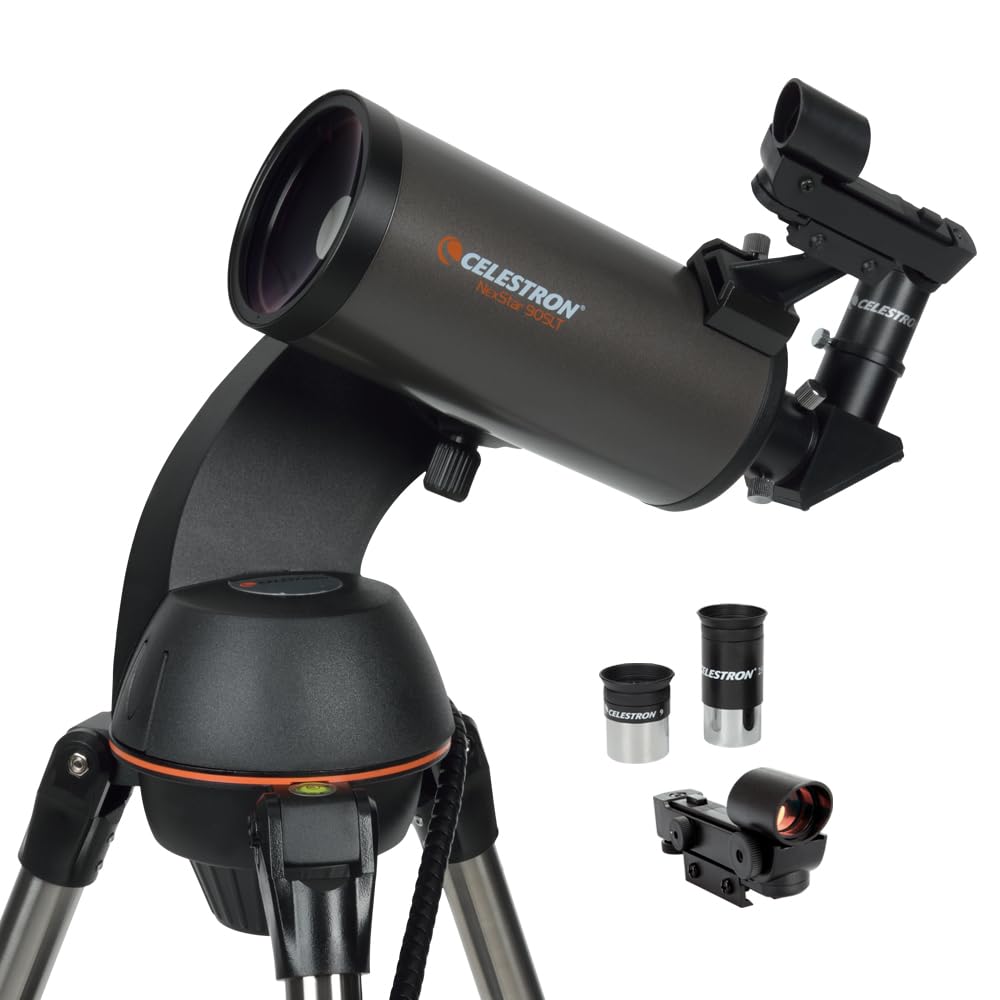
The one that fits in the boot of the car — 90mm of Maksutov glass that packs down for a dark-sky weekend.
Packability is the entire reason this scope exists. It is the smallest in Celestron’s SLT family, which makes it the one you actually take to a campsite instead of leaving at home. A 1250mm focal length on a 90mm tube still delivers enough magnification to show Saturn’s rings and Jupiter’s cloud bands in detail, and the fully coated optics keep the Moon bright and defined.
Then there is the sky you get back. The field of view is 1.7 degrees, which is the widest here by a country mile — against 0.11 degrees on the NexStar 4SE above, it opens up a completely different kind of viewing. Star hopping is less painful, open clusters fit in the frame, and finding your first target by eye is far less of a fight. The 40,000+ object database and SkyAlign alignment work the same way as on the more expensive 4SE.
What to expect honestly: sky alignment is the sticking point for some owners, with alignment failures the most common complaint. It rewards a clean horizon and three genuinely bright stars. At 4.0+ stars, this is a well-liked scope with a vocal minority who hit setup trouble — a fair caveat rather than a verdict. Two eyepieces (25mm and 9mm) and a StarPointer red dot finder come included, so you can observe on night one.
Why travellers like it
- 1.7 degrees of field is the widest in this lineup — you can actually see where you are pointing.
- Compact enough for a camping trip or a dark-sky excursion.
- SkyAlign plus a 40,000+ object database removes the star-chart homework.
- Two eyepieces and a red dot finder ship in the box.
Plan around this
- Alignment can fail when your view of the sky is obstructed.
- 90mm of aperture hits a ceiling on faint deep-sky objects.
Pick this one if: the scope needs to travel with you and you value a wide, forgiving field over raw light grasp.
skip it if: your main target is a barely-there galaxy rather than the Moon and planets.
5. Sky-Watcher AZ-GTi SkyMax 102 Mount

Run the whole rig from your phone over its own WiFi signal — no hand controller, no cable spaghetti.
The mount here is the star. An 8.6lb Alt-Az head with an 11lb payload capacity means it can carry the bundled 102mm Maksutov tube and then, later, a DSLR camera body instead. It broadcasts its own WiFi signal so your smartphone or tablet becomes the controller. Freedom Find dual encoders are the clever part: you can unclamp and swing the tube by hand without losing your alignment, which saves re-doing the whole pointing routine every time you move.
The 102mm SkyMax Mak delivers a high-contrast 1300mm focal length in a compact tube — exactly the spec you want for lunar and planetary work. The multi-coated optics get consistently good feedback. The bundle is genuinely complete too: mount, optical tube, pier extension, red dot finder, diagonal, 10mm and 25mm eyepieces, and tripod all arrive together.
The catch is the 102mm aperture. 102mm is modest, and this rig has a mixed reputation for deep-sky viewing — it is a planet and double-star machine, not a nebula hunter. The field of view comes in at 1.3 degrees, which is generous for a Mak but doesn’t change the light-gathering limit. If your heart is set on faint galaxies, a bigger tube is the honest answer.
Where the money goes: you are paying for a travel-sized GoTo mount that will outlive the tube — the 11lb payload and WiFi hand-off mean it can grow with your gear.
The limit to accept: the exit pupil is 8 millimeters, so low-power wide views stay dim on faint targets.
The right buyer: a phone-first observer who wants the mount to find and track targets over WiFi.
The mismatch: a deep-sky chaser who needs more light grasp than a 102mm tube delivers.
6. BRESSER First Light Mac 100/1400 Telescope

Built for a back garden with a streetlight in view — compact, colour-free, and ready for your phone.
This is a Mak for the person who will not drive to a dark sky site. The 100mm aperture and 1400mm focal length pull in enough light to see compact, bright targets — planets, the Moon, brighter deep-sky objects — and the seller points out that you don’t need to travel out of town to get a decent view. Its compact tube and lack of noticeable chromatic aberration are the Maksutov advantages, doing exactly the job they were designed for.
The included 25mm Plössl eyepiece gives you 56x magnification, which is a sensible starting power for lunar and planetary work — enough to resolve craters and ring structure without running so high that the view goes soft. And this is one of the few Mak packages here that includes a smartphone holder, so you can grab a snapshot of the Moon and send it to your family instead of describing it badly.
The honest limit is the EQ3 equatorial mount. An EQ3 equatorial head is more fiddly to set up than a simple Alt-Az, and it rewards a proper polar alignment. If you have never used an equatorial mount, budget an evening to learn it before you judge the optics. The bundled package is otherwise complete, and the price sits in the mid-range with the tube and mount together.
The practical upside: one box gets you the 90-degree star diagonal, the 25mm Plössl, the EQ3 tripod, and the phone holder — a full starter kit rather than a tube you have to finish yourself.
It suits: a city-dweller who wants a complete, phone-friendly lunar and planetary setup in one purchase.
Worth knowing: an EQ3 mount needs polar-alignment practice, so your first night is partly a lesson.
7. Sky-Watcher Skymax 150mm Maksutov-Cassegrain

A dark-sky tube the size of a small suitcase that resolves planetary detail like a dedicated instrument.
At 150mm of aperture and 1800mm of focal length, this is where the Mak design starts to feel serious. The primary mirror is borosilicate with an aluminium coating under a quartz overcoat, quoted at 94% reflectivity — a maker figure, not an independent test result — so light transmission stays high and the view of a planet stays bright and contrasty.
The fully baffled tube is the under-appreciated spec. Baffles are internal ridges that block stray light bouncing around inside the barrel, and the result is charcoal-black sky behind a planet rather than a grey wash. A Vixen-style dovetail sits on the underside, which is the industry-standard bar and fits almost any mount you might already own.
Consider the weight before you commit: 16 pounds of tube, and no mount in the box. This is a scope you mount permanently or carry in two trips. What the box does give you is a 28mm 2-inch eyepiece, a 2-inch 90-degree star diagonal, and a 9×50 straight-through finderscope — enough to start observing without a second purchase. At 4.5+ stars from a small pool of ratings, it is the highest-scoring Mak here despite the tube-only packaging.
Reasons this tube stands out
- 150mm aperture gathers enough light for detailed planetary study.
- Fully baffled tube keeps the background sky black.
- 94% reflectivity coating on a borosilicate mirror.
- 2-inch eyepiece and diagonal included — nothing missing from the kit.
Before you order
- No mount included — 16 pounds of tube needs a serious head underneath.
- It is a high-sticker premium tube, so the budget has to include the mount too.
Buy it if: you own a mount that can carry 16 pounds and want more light grasp for planetary detail.
Look elsewhere if: you need a package that includes a tripod — this is optics only.
8. Sky-Watcher Skymax 180mm Maksutov-Cassegrain (S11540)

The biggest Mak here, and the one that drags the faintest detail out of the ecliptic.
2700mm of focal length and 180mm of aperture is the top of the Maksutov ladder in this lineup. Where the 150mm Skymax gathers enough for detailed planetary study, this 180mm tube reaches further into the deep sky — and owners describe the optics in the kind of terms that make a planetary observer sit up. That is the whole point of a big Mak: aperture plus a long focal length, in a tube shorter than a conventional reflector of the same reach.
The build follows the same formula as its smaller sibling: a borosilicate primary mirror with aluminium coating under a quartz overcoat, quoted at 94% reflectivity, a fully baffled tube, and a Vixen-style dovetail. You also get a 28mm 2-inch eyepiece, a 2-inch 90-degree star diagonal, and a 9×50 straight-through finderscope. For someone upgrading from a small refractor, that bundle is a clean step up.
Two things to plan for. First, 19 pounds of tube with no mount means the tripod bill lands separately and it will not be cheap. Second, field quality is the recurring complaint — brightness and wide-field performance draw mixed feedback, and a long focal length means the field is narrow by design. The sharpness and detail, though, are what win people over.
The standout number: 2700mm is nearly double the 1365mm of the MK105 below, which is why this scope magnifies so hard with ordinary eyepieces.
Made for: a committed planetary and double-star observer with a mount that handles 19 pounds.
The cost of the reach: wide-field sweeping is not its strength, and field brightness divides opinion.
9. Bresser Messier MC-152/1900 Maksutov-Cassegrain

A 65mm focuser and a camera handle — the tube built to be loaded up and pointed at nebulae.
The focuser is the headline. A 65mm Hexafoc drawtube is unusually wide for a Mak, so the light path is not pinched at the eyepiece, and a wide drawtube also means you can adapt to camera gear without a thimble-sized opening getting in the way. A 152mm aperture with 1900mm of focal length takes you up to 300x magnification, which is enough to push a planet to the limit of what the atmosphere will allow.
The tube is heavy — 6.5kg, or about 14 pounds — and 49cm long, with a 17.6cm diameter. The handle is not a gimmick: it makes moving a 14-pound tube safe, and it doubles as a mounting surface for a camera. GP prism rails with stainless-steel clamping surfaces mean the tube will sit on almost any astronomical mount you already own.
The kit is deep. You get a 26mm Super Plössl eyepiece in a 1.25″ barrel, adapters for both 1.25″ and 2-inch, an integrated T2 adapter for camera connection, a 90-degree star diagonal, a 6×30 viewfinder, a rotatable star map, and Stellarium astronomy software on disc. The honest caveat is its 3.5+ star rating from a small pool of reviews — the lowest here — so weigh the spec sheet and return terms over the star line.
Best used for: deep-sky observation and nebula photography where a wide focuser and camera mount matter more than a lightweight carry.
One honest flag: at 6.5kg with no mount in the box, budget for a mount rated for that weight before you click buy.
The buyer it fits: an imager who wants a Hexafoc focuser, a camera handle, and adapters already in the box.
The buyer it doesn’t: anyone chasing a light, grab-and-go tube — 6.5kg is a two-handed lift.
Know the Specs
Aperture In Millimeters
Aperture is the width of the opening that gathers light, and it sets the ceiling on what you can see. A 90mm tube shows the Moon and planets well; a 180mm tube reaches fainter deep-sky objects. More aperture almost always means more weight, so match the glass to the mount and your willingness to carry it.
Focal Length And Ratio
Focal length is how far light travels inside the folded tube, and it decides your magnification with any given eyepiece. A longer focal length magnifies harder but narrows the field of view. Focal ratio — written as f/11.8 or f/13 — describes how fast the tube gathers light, and a lower number is faster.
Exit Pupil In Millimeters
The exit pupil is the tiny disc of light that reaches your eye through the eyepiece. A small exit pupil means dim, high-power views for lunar and planetary work; a larger one is brighter and easier for a beginner. Very small values, like the 0.08 millimeters on the MK105, point to a specialist high-power tube.
Mounts, Dovetails, And GoTo
A Vixen-style dovetail is the standard bar that slides into most mounts, so it keeps your tube compatible. GoTo mounts use a database of objects and motors to point the scope for you, and SkyAlign or WiFi control shortens setup. A bare optical tube needs a mount and tripod you supply.
Common Questions
What makes a telescope a Maksutov-Cassegrain rather than an ordinary reflector?
Will a Mak show me deep-sky objects or only planets?
Do I need to buy a mount separately for a Mak optical tube?
What does the focal ratio number like f/11.8 actually control?
How much does a Mak weigh and can I carry it outside in one trip?
Is a GoTo mount worth it on a Maksutov-Cassegrain?
Can I attach a camera or smartphone to these telescopes?
What eyepiece sizes fit these scopes?
Is a bigger Mak always better for planetary viewing?
How do I check a new Mak for collimation problems?
The Bottom Line
The Celestron NexStar 4SE takes the top spot: a 1325mm Maksutov tube on a GoTo mount with SkyAlign, so it slews to targets instead of leaving you to hunt them. If you already own a mount and want the wide, forgiving view that suits a campsite, grab the Celestron NexStar 90SLT. And for raw aperture on a fixed mount, the Sky-Watcher Skymax 150 is the one to reach for.
One nudge worth making: the 4SE’s crowd favourite status — 4.0+ stars across 770+ ratings — comes from people who accepted a narrow field in exchange for clean, sharp planetary views. That is the trade-off every Mak asks of you, and it is worth making knowingly.
How we choose
We do not accept paid placement. Every pick is matched to a real buyer and a real use-case; we do not hands-on test units.
Sources
Specifications: manufacturer listings and product documentation. Review insights: verified customer reviews, as of November 2026. Pricing: not shown on this page (it changes often); check the current price via the retailer link.
As an Amazon Associate, Tactical Gear Guy earns from qualifying purchases. This does not affect which products we feature.