Specs are compiled from manufacturer listings and verified buyer reviews and can change over time — please confirm the key details on the product page before buying.
If your wood stove heats one spot on the hearth and leaves the far end of the room shivering, a heat-powered stove fan is the fix — it sits on the hot stovetop, spins itself from that heat, and pushes warm air out into the room. No cord, no battery, no extra electricity bill. The catch is that these fans vary wildly in real airflow and how long they survive the heat, so the nine picks below are sorted by what actually matters: honest air movement, quiet running, and build quality that holds up over a winter of daily burns.
This guide is built by comparing the manufacturers’ published specifications and the patterns across verified customer reviews, so you get each pick’s real strengths and trade-offs instead of marketing spin.
Some fans here push a genuine breeze across the room while others barely stir the air, and build quality separates the ones that last from the ones that fade. Below you’ll find the strongest log burning fans broken down by airflow, blade count, and how well each one survives the heat.
Top Picks


How To Choose The Best Log Burning Fans
A stove fan is a simple thing that is easy to buy badly. You set it on the hot stovetop, the heat warms a thermoelectric module (a small plate that makes electricity from a temperature difference), and that current turns the blades. The whole point is to move the warm air pooled above your stove out into the room instead of letting it sit and head straight up the flue. Getting the right one is about three things: how much air it truly shifts, whether it kicks in at the temperatures your stove actually reaches, and how it protects itself when the fire runs hot.
Airflow in CFM tells you the push
Airflow is measured in CFM (cubic feet per minute — the volume of air the fan moves in a minute). A fan around the 100 CFM mark suits a small snug or a compact living room. If you’re heating a larger open-plan space or fighting a stubborn cold spot at the far wall, a fan with a higher CFM figure and more blades is the sensible target, because it can push warmth across the room rather than just around the stove.
Why blade count and motor count matter
More blades and a second motor generally mean a wider, stronger sweep of air instead of a thin waft pointed one way. Single-head fans can leave cold pockets in big rooms, while dual-motor 12- or 16-blade heads spread the stream further. The trade-off is that extra moving parts are more to go wrong, so the build quality of the motor and the base matters just as much as the blade count.
The heat you use it at
These fans only start once the stovetop is hot enough, so you want one that activates in a range your stove actually hits and keeps working efficiently through a normal burn. Many owners find the fan spins faster as the stove gets hotter and slows as it cools, which is exactly how it should behave. A base with a bimetallic overheat strip (a metal plate that lifts the fan off the stove when it gets too hot) is the detail that saves the thermoelectric module on a roaring fire.
Side-by-Side Comparison
| Model | Best For | Airflow | Blades | Weight | Amazon |
|---|---|---|---|---|---|
| Caframo Ecofan Original★ Best Overall | Small rooms, quiet nights | 100 CFM | 2 | 1.8 pounds | Amazon |
| VODA 5-BladeBudget Champion | Budget entry to heat moving | 180 cfm | 5 | 532 g | Amazon |
| Tomersun 16-Blade Dual MotorBest for Big Rooms | Large rooms, big stoves | 160 cc/minute | 16 | 575 g | Amazon |
| HIDALIFE 6-Blade | Compact stoves, tight hearths | — | 6 | 1.7 pounds | Amazon |
| VODA 16-Blade w/ Bracket | Buddy heaters and log burners | — | 16 | 1.3 pounds | Amazon |
| Ourhom 8-Blade Double-Head | Double-wide heat capture | — | 8 | 2 pounds | Amazon |
| XTIMES 12-Blade Dual Motor | Heaters and stoves together | — | 12 | 1.6 pounds | Amazon |
| Ecofan Original 100 CFM | Big stoves, strong push | 100 cfm | 2 | — | Amazon |
| Freedom Stoves 4-Blade | Medium-to-large rooms | 348 cfm | 4 | — | Amazon |
Detailed Reviews
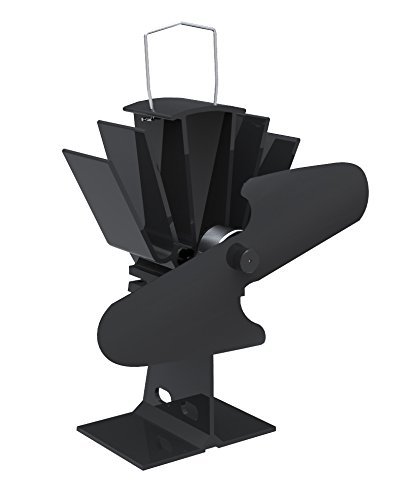
1. Caframo Ecofan Original Heat Powered Stove Fan
Our pick — 4.5+★ from 500+ verified ratings; the strongest balance of quality and price.
The quiet little workhorse that has been moving stove heat since the idea was new.
This is the fan the rest of the category got measured against. It pushes up to 100 CFM from just two blades, and it runs on stove surface temperatures between 300F and 650F. So on a normal burn it starts working in the range your stovetop actually sits in, then spins faster as the fire builds. What wins people over is the quiet: it moves heat without a hum you have to talk over, and owners keep coming back to how smoothly it warms the room instead of just the hearth.
Set against the VODA 5-blade, which lists 180 cfm, this one gives up raw airflow numbers — but it makes up for it in airflow quality and noise. The bigger head-to-head is blades: the Caframo carries 2 blades where the Tomersun 16-Blade packs 16, a wide gap in surface area. Two blades means less to fail and less motor strain, which is part of why it stays so quiet. For a snug, a cabin, or a living room where the stove already throws good heat, that trade is a sensible one.
The thing to weigh before you buy is longevity at the top end. This is an established, well-loved design, but a fan this small running against the kind of heat a hard-burning stove throws out will eventually need care. Keep the stove within the stated range and treat the base gently, and it earns its keep burn after burn. The honest caveat: if you’re trying to heat a very large open room, the modest airflow here may leave the far corners cool — that’s a job for a dual-motor head.
What earns its keep
- Runs on stove heat alone with no cord or battery
- 100 CFM from just two blades, tuned for quiet running
- Warms the room fast and smooths out cold corners
What to weigh first
- Modest airflow for very large open-plan rooms
- Two-blade head means less brute push than multi-blade rivals
Reach for this if: you have a compact-to-medium room and want a quiet, proven fan that works on its own.
Look elsewhere if: you need to shove heat right across a big hall — a dual-motor 16-blade head gives more spread.
2. VODA Wood Stove Fan 5 Blades
A five-blade entry fan that asks for very little and spins itself from the heat.
The defining number here is airflow: this fan lists 180 cfm, which is the highest single-head figure in the group at this budget tier. The five-blade head is designed to divert warm air horizontally out across the room rather than let it rise straight up, so it does a believable job of spreading stovetop warmth instead of hoarding it. It’s dead quiet too — the only moving part is the blade assembly, and the working noise is stated under 25db, which is softer than a whisper. The adjustable bimetallic overheat strip at the base lifts the edge of the fan when it nears its maximum temperature, then lets it settle back down as the stove cools.
Where it stumbles is longevity. The recurring theme is the motor giving out well before the fan should — some units stop spinning far too early, and the value argument weakens the moment that happens. That matters because a stove fan only pays for itself by running quietly, burn after burn, for years. If yours keeps running, it’s a lovely little bargain with genuinely strong airflow for its size. If it doesn’t, it’s a short-lived experiment.
The genuine draw: 180 cfm of airflow and near-silent running for a lightweight 532 g fan that needs no power at all.
The honest catch: durability is a real gamble — several units give up within weeks, so go in knowing it’s the least-sturdy fan here.
The verdict: a solid first stove fan if you want hands-off heat spreading on a tight budget and can accept the lifespan risk.
Think twice if: you want a fan that will still be spinning five winters from now — this isn’t the one to bet on for that.
3. Tomersun Wood Stove Fan, 16 Blades Dual Motor
Sixteen blades and two motors aimed straight at the cold end of a large room.
If your problem is a big, open space where one head can’t reach the far wall, this is built for exactly that. Sixteen blades across a dual-motor head sweep a wider, more concentrated stream than the single-head fans here, so heat gets distributed across a room instead of pocketing around the stove. It comes with a magnetic stove thermometer that sticks to your stovepipe, which lets you watch surface temperature in real time. Keep it in the stated 392°F–482°F (200°C–250°C) band and below 572°F (300°C) to keep the thermoelectric module inside its comfort zone. No batteries, no cord, and it’s quiet enough for a cabin, a tent, or an ice-fishing shelter.
It’s heavier than the VODA 5-blade at 575 g versus 532 g, and its footprint is listed as 4.4″D x 10″W x 5.4″H against the compact HIDALIFE at 2.2″D x 3.5″W x 7.9″H — a much wider stance that wants a flat, roomy stovetop. The aluminum body with electrophoretic coating (a factory finish that helps resist heat discoloration) is built to resist discoloration and loosening under heat, which is the failure point on cheaper fans that peel and rattle.
Here’s the practical part: this fan rewards a stove that runs hot and steady, because its output climbs with the heat. On a small or slow-burning stove it has less to work with. Match it to a big firebox in a big room and it does its best work.
The case for the 16-blade head
- Dual-motor, 16-blade design spreads heat wider than single-head fans
- Free magnetic thermometer helps you stay in the safe temperature band
- Runs off-grid on heat alone, with no batteries or cord
The trade-offs
- Wide 10-inch footprint needs a generous flat stovetop
- Rewards a hot, steady stove — thin fires give it less to work with
Best for: large rooms and big stoves where you need the warmth spread across the whole space.
The caveat: the wide stance and heavier 575 g build want a flat top with room to sit — measure your stove first.
4. HIDALIFE Wood Stove Fan with Thermometer

A narrow six-blade fan built to squeeze onto a tight stovetop.
The number that sets this one apart is its footprint: 2.2″D x 3.5″W x 7.9″H, making it one of the slimmest on this list. If your stove has a small flat top, a modest chimney shelf, or a hearth where a wide 16-blade head just won’t fit, this slips into the gap. The six-blade design is meant to add air circulation, and it runs with noise below 25dB — the only moving part is the blade assembly, so it’s a whisper rather than a whir. The base lifts itself gently if the working temperature climbs too high, protecting the motor, and a magnetic thermometer comes in the pack.
It’s light at 1.7 pounds, a touch under the Ecofan Original’s 1.8 pounds, so it’s easy to set down and shift when the fire’s out. The anodized-aluminum body resists rust and handles the heat. Where a buyer should be honest with themselves: it’s narrow, which is great for tight spots but gives less spread than the multi-blade dual-motor heads if you’re trying to reach across a big room.
Where it fits: slim hearths, small stoves, and spaces where a wide fan simply won’t sit — this is the fit-first pick.
Where it doesn’t: if room-spreading airflow is the goal, its narrow six-blade head can’t match a 16-blade dual-motor unit.
Reach for this if: your stovetop is compact and you need a quiet fan that actually fits the space.
Look elsewhere if: raw airflow spread across a large room is your priority.
5. VODA 16-Blade Wood Stove Fan with Mounting Bracket
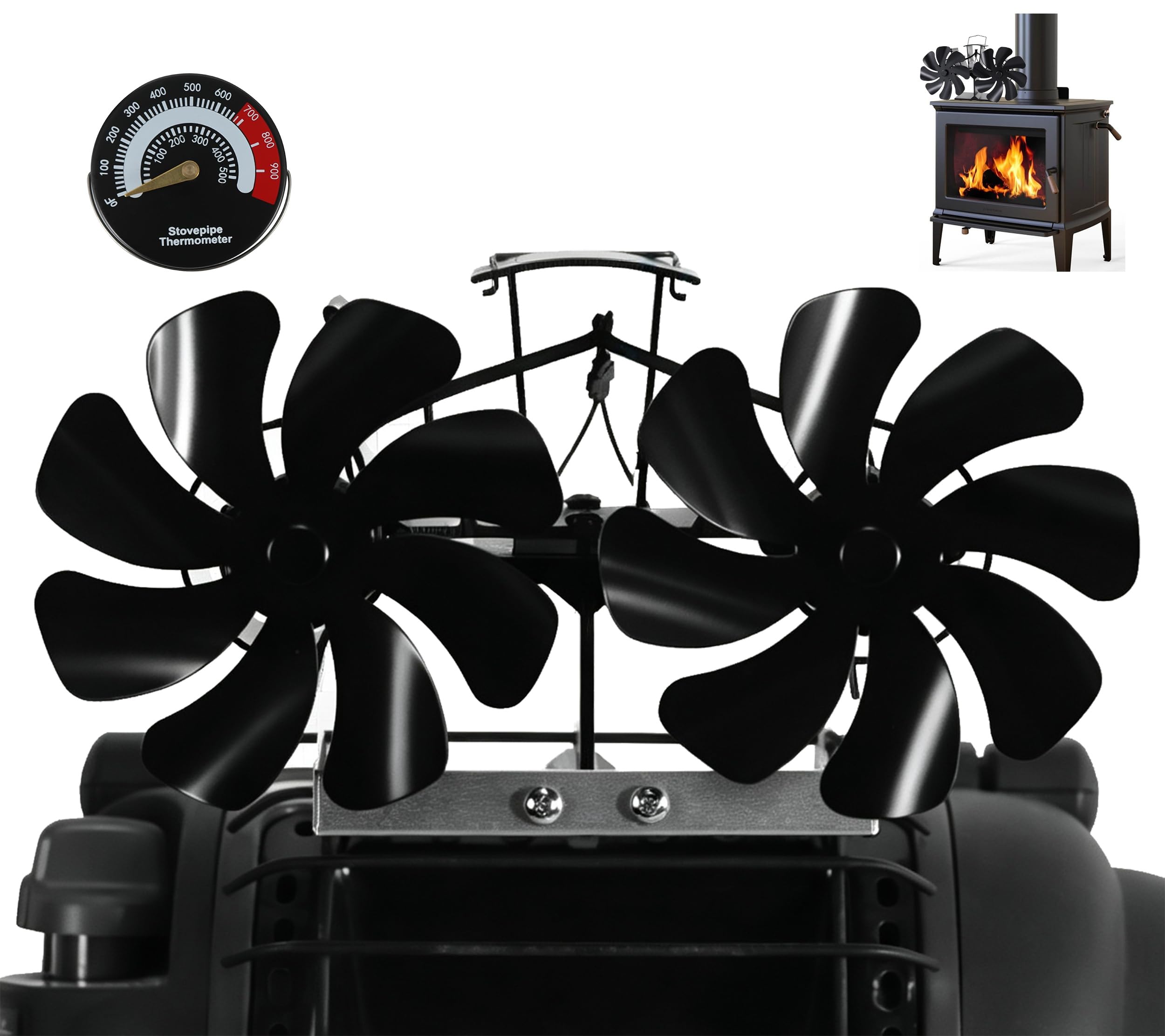
The dual-motor fan that also clips onto a propane Buddy Heater when the woodstove’s cold.
Most stove fans only work on a flat wood-burning top, but this one comes with a mounting bracket that lets it work on Buddy Heaters, gas stoves, and pellet fires too. That flexibility is the real sell for anyone heating a tent, a shed, or a hunting cabin where propane is the fuel. Inside, a dual high-efficiency motor drives 16 blades, and VODA claims 50% more airflow than standard single-motor units — the maker’s own figure, not a measured test. It stays whisper-quiet at ≤25 decibels and runs entirely cordless on stove heat.
Where it sits in the pack: the blades and dual motor here echo the Tomersun 16-Blade, and it matches the Caframo’s quiet-running priority. Its dimensions of 4.4″D x 10″W x 5.3″H put it in the same wide-footprint class as the Tomersun, so both want a roomy flat top or the bracket. Anodized aluminum keeps the base and blades rust-free, and the included magnetic thermometer helps you watch surface temperature for safe, efficient running.
The honest note: airflow is the most argued-about part of this fan’s reputation. Owners split — plenty find it pushes hot air between rooms, while others feel it doesn’t move as much as the dual-motor spec suggests. If you’re counting on a strong cross-room push on a woodstove, temper the expectation; if you mainly want versatile heat spreading on a variety of heaters, it’s a smart fit.
Go for it if: you heat with propane, a Buddy Heater, or a mix of heat sources and want one fan that adapts.
Pause if: you expect a strong cross-room woodstove push — airflow reports are genuinely split.
6. Ourhom 8-Blade Double-Head Wood Stove Fan
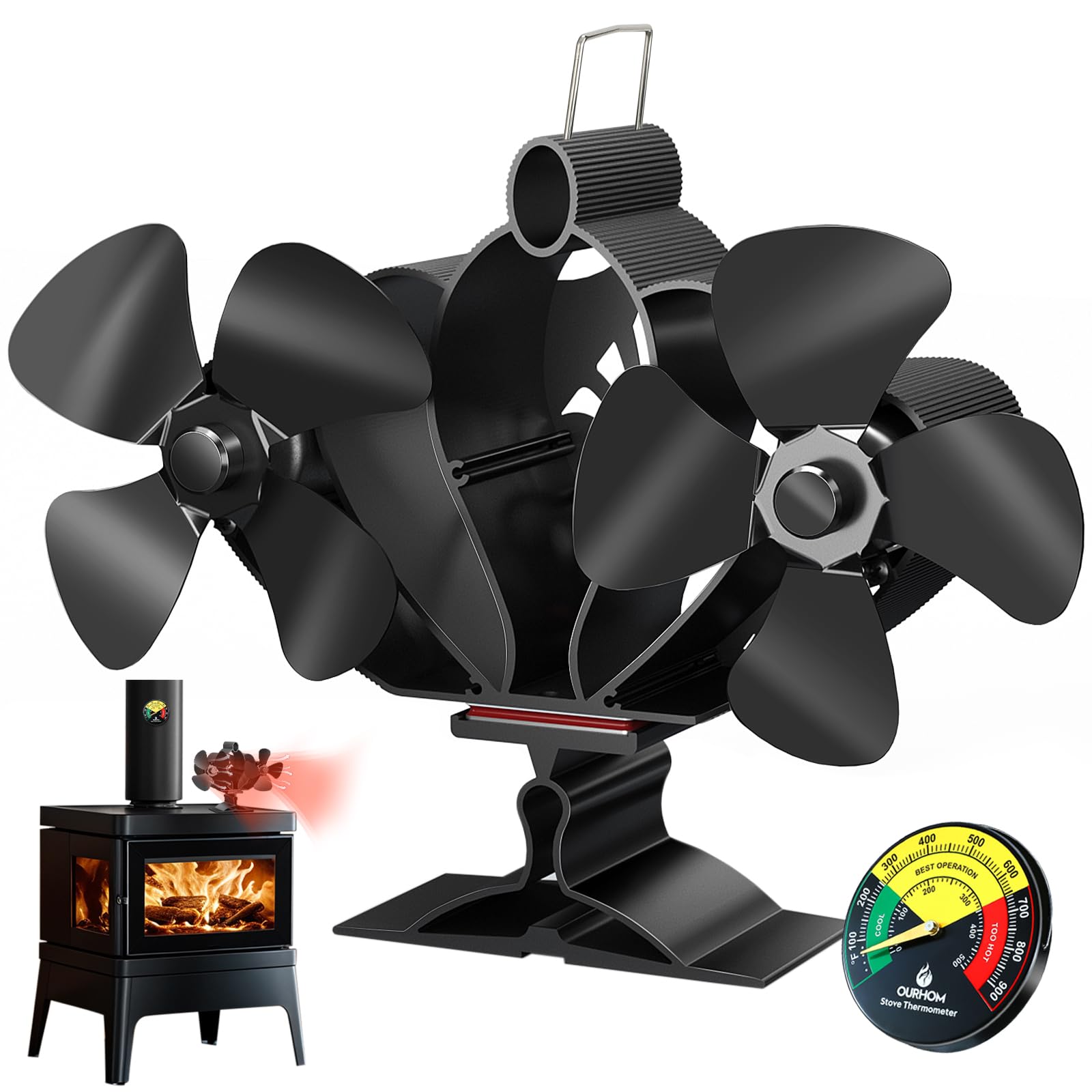
Two synchronized heads that grab more of the stove’s waste heat across a wider span.
The idea here is surface area. Instead of the single-head layout most fans use, this one doubles the head so it captures more of the heat coming off the stove, then the synchronized blades push it out in a concentrated stream. It kicks in around 100°C (210°F) and runs with no outlets, no batteries, and no running cost. A bimetallic safety device at the base lifts the front of the fan above 644°F/340°C to protect the motor from overheating. The aluminum body is die-cast, and a magnetic thermometer is included so you can read surface temperature at a glance.
This is also the heaviest fan here at 2 pounds, and it’s a chunky unit at 11″D x 5″W x 8″H — a real consideration if your stovetop is small. The footprint wants a flat, open top with room around the chimney, and the maker advises leaving roughly 15cm of space behind the fan so it can push warm air out into the room.
Here’s where you need to be clear-eyed: this is the fan whose reputation is most mixed on whether it delivers the push it promises. Quality and heat distribution get genuine praise, but the recurring feedback is that some units don’t spin fast enough or the blades read smaller than expected in person. If you’re handy with placement and have a hot stove, it can work well; if you want the surest airflow, look to the higher-rated dual-motor picks.
What it gets right: the double-head design captures more stove surface for heat, and the included thermometer keeps you in a safe range.
The real hesitation: performance is the most debated part of its record — some units don’t spin as fast as buyers expect, and the head reads compact once it’s from the start.
Best for: buyers who want a double-head heat-capture design and can give it a flat, spacious stove top.
Think twice if: you want the most certain airflow — this one’s performance record is split.
7. XTIMES 12-Blade Dual Motor Wood Stove Fan
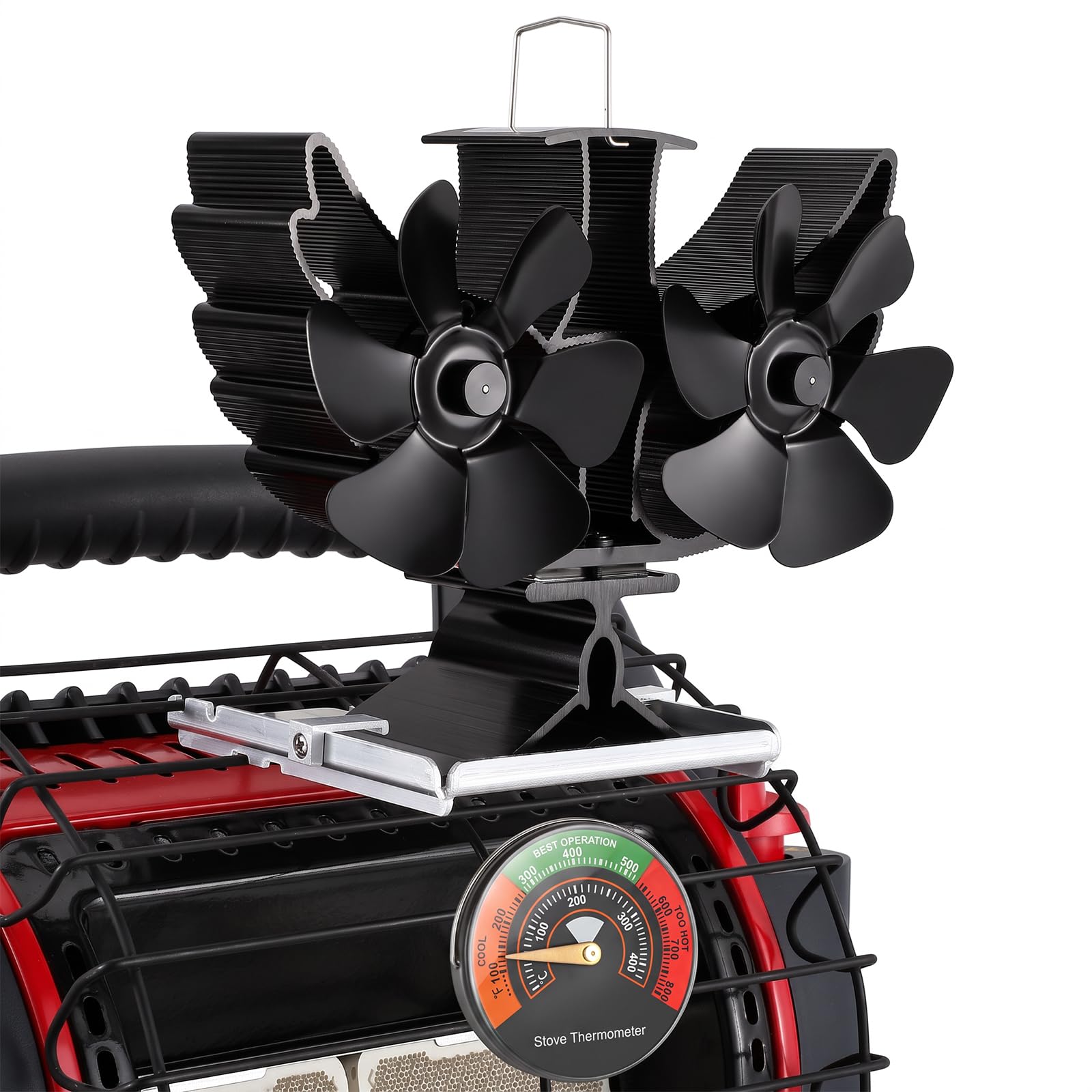
Twelve blades and two motors, with a bracket that works on heaters as well as stoves.
This is the pick for someone heating with more than just a woodstove. The extra bracket lets the same fan sit on a heater, so it spreads heat whether you’re burning logs or running a space heater. Twelve blades across two motors move air faster than a single head, and the only moving part is the blade holder, so it runs under 25 decibels — quiet enough to sleep beside. The anodized-aluminum body won’t rust or corrode when hot, and a bimetallic strip in the base lifts the edge of the fan when the maximum operating temperature is reached, protecting it from heat damage. A magnetic stove thermometer is included to monitor the firebox.
Compared with the Caframo’s two-blade head, this carries twelve — a big jump in surface area and push, and a different tool for a different job. It’s a mid-pack 1.6 pounds, and the dimensions of 7.3″D x 4.9″W x 8.2″H keep it reasonably compact on the stovetop. Spreading heat and improving stove flow are the two things it does best, and owners reliably find the warmth reaches further into the room than it did before.
The one to keep in mind is durability: that’s the mixed part of its record, with some units running long and a few giving out early. Treat the base reasonably and run it within its temperature range, and it’s one of the better-rounded fans here.
Why it leads on versatility
- Extra bracket works on heaters as well as woodstoves
- 12 blades and dual motors for faster air circulation
- Under 25dB with anodized aluminum that resists rust
What’s less certain
- Durability is the split part of its record — some units fail early
Reach for this if: you want one fan that covers a stove and a heater, with strong dual-motor air movement.
Weigh first: durability is genuinely mixed, so lean on the warranty and keep the stove within its range.
8. Ecofan Original Heat Powered Stove Fan, 100 CFM

A classic two-blade design with FingerSafe blades and a warranty to lean on.
The headline is performance, and it’s the thing that carries this fan: heat distribution across the room is what it does best, spreading warmth evenly instead of letting it climb the flue. It pushes 100 cfm from a two-blade head, and the blade system is designed to minimize motor resistance so it spins easily on stove heat alone. The 7.9-inch aluminum blades are FingerSafe — a real plus in a house with kids or a busy hearth. It generates its own electricity from the stove, needs no cord or battery, and is built to last with recyclable materials. Designed and made in Canada by Caframo, a name that’s been in this category for years.
Set it next to the Freedom Stoves 4-blade, which lists 348 cfm, and this gives up raw airflow by a wide margin. But the Ecofan trades brute push for a quieter, gentler spread that owners tend to prefer in living spaces. The classic look fits a range of stoves, and replacement motors are available, which matters over the long haul.
The catch to know going in: airflow is the debated part. Some owners say it definitely moves air, others find it gentle. If you want a hurricane it isn’t that; if you want even, quiet warmth and a name you can get parts for, it fits the bill.
The standout: smooth, even heat distribution from a proven two-blade design, with FingerSafe blades and replacement motors on offer.
The honest limit: 100 cfm is gentle next to the 348 cfm class, so very large rooms may want more push.
Best for: buyers who value quiet, even warmth and a long-established design with parts support.
Skip the expectation of: a hurricane-force push — this one spreads heat gently, not violently.
9. Freedom Stoves Heat Powered Stove Fan, 348 CFM
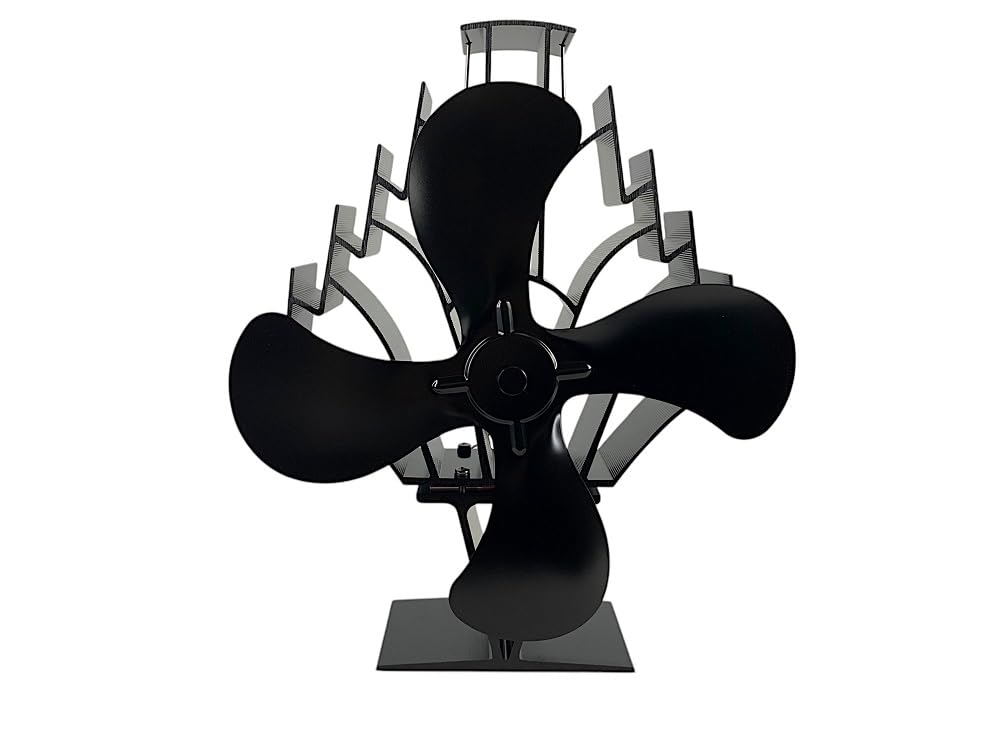
The airflow heavyweight — 348 CFM meant to shove warmth across a big room.
If airflow numbers decide your buy, this is the one to look at. It lists 348 cfm from a 13-inch, 4-blade dual-motor head, which is by far the highest figure in this group — the Ecofan Original lists 100 cfm, so this leads on paper by a wide margin. It’s sized for medium to large rooms where you need warm air pushed further out. The design sits on flat-top wood, pellet, and log-burning stoves, and its speed rises and falls with the stove heat, so output follows your fire. No cords, no batteries, no outlets.
Owners are consistently happy with the performance and the amount of air it moves — this is a fan that pushes a genuine stream, and the size is well-liked. It runs quietly, and the 10.5-inch metal blades are built for the long push. The practical check before you buy is your stovetop: confirm it has a flat top suited to the fan, since it relies on direct heat transfer to spin.
Two things to hold in mind. First, durability is the mixed note here — several units didn’t make it past a year, so this isn’t the fan to bet your whole winter on indefinitely. Second, the value conversation runs both ways; some feel it saves on electricity and earns its keep, others aren’t convinced. For a big room where you need the airflow, though, few fans in this category push this hard.
Why airflow chasers like it
- 348 cfm from a 13-inch 4-blade dual-motor head — the biggest figure here
- Speed tracks stove heat, so output follows your fire
- Quiet running and a large, well-liked size for big rooms
What to know
- Durability is mixed — several units didn’t last a year
- Value opinions split, so weigh the airflow against lifespan
Best for: medium-to-large rooms where maximum airflow is the whole point.
The caveat: confirm a flat stovetop first, and go in aware its lifespan record is mixed.
Know the Specs
Airflow (CFM)
CFM means cubic feet per minute — how much air the fan moves each minute. A fan rated around 100 CFM suits a small room, while higher figures like 348 CFM push warmth across a larger space. Bigger isn’t automatically better; a gentle 100 CFM spread can feel more comfortable in a snug than a strong stream.
Blade Count and Motor Count
More blades and a second motor generally sweep a wider, stronger stream of air. A two-blade head like the Caframo trades brute push for quiet running, while 12- and 16-blade dual-motor heads spread heat further. More moving parts mean more to go wrong, so build quality matters alongside the count.
Thermoelectric Module
This is the small plate that turns stove heat into a tiny electric current to spin the blades — no battery, no cord. It has a temperature band it works best in, and running the fan far above that band shortens its life. That’s why the overheat protection at the base matters so much.
Overheat Protection
A bimetallic strip at the base is a metal plate that lifts the fan slightly off the stovetop when it gets too hot, protecting the module, then settles back as the stove cools. Fans without working protection can cook their module on a hot burn.
Common Questions
Do heat-powered stove fans really work without electricity?
What temperature does a stove fan need to start spinning?
Will a stove fan fit on my log burner?
Is a 16-blade fan better than a 2-blade fan?
How quiet are these fans?
Can I leave a stove fan on the stove overnight?
Do stove fans actually save on firewood?
How long do heat-powered stove fans usually last?
Can a stove fan be used on a gas or propane heater?
The Bottom Line
For most rooms, the strongest log burning fans pick is the Caframo Ecofan Original — a two-blade design that pushes 100 CFM quietly on stove heat alone, with the kind of steady, even warmth that suits most hearths. If your room is large and the cold spot sits at the far wall, the Tomersun 16-Blade Dual Motor spreads heat across a wider span. And if you heat with propane or a Buddy Heater as well as logs, the VODA 16-Blade with Bracket is the versatile one to reach for. Whichever you choose, keep the stove within the fan’s working range, let the overheat protection do its job, and it will quietly move the warmth you’ve already paid for into the room where you actually sit.
How we choose
We do not accept paid placement. Every pick is matched to a real buyer and a real use-case; we do not hands-on test units.
Sources
Specifications: manufacturer listings and product documentation. Review insights: verified customer reviews, as of November 2026. Pricing: not shown on this page (it changes often); check the current price via the retailer link.
As an Amazon Associate, Tactical Gear Guy earns from qualifying purchases. This does not affect which products we feature.