Specs are compiled from manufacturer listings and verified buyer reviews and can change over time — please confirm the key details on the product page before buying.
If you are here, you are probably tired of buying disposable batteries in bulk and watching them die in a week. The pick most people should start with is the DEWALT 20V MAX 5.0Ah pack if you already run power tools, or a rechargeable AA set if your house eats batteries in remotes, cameras and controllers. This guide splits nine real options by what each one actually powers, so you can match a battery to your device instead of guessing. Every pick below is a genuine lithium-ion or LiFePO4 product with the chemistry stated in its own listing.
This guide is built by comparing the manufacturers’ published specifications and the patterns across verified customer reviews, so you get each pick’s real strengths and trade-offs instead of marketing spin.
Match chemistry and voltage to the device: a 12V LiFePO4 marine block will not run a 3V smoke alarm, and a 1.5V AA cell will not crank a truck engine. Below, nine options are sorted by what they actually power, so you can find your fit fast when shopping for the Best Lithium Ion Battery.
Top Picks

How To Choose The Best Lithium Ion Battery
Start with what the battery has to feed: a 20V MAX drill, a 1.5V AA device or a 12V trolling motor each needs a different pack. A power tool, a trail camera and a trolling motor all need very different packs, and buying the wrong shape or voltage wastes your money faster than any brand choice will. Identify the device first, then match voltage, capacity and cycle life to it.
Voltage and form factor decide compatibility before anything else
A DEWALT 20V MAX pack only fits tools built for that system, and a 12V LiFePO4 block is a completely different animal — it is a box with terminals, not a slide-in cell. If you are replacing AA cells, check that your device accepts 1.5V lithium rechargeables. Some smoke alarms and doorbell cameras run on 3V and will not take them.
Capacity tells you runtime, not power
For AA cells, capacity shows up in mWh (milliwatt-hours, a measure of total stored energy) — the rechargeable sets here run 3,400mWh and 3,600mWh. For big packs it shows up in amp-hours: a 5.0Ah tool battery, a 22Ah camping block, a 100Ah marine battery. A higher Ah or mWh rating buys more runtime between charges, not more voltage or power.
Cycle life is the real cost-per-use number
Every recharge cycle is one less you have to buy. Some AA sets here are rated to 1,200 cycles, others to 2,000+. The LiFePO4 blocks go far higher, with ratings that ladder up depending on how deeply you discharge them. A pack rated 4,000+ cycles is a long-term purchase; a cell rated 1,200 cycles is a stopgap.
Safety electronics are not marketing filler
A BMS (battery management system — a small circuit board that cuts the power if the battery is overcharged, overheated or shorted) is what keeps a big lithium pack from becoming a hazard. Smaller AA chargers use indicator chips for the same reason. Skip any 12V pack whose listing does not state a BMS amp rating.
Side-by-Side Comparison
| Model | Best For | Chemistry | Capacity | Recharge Rating | Amazon |
|---|---|---|---|---|---|
| DEWALT 20V MAX 5.0Ah (DCB205)★ Best Overall | Power tools | Lithium Ion | 5 amp_hours | — | Amazon |
| 12 Pack 3400mWh AA with 12 Slot ChargerBest Value | Household devices | Lithium Ion | 3400 mWh | 2000+ cycles | Amazon |
| PHILIPS 8-Pack 3600mWh AATop Performer | Controllers and cameras | Lithium Ion | 3600 mWh | 1200 cycles | Amazon |
| Homesuit 12 Bay AA with Charger | Blink cameras and remotes | Lithium Ion | 3600 mWh | 2000+ cycles | Amazon |
| ZapLitho 12V 22Ah LiFePO4 | Camping and fish finders | LiFePO4 | 22 amp_hours | 4000+ cycles | Amazon |
| GOLDENMATE 12V 20Ah LiFePO4 | Ham radio and off-grid | LiFePO4 | 20 amp_hours | 5000+ cycles | Amazon |
| DEWALT XR POWERPACK 4Ah, 2 PK (DCB2104-2) | Heavy tool use | Lithium Ion | 4 amp_hours | — | Amazon |
| Eiiev 12V 100Ah LiFePO4 | Trolling motors and RV | LiFePO4 | 100 amp_hours | 4000~15000 cycles | Amazon |
| LiTime 12V 100Ah Trolling Motor | Marine and Bluetooth monitoring | LiFePO4 | 100 amp_hours | 4000–15000 cycles | Amazon |
Detailed Reviews
1. DEWALT 20V MAX Battery, Lithium Ion, 5.0Ah (DCB205)
Our pick — 4.5+★ from 20,500+ verified ratings; the strongest balance of quality and price.
The pack that keeps your whole 20V MAX lineup running all afternoon.
You stop swapping batteries mid-job if you already own DEWALT 20V MAX tools. The 5Ah capacity (amp-hours — the stored energy that sets how long a tool runs between charges) is the number that matters: fewer mid-task stops when you drill a full fence line or cut a stack of decking.
What wins people over is the build. It sits at 1.5 pounds, so a drill with this pack on the back stays balanced in one hand. The LED state-of-charge readout shows you how much is left before you start, which is the small feature you end up using every single session.
It slots into the 20V MAX system, so anything else you own on that line shares it. Compared with the heavier POWERPACK in this list, it is the sensible everyday choice — a lighter cell that fits the same chargers. The honest caveat: a few buyers report cells that die early, so buy from a reputable seller and register the pack.
Where It Delivers
- 5Ah capacity keeps high-drain tools running through long jobs
- 1.5 pounds keeps a drill balanced in one hand
- LED state-of-charge readout avoids mid-task surprises
- Fits every tool and charger on the 20V MAX line
Weigh Before You Buy
- Not a rechargeable AA replacement — it only powers 20V MAX tools
- A small minority of packs fail early, so buy from a trusted seller
Built for: anyone already running DEWALT 20V MAX drills, saws or drivers who wants a spare pack with real runtime.
Look elsewhere: if you need batteries for household devices — this pack powers tools only.
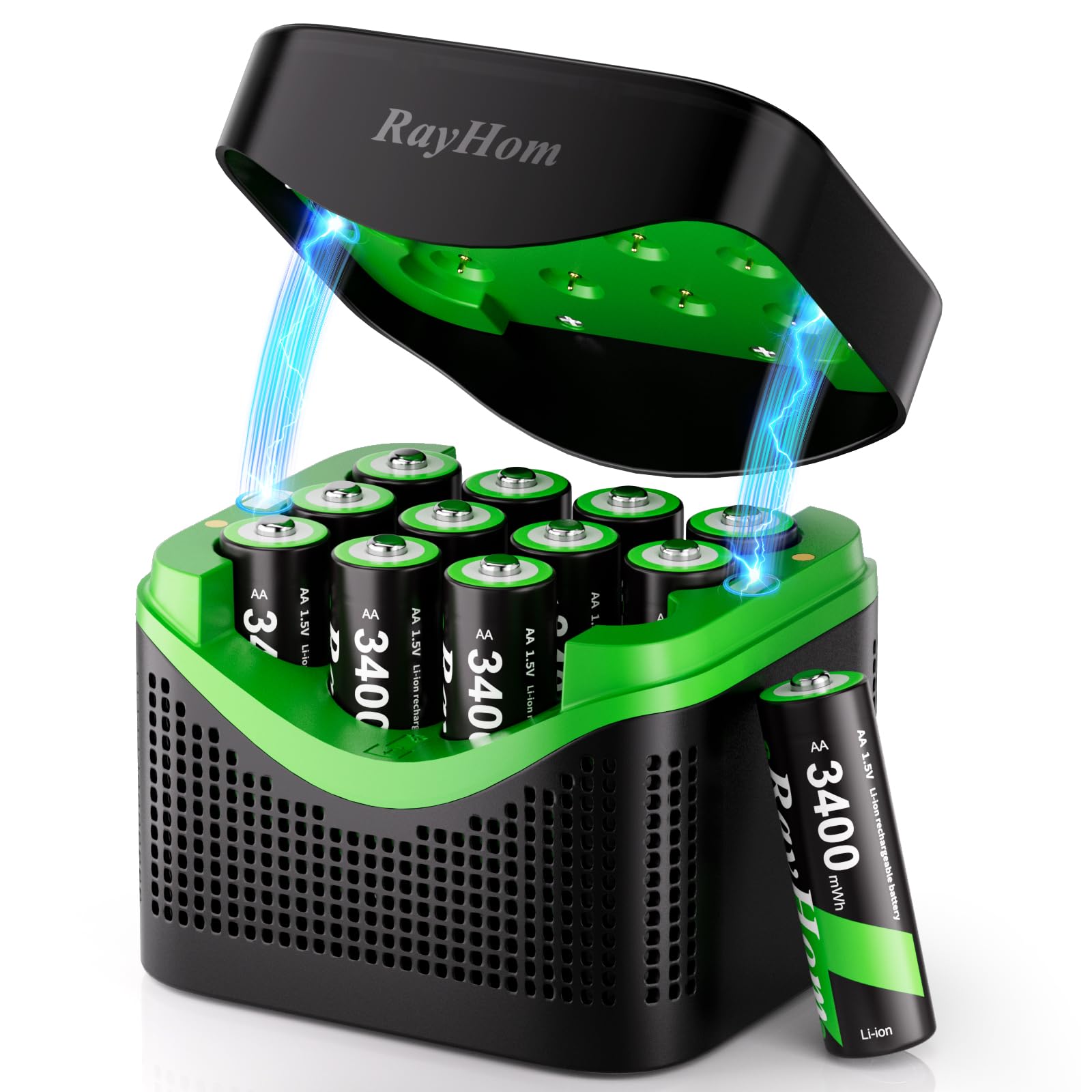
2. 12 Pack 3400 mWh Rechargeable AA Lithium Batteries
Twelve AA cells and a charger that snaps shut like an earbuds case.
This set is the fix for a house that burns through AA cells in remotes, toys and Blink cameras. You get 12 AA batteries at 3,400mWh each (milliwatt-hours — the total energy a cell holds), and the charger holds all 12 at once. Compare that with the PHILIPS eight-pack below: this box carries 50% more cells for the same drawer.
The charger is the part that stands out. It uses a wireless earbuds case design — a magnetic clamshell that closes over the cells, keeps them dustproof and waterproof, and travels without scattering. A smart LCD shows a scrolling icon while charging and a solid icon when done, and flashes when a cell is incompatible.
Each cell is rated to 2,000+ recharge cycles, so the box keeps going long after disposables would be landfill. The catch is honest and worth knowing: runtime is the mixed part. Some cells hold charge for a long stretch between swaps, others drain faster than expected. Treat this as a good value set for low-drain household gear rather than a guaranteed marathon cell.
Twelve-cell capacity: the magnetic clamshell charger doubles as storage and drop protection, and the LCD makes a bad cell obvious at a glance.
The honest catch: not every cell in the box performs the same, and the charger only feeds AA lithium cells — not NiMH or alkaline.
Great fit: busy households with remotes, controllers and kids’ toys that need a full rotation of charged cells ready to swap.
Think twice: if you need a cell that holds a hard-drain device for weeks, look at the higher-capacity options above.
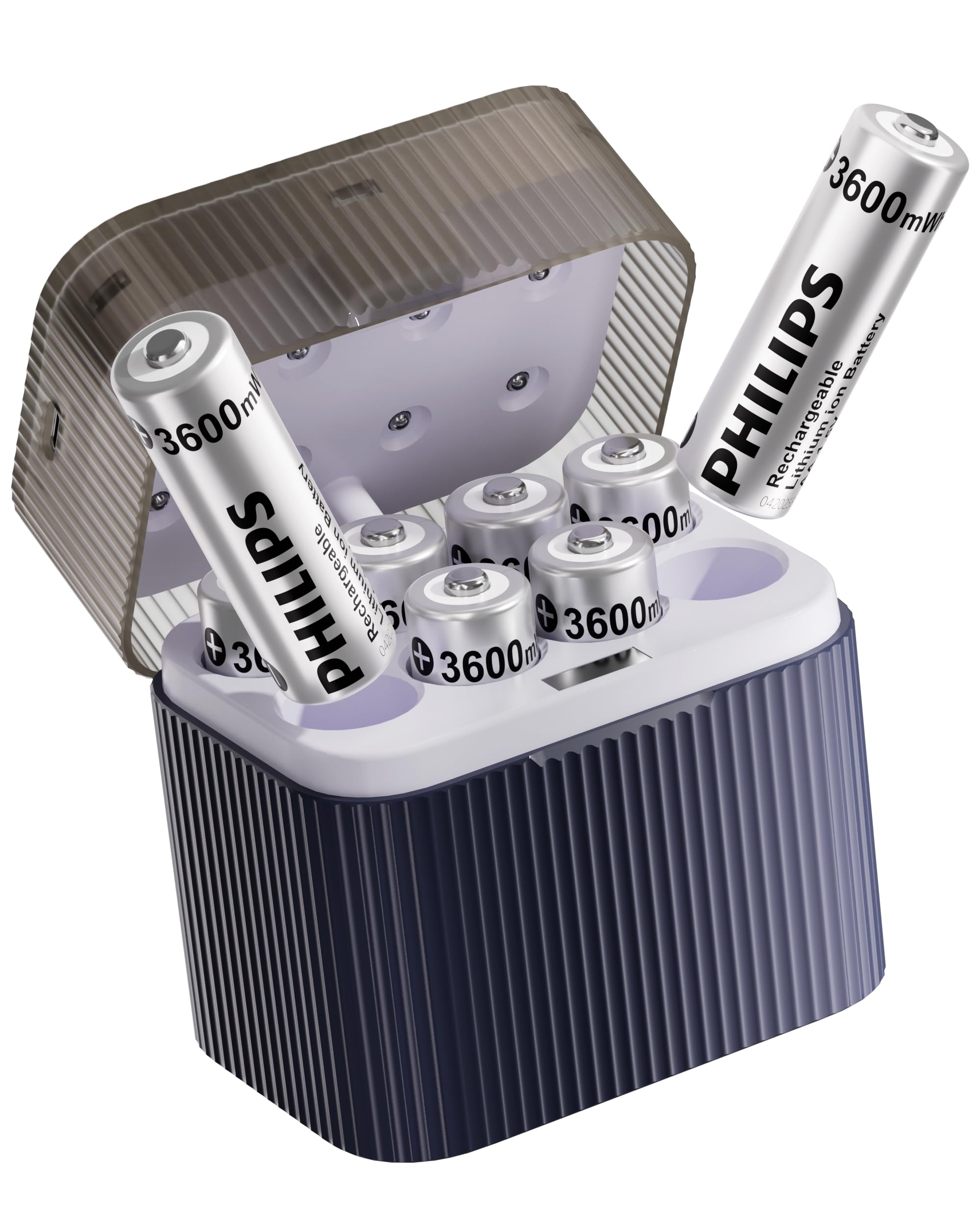
3. PHILIPS 8-Pack Rechargeable AA Lithium Batteries
Eight high-capacity cells with the charger built into the case.
Rule one for game controllers and cameras: capacity wins. These PHILIPS cells carry 3,600mWh each, which beats the 3,400mWh set above on raw stored energy. That extra headroom is what keeps a controller alive through a long session instead of dropping out mid-match, and it is rated 40% more endurance than regular Ni-MH AA batteries per the maker.
The design does something different from the other sets here. The charger is a storage case with a Type-C port (the modern USB connector, so a phone cable works) and a 5V/2A fast-charge draw. An identification chip checks each cell’s status so you are not charging a dead cell in the wrong slot. The flame-retardant ABS shell is built to survive a 1-meter drop, which matters if the case lives in a bag.
Cycle life is 1,200 recharges, and the self-discharge rate is listed below 3% per month, so a charged spare stays ready in a drawer. The real limitation: these are 1.5V cells and the listing warns they are not compatible with 3V devices like smoke alarms and doorbell cameras. One cell failing early is the pattern worth knowing about — check each one soon after arrival.
Capacity first: 3,600mWh per cell and a Type-C charger built into the case make this a self-contained kit for controllers and cameras.
Check your device: not built for 3V hardware, so smoke alarms and doorbells need a different cell.
Right for: gamers and photographers who want the highest-stored-energy AA here plus a case that charges on the go.
Wrong for: anyone whose device runs on 3V — read the voltage label before you buy.
4. Homesuit Rechargeable Lithium AA Batteries

Twelve cells that hold a steady 1.5V until they are nearly empty.
The standout feature here is voltage discipline. These cells hold a constant 1.5V output until they drop to almost nothing at around 1.1V, instead of sagging steadily like a 1.2V cell does. In practice that means your Blink outdoor camera or door lock keeps working at full power right up to the end rather than fading out.
The list of devices this set suits is long: gamepad, VR grip, outdoor camera, flash, door lock, microphone, RC toys and alarm clocks all appear in the listing. Capacity is 3,600mWh, the same as the PHILIPS set above, and each cell handles 2,000+ recharge cycles. The charger takes all 12 slots at once and finishes a full batch in 4.5 hours, with LED indicators that flash green while charging and go solid green when done.
Build quality is the thing buyers keep coming back to — the batteries feel solid and the case looks good enough to leave out. The trade-off sits in the indicator lights and occasional cell failures late in the batch. Both are the kind of thing you handle with a quick swap, not a reason to write the set off. The one-year warranty covers you if a cell dies early.
Steady-power design: a flat 1.5V output is why high-drain gear like cameras and door locks stay happy all the way down the discharge curve.
Honest note: a few cells in a large batch can stop holding charge, and some users find the indicator lights hard to read in bright light.
Pick it if: your house is full of 1.5V battery hogs — cameras, locks, controllers — and you want a 12-cell rotation charging in one go.
Pass if: you only need two or three cells; a large set is more batteries than you need.
5. ZapLitho 12V 22Ah LiFePO4 Lithium Battery
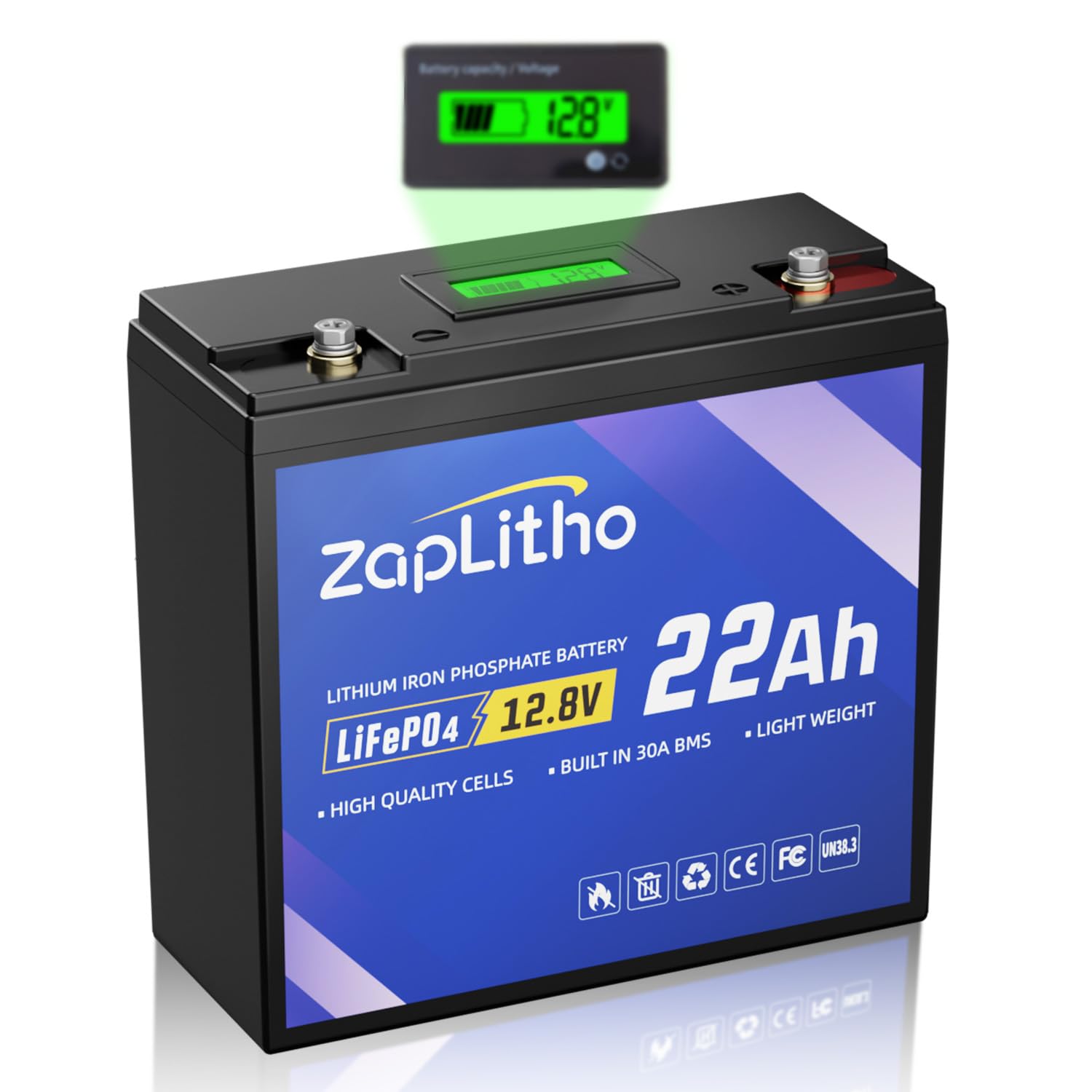
A carry-anywhere 12V block built for fish finders and campsite power.
Weighing 5.5 pounds, this is a battery you can lift with one hand and drop into a kayak or a tackle box. The 22Ah capacity (amp-hours — how much total charge it holds) powers a fish finder, Ham radio or a set of camp lights without the bulk of a full marine battery. The LCD voltmeter on the front tells you exactly where it stands before you head out.
Safety is handled by a built-in 30A BMS (battery management system — the circuit that shuts off charge and discharge if anything goes wrong), guarding against overcharge, over-discharge, over-current and short circuit. The cells are rated for 4,000+ cycles. For context, the listing puts lead-acid batteries at only 300-400 cycles, so the chemistry switch is the whole point here.
Compared with the DEWALT tool pack above, this is a completely different product — 5.5 pounds versus 1.5 pounds, and made to feed electronics rather than spin a motor. Same voltage, opposite job. Just note it needs a LiFePO4 charger at 14.6V, not a lead-acid one, and it is not meant to start an ATV or a motorcycle.
Why It Works
- 5.5 pounds makes it a genuine carry-along pack
- 22Ah capacity covers a day of fish finder or camp light use
- LCD voltmeter shows charge at a glance
- 30A BMS protects against the four main failure modes
Read Before You Order
- Needs a LiFePO4 charger at 14.6V — a lead-acid charger is not supported
- Not built to start vehicles or power a trolling motor
Suits: anglers and campers who need a light 12V pack to run electronics off-grid.
Not for: anyone hoping to crank an engine or run a high-thrust trolling motor.
6. GOLDENMATE 12V 20Ah LiFePO4 Lithium Battery

A 5.95-pound block sealed to IP67, so rain and dust stay out.
The IP67 rating is what separates this pack from the rest. That rating means it is fully protected against dust and against water immersion — a real difference if the battery lives on a kayak, a boat deck or a bike rack that sees weather. Add 5,000+ charge cycles, and this is the pack you buy once.
Capacity is 20Ah at 12.8V, with a built-in 20A BMS guarding overcharge, over-discharge, over-current and short circuit. It supports a continuous discharge up to 10A and a maximum charge current of 10A, so a compatible LiFePO4 charger tops it up quickly. Expansion runs up to four batteries in series or parallel for up to 51.2V 80Ah if you need a bigger bank.
The self-discharge rate is low enough that the maker says it stores for up to one year without a top-up — handy for a backup pack that sits idle. Compared with the ZapLitho above, this one trades 2Ah of capacity for the sealed waterproof housing and a higher cycle count. Worth knowing: lithium chemistry needs a lithium charger, and mixing it into a lead-acid charging setup will not give you good results.
Weatherproofing earns its keep: the IP67 seal is the feature that makes this the pick for marine and outdoor setups.
Know before you wire it: it wants a compatible LiFePO4 charger, and pairing it with lead-acid charging gear defeats the point.
Worth it for: marine, kayak, RV and outdoor installs where a dustproof, waterproof pack matters more than saving a little capacity.
Overkill if: the battery sits indoors in a dry cabinet — you pay for sealing you will never need.
7. DEWALT 20V MAX XR POWERPACK 4Ah
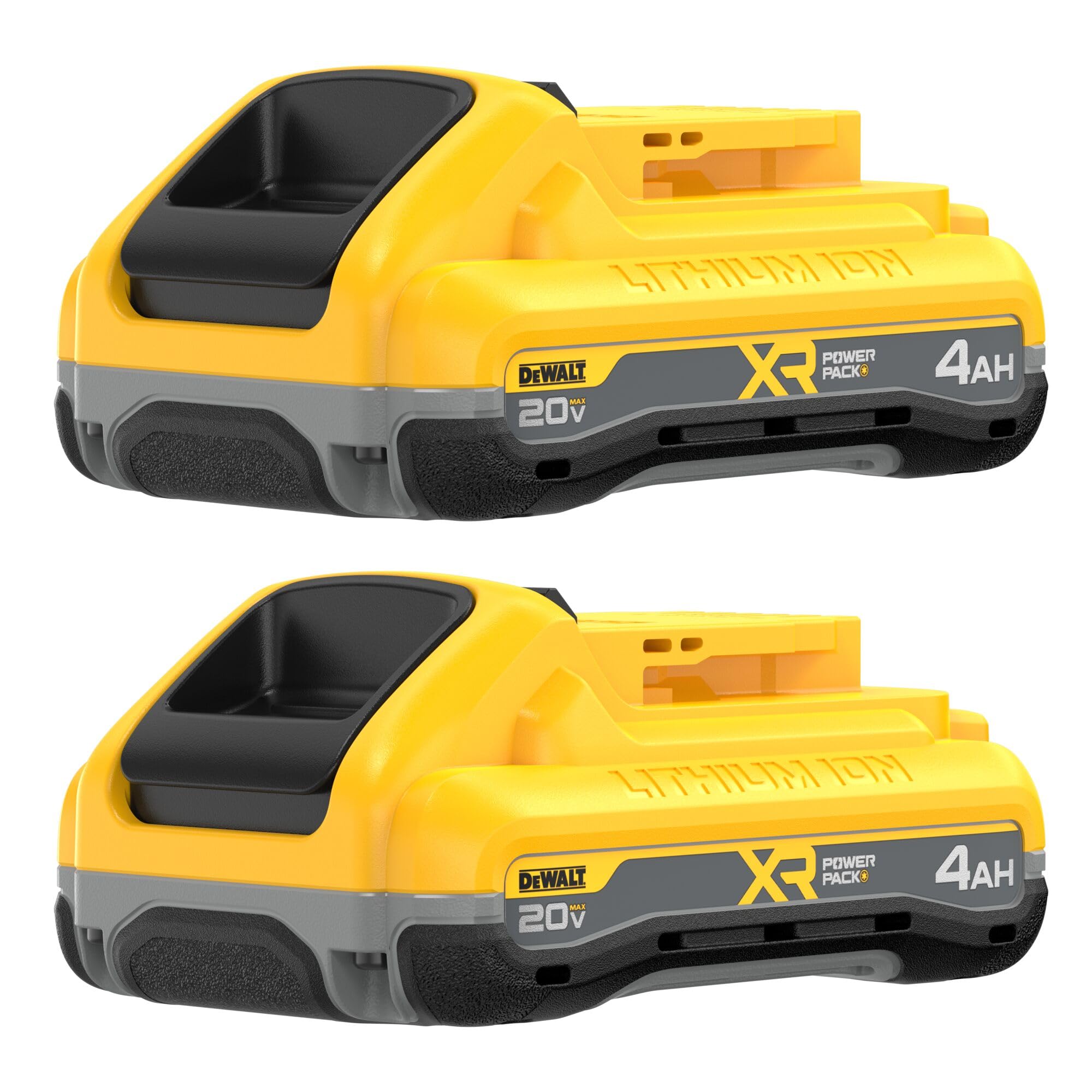
Two packs with an overmolded base built to survive a jobsite drop.
This pair is for the trades, not the weekend DIYer. The overmolded base provides a high level of impact resistance, and the XR line is the maker’s best-performing 20V MAX battery series. You get two 4Ah packs in the box, so one charges while the other works — the single biggest quality-of-life upgrade on a long job.
The maker rates these for 50% more power than standard packs, with a longer life than traditional cylindrical batteries, and lists 2.8 pounds for the pair. Each pack carries an LED state-of-charge indicator. Note the 4Ah capacity is lower than the 5.0Ah DCB205 above — but reviewers consistently call these compact and powerful, and some say they run longer than the original 4Ah cells.
Wait — 4Ah is less than 5Ah, so why pick this? Because the total energy across two packs is more than one DCB205, and the rugged housing is the point. These are for someone who would rather finish the day with two fresh packs than one.
Two-pack logic: 4Ah per pack is lower than the DCB205’s 5.0Ah, but two packs means less downtime — one works while one charges.
Honest limit: it is a power-tool-only battery and commands a premium price for the two-pack format.
Choose it if: you work long days with DEWALT 20V MAX tools and want rugged packs that keep going after a drop.
Skip if: you only need one spare for light home use — a single pack makes more sense.
8. Eiiev 12V 100Ah Lithium Battery, LiFePO4 with 100A BMS
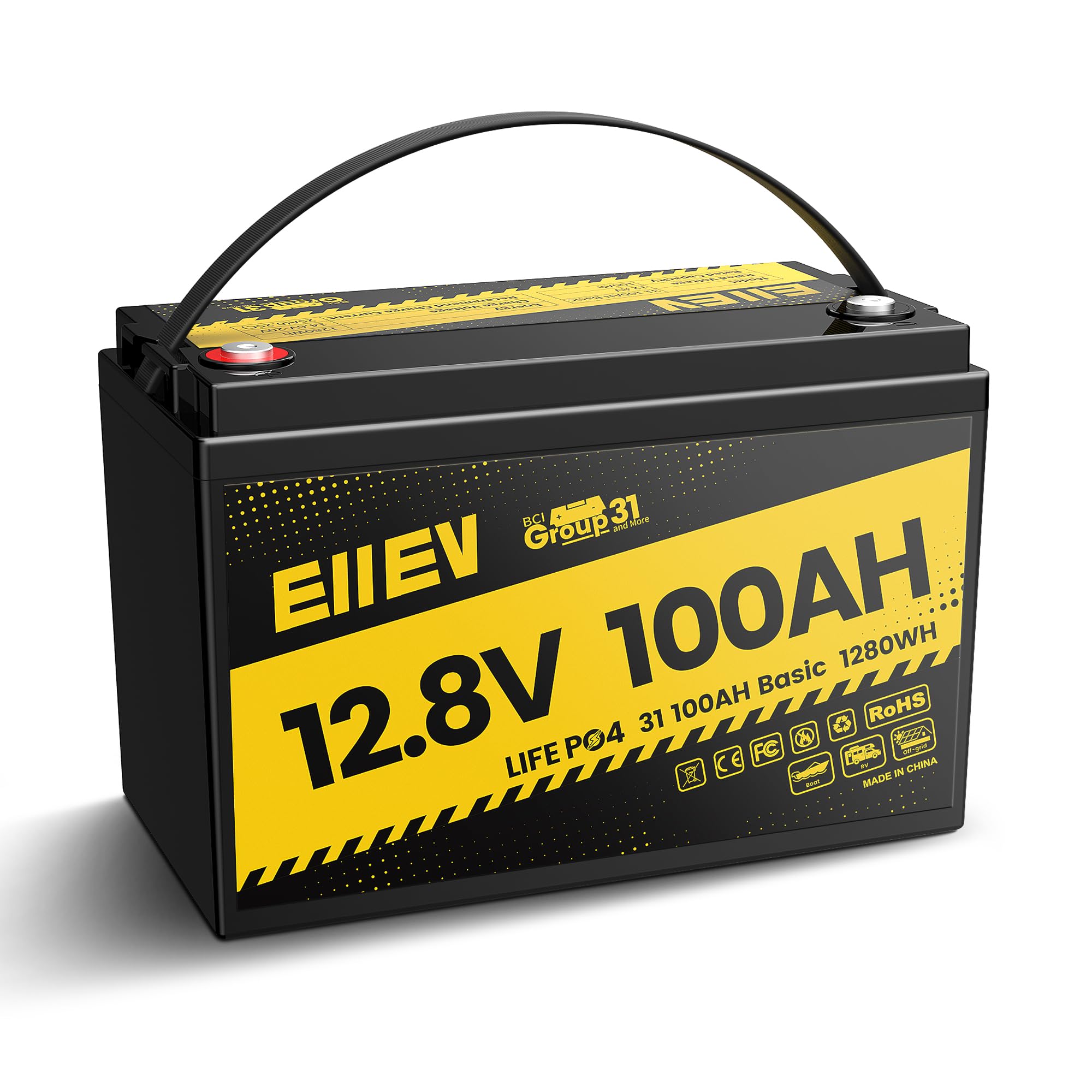
A 100Ah bank that powers a trolling motor through a full day on the water.
Down here in the heavy power tier, capacity gets serious. This pack is a 100Ah LiFePO4 (lithium iron phosphate — a lithium chemistry known for long cycle life and stability) rated for 4000~15000 cycles depending on depth of discharge, versus the 200~500 cycles the listing assigns to lead-acid. It is built for trolling motors in the 30-70LB thrust range, RVs and home backup.
Build quality is where the mixed notes cluster here. A solid chunk of owners mention it performing well and holding charge under heavy load. The recurring complaint is charging — some units stop charging after a couple of weeks, and a few arrive below 12V and need a 14.6V charger to activate them. Both are surmountable, but this is the pick where you want to test the pack right from the start and confirm voltage before you mount it.
The upside is flexibility. It expands to 4P4S (four in parallel, four in series) for up to 20.48kWh of storage, uses standard M8 terminals, and weighs 24.25 lbs. The maker notes it is for energy storage, not starting a vehicle. Buy it if you need a large-capacity pack at a value price; just plan to verify the charge early.
Big capacity, big flexibility: 100Ah of storage that expands to 4P4S for up to 20.48kWh, sized for trolling motors and RV systems.
Check it on arrival: some units ship low and need a 14.6V charge to wake up, and a minority develop charging faults.
Built for: trolling motors, RV house power and home backup where you need a large LiFePO4 bank.
Not for: starting a car or engine cranking — the listing states it is an energy-storage pack, not a starter.
9. LiTime 12V 100Ah Trolling Motor LiFePO4 Battery
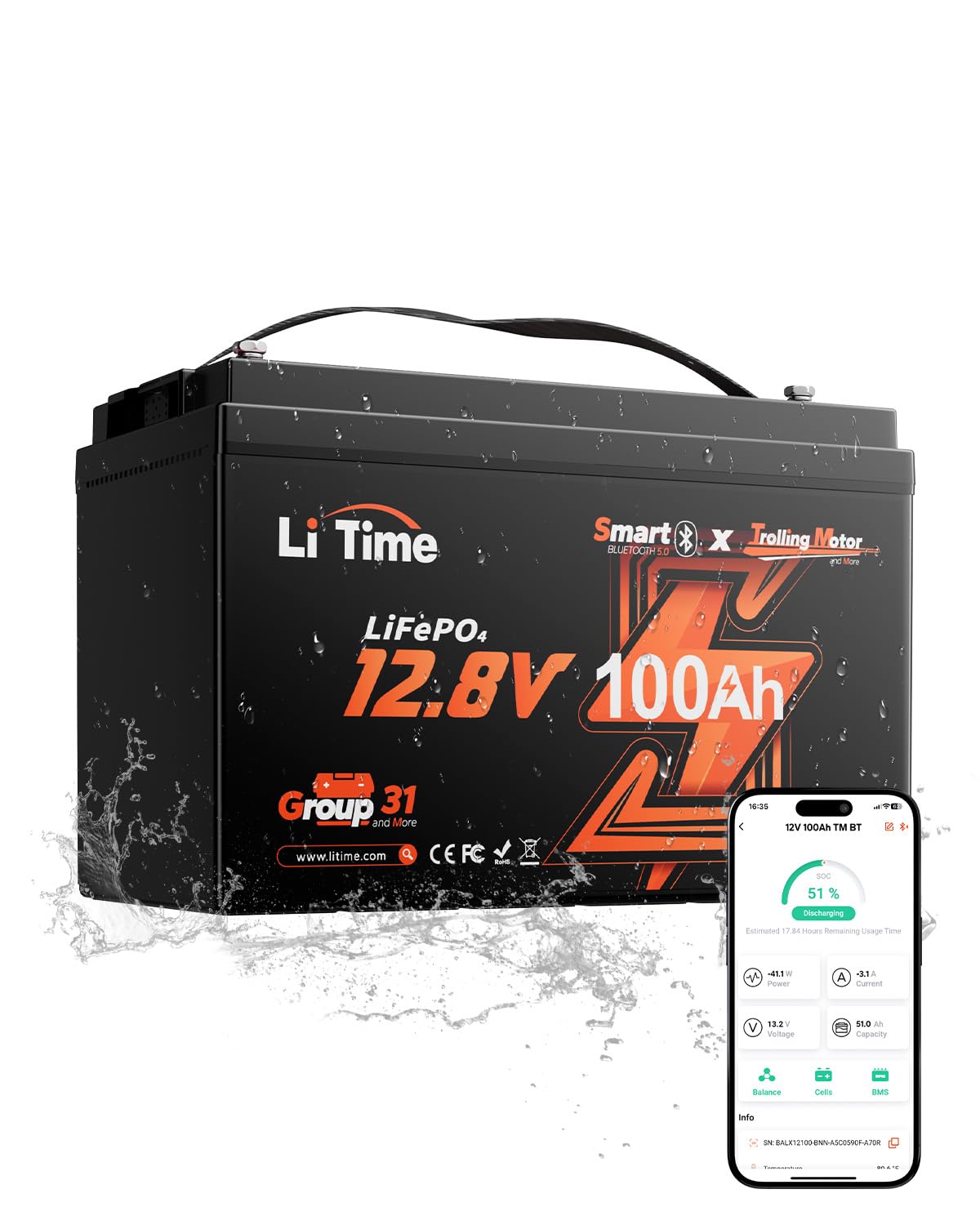
The marine pack that talks to your phone and runs a trolling motor all day.
You get phone-based battery monitoring on the water, which is what earns this the premium marine spot. Bluetooth auto-connects in seconds, so you can watch battery status, control discharge and run system checks from your phone. The Eiiev and most other 100Ah packs at this level do not offer that.
The safety side is well thought out. Smart low-temp protection stops charging below 32°F and stops discharging below -4°F, which is the kind of protection cold-water anglers need. It carries 20+ safety protections, plus IP65 waterproofing and salt resistance for harsh marine environments. Cycle life runs 4000 deep cycles at 100% DOD, up to a maximum of 15,000 at 60% DOD.
At 22.2 pounds in a standard Group 31 footprint, it is light enough to swap by yourself — and light enough that moving it off the boat for the winter is not a chore. It expands to 4P4S for 20.48kWh if you need a larger bank. The catch: it is a pure energy-storage pack, so keep it out of starting and jacking duty, and the Bluetooth app only activates after a proper lithium-activation or MPPT charge.
Why Anglers Rate It
- Bluetooth app shows live battery status from your phone
- Low-temp protection stops charging below 32°F
- 22.2 pounds in Group 31 — light enough to carry off the boat solo
- IP65 waterproof and salt-resistant for marine duty
Worth Knowing
- Bluetooth only activates after a lithium-activation or MPPT charge
- Energy storage only — not for starting, golf carts or jacks
Best match: boat owners running 30-70lb trolling motors who want live monitoring and cold-weather protection.
Not the one: if you need a starting battery or something for a golf cart, look at a purpose-built starter.
Know the Specs
mAh vs mWh on small cells
Small rechargeable cells list capacity in either mAh (milliamp-hours) or mWh (milliwatt-hours). The mWh figure is the total stored energy, so it lets you compare cells of different voltage fairly. A 3,600mWh AA holds more total energy than a 3,400mWh cell. A DEWALT 5.0Ah pack is a different scale entirely — that is amp-hours, thousands of times bigger than a AA cell. Never compare the two directly.
Amp-hours on 12V packs
For big LiFePO4 blocks, capacity is quoted in Ah (amp-hours). That is how many hours the pack can supply one amp. A 22Ah pack will run a light load far longer than a 20Ah pack, and a 100Ah marine battery will run a trolling motor for a full day where a 20Ah block would not. Match Ah to the load draw of your device.
Cycle life and depth of discharge
Cycle life is how many full charge-and-drain runs a battery survives. Depth of discharge (DOD — how empty you run it each time) changes that number. On a LiFePO4 pack, 4,000 cycles at 100% DOD can stretch to 15,000 cycles at 60% DOD. Running a battery only partly down is the cheapest way to extend its life.
BMS and protection ratings
A BMS (battery management system) is a small board inside a 12V pack that cuts power if something goes wrong — overcharge, over-discharge, over-current, short circuit. Amp ratings like 20A or 100A tell you how much current the BMS will pass before it trips. An IP rating (ingress protection) such as IP65 or IP67 tells you how well the case keeps out dust and water. IP67 handles immersion; IP65 handles jets of water.
Common Questions
Will a rechargeable AA lithium cell work in my smoke alarm?
What is the difference between a 5Ah and a 4Ah power tool battery?
Can a 12V LiFePO4 battery replace my lead-acid boat battery?
How long does a rechargeable AA lithium cell last between charges?
Do I need a special charger for a LiFePO4 battery?
What does the BMS actually do in a 12V battery?
Can these 12V batteries start a car or truck?
Why do some AA rechargeable batteries fail early?
Can I mix different brands of 12V lithium battery in one bank?
How do I store a lithium battery long term?
The Bottom Line
The right lithium ion battery is the one whose voltage, form factor and capacity match your device — not the biggest or cheapest on the page. For power tools, the DEWALT 20V MAX 5.0Ah is the clear starting point — it fits the whole 20V MAX line, shows charge at a glance, and weighs 1.5 pounds. For household gear, grab the 12 Pack 3400mWh AA set if you want twelve cells and a magnetic charger, or the PHILIPS 8-Pack if 3,600mWh per cell and a Type-C case matter more. And for marine duty, the LiTime 12V 100Ah is the pick that gives you Bluetooth monitoring and low-temp protection in a 22.2-pound Group 31 shell. A pack sized to your load and kept at 40%-60% charge between uses will outlast three cheap cells you swap every season.
How we choose
We do not accept paid placement. Every pick is matched to a real buyer and a real use-case; we do not hands-on test units.
Sources
Specifications: manufacturer listings and product documentation. Review insights: verified customer reviews, as of November 2026. Pricing: not shown on this page (it changes often); check the current price via the retailer link.
As an Amazon Associate, Tactical Gear Guy earns from qualifying purchases. This does not affect which products we feature.