Specs are compiled from manufacturer listings and verified buyer reviews and can change over time — please confirm the key details on the product page before buying.
If you are buying a light commercial treadmill for a home gym, a garage studio, or a small training space, the real question is simple: will the deck and the motor still feel right after a thousand sessions? The picks below all clear commercial-duty expectations, and they range from a marathon-ready machine with a 400 lb capacity to a self-powered curved runner that needs no outlet at all.
This guide is built by comparing the manufacturers’ published specifications and the patterns across verified customer reviews, so you get each pick’s real strengths and trade-offs instead of marketing spin.
You will see where each machine fits, what the running surface actually measures, and which trade-offs are worth living with. Here is the honest way to pick a light commercial treadmill that fits your room, your stride, and your training.
Top Picks


How To Choose The Best Light Commercial Treadmill
Most home treadmills are rated for one casual user. A light commercial treadmill is built for shared use, repeated sessions, and a frame that does not flex under a hard landing. That is why the deck and the drive matter more than the console.
The running deck is the first thing to measure
The deck (the belt surface you actually run on) sets your stride comfort. A longer deck gives tall runners room to land without clipping the front roller. Wider decks help with lateral foot placement during faster intervals. Compare the 62-inch deck on the Elite Runner X with the 48-inch deck on the RUNOW curved model, and you can see how much stride room varies within this category.
Motor power versus a self-powered track
A motorized treadmill uses an electric motor to drive the belt at a set speed. A curved treadmill has no motor at all — your own legs turn the slats. Motorized suits steady paced running and incline work. Curved suits sprints, sled pushes, and short all-out efforts where you control the pace with your feet.
Incline, speed, and belt life
Incline is measured in percent of grade. A 15% grade simulates a steeper hill than a 12% top incline. Belt life in miles tells you how long the running surface is rated to last. For a machine you plan to keep for years, a belt rated at 150,000 miles is the kind of number that separates commercial gear from a casual home unit.
Side-by-Side Comparison
| Model | Best For | Deck Size | Drive / Motor | Incline | Amazon |
|---|---|---|---|---|---|
| Elite Runner X Treadmill★ Best Overall | Marathon training and heavy runners | 22″ x 62″ | 4.0 HP motor | Up to 15% | Amazon |
| CT400 Curved TreadmillBest Self-Powered | Self-powered HIIT and sprints | 18″ x 60″ | Self-generated, 800 watts input | 3 resistance levels | Amazon |
| NordicTrack Commercial 1750 | Guided iFIT workouts and streaming | 22″ x 60″ | 1750 watts input | -3% to 12% | Amazon |
| RUNOW Curved Treadmill | No-electricity curved running | 48″ | Non-motorized | 4 resistance levels | Amazon |
| Niceday TM3 Commercial | Low-maintenance daily running | 20″ x 60″ | 4.0 HP brushless | 0% to 15% auto | Amazon |
| CT700 Curved Treadmill | Sprint and sled-push training | 19″ x 66.5″ | Self-generated | 8 resistance levels | Amazon |
| AssaultRunner | Serious HIIT and commercial gyms | 69.9″ track | Self-powered, no motor | — | Amazon |
Detailed Reviews
1. Elite Runner X Treadmill
Our pick — 4.5+★ from 100+ verified ratings; the strongest balance of quality and price.
A 400 lb capacity steel frame with a club-rated motor — built for the runner who wants marathon distance at home.
Start with the number that decides whether tall runners stay comfortable: a 22-inch by 62-inch running surface. That is the same deck length as the Elite Runner X’s commercial peers, and it beats the RUNOW curved model’s 48-inch deck by a wide margin. Underneath it sits the Ortho Flex Shock Suspension system, a cushioned layer that takes the sting out of each footstrike so long runs feel kinder on your legs.
Powering that belt is a club-rated, high-torque 4.0 HP motor on a 386 lb machine. It reaches 12 mph in 18 seconds, which is the exact trait interval and HIIT sessions need. Speed runs from 0.5 to 12 mph with one-touch settings, and incline climbs to 15%. That 15% grade beats the NordicTrack Commercial 1750’s 12% top incline, so hill repeats have more headroom here.
The machine arrives with wireless heart-rate control and a chest strap in the box, built-in speakers, a multi-speed fan, and a USB charging port. No membership is required to use any of it. The low 7.5-inch step-up deck height keeps the running surface close to the floor, which helps in a room with a standard ceiling. Assembly is straightforward, and what wins people over across the review pages is simply the build quality — the treadmill feels gym-grade out of the crate.
The honest catch is weight and value. At 386 lb and non-foldable, this is a machine you place once and leave put. Some owners also question whether the price matches the feature set next to rival decks. That is a fit question, not a defect — if you want a folding frame or a big touchscreen, this is not your machine.
Where this deck earns its keep
- 22″ x 62″ deck with Ortho Flex Shock Suspension for long-distance comfort
- 4.0 HP motor reaches 12 mph in 18 seconds for intervals
- 15% incline tops the NordicTrack’s 12% for steeper hills
- 400 lb max user weight and lifetime frame warranty
What you give up
- 386 lb, non-foldable frame — plan its spot before delivery
- Value is the most-debated point in owner feedback
Reach for this if: you want a marathon-capable deck with real suspension and a 400 lb rating, and the machine has a permanent home.
Look elsewhere if: you need to fold the treadmill away or want a built-in touchscreen for guided classes.
2. CT400 Curved Treadmill
No motor, no outlet, no speed ceiling — your legs set the pace and the belt keeps up.
A curved treadmill works differently from everything else on this list. There is no motor driving the belt. Your own stride turns the slats, so the faster you run, the faster the track moves. The CT400 sits on a 60-inch long, 18-inch wide deck, and its 145 lb weight makes it far easier to reposition than the 287 lb RUNOW curved model. Transport wheels are included, so moving it out of the way is a one-person job.
You get three resistance levels to dial up the effort without touching a speed button. The digital display tracks time, distance, speed, calories, and total miles of use. Flexible track slats add shock absorption, and the machine lists 800 watts of input power — that is well under the NordicTrack Commercial 1750’s 1750 watts, a good hint at how little electricity a self-powered deck needs.
Build quality is the theme in owner feedback, and the treadmill reads as solid for the money. Assembly is simple enough that most buyers are running within a session. On the whole the run feels smooth and the resistance changes are responsive.
Who it fits: anyone who wants sprint and HIIT training without a motorized belt that waits for a speed setting to catch up. The curved surface speeds up the moment your stride does.
The real trade-off: an 18-inch wide deck is narrower than the 22-inch belt on the Elite Runner X, so runners with a wide stance will feel the edges. Curved running also takes a few sessions to learn.
Worth it for: interval trainers who want resistance control and zero speed limits from their own legs.
Think twice if: you want a wide, forgiving belt for long steady-state distance.
3. NordicTrack Commercial 1750 Treadmill with iFIT

The folding iFIT machine with a pivoting 16-inch touchscreen — for the household that wants guided classes in a small room.
If your space is tight and you want a screen, start here. The Commercial 1750 folds down and rolls away, and the 16-inch pivoting touchscreen turns to face you whether you are running or doing a floor class. Sync workouts with Strava, Garmin Connect, and Apple Health so your pace and calories land in one place. Speed runs up to 12 mph on a 22-inch by 60-inch deck.
The terrain range is the standout. Incline goes up to 12% and declines to -3%, so downhill runs are possible on a treadmill. That 12% top incline falls short of the Elite Runner X’s 15% by a visible margin, so the steepest hill simulations favor the other machine. RunFlex cushioning softens each footstrike on the 22-inch by 60-inch deck.
Understand what the price covers. The 16-inch screen and iFIT extras — auto-adjusting speed and incline, the AI Coach, off-treadmill classes — depend on an iFIT Pro Membership that runs a monthly fee. Buyers who go in knowing that are happy. It is the buyers who expect everything free from the start who rate it lower.
Stands out for: a foldable frame, a 16-inch pivoting touchscreen, and a decline range no other pick here matches.
Weigh before buying: the best features are tied to a subscription, and 12% top incline is shallower than the Elite Runner X’s 15%.
Choose this for: in-home guided workouts and a screen your whole household can share.
Pass if: you want every feature included with no ongoing membership fee.
4. RUNOW Curved Treadmill for Home and Commercial Running

A no-electricity curved runner on a compact 48-inch deck with a 450 lb capacity.
The RUNOW runs on your legs alone — no power cord, no max speed. That means no electricity bill from your training and no motor to service. The 48-inch deck is the shortest running surface here, noticeably shorter than the 62-inch deck on the Elite Runner X. Sprinters who like to drive hard off the front will feel the limit; joggers and walkers on a compact footprint will not.
Four manual resistance levels let you add load, and the 5-inch LCD tracks time, distance, calories, watts, pace, and your L1-L4 resistance setting. A cup holder and transport wheels round out the details. The steel and rubber crawler build absorbs shock, and the manufacturer backs it with a two-year replacement promise. Quality control is what earns the treadmill its reputation — it arrives solid and runs as expected.
Plan for the unboxing. Assembly gets split responses: some find it quick, others find it takes a while to finish. Either way, a second pair of hands smooths the process on a 287 lb frame.
Best home for this one: a walker or jogger who wants a curved deck with no electricity and a short footprint.
The limitation to accept: a 48-inch deck leaves less room for a long sprint stride than the longer curved tracks here.
5. Niceday TM3 Commercial Series Treadmill
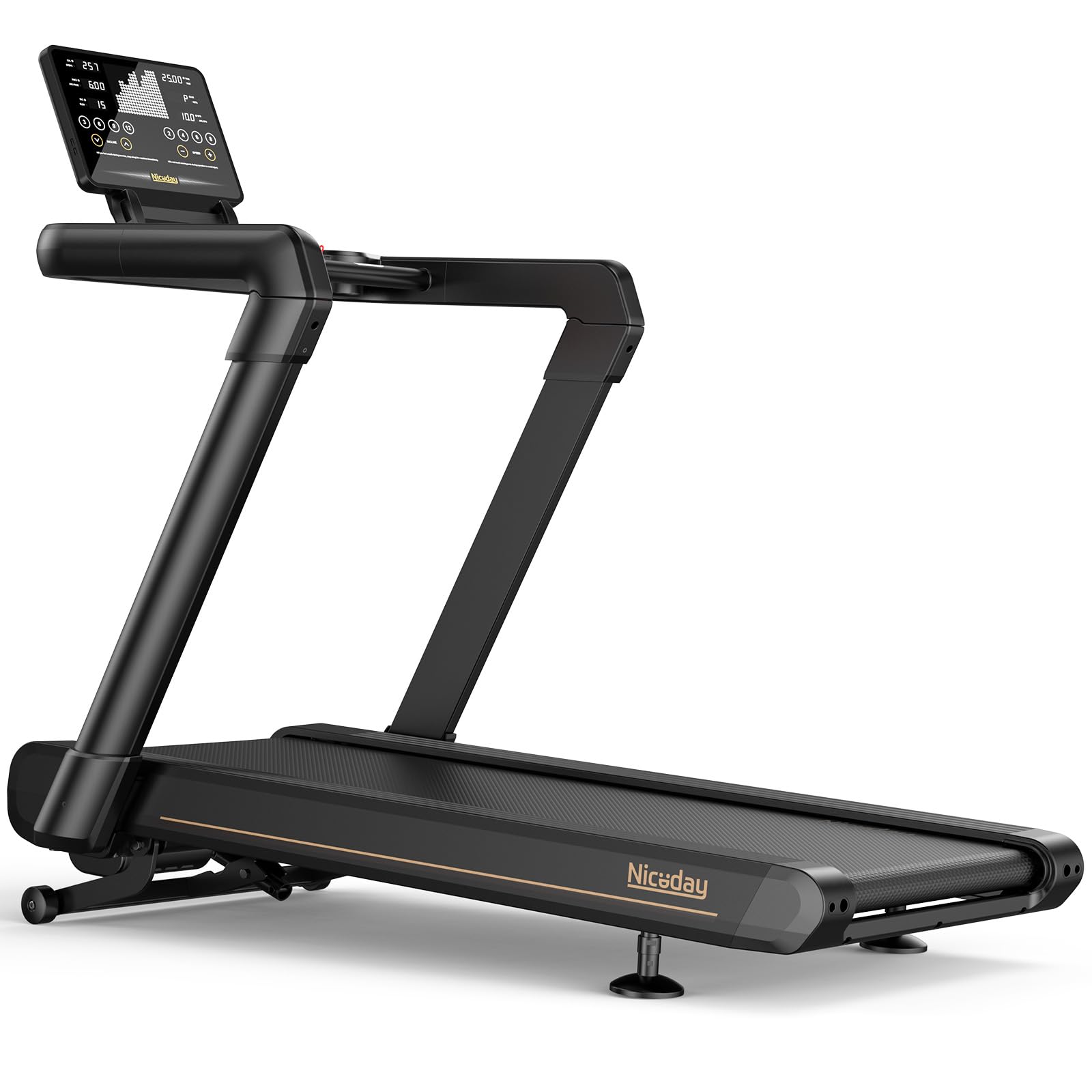
Arrives 95% pre-assembled with a self-lubricating belt — the low-maintenance runner for busy households.
The 95% pre-assembled build is the first thing to know about the Niceday TM3. Six steps and you are running, which matters if you would rather train than wrestle a tool kit. The second is the self-lubricating belt: it removes the routine silicone oil chore that most motorized decks demand, so upkeep is close to nothing.
The 4.0 HP brushless motor (a motor type that skips the brushes that wear over time) reaches 0.6 to 11.2 mph and delivers 0% to 15% automatic incline. That 15% grade matches the Elite Runner X for steepness, though the 60-inch by 20-inch deck is a touch narrower than the Elite’s 22-inch width. Six impact zones in the 20mm cushioned deck absorb footstrike, and the 330 lb weight capacity covers a broad range of runners.
The 15-inch LED console shows 12 metrics including pace and heart rate, and the marathon pace window helps you hold a target. Bluetooth pairs with Kinomap and Zwift, and the device holder fits 9-inch to 15-inch tablets and phones. A two-year parts and one-year labor warranty backs the machine.
Low-maintenance appeal: a self-lubricating belt and near-finished assembly save you both setup and upkeep time.
One thing to note: the 330 lb capacity is the lowest rating on this list, so heavier runners should check the Elite Runner X’s 400 lb limit first.
Ideal for: the runner who wants a motorized belt with auto incline and almost no maintenance.
Check first if: you are above 330 lb, or you need a wider than 20-inch belt for a broad stride.
6. CT700 Self Generated Manual Curved Commercial Treadmill

An 8-level resistance curved track built for sled pushes and full-out sprints — with the widest stance room of the self-powered picks.
Sprinting and sled work demand a track that gives back exactly what you put in. The CT700 answers with eight resistance levels and instant speed changes — no button, no motor ramp-up. The 66.5-inch by 19-inch track is longer than the CT400’s 60-inch surface, giving big striders more room to drive. That length also beats the RUNOW’s 48-inch deck by a wide margin.
Rigid rubber slats absorb impact and hold grip through hard pushes. Multi-grip positional handrails give you different holds for sprint lean, and the digital display tracks time, distance, speed, calories, and total miles. Weight lands at 308 lb, and transport wheels help when you need to shift it.
Performance is where this machine lives up to its billing — it feels like a serious running machine that delivers a real workout, and the adjustability and instant speed changes draw consistent praise. Durability is a strength too, with far fewer breakable parts than a motorized deck. The friction point is assembly: instructions get split reactions, and a few buyers find the price hard to swallow. Set aside a proper block of time and help for setup.
Strike here if: sprint and sled-push training is your main goal and you want wide, long track room underfoot.
Be ready for: a longer assembly and a premium price for the manual build.
7. AssaultRunner by Assault Fitness

The curved runner with a 150,000-mile belt life and a 350 lb capacity — commercial gym durability, self-powered.
The number that sets the AssaultRunner apart is belt life: 150,000 miles. That is a commercial-durability rating for the running surface itself, and it is the clearest signal on this list that the machine is built to keep going. It runs on your energy with zero electrical consumption, on a 69.9-inch long track that is the longest running surface here. Max user weight sits at 350 lb.
Performance targets HIIT directly. The self-powered belt speeds up the moment you do, and the natural running feel promotes an efficient stride. Owners describe it as high-end, gym-worthy training equipment that is smooth to operate and quiet in use.
Durability draws the strongest reactions — the build reads as something that will last for decades. The one continuing conversation is price: some buyers call it worth the money, others find it steep for a manual machine. And at 280 lb, it is not something you casually slide around.
Mic-drop spec: a 150,000-mile belt life pairs with a 350 lb capacity and a 69.9-inch track.
Weigh the cost: value is the most-debated point in feedback, and this is the most expensive build on the list. Compare the CT700’s eight resistance levels if you want that adjustability for less.
Built for: a serious HIIT athlete or small gym that wants the toughest self-powered track in the room.
Ask yourself first: whether the premium build justifies the top price versus the CT700’s adjustable resistance.
Know the Specs
Deck Size (Length x Width)
The deck is the belt surface you run on. Length controls how much room your stride gets; width controls lateral room during fast intervals. A 62-inch deck like the Elite Runner X’s leaves more room than a 48-inch deck like the RUNOW’s. Tall runners and sprinters usually want the longer, wider end of the range.
Motor and Drive Type
A motorized treadmill uses a motor — measured in horsepower on the belt or watts of input power — to drive the belt at a set speed. A self-powered curved treadmill has no motor; your legs turn the track. Motorized suits steady running and incline work. Curved suits sprints and intervals where you control pace instantly.
Incline in Percent
Incline is the grade of the running surface, written as a percent. A higher percent means a steeper simulated hill. Some decks add a negative decline for downhill work, like the NordicTrack Commercial 1750’s -3% low point. A 15% grade recruits more muscle per session than a flat belt.
Belt Life and Weight Capacity
Belt life in miles is how long the running surface is rated to last, and weight capacity is the heaviest user the frame supports. A belt rated at 150,000 miles signals commercial-grade materials. A higher weight capacity means the frame handles heavier users without flexing.
Common Questions
Can a light commercial treadmill go in a home with a standard ceiling?
Is a curved treadmill harder than a motorized one?
What does a 15% incline actually do for training?
How long does a commercial treadmill belt last?
Do I need a subscription to use a NordicTrack treadmill?
What weight capacity should I look for on a light commercial treadmill?
Can a curved treadmill be moved around a home gym?
Do I need to oil or maintain the running belt?
Is incline training better than flat running for building endurance?
The Bottom Line
For most buyers, the strongest light commercial treadmill here is the Elite Runner X — a 400 lb frame, a 22″ x 62″ deck with suspension, and a 4.0 HP motor that hits 12 mph in 18 seconds. If you want guided workouts on a foldable frame, the NordicTrack Commercial 1750 brings its 16-inch touchscreen and -3% to 12% terrain range. And for sprint and sled-push training with no power cord, reach for the CT700 and its eight resistance levels. Whichever you pick, check the deck length and weight capacity against your own stride first — those two numbers decide comfort more than any screen or app.
How we choose
We do not accept paid placement. Every pick is matched to a real buyer and a real use-case; we do not hands-on test units.
Sources
Specifications: manufacturer listings and product documentation. Review insights: verified customer reviews, as of November 2026. Pricing: not shown on this page (it changes often); check the current price via the retailer link.
As an Amazon Associate, Tactical Gear Guy earns from qualifying purchases. This does not affect which products we feature.