Specs are compiled from manufacturer listings and verified buyer reviews and can change over time — please confirm the key details on the product page before buying.
A modular LED video wall panel is not a TV. You are buying a portable screen that has to survive a van ride, unfold in under fifteen minutes, and still show flawless edges once it is standing. The two panels here solve that in different ways. The 80-inch kiosk is the safer all-round buy for rental and event work; the tri-fold wins when one cabinet has to face two directions.
This guide is built by comparing the manufacturers’ published specifications and the patterns across verified customer reviews, so you get each pick’s real strengths and trade-offs instead of marketing spin.
Four specs decide these purchases: pixel pitch, brightness in cd, how many units splice together, and how fast the panel unfolds on site. Here is how the leading options in led video wall panels compare.
Quick Picks
- 80 Inch LED Digital Signage Display — Best Overall
- MWE P1.86 Tri-Fold LED Poster Screen — Dual-Sided Standout
How To Choose The Best LED Video Wall Panels
A panel that never leaves the lobby is a different purchase from one that gets loaded into a case twice a week, so settle that question before you compare specs.
Pixel pitch is the detail metric
Pixel pitch is the physical gap between the tiny light clusters that draw the image, measured in millimeters. A smaller number means more detail in the same space. Both panels here sit at P1.86, which is a fine pitch meant for close viewing rather than viewing from across an arena. That makes them poster-style displays you stand near, not billboards you view from forty feet away.
Brightness decides where the screen can live
Brightness is rated in cd, short for candela per square meter — put simply, how hard the panel pushes light into the room. A panel in a sunny atrium needs far more than one in a dim event hall. Check the rated figure against where you plan to place the screen, and remember that glossy glass and glare are separate problems from raw brightness.
Splicing count sets your maximum canvas
Splicing is how many units you can chain so they act as one continuous image. Splicing count caps the biggest wall you can ever build from your fleet, so it matters more than panel size. One display tops out at 6 units, the other at 3. If you quote large stage jobs, that 6-versus-3 ceiling decides which jobs you can bid.
Surface protection and the case
GOB (Glue on Board) is a clear resin layer sealed over the LED modules. It turns a delicate face of exposed emitters into something you can wipe with a cloth and bump without panic. That resin layer plus the padded flight case each unit ships with are what decide how long the panel survives rental life.
Side-by-Side Comparison
Detailed Reviews
1. 80 Inch LED Digital Signage Display
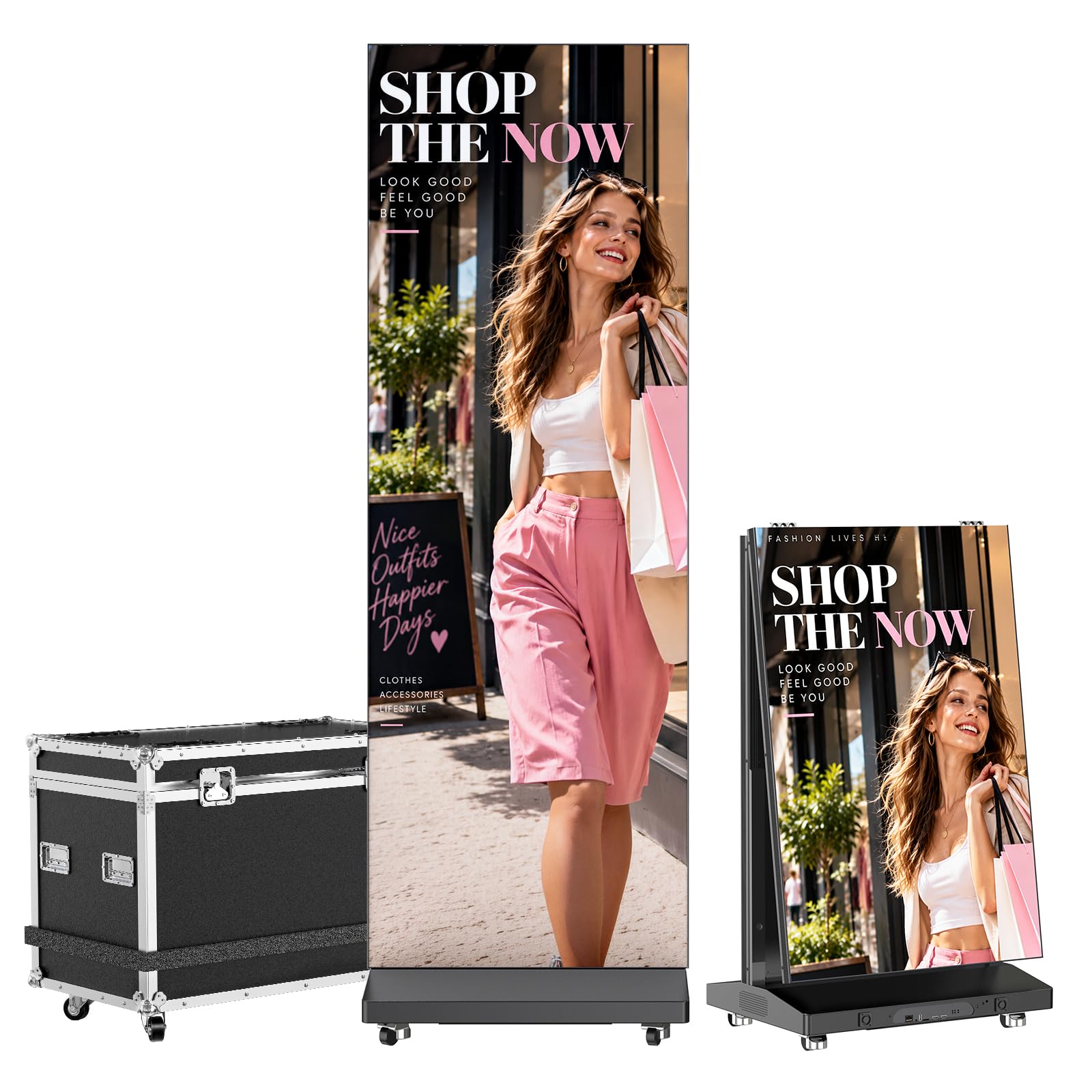
The rental workhorse that turns six units into one wall with a border under a tenth of a millimeter.
Six. That is the number that earns this panel the top slot. It splices up to 6 units into one continuous image, and 6 is double the 3-unit ceiling on the tri-fold model below. So a fleet you already own can grow twice as far before you hit your maximum canvas. For a rental operation, that 6-unit headroom is the whole point of a modular panel over a fixed screen.
The picture side backs it up. A 1.86mm pixel pitch draws at 344 x 1032 across an 80-inch face, which keeps text crisp and video sharp when your audience is standing close to the poster. Brightness is rated at 650 cd, enough to hold its own in a lit lobby or a trade-show aisle rather than only in a darkened hall. The 8000:1 contrast ratio keeps dark backgrounds deep and white type clean, and the 32:9 aspect gives you a wide banner shape that suits ad loops better than a boxy 16:9 frame.
Then there is the part you notice on site. The frame folds and rides on height-adjustable wheels, and the maker quotes ten minutes from unpacking to connected. A high-strength flight case with custom internal padding ships with it, so the bumps of a van ride land on foam, not on the face. The GOB (Glue on Board) resin layer seals the modules against dust and splashes and wipes clean with a soft cloth, and the maker rates that surface at a 50,000-hour lifespan.
Content is the quiet win. The wireless cloud platform pushes new ads from a phone, tablet, or computer in real time, and you can also feed it by APP, U disk, network port, or USB 3.0, with HDMI on the hardware side. That mix means you can hand a venue a USB stick, or update a screen remotely without sending anyone to the site. Its own measure of quality: the panel has drawn a 4.0+ star rating across 20+ reviews.
Where the value sits
- Splices up to 6 units — double the tri-fold’s ceiling — so your maximum wall keeps growing with your fleet
- 650 cd brightness and an 8000:1 contrast ratio keep ads readable in a lit room
- Folds to a slim 0.7-inch depth profile and rolls on height-adjustable wheels for fast load-in
- Flight case with custom padding included, plus a 50,000-hour GOB surface rating
What to weigh first
- Ships as a single unit, so a big wall means stacking up units rather than unfolding one wide screen
- No dual-sided mode, so it shows one ad face at a time
Built for fleets: rental shops, event crews, and venues that plan to chain panels into ever-larger walls.
Look elsewhere if: you need two ads facing opposite directions from one cabinet — the tri-fold handles that.
2. MWE P1.86 Tri-Fold LED Poster Screen
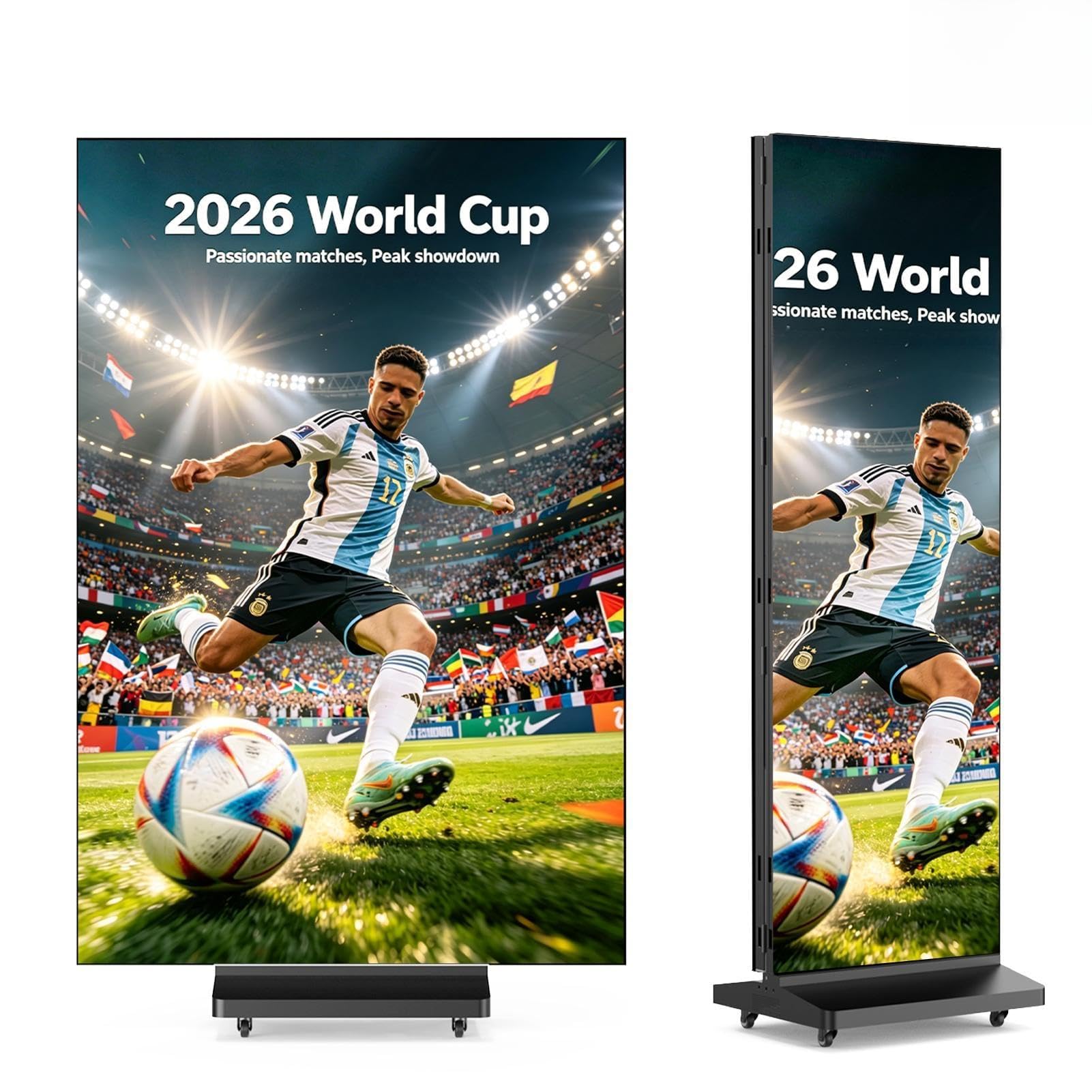
One cabinet that folds back into two ad faces — the mall and trade-show answer.
Fold the side panels back and this becomes a dual-sided display, showing two different ads from a single cabinet. That is something the six-unit splicer above simply cannot do. For a mall concourse, an airport corridor, or a trade-show corner where traffic flows both ways, one tri-fold replaces two separate posters and the floor space they would eat.
Unfolded, it stands as a 90-inch LED digital signage face. The pixel pitch (the distance between pixels, which sets how sharp the image looks) matches the other pick at P1.86. Maximum resolution is 688 x 1032 — notably wider than the 1926 x 646 of the 80-inch model. That is why this one reads as a true dual-panel canvas rather than a single banner. The high refresh rate is quoted as flicker-free, which matters the moment a phone camera points at the screen during an event.
Mobility is where it surprises you. There are universal casters on the screen itself plus a wheeled flight case, and the triple-fold shape collapses to save transport space. The other unit stands 81.5 inches high with a 19.69-inch depth footprint; this one folds down to a 0.7-inch depth, which is the difference between a van slot and a second trip. Weight is the honest catch — 170 pounds means two people and a ramp, not one person and a stairwell.
Quality is what the review pages keep returning to, and it is the most-praised trait on this listing. The GOB surface treatment is quoted as splash-proof, scratch-proof, and collision-proof, which suits a panel that lives in transit. Content runs through Wi-Fi, USB, HDMI, or Ethernet, with the LEDArt app on iOS and Android or the Xiaohui Cloud Platform on a computer, and a USB stick auto-plays the moment it goes in. Priced at the premium tier, it matches that standing with a 4.5+ star rating across 20+ reviews.
Two faces, one slot: the dual-sided mode is the reason to pay the premium here — it sells the same floor space twice.
The setup ceiling: splicing stops at 3 units, so the six-unit wall the other pick can build is out of reach — plan your biggest jobs around that limit. And at 170 pounds, treat load-in as a two-person task.
Worth it when: your venue has traffic on both sides and you want one cabinet doing the work of two.
Think twice if: you are building the largest possible wall — this one caps at 3 spliced units.
Know the Specs
Pixel pitch (the P number)
Pixel pitch is the distance between adjacent light clusters, measured in millimeters. Smaller numbers pack more detail into the same area. Both panels here are P1.86, a fine pitch that reads cleanly from a few feet away — the reason they work as poster-style signage you stand near rather than distant billboards.
Brightness in cd
Brightness is quoted in cd, or candela per square meter — how much light the panel throws. The 80-inch model is rated at 650 cd, which suits a lit lobby or trade-show aisle. Match the figure to the room, and check for glare separately, since a bright screen behind reflective glass still washes out.
smooth splicing
Splicing chains multiple cabinets into one continuous image. The border between spliced units is quoted under 0.1 mm on the 80-inch model, which keeps the picture looking like one surface instead of a grid. The unit count decides your maximum wall, so buy for the biggest job you intend to quote.
GOB encapsulation
GOB means Glue on Board — a clear resin layer sealed over the LED modules. It guards the emitters against dust, splashes, scratches, and knocks, and it gives you a flat surface you can wipe with a soft cloth. On a panel that travels weekly, that layer is what keeps the face intact.
Common Questions
Can I chain two of these LED video wall panels into one image?
What does P1.86 pixel pitch actually mean for my audience?
Is 650 cd bright enough for a lit lobby?
Can I update the screen content without visiting the venue?
Will a USB stick play automatically?
How long does it take to set one up on site?
How much does the 170-pound tri-fold screen change load-in?
What does GOB coating protect against?
Does a flight case come with each panel?
Which unit should a rental business buy first?
The Bottom Line
On paper the two panels share the same P1.86 pitch, so the decision lands on how you sell screen space. The 80 Inch LED Digital Signage Display takes my top slot because its 6-unit splicing ceiling and 650 cd brightness give a rental operation the most room to grow. A 4.0+ star rating across 20+ reviews backs a product that does the unglamorous things well. The MWE P1.86 Tri-Fold LED Poster Screen is the one to reach for when a single cabinet needs to face two directions. Its 90-inch dual-sided fold is the reason to pay more, and it holds the higher score of the pair.
How we choose
We do not accept paid placement. Every pick is matched to a real buyer and a real use-case; we do not hands-on test units.
Sources
Specifications: manufacturer listings and product documentation. Review insights: verified customer reviews, as of November 2026. Pricing: not shown on this page (it changes often); check the current price via the retailer link.
As an Amazon Associate, Tactical Gear Guy earns from qualifying purchases. This does not affect which products we feature.