Specs are compiled from manufacturer listings and verified buyer reviews and can change over time — please confirm the key details on the product page before buying.
If raking a pile twice the size of your green bin has worn you out, buy a machine that shreds leaves as it sucks them up. That single job — vacuum plus mulch — is what separates a real leaf yard vacuum from a glorified blower. Every pick below does it, and the difference between them depends on mulch ratio, bag size, and if you want a cord, a battery, or a pull cord.
This guide is built by comparing the manufacturers’ published specifications and the patterns across verified customer reviews, so you get each pick’s real strengths and trade-offs instead of marketing spin.
The picks below range from a corded electric workhorse to a walk-behind machine that chips branches. Read on to match one to your yard, and the list of the best leaf yard vacuum options will make a lot more sense once you know your mulch ratio target.
Top Picks


How To Choose The Best Leaf Yard Vacuum
A leaf yard vacuum has to do two jobs at once. It pulls leaves off the ground, then shreds them small enough that your bag fills slowly instead of every few minutes. Get the mulch ratio wrong and you spend your afternoon emptying a bag instead of clearing a lawn. Get the power source wrong and you spend it dragging a cord or hunting for a charged battery.
Start with the mulch ratio, not the air speed
The mulch ratio tells you how far leaves get shredded before they land in the bag — a 16:1 ratio shreds sixteen bags of loose leaves down into roughly one bag of mulch. That number is the difference between a few trips to the compost pile and a dozen. A machine with a strong ratio and modest airflow often beats a fast blower that dumps whole leaves into the bag.
Understand CFM and MPH before you compare numbers
CFM (cubic feet per minute) measures how much air the machine moves — that is what pushes a big dry pile across the lawn. MPH (miles per hour) measures how fast that air travels — that is what peels wet leaves off a driveway. You want both, but on a vacuum the CFM figure does most of the lifting on leaf piles, and the bag design does the rest.
Decide your power source honestly
Corded electric runs as long as you do and never needs fuel, but you are tethered to an outlet and an extension cord. Battery units free you from that cord but only run as long as the pack allows. Gas units run indefinitely with fuel but add pull-starting, oil mixing, and exhaust. Pick the one that matches how you actually work, not the one with the biggest number on the box.
Weigh the bag, not just the machine
A 42L collection bag sounds generous until you fill it with damp leaves. The machine’s stated weight is only half the story — your shoulder carries the rest. Look for a padded shoulder strap and a bag with a zippered bottom, because both turn a chore into a tolerable one.
Side-by-Side Comparison
| Model | Best For | Air Flow | Air Speed | Weight | Amazon |
|---|---|---|---|---|---|
| Echo ES-250 25.4cc Shred N Vac★ Best Overall | Big yards, no cord | 391 cfm | 165 mph | 11 lb | Amazon |
| WORX Trivac WG509Most Proven | Routine seasonal cleanup | 350 cfm | 210 mph | 9.3 lb | Amazon |
| WORX Trivac WG505.2Best Value | Smaller yards on a cord | 350 cfm | 210 mph | 9.7 lb | Amazon |
| NEO-TEC 3-in-1 Gas 25.4cc | Wet leaves and pine needles | 432 cfm | 180 mph | 10.5 lb | Amazon |
| MAXLANDER 40V Cordless | Lightweight cordless work | 335 cfm | 170 mph | 8.4 lb | Amazon |
| SOYUS 40V Cordless 3-in-1 | Long runtime on two packs | 360 cfm | 170 mph | — | Amazon |
| EARTHCRAFT 26CC Gas 3-in-1 | Large areas without a cord | 450 cfm | 200 mph | 10.5 lb | Amazon |
| Greenworks 40V Blower/Vacuum | One-battery yard ecosystem | 340 cfm | 185 mph | 13.4 lb | Amazon |
| SuperHandy Leaf Vacuum & Chipper | Branches plus leaves | — | — | 131 lb | Amazon |
Detailed Reviews
1. Echo ES-250 25.4cc Shred N Vac
Our pick — 4.0+★ from 150+ verified ratings; the strongest balance of quality and price.
The gas workhorse that pulls 391 cfm without a cord in sight.
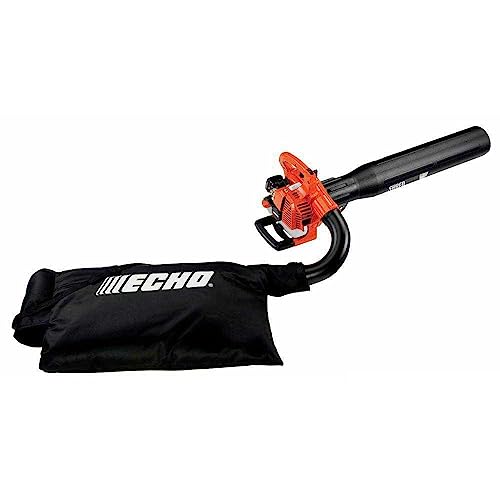
If your lot is measured in fractions of an acre rather than feet, the Echo ES-250 is the pick that will not quit on you mid-pile. Its 25.4cc two-stroke engine moves 391 cubic feet of air per minute (the volume of air it pushes each minute) at 165 miles per hour. That means it lifts wet leaves and small twigs off a lawn in one pass, then sucks them into the collection bag through the vacuum pipe. No cord to drag across the driveway. No battery that dies with three piles left.
The 25.4cc two-stroke fires on the first or second pull and holds a steady idle through a long cleanup. It also runs quieter than a lot of gas handhelds at a stated 70 dBA (a decibel reading of how loud the machine is at the operator’s ear), so a morning session won’t be the loudest thing on the block. Fuel capacity sits at 16.9 oz, so you can work a good stretch before a refill.
The honest trade-off with any small gas engine is reliability variance. Some units start on the first pull and run for seasons; an occasional one refuses to fire or quits early. That is the reality of a two-stroke, not a flaw unique to this machine. The Echo still holds the top spot here because when it runs, it runs — and the review pattern shows that most buyers get a unit that starts easy and clears leaves well. If you want zero engine fuss, a corded or battery unit is the smarter fit.
What Earns The Top Spot
- 391 cfm of airflow moves big volumes of leaves without a cord
- Stated 70 dBA keeps the noise down for a gas handheld
- 165 mph air speed lifts wet debris off pavement
- Gas power means no battery runtime ceiling on a big job
What To Know Before Buying
- 11 pounds sits at the heavy end of this handheld group
- Two-stroke engine means mixing oil into the fuel
- A small share of units arrive with starting trouble
Reach for this if: you have a large yard and refuse to be tied to an extension cord.
Think twice if: you want zero maintenance and no fuel mixing — a corded unit saves you the fuss.
2. WORX Trivac WG509
An 18:1 shredder that turns a lawn of leaves into one bag of mulch.
The WG509 is the version to pick if you want the WORX Trivac name with the stronger mulch ratio. Its 18:1 shredding turns eighteen bags of loose leaves into roughly one bag of fine mulch — a real difference from the 16:1 ratio on the WG505.2 below. That higher ratio means fewer trips to the compost bin and a bag you empty far less often, which is the whole reason to buy a vacuum instead of a blower.
It delivers 350 cfm and up to 210 miles per hour from a 12-amp corded motor — that 210 mph is the fastest air speed among this group, higher than the Echo’s 165 mph, so it peels stubborn wet leaves off a patio quickly. The corded setup is the real advantage here: no battery to run flat, no fuel to mix, so you can work through an entire seasonal cleanup without a recharge break. Reviewers consistently rate the 18:1 shredding and 210 mph air speed above what they expected from a corded handheld.
What you will notice on a long afternoon is the bag weight. The 42L collection bag holds a lot of shredded leaves, and a 9.3-pound machine plus a full bag hanging off your shoulder is the part that tires you out. Mode switching is quick with a flip of a switch, but maneuvering a fully-loaded bag around a flower bed takes some getting used to. For most seasonal yard work it is a fair trade for never charging a battery.
Where it delivers: the 18:1 ratio plus 210 mph air speed is the combination that makes both dry piles and damp pavement leaves a one-pass job, and the corded motor never asks you to wait for a recharge.
The part that wears on you: a full 42L bag gets heavy on the shoulder fast, so plan shorter sessions with more dumping rather than one marathon pass.
The short verdict: the strongest all-round corded choice if your cleanup routine is a few big weekends a year and your yard has an outlet within reach.
Different fit needed if: you work a half-acre with no cord access — that is where the Echo or a gas unit earns its keep.
3. WORX Trivac WG505.2
The entry-level Trivac that blows, vacuums, and shreds on a cord.
The WG505.2 is the budget door into the WORX Trivac line, and it keeps the important parts of the formula. You get 350 cfm and up to 210 miles per hour from a 12-amp corded motor — the same headline airflow as the WG509 above. It also does 3-in-1 duty: blow leaves into piles, vacuum them up, then mulch them down for disposal or composting. A 16:1 mulch ratio shreds sixteen bags of loose leaves into about one bag of mulch, so the bag fills slowly enough to finish a small yard before you empty it.
The corded design is the draw for anyone with a small lawn, a walkway, or a deck to clear. You never wait for a battery to charge, and the variable-speed control lets you dial down the airflow near flower beds and crank it up for open pavement. Mode conversion is tool-free, so switching from blowing to vacuuming takes a second — no wrench, no swapping pipes mid-job. If your cleanup is routine seasonal leaf collection on a property with an outlet, that continuous power is the whole pitch.
Where it asks you to be realistic is in the heavier leaves and the long session. The airflow velocity is not the same as a premium machine’s, so big wet leaf piles can be more of a push. And like any corded vacuum, the bag weight adds up — the machine with a full bag is not something you want to carry one-handed for an hour. Clear smaller sections, and the value holds up.
Best matched to: a first leaf vacuum for a modest yard where budget and continuous corded power both matter.
Not the right call if: your cleanup is a sprawling acre with no outdoor outlet in sight.
4. NEO-TEC 25.4cc Leaf Blower

432 cfm of gas-powered pull that takes on wet leaves and pine needles.
Start with the number that sets this one apart: 432 cfm. That is more airflow than the Echo ES-250’s 391 cfm and a big step past the MAXLANDER’s 335 cfm, and it is what lets this NEO-TEC tackle the stuff other machines leave behind — damp leaves, pine needles, small twigs. The 25.4cc two-cycle gas engine pairs that volume with 180 miles per hour of air speed, and the pull-start engine means no cord and no battery pack to manage.
The collection side is built for a long job. A 12-gallon collection bag holds a fair amount before you empty it, and a padded shoulder strap helps carry the load while the bag fills. At roughly 10.5 pounds the machine itself is manageable for routine outdoor work, and the ergonomic handle keeps the grip comfortable as you move around lawns and walkways. Reviewers repeatedly call out the 350 cfm airflow and 16:1 shredding as more than the price suggests.
The catch is the gas routine itself. You mix oil into the fuel, you pull-start the engine, and you refuel outdoors. The machine also weighs in at 16 pounds in its shipping configuration, so plan on a lighter working weight but a heavier box to haul. And a small gas engine always wants the starting instructions followed closely — skip them and it will be stubborn.
Why This One Stands Out
- 432 cfm is the highest airflow among the handheld gas units here
- 12-gallon bag cuts down on emptying trips
- Padded shoulder strap carries the bag load comfortably
- Gas power clears wet debris without a cord or recharge
Trade-Offs You Should Weigh
- Two-stroke means mixing oil into fuel before every run
- Pull-start engine wants the starting steps followed closely
- Shipping weight is heavier than the working weight suggests
The right buyer: someone with tall wet leaf piles or pine needle beds who wants gas airflow without the Echo’s price jump.
Keep looking if: you would rather plug in than deal with fuel mixing and a pull cord.
5. MAXLANDER 40V Cordless Leaf Blower Vacuum Mulcher
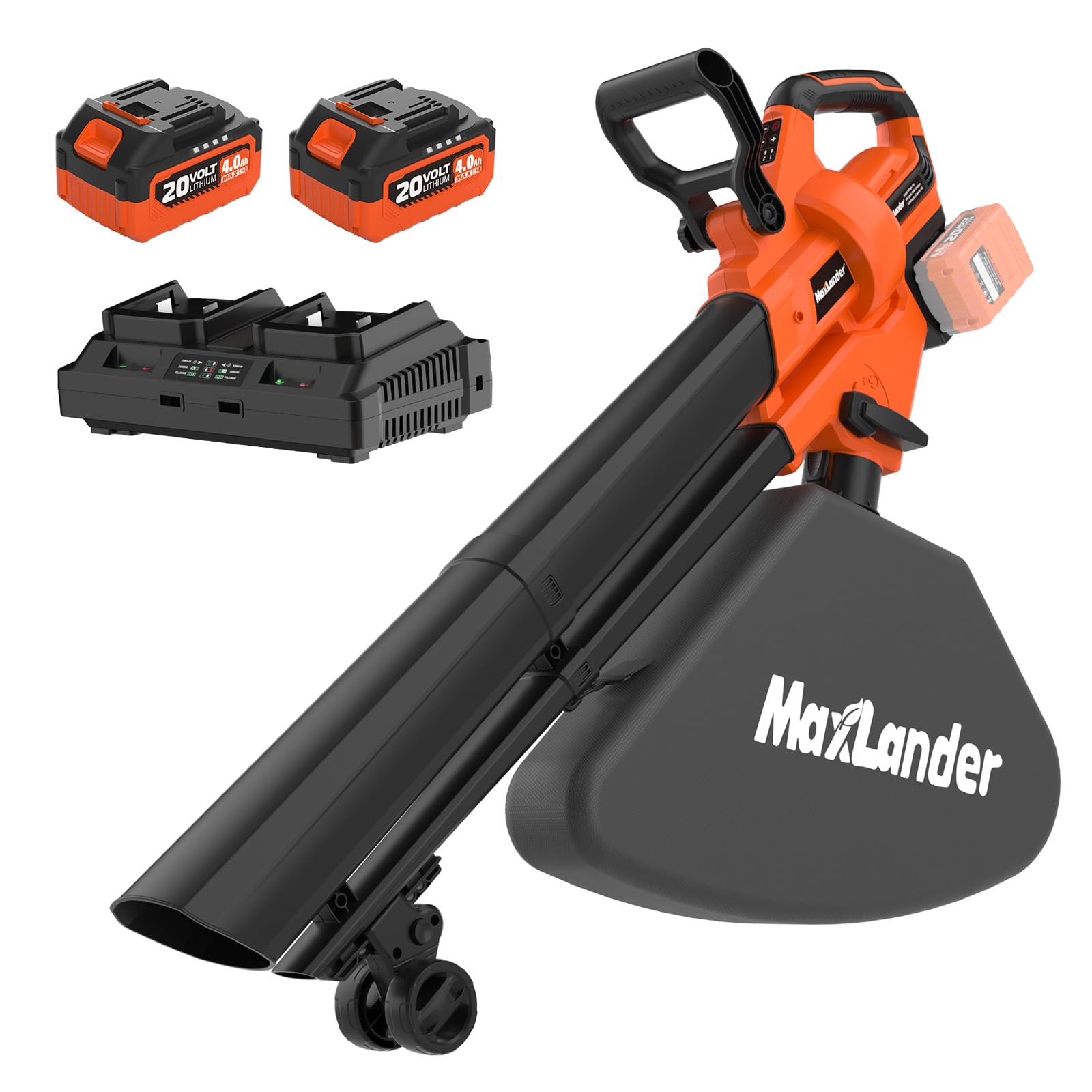
8.4 pounds and cordless — the one you can grab for a quick pass.
At 8.4 pounds, this MAXLANDER is the lightest full 3-in-1 in this lineup, and it is also the most compact — its frame measures 8.58 by 12.79 by 17.32 inches, versus the Echo ES-250’s much longer 37-inch body. That small footprint is what makes it easy to store in a garage corner and easy to swing along a path. The 40V brushless motor (a motor design that cuts friction and runs cooler than a brushed one) delivers 335 cfm across a 6-speed dial and up to 170 miles per hour, with two 4.0Ah batteries and a charger in the box.
The 15:1 mulch ratio shreds leaves as they are vacuumed, and the 40L collection bag holds more material between empties than a smaller bag would. At 8.4 pounds it is the one you grab off the shelf to clear a patio, a deck, or a pile of leaves before it gets tracked through the house. No gas, no cord, no engine to fuss over.
The honest catch is runtime. A cordless blower this light pays for its weight with battery capacity, and a full charge runs shorter than a corded session — the recurring complaint is that the packs drain fast. It is not a machine for a half-acre cleanup on one charge. The power also sits below the gas units: at 335 cfm it falls under the NEO-TEC’s 432 cfm, so massive wet piles are more of a push.
Who it fits: a homeowner who wants a grab-and-go tool for decks, driveways, and small leaf patches, and values an 8.4-pound body over raw power.
Consider this one when: light weight and cordless freedom top your list and your cleanup is measured in minutes, not hours.
Step up if: your yard throws big wet piles — the battery and 335 cfm airflow will run out before the leaves do.
6. SOYUS 40V Cordless Leaf Blower & Vacuum 3-in-1
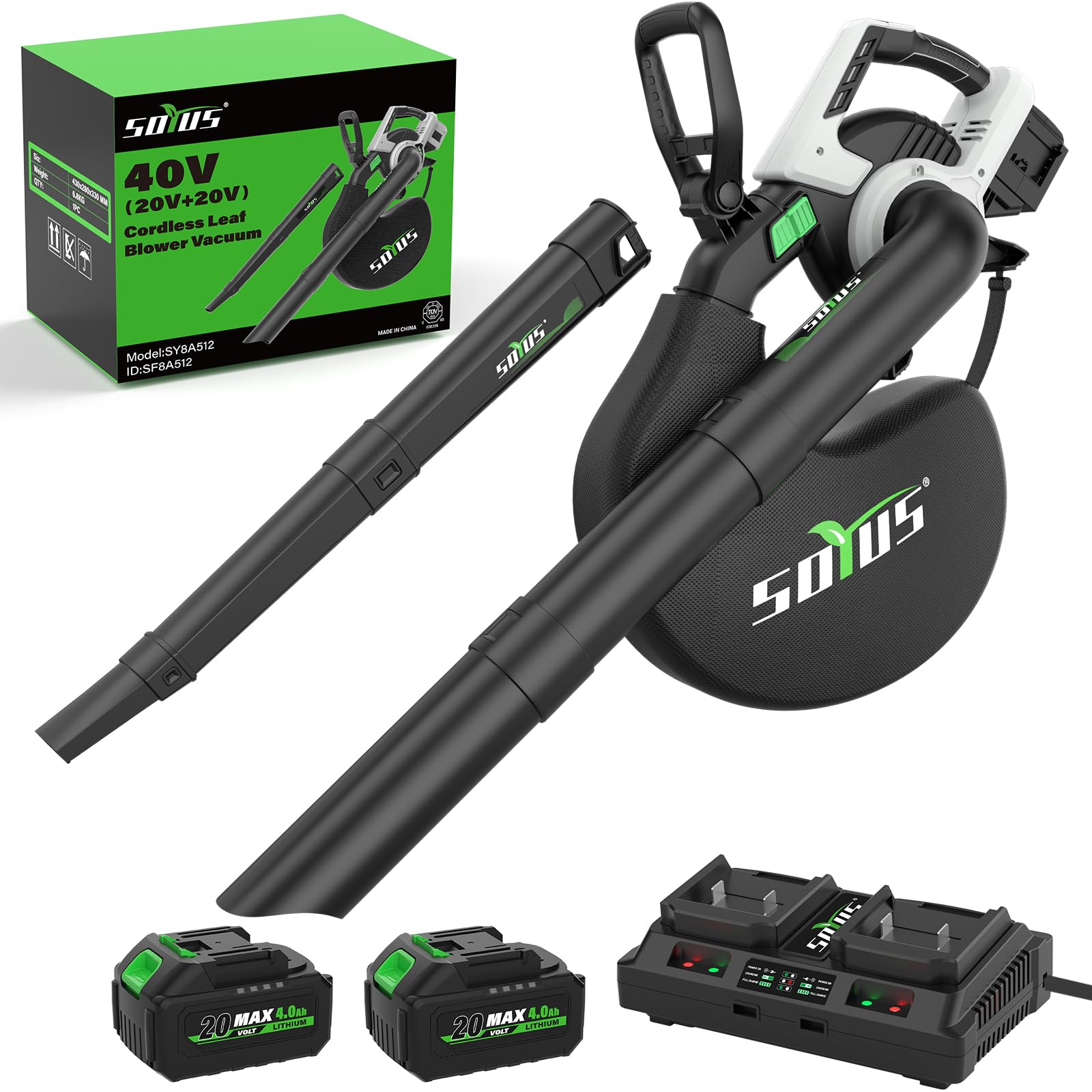
Two battery packs and a 45L bag for a longer cordless run.
The pitch here is runtime, and it starts with two batteries instead of one. This SOYUS ships with 2 x 4.0Ah packs and a charger, so you can keep one working while the other tops up. The maker states more than 30 minutes at maximum speed and up to 90 minutes at low speed, with a full charge taking about 1.5 hours. A 4-speed control with a TURBO button lets you choose how much airflow you spend.
The numbers on paper are respectable for a cordless 3-in-1: a brushless motor pushing up to 360 cfm and 170 miles per hour, a 45L collection bag with a zippered bottom for easy dumping, and a shoulder strap to carry the load. That 45L bag is the largest collection bag in this cordless group — bigger than the MAXLANDER’s 40L — so you empty it less often. The zipper bottom is the small feature you will appreciate every single time: unzip, dump, keep going.
Where you should set expectations is on the biggest leaves. Airflow velocity is the recurring weak point — several owners find it is not strong enough for large, thick leaves, even with the TURBO mode. It clears light yard debris and dry leaves well, but a pile of big wet leaves will slow it down. The battery also runs about as long as the maker claims at full speed, which is fine for a small yard and short for a big one.
The Strong Points
- Two 4.0Ah batteries let you keep working while one charges
- 45L bag is the largest collection bag in this cordless group
- Zippered bottom makes dumping fast and clean
- Up to 90 minutes at low speed stretches a session
The Honest Limits
- Airflow velocity struggles with large, thick leaves
- Runs roughly 30 minutes at maximum speed
- Turbo helps, but it drains the pack faster
Suits you if: a small-to-mid yard and dry leaf work are your normal job, and you want two batteries instead of one.
Look elsewhere if: your property is all big wet leaves — this one wants lighter loads.
7. EARTHCRAFT 3-in-1 26CC Gas Leaf Blower
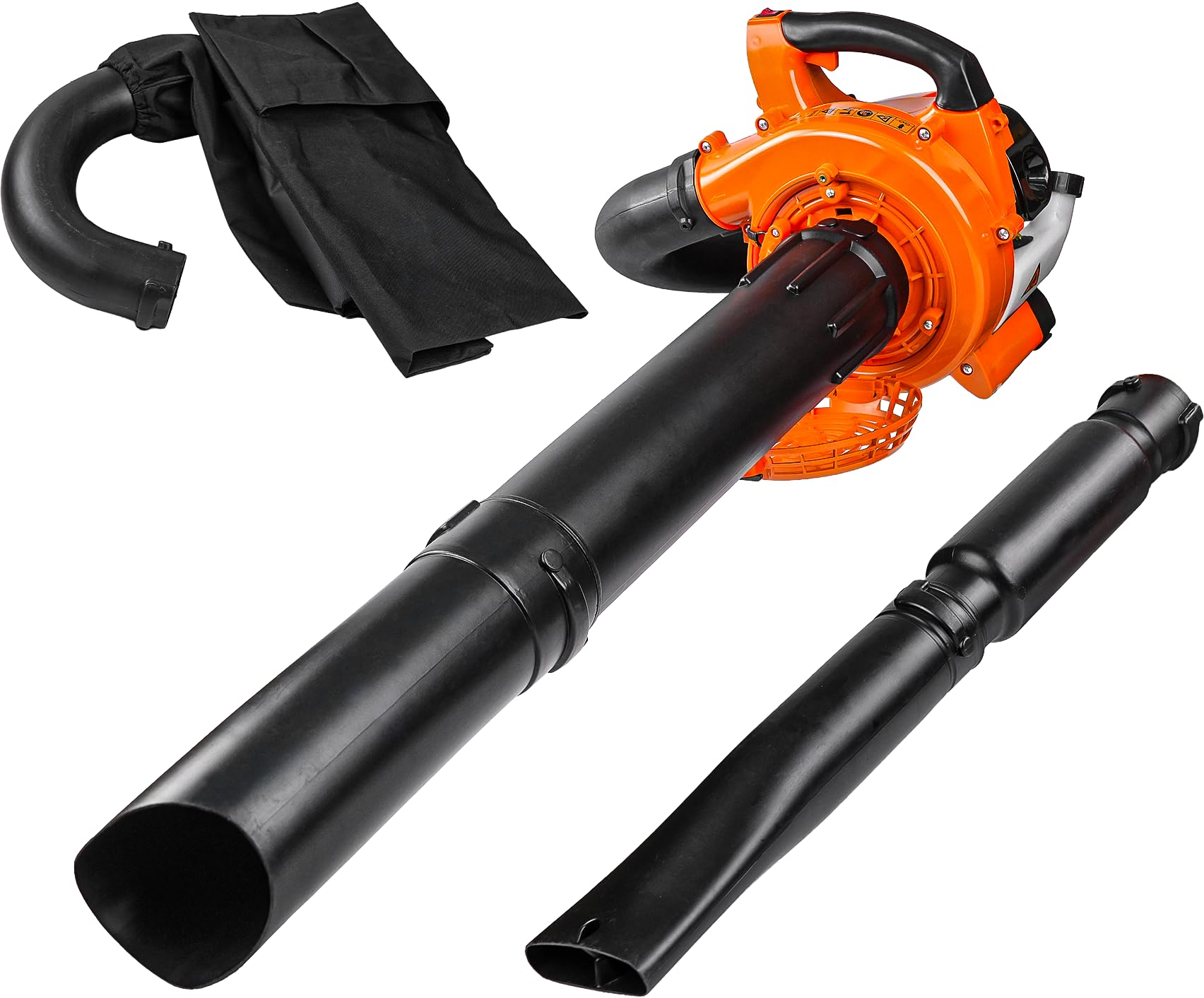
450 cfm and 200 mph from a 26cc gas engine, with a 45L bag.
If raw airflow is what you are after, this EARTHCRAFT leads the handhelds here on paper. It pushes up to 450 cfm at 200 miles per hour — more volume than the NEO-TEC’s 432 cfm and more speed than the Echo’s 165 mph — from a 26cc two-cycle engine. The numbers are the sort that clear dry leaves and light snow in a single pass, and the gas engine means no cord and no battery ceiling on a big job.
The collection setup keeps pace. A 45-liter bag holds plenty of shredded leaves before you empty it, and the package includes the vacuum pipe, blowing pipe, and collection bag connecting pipe so you have all the modes. The maker states a low-resistance pull cord starts the 26cc engine in 1 to 2 pulls, and the 78 dB rating runs louder than the Echo’s 70 dBA — worth knowing for early weekend cleanups. A set of noise-canceling headphones comes in the box, which is a thoughtful touch for a gas tool.
The trade-off is the usual one with a gas machine: quality and functionality land mixed in the reviews, with some units running well and an occasional one that will not fire. That is the nature of a pull-start engine. The 1-year warranty softens the risk, and the value is clearly there for the airflow you get. If you want the quietest possible session, gas is not your answer.
The takeaway: 450 cfm and 200 mph make this the airflow leader among the handheld gas picks, and a 45L bag backs it up for big dry cleanups.
Your pick if: you want the biggest airflow number without stepping up to a walk-behind machine.
Not for you if: the 78 dB noise or the fuel mixing is a deal you would rather not make.
8. Greenworks 40V Leaf Blower / Vacuum, 505 CFM, 5.0 Ah Battery

A 40V blower-vac that slots into the Greenworks battery family.
The reason to consider this Greenworks is the battery you may already own. It runs on the Greenworks 40V system, which the maker says spans 75+ tools, so an existing 40V pack on your shelf covers leaf duty without a new battery ecosystem. The kit includes a 5.0Ah battery and charger, and it does 3-in-1 duty with a 12:1 mulch ratio and a Turbo Boost button rated at 185 miles per hour.
The brushless motor is rated at 2X the torque and 30% longer runtime than a brushed design, backed by a 3-year full tool warranty. A variable speed dial plus the on-demand Turbo mode lets you back the airflow down for a tight corner and open it up for gravel or wet leaves.
Set expectations on runtime before you commit. The recurring report is a battery that runs far shorter than a full afternoon of cleanup — much shorter than the SOYUS’s stated runtime on two packs. The power itself gets mixed marks too: some owners find it strong, others say it is underpowered for the big jobs, and the suction is often described as modest. Treat it as a good fit for a small yard when you are already inside the Greenworks ecosystem, not as a do-everything machine.
Where it earns a place: the 40V battery sharing across 75+ Greenworks tools is the real value — one battery platform for the whole shed.
Where it falls short: the battery drains fast and the suction is modest, so big wet leaf piles are more of a fight here.
Worth it mainly for: Greenworks 40V owners who want to add a vacuum mode to a system they already have.
Better options exist if: you want strong suction and long runtime on big piles — the corded or gas picks do that job with more headroom.
9. SuperHandy Leaf Vacuum & Wood Chipper 7HP 209cc
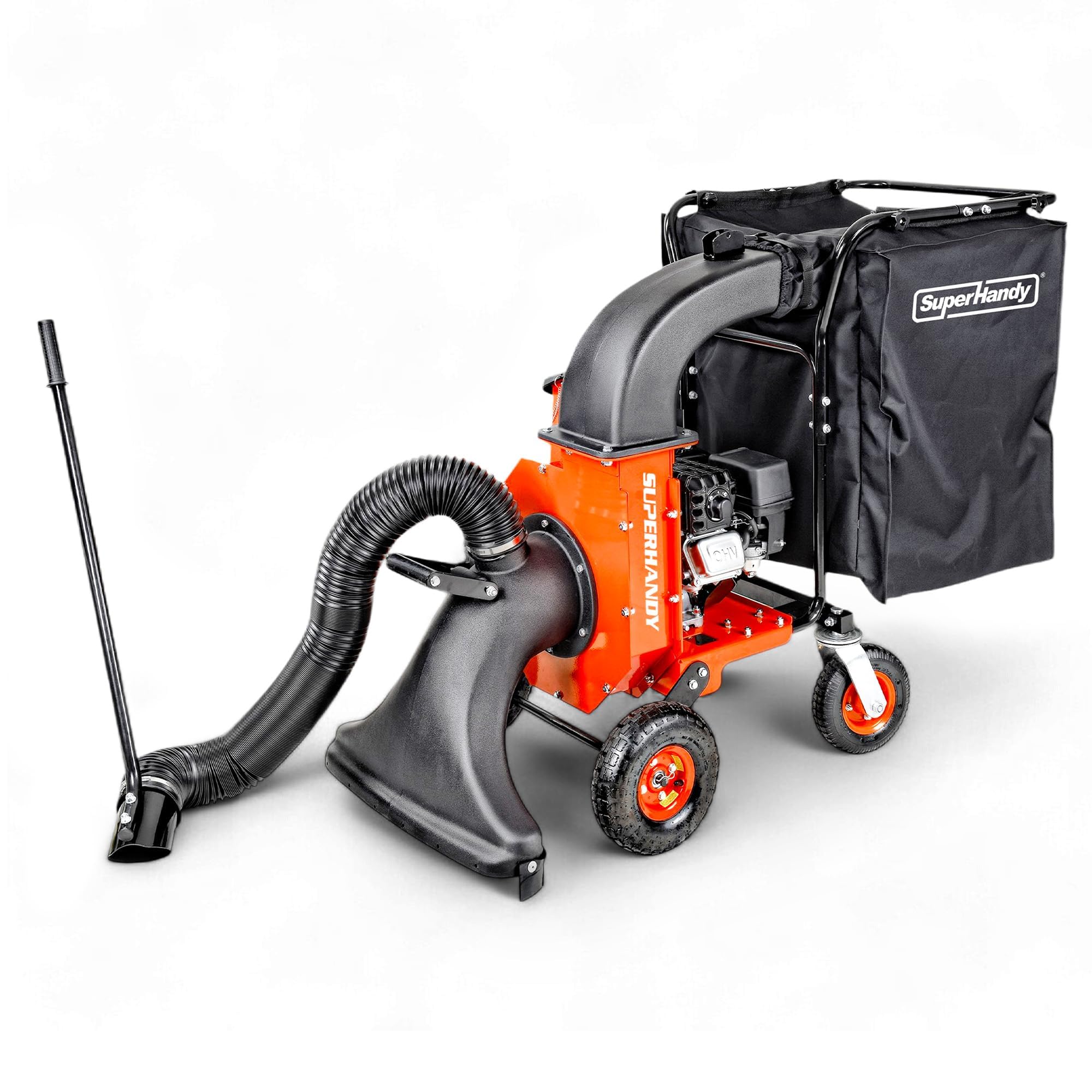
A walk-behind 7HP machine that vacuums leaves and chips branches.
This is the one for a property with sticks as well as leaves. The SuperHandy combines a leaf vacuum with a wood chipper, taking branches up to 2 inches in diameter and shredding leaves through a steel 13.4-inch serrated impeller at a 10:1 reduction ratio. The 7HP 209cc OHV engine runs at 3600 rpm, and the walk-behind design means you push it across the lawn rather than carry it.
The hauling is handled by four wheels — 10-inch by 3-inch front castor wheels and 8-inch by 2-inch rear swivel wheels — that steer over flat terrain. A 6-bushel collection bag with a side zipper makes unloading quick. This is a different class of machine from every handheld above: at 131 pounds you are not lifting it, you are driving it, and that is the point for a large yard with heavier debris.
Be honest about the vacuum height before you buy. The recurring complaint is that the nozzle sits too high off the ground and cannot be lowered, so it does not pick up flat leaves as aggressively as a handheld does. Performance lands mixed for that reason — it works well as a chipper and less well as a ground-level leaf vacuum. This is a fit note, not a reason to write it off: buy it for the branches, not as a replacement for a handheld leaf vacuum.
What It Brings To The Yard
- 7HP 209cc engine runs at 3600 rpm for steady suction and chipping
- Chips branches up to 2 inches in diameter
- Steel 13.4-inch serrated impeller delivers a 10:1 reduction ratio
- Four wheels and swivel steering handle flat terrain easily
The Reality Check
- Nozzle sits high off the ground and cannot be lowered
- 131 pounds makes it a push-it machine, not a carry-it one
- Picks up flat leaves less aggressively than a handheld vacuum
Built for: a big property with fallen branches and brush to clear alongside leaves.
Wrong tool if: you want a handheld vacuum for patio leaves — that job belongs to a machine you can carry.
Know the Specs
Mulch Ratio, Explained Plainly
The mulch ratio is how many bags of loose leaves get shredded down into one bag of mulch. A 16:1 ratio means sixteen bags become one, and an 18:1 ratio shreds even further. A higher ratio means the collection bag fills slower, so you spend less time walking to the compost bin and more time actually clearing. It is the number to weigh first when you compare one leaf vacuum to another.
CFM Versus MPH
CFM (cubic feet per minute) measures how much air moves — the volume that pushes a leaf pile. MPH (miles per hour) measures how fast that air travels — the speed that lifts a wet leaf off pavement. A vacuum needs strong CFM to pull leaves through the bag, and it needs enough MPH to break leaves loose first. Read both numbers, but on a vacuum the CFM figure usually matters more than the speed.
Collection Bag Size In Liters
Bag size is measured in liters or bushels, and it sets how often you stop. A 40L to 45L bag holds a good amount of shredded leaves; a 6-bushel bag is what you see on walk-behind chippers. Larger bags save trips but get heavier as they fill, so a padded shoulder strap or a set of wheels is what makes a big bag practical rather than painful.
Power Source Trade-Offs
Corded electric runs indefinitely on an outlet and never needs fuel, but you are tethered to an extension cord. Battery units free you from the cord but run as long as the pack allows, often around a half hour at maximum speed. Gas units run on fuel with no cord or battery ceiling, but add pull-starting, oil mixing, and exhaust. Match the power source to the size of your yard and how long you plan to work.
Common Questions
What mulch ratio should I look for in a leaf yard vacuum?
Is CFM or MPH more important on a leaf vacuum?
How long does a cordless leaf vacuum battery actually last?
Can a leaf vacuum handle wet leaves?
Do I need to mix oil with gas for these leaf vacuums?
How heavy is a leaf vacuum with a full bag?
Can a leaf vacuum clear branches as well as leaves?
Is corded or cordless better for fall leaf cleanup?
How often will I need to empty the collection bag?
Will a gas leaf vacuum start easily after storage?
The Bottom Line
For most people with a real yard, the best leaf yard vacuum here is the Echo ES-250 because its 391 cfm of gas power clears big piles without a cord holding you back. If you would rather plug in and never charge a battery, the WORX Trivac WG509 shreds at 18:1 and hits 210 mph on a continuous cord. And if you have branches alongside leaves, the SuperHandy chipper combo is the walk-behind that takes both.
My one nudge: figure out your mulch ratio target before you shop, because it is the spec that decides how many trips you make to the compost pile. Get that right, and any of these picks will turn a weekend of raking into an afternoon of shredding.
How we choose
We do not accept paid placement. Every pick is matched to a real buyer and a real use-case; we do not hands-on test units.
Sources
Specifications: manufacturer listings and product documentation. Review insights: verified customer reviews, as of November 2026. Pricing: not shown on this page (it changes often); check the current price via the retailer link.
As an Amazon Associate, Tactical Gear Guy earns from qualifying purchases. This does not affect which products we feature.