Specs are compiled from manufacturer listings and verified buyer reviews and can change over time — please confirm the key details on the product page before buying.
Parting a workpiece on a lathe is the cut that punishes every weak tool, and most of the frustration depends on one choice: the blade itself. The short answer: a 5% cobalt parallel cut-off blade holds its edge through a deep plunge and forgives a slightly loose manual lathe. An indexable carbide holder (a holder that takes replaceable carbide inserts) trades that forgiveness for repeatable accuracy and faster insert swaps. Below are six specific blades and holders, so you can match one to your lathe’s swing, your material, and the depth of cut you actually run.
This guide is built by comparing the manufacturers’ published specifications and the patterns across verified customer reviews, so you get each pick’s real strengths and trade-offs instead of marketing spin.
Blade geometry, insert style, and holder fit decide whether your cut runs clean or stalls halfway in. Here is how each of these lathe parting tools performs once the chips start flying, ranked from the solid cobalt blade down to the budget spare pair.
Top Picks


How To Choose The Best Lathe Parting Tool
Parting is the operation where the tool is buried in the work with the least room to clear chips, so the wrong blade shows up as chatter, a wandering cut, or a snapped edge. Work out your material and your lathe size first, then let the tool specs follow.
Solid HSS blade or indexable carbide holder
A solid high-speed steel blade is one piece of ground metal you sharpen or replace. It forgives a slightly loose machine and a hand-fed carriage, which is why it suits manual lathes and hobby setups. An indexable holder uses a small carbide insert clamped in a steel shank, and when the tip dulls you rotate or swap the insert instead of regrinding. Indexable gives you repeatable depth and faster turnaround, but carbide is brittle and dislikes interrupted cuts.
Match the blade thickness to the groove you need
A 1/8 inch blade removes a narrow kerf but flexes more in a deep cut. Wider blades track straighter but eat more material. Trapezoid blades are thinner on one edge than the other, so the relief side clears the walls of the groove as you plunge.
Check shank size against your tool holder
A 1/2 inch by 3/8 inch shank drops into common quick-change and turret holders, but a mini lathe may not have the rigidity for it. Measure the holder slot and the swing of your machine before you buy, because an oversized shank on a small lathe produces chatter no insert can fix.
Side-by-Side Comparison
| Model | Best For | Blade / Insert Size | Material | Pieces Included | Amazon |
|---|---|---|---|---|---|
| HHIP 2000-7035 Cobalt P3 Cut-Off Blade★ Best Overall | Manual lathe parting in hard metal | 1/8 x 11/16 x 5 inch | 5% cobalt high-speed steel | 1 | Amazon |
| OSCARBIDE QA06R-20J Grooving HolderTop Performer | External parting in tight space | 3/8 x 1/2 shank, GTN-2 insert | Nickel-plated steel | Holder with insert | Amazon |
| Accusize 2415-5022 Grooving Holder | Full-size lathe grooving | 3/8 x 1/2 shank, GTN-2 insert | Steel with TiN carbide insert | Holder with insert | Amazon |
| Accusize NCIH32-3 Parting Blade | CNC and manual parting to center | For GTN-3 inserts | 60Si2Mn spring steel, HRC 40 | Blade body only | Amazon |
| Accusize 2415-5024INS Cut-Off Holder | High-production cut-off with spare inserts | 1/2 x 1/2 shank, 10 GTN-2 inserts | Nickel-plated steel | Holder plus inserts | Amazon |
| ASSORTS HSS Trapezoid Blades | Spare blades for an existing holder | 1/8 x 3/4 x 6 inch | Hardened and ground HSS | 2 | Amazon |
Detailed Reviews
1. HHIP 2000-7035 Cut-Off Blade
Our pick — 4.5+★ from 600+ verified ratings; the strongest balance of quality and price.
The solid cobalt blade that keeps a straight kerf without asking you to change holders.
For anyone parting on a manual lathe, this is the simplest path to a clean cut. It is a single piece of high-speed steel with 5% cobalt in the mix, and that cobalt is what lets the edge survive the heat of a deep plunge instead of softening halfway through. The blade is 1/8 inch thick by 11/16 inch wide by 5 inches long, which is a size that fits common quick-change tool holders.
Where it earns its keep is the geometry. The parallel design holds a continuous cutting edge width along the whole blade, so the groove does not pinch or taper as you feed in. A ground chip breaker groove runs along the top length, which curls the chip away instead of letting a bird’s nest build up and jam the cut. One end is beveled and one is square, giving you a second setup option when you need to reach a shoulder or finish a face. It is built to drop into Aloris, DORIAN, and KDK style quick-change holders.
What wins people over is the consistent quality of the 5% cobalt steel — it holds an edge and cuts accurately, which is why this is the pick most buyers land on when they want to stop fighting their machine. Worth noting: this is the 5% cobalt listing, while the item description elsewhere on the page mentions 8% cobalt, so confirm the grade with the seller if that distinction matters to your job. There is also a durability pattern worth respecting. In deep or interrupted cuts, a solid blade this thin is the part that pays, so keep your overhang short and your feed steady rather than force a heavy plunge.
What earns the top spot
- Consistent edge that keeps cutting accurately through a long parting pass.
- Ground chip breaker groove clears swarf instead of jamming the groove.
- Fits Aloris, DORIAN, and KDK quick-change holders without adapters.
- Beveled and square ends give two finish options on one blade.
The honest caveats
- It is a thin solid blade, so aggressive plunging can snap it.
- The cobalt grade is listed two different ways on the page — verify it.
- You still need a compatible quick-change holder to run it.
Reach for this if: you part on a manual lathe with a quick-change holder and want a cut that tracks straight without changing your setup.
Look elsewhere if: you run very deep, heavy interrupted cuts, where an indexable holder that swaps tips will cost you less downtime.
2. OSCARBIDE QA06R-20J Cut-Off Tool Holder
A short, stiff holder that puts a carbide insert where a solid blade would chatter.
If your lathe already has a rigid tool post and you want repeatable depth without regrinding, this one-piece holder is the natural step up. The shank is 3/8 inch by 1/2 inch with a 3.5 inch overall length, so it sits close to the post and shrugs off the vibration that ruins a parting cut. Nickel plating on the body adds wear resistance on the shank edge.
The GTN-2 insert clamps down to a stated ±0.001 inch cutting accuracy, and the auto-center height lock holds a consistent depth of cut without you recalibrating each pass. The wedge clamp squeezes the insert so it cannot creep sideways during a face grooving pass — that creep is usually what kills a parting tool. You can plunge straight down or side-turn to open a wider groove, and it handles external parting plus profile and copy turning on steel, stainless, and alloys up to 65 HRC.
Owners rate its cutting performance highest, and the GTN-2 insert holds up whether you are parting aluminum or mild steel. The trade-off is life span. Some buyers report a very sturdy holder, while others find it does not survive a full cut — treat it as a holder that rewards a properly set height and steady feed rather than a hammer. Compare the shank to your machine before you buy; this is sized for standard holders, not micro lathes.
Why it stands out: the wedge clamp plus the height lock is the pair that keeps a parting cut true, and it is the piece of this tool most worth paying for.
Fair warning: run it too hard or too long and the insert is what fails — set your height, clear the chips, and let the clamp do its job.
The short version: a strong pick for anyone who wants indexable carbide accuracy on a rigid lathe.
Not for you if: you work on a bench-top mini lathe, where a shank this size leaves little room to run.
3. Accusize 2415-5022 Grooving/Parting Holder

Built for the full-size lathe, with a TiN-coated insert that cuts rings and grooves as happily as it parts stock.
This is the holder you pick when your work is not just parting. It is set up for shallow precision grooving, O-ring and snap-ring work, relief grooving, and opening wide grooves by plunging and side turning. The shank runs 3/8 inch high by 1/2 inch wide with a 3-1/2 inch overall length, and the whole thing stays compact in the post to keep chatter down.
You get repeatable depth from precision clamping and accurate insert indexing (the insert seats in the same spot each time). The short overhang (how far the tool sticks out of the holder) keeps it stable under side cutting forces during profile turning. The included GTN-2 TiN coated carbide insert (TiN is a gold wear coating) has a 0.63 inch cutting diameter and 0.079 inch thickness. It also shows how compact this tool is beside a full blade-only setup — the Accusize blade body below measures 5.91 x 1.57 x 0.39 inches against this holder’s 3.54 x 0.98 x 0.98 inches, so the holder is the tighter package in the post.
Buyers consistently rate the 2415-5022 as well-made and effective on full-size lathes, though several flag the carbide inserts as fragile. The recurring honest note is about the carbides: they can break, and the tool is too big for mini and micro lathes. If you run a small machine, expect fit problems. If you run a standard lathe and want one holder that grooves, faces, and parts, this earns its spot — though it costs more per setup than a solid blade because replacement tips are a running expense.
Where it delivers
- Handles O-ring, snap-ring, relief grooving, and wide grooves on one shank.
- Precision clamping and indexing keep depth repeatable.
- Short overhang resists side-cutting forces during profile work.
- TiN coated insert is included and ready to run.
What to weigh
- Carbide inserts are fragile and break under abuse — a cost you keep paying.
- Too large for mini and micro lathes.
- Several buyers question whether the price matches the longevity.
Best fit: full-size lathe owners who need one tool for grooving and parting, not just cut-off.
Think twice if: your machine is a mini or micro lathe, or you want the lowest running cost per cut.
4. Accusize NCIH32-3 Parting Blade
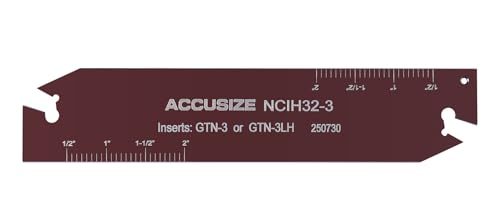
A projection-marked blade body for the machinist who already runs GTN-3 inserts.
This one is a blade body, not a complete tool, and that changes who it suits. You get the NCIH32-3 holder designed for GTN-3 self-lock cut-off and grooving inserts, but the insert is not included — you select it for your work material separately. The body is made from 60Si2Mn spring steel hardened to HRC 40, so it resists bending and holds its shape under a long overhang.
The design detail that matters most is the positive stop. Projection-setting lines are marked in 1/32 inch divisions, so you can set how far the blade sticks out of the holder quickly and repeatably. That adjustability lets you run it as a grooving tool, part to center, or chamfer on compatible CNC or manual lathes. The extractor-assisted pocket geometry also makes insert swaps quick between jobs, which is the difference between a fast turnaround and resetting your whole tool.
What buyers like is the quality of the 60Si2Mn spring steel blade body itself. The cutting performance and durability feedback is genuinely split — some report it cuts well and holds up, while others find it bends or breaks during use. That spread tells you this is a tool that depends heavily on how you set overhang and feed. It also sits longer in the pocket than the Accusize grooving holder above: 5.91 x 1.57 x 0.39 inches versus that holder’s 3.54 x 0.98 x 0.98 inches. If you already run GTN-3 tooling and want a properly marked blade, this is a solid choice; if you want a ready-to-cut holder, look at the GTN-2 setups.
The real draw: 1/32 inch projection markings let you dial blade stick-out without guessing, which is exactly the control a parting operation lives or dies on.
The catch: it arrives without an insert and reports of breakage mean you should keep overhang short and your feed gentle.
Buy this when: you already stock GTN-3 inserts and want a marked, adjustable blade for grooving and parting to center.
Look past it when: you need a complete plug-and-run tool from the start, insert included.
5. Accusize 1/2″ x 1/2″ Cut-Off Tool Holder

The kit that keeps you cutting — a rigid holder with a stack of spare carbide tips.
Production work lives or dies on how fast you swap a dull insert, and this package answers that directly. It bundles the 1/2 inch by 1/2 inch nickel-plated holder with 10 GTN-2 TiN coated carbide inserts at a 0° lead angle and 0.079 inch cutting width. That spare stack means you finish a batch instead of hunting for a replacement mid-run.
The holder carries the same stable design as its smaller sibling — precision clamping, accurate insert indexing, and a short overhang that keeps it balanced under side cutting forces. It supports up to a 0.63 inch cutting diameter with a 4.5 inch overall length, enough for wide-ranging grooving and cut-off. One honest comparison to keep in mind: this shank is 1/2 inch square where the GTN-2 grooving holder above runs a 3/8 inch height, so measure your tool post before ordering either. This is among the beefiest options here, at 7 ounces, roughly 2.4 times the weight of the 2.88 ounce grooving holder above.
The nickel plating adds wear resistance for demanding environments, and the holder plus ten GTN-2 inserts turns a fragile carbide into a consumable you plan for rather than fear. It is the practical pick for someone who parts regularly and wants minimal downtime between jobs. The main thing to weigh is that carbide still breaks under a bad cut, and the spares only help if you keep your setup honest.
The case for the kit
- Ten GTN-2 TiN inserts included, so dull tips rarely stop the job.
- Precision clamping and short overhang keep cuts stable.
- Supports a 0.63 inch cutting diameter and 4.5 inch overall length.
- Nickel-plated shank resists wear under heavy use.
Know before you buy
- A 1/2 inch square shank needs a stout tool post to fit.
- Carbide inserts still break under an aggressive or interrupted cut.
- On the high side of the range for a single holder setup.
The best match for: anyone running regular cut-off jobs on a full-size lathe who wants spare tips ready at the bench.
Skip the splurge if: you part occasionally, where a single solid blade handles your needs for less.
6. Set of 2 HSS Trapezoid Blades 1/8″ x 3/4″ (Wide) x 6″ (Long)
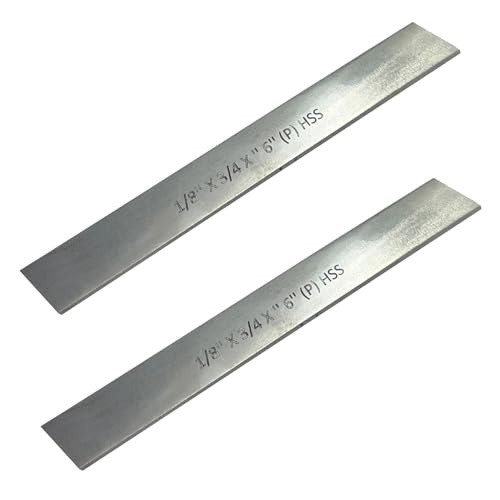
Two hardened spare blades for the holder you already own.
If you have a cut-off holder and just need fresh blades, this pair is the no-fuss answer. Each blade measures 1/8 inch by 3/4 inch wide by 6 inches long, ground and hardened for work on metal. The trapezoid shape is the useful part: one edge is 1/8 inch thick while the other is only 5/64 inch, so the thin side gives relief clearance as the blade plunges into the groove.
You get two blades in the set, and the pair weighs 0.09 kg against a single HHIP blade’s 0.05 kg, so there is real metal in the box for the money. Each runs 6 inches long by 0.75 inch wide with 0.13 inch thickness. These are consumables, meant to be fitted to your existing holder and replaced when they dull or chip — they are spare parts, not a complete tool.
Treat them as what they are: a value pair for keeping a holder fed. Because they are thinner on one edge, handle them carefully and set your overhang short, since a trapezoid blade flexes more in a deep cut than a full rectangular one. For a hobby machinist topping up the tool drawer, this is a sensible, affordable buy rather than a hero tool.
What you get: a genuine spare-parts value — two hardened trapezoid blades in one set, sized 1/8 inch by 3/4 inch by 6 inches.
Set expectations: no holder here, and a thin relief edge means these are best for lighter parting work where you control the feed.
Right for you if: you already have a compatible holder and want two affordable replacement blades on hand.
Not for you if: you are starting from scratch and need a complete tool, holder and all.
Know the Specs
Blade thickness and trapezoid shape
A thinner blade cuts a narrower kerf but flexes more in a deep pass. Trapezoid blades taper from a thick edge to a thin one, so the thin side clears the groove walls during a plunge. For a straight rectangular blade, thickness stays constant, which gives more rigidity but no built-in clearance.
Cobalt content in high-speed steel
Cobalt raises how hot an edge can get before it softens. A blade listed with 5% cobalt is mixed for heat resistance under a heavy cut in hard material. More cobalt tends to mean longer edge life, but the trade is a slightly harder steel to sharpen and, in thin sections, more risk of a snap.
GTN insert numbers
A GTN insert is a small carbide tip that clamps into a holder and gets swapped when it dulls. The number after GTN tells you the size and style, so a GTN-2 tip drops into a holder built for GTN-2 and a GTN-3 tip drops into a GTN-3 blade body. Getting the number right is the whole game — the wrong insert will not seat or cut to depth.
Shank size and overhang
The shank is the bar that clamps in your tool post. A 1/2 inch square shank is stiff but heavy and needs a stout post, while a 3/8 inch height suits smaller holders. Overhang is how far the tool sticks out — a shorter overhang resists chatter, which is exactly why a rigid parting setup beats a flexible one.
Common Questions
Will these parting tools fit a mini lathe?
Is GTN-2 the same as GTN-3?
Do I need a separate holder to use the solid HSS blades?
Why does my parting blade keep breaking?
What metal can these tools cut?
What does the 1/32 inch marking on the Accusize blade body do?
Can I run an indexable holder as a grooving tool, not just for parting?
Is the carbide insert included with every tool?
How do I keep chips from jamming the groove during a deep cut?
The Bottom Line
For most manual-lathe machinists, the lathe parting tool worth starting with is the HHIP 2000-7035 Cobalt Cut-Off Blade, because its parallel geometry and chip breaker groove give you a clean, accurate cut in an existing holder. If you want indexable carbide accuracy and a repeatable depth lock, reach for the OSCARBIDE QA06R-20J Holder. And if you part regularly and want spare tips ready at the bench, the Accusize Cut-Off Tool Holder kit with its ten GTN-2 inserts is the one that keeps you cutting.
How we choose
We do not accept paid placement. Every pick is matched to a real buyer and a real use-case; we do not hands-on test units.
Sources
Specifications: manufacturer listings and product documentation. Review insights: verified customer reviews, as of November 2026. Pricing: not shown on this page (it changes often); check the current price via the retailer link.
As an Amazon Associate, Tactical Gear Guy earns from qualifying purchases. This does not affect which products we feature.