Specs are compiled from manufacturer listings and verified buyer reviews and can change over time — please confirm the key details on the product page before buying.
You are about to zap hair with a laser or IPL (intense pulsed light, a bright flash-based hair removal device), and the thing you actually need to protect is your eyes. Only one pair on this list is the safest all-round buy for hair removal, and it is not the most expensive. Below you get the right glass for home IPL, for a beauty-tech session, and for anyone who wears prescription frames underneath.
This guide is built by comparing the manufacturers’ published specifications and the patterns across verified customer reviews, so you get each pick’s real strengths and trade-offs instead of marketing spin.
Wavelength range is the number that decides whether a lens is right for your device. This guide sorts each pair by what it actually blocks, so you match it to your machine instead of guessing at the till for the best laser hair removal glasses.
Top Picks


How To Choose The Best Laser Hair Removal Glasses
Before you buy anything, find the wavelength your device runs at — it is usually printed in the manual or on the device itself in nanometers. A lens only protects on the wavelengths it was built to block. Buy too narrow a pair and you get a false sense of safety.
Match the wavelength to your device, not the colour of the flash
Home IPL units and hair-removal lasers vary widely in what they emit. A pair rated for 190nm to 490nm will not cover the infrared end some devices run at, so check your device figures against the lens range first. If your machine covers a broad span, look for a lens that reaches into the 800nm to 2000nm bands as well.
Optical density is the strength of the filter
Optical density, or OD, is a rating of how much laser light a lens shuts out at a given wavelength. A higher OD number means more protection. An OD 6+ rating cuts more than an OD 5+ one, so if you are unsure, go for the highest OD your budget allows.
Fit over glasses and side coverage
If you wear prescription specs, an over-the-glasses frame saves you from swapping into contacts just to run a session. Side shields matter too — they stop stray light reaching your eyes from the side, which is exactly where a hair-removal flash often comes from.
Side-by-Side Comparison
| Model | Best For | Wavelength Range | Optical Density | Over-Glasses Fit | Amazon |
|---|---|---|---|---|---|
| FreeMascot New Professional OD 6+★ Best Overall | All-round home use | 190nm-490nm | OD 6+ | — | Amazon |
| JILERWEAR IPL Professional Safety GlassesBest Value | Budget IPL sessions | 190-450, 560-1200nm | OD 6+ | — | Amazon |
| 190nm-490nm OD 6+ UV Violet & BlueBest For Glasses Wearers | Prescription glasses wearers | 190nm-490nm | OD 6+ | Yes | Amazon |
| FreeMascot Professional 190nm-2000nm | Broad-band IPL and infrared | 190nm-2000nm | — | — | Amazon |
| JILERWEAR Laser Safety Goggles OD 6+ | Violet, blue, green lasers | 180-540nm | OD 6+ | — | Amazon |
| LaserPair IPL Safety Glasses | Salon-grade broad band | 200-2000nm | — | Yes | Amazon |
| TRQWH IPL Laser Safety Glasses | Pro-focused fit | 190-540nm & 800-1100nm | OD 5+ | — | Amazon |
| LaserPair 200-534nm & 740-1095nm | Engraving and laser work | 180-534nm & 740-1095nm | OD 7+ / OD 5+ | Yes | Amazon |
| Professional 180-540 & 750-1100nm | Glasses-wearing technicians | 180-540nm & 750-1100nm | — | Yes | Amazon |
Detailed Reviews
1. FreeMascot OD 6+ 190nm-490nm Laser Safety Glasses
Our pick — 4.5+★ from 750+ verified ratings; the strongest balance of quality and price.
The steady all-rounder that blocks violet and blue diode light without darkening the whole room.
The first thing to know is the range: this lens filters 190nm through 490nm, which covers the blue and violet end where a lot of home hair-removal gear sits. An optical density of OD 6+ means it cuts a heavy amount of light at those wavelengths — a strong shield for that band. Owners consistently report the OD 6+ filter blocks the violet and blue light it’s rated for.
It also gets transmission right. Visible light transmission (VLT) on this lens is 40%, which is enough to see around you while the filter does its work — brighter than you might expect from a safety lens. That 40% VLT is why owners say they can see their device and surroundings without lifting the lens.
Here is the honest catch: durability is the split point. Some pairs arrive sturdy, and some have a frame that gives way around the lens on first use. So treat the arms gently and store the glasses in the included protective case. If you need a lens that survives heavy handling, look at a metal-framed option instead. You get a protective storage case and a cleaning cloth in the box.
wide UV coverage
- OD 6+ optical density cuts a heavy amount of light across the 190nm-490nm band
- 40% visible light transmission keeps the room readable, not pitch black
- Fits violet 405nm, blue 445nm and 450nm, and 473nm laser sources
- Lens is polycarbonate with a broad-spectrum filter
fit needs checking
- Frames are flimsy — store it in the case rather than tossing it in a drawer
- Not built for fitting over prescription glasses for everyone; check the frame width
- Durability gets the weakest response across the review set, so treat it gently
for UV work: you run a home IPL or diode-laser device and want a lens that wins people over on eye protection, all for a reasonable price.
if fit matters: baby the frame — the case is included for a reason, and it is the one weak spot in this pick.
2. JILERWEAR IPL Safety Glasses
A wallet-friendly IPL lens that reaches into the infrared, not just the violet band.
The wavelength split is the story here. This lens covers 190nm to 450nm and then a second window of 560nm to 1200nm, so it handles a broader device range than the FreeMascot pick above (which stops at 490nm) on the infrared side. At OD 6+ it still cuts a heavy amount of light, and that is the kind of range that catches a home IPL unit running in the red or near-infrared portion of the spectrum.
Comfort is where this pair earns its place. Across the review pages it blocks the harsh IPL flash, sits without temple pressure, and reads as solid value for the 560-1200nm infrared coverage. It ships with a protective case, cleaning cloth, and a specific instruction worth heeding: do not shield the green 405-540nm light you may need to see.
Two honest notes. Brightness is the point a few owners push back on — the darkening is real, and if you find darkened vision disorienting for close work, that is the trade-off. Fragility turns up too, so keep it in the case. It also fits over glasses for many but not everyone, so check your frame width first.
for IPL sessions: anyone running a home IPL device who wants broad infrared coverage without a premium price.
for broad spectrum: the darkened view can feel strong, so try it before you rely on it for close, detailed work.
3. 190nm-490nm OD 6+ Laser Safety Glasses
Built to slide over your prescription frames so you never have to take your specs off mid-session.
If you wear glasses, this is the spec you care about: it fits over prescription frames. The knee or near-sighted user can leave the refractive glasses on and wear these straight over them — no contact lenses needed. That single feature makes it a contender for anyone doing home IPL who normally spends a session half-blind without their glasses.
The lens itself filters 190nm to 490nm with OD 6+, and it uses absorption filter technology — a design that keeps protecting even if the surface takes a scratch. Compared with the FreeMascot above, there is no side-shield spec listed here, but there is a shading lens on the frame side to keep stray light from the edges off your view. Visible light transmission is listed at 55%, which keeps the room readable.
Owners call the build midlevel but rate the over-glasses fit and eye protection firmly positive — it sits snugly over prescription frames without pinching. The honest note: at 130g and with a wide frame, it is not the lightest choice, so a long session may leave a little pressure. It handles 275nm, 365nm, 405nm, 445nm, 450nm and 473nm.
OD 6+ rating: you wear these over your prescription frames, so you never juggle two pairs mid-session. A shading side lens adds coverage at the edges. The 55% transmission (the share of ordinary light that gets through) keeps the room workable, while the OD 6+ filter (a strong light-blocking rating) does the blocking.
narrow UV band: 130g on your nose is real, and a broad over-glasses frame is not for everyone all day — reach for this when you need the specs to stay on, not when you want feather-light.
for intense UV: if you wear prescription glasses and want a lens that sits cleanly over them for home IPL and blue-laser work.
if need visible: you want the lightest possible goggles — the weight is the honest cost of the over-glasses build.
4. FreeMascot 190nm-2000nm IPL Laser Safety Glasses

The lens that plays it broad — 190nm to 2000nm covers hair removal, red light therapy, and beyond.
For a device that swings across the whole spectrum, this is the pick that matches it. The range runs 190nm to 2000nm, which spans UV, blue, red, and infrared — useful if you also do red light therapy or tanning and want one pair for all of it. Its PC lens is built to cut UV, blue, red, and infrared light in one filter.
Understand the honest trade before you buy. Broad coverage this wide often means a darker view, and here that is exactly what happens — owners split on visibility, with some finding it dark enough that the room itself is hard to read. The protection side gets a similarly split response: some find it effective, others are unsure it does what the label promises. It is not the cleanest data set on this list.
What does hold up is the build quality and fit — reviewers rate both positively, and the pair ships with a protective case and cleaning cloth. Pair this with the FreeMascot above and you get two distinct jobs: that one is a stronger narrow-band blue/violet shield, this one is the broad-coverage backup. The case and cloth round it out.
for multi-laser: your device or your routine spans UV through infrared and you want one lens to sit behind all of it.
if lightweight needed: you want maximum clarity in the room — the darkening here is the trade-off for the wide range.
5. JILERWEAR OD 6+ Laser Safety Goggles

A certified 180-540nm shield built for the violet, blue, and green end of the laser family.
Both the frame and the lens here are made to the European standard EN 207, and that is the certification you want to see on a pair you rely on. The lens runs 180nm to 540nm at OD 6+, so it catches the green band up to 532nm and the violet-blue range down low — perfect if your work or your device leans green rather than red.
Owners rate the fit highest — the EN 207 frame sits close to the head without slipping, and they call it a must-have for green and violet laser work. Functionality reviews are a clean sweep: comfortable through a session and no slipping during use. If you also do engraving or UV printing, this same lens is built for that environment.
The honest catch is light blocking in one specific case. A few buyers find that the blue diode laser light is not shut out as fully as they hoped, so if blue-diode blocking is your whole reason for buying, test against your device first. The green side is solid — it is the blue edge where expectations and results can diverge.
violet laser blocking
- Frame and lens both meet EN 207 certification
- OD 6+ across 180nm-540nm covers green, blue, and violet
- Fit is consistently described as right for the head
- Comfortable through a session, per owner feedback
limited to 532nm
- Blue-diode blocking is the point a few owners feel is incomplete
- Not a broad-spectrum infrared lens — this is a visible-light band shield
- Certification means compliance, not that it fits every face
for violet lasers: your laser leans green or violet and you want a certified, comfortable lens with a clean fit.
for IR work: blue-diode light is the main thing you need blocked — this is where the range shows its edge.
6. LaserPair IPL Safety Glasses

A broad-band salon goggle with anti-fog lenses and side shields for whole-session wear.
Full coverage is the reason a professional reaches for this pair. The lens runs 200nm to 2000nm, and that span filters broad-band light from IPL hair-removal gear plus UV radiation across the board. If you run a beauty device or work with a technician, that wide block is the main draw — one lens behind many different machines.
The build is what separates this from a basic pair. The frame is lightweight TR90, the lenses are scratch-resistant polycarbonate, and anti-fog treatment keeps your view clear through a long treatment. Add 360-degree side shields and you get all-round protection for a beauty technician, not just the front of the eye. It also fits over prescription glasses.
The catch is fit. The frame is on the larger side, and owners split on whether it sits well — some say it stays put, others find it a touch big for the head. The lighter build is what makes the size forgivable, but if you have a narrow face, that is the honest risk.
beauty therapy use: the TR90 frame, scratch-resistant polycarbonate lens, anti-fog finish, and 360-degree side shields together put this in professional territory, and the 200-2000nm span means it keeps pace with a whole range of IPL machines.
comfort concerns: that oversized fit is a real variable — it is the one thing that splits opinions, and it is fixed, not adjustable.
for salon use: you want a professional-grade broad-band goggle with side coverage and a clear anti-fog view.
if long wear: you have a narrow face and want a snug, small frame — the size is the honest drawback.
7. TRQWH IPL Laser Safety Glasses OD5+
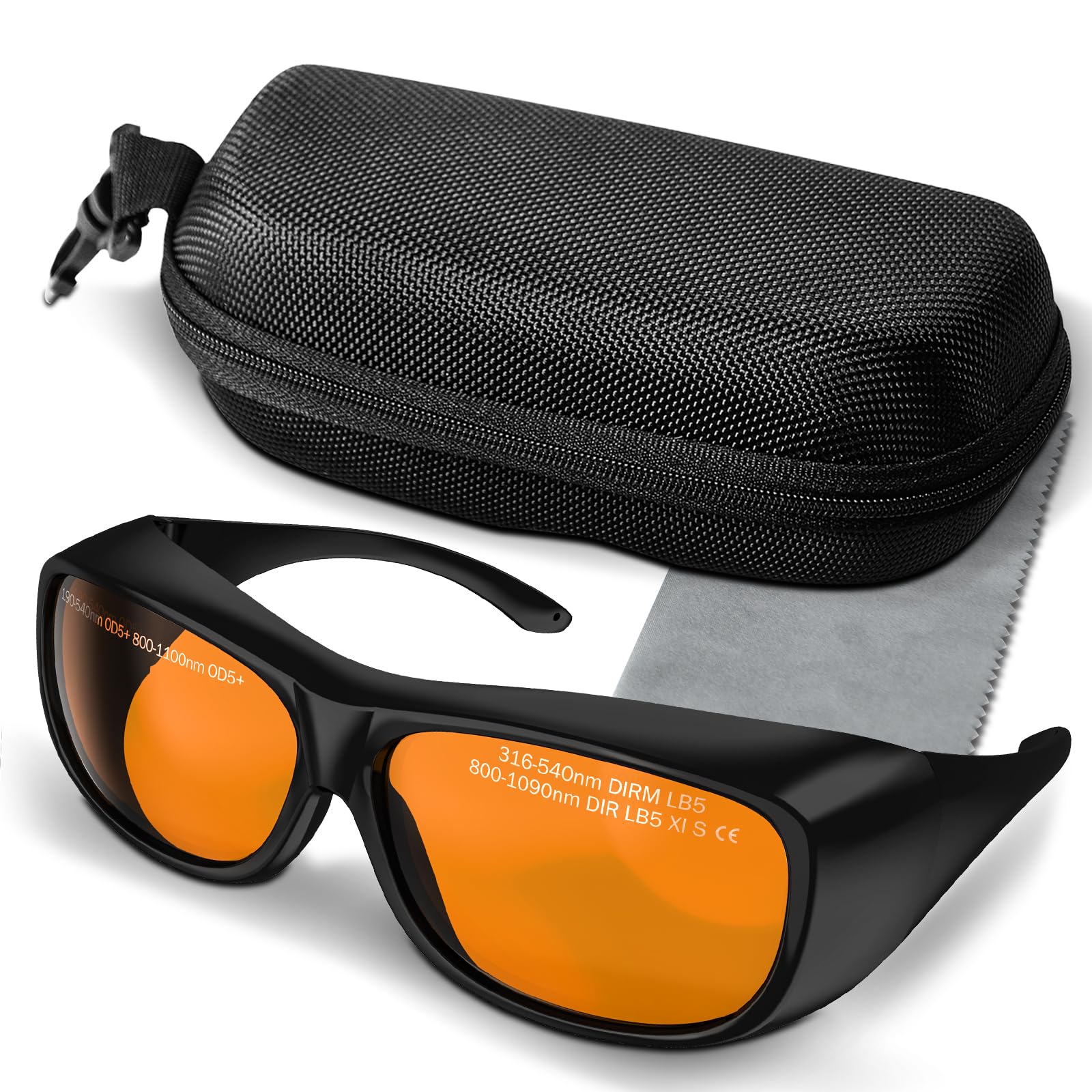
A two-band OD 5+ goggle built for European and American head shapes with a wide vertical view.
The two-window design is the point: this lens covers 190nm to 540nm then a second range of 800nm to 1100nm. That means it handles both the visible violet-blue band and the near-infrared range in one pair, so it can sit behind a device that runs outside the visible spectrum. The OD 5+ rating is a lower filter strength than the OD 6+ picks, but the two-band coverage is what makes it interesting.
The frame is shaped for bigger faces — the makers designed it around European and American head shapes, in soft PC material with a lightweight feel. It follows US FDA testing standards and CE EN207.
The one honest caveat: OD 5+ is a step below the OD 6+ lenses on this list, so if maximum light cut is your priority at close range, a higher OD wins. For a long shift or a big-head fit, though, the wide view and light frame are what keep it useful. Note the orange lens — meant for indoor laser work only.
for mixed lasers: you need both visible and near-infrared coverage and a larger fit that stays light on the face.
if need OD6+: you want the maximum filter strength — OD 5+ is a notch below the OD 6+ options here.
8. LaserPair Laser Safety Glasses

The highest filter strength on this list — OD 7+ across three separate wavelength windows.
If you want the strongest filter here, this is it. The lens is rated to 180-534nm at OD 7+, 740-900nm at OD 5+, and 900-1095nm at OD 7+. Those OD 7+ figures sit a whole notch above the OD 6+ and OD 5+ picks, so this lens cuts more light at those bands. One lens covers 355nm, 405nm, 532nm, 740nm, 808nm, 980nm, and 1064nm.
The frame is a wrap-around TR90 build with flank ventilation, so it protects from the sides while letting air move — useful during a long session. It is also certified by DIN CERTCO to EN207, and it fits over prescription glasses. Owners call it a comfortable pair that stays put, and the OD 7+ coverage justifies the price.
The honest trade is optical clarity. A wrap-around this strong dims the view, and the optical quality is where opinion splits — some find the lenses clear, others notice a slightly distorted laser line. VLT sits at 23%, the darkest on this list, so plan for a dimmer view of your work surface.
specific wavelength fit
- OD 7+ at 180-534nm and 900-1095nm — the highest filter strength on this list
- Covers 355nm, 405nm, 532nm, 740nm, 808nm, 980nm, and 1064nm
- Wrap-around TR90 frame with flank ventilation and over-glasses fit
- DIN CERTCO certified to EN207
narrow application
- 23% visible light transmission — the darkest lens here
- Optical clarity splits opinion, so precision work needs a test first
- Do not wipe the frame with alcohol or alcohol-based disinfectant
for 534nm lasers: laser work that needs the strongest filter strength and side coverage, where a dimmer view is acceptable.
for broad use: you need bright, undistorted vision for close work — the 23% transmission and optical variance are real.
9. Professional Laser Safety Glasses
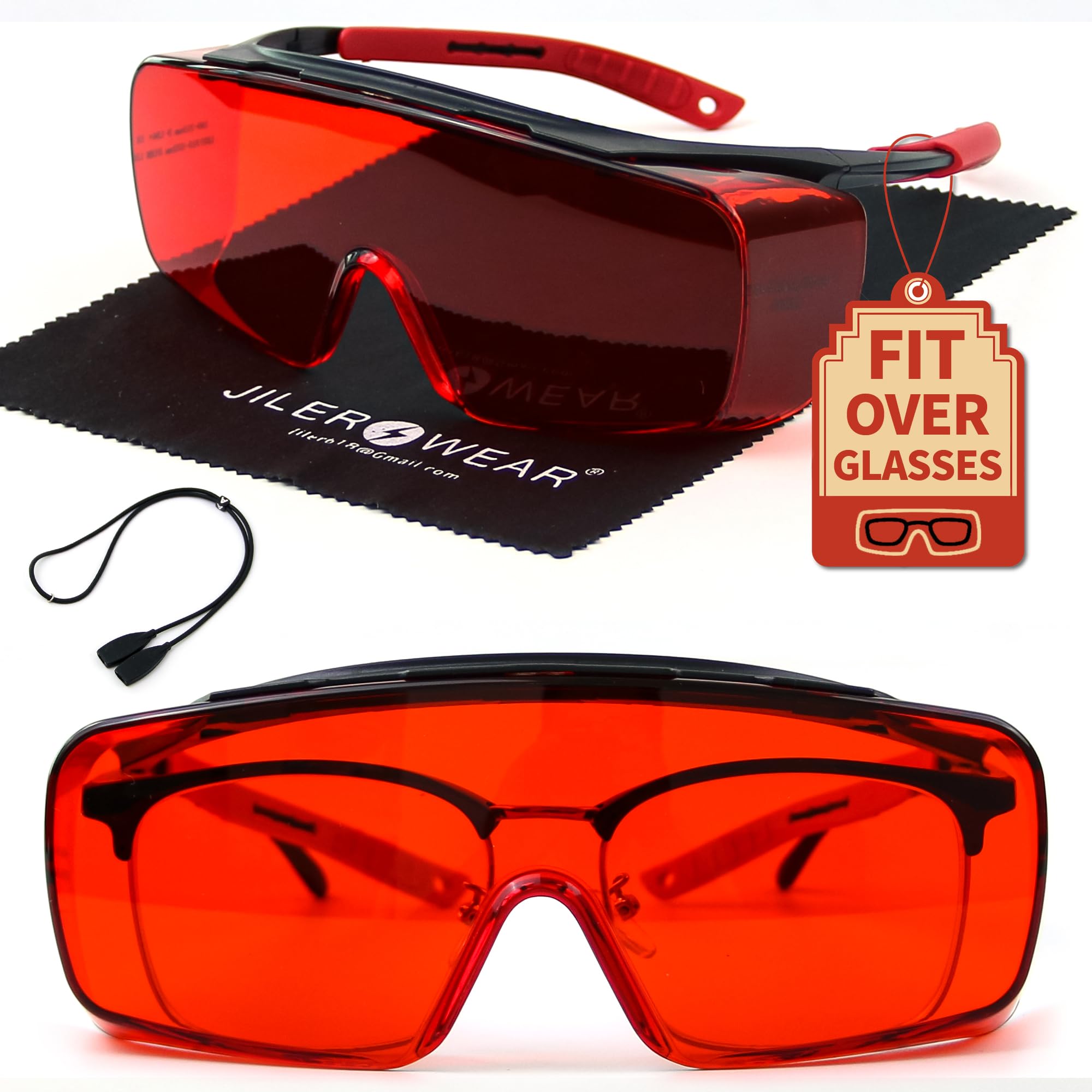
A two-band fit-over goggle that slides cleanly over your prescription specs without forcing a swap.
This one was built for the glasses-wearing technician. The two windows run 180nm to 540nm then 750nm to 1100nm, so it covers the visible violet-blue-green band and the near-infrared range in one lens. Fit over prescription frames is the whole point — owners confirm it slides on cleanly with the specs still comfortable underneath.
What wins people over here is the over-glasses fit — it does not pinch the frames underneath and stays put through a session. Eye protection and overall quality both land on the positive side, and the pair is built by JILERWEAR to the same professional standard as its other goggles on this list. Light at 3.88 ounces, it is one of the easier pairs to wear through a long working stretch.
Compare it with the LaserPair above and it is a narrower filter — OD 7+ at the broad ranges versus a full-spectrum block — but it wins on comfort and the clean over-glasses fit. The honest note: it does not reach 1064nm the way the dedicated long-range goggles do, so if 1064 is your target, look higher up this list.
for UV-visible: glasses wearers who want a light, professional goggle that covers visible and near-infrared ranges over their frames.
if style critical: you specifically need 1064nm coverage — this lens stops short of that band.
Know the Specs
Wavelength range in nanometers
A lens only protects the wavelengths it was built for, and those are written in nanometers — billionths of a metre. A pair rated for 190nm to 490nm blocks violet and blue light; it will not necessarily cover the infrared end some hair-removal devices run at, often 800nm to 2000nm. Check your device’s own figure against the lens range before you trust it.
Optical density (OD) and visible light transmission (VLT)
Optical density (OD) is a rating of how strongly a lens shuts out laser light at a given wavelength (the color of the laser beam). A higher number means a stronger filter, so OD 7+ cuts more than OD 6+, which in turn cuts more than OD 5+. Visible light transmission (VLT) is the flip side: a percentage telling you how much ordinary light gets through. Higher VLT means a brighter, clearer view; lower VLT means a darker room but more blocking. Read the two values together to judge how a lens actually feels and performs.
Common Questions
Will these glasses work with my home IPL hair removal device?
What does OD 6+ mean and why does it matter?
Do I need a different pair for a laser hair removal device than for a hair removal clinic session?
Can I wear these over my prescription glasses?
What wavelengths do I need for hair removal protection?
How long do these laser safety glasses last?
Will the room look dark when I wear them?
Are the certification labels real protection?
Can I use one pair for both laser and red light therapy?
What is the difference between OD 5+ and OD 7+ goggles?
The Bottom Line
For most people shopping for the best laser hair removal glasses, the winner is the FreeMascot New Professional OD 6+. Its OD 6+ filter on the 190nm-490nm band gives you the balance most home users need: solid protection and a view you can still read. If you need to see through your prescription frames mid-session, grab the 190nm-490nm OD 6+ UV Violet & Blue pair, which fits over your glasses. For one broad-spectrum lens that covers hair removal plus red light therapy, reach for the FreeMascot Professional 190nm-2000nm. One nudge worth making: if you want the strongest filter on this list, the LaserPair 200-534nm and 740-1095nm pair carries the highest OD rating at 7+, so it earns its place as the step-up option.
How we choose
We do not accept paid placement. Every pick is matched to a real buyer and a real use-case; we do not hands-on test units.
Sources
Specifications: manufacturer listings and product documentation. Review insights: verified customer reviews, as of November 2026. Pricing: not shown on this page (it changes often); check the current price via the retailer link.
As an Amazon Associate, Tactical Gear Guy earns from qualifying purchases. This does not affect which products we feature.