Specs are compiled from manufacturer listings and verified buyer reviews and can change over time — please confirm the key details on the product page before buying.
Most pulse oximeters are built for grown-up fingers, and that is exactly why readings on a child go sideways. A clip sized for an adult thumb slides, rocks, and lets light leak in, so the number on the screen wobbles. The fix is a small finger chamber that holds a thin finger steady enough to return a clean number in one try. Every pick here is judged on one test: does the chamber genuinely fit a child’s finger, and does it read without a fight?
This guide is built by comparing the manufacturers’ published specifications and the patterns across verified customer reviews, so you get each pick’s real strengths and trade-offs instead of marketing spin.
Each pick is weighed on chamber size, battery type, and display layout for a real bedtime check, so you can choose once instead of guessing. This breakdown of the kids pulse oximeter covers fit, battery, and screen so you can pick once and stop shopping.
Top Picks


How To Choose The Best Kids Pulse Oximeter
The single question that decides everything: will the clip hold your child’s finger without slipping? Everything else — battery, screen, memory — is a bonus layered on top of that fit. Get the fit wrong and even a perfect sensor returns a number you cannot trust.
Finger chamber size comes first, before anything else
A chamber that is too wide lets the finger shift mid-reading. When the finger moves, the light sensor loses its path through the nail bed and the display either stalls or jumps around. Look for a stated finger thickness range where you can find one, and treat a “fits all ages” claim as a starting point rather than a guarantee. Newborns and toddlers have very different finger geometry from a seven-year-old, so a chamber tuned for small hands is worth more than a chamber tuned for everybody.
The reading needs a still hand — build in a pause
Oxygen sensors need a few seconds of stillness to lock on. Most of these devices want eight to ten seconds of a steady finger. A silicone pad inside the clip helps keep the finger from drifting, and a soft cushion is a real comfort difference on a small thumb. The practical trick: start the reading while your child is distracted, not mid-protest.
Battery type shapes how the device lives in your house
Two AAA batteries are the common setup and usually arrive included. That means a spare pair in a drawer brings it back to life in seconds. Rechargeable packs with a USB Type-C port remove the battery hunt but tie you to a charger. Neither is wrong — pick based on whether you keep spare AAAs around or a charging cable near the bedside.
Display layout matters with a moving hand
A screen that rotates or offers several orientations lets you read the number from the angle the hand actually is, not the angle you wish it were. Bright OLED panels read better in a dim bedroom. Larger red digits read better in daylight through a car window. Note that one owner-friendly feature matters more on a child’s device than on an adult’s: a battery door with a locking design, so curious small hands cannot get at the cells.
Side-by-Side Comparison
| Model | Best For | Battery Life | Display | Power Source | Amazon |
|---|---|---|---|---|---|
| AccuMed CMS-50D1★ Best Overall | First-time buyers wanting a proven all-rounder | 32 hours | Auto-rotating LED | 2 AAA (included) | Amazon |
| Roscoe Medical POX-ROSBudget Champion | Big red digits read at a glance | — | Large digital LED | 2 AAA (included) | Amazon |
| VOLUETH A350Compact Pick | Slim fingers and shared family use | 40 hours | OLED | 2 AAA (included) | Amazon |
| Alecaremed YM601 | Tracking trends with saved readings | 60 hours | Large color screen | 2 AAA (included) | Amazon |
| Kolapuls PUOX-A | Ditching disposable batteries | 18 hours | Auto-rotating OLED | Rechargeable Type-C | Amazon |
| CRFISH OX-838 | Little ones who like an animal theme | 10 days | OLED, 6 layouts | Rechargeable Type-C | Amazon |
| orynxusy PandaPulse | Saved readings plus a panda case | 48 hours | Bright TFT | 2 AAA (included) | Amazon |
| Amemo Pediatric | Sleep and exercise monitoring with alarms | 24 months | OLED with waveform | 2 AAA (included) | Amazon |
| Zacurate 10430P-W | Newborns and the smallest fingers | 30 hours | OLED, 6 layouts | 2 AAA (included) | Amazon |
Detailed Reviews
1. AccuMed CMS-50D1 Fingertip Pulse Oximeter
Our pick — 4.5+★ from 750+ verified ratings; the strongest balance of quality and price.
The proven all-rounder that reads a child’s finger in eight to ten seconds flat.
Here is the pick that earns the top slot on consistency rather than novelty. AccuMed states this clip fits all finger sizes from kids above four years old up to adults, and it returns a blood oxygen and pulse reading in eight to ten seconds. That range is the whole reason it lands first: one device covers a four-year-old today and a ten-year-old in a few years, so you are not re-buying as hands grow. The 32 hours of continuous runtime from two included AAA batteries means a spare pair in a kitchen drawer covers you for months of bedtime checks.
What wins people over is the build and the daily usability. The auto-rotating LED display flips between portrait and landscape by sensing your hand position, so the number lands upright no matter how your child holds it — a small thing that saves a lot of squinting. The included travel case and lanyard keep it protected in a gym bag or backpack, and at 50 grams it disappears in a pocket. The crowd consensus here is strong: 4.5+ stars across 700+ ratings, with accuracy and clarity the recurring themes in the feedback.
The honest catch is that this is an adult-first design that happens to reach down to kid sizes, not a chamber purpose-built for a two-year-old’s thumb. The clip can drift on a very small, restless finger, and the manufacturer is clear this is a sports and aviation reference device rather than a medical instrument. A few buyers also find the reading pace slower than they expected. Neither is a reason to walk away — it is a reason to know who this suits.
What earns it first place
- Fits kids above four years old through adult fingers with one clip
- Eight to ten second readings with auto-rotating portrait or landscape display
- 32 hours of runtime on two included AAA batteries
- Travel case and lanyard in the box, 50 grams on the move
Where it asks for care
- The clip can slip on a very small, wriggling finger
- Reading pace feels slower for some owners
- Built as a sports and aviation reference device, not a medical monitor
Go with this one if: your child is four or older and you want a single clip that will keep fitting as hands grow.
Pass it by if: you need a chamber built specifically for a toddler or newborn’s smaller thumb.
2. Roscoe Medical Finger Pulse Oximeter
The one with digits big enough to read across a dim bedroom without your glasses.
You get a reading you can see across the room with the Roscoe, because its big digital LED shows oxygen saturation and pulse rate in large red digits. A battery life indicator means it won’t die mid-check. It runs a 10-second check, ships with two AAA batteries and a wrist lanyard, and backs it with a 12-month warranty against defects. It also measures smaller than the larger-bodied AccuMed clip — at 2.25 x 1.25 x 1.25 inches versus the AccuMed’s 3 x 1 x 2 inches — and at 1.6 ounces it sits 0.16 ounces lighter than the AccuMed’s 1.76 ounces, which matters when you are holding a small hand still.
The ergonomic claim deserves a plain read. Roscoe says the clip accommodates all finger sizes, so kids and adults can share it, and the 10-second pulse and oxygen check is quick. The one-button operation means no menu to hunt through in the dark. That simplicity is the real appeal for a parent who just wants a number now.
Here is the trade-off you should hear plainly: this is the most-discussed unit on the list and the discussion is split. Some owners find it reliable and accurate; others hit units that will not turn on or give readings they do not trust, and the spring clip has drawn durability complaints. Treat it as a value pick with a warranty backstop, and set expectations that a tiny fraction of units arrive imperfect.
What it does well: large red digits plus a battery indicator make it the easiest screen to read quickly, and the 12-month warranty softens the value-tier gamble.
Reach for it when: you want the biggest, brightest digits and a warranty behind a budget-friendly purchase.
Look elsewhere when: you want the most consistent fit and build feedback, where the AccuMed leads.
3. VOLUETH New Version Fingertip Pulse Oximeter
A chamber engineered for slim, petite fingers, with the cushioning to prove it.
Most of these devices shrink an adult clip and call it kid-sized. VOLUETH actually builds a smaller, lightweight finger chamber for slim and petite fingers, and lines it with a soft medical-grade silicone pad so the fit is snug without pinching. That pad is the feature that separates it — a gentle seal keeps a small finger from drifting, and a steady finger is what a reliable reading depends on. The OLED screen returns SpO2 in eight seconds, and 40 hours of battery life from two included AAA cells keeps it ready for a while between changes.
The 4-in-1 framing is worth spelling out in everyday terms. Beyond blood oxygen and heart rate, it also reports respiratory rate and perfusion index — the perfusion index being a rough measure of blood flow at the fingertip — plus a pulse waveform you can glance at. For a parent who wants a little more context than one bare number, that is useful. It is built to be shared around the house or packed for travel.
Set your expectations on feedback volume: this is a newer listing with a light review trail, so the track record is shorter than the veterans on this list. The early read is positive on accuracy across both small and large fingers and strong on build quality, which is a good start, though a longer history would tell you more. As with all of these, it is a sports and aviation reference device, not a medical instrument.
The silicone difference: a soft medical-grade pad inside a petite chamber is what makes repeated readings on a small hand calmer and steadier.
The honest caveat: a newer listing means a shorter ownership record, so you are trusting the early accuracy and quality feedback rather than years of it.
Fits best for: a household with slim fingers that wants one cushion-lined device the whole family can share.
Think twice if: you would rather lean on a long-established record than a newer model.
4. Alecaremed YM601 Pulse Oximeter

The trend-tracker that remembers twenty readings so you never write a number down.
Nurse visits and pediatric check-ins often ask “what were the readings yesterday?” This is the pick that answers it. The YM601 saves each reading automatically after a 30-second countdown, shows your last five the moment you power on, and lets you scroll back through up to 20 saved readings to spot a pattern. For anyone logging a child’s oxygen over a few days, that memory bank replaces the notebook. It also brings a bright, large screen that shows oxygen level, pulse rate, perfusion index, pulse waveform, and battery life all at once.
The battery story is the best on this list by a wide margin. Alecaremed rates it at 60 hours of runtime, which beats the AccuMed CMS-50D1’s 32 hours on the same two AAA cells. It also shuts itself off eight seconds after you pull your finger out, so the battery stretches further in a house where the device sits in a drawer between uses. The soft, plush silicone cushion creates a gentle seal without pinching, sized for small fingers, and the cute green housing feels approachable rather than clinical.
The recurring gripe is reliability at the edges — a minority of buyers find the readings inconsistent or the unit unreliable over time, and reading speed draws mixed notes, with some waits stretching past ten seconds. It is a capable device that leans on its memory and battery rather than a spotless reliability record, so buy it for the tracking features and keep the return window in mind.
Why it earns a spot
- Stores up to 20 readings and shows the last five on power-up
- 60 hours of runtime on two included AAA batteries
- Large screen shows SpO2, pulse, perfusion index, waveform, and battery together
- Plush silicone cushion sized for small fingers
What to weigh
- Some buyers report inconsistent readings over time
- Reading speed draws mixed feedback, occasionally past ten seconds
Best for logging: parents who want a saved history of readings without keeping a written chart.
skip it if: a spotless reliability record matters more to you than a memory bank and 60-hour battery.
5. Kolapuls Rechargeable Fingertip O2 Monitor

No disposable batteries — plug in a Type-C cable and it is ready again.
If your drawer is a graveyard of dead AAAs, this is the one built to escape it. Kolapuls uses a Type-C fast-charging design with a built-in rechargeable battery, so there is no cell to swap and no last-minute hunt for a spare. The chamber is engineered for slender fingers in the 5 to 16 mm thickness range, delivering a snug fit for thin fingers and smaller hands. One button does everything: insert a finger and the SpO2 and pulse readings arrive within seconds, and it powers off by itself after inactivity to save charge.
The screen adds a genuinely useful touch for a wriggling hand. The bright OLED automatically adjusts orientation to your line of sight, so the number stays readable at whatever angle your child holds their finger. There are also cute animal-themed DIY stickers and an anti-lost lanyard in the kit, which is a small thing that makes a wellness device feel less scary to a child. It is rated at 18 hours of battery life.
The catch is the same one that comes with any rechargeable plus a fresh listing: the 18 hours is the shortest runtime here, and the review record is still small, so the long-term picture is short. There is also a spec wrinkle note in the listing itself on battery count. Set against that, the Type-C convenience and rotating OLED make it an easy traveler to live with.
Why it travels well: Type-C charging removes the battery hunt, and an auto-rotating OLED keeps the number upright from any angle.
Pick it for: a diaper bag or carry-on where a charging cable beats a spare battery every time.
Consider a AAA model instead if: you want the longest runtime between top-ups or a longer ownership record.
6. CRFISH Children Digital Fingertip Pulse Oximeter

Bunny graphics and a caregiver-facing screen — built to win over a nervous child.
Getting a squirming child to sit still for a reading is half the battle, and this one attacks that directly. The pink housing is covered in cute bunny and heart graphics, and it ships with a cartoon key chain storage bag, a long lanyard, and DIY stickers, all aimed at making the check feel less clinical. It is designed for infants and children under 14 and charges over Type-C with a built-in 800mA/h polymer lithium battery, so it is ready the moment it comes from the start.
The patented multi-directional display is the smartest feature here. You get six different layout options at the push of a button, and you can flip the OLED from facing the child to facing you, the caregiver. Add a plethysmograph — a waveform that shows the amount of blood flow for extra confidence — and you get a clearer read on whether a number is trustworthy. The one-button operation keeps it simple.
Set expectations honestly: this is a low-volume listing with a modest rating, so the ownership record is thin. It is best treated as the fun-first choice for a child who resists the check, not the accuracy-first pick. The 10-day battery rating is generous on paper but reflects a lithium pack rather than a swappable AAA pair.
The kid-magnet angle: bunny graphics, stickers, and a caregiver-facing flip screen do real work getting a reluctant child to hold still.
The honest trade-off: a thin track record means you are betting on the child-friendly design more than a long ownership history.
It is the right call when: your priority is getting a resisting child to cooperate with the check at all.
It is not the pick when: you want the deepest accuracy record, where the Zacurate and AccuMed lead.
7. orynxusy Pulse Oximeter with Panda Case
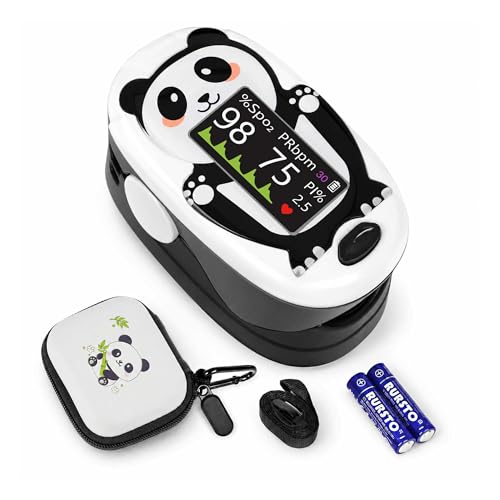
A compact chamber, a bright TFT screen, and a panda case that softens the whole ritual.
The small-finger fit is the headline here. Orynxusy builds a compact fingertip chamber sized for smaller hands, and pairs it with a cute panda look to make it friendlier. Results land in eight seconds on a bright TFT screen — TFT being the sharper, higher-contrast kind of LCD panel — and stock readings climb quickly with one button. A soft silicone padding runs inside the clip for a secure yet gentle fit, easing the pressure a firm clip puts on a little finger.
Battery and memory go beyond what the price tier suggests. It runs 48 hours on two included AAA batteries, and it stores up to 20 readings with an alarm and adjustable brightness in the highlight set. For a parent tracking a child’s oxygen across a stretch of days, that saved history plus a dimmable screen in a dark bedroom is a genuine convenience. The kit includes a lanyard, a manual, and a one-year manufacturer warranty.
Be clear on one point: this is a newer listing with a limited review trail, so the long-term picture is unproven. It is a premium-leaning option on features rather than on a long record of owners. Buy it for the fit, memory, and brighter screen rather than the reassurance of years of history.
Where it stands out
- 48 hours of runtime on two included AAA batteries
- 20x memory plus alarm and adjustable brightness
- Soft silicone padding in a compact, small-finger chamber
- One-year manufacturer warranty
What to keep in mind
- Newer listing with a limited ownership record
- Premium-leaning features rather than a long history of owners
Choose it for: the combination of a small-finger chamber, 20-reading memory, and a dimmable bright TFT screen.
Look past it for: a long track record — this one is buying features, not history.
8. Amemo Pediatric Pulse Oximeter
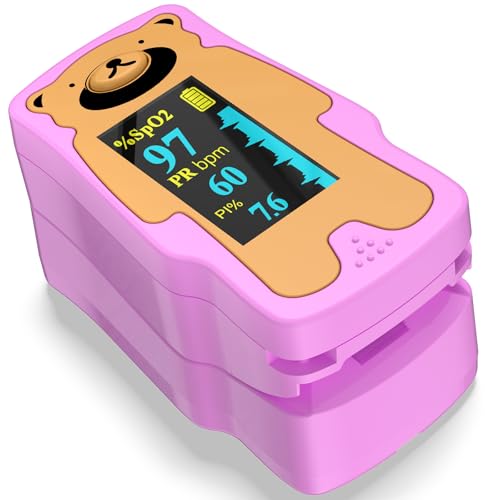
A spring-clip design with alarms and silicone grip, made for continuous monitoring.
This is the pick for anyone who wants the reading to keep running while the child moves or sleeps. Amemo pairs a spring-clip design with internal medical-grade silicone to keep the device in place, so it can monitor blood oxygen and heart rate continuously during exercise or sleep. You can set alarm values for oxygen and heart rate, and it will sound if levels wander outside them. For a child over two, the manufacturer recommends measuring the big toe for the most accurate result; for one-to-two-year-olds it suggests the big toe too.
The little safety details stand out. The battery compartment has four locking positions, so a curious child cannot pop the cover and get at the cells — a thoughtful touch on a kids’ device. Measurement arrives in as little as three seconds, and the screen shows SpO2, pulse rate, pulse intensity, a waveform, and a battery level together, then shuts off ten seconds after the finger is removed. The package includes a carrying case, two batteries, a lanyard, and a manual.
What to weigh honestly: the feedback on this unit is genuinely split, with functionality and value drawing mixed reviews, so it is not the surest bet on this list. The depth of its alarm and continuous-monitoring feature set is real, but the reliability record leans on that feature list rather than on a strong consensus. Buy it for the monitoring features and the locking battery door.
The safety detail that matters: a four-locking-position battery cover makes it much harder for small hands to reach the cells.
The split verdict: owners disagree on how reliably this one performs, so weigh the strong monitoring features against a mixed reliability picture.
The one to grab for: continuous monitoring with adjustable alarms and a child-safe battery door.
Think it over if: you want the strongest consensus, since feedback here is divided.
9. Zacurate Cute Fingertip Pulse Oximeter
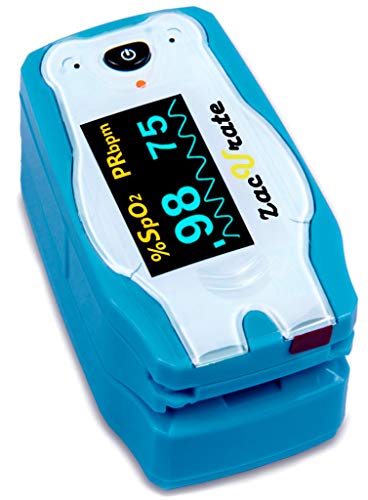
The small-finger specialist that owners trust most on newborns and the tiniest hands.
You can check fit before you buy with the Zacurate, because it names the exact size that matters: a recommended finger thickness of 0.2 to 0.6 inch (5 to 16 mm). If you can picture your baby’s thumb against that range, you know instantly whether this fits. That specificity is why it takes the newborn slot. One-button operation returns SpO2 (blood oxygen) and pulse rate in seconds, and the OLED (organic light-emitting diode) display offers the same patented multi-directional layout — six orientations at the push of a button — so you can read the number or flip it toward you.
The track record is the reason it earns its place. Owners rate the quality and functionality highly and return to it for newborns specifically, with repeated comments that it works well on the smallest fingers. Owners also report readings on small fingers that track closely with the hospital equipment they use. A plethysmograph shows blood flow for extra confidence, and the kit is loaded — two AAA batteries included, a silicone cover, a pouch to protect it from dirt and damage, and a lanyard for carrying.
The honest note is on reading speed, where feedback is split: fast for many, slower for others, and a few find it takes a while to settle on a number. It also lists a sapphire blue color, so if you want pink this is not it. Backed by a 12-month warranty plus an optional free 12-month extension and USA-based phone support, it is the most reassuring newborn pick here.
What the newborn pick gets right
- Stated small-finger fit of 0.2–0.6 inch (5–16 mm)
- Six-orientation OLED with one-button operation in seconds
- Plethysmograph waveform plus silicon cover and pouch in the box
- 12-month warranty with optional free 12-month extension and USA phone support
Worth a second thought
- Reading speed draws split feedback, slower for some owners
- Sapphire blue color only if you want to match a nursery
Top choice for: newborns and the smallest fingers, backed by the most reassuring warranty and support.
One to skip for: a specific color match — this comes in sapphire blue, not pink.
Know the Specs
Finger chamber size and fit
This is the spec that decides whether a reading is stable. A chamber sized for slim and petite fingers, or a stated range like 0.2–0.6 inch (5–16 mm) thickness, keeps a small finger steady so the light sensor has a clean path through the nail bed. An adult chamber that happens to reach down to a child can let the finger drift, and a drifting finger means a wobbly number. Match the chamber to the hand and the reading settles.
Battery life and power source
Two AAA batteries offer a fast swap — a spare pair brings the device back in seconds — and the included batteries mean it works straight from the start. Rechargeable Type-C packs remove the battery hunt but tie you to a charger and cable. Battery life itself is quoted in hours of continuous use or, on some listings, in days of standby. For a bedtime device, pick whichever power source you can keep topped up without thinking.
SpO2, pulse rate, and perfusion index
SpO2 (blood oxygen saturation) is the headline number, measured as a percentage. Pulse rate is the heartbeat count per minute. The perfusion index is a rough measure of blood flow at the fingertip, and a waveform shows the pulse in real time. Those extras help you judge whether a number is trustworthy rather than just reading one bare figure. A plethysmograph — the waveform display — gives you a second signal that the sensor is picking up a clean pulse.
Display layout and readability
A rotating or multi-orientation screen lets you read the number from the angle the hand actually is, not the angle you wish it were. Larger red digits read better in bright daylight; bright OLED reads better in a dim bedroom. Adjustable brightness helps further. On a kids’ device, the display details matter more than on an adult’s, because you are often reading it one-handed while holding a moving child.
Common Questions
Will an adult pulse oximeter work on a child’s finger?
How do I get a stable reading on a wriggling child?
Are AAA batteries or a rechargeable pack better for a kids’ device?
What is a perfusion index and does it matter on a kids’ oximeter?
Is a pulse oximeter for infants the same as a medical-grade monitor?
Can a child’s small finger give an inaccurate reading?
How long does a kids oximeter battery actually last?
Is the battery door a safety concern on a device for kids?
Does a pulse oximeter work on a newborn?
Will a bright screen wake a sleeping child during a check?
The Bottom Line
For most families, the kids pulse oximeter to beat is the AccuMed CMS-50D1, because it fits four-year-olds through adults in one clip, returns a reading in eight to ten seconds, and runs 32 hours on two included AAA batteries. It is the one clip that grows with a child instead of being outgrown.
If you need the tiniest fingers covered — a newborn or infant — the Zacurate names the 0.2–0.6 inch range and backs it with a 12-month warranty plus optional extension. And if logging readings without a notebook matters, the memory bank on the Alecaremed YM601 keeps twenty saved, with 60 hours of runtime on top.
How we choose
We do not accept paid placement. Every pick is matched to a real buyer and a real use-case; we do not hands-on test units.
Sources
Specifications: manufacturer listings and product documentation. Review insights: verified customer reviews, as of November 2026. Pricing: not shown on this page (it changes often); check the current price via the retailer link.
As an Amazon Associate, Tactical Gear Guy earns from qualifying purchases. This does not affect which products we feature.