Specs are compiled from manufacturer listings and verified buyer reviews and can change over time — please confirm the key details on the product page before buying.
If your wall-mounted TV looks like a nest of black snakes dropping to the floor, an in-wall power kit is the fix — and the right one depends almost entirely on two things: whether your wall cavity is deep enough, and if you want a plug-in system or a hardwired one. This guide sorts that out fast. A quick note before we start: this list uses flexible, human-like matching for in-wall and recessed installation, meaning every pick is built to sit inside the wall behind a TV, but not every one is the exact model number you typed into the search bar — the nearest same-type kit serves the same purpose, and we tell you which is which.
This guide is built by comparing the manufacturers’ published specifications and the patterns across verified customer reviews, so you get each pick’s real strengths and trade-offs instead of marketing spin.
The short version: a plug-in kit plugs into an existing outlet with no electrician, while a hardwired unit ties into a circuit and needs a licensed hand. Either way, the cutout depth is the number that decides whether your wall cooperates at all, so check it before you buy anything on this list of the best in-wall tv power kit options.
Top Picks

How To Choose The Best In-Wall TV Power Kit
You are cutting a hole in drywall behind a television. That single fact makes three questions more important than any feature list: will the kit physically fit inside your wall, will it power everything you own, and can you legally install it yourself where you live? Get those three right and the rest is details.
Measure the cavity before you measure anything else
Walls have two skins of drywall on a stud frame, and the space between them is your working room. Standard interior walls usually run about 3.5 inches deep, but that is not guaranteed in every part of every house. Two picks here publish a minimum: the Mount-It! kit wants a cavity depth of at least 2.4 inches, and the Perlegear kit asks for at least 2.8 inches. Poke a wire or a straightened coat hanger through a small test hole before you commit, because a kit that will not sit flush is money wasted.
Plug-in harness or hardwired receptacle
A plug-in kit ships with a power cable that ends in a normal plug. You run it through the wall and plug it into the nearest wall outlet — no electrician, no breaker work, no permits in most cases. A hardwired kit, like the Legrand OnQ unit here, connects directly into an existing power source inside the wall. That gives you a cleaner permanent install, but it demands electrical work you may not be licensed to do. If you rent, or the outlet is close by, a plug-in kit is the simpler choice.
Count your cables, not your outlets
Power is rarely the bottleneck — one outlet runs most TVs. The pain point is low-voltage cable volume. HDMI, Ethernet, optical audio, and the soundbar feed all need to pass through the same wall cavity. Pick a kit with a genuinely roomy brush plate or pass-through opening, because a cramped opening turns a clean install into a fight with a cable that keeps sliding back into the wall.
Look for a real safety listing
An in-wall module sits inside a sealed cavity with no airflow, so the listing matters. ETL, UL, and RoHS all indicate the kit has been tested to standard for that placement. These words must appear in the manufacturer’s own documentation — if a listing is not printed in the specs, do not assume it is there.
Installation time is a real spec
Most kits on this list claim a job that finishes inside 30 minutes, and a couple say 20. That estimate assumes the cutout goes cleanly and the cavity is clear. A drywall saw, a cutting template, and a hole-saw drill attachment are the three tools that decide whether you hit that number or spend the afternoon patching.
Side-by-Side Comparison
| Model | Best For | Power Outlets | Included Cord | Install Type | Amazon |
|---|---|---|---|---|---|
| Mount-It! Triple Outlet Kit★ Best Overall | Triple-device living rooms | Triple outlet | 9 ft | Plug-in | Amazon |
| ZEXMTE Wall Cable Concealer KitBudget Champion | Budget-first installs | 20 amp/125 volt duplex | Cable not included | Screw-in | Amazon |
| Perlegear In-Wall Cable Management KitCleanest Cut | Dust-free drilling | Two power modules | 5.9 ft | Plug-in | Amazon |
| Legrand Wiremold Grommet Kit | Pro-brand simplicity | 2 power grommets | 6 ft | Plug-in | Amazon |
| ECHOGEAR TV Cord Hider | USB charging behind the TV | 2 AC + 2 USB-A | 6 ft | Plug-in | Amazon |
| DataComm Recessed Pro-Power Kit | Long-proven design | 1 receptacle | 6 ft ground | Hardwired | Amazon |
| Legrand OnQ USB Wall Kit | Flush USB outlet | 15A TR outlet + USB-A | — | Hardwired | Amazon |
| Made for Amazon In-Wall Kit | Fire TV owners | Upper + lower module | Included | Plug-in | Amazon |
| Sanus In-Wall Kit for TV & Soundbar | TV plus soundbar setups | Dual outlet + soundbar module | 6 ft | Plug-in | Amazon |
Detailed Reviews
1. Mount-It! in-Wall TV Cable Concealer Kit
Our pick — 4.5+★ from 650+ verified ratings; the strongest balance of quality and price.
Three outlets and nine feet of cord — this is the kit that powers the whole shelf, not just the screen.
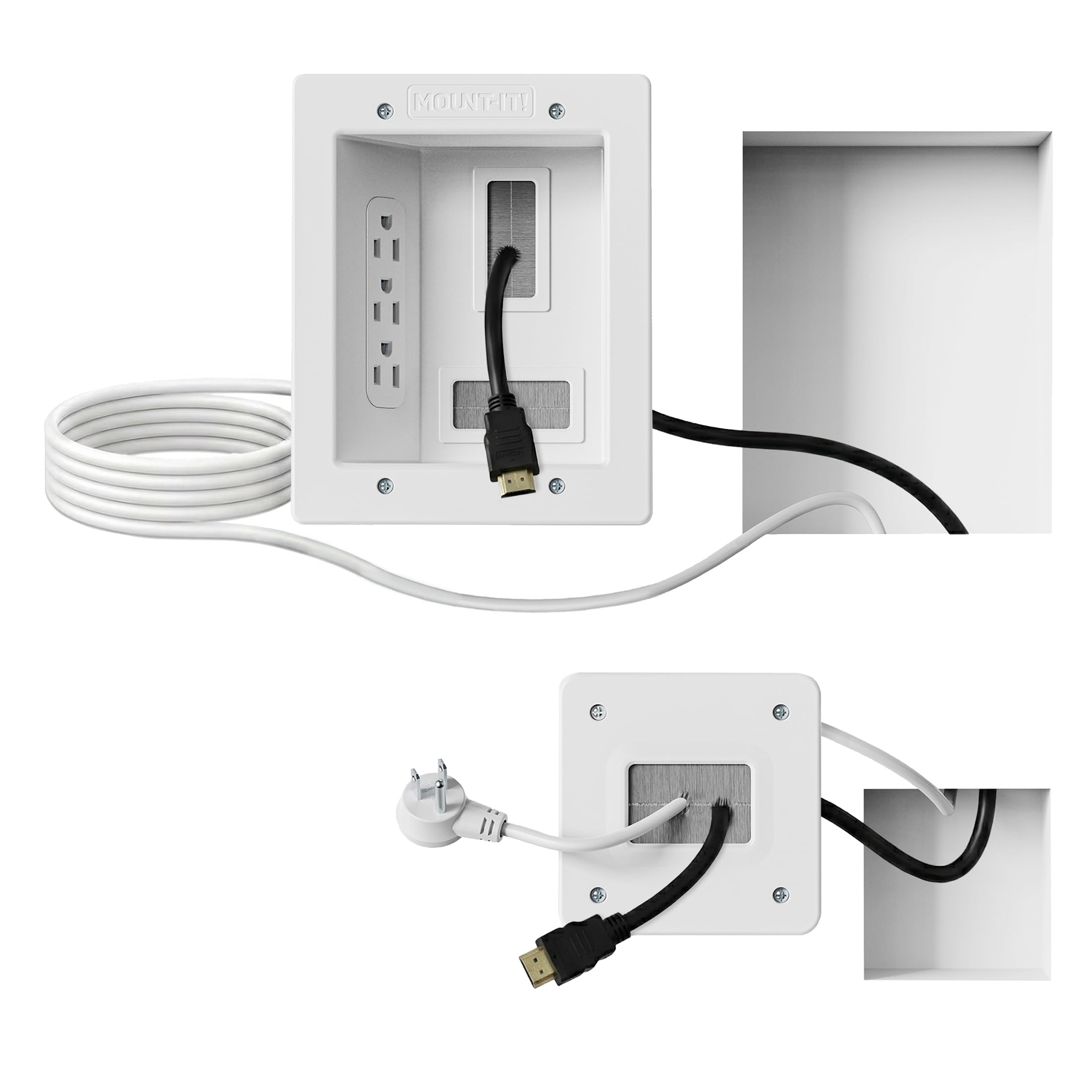
Most kits give you one or two power points and call it done. This Mount-It! unit carries a triple outlet behind a large 6.3″ x 7.9″ plate, so a TV, a streaming box, and a soundbar or LED strip all draw power from inside the wall on one clean face. The cord runs 9 feet versus the Perlegear kit’s 5.9 feet — which gives you real slack to reach an outlet around the corner or on the far side of the stud bay.
The setup is genuinely beginner-level and that is why it takes the top spot. It is a plug-in system, not hardwired, so no electrician and no breaker panel. The box includes a drywall saw, a cutting template, and step-by-step instructions, and the brand quotes a finish inside 30 minutes. Cutting the wall is the part that worries most buyers, and having the saw in the box removes the one shopping trip that stalls the job. The kit is ETL In-Wall Certified, meaning it has been tested for the no-airflow cavity behind drywall, and it holds 2.5 pounds in total.
What wins people over is how little friction the install creates — the ease of the job is the single thing owners bring up again and again, followed closely by how solid the plastic parts feel. The 2.4-inch minimum cavity depth is the number to check first, since standard 3.5-inch walls clear it but a shallow furred wall may not. Measure, then cut.
What earns its place up top
- Triple outlet feeds three devices from one recessed face
- 9 ft cord gives real reach across a stud bay
- Drywall saw and cutting template both in the box
- ETL In-Wall Certified for sealed-cavity placement
- Plug-in design skips the electrician entirely
What to measure first
- Needs a 2.4″ minimum cavity depth behind the large plate
- The 6.3″ x 7.9″ plate means a bigger drywall cutout
- No USB ports for a streaming stick
Go with this one if: you are powering more than a TV and want the longest cord here to reach a distant outlet.
Think twice if: your wall cavity measures under 2.4 inches deep, because the large plate and its recessed box need that room.
2. ZEXMTE Wall Cable Concealer Kit
The entry ticket to a wire-free wall, as long as you already own a length of electrical cable.
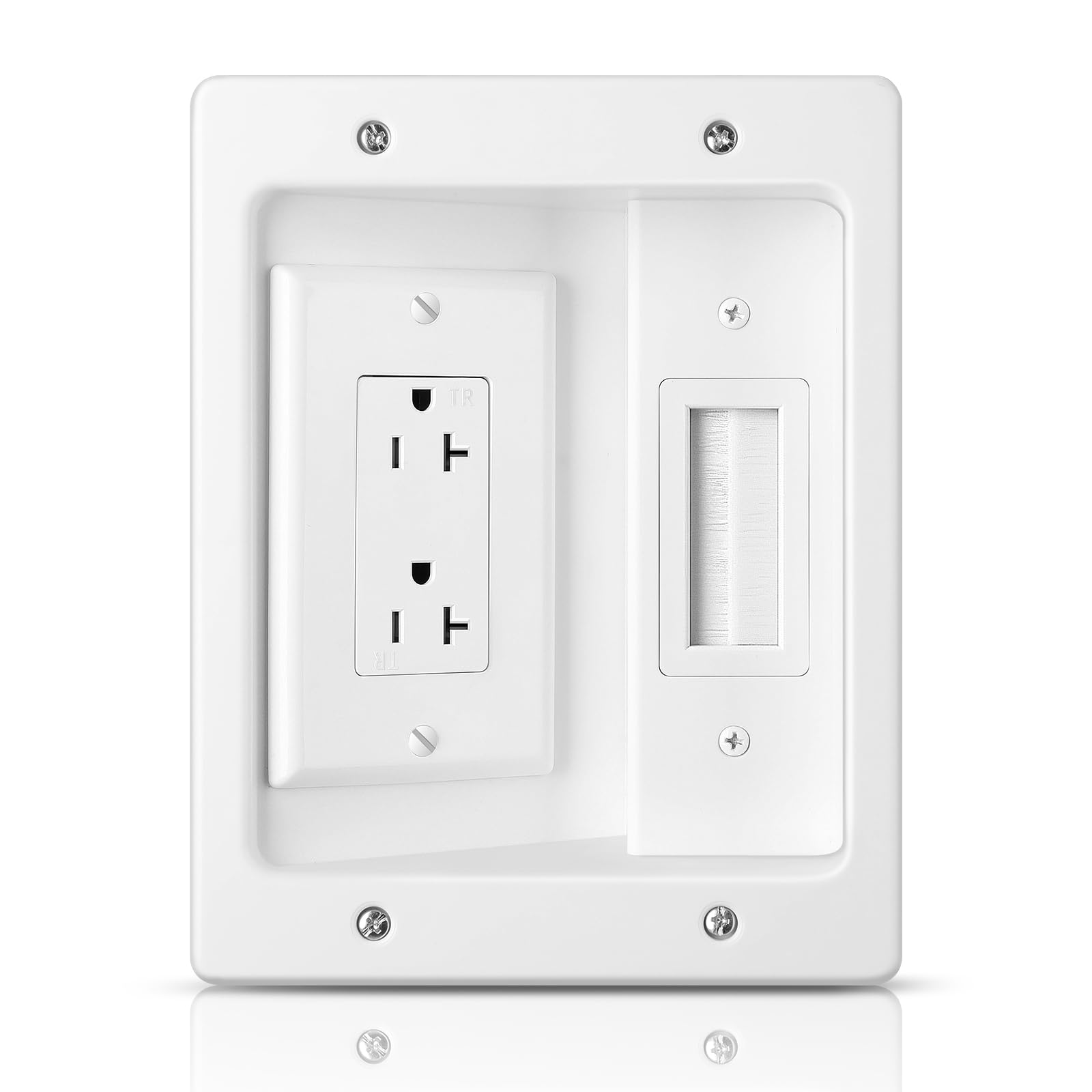
Read the fine print before you order this one: it ships as wall plates, a socket, an electrical box, a manual, and a cutting template — the electrical cable itself is not in the box. That is the trade for the lowest outlay on this list. If you already have cable on hand or you are comfortable buying a length, this gets you a recessed face with a 20 amp/125 volt duplex receptacle at the back of it.
The brush wall plate is the quiet hero here. It holds low-voltage cables in place so an HDMI lead cannot slip back into the hole and out of reach — a genuine annoyance in cheaper pass-through plates. The white finish is chosen to sit quietly against typical wall paint, and the whole thing mounts with clips rather than extra brackets.
Where this kit asks for patience is the paperwork. The instructions are the weakest link in the package and wiring the receptacle is the step people struggle with, so this is a pick for someone who has run a socket before or has a handy friend. The plastic-polycarbonate construction holds up fine, but treat this as a shell that needs your own cabling to complete it.
Money well spent: for a lean install where you already own the cable, the 20 amp duplex and the cable-catching brush plate give you more than the outlay suggests.
The honest catch: no cable included and thin instructions mean the job lands on your shoulders — factor in that time before committing.
Suits the confident DIYer: someone with spare electrical cable and a working knowledge of a duplex receptacle.
Not for a first-timer: if you have never wired an outlet, the missing cable and light instructions make this a harder start than the kits with a pre-wired harness.
3. Perlegear In-Wall Cable Management Kit
A hole saw and a dust bag — because the worst part of cutting drywall is what lands on your floor.
Every kit on this list asks you to cut a hole. This is the one that thinks about what happens next. A hole-saw drill attachment cuts a round, tidy opening, and a dust bag collects the scraps as they fall — so your living room floor survives the job. The brand quotes a 30-minute install, and the locking wings hold each module firmly against the drywall once it is seated.
Safety is well covered: the modules are UL and SGS certified and built from fire-resistant material, which is exactly the quality you want inside a sealed wall cavity. You get two power modules, the cables that link them, and a 5.9 ft extension cord. That cord is 5.9 feet versus the Mount-It! kit’s 9 feet — so check your outlet distance before you order.
The opening handles HDMI, Ethernet, and audio together, which covers a normal TV plus a streaming box. The honest trade-off is depth: this kit wants a wall at least 2.8 inches deep, the strictest published requirement on the list, so it is the one to verify most carefully before cutting.
The standout detail: the dust bag turns a messy drywall job into a tidy one, and the round hole-saw cut looks more professional than a freehand square.
Where it stops: that 2.8-inch minimum rules out shallow walls, and the 5.9 ft cord limits where the outlet can sit.
Reach for this if: you want a clean circular cut, less mess, and certified fire-resistant modules.
Look elsewhere if: your wall is shorter on depth than 2.8 inches or your outlet sits far from the TV.
4. Legrand Wiremold In-Wall TV Power and Cable Grommet Kit

Two grommets, one pre-wired harness, and a name that installers have trusted for years.
Wiremold parts are made to work with one another, and that is the whole promise here. Inside the box you get two power grommets joined by a 54-inch harness, a 6-foot power cord, and a hole saw. Install the top grommet behind the TV, the bottom one near the outlet, run the harness between them, and the power simply flows inside the wall. No hardwiring, no electrician — the brand quotes under 30 minutes and calls the design “plug and play.”
Low-voltage cable handling is where it shines. The grommet design lets HDMI and other component leads pass through as well as power, so a Fire Stick adapter and an HDMI feed both tuck away. The brand states it works with all brands of TVs, which keeps your options open if the screen gets replaced down the line.
The one honest caveat is the cost-to-what-is-in-the-box read. The value of the brand name is real, and the install is genuinely simple, but this is a lean kit compared with the triple-outlet options. If you want maximum outlets for the money, look at the Mount-It! pick; if you want a trusted name and a pre-wired harness that goes in fast, this delivers.
Best for the brand-loyal buyer: someone who wants a proven pre-wired harness and a fast, simple install.
Consider the alternative if: you need three power points or maximum outlets for the outlay — the lean two-grommet kit may feel light.
5. ECHOGEAR TV Cord Hider

Two AC outlets and two USB-A ports — charging a streaming stick without a wall wart floating behind the screen.
Charging is the angle that sets this apart. The face carries 2 standard AC plugs and 2 USB-A ports, so a Fire Stick, a Chromecast, or a phone on a shelf cable all draw power from the wall itself. No bulky adapter crammed into the cavity. The dual top outlet is deliberately spaced to swallow awkward plug shapes — right-angle cords and chunky adapters included.
The install kit is complete in the box: a wall template, a drywall saw, and a 6-foot extension cord with a low-profile plug. The cord’s low-profile end is a small detail that matters — it sits flush against the wall so the outlet does not push the furniture forward. The brush plate pass-through has a cable-catching design so the wall cannot swallow an HDMI lead, and the whole thing runs on a plug-in harness with no wiring required. The brand also quotes a US-based support team reachable seven days a week.
Fit is the one area that draws mixed feedback, so measure your cutout against the template before the saw goes in. That is a measure-first note, not a reason to walk away — the rest of the package, from the USB charging to the cable-catching plate, is well thought through.
The clever parts
- 2 USB-A ports charge streaming sticks without a wall adapter
- Dual top outlet spaced for bulky plugs
- Cable-catching brush plate stops leads sliding into the wall
- Drywall saw and template included
- Low-profile 6 ft extension cord keeps furniture flush
Worth measuring before you cut
- Fit draws mixed feedback, so check the template against your cutout
- No triple AC outlet, unlike the Mount-It! pick
- USB-A ports only, no USB-C
Pick it for the ports: this is the one for anyone who wants USB devices charged right behind the screen.
Skip only if: you need three AC sockets and are happy to pass on USB charging — otherwise the port set here is class-leading on the list.
6. DataComm Electronics Recessed Pro-Power Kit

The recessed pro-power design that much of the category has since copied.
Most recessed TV power kits on the market follow this DataComm layout, or something close to it. It is a hardwired kit, so it connects into an existing power source via Romex wire and a straight-blade inlet rather than plugging into a wall outlet. That is the professional path — a permanent feed that never crosses a visible surface. The low-profile plates are built to sit behind ultra-slim mounts and flat panels, and the mounting system works in multiple orientations.
It carries UL-listing and RoHS compliance, the two words that mean the module has been tested for sealed in-wall use and for restricted hazardous substances. You get the two electrical outlet boxes, a 6-foot ground extension cord, the building wire, a recessed plate with a straight-blade inlet, a recessed plate with power, and wire nuts — the full run, in one box.
This is the pick for an installation that will not move for years, and it rewards someone comfortable tying in to a circuit. If you are renting, or you want to avoid electrical work entirely, the plug-in picks are the smarter move. But for a permanent, code-conscious install, it sets the standard the other picks are judged by.
Why it lasts: UL-listed, RoHS-compliant, hardwired into the circuit — a permanent install built for years of service, not a weekend fix.
The clear limit: hardwiring means circuit work, which puts it out of reach for renters and anyone avoiding electrical labor.
Consider it for: a permanent home-theater build where a hardwired feed and a low-profile plate are exactly what you want.
Think twice if: you rent, or you would rather not touch a circuit — a plug-in harness is the better fit.
7. Legrand OnQ In-Wall Cable Management Kit HT21USBWHV1

A tamper-resistant 15A outlet with USB Type-A ports, set flush into the wall so nothing juts out.
This is the premium hardwired option, and it does two jobs at once. The recessed plate holds a 15A tamper-resistant outlet and USB Type-A ports, so a soundbar or streaming device charges right at the wall with nothing protruding. The tamper-resistant shutters matter if a child is ever near the set — the outlet stays protected when nothing is plugged in. Legrand also states the design accepts all TV power plugs, right-angle cords and bulky adapters included.
Installation is a hardwired job: you get a recessed wall plate, a junction box, and a 15A TR outlet with its plate, and the instructions spell it out. The unit has to be connected to an existing power source, which means circuit work — the brand is upfront that this is not a plug-and-play kit. The plates measure 7.13 inches by 5.38 inches, so plan a cutout sized for the housing.
What owners appreciate most is the build — the quality of the parts comes up first, then how straightforward the install goes once you are into it. If you want a hardwired finish with USB on the face, this is a strong fit; if plugging in a cord is the whole point of the project, look to the plug-in picks instead.
Right for a hardwired USB setup: anyone who wants a flush 15A outlet plus USB without a plug-in cord on show.
Not for a plug-and-play job: it must be hardwired to an existing source, so budget for electrical work if that is not your skill set.
8. Made for Amazon In-Wall Power and Cabling Kit

Designed around Amazon’s own TVs, but there is no reason it cannot feed any screen on your wall.
The name is the giveaway: this kit is built for Fire TVs but works with other brands too. It is a plug-in harness rated ETL in-wall, and it supplies power safely inside the cavity while leaving room for 4 AV cables — HDMI, audio, and Ethernet all tucked behind the wall. The two modules can be placed up to 5 feet apart, which gives you flexibility on where the lower plate lands relative to the set.
Speed is the selling point. The brand quotes a job finished in under 20 minutes, and the box arrives ready — upper module, lower module, power cord, hole saw, driver bit, and manual. That is the shortest quoted install on the list. Locking wings clamp each module to the drywall securely, and the brand pairs it with a US-based support team reachable seven days a week.
The trade is choice: this is a lean two-module kit with a short run and no USB on the face, so it suits a simple TV install rather than a full component stack. If you want USB or a triple outlet, the ECHOGEAR and Mount-It! picks cover those; if speed is your priority and a Fire TV is on the wall, this is the straightforward answer.
Speed wins here: under 20 minutes, everything in the box, and locking wings that hold firm — the fastest quoted install among these picks.
Trade-off to accept: no USB ports and a lean two-module setup, so it fits a plain TV job rather than a full media stack.
Best when speed matters most: a Fire TV or any wall-mounted set, installed fast with everything in the box.
Look past it if: you need USB charging or three power points on the face.
9. SANUS In-Wall Cable Management Kit for TV and Soundbar

Three modules, one of them slim for the soundbar — this is the kit for a TV-plus-audio wall.
Most kits treat the TV as the whole job. This one adds a third module built for a soundbar, short and slim at 5.5″ x 2″, so the audio bar on the wall gets its own discreet power point. The upper module holds a dual outlet for a TV and a small media device, and the in-wall pass-through handles 4 large HDMI cables with room for more low-voltage leads.
Everything for the job ships in the box: a drywall saw, cutting templates, hardware, 3 power modules, a 6-foot extension cord, and the cables to connect the modules. The pre-wired power cables are in-wall rated and safety tested to meet national code requirements. The covers on each module are paintable, so you can blend them into your wall color instead of leaving plastic white on a colored wall.
The honest note is on value. Owners find it a good purchase and a straightforward install, but the outlay versus what is in the box is the one point of question — this is the premium price tier, and the sum of the parts is modest. If you are outfitting both a TV and a soundbar, the extra module earns its keep; for a TV alone, a simpler kit would do.
Chosen for a two-device wall: a TV plus a soundbar, with a dedicated slim module and paintable covers to blend it in.
Harder to justify for a TV only: the premium outlay sits uneasily if you will never use the soundbar module.
Know the Specs
Four numbers and two words decide most of these kits. Here is what each one means in plain terms, and what it does for your install.
Cavity depth (inches)
The gap between the two drywall faces inside your wall. A kit with a recessed box needs that box to sit inside it, so the depth becomes your pass-or-fail measure. The Mount-It! kit wants at least 2.4 inches and the Perlegear kit asks for 2.8 — standard walls usually give about 3.5, but shallower furred walls do not, so test before cutting.
Outlet count (AC)
How many power sockets the kit exposes behind the TV. One runs a screen; two cover a screen and a soundbar or a streaming box; three cover a full shelf. Pair the count with what you actually intend to plug in, so you do not come up one short after the wall is open.
Extension cord length (ft)
How far the power cord reaches from the lower module to your wall outlet. A 9-foot cord reaches around a corner or across a stud bay; a 5.9-foot cord needs the outlet nearby. Measure outlet-to-TV distance before choosing, since a short cord forces an extension run or a second outlet.
Low-voltage pass-through
The opening that carries HDMI, Ethernet, and audio cables through the wall. The “brush” version has soft bristles that let a cable slide through yet catch it before it falls back into the hole. Check how many cables the opening accepts if you run several — a cramped opening makes a clean install harder.
Plug-in vs hardwired
A plug-in kit has a cord that ends in a plug you insert into a wall outlet — no circuit work. A hardwired kit ties directly into an existing power source and usually needs a licensed hand. The first suits renters and quick jobs; the second gives a permanent feed with nothing on show.
ETL, UL, and RoHS listings
Testing marks that confirm a module has been checked for sealed in-wall use (ETL and UL) and for restricted hazardous substances (RoHS). Inside a wall cavity with no airflow, these marks are the assurance that the parts are rated for the job. They appear only when a manufacturer has earned and published them.
Common Questions
Can I install an in-wall TV power kit myself without an electrician?
How deep does my wall need to be for an in-wall power kit?
Will an in-wall power kit work with a soundbar as well as a TV?
Do these kits include the cables, or do I need to buy them separately?
Is a plug-in kit as safe as a hardwired one?
Can I run HDMI and Ethernet through the same wall opening as the power?
How long does the install usually take?
What tools come in the box, and what do I still need?
Will a recessed power kit work behind an ultra-slim TV mount?
Can I paint the wall plates to match my wall colour?
The Bottom Line
For most wall-mounted TVs, the winner is the Mount-It! Triple Outlet Kit — three power points, a 9-foot cord for real reach, drywall saw and template in the box, ETL in-wall certified, and a plug-in install that skips the electrician. It is the most complete package for the widest range of setups. If you want USB charging built into the face, the ECHOGEAR kit is the one to reach for. And for a soundbar-plus-TV wall, the Sanus kit earns its extra module. Whichever you choose, measure your cavity depth first — that single check saves the whole job.
How we choose
We do not accept paid placement. Every pick is matched to a real buyer and a real use-case; we do not hands-on test units.
Sources
Specifications: manufacturer listings and product documentation. Review insights: verified customer reviews, as of November 2026. Pricing: not shown on this page (it changes often); check the current price via the retailer link.
As an Amazon Associate, Tactical Gear Guy earns from qualifying purchases. This does not affect which products we feature.